
Grade 2 Math Worksheets in Canada: Choosing, Using and Tracking Progress
Grade 2 math worksheets can be a valuable part of home practice when they’re short, curriculum-aligned and used alongside hands-on activities and games. In Grade 2, worksheets help children practice facts to 20, place value to 200, two-digit addition and subtraction, fractions, patterns, graphs, measurement and Canadian money.
The difference between a worksheet that helps and one that frustrates comes down to quality and how it’s used. One focused page, discussed together, beats a stack of busywork every time.
This guide explains what makes good Grade 2 math worksheets, how to match them to the Canadian curriculum, nine smart tips for Canadian parents, a weekly plan, how to track progress and common mistakes to avoid.
Quick Answer
The best Grade 2 math worksheets are one page, curriculum-aligned, use Canadian coins and metric units, include visual models like number lines and base ten blocks, and mix new skills with review. Use them two or three times a week after hands-on practice, check answers together and track progress in a folder.
Key Takeaways
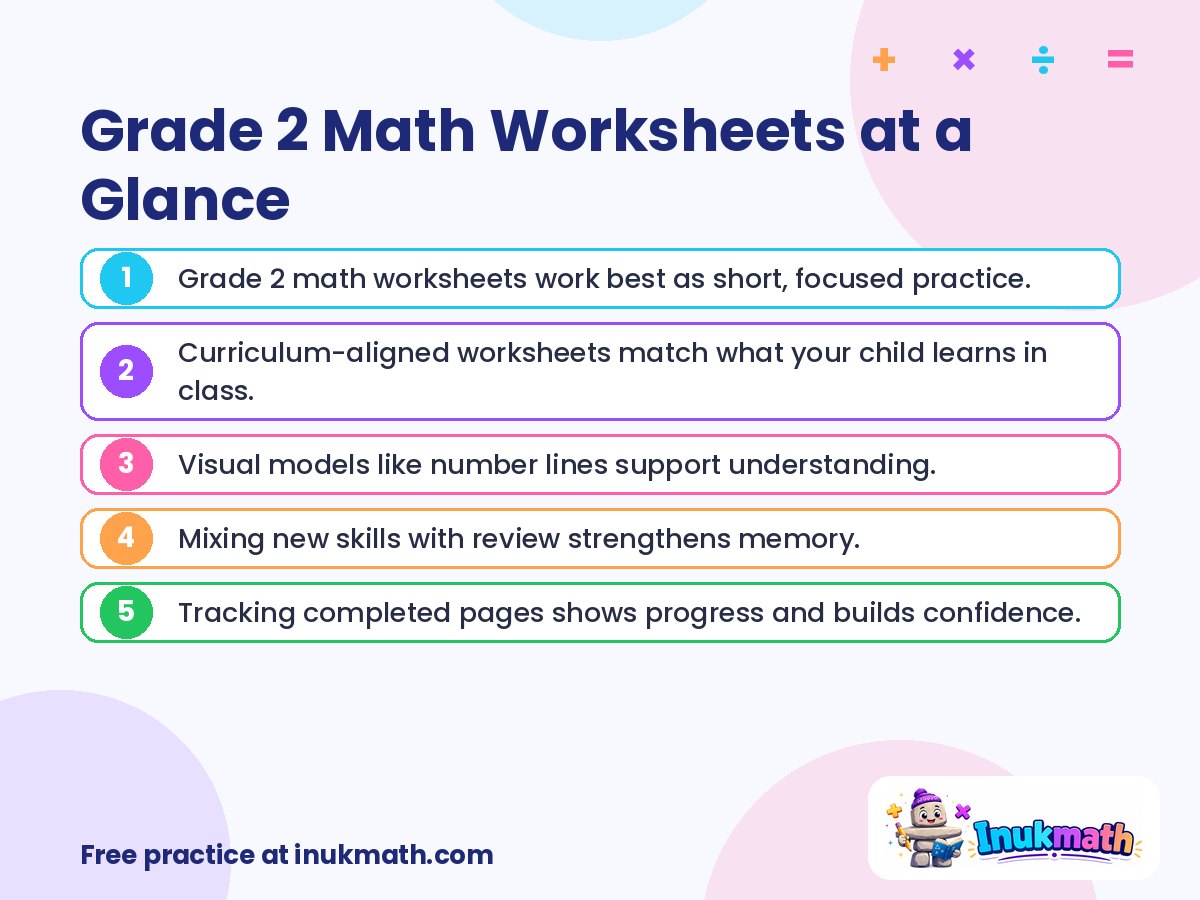
- Grade 2 math worksheets work best as short, focused practice.
- Curriculum-aligned worksheets match what your child learns in class.
- Visual models like number lines support understanding.
- Mixing new skills with review strengthens memory.
- Tracking completed pages shows progress and builds confidence.
Table of Contents
- What Are Grade 2 Math Worksheets?
- Why Use Grade 2 Math Worksheets?
- What Makes a Good Grade 2 Math Worksheet?
- 9 Smart Tips for Using Grade 2 Math Worksheets
- How Should Grade 2 Math Worksheets Change Through the Year?
- How Do You Track Progress With Grade 2 Math Worksheets?
- How Can Grade 2 Math Worksheets Support Regrouping?
- What Does a Good Grade 2 Worksheet Session Look Like?
- Free Math Worksheets Grade 2: What to Watch For
- How Do You Match Worksheets to the Curriculum?
- How Do Grade 2 Math Worksheets Help With Word Problems?
- Do Grade 2 Math Worksheets Work Across Canada?
- What Should Parents Say During Worksheet Time?
- What Do Teachers Wish Parents Knew About Worksheets?
- How Can You Adapt Worksheets for Different Learners?
- What Does a Weekly Grade 2 Math Practice Plan Look Like?
- Try It: 8 Sample Grade 2 Worksheet Questions
- What Are Common Grade 2 Worksheet Mistakes?
- How Do You Know Worksheets Are Helping?
- Where Do Worksheets Go in Grade 3?
- Frequently Asked Questions About Grade 2 Math Worksheets
- Conclusion: Smart Pages, Strong Skills
What Are Grade 2 Math Worksheets?
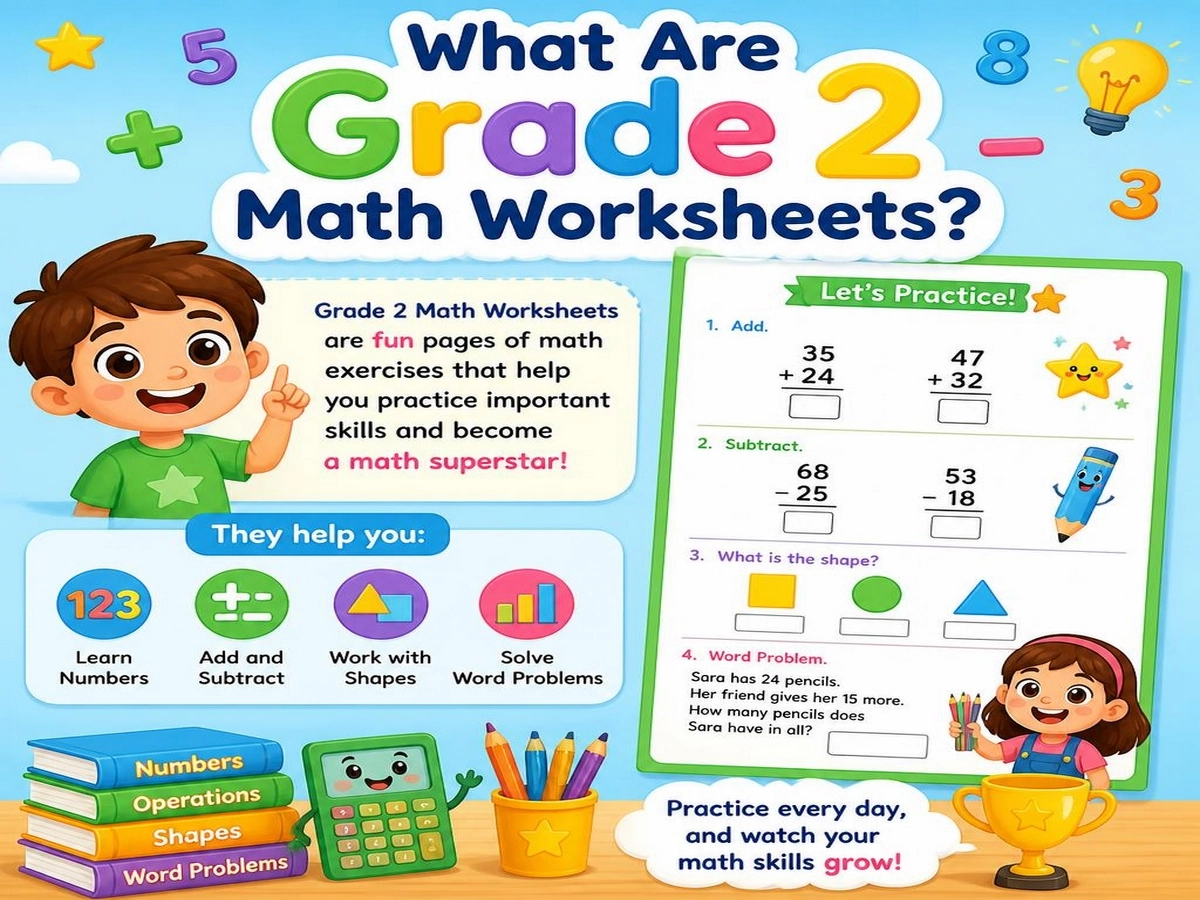
Grade 2 math worksheets are printed or digital practice pages covering Grade 2 math skills. Good ones include clear instructions, visual models, a manageable number of questions and an answer key.
For Canadian families, the best worksheets follow provincial expectations. In Ontario, that means the strands of the 2020 mathematics curriculum: number, algebra (including coding), data, spatial sense, financial literacy and social-emotional learning skills.
Printable Grade 2 Math Worksheets vs. Online Practice
Printable Grade 2 math worksheets build writing, drawing and focused independent work. Online practice gives instant feedback and adapts to your child’s level. Using both gives the best balance.
What Curriculum-Aligned Worksheets Include
Curriculum-aligned worksheets match grade-level expectations, use Canadian money and metric units, and follow the order many classrooms use. That prevents confusion caused by worksheets designed for other countries.
Why Use Grade 2 Math Worksheets?
Grade 2 math worksheets are useful because they provide focused practice, show what your child can do independently, build stamina for written work and help you spot gaps before they grow.
- Focused practice. One skill, practiced several ways.
- Independence. Shows what your child can do alone.
- Evidence of progress. Pages over time reveal growth.
- Gap spotting. Errors show what needs reteaching.
- Test familiarity. Prepares for written assessments in Grade 3.
Research supports short, spaced practice. A review by Dunlosky and colleagues (2013) rated practice testing and distributed practice as highly effective, and a classroom study by Rohrer and colleagues (2020) found mixed review improves long-term retention.

What Makes a Good Grade 2 Math Worksheet?
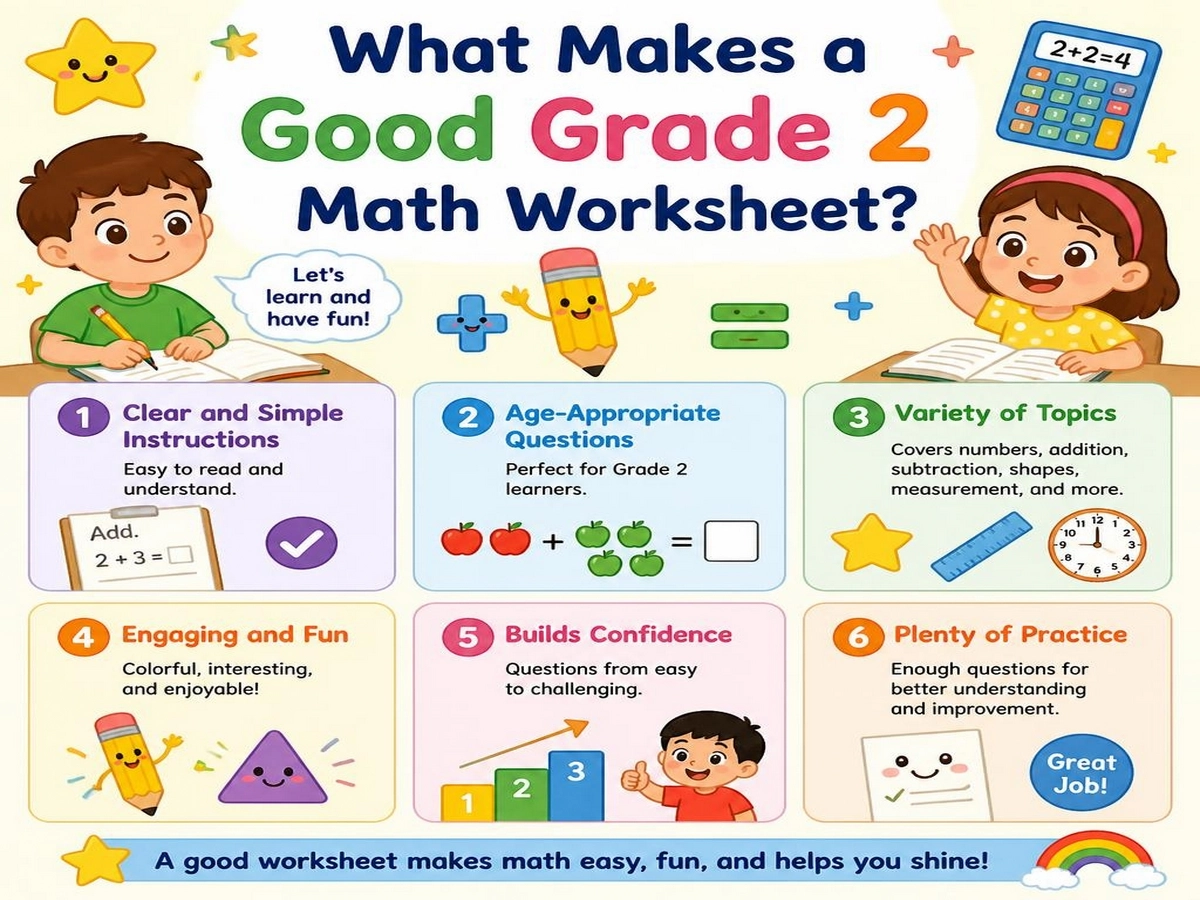
A good Grade 2 math worksheet focuses on one main skill, includes visuals, uses Canadian contexts, has 10 to 15 questions, includes a few review items and comes with an answer key.
| Feature | Good worksheet | Weak worksheet |
|---|---|---|
| Length | One page, 10 to 15 questions | Many pages, 1,500+ questions |
| Focus | One skill plus review | Random mix |
| Visuals | Number lines, base ten, pictures | Bare equations only |
| Context | Canadian coins, metric units | Pennies, inches |
| Difficulty | Builds from easy to harder | Jumps around |
| Answers | Answer key included | No way to check |
Inuk Math’s Grade 2 worksheets are built around these features and aligned with the Ontario curriculum.
9 Smart Tips for Using Grade 2 Math Worksheets
These nine tips help Canadian parents use Grade 2 math worksheets effectively.
1. Hands-On First
Introduce a skill with objects before the worksheet. Regrouping with blocks first makes regrouping worksheets meaningful.
2. One Page at a Time
A single focused page is enough for most Grade 2 children.
3. Model the First Question
Think aloud on question one, then let your child continue.
4. Check Together
Review answers right away and talk about mistakes.
5. Ask for Explanations
Pick two questions and ask, “How did you solve this?”
6. Mix in Review
Choose pages with a few questions from earlier topics.
7. Allow Tools
Number lines, hundred charts and base ten blocks support thinking.
8. Spot Patterns in Errors
If the same mistake repeats, stop and reteach with objects.
9. Keep a Progress Folder
Store finished pages and look back together monthly.
How Should Grade 2 Math Worksheets Change Through the Year?
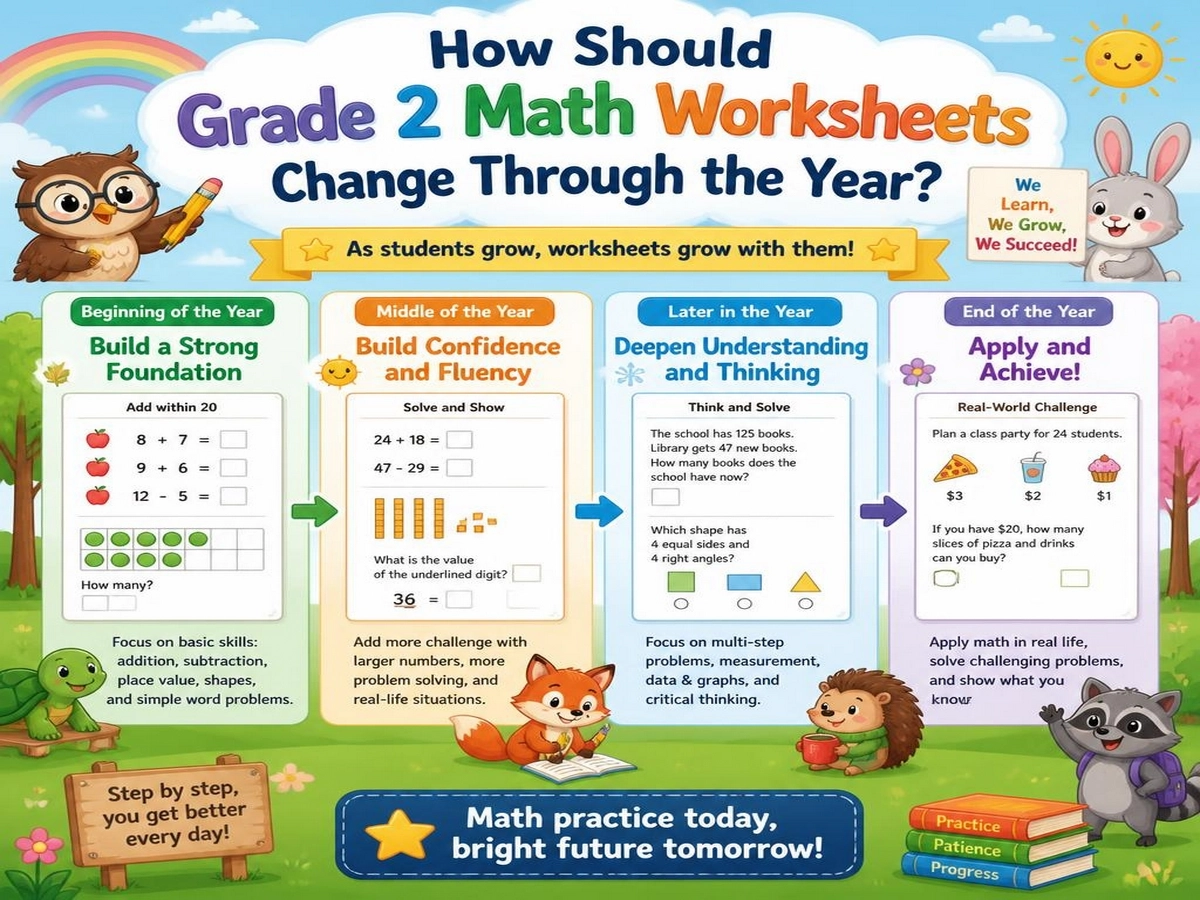
Grade 2 math worksheets should follow the flow of the year: number sense and facts in the fall, operations and place value in winter, fractions, data and geometry in spring, and mixed review in June.
| Time of year | Worksheet focus | Example skills |
|---|---|---|
| September to November | Number sense and facts | Counting to 200, place value, facts to 20 |
| December to February | Operations | Two-digit addition and subtraction, regrouping, mental math |
| March to April | Fractions, data, geometry | Thirds and sixths, bar graphs, symmetry |
| May to June | Measurement, money and review | cm and m, money to $200, mixed review |
Ask your child’s teacher which unit is current and adjust as needed. If the class is spending extra weeks on regrouping, for example, keep your Grade 2 math worksheets on that skill rather than racing ahead to fractions.
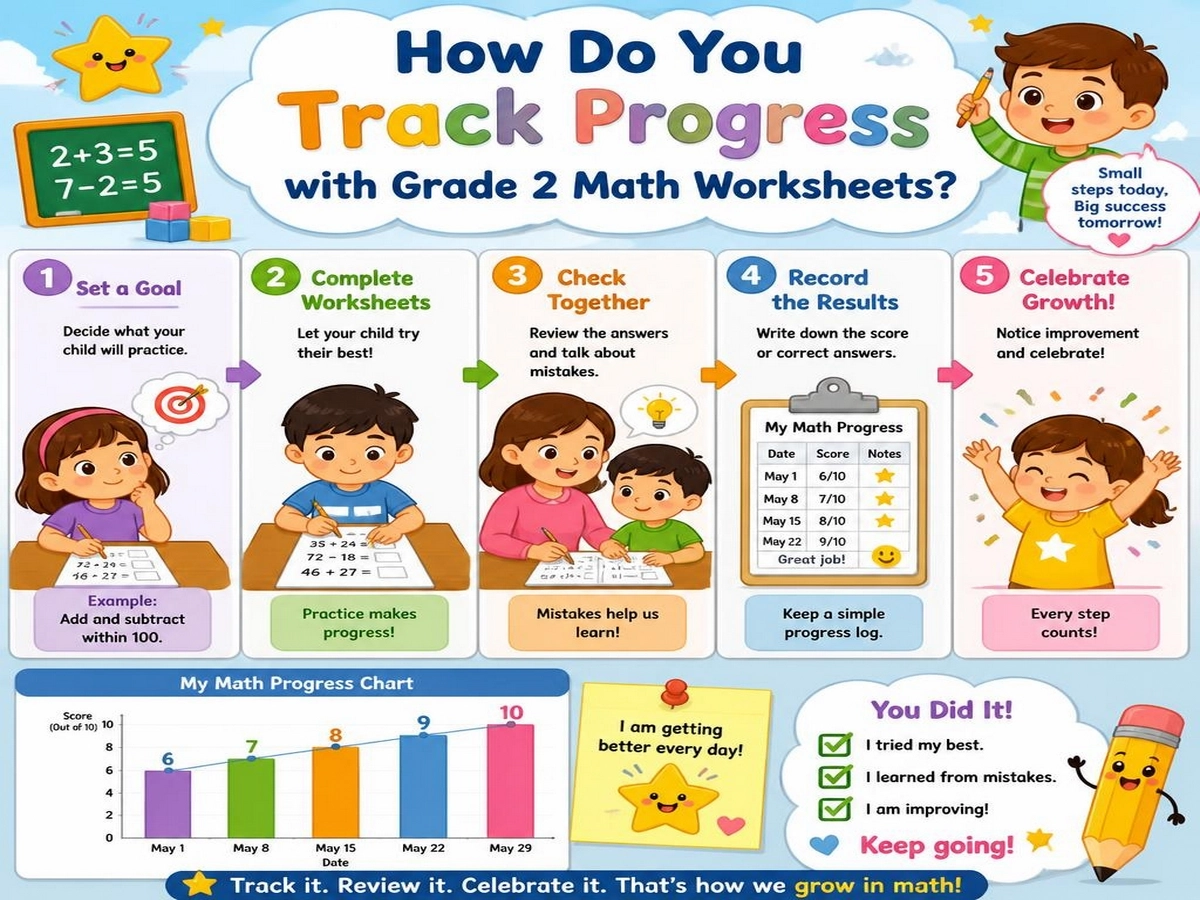
How Do You Track Progress with Grade 2 Math Worksheets?
Tracking progress with Grade 2 math worksheets helps you see growth, spot gaps and celebrate success. A simple system takes just a minute after each page.
- Date every page. Write the date at the top.
- Note the score. For example, 11 out of 14.
- Circle error types. Regrouping, place value, facts or reading the question.
- Keep a folder. File pages in order.
- Review monthly. Compare early and recent pages together.
| Month | Skill | Score | Most common error |
|---|---|---|---|
| October | Place value | 9/12 | Zeros in numbers like 104 |
| November | Two-digit addition | 10/14 | Forgetting regrouped ten |
| December | Two-digit subtraction | 12/14 | Subtracting smaller from larger |
| January | Mixed review | 13/15 | Word problem reading |
Patterns in errors tell you exactly what to reteach. Progress over months shows your child that practice works, which is one of the best confidence builders in Grade 2.
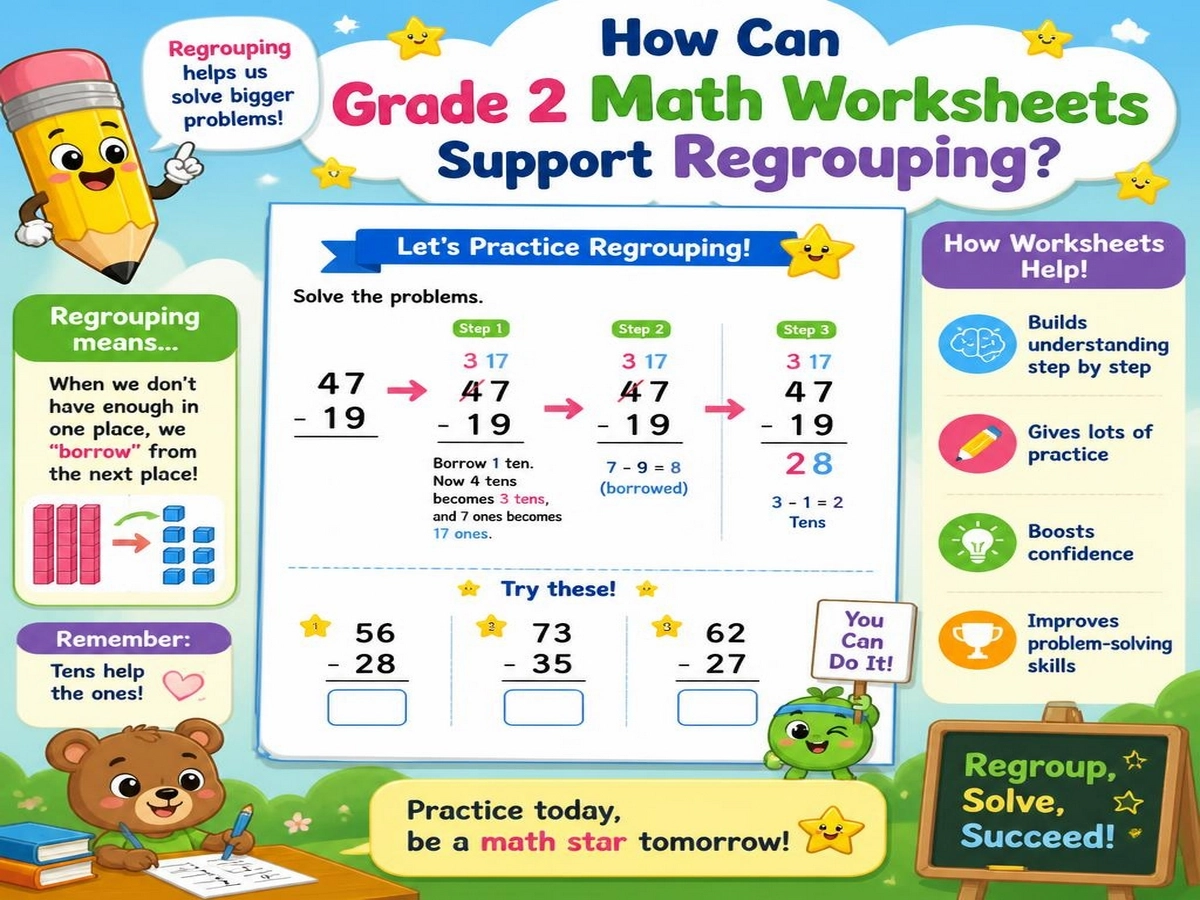
How Can Grade 2 Math Worksheets Support Regrouping?
Grade 2 math worksheets can support regrouping when they include visual models alongside equations. Look for pages that show base ten pictures, place value charts or number lines next to each problem.
- Model-first pages: draw tens and ones, then write the equation.
- Error-analysis pages: “Sam says 52 − 17 = 45. What did he do wrong?”
- Estimate-first pages: estimate before solving to catch big errors.
- Mixed pages: some problems need regrouping, some don’t, so children learn to check.
Error-analysis questions are especially powerful. Explaining someone else’s mistake deepens understanding without the pressure of being wrong yourself. Our Grade 2 regrouping guide explains the steps in detail.
What Does a Good Grade 2 Worksheet Session Look Like?
A good Grade 2 worksheet session is calm, short and conversational. Here’s what 12 minutes might look like:
- Warm-up (2 minutes): quick skip counting or facts.
- Model (2 minutes): solve the first question together, thinking aloud.
- Independent work (5 minutes): your child completes the rest.
- Check (2 minutes): review answers together; discuss one mistake.
- Celebrate (1 minute): name one thing done well.
Keeping this rhythm consistent turns Grade 2 math worksheets into a predictable, low-stress routine.

Free Math Worksheets Grade 2: What to Watch For
Free math worksheets grade 2 families find online vary widely in quality. Before printing, check that worksheets use Canadian money, metric units, clear layouts and age-appropriate content.
Red flags:
- Pennies or U.S. coins
- Inches, feet or Fahrenheit
- Topics far beyond Grade 2, like long division
- Tiny print or cluttered pages
- No answer key
Our post on free printable Ontario math worksheets lists trustworthy Canadian options, and our Grade 2 money worksheets post focuses on Canadian coins.
How Do You Match Worksheets to the Curriculum?
Match Grade 2 math worksheets to the curriculum by checking the current classroom strand and choosing worksheets for that strand, using Ontario’s Grade 2 expectations as a guide.
| Grade 2 strand | What worksheets should practice | InukMath guide |
|---|---|---|
| Number | Place value, facts, regrouping | Grade 2 place value |
| Algebra | Patterns, equations, coding | Grade 2 equations |
| Data | Tally charts, bar graphs, mode | Grade 2 bar graphs |
| Spatial sense | Symmetry, measuring length, maps | Grade 2 measuring length |
| Financial literacy | Money to $200 | Grade 2 financial literacy |
How Do Grade 2 Math Worksheets Help With Word Problems?
Grade 2 math worksheets that include word problems help children apply skills to real situations. Look for worksheets with short, clear stories and space to draw.
Encourage your child to:
- Read the problem twice.
- Underline the question.
- Draw a picture or bar model.
- Write an equation.
- Check if the answer makes sense.
Our post on Grade 2 word problems offers more strategies.
Do Grade 2 Math Worksheets Work Across Canada?
Grade 2 math worksheets aligned with Ontario expectations work well across Canada, because Grade 2 skills overlap heavily between provinces. Place value, facts to 20, two-digit operations, patterns, graphs and measurement appear everywhere.
- Ontario: numbers to 200, facts to 20, concurrent coding, money to $200.
- British Columbia: the BC curriculum emphasizes numbers to 100 and addition and subtraction strategies.
- Other provinces: similar core skills with some differences in sequence.
The key is Canadian money and metric units, which match what children see every day.
What Should Parents Say During Worksheet Time?
Encouraging language keeps worksheet time positive.
- “Let’s do the first one together.”
- “How did you figure that out?”
- “Can you show me with blocks?”
- “That one was tricky; you kept going.”
- “Look how many you did on your own!”
What Do Teachers Wish Parents Knew About Worksheets?
Teachers often wish parents knew that more worksheets don’t mean more learning. One focused page, discussed together, is worth more than many done alone.
- Quality over quantity.
- Discuss mistakes.
- Tools are fine.
- Match the class.
A Quick Story
A parent prints five pages of regrouping every evening. Her son starts making careless errors and hiding the pages. She switches to one page plus a game. Within two weeks, his accuracy improves and he volunteers, “Can I show you how I regroup?” Less really was more.
How Can You Adapt Worksheets for Different Learners?
Adapt Grade 2 math worksheets to each child.
Learners Who Need Support
Cut pages in half, do more questions together and use manipulatives. Highlight the question on each word problem so your child knows exactly what to find, and celebrate every correct answer along the way.
Visual Learners
Choose worksheets with number lines, base ten pictures and colorful diagrams that show the math clearly.
Active Learners
Add movement breaks between sections, or let them stand at a counter or work on a clipboard outside. Short bursts of focused work with movement in between often produce better results than one long sitting.
Learners Ready for More
Add challenge questions or ask them to write their own problems, then swap with you and check each other’s work.
What Does a Weekly Grade 2 Math Practice Plan Look Like?
A weekly Grade 2 math practice plan uses worksheets two or three times alongside games and hands-on work.
| Day | Activity |
|---|---|
| Monday | Hands-on introduction to the week’s skill |
| Tuesday | One worksheet page |
| Wednesday | Math game |
| Thursday | Worksheet page with mixed review |
| Friday | Online practice questions or a challenge |
InukMath’s Grade 2 practice questions fit perfectly on Friday.
Try It: 8 Sample Grade 2 Worksheet Questions
Answers follow.
- Write 147 in expanded form.
- 38 + 25 = ___
- 62 − 27 = ___
- Skip count by 25s to 100.
- Share 12 cookies among 3 friends. How many each?
- Is 15 even or odd?
- How many centimeters are in 1 meter?
- Show 50¢ with two different coin combinations.
Answers: 1) 100 + 40 + 7; 2) 63; 3) 35; 4) 25, 50, 75, 100; 5) 4; 6) odd; 7) 100; 8) 2 quarters, or 5 dimes (others possible).
Myths vs. Facts About Grade 2 Worksheets
| Myth | Fact |
|---|---|
| More worksheets mean more learning. | Short, focused practice works better. |
| Tools on worksheets are cheating. | Tools support understanding. |
| Any worksheet will do. | Canadian-aligned worksheets avoid confusion. |
| Worksheets replace hands-on learning. | Hands-on work should come first. |
What Are Common Grade 2 Worksheet Mistakes?
Common mistakes with Grade 2 math worksheets include too many pages, skipping hands-on work, non-Canadian materials, no checking and using worksheets as punishment.
- Too many pages. One is enough.
- No hands-on first. Build understanding first.
- Wrong contexts. Use Canadian money and metric.
- No checking. Review together.
- Punishment. Keep it positive.
Common Mistake
Letting worksheets pile up unchecked. Errors repeated over many pages become habits. Check each page soon after it’s done.
How Do You Know Worksheets Are Helping?
Grade 2 math worksheets are helping when your child completes pages more independently, makes fewer errors, explains answers and feels confident.
Checklist
- Completes pages with little help
- Makes fewer errors over time
- Explains answers
- Uses tools appropriately
- Feels positive about practice
Where Do Worksheets Go in Grade 3?
In Grade 3, worksheets cover numbers to 1,000, multiplication and division facts, fractions, area and perimeter, and EQAO-style questions.
- Grade 1: Grade 1 math worksheets.
- Grade 2 connections: Grade 2 math games and Grade 2 math homework.
- Grade 3: Grade 3 math worksheets.
Future Trends
Worksheets increasingly pair with digital checking and adaptive practice. The Education Endowment Foundation recommends a mix of representations and practice types, and good worksheets are one part of that mix.
Frequently Asked Questions About Grade 2 Math Worksheets
Where can I find good Grade 2 math worksheets?
Look for curriculum-aligned worksheets with Canadian money and metric units. InukMath offers free Grade 2 worksheets aligned with the Ontario curriculum.
How many worksheets should a Grade 2 child do?
One page, two or three times a week, is plenty.
Are free math worksheets grade 2 good quality?
Some are excellent; check for Canadian contexts, clear layouts and answer keys.
What topics should Grade 2 worksheets cover?
Place value to 200, facts to 20, two-digit operations, fractions, patterns, data, measurement and money.
What are curriculum-aligned worksheets?
Worksheets designed around provincial expectations, using Canadian contexts.
Can my child use tools on worksheets?
Yes. Number lines, base ten blocks and hundred charts support thinking.
What if my child hates worksheets?
Shorten them, start together, add games and keep it positive.
Are printable grade 2 math worksheets better than online?
Both help. Printables build focus and writing; online gives instant feedback.
How do worksheets fit into grade 2 math practice?
As one part of a weekly routine that also includes games and hands-on work.
Conclusion: Smart Pages, Strong Skills
Grade 2 math worksheets work best when they’re short, curriculum-aligned, visual and discussed together. Use them a few times a week after hands-on learning, mix in review and track progress. They’ll become a tool for confidence, not a chore.
Explore the full year in our Canadian Grade 2 math guide, and see how practice fits together in our Canadian math practice roadmap.
Get free, curriculum-aligned worksheets. InukMath offers printable Grade 2 worksheets with answers, plus lessons and games. Join free and download our Grade 2 worksheets.
Sources and Further Reading
- Ontario Ministry of Education, The Ontario Curriculum: Mathematics, Grades 1 to 8 (2020)
- Dunlosky et al. (2013), Improving students’ learning with effective learning techniques, Psychological Science in the Public Interest
- Rohrer et al. (2020), A randomized controlled trial of interleaved mathematics practice, Journal of Educational Psychology
- BC Ministry of Education, Mathematics K-9 curriculum
- Education Endowment Foundation, Improving Mathematics in the Early Years and Key Stage 1