
Grade 2 Math Vocabulary: Essential Words for Confident Math Talk
Grade 2 math vocabulary grows quickly as children move into bigger numbers, two-digit operations, fractions, data, geometry and measurement. Words like “regroup,” “difference,” “expanded form,” “line of symmetry,” “mode” and “centimeter” carry precise meanings, and children need them to understand lessons, follow instructions and explain their thinking.
In Ontario, Grade 2 students are expected to explain their strategies, describe patterns and justify their answers. That depends on vocabulary. A child who can solve 52 − 17 but can’t explain “I regrouped a ten into ten ones” is missing part of the picture.
This guide explains why Grade 2 math vocabulary matters, lists 60 essential words by strand with kid-friendly definitions, shares fun ways to build math talk at home and highlights tricky words to watch.
Quick Answer
Grade 2 math vocabulary includes about 60 essential words across number (hundreds, expanded form, even, odd), operations (sum, difference, regroup, fact family), fractions (third, sixth, equal parts), algebra and coding (equation, growing pattern, concurrent), data (tally, bar graph, mode), geometry (vertex, prism, line of symmetry), measurement (centimeter, meter, benchmark) and money (quarter, toonie). Daily math talk builds these words best.
Key Takeaways
- Grade 2 math vocabulary supports understanding and explanation.
- Many math words have everyday meanings that differ in math.
- Learning words in context works better than memorizing lists.
- Daily math talk at home builds vocabulary quickly.
- Newcomer and French immersion families can connect words across languages.
Table of Contents
- What Is Grade 2 Math Vocabulary?
- Why Does Grade 2 Math Vocabulary Matter?
- What Are the 60 Essential Grade 2 Math Vocabulary Words?
- How Do You Build Math Talk at Home?
- Which Grade 2 Math Words Are Most Confusing?
- How Do Math Words Help With Word Problems?
- How Can Newcomer and French Immersion Families Build Math Vocabulary?
- How Is Grade 2 Math Vocabulary Assessed?
- What Do Teachers Wish Parents Knew About Math Vocabulary?
- How Can Everyday Life Build Math Language?
- How Can You Adapt Vocabulary Practice for Different Learners?
- What Does a 4-Week Vocabulary Plan Look Like?
- Try It: 8 Grade 2 Math Vocabulary Questions
- What Are Common Grade 2 Math Vocabulary Mistakes?
- How Do You Know Your Child’s Vocabulary Is Growing?
- How Does Math Vocabulary Grow in Grade 3?
- Frequently Asked Questions About Grade 2 Math Vocabulary
- Conclusion: Words That Power Thinking
What Is Grade 2 Math Vocabulary?
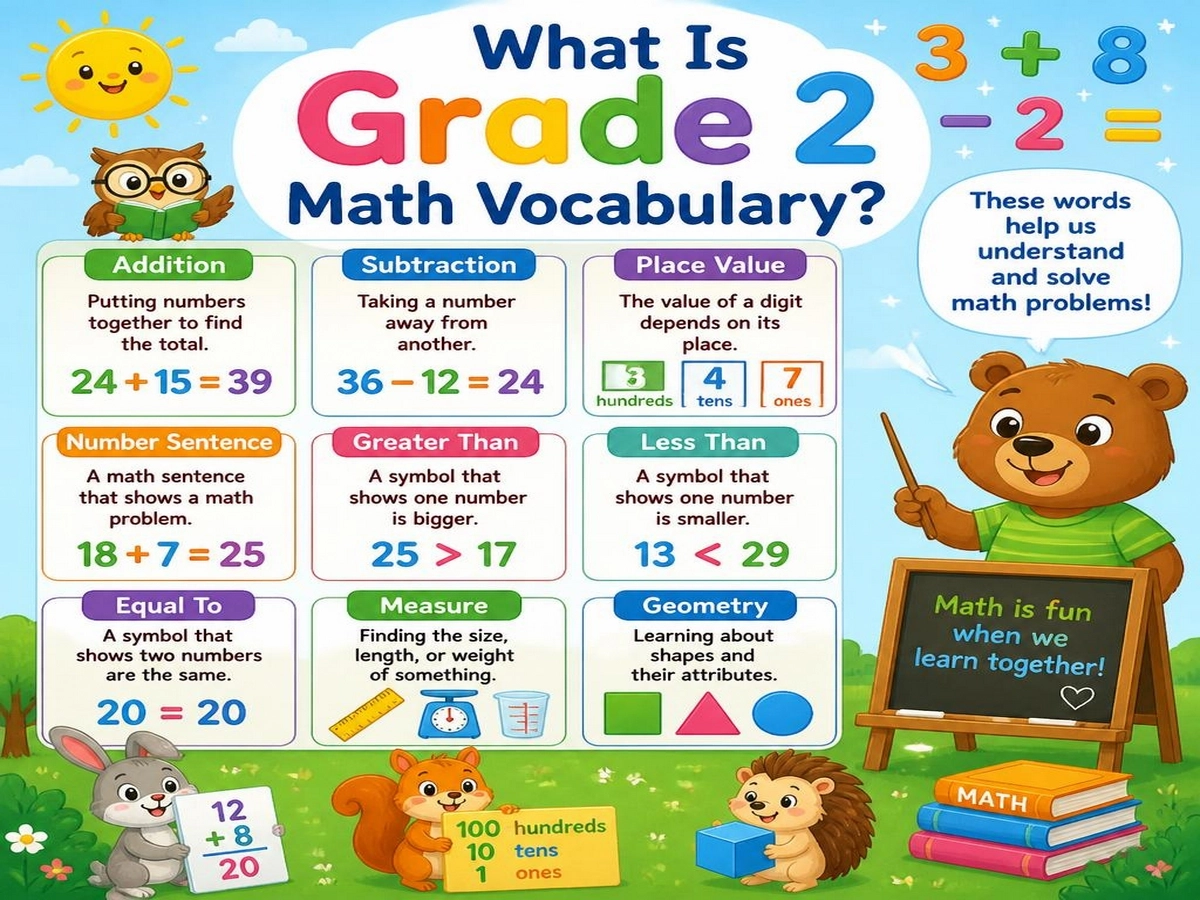
Grade 2 math vocabulary is the set of math words children use to understand and talk about Grade 2 math. It includes terms for numbers and place value, operations, fractions, patterns, coding, data, geometry, measurement and money.
The Ontario mathematics curriculum asks Grade 2 students to explain strategies, describe patterns and sorting rules, and use specific mathematical language. Vocabulary is the foundation for all of these.
Math Terms for Kids: Why Precision Matters
In everyday speech, “difference” means anything that’s not the same. In math, it’s the result of subtraction. “Even” can mean smooth or fair; in math, it means divisible into pairs. Precise math terms for kids prevent confusion.
Second Grade Math Language
Second grade math language includes not just individual words but phrases like “how many more,” “in all,” “is the same as” and “groups of.” These phrases signal operations and relationships.
Why Does Grade 2 Math Vocabulary Matter?
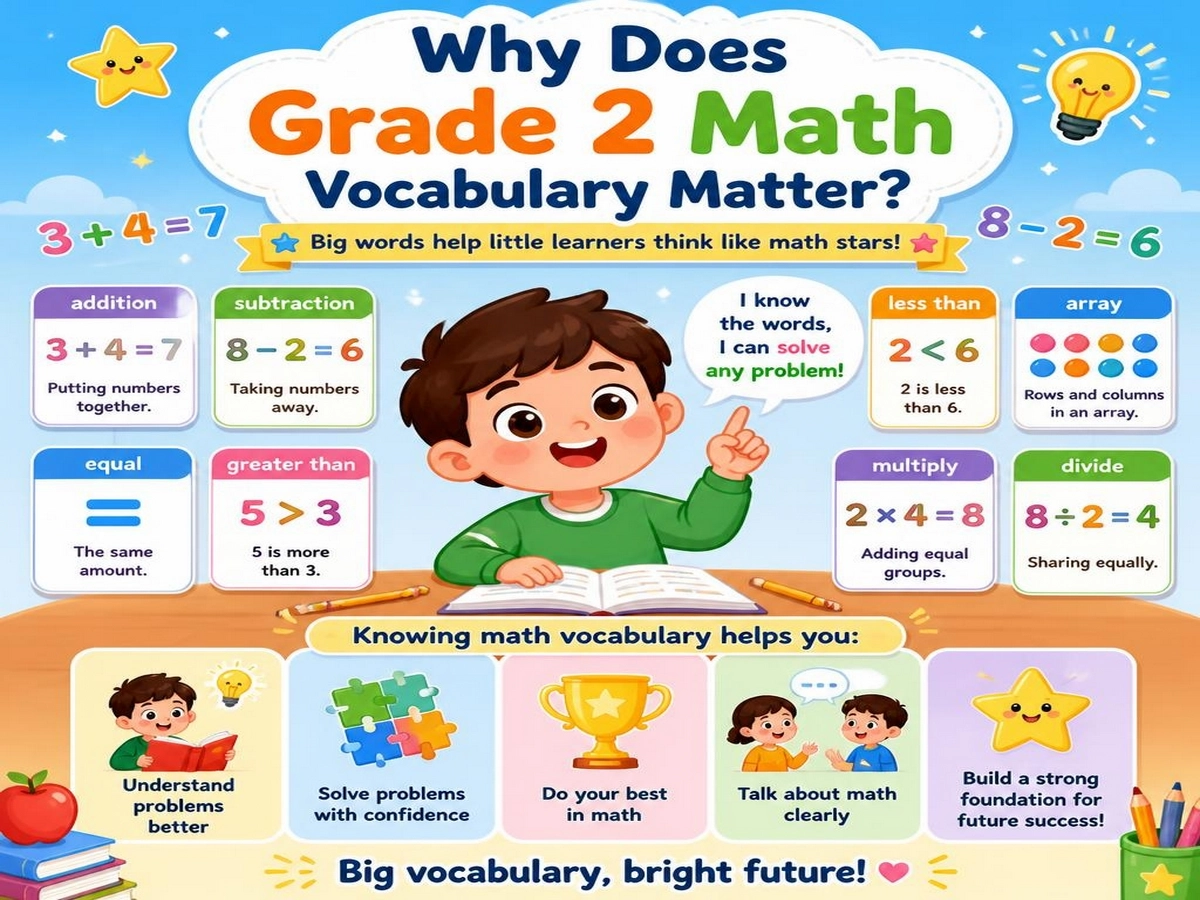
Grade 2 math vocabulary matters because children need words to understand instructions, solve word problems, explain strategies and participate in classroom discussions. Strong vocabulary predicts stronger problem solving.
- Understanding questions. “What is the difference?” means subtract.
- Following instructions. “Write in expanded form.”
- Explaining strategies. “I regrouped 10 ones as a ten.”
- Word problems. Key phrases signal operations.
- Discussions. Number talks depend on shared words.
The Education Endowment Foundation recommends developing children’s mathematical language through everyday conversation, and the Institute of Education Sciences recommends teaching children to describe their world mathematically.
What Are the 60 Essential Grade 2 Math Vocabulary Words?
The 60 essential Grade 2 math vocabulary words are grouped below by strand, with kid-friendly meanings.

Number and Place Value (12 Words)
| Word | Kid-friendly meaning |
|---|---|
| digit | One of the symbols 0 to 9 |
| place value | The value of a digit based on its position |
| ones | Single units |
| tens | Groups of ten |
| hundreds | Groups of one hundred |
| expanded form | A number written as a sum of place values (146 = 100 + 40 + 6) |
| even | Can be split into pairs with none left over |
| odd | Has one left over when paired |
| greater than | Bigger in value (>) |
| less than | Smaller in value (<) |
| estimate | A close, reasonable guess |
| skip count | Count by a number other than 1 |
Operations (12 Words)
| Word | Kid-friendly meaning |
|---|---|
| add | Put together |
| sum | The answer to an addition |
| subtract | Take away or find the difference |
| difference | The answer to a subtraction |
| regroup | Trade 10 ones for a ten, or a ten for 10 ones |
| double | Add a number to itself |
| near double | A double plus or minus one |
| fact family | Related addition and subtraction facts |
| mental math | Solving in your head |
| number line | A line with numbers in order |
| equal groups | Groups with the same number in each |
| share | Split fairly |
Fractions (6 Words)
| Word | Kid-friendly meaning |
|---|---|
| whole | The complete object or group |
| half | One of two equal parts |
| third | One of three equal parts |
| fourth | One of four equal parts |
| sixth | One of six equal parts |
| equal parts | Parts that are the same size |
Algebra and Coding (8 Words)
| Word | Kid-friendly meaning |
|---|---|
| pattern | Something that follows a rule |
| growing pattern | Increases by the same amount each step |
| shrinking pattern | Decreases by the same amount each step |
| rule | Describes how a pattern works |
| equation | A number sentence with an equal sign |
| equal sign | Means “is the same as” |
| code | Step-by-step instructions |
| concurrent | Happening at the same time |
Data and Probability (8 Words)
| Word | Kid-friendly meaning |
|---|---|
| survey | Asking questions to collect data |
| tally | A mark used to count |
| bar graph | A graph with bars to compare data |
| line plot | Xs above a number line |
| mode | The most common answer |
| impossible | Cannot happen |
| possible | Might happen |
| certain | Will definitely happen |
Geometry (8 Words)
| Word | Kid-friendly meaning |
|---|---|
| side | A straight edge of a 2D shape |
| vertex | A corner where sides or edges meet |
| face | A flat surface of a 3D shape |
| edge | Where two faces meet |
| prism | 3D shape with two matching bases |
| pyramid | 3D shape with one base and a point |
| symmetry | Matching mirror halves |
| line of symmetry | The fold line that makes matching halves |
Measurement and Money (6 Words)
| Word | Kid-friendly meaning |
|---|---|
| centimeter | A small metric unit of length (cm) |
| meter | A larger unit of length; 100 cm (m) |
| benchmark | A familiar object used to estimate |
| quarter | A 25¢ coin |
| loonie | The $1 coin |
| toonie | The $2 coin |
That’s 60 words. Introduce a few at a time, in context.
How Do You Build Math Talk at Home?
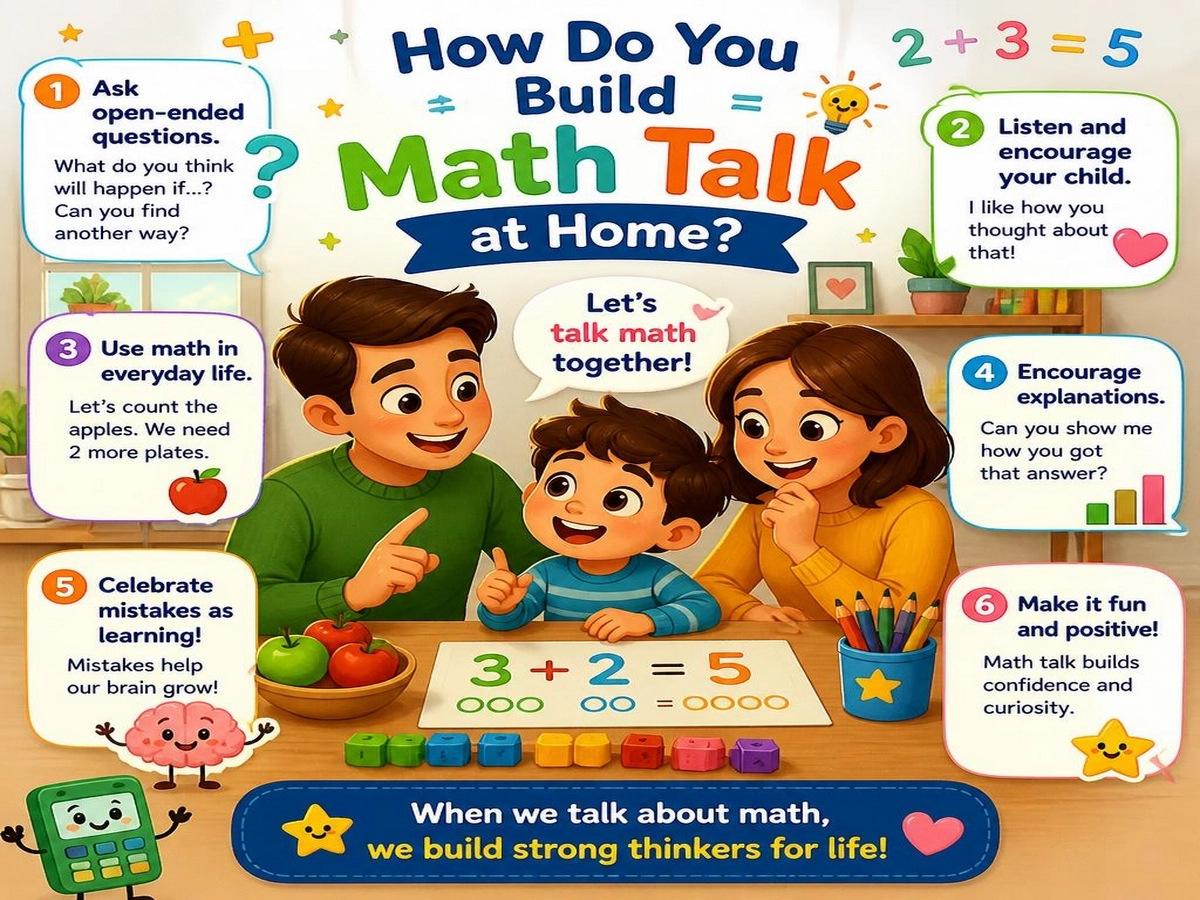
Build math talk at home by using math words naturally in daily life, asking open questions, encouraging full-sentence explanations and modeling precise language. Five minutes of math conversation each day builds Grade 2 math vocabulary faster than flashcards.
- Narrate math moments. “I’m regrouping these 10 cents into a dime.”
- Ask “how do you know?”
- Use precise words. “Difference,” not just “what’s left.”
- Read math picture books.
- Play word games. “I’m a 3D shape with one base and a point.”
Expert Tip
Use the same words your child’s teacher uses. Ask for the unit vocabulary list or look at class newsletters, and echo those words at home.
Which Grade 2 Math Words Are Most Confusing?
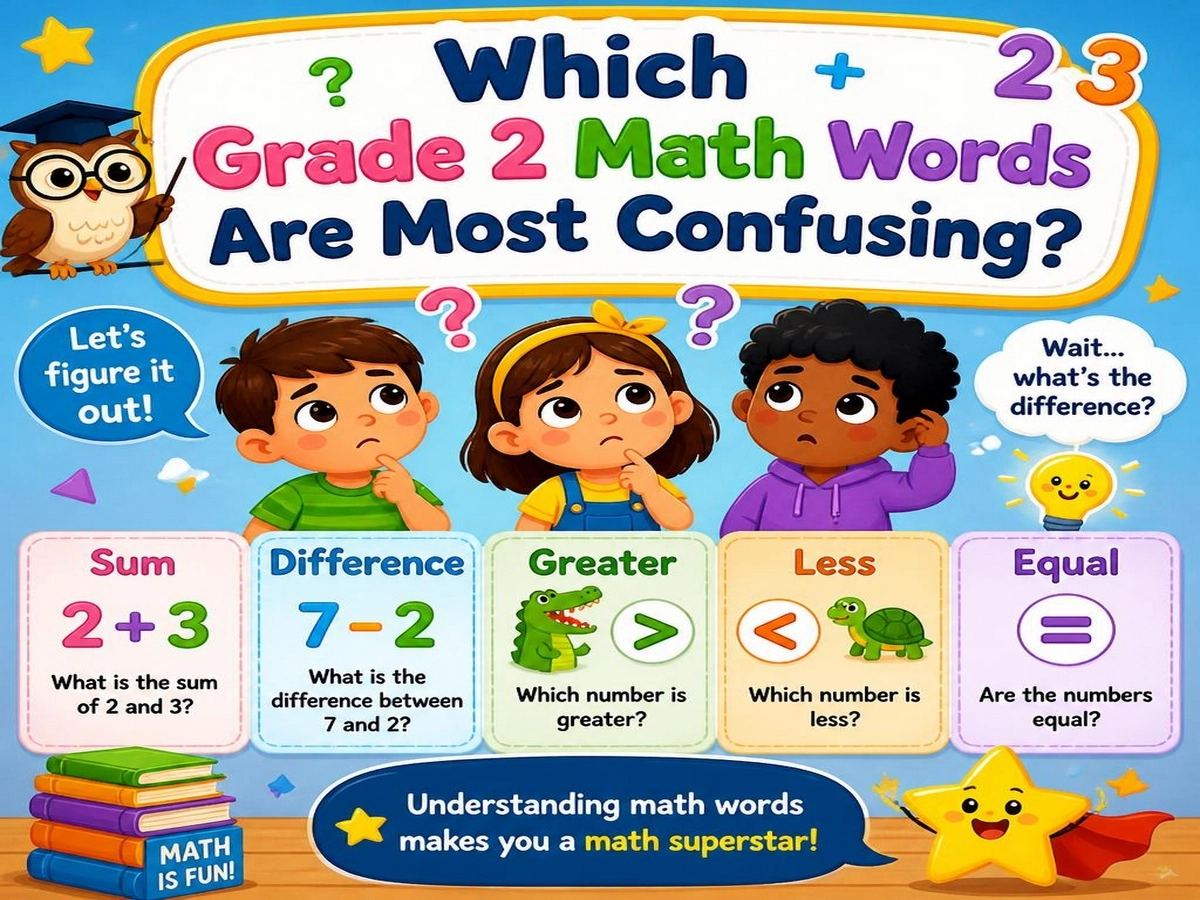
The most confusing Grade 2 math words are those with everyday meanings, words for similar ideas and words that signal operations in word problems.
| Confusing word | Why it’s tricky | How to help |
|---|---|---|
| difference | Sounds like “different” | Show it as the gap between two numbers |
| regroup | Unfamiliar | Trade dimes and cents |
| even | Many everyday meanings | Pair objects |
| face | Body part | Touch faces of a cube |
| equal | Often read as “the answer” | Use balances |
| mode | Unfamiliar | “Most popular answer” |
| left | Direction or “remaining” | Discuss both meanings |
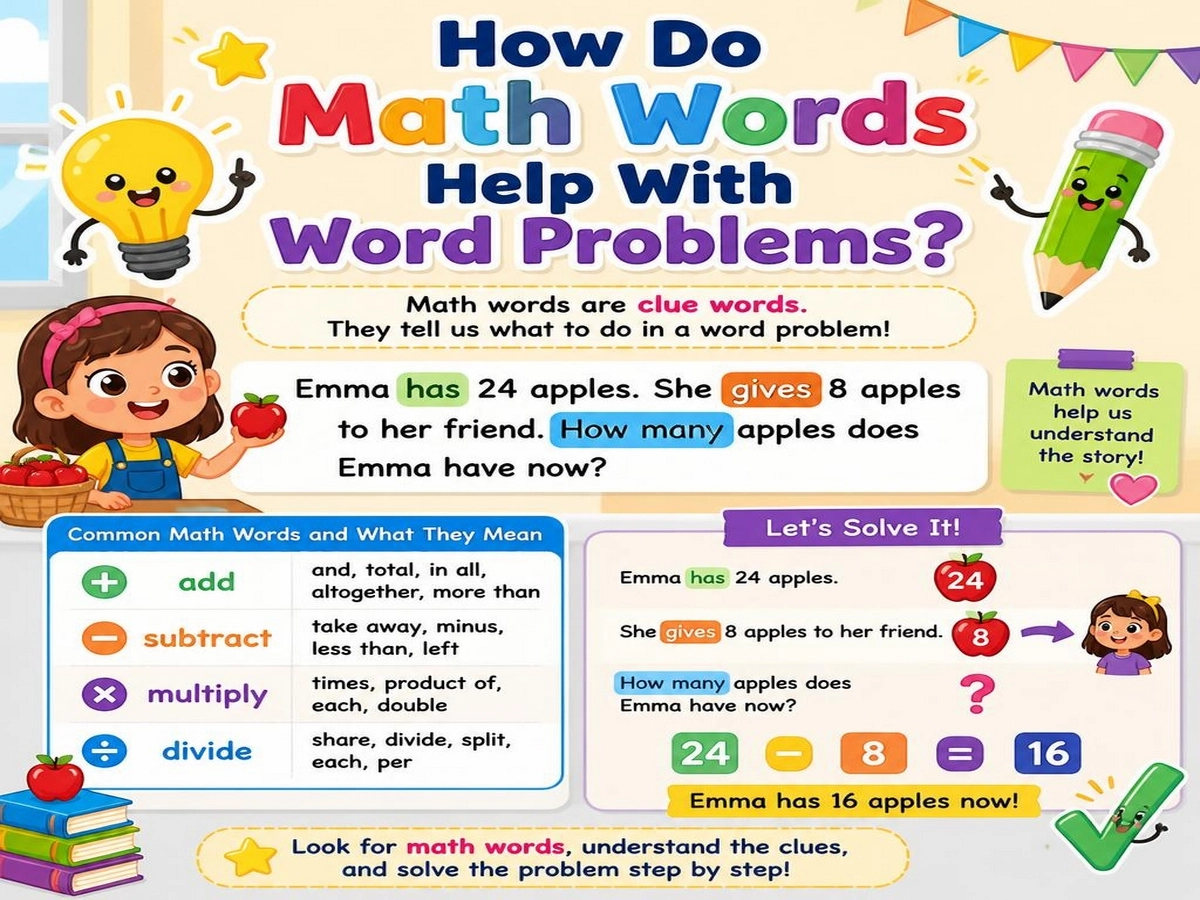
How Do Math Words Help With Word Problems?
Math words help with word problems because certain phrases signal relationships. But children should understand the story, not just hunt for keywords.
| Phrase | Often means | Example |
|---|---|---|
| in all, altogether | Addition | “How many in all?” |
| how many more | Comparison or subtraction | “How many more red than blue?” |
| left | Subtraction | “How many are left?” |
| each | Equal groups or sharing | “How many does each get?” |
| difference | Subtraction | “What’s the difference?” |
Caution: keywords can mislead. “Sam had some marbles, then got 5 more, and now has 12” uses “more” but requires subtraction to find the start. Always encourage drawing the story. See our post on Grade 2 word problems.
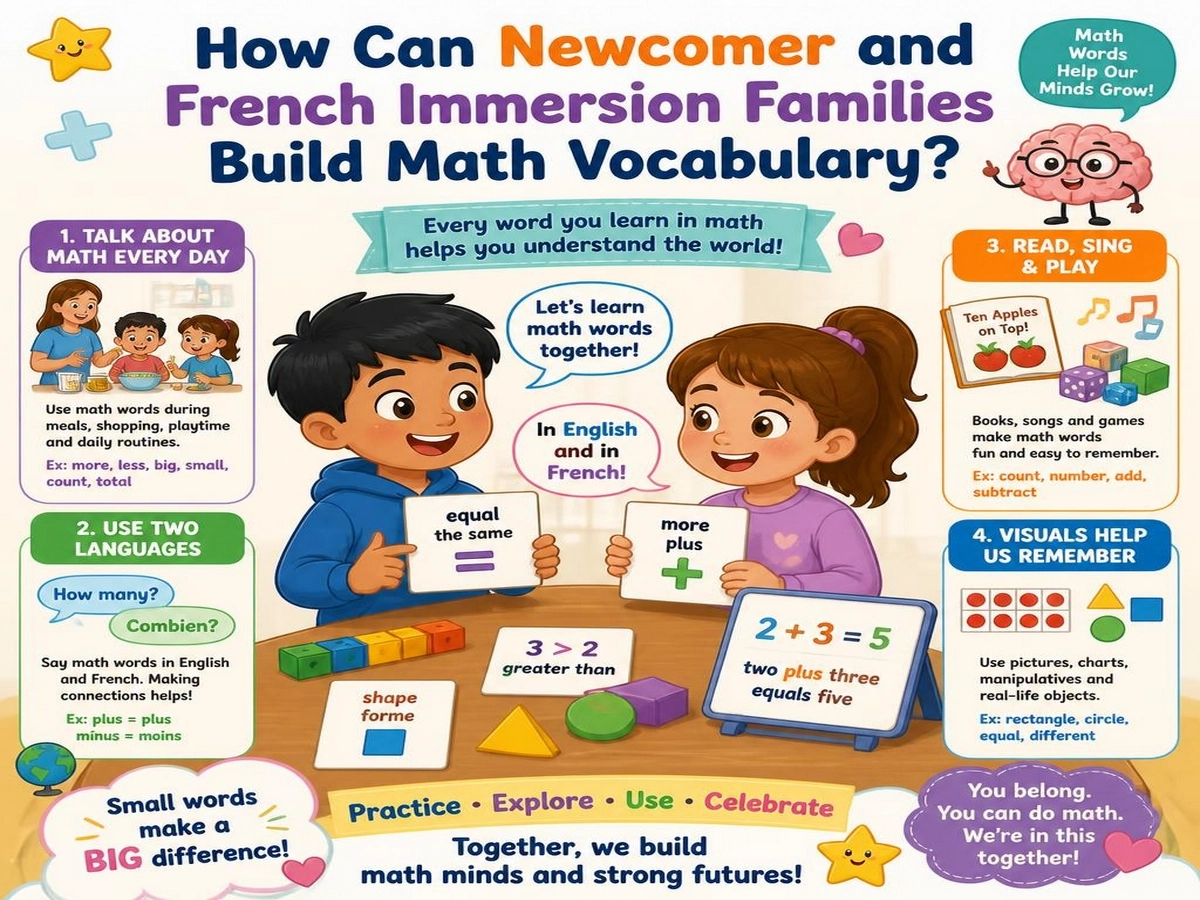
How Can Newcomer and French Immersion Families Build Math Vocabulary?
Newcomer and French immersion families can build Grade 2 math vocabulary by connecting words across languages, using visuals and talking about math in the language that’s most comfortable at home.
- Math ideas transfer. Concepts learned in any language help.
- Bilingual word cards. Write the English or French word with your home language.
- Use pictures and objects. A picture of a prism works in any language.
- Ask for word lists. Teachers often share unit vocabulary.
French immersion families will see words like “dizaine” (ten), “centaine” (hundred), “différence” and “axe de symétrie.” Our posts on newcomer families and the Ontario math curriculum and French immersion math offer more support.
How Is Grade 2 Math Vocabulary Assessed?
Teachers assess Grade 2 math vocabulary mainly by listening to how children explain their thinking during lessons, number talks and small-group work. Written explanations on worksheets also show which words children can use correctly.
At home, ask your child to “teach” you something they learned: how to regroup, how to find the mode or how to make a growing pattern. Listen for precise Grade 2 math vocabulary like “difference,” “regroup,” “expanded form” or “line of symmetry.” If a word is missing, model it naturally in your reply. That gentle echo is one of the best ways to build vocabulary.

What Do Teachers Wish Parents Knew About Math Vocabulary?
Teachers often wish parents knew that Grade 2 math vocabulary grows through use, not memorization, and that explaining thinking is part of math.
- Context beats lists.
- Precision matters.
- Explaining builds vocabulary.
- Every language helps.
A Quick Story
A child solves 45 − 18 correctly but, when asked to explain, says “I did the borrow thing.” His mom asks him to show it with dimes and cents. “I traded a dime for 10 cents, so I had enough ones.” She says, “That’s called regrouping.” The next week, he proudly tells his teacher, “I regrouped.” Understanding came first; the word gave it a name.
How Can Everyday Life Build Math Language?
Everyday life is full of chances to use Grade 2 math vocabulary.
- Shopping: “What’s the difference in price?”
- Cooking: “Cut the pizza into sixths.”
- Sports: “What was the sum of goals?”
- Walks: “That house number is even.”
- Building: “This block is a rectangular prism.”
How Can You Adapt Vocabulary Practice for Different Learners?
Adapt Grade 2 math vocabulary practice to each child.
Visual Learners
Create a home word wall with pictures.
Active Learners
Play charades with math words.
Learners Who Need More Time
Focus on 3 to 5 words per week, each paired with a picture or gesture, and use them in many different situations.
Learners Ready for More
Write word problems using new vocabulary or define words in their own words.
What Does a 4-Week Vocabulary Plan Look Like?
A 4-week Grade 2 math vocabulary plan introduces words by strand.
| Week | Words | Activities |
|---|---|---|
| 1 | place value, expanded form, even, odd, estimate | Build numbers, pair objects |
| 2 | sum, difference, regroup, fact family | Coin trading, fact triangles |
| 3 | third, sixth, equation, growing pattern | Pizza sharing, block patterns |
| 4 | tally, mode, prism, line of symmetry, centimeter | Survey, shape hunt, measuring |
Try It: 8 Grade 2 Math Vocabulary Questions
Answers follow.
- What does “difference” mean in math?
- Write 156 in expanded form.
- What does “regroup” mean?
- Is 23 even or odd?
- What’s a line of symmetry?
- What is the mode?
- How many centimeters are in a meter?
- What does the equal sign mean?
Answers: 1) the answer to a subtraction; 2) 100 + 50 + 6; 3) trading 10 ones for a ten or a ten for 10 ones; 4) odd; 5) a line that divides a shape into matching mirror halves; 6) the most common value; 7) 100; 8) “is the same as.”
Myths vs. Facts About Math Vocabulary
| Myth | Fact |
|---|---|
| Math is numbers, not words. | Vocabulary is essential for understanding and explaining. |
| Kids pick up math words automatically. | Many words need explicit, repeated use. |
| Keywords always signal the operation. | Children must understand the whole story. |
| Word lists are enough. | Words learned in context stick better. |
What Are Common Grade 2 Math Vocabulary Mistakes?
Common mistakes include confusing “difference” with “different,” treating “=” as “the answer,” relying on keywords and introducing too many words at once.
- Difference confusion. Show it as a gap.
- Equal sign misunderstanding. Use balances.
- Keyword hunting. Draw the story.
- Too many words. A few at a time.
- No explanations. Ask how they know.
Common Mistake
Teaching students to rely on keywords like “more means add.” It works sometimes and fails often. Teach children to understand and draw the situation.
How Do You Know Your Child’s Vocabulary Is Growing?
Your child’s Grade 2 math vocabulary is growing when they use math words correctly without prompting, explain strategies clearly and understand word problems.
Checklist
- Uses sum, difference and regroup correctly
- Describes numbers with place value words
- Names fractions like thirds and sixths
- Uses geometry words like vertex and prism
- Explains strategies in full sentences
How Does Math Vocabulary Grow in Grade 3?
In Grade 3, children add words like multiply, divide, product, quotient, equivalent fraction, perimeter, area, transformation, mean and variable.
- Grade 1 roots: Grade 1 math vocabulary.
- Grade 2 connections: Grade 2 math curriculum and Grade 2 math homework.
- Grade 3: Grade 3 math vocabulary.
Future Trends
Classrooms increasingly use number talks, math journals and digital word walls. The core approach remains the same: use words often, in context, and ask children to explain.
Frequently Asked Questions About Grade 2 Math Vocabulary
What is Grade 2 math vocabulary?
The math words children use in Grade 2 to understand and explain number, operations, fractions, patterns, data, geometry, measurement and money.
What math words grade 2 students should know?
Place value, expanded form, sum, difference, regroup, third, sixth, equation, tally, mode, prism, line of symmetry, centimeter and more.
What are math terms for kids?
Kid-friendly definitions of math words, like “difference means how far apart two numbers are.”
How do I build math talk at home?
Use math words during daily activities and ask your child to explain their thinking.
Why is “difference” confusing?
In everyday language it means “not the same,” but in math it’s the result of subtraction.
Should I use keywords to teach word problems?
Use them carefully. Understanding the story is more reliable than keywords.
How can French immersion families help?
Connect French and English math words and talk about concepts in your home language.
How many words should I introduce weekly?
Three to five, used in context every day.
What is second grade math language?
The words and phrases children use to describe Grade 2 math, like “groups of” and “is the same as.”
Conclusion: Words That Power Thinking
Grade 2 math vocabulary gives children the language to understand, solve and explain. Introduce words in context, use them daily, watch for tricky terms and ask your child to explain their thinking. Strong words lead to strong math.
Explore the full year in our Canadian Grade 2 math guide, and see how vocabulary grows across grades in our Canadian math practice roadmap.
Build math language through practice. InukMath offers free Grade 2 lessons, games and worksheets with clear math vocabulary. Join free and explore our Grade 2 lessons.