
Grade 2 Math Homework: How to Help Without Taking Over
Grade 2 math homework can be a calm, useful part of the evening, or a nightly battle. The difference usually isn’t the homework itself; it’s the routine around it and how parents help. In Grade 2, homework often includes facts to 20, place value, two-digit addition and subtraction, and word problems, sometimes using methods parents didn’t learn in school.
Research suggests that how parents help matters. A study by Maloney and colleagues (2015) found that when math-anxious parents helped frequently with homework, their first and second graders learned less math and became more anxious. The lesson isn’t “don’t help.” It’s “help in a calm, supportive way.”
This guide offers nine easy tips for calm evenings, explains how to help without taking over, decodes common new math methods, shows what to do when your child is stuck and helps you know when to talk to the teacher.
Quick Answer
The best Grade 2 math homework help is calm, short and supportive: set a consistent homework routine, ask your child to explain the class method first, offer hints instead of answers, use objects or drawings, keep sessions under 20 minutes and talk to the teacher if homework regularly causes stress. Understanding new math methods like number lines makes helping much easier.
Key Takeaways
- Grade 2 math homework works best with a calm, consistent routine.
- Ask your child to explain the class method before showing yours.
- Hints and questions help more than giving answers.
- Keep homework short; stop if frustration takes over.
- Talk to the teacher if homework regularly causes stress or confusion.
Table of Contents
- What Does Grade 2 Math Homework Usually Include?
- Why Does Grade 2 Math Homework Cause Stress?
- 9 Easy Tips for Calm Grade 2 Math Homework Evenings
- How Can You Help Without Taking Over?
- What New Math Methods Will You See in Grade 2?
- What Should You Do When Your Child Is Stuck?
- What Does Helping With Math Homework Look Like in Practice?
- How Can You Handle Homework When You’re Not Confident in Math?
- How Does Grade 2 Math Homework Connect to Practice at Home?
- Is Homework Handled the Same Way Across Canada?
- What Do Teachers Wish Parents Knew About Grade 2 Math Homework?
- How Can Everyday Life Reduce Homework Stress?
- How Can You Adapt Homework Help for Different Learners?
- What Does a Calm Homework Routine Look Like?
- Try It: 8 Grade 2 Homework-Style Questions
- What Are Common Grade 2 Math Homework Mistakes?
- How Do You Know Homework Is Going Well?
- When Should You Talk to the Teacher?
- Frequently Asked Questions About Grade 2 Math Homework
- Conclusion: Calm Evenings, Stronger Skills
What Does Grade 2 Math Homework Usually Include?
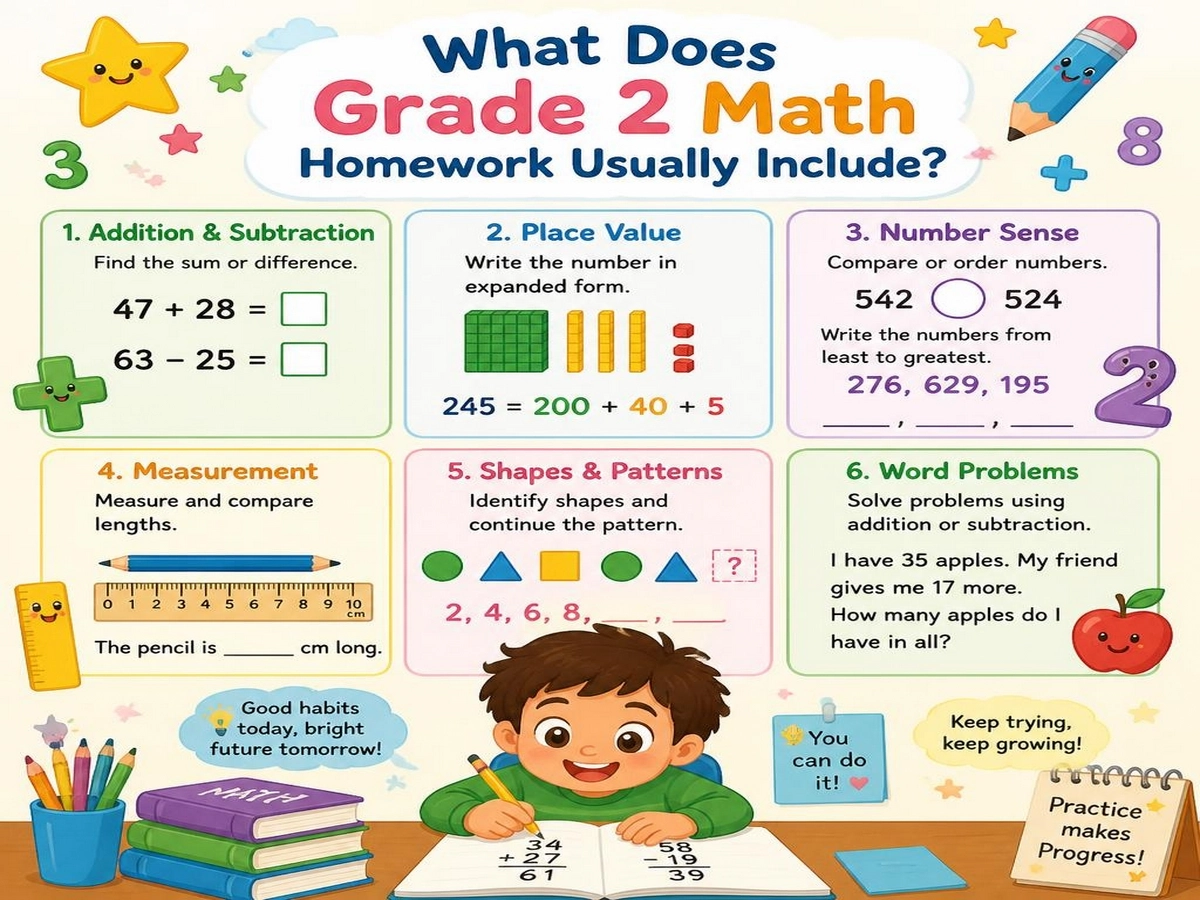
Grade 2 math homework usually includes short practice on what’s being taught in class: facts to 20, place value to 200, two-digit addition and subtraction, word problems, patterns, money and occasional measurement or data activities.
Homework policies vary by school and board. Some Grade 2 classes send home a weekly package; others assign little or no homework and encourage reading and games instead. Whatever your school’s approach, the goal is the same: short, meaningful practice.
Common Grade 2 Homework Types
| Type | Example | Parent role |
|---|---|---|
| Fact practice | Facts to 20 | Play a quick game |
| Place value | Write 147 in expanded form | Use coins or blocks |
| Two-digit operations | 46 + 37 | Ask about the class strategy |
| Word problems | Sharing or comparing stories | Encourage drawing |
| Data | Survey family members | Be a participant |
| Measurement | Measure 5 objects in cm | Supervise the ruler |
Why Does Grade 2 Math Homework Cause Stress?
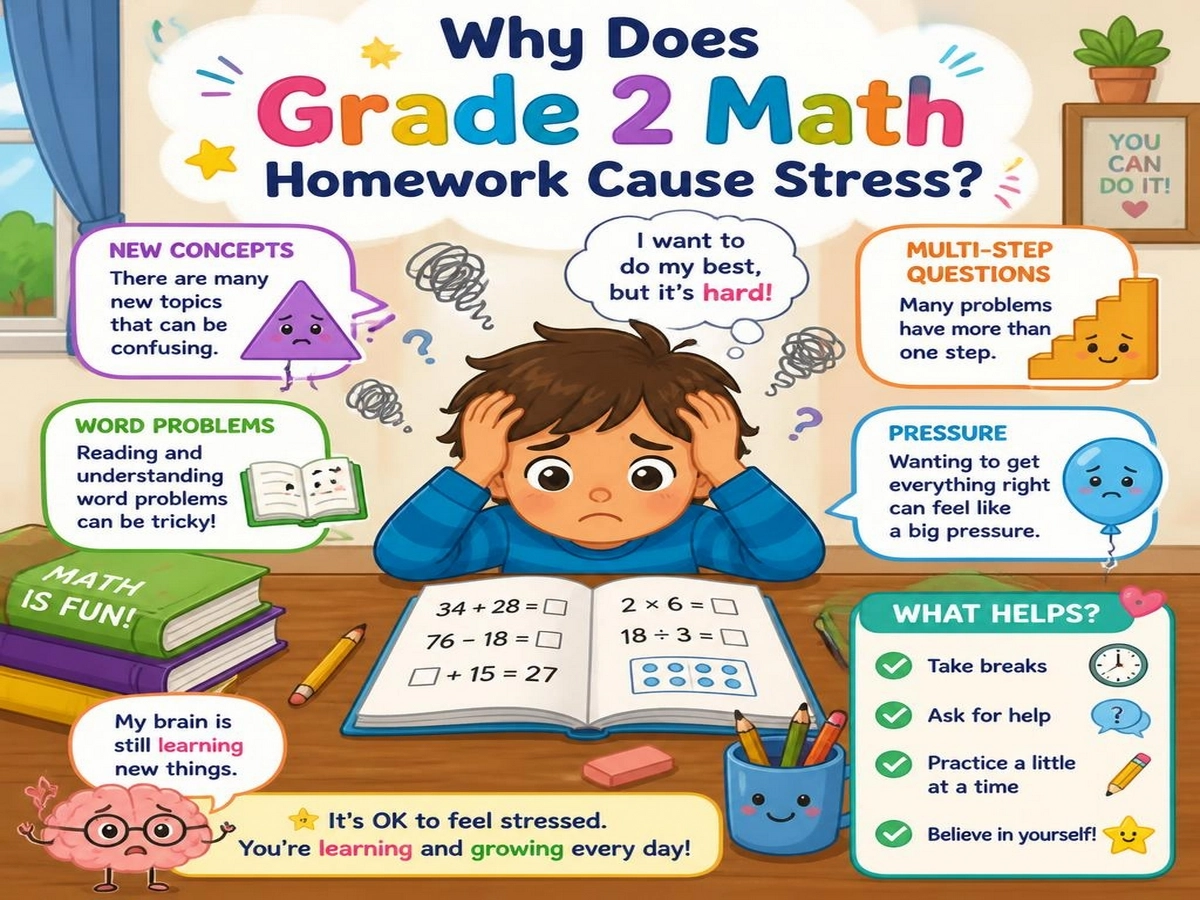
Grade 2 math homework causes stress when children are tired, when methods look unfamiliar to parents, when tasks are too hard or long, or when adults feel anxious about math themselves.
- Fatigue. After a full school day, attention is low.
- Unfamiliar methods. Parents may not recognize number lines or regrouping models.
- Difficulty. Homework sometimes targets skills still being learned.
- Pressure. Timed or high-stakes feelings increase anxiety.
- Adult anxiety. Children pick up on parents’ feelings.
The good news: each of these has a simple fix, and most families see a big difference within a couple of weeks.
9 Easy Tips for Calm Grade 2 Math Homework Evenings
These nine tips make Grade 2 math homework calmer and more effective.

1. Set a Consistent Routine
Same time, same place. Many families do homework after a snack and some active play.
2. Keep It Short
Most Grade 2 homework should take 10 to 20 minutes. If it’s taking much longer, talk to the teacher.
3. Ask Your Child to Teach You
“Show me how your teacher does it.” This respects the class method and reveals understanding.
4. Offer Hints, Not Answers
Ask, “What’s the first step?” or “Can you draw it?” instead of solving it.
5. Use Objects
Coins, blocks and number lines make abstract problems concrete.
6. Praise Effort and Strategies
“You kept trying and found a way” builds persistence.
7. Stay Calm
Your tone matters. If you feel frustrated, take a break.
8. Stop at Frustration
If tears start, stop. Write a note to the teacher. Tomorrow is another chance.
9. Connect With the Teacher
Ask about strategies, expectations and how long homework should take.
How Can You Help Without Taking Over?
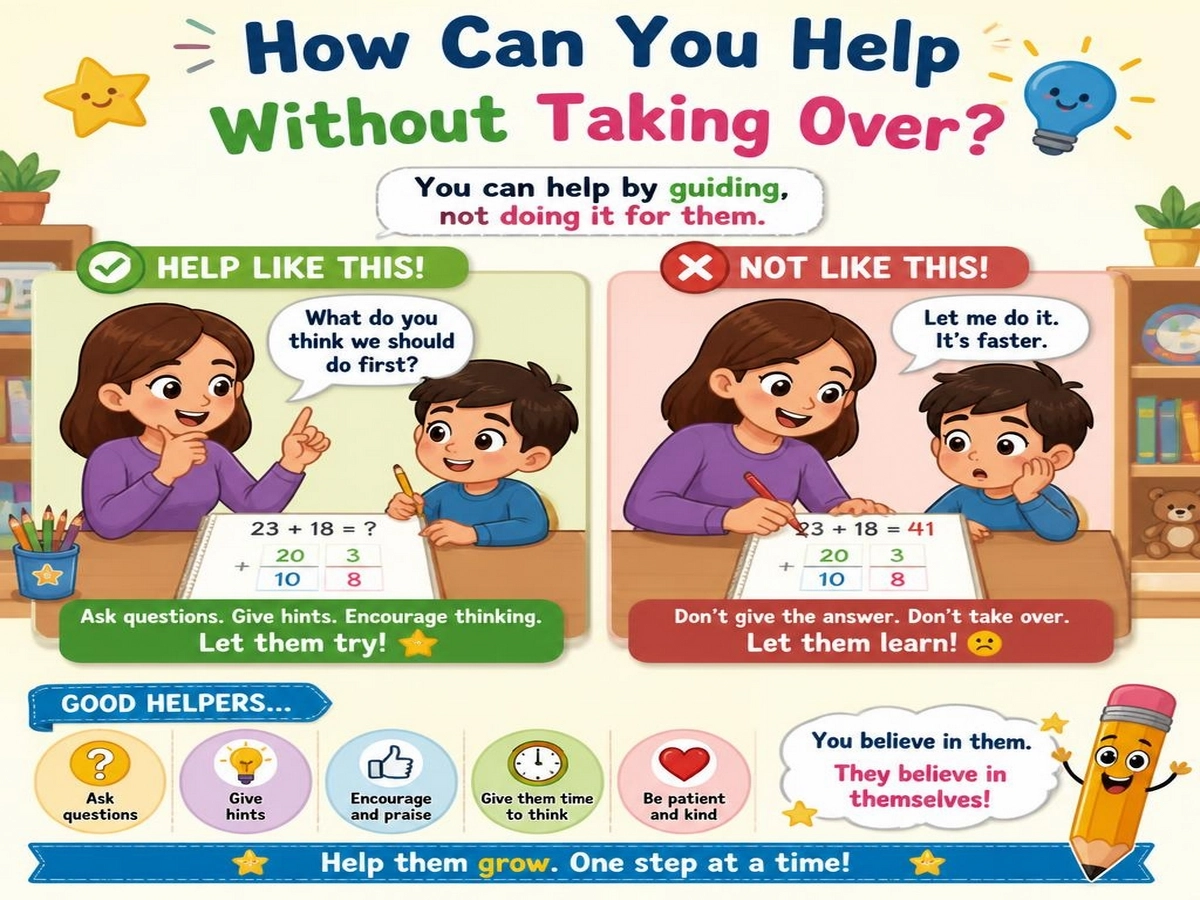
Help with Grade 2 math homework without taking over by asking questions, offering tools, letting your child do the thinking and checking the work together at the end.
Helpful questions:
- “What is the question asking?”
- “What do you already know?”
- “Can you draw a picture?”
- “What strategy did your class use?”
- “Does your answer make sense?”
Avoid:
- Writing answers for your child.
- Teaching a completely different method without asking.
- Saying “This is easy.”
- Comparing to siblings or classmates.
Expert Tip
Sit beside your child, not across. It feels more like teamwork and less like supervision, and it makes left-right directions easier to share.
What New Math Methods Will You See in Grade 2?
New math methods in Grade 2 include open number lines, making 10, splitting into tens and ones, base ten drawings and bar models. They build understanding and mental math, and they’re worth learning.
| Method | What it looks like | Example: 38 + 25 |
|---|---|---|
| Open number line | Jumps along a line | 38 → 58 (+20) → 63 (+5) |
| Split strategy | Add tens and ones separately | 30 + 20 = 50, 8 + 5 = 13, 50 + 13 = 63 |
| Make 10 | Use a friendly ten | 38 + 2 = 40, 40 + 23 = 63 |
| Base ten drawing | Lines for tens, dots for ones | Draw and regroup 13 ones |
| Column method | Stack and regroup | Ones: 8 + 5 = 13, write 3, regroup 1 ten |
Our guides to Grade 2 number line strategies, regrouping and mental math explain each method.

What Should You Do When Your Child Is Stuck?
When your child is stuck on Grade 2 math homework, slow down, reread the question together, try an object or drawing, give a hint rather than the answer and, if needed, stop and note it for the teacher.
- Reread together. Many mistakes come from misreading.
- Ask what they know. Start from their understanding.
- Use objects. Build the problem with coins or blocks.
- Try a simpler version. Solve 8 + 5 before 38 + 25.
- Give one hint. “What if you jump to 40 first?”
- Stop if needed. Write “We worked on this; still confused” for the teacher.

What Does Helping With Math Homework Look Like in Practice?
Helping with math homework in Grade 2 looks like guiding, not doing. Here’s a sample conversation for the problem 46 + 37, showing how a parent can support thinking without giving the answer.
- Parent: “What’s the question asking?”
- Child: “Add 46 and 37.”
- Parent: “About how much do you think it’ll be?”
- Child: “Around 80, because 50 + 30 is 80.”
- Parent: “Great estimate. How does your class add numbers like this?”
- Child: “We use a number line. 46, jump 30 to 76, then 7 more… 83.”
- Parent: “Does 83 make sense with your estimate?”
- Child: “Yes, it’s close to 80.”
Notice the parent never solved anything. They asked questions, encouraged estimation and let the child explain. That’s the heart of good Grade 2 math homework support.
How Can You Handle Homework When You’re Not Confident in Math?
You can support Grade 2 math homework even if you don’t feel confident in math. Your role is to be curious, calm and encouraging, not to be the expert.
- Ask your child to teach you. It builds their understanding and yours.
- Use the class materials. Look at examples in notebooks or newsletters.
- Watch a short lesson together. InukMath’s Grade 2 lessons explain methods step by step.
- Keep your tone positive. Avoid “I’m bad at math.”
- Reach out. Teachers are happy to explain methods to families.
Research by Dunlosky and colleagues (2013) shows that practice spread over time is powerful, so short, calm sessions matter more than perfect explanations.

How Does Grade 2 Math Homework Connect to Practice at Home?
Grade 2 math homework is one part of home practice. When homework is light, short daily games and activities keep skills growing.
- Light homework days: play a math game for 10 minutes.
- Heavy homework days: focus on homework only.
- No homework: read a math picture book or do a quick survey.
InukMath’s Grade 2 practice questions and Grade 2 math games are great on homework-free nights. Our post on Ontario math homework help offers more ideas.
Is Homework Handled the Same Way Across Canada?
Homework practices vary across Canada and even between schools in the same city. Many boards emphasize short, meaningful homework in the primary grades, along with daily reading.
- Ontario: homework policies are set by school boards; many recommend limited primary homework.
- Other provinces: similar variation, often emphasizing reading and practice.
Wherever you live, the principles of calm, short, supportive help are the same.
What Do Teachers Wish Parents Knew About Grade 2 Math Homework?
Teachers often wish parents knew that homework should be practice, not new teaching, and that they want to know when homework causes stress or confusion.
- Homework is practice. It reinforces class learning.
- Mistakes are useful. They show teachers what to reteach.
- Don’t fix everything. Teachers need to see real work.
- Communicate. Notes about struggles help teachers adjust.
A Quick Story
A dad helps his son with 52 − 17 by teaching “borrowing.” His son gets confused because his teacher uses number lines. The next night, the dad asks, “Can you show me your teacher’s way?” His son draws jumps: “17 to 20 is 3, then to 52 is 32. That’s 35!” The dad realizes the number line works beautifully, and homework becomes peaceful again.
How Can Everyday Life Reduce Homework Stress?
Everyday math practice makes Grade 2 math homework easier, because children arrive with stronger skills.
- Car rides: quick fact questions.
- Shopping: count coins and compare prices.
- Cooking: measure and count.
- Games: card and dice games for facts.
- Walks: skip count steps.
How Can You Adapt Homework Help for Different Learners?
Adapt Grade 2 math homework help to your child.
Children Who Rush
Ask them to check two answers with estimation. Turning checking into a quick game, like “find the sneaky mistake,” makes slowing down feel fun rather than like a punishment.
Children Who Freeze
Start with an easy question to build momentum, and remind them that it’s okay to try something and check it.
Active Children
Allow movement breaks between questions. A quick lap around the kitchen or ten jumping jacks between sections can reset focus and make homework time feel less like sitting still for too long.
Children Ready for More
Add a challenge question or ask them to create a similar problem for you to solve. Writing their own problems shows deep understanding, and kids love seeing a grown-up work on their questions.
What Does a Calm Homework Routine Look Like?
A calm Grade 2 math homework routine is predictable and short.
| Step | Time | What happens |
|---|---|---|
| Snack and play | 20 to 30 minutes | Recharge after school |
| Settle in | 2 minutes | Same spot, materials ready |
| Homework | 10 to 20 minutes | Child works; parent nearby |
| Check together | 3 minutes | Review and praise |
| Pack up | 1 minute | Homework back in the backpack |
Try It: 8 Grade 2 Homework-Style Questions
Answers follow.
- 46 + 28 = ___
- 71 − 35 = ___
- Write 163 in expanded form.
- Skip count by 25s to 200.
- Share 10 stickers between 2 friends.
- Is 34 even or odd?
- Measure: a crayon starts at 0 and ends at 9. How long?
- Show 75¢ with the fewest coins.
Answers: 1) 74; 2) 36; 3) 100 + 60 + 3; 4) 25, 50, 75, 100, 125, 150, 175, 200; 5) 5 each; 6) even; 7) 9 cm; 8) 3 quarters.
Myths vs. Facts About Grade 2 Math Homework
| Myth | Fact |
|---|---|
| More homework means more learning. | Short, focused practice is more effective. |
| Parents should correct every mistake. | Teachers need to see real work. |
| New methods are confusing on purpose. | They build understanding and mental math. |
| Helping more always helps. | Calm, supportive help matters more than amount. |
What Are Common Grade 2 Math Homework Mistakes?
Common Grade 2 math homework mistakes include doing work for the child, teaching conflicting methods, letting sessions run too long, pushing through tears and not communicating with the teacher.
- Doing the work. Offer hints.
- Conflicting methods. Learn the class way.
- Too long. Keep it short.
- Pushing through tears. Stop and try later.
- Silence. Tell the teacher about struggles.
Common Mistake
Saying “I was never good at math either.” It can make children believe math ability is fixed. Try “Math takes practice, and we’re practicing together.”
How Do You Know Homework Is Going Well?
Grade 2 math homework is going well when your child starts with little resistance, completes most work independently, explains strategies and finishes in a reasonable time.
Checklist
- Starts homework with little fuss
- Works mostly independently
- Explains at least one strategy
- Finishes in about 10 to 20 minutes
- Feels proud of the work
When Should You Talk to the Teacher?
Talk to the teacher if Grade 2 math homework regularly takes much longer than expected, causes tears, includes skills your child doesn’t understand or if you’re unsure how to help.
- Grade 2 support: Grade 2 math intervention.
- Big picture: Canadian Grade 2 math and Canadian math practice.
- Grade 3: Grade 3 math homework help.
Future Trends
Many schools are moving toward lighter, more meaningful homework in the primary grades, often with digital practice options. The Canadian Paediatric Society recommends balancing screen time with sleep, play and family time, which applies to digital homework too.
Frequently Asked Questions About Grade 2 Math Homework
How long should Grade 2 math homework take?
Usually 10 to 20 minutes. If it regularly takes much longer, talk to the teacher.
How can I help with math homework without doing it?
Ask questions, offer hints, use objects and let your child do the thinking.
What are new math methods in Grade 2?
Open number lines, split strategies, making 10 and base ten drawings.
Should I teach my child my way?
Ask about the class method first, then connect it to yours.
What if my child cries over homework?
Stop, stay calm and note the struggle for the teacher.
What is a good homework routine?
Same time and place daily, after a snack and some play, with a short check-in at the end.
Is it okay if homework has mistakes?
Yes. Mistakes help teachers know what to reteach.
What if there’s no math homework?
Play a math game or practice everyday math for 10 minutes.
Where can I find math homework help?
Ask the teacher, use InukMath’s Grade 2 lessons and practice questions, and read our homework guides.
Conclusion: Calm Evenings, Stronger Skills
Grade 2 math homework works best when it’s calm, short and supportive. Set a routine, learn the class methods, offer hints instead of answers and talk to the teacher when needed. With the right approach, homework becomes a time to practice and connect, not a nightly battle.
Make homework easier. InukMath offers free Grade 2 lessons that explain class methods step by step, plus practice questions and games. Join free and explore our Grade 2 lessons.
Sources and Further Reading
- Maloney et al. (2015), Intergenerational effects of parents’ math anxiety, Psychological Science
- Dunlosky et al. (2013), Improving students’ learning with effective learning techniques, Psychological Science in the Public Interest
- Canadian Paediatric Society, Digital media: Promoting healthy screen use in school-aged children (reaffirmed 2025)