
Grade 2 Math Intervention: How to Find and Close Gaps Early
Grade 2 math intervention is targeted, extra support that helps a child close specific gaps in math skills. In Grade 2, common gaps include place value, facts to 20, regrouping and understanding word problems. Because Grade 3 builds directly on these skills, and Ontario students write the EQAO assessment in Grade 3, Grade 2 is an ideal time to catch and close gaps.
Intervention doesn’t have to mean expensive tutoring. Often, it means finding exactly which skill is shaky, practicing it a little every day with the right tools and checking progress weekly, ideally in partnership with your child’s teacher.
This guide explains Grade 2 math intervention in practical terms, eight proven steps to close gaps, quick diagnostic checks, what schools offer, when to seek more help and how to keep your child’s confidence strong.
Quick Answer
Effective Grade 2 math intervention follows 8 steps: notice the struggle, check foundations with quick diagnostics, pick one target skill, practice 10 to 15 minutes daily, use concrete tools, track progress weekly, partner with the teacher and adjust or escalate if progress stalls. Targeted math support works best when it starts early and stays positive.
Key Takeaways
- Grade 2 math intervention targets specific gaps, not everything at once.
- Quick diagnostic checks reveal exactly where to start.
- Short daily practice with concrete tools closes most gaps.
- Weekly progress tracking shows whether the plan is working.
- Partnering with the teacher makes intervention far more effective.
Table of Contents
- What Is Grade 2 Math Intervention?
- Why Does Grade 2 Math Intervention Matter?
- What Are 8 Proven Steps to Close Math Gaps in Grade 2?
- How Do You Find Math Gaps With Quick Diagnostic Checks?
- What Targeted Math Support Works Best at Home?
- What Do Schools Offer for Math Support?
- How Do You Keep Confidence Strong During Intervention?
- How Does Grade 2 Math Intervention Show Up in Daily Life?
- Is Math Support Similar Across Canada?
- What Do Teachers Wish Parents Knew About Intervention?
- How Can You Adapt Intervention for Different Learners?
- How Does Grade 2 Math Intervention Connect to Word Problems?
- How Should Home and School Intervention Work Together?
- What Does a 6-Week Grade 2 Math Intervention Plan Look Like?
- Try It: 8 Grade 2 Diagnostic Questions
- What Are Common Intervention Mistakes?
- How Do You Know Intervention Is Working?
- When Should You Seek More Help?
- Frequently Asked Questions About Grade 2 Math Intervention
- Conclusion: Find the Gap, Close the Gap
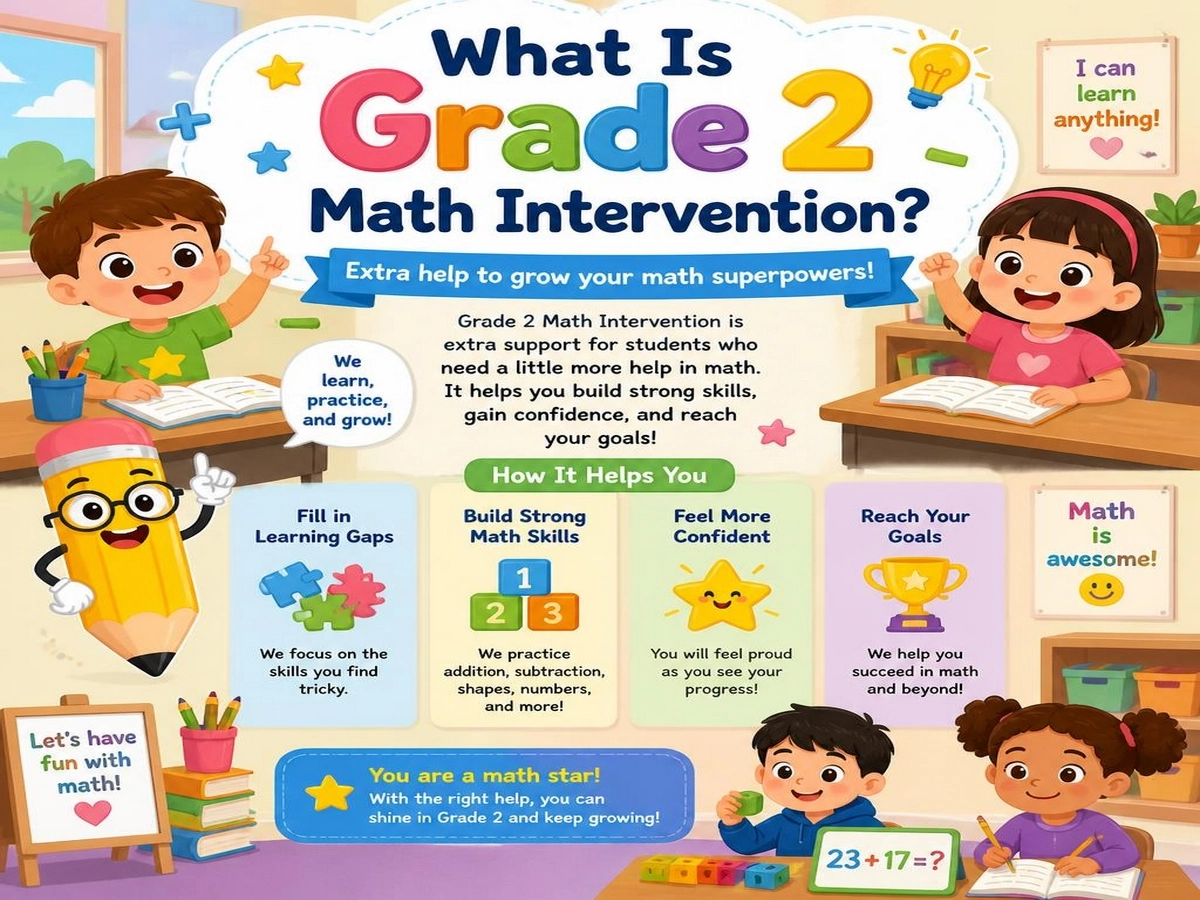
What Is Grade 2 Math Intervention?
Grade 2 math intervention is focused support designed to help a child who is struggling with specific math skills catch up. It identifies the gap, provides targeted practice and monitors progress until the skill is secure.
Intervention can happen at school (small groups, extra teacher time), at home (structured daily practice) or both. The best intervention combines home and school efforts.
Catching Up in Math Is Common
Catching up in math is common in the early grades. Children develop at different rates, miss school, move between provinces or simply need more time with certain ideas. A gap in Grade 2 is not a label; it’s a signal for support.
Struggling Grade 2 Math: What It Looks Like
Struggling Grade 2 math often shows up as:
- Counting by ones for most facts
- Confusion with numbers like 104 and 140
- Regrouping errors like 52 − 17 = 45
- Difficulty with word problems
- Avoidance, tears or “I’m bad at math”
Why Does Grade 2 Math Intervention Matter?
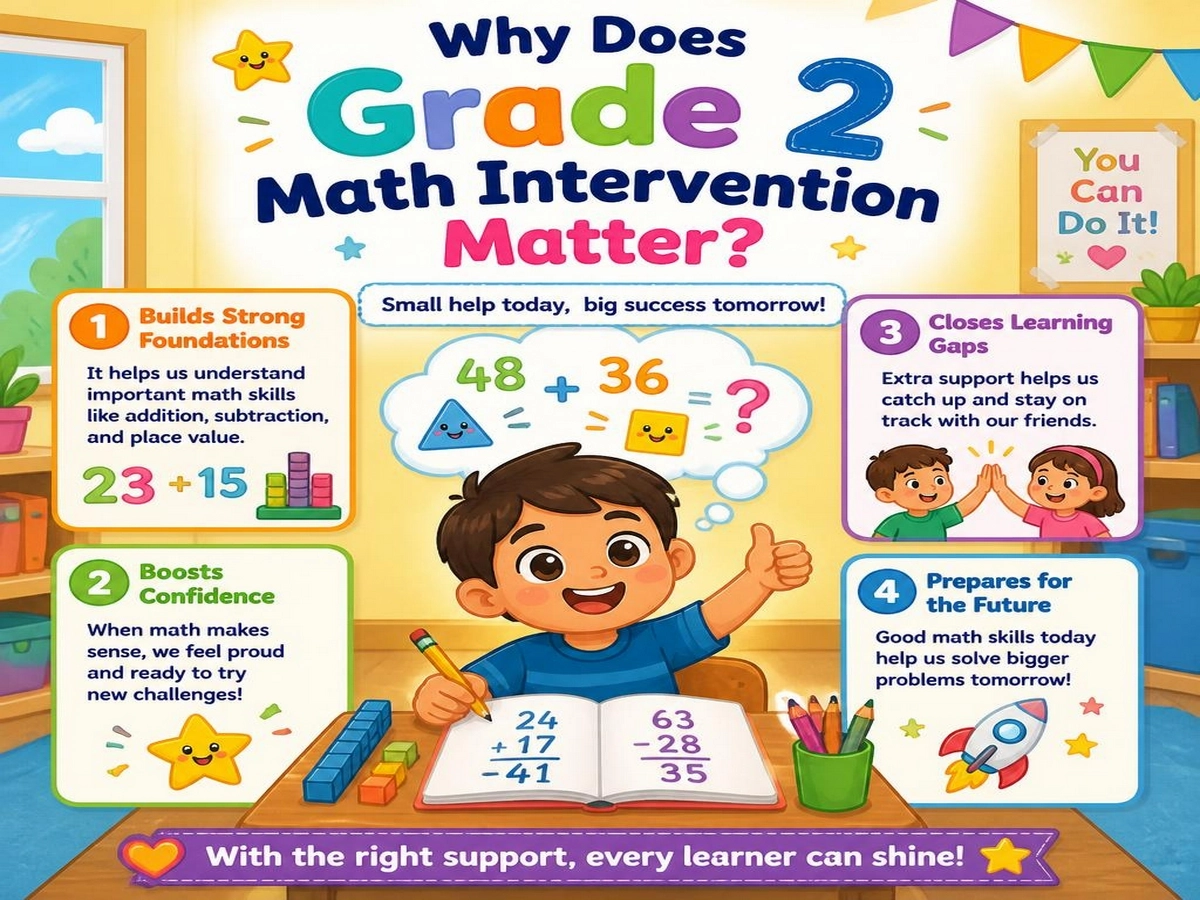
Grade 2 math intervention matters because gaps tend to widen over time, Grade 3 content builds directly on Grade 2 skills and early support is more effective and less stressful than late support.
In Ontario, 64% of Grade 3 students in English-language schools met the provincial math standard in 2024-25, according to EQAO’s 2025 results. Many Grade 3 struggles trace back to Grade 2 foundations like place value and regrouping.
The Institute of Education Sciences early math guide recommends progress monitoring so instruction builds on what each child knows. That’s the essence of good intervention: start where the child is, not where the textbook is.
What Are 8 Proven Steps to Close Math Gaps in Grade 2?
The eight proven steps for Grade 2 math intervention are noticing, diagnosing, targeting, practicing daily, using concrete tools, tracking progress, partnering with the teacher and adjusting.

Step 1: Notice the Struggle
Pay attention to homework, report cards and your child’s feelings about math. Teacher comments like “developing” or “needs support” are important signals.
Step 2: Check Foundations
Use quick diagnostic checks (below) to find the earliest skill that’s shaky. Many Grade 2 gaps start in Grade 1 skills.
Step 3: Pick One Target
Choose one skill to work on, like “facts to 10” or “tens and ones.” Trying to fix everything at once overwhelms children.
Step 4: Practice 10 to 15 Minutes Daily
Short daily sessions beat long weekly ones. Consistency is the secret ingredient.
Step 5: Use Concrete Tools
Base ten blocks, ten frames, number lines and coins make abstract ideas visible.
Step 6: Track Progress Weekly
Do the same quick check each Friday and record results.
Step 7: Partner With the Teacher
Share what you’re doing and ask what the teacher sees in class.
Step 8: Adjust or Escalate
If progress stalls after several weeks, adjust the plan or ask about additional school support.
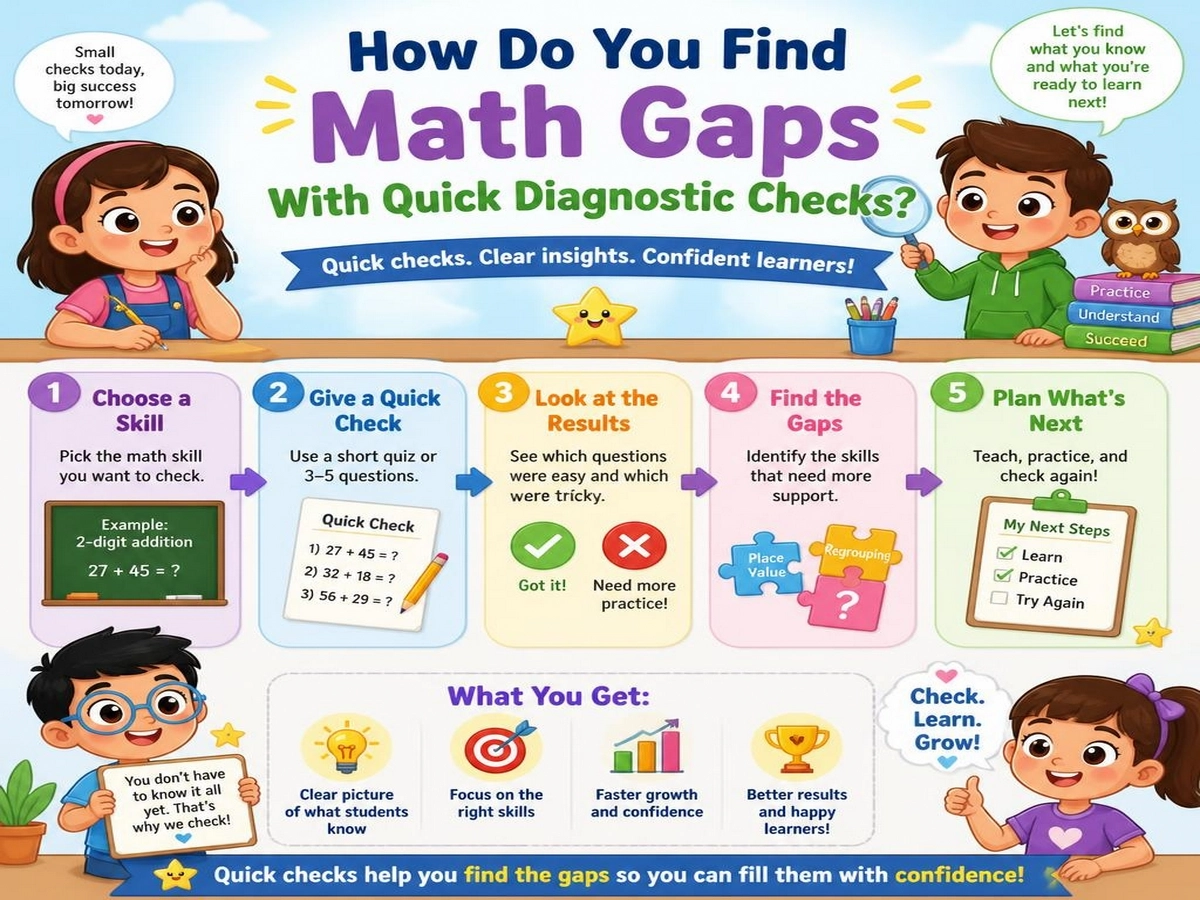
How Do You Find Math Gaps With Quick Diagnostic Checks?
You can find math gaps with quick, low-pressure diagnostic checks that take about 10 minutes total. Start with Grade 1 foundations and move up until you find the shaky skill.
| Skill | Quick check | Secure if your child… |
|---|---|---|
| Counting | Count 30 objects | Counts accurately, groups by tens |
| Facts to 10 | Ask 10 facts | Answers most within 3 seconds |
| Tens and ones | Show 47 with blocks | Uses 4 tens and 7 ones |
| Facts to 20 | Ask 10 facts | Uses strategies, mostly quick |
| Place value to 200 | Write 104 and 140 | Writes both correctly |
| Two-digit addition | 36 + 27 | Gets 63 and explains |
| Two-digit subtraction | 52 − 17 | Gets 35 and explains |
| Word problems | One comparison story | Draws and solves correctly |
The first skill that isn’t secure is your starting point.
Expert Tip
Make diagnostic checks feel like a game, not a test. Say, “Let’s see what your brain already knows!” and stop if your child gets upset.
What Targeted Math Support Works Best at Home?
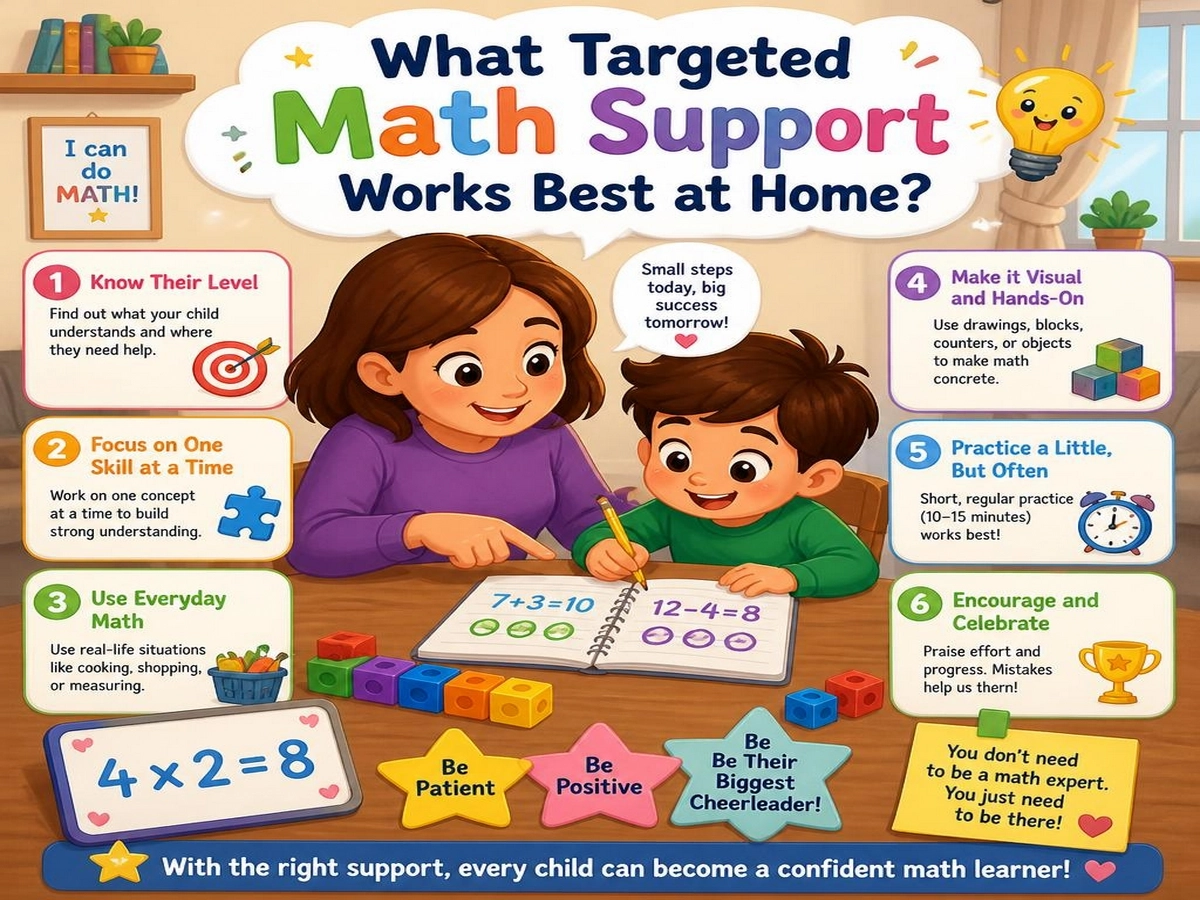
Targeted math support at home works best when it focuses on one skill, uses concrete tools, includes daily short practice and builds confidence with frequent success.
| Gap | Targeted activities | InukMath guide |
|---|---|---|
| Facts to 20 | Doubles games, make 10 | Grade 2 math facts |
| Place value | Base ten blocks, coins | Grade 2 place value |
| Regrouping | Trading with dimes and cents | Grade 2 regrouping |
| Mental math | Number talks, hundreds chart | Grade 2 mental math |
| Word problems | Drawing, bar models | Our post on Grade 2 word problems |
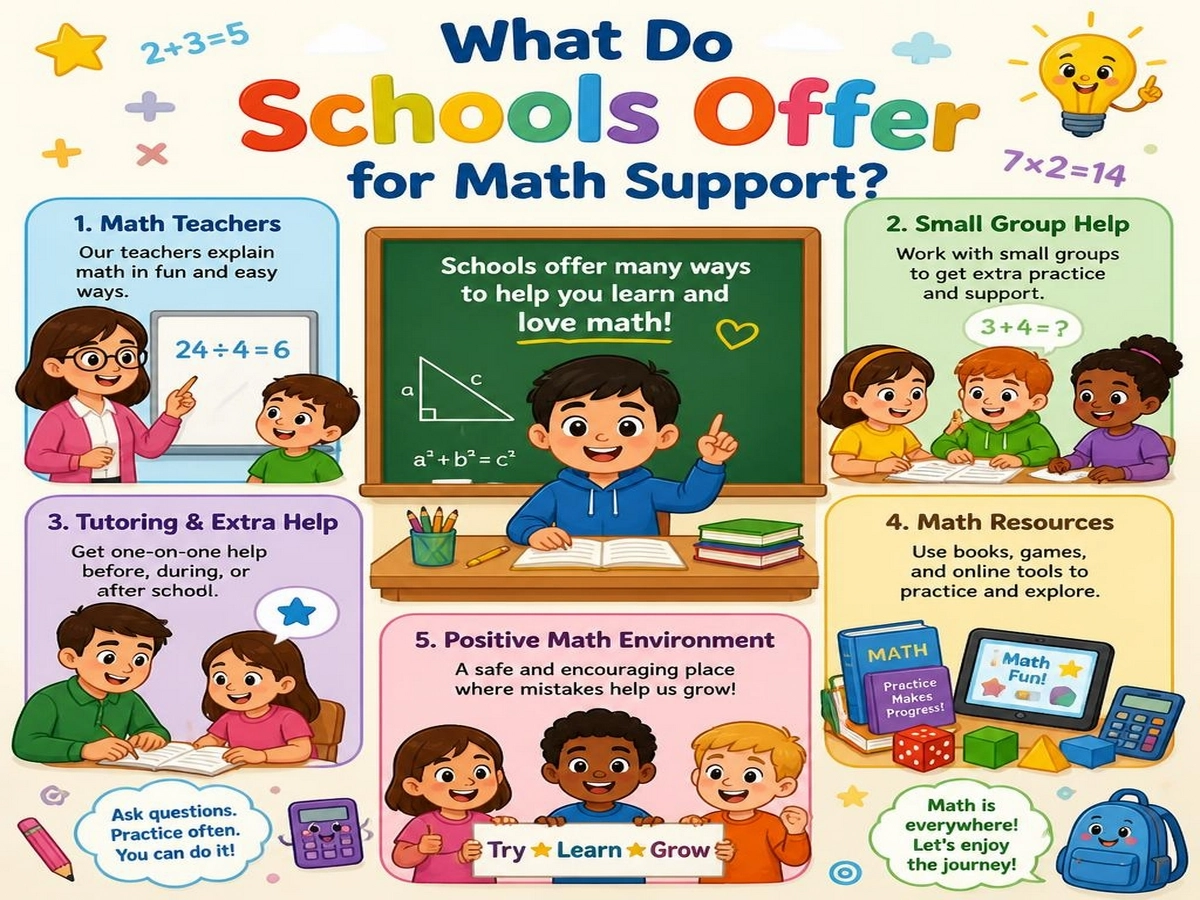
What Do Schools Offer for Math Support?
Schools can offer classroom differentiation, small-group intervention, extra practice time and, when needed, support from special education resources. In Ontario, if a learning disability is suspected, the school team may discuss further assessment.
Questions to Ask the Teacher
- “Which skills are strongest and weakest?”
- “What strategies are you using in class?”
- “Is small-group support available?”
- “How can I match your strategies at home?”
- “When should we check in again?”
The Learning Disabilities Association of Ontario offers resources for families concerned about learning disabilities, and our post on dyscalculia signs explains warning signs.
How Do You Keep Confidence Strong During Intervention?
Keep confidence strong during Grade 2 math intervention by starting with easy wins, celebrating effort, avoiding comparisons, keeping sessions short and showing progress visually.
- Start easy. Begin each session with something your child can do.
- Praise strategies. “You used making 10. Smart!”
- Avoid comparisons. Focus on personal growth.
- Show progress. Use a chart that fills up over time.
- Stay calm. Your tone matters.
Research by Ramirez and colleagues (2013) found that math anxiety appears early and is linked to lower achievement, so protecting confidence is part of effective intervention.

How Does Grade 2 Math Intervention Show Up in Daily Life?
Grade 2 math intervention can extend into daily life with short, natural practice moments that reinforce the target skill.
- Facts: car-ride fact questions.
- Place value: reading prices and addresses.
- Regrouping: trading coins at the store.
- Word problems: real-life stories at dinner.
- Estimation: guessing totals before counting.

Is Math Support Similar Across Canada?
Math support in Canada varies by province and board, but most schools offer classroom differentiation, small-group help and special education services for identified needs.
- Ontario: in-school support teams and special education processes.
- British Columbia: school-based teams and individualized plans.
- Other provinces: similar tiered support models.
Wherever you live, talking to the teacher is the best first step.
What Do Teachers Wish Parents Knew About Intervention?
Teachers often wish parents knew that early intervention is normal and effective, and that home practice matching class strategies makes a big difference.
- Gaps are common.
- Small, steady practice works.
- Consistency matters.
- Communication helps.
A Quick Story
A Grade 2 child struggles with two-digit subtraction. A quick check reveals the real gap: tens and ones from Grade 1. For three weeks, her parents spend 10 minutes daily bundling straws and trading dimes. By the fourth week, regrouping clicks. The intervention worked because it started at the right place.
How Can You Adapt Intervention for Different Learners?
Adapt Grade 2 math intervention for each child.
Children With Anxiety
For anxious children, Grade 2 math intervention should feel like play. Use games, avoid timing, celebrate effort and keep a calm, predictable routine so math time never feels like a test.
Children With Attention Challenges
Use short bursts of five minutes, movement breaks and hands-on tools. Grade 2 math intervention can even happen while hopping along a floor number line.
Children Learning English
Use visuals, gestures and home-language support. Our post on newcomer families and Ontario math can help.
Children With Possible Learning Disabilities
Work closely with the school and use consistent concrete tools.
How Does Grade 2 Math Intervention Connect to Word Problems?
Grade 2 math intervention often reveals that word problems are hard not because of the math, but because of reading, vocabulary and choosing an operation. A child who solves 14 − 9 easily may freeze when the same numbers appear in a story about stickers.
To support word problems during intervention, read the story aloud together, ask your child to retell it in their own words, then draw it. Bar models work especially well: one long bar for Mia’s 14 stickers and a shorter bar for Leo’s 9 show the “how many more” gap clearly. Over time, children learn that stories about “more,” “fewer,” “left” and “altogether” each have a shape they can draw.
Three Story Types to Practice
| Story type | Example | Helpful drawing |
|---|---|---|
| Joining | 23 kids, 8 more arrive | Number line jumps |
| Separating | 40 apples, 15 eaten | Crossing out groups |
| Comparing | 14 vs. 9 stickers | Two bars side by side |
Practice one story type per week so your child gets lots of success before mixing them.
How Should Home and School Intervention Work Together?
Grade 2 math intervention works best when home and school use the same language and tools. If the teacher calls it “making 10,” use that phrase at home. If the class uses ten frames, borrow or print ten frames for your kitchen table. Matching strategies prevents confusion and doubles the practice a child gets with each idea.
A simple weekly note can keep everyone aligned. Write down the target skill, what you practiced, how the Friday check went and one question for the teacher. Many teachers appreciate this kind of short update because it shows them what the child can do outside the classroom. Some families use a shared notebook in the backpack; others send a quick email every second week.
Remember that the goal of Grade 2 math intervention is independence. As each skill becomes secure, gradually remove supports: blocks become drawings, drawings become mental pictures and mental pictures become quick recall.
What Does a 6-Week Grade 2 Math Intervention Plan Look Like?
A 6-week Grade 2 math intervention plan targets one skill at a time with weekly checks.
| Week | Target | Daily activity (10 to 15 min) | Friday check |
|---|---|---|---|
| 1 | Tens and ones | Straw bundles, coins | Builds numbers to 99 |
| 2 | Place value to 200 | Base ten blocks | Writes 104, 140, 170 correctly |
| 3 | Facts to 20 | Doubles and make 10 games | 10 facts with strategies |
| 4 | Two-digit addition | Number lines | 3 of 4 correct |
| 5 | Two-digit subtraction | Trading coins | 3 of 4 correct |
| 6 | Mixed review | Games and word problems | Teacher feedback |
Try It: 8 Grade 2 Diagnostic Questions
Answers follow.
- Count by 10s from 30 to 100.
- 7 + 8 = ___
- 15 − 6 = ___
- Write one hundred four.
- How many tens are in 70?
- 36 + 27 = ___
- 52 − 17 = ___
- Mia has 14 stickers. Leo has 9. How many more does Mia have?
Answers: 1) 30, 40, 50, 60, 70, 80, 90, 100; 2) 15; 3) 9; 4) 104; 5) 7; 6) 63; 7) 35; 8) 5.
Myths vs. Facts About Grade 2 Math Intervention
| Myth | Fact |
|---|---|
| Intervention means a child is failing. | It’s normal, targeted support. |
| More practice time is always better. | Short, daily, focused practice works best. |
| Kids catch up on their own. | Many gaps widen without support. |
| Only tutors can help. | Parents can provide effective support at home. |
What Are Common Intervention Mistakes?
Common Grade 2 math intervention mistakes include working on too many skills at once, starting at the wrong level, long sessions, inconsistent practice and not involving the teacher.
- Too many targets. One at a time.
- Wrong level. Diagnose first.
- Long sessions. Keep them short.
- Inconsistency. Daily beats occasional.
- Going it alone. Partner with the teacher.
Common Mistake
Starting intervention with grade-level worksheets when the real gap is a year earlier. Always check foundations first.
How Do You Know Intervention Is Working?
Grade 2 math intervention is working when weekly checks improve, your child uses strategies more independently, the teacher reports progress and your child feels more confident.
Checklist
- Weekly checks show improvement
- Uses tools and strategies independently
- Teacher sees progress in class
- Less avoidance or anxiety
- Ready to move to the next target
When Should You Seek More Help?
Seek more help if Grade 2 math difficulties persist after six to eight weeks of consistent targeted support, if anxiety is severe or if the teacher recommends further assessment.
- More guidance: our posts on whether your child is behind in math and math tutors vs. online practice.
- Grade 1 roots: Grade 1 math difficulties.
- Grade 3: Grade 3 math intervention.
Future Trends
More Canadian schools are using early screening and tiered support models to catch gaps early. Combined with consistent home practice, these approaches help more children succeed.
Frequently Asked Questions About Grade 2 Math Intervention
What is Grade 2 math intervention?
Targeted support that helps a child close specific math gaps through focused practice and progress monitoring.
How do I know if my child needs intervention?
Watch for slow facts, place value confusion, regrouping errors, word problem struggles and math anxiety.
What are common math gaps in Grade 2?
Place value, facts to 20, regrouping and word problems.
How long does intervention take?
Many gaps close in 4 to 8 weeks of consistent daily practice.
Can parents provide intervention at home?
Yes. Short, targeted daily practice with concrete tools is very effective.
What is targeted math support?
Support focused on one specific skill at a time.
Should I get a tutor?
If home practice and school support aren’t enough after several weeks, a tutor may help.
How do I talk to the teacher?
Share observations, ask about strategies and request regular check-ins.
Will intervention affect my child’s confidence?
Done positively, it builds confidence by showing real progress.
Conclusion: Find the Gap, Close the Gap
Grade 2 math intervention works best when it’s early, targeted and positive. Diagnose the starting point, choose one skill, practice daily with concrete tools, track progress and partner with the teacher. With steady support, most children catch up and head into Grade 3 with confidence.
Explore the full year in our Canadian Grade 2 math guide, and find more support in our Canadian math practice roadmap.
Close gaps with targeted practice. InukMath offers free Grade 2 lessons, practice questions and games organized by skill. Join free and explore our Grade 2 practice questions.
Sources and Further Reading
- EQAO, Provincial assessment results 2024-2025
- Institute of Education Sciences, Teaching Math to Young Children practice guide (2013)
- Learning Disabilities Association of Ontario
- Ramirez et al. (2013), Math anxiety, working memory, and math achievement in early elementary school, Journal of Cognition and Development