
Grade 2 Math Facts: Building Fluency With Addition and Subtraction to 20
Grade 2 math facts are the addition facts for numbers up to 20 and their related subtraction facts, like 8 + 7 = 15 and 15 − 7 = 8. In the Ontario curriculum, Grade 2 students recall and demonstrate addition facts for numbers up to 20 and related subtraction facts.
Fact fluency in Grade 2 is a big deal. Two-digit addition, regrouping, mental math and word problems all lean on quick, accurate facts. When a child still counts on fingers for 9 + 6, every bigger problem takes twice as long and invites more errors.
The good news: fluency doesn’t come from endless drills or stressful timed tests. This guide shares ten proven strategies, a simple 4-week plan, the timed-test trap to avoid and ways to practice that children actually enjoy.
Quick Answer
Grade 2 math facts are addition facts to 20 and related subtraction facts to 20. Children build fluency through strategies like doubles, near doubles, making 10, fact families and thinking addition for subtraction, practiced in short daily games. Aim for accurate answers within about three seconds by year’s end, without relying on timed tests.
Key Takeaways
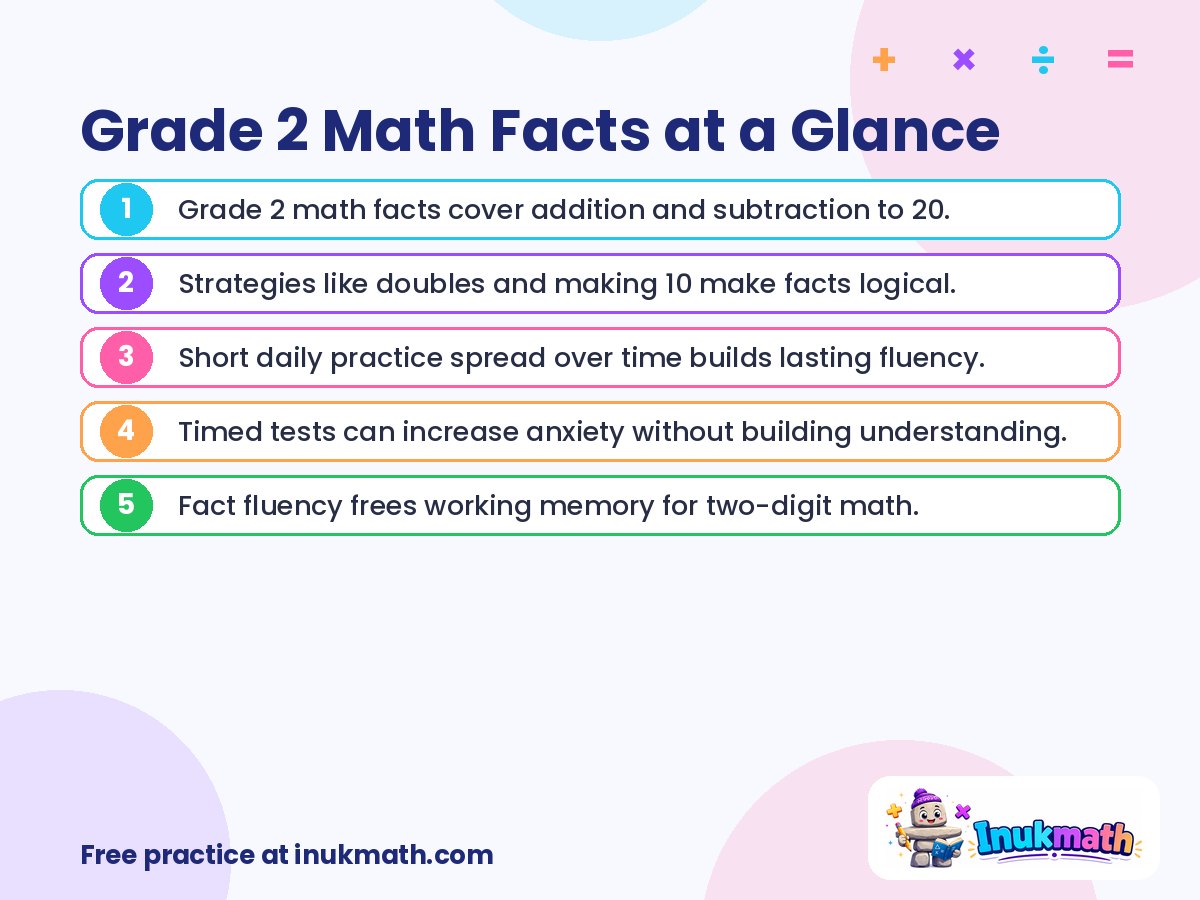
- Grade 2 math facts cover addition and subtraction to 20.
- Strategies like doubles and making 10 make facts logical.
- Short daily practice spread over time builds lasting fluency.
- Timed tests can increase anxiety without building understanding.
- Fact fluency frees working memory for two-digit math.
Table of Contents
- What Are Grade 2 Math Facts?
- Why Do Grade 2 Math Facts Matter So Much?
- How Do Kids Learn Grade 2 Math Facts?
- 10 Proven Strategies for Grade 2 Math Facts Fluency
- What Does a 4-Week Grade 2 Math Facts Plan Look Like?
- What Is the Timed-Test Trap?
- How Do Grade 2 Math Facts Show Up in Word Problems?
- What Should a Grade 2 Math Facts Tracker Look Like?
- Which Practice Methods Work Best for Facts?
- Are Math Facts Taught the Same Way Across Canada?
- What Should Parents Say During Fact Practice?
- What Do Teachers Wish Parents Knew About Math Facts?
- How Can Everyday Life Build Fact Fluency?
- How Can You Adapt Fact Practice for Different Learners?
- Try It: 8 Grade 2 Math Facts Practice Questions
- What Are Common Grade 2 Math Facts Mistakes?
- How Do You Know Your Child Has Mastered Grade 2 Math Facts?
- Where Do Grade 2 Math Facts Lead?
- Frequently Asked Questions About Grade 2 Math Facts
- Conclusion: Fluency Through Understanding
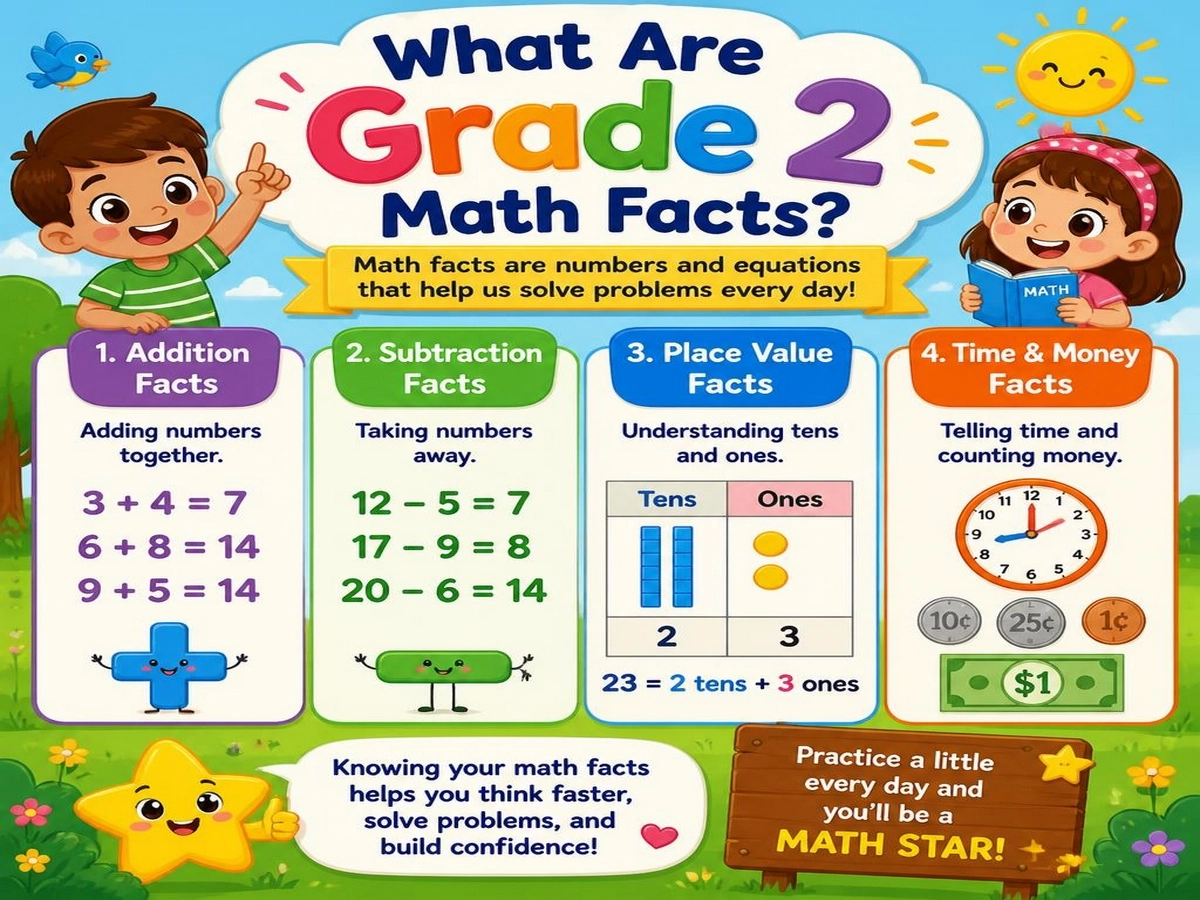
What Are Grade 2 Math Facts?
Grade 2 math facts are addition combinations where both addends are single-digit numbers and the sum is 20 or less, along with the related subtraction facts. Examples include 6 + 9 = 15, 7 + 7 = 14, 13 − 5 = 8 and 18 − 9 = 9.
The Ontario mathematics curriculum states that Grade 2 students “recall and demonstrate addition facts for numbers up to 20, and related subtraction facts.” Grade 2 students also use mental math to add and subtract numbers to 50.
Addition Facts to 20
Facts to 20 build on Grade 1’s facts to 10. The new challenge is crossing 10: 8 + 5, 9 + 7, 6 + 8. These require strategies like making 10 or near doubles.
Subtraction Facts to 20
Subtraction facts to 20, like 14 − 6, are usually harder than addition. Teaching them through fact families (“6 + 8 = 14, so 14 − 6 = 8”) makes them far easier.
What Is Fact Fluency Grade 2 Teachers Look For?
Fact fluency in Grade 2 means accuracy, efficiency and flexibility. A fluent child answers quickly, uses strategies when unsure and can explain how they know.
Why Do Grade 2 Math Facts Matter So Much?
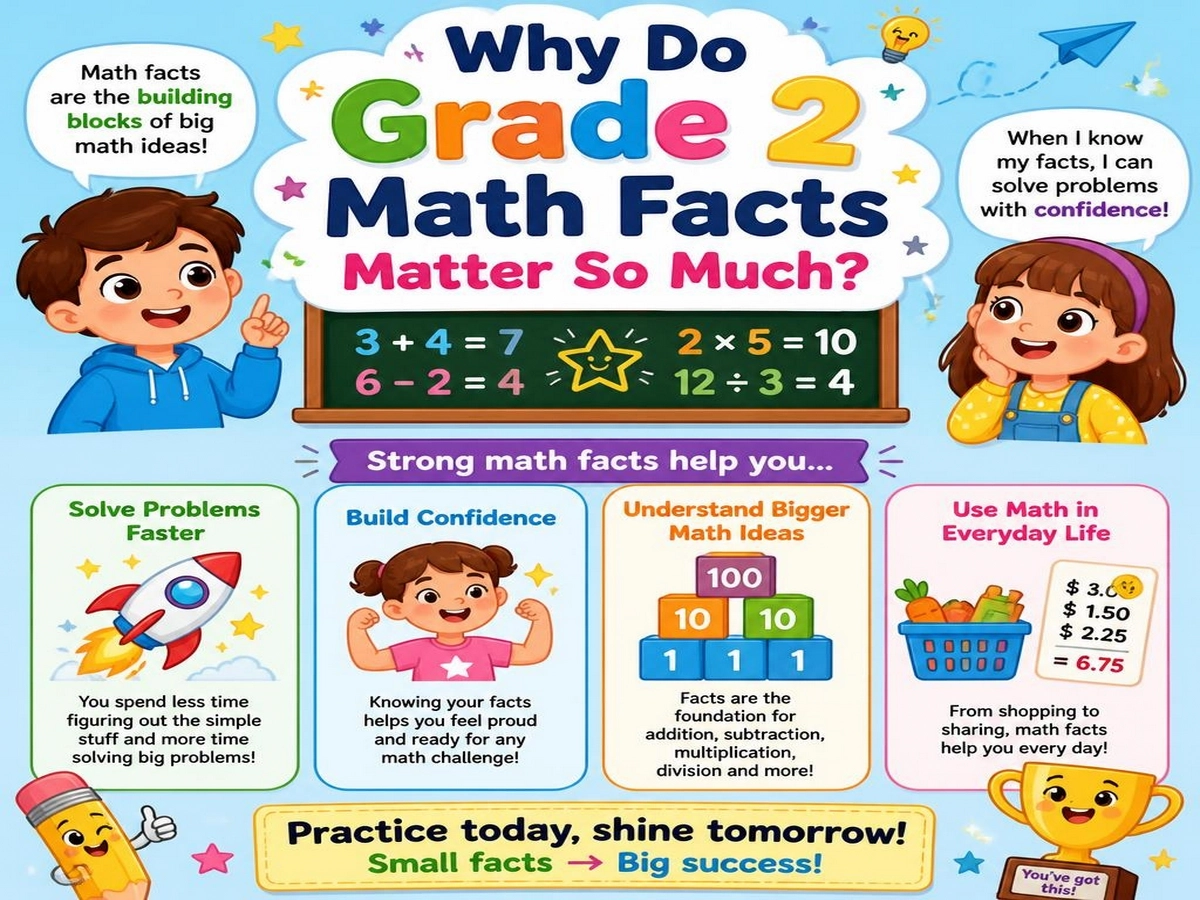
Grade 2 math facts matter because fluency frees working memory for harder problems, makes two-digit addition and subtraction faster and more accurate, supports regrouping and builds confidence.
Consider 47 + 28. A child must add 7 + 8 (a fact to 20), regroup and add the tens. If 7 + 8 takes ten seconds of finger counting, the child may lose track of the bigger problem.
Learning science supports short, spaced practice. A review by Dunlosky and colleagues (2013) rated practice testing and distributed practice as highly effective. A classroom study by Rohrer and colleagues (2020) found mixed (interleaved) practice led to better long-term results. And because Ramirez and colleagues (2013) found math anxiety linked to lower achievement in early grades, keeping practice low-stress matters.
How Do Kids Learn Grade 2 Math Facts?
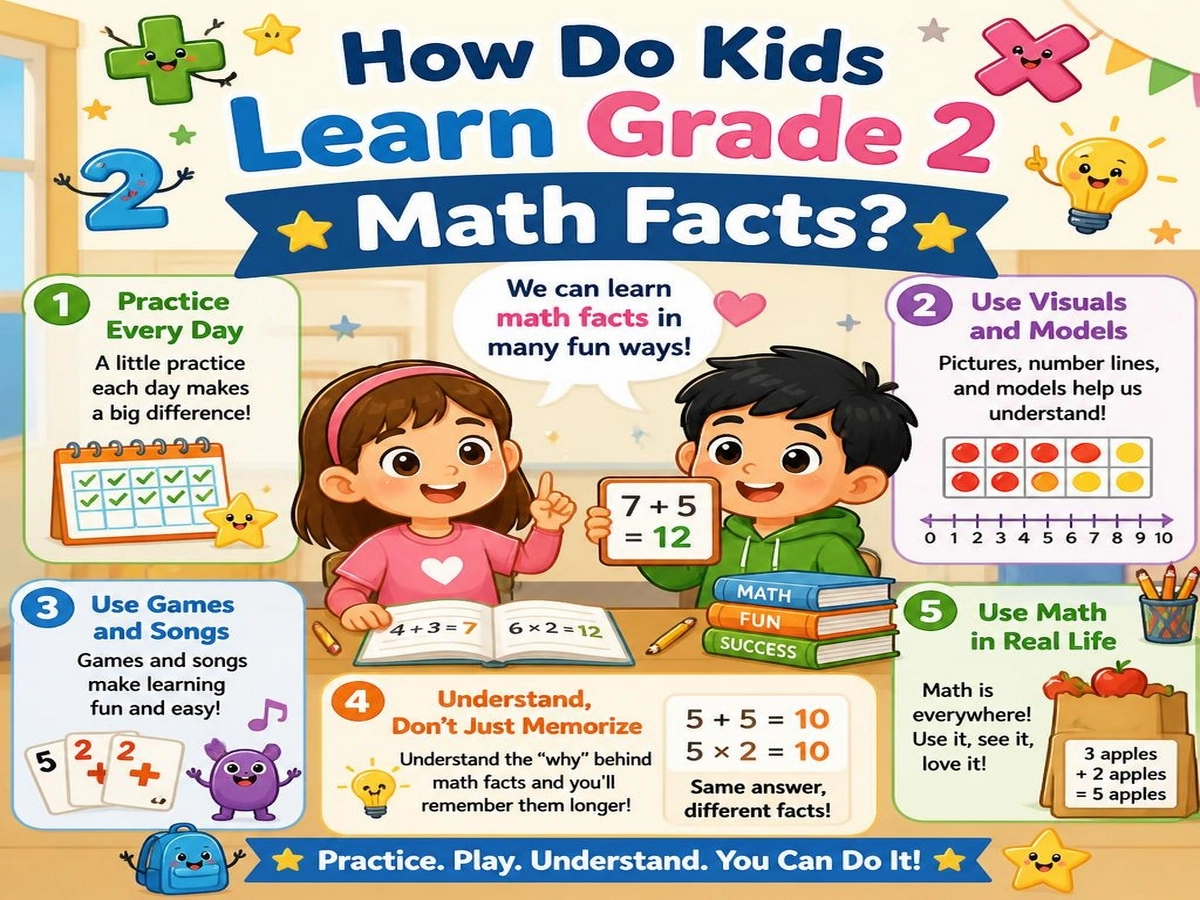
Kids learn Grade 2 math facts by moving from counting to strategies to recall. They first count on, then use strategies like doubles and making 10, then gradually recall facts automatically through varied, spaced practice.
- Count on. For 9 + 3, start at 9: “10, 11, 12.”
- Learn anchor facts. Doubles and facts that make 10.
- Derive new facts. “7 + 8 is double 7 plus 1.”
- Use fact families. Connect addition and subtraction.
- Practice in games. Short, frequent, varied.
- Recall. Facts become automatic.
Expert Tip
Group facts by strategy, not by number. Practice all doubles together, then all near doubles, then all make-10 facts. Strategy groups are easier to learn than number lists.
The InukMath lessons on numbers to 20 and more about addition and subtraction support these steps.
10 Proven Strategies for Grade 2 Math Facts Fluency
These ten strategies cover every Grade 2 fact to 20. Teach one at a time and practice it in games before moving on.
1. Count On (+1, +2, +3)
Start with the bigger number and count on small amounts. 8 + 3: “9, 10, 11.”
2. Doubles
6 + 6, 7 + 7, 8 + 8, 9 + 9. Doubles are memorable and anchor many other facts. See Grade 2 doubles facts.
3. Near Doubles
7 + 8 = double 7 + 1 = 15. Or double 8 − 1 = 15.
4. Make 10
9 + 6: take 1 from 6 to make 10, then add 5: 15.
5. Add 10
10 + 7 = 17. Adding 10 to a single digit is quick once place value is clear.
6. Add 9 (Add 10, Take 1)
9 + 7 = 10 + 7 − 1 = 16.
7. Turnaround Facts
4 + 9 = 9 + 4. Knowing one means knowing the other.
8. Fact Families
5 + 8 = 13, 8 + 5 = 13, 13 − 5 = 8, 13 − 8 = 5.
9. Think Addition for Subtraction
15 − 7: “7 plus what makes 15?” (8).
10. Subtract Through 10
14 − 6: subtract 4 to get 10, then 2 more: 8.
What Does a 4-Week Grade 2 Math Facts Plan Look Like?
A 4-week plan introduces one or two strategies per week with daily games and mixed review. Each session takes about 10 minutes.
| Week | Strategies | Daily game | Review |
|---|---|---|---|
| 1 | Count on, add 10, turnarounds | Dice race to 50 | Facts to 10 |
| 2 | Doubles and near doubles | Doubles memory | Week 1 facts |
| 3 | Make 10 and add 9 | Make 10 Go Fish to 20 | Doubles |
| 4 | Fact families and subtraction | Fact family triangles | All facts mixed |
Repeat the cycle with a focus on any facts still being counted. Use Grade 2 worksheets and practice questions for review days.

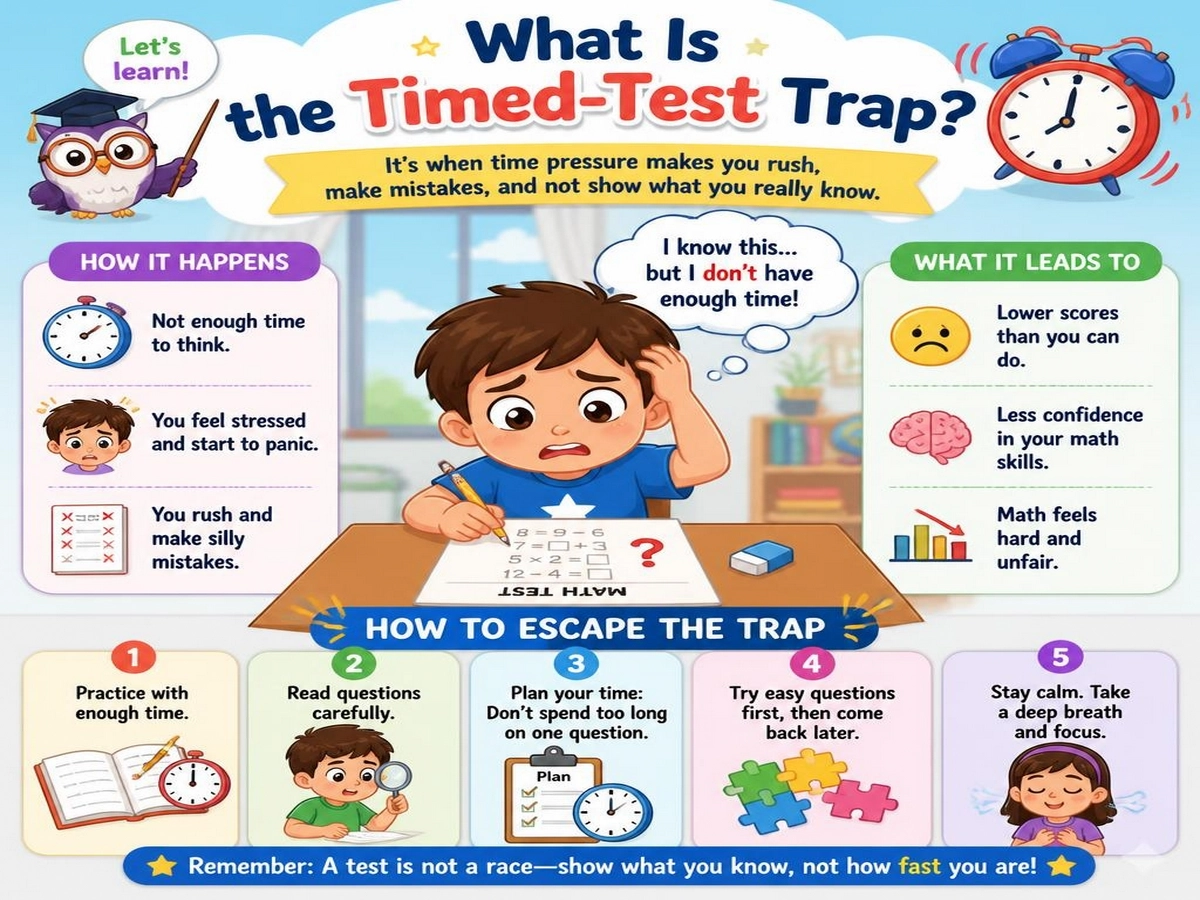
What Is the Timed-Test Trap?
The timed-test trap is using stopwatch drills before children have strategies, which can create anxiety, encourage guessing and make some children freeze, even on facts they know. Speed should come from understanding, not pressure.
Why timed tests can backfire:
- They measure speed, not understanding.
- Anxious children may perform worse than they’re capable of.
- Children may guess or skip rather than reason.
- They can make math feel like a race some kids always lose.
Better alternatives:
- Untimed fact games.
- “Beat your own score” with no comparisons.
- Quick oral fact checks in a relaxed setting.
- Self-tracking charts of facts “I just know.”
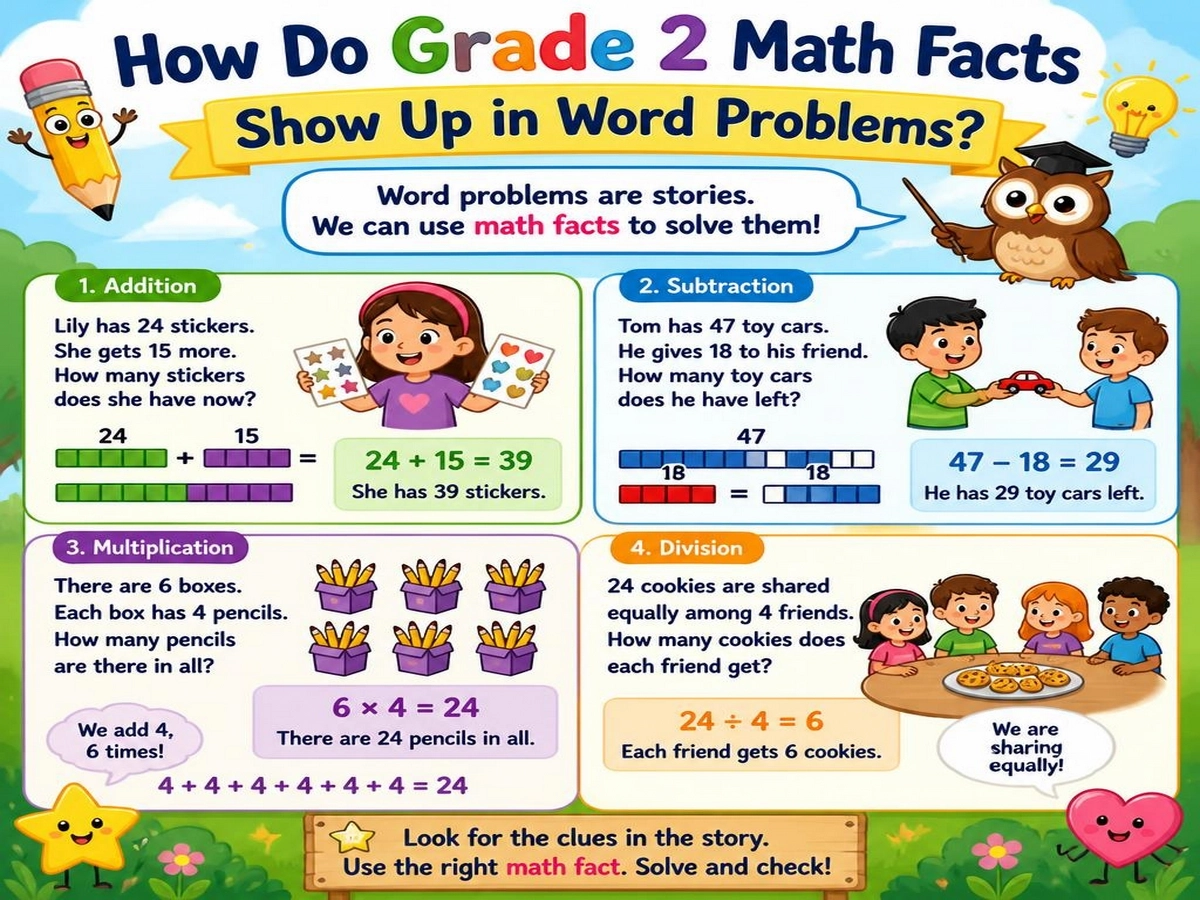
How Do Grade 2 Math Facts Show Up in Word Problems?
Grade 2 math facts show up in almost all word problem children meet this year. When facts are automatic, children can focus on understanding the story instead of counting. When facts are slow, the story often gets lost.
- Joining: “Maya has 8 stickers and gets 7 more.” (8 + 7)
- Separating: “There were 16 birds; 9 flew away.” (16 − 9)
- Comparing: “Liam read 13 pages; Zoe read 6. How many more did Liam read?” (13 − 6)
- Missing part: “We need 15 chairs and have 8. How many more?” (8 + ? = 15)
Encourage your child to say the fact they’re using: “This is 8 plus 7, which is double 7 plus 1.” Naming the fact links the story to the strategy. Our earlier post on Grade 2 word problems has many more examples.
What Should a Grade 2 Math Facts Tracker Look Like?
A simple tracker helps children see their progress with Grade 2 math facts and stay motivated. Use a grid with addends 0 to 10 across the top and down the side. Each time your child answers a fact quickly and confidently on three different days, they color that square.
Turnaround facts can be colored together (7 + 8 and 8 + 7), which shows children how much smaller the job really is. Watching the grid fill up over a few weeks is surprisingly motivating, and it helps you spot exactly which facts need more attention. Keep the focus on growth: “Look how many squares you colored this week!”.

Which Practice Methods Work Best for Facts?
Strategy-based games and short mixed practice work best for building Grade 2 math facts fluency. Flashcards and online practice help when used without pressure.
| Method | Strengths | Weaknesses | Recommendation |
|---|---|---|---|
| Strategy games | Builds reasoning and recall | Needs adult at first | Daily |
| Flashcards (untimed) | Quick recall practice | Can become rote | A few minutes, with strategy talk |
| Worksheets | Independent practice | Can be repetitive | 2 to 3 times a week |
| Online practice | Instant feedback, adaptive | Screen time | Short sessions |
| Timed tests | Measures speed | Can cause anxiety | Avoid or use rarely |
See our Grade 2 math games guide for dozens of fact games.
Are Math Facts Taught the Same Way Across Canada?
Math facts to 20 are taught across Canada in Grade 2, and strategy-based teaching is common in every province. Ontario explicitly expects recall of facts to 20 in Grade 2.
- Ontario: recall facts to 20 and related subtraction.
- British Columbia: the BC curriculum includes addition and subtraction facts to 20 with strategies.
- Other provinces: facts to 20 are typical Grade 2 goals.
What Should Parents Say During Fact Practice?
Use these prompts during Grade 2 math facts practice.
- “What strategy could help with 8 + 7?”
- “What double is close to this?”
- “How could you make 10 first?”
- “If 6 + 9 = 15, what’s 15 − 9?”
- “How do you know?”
What Do Teachers Wish Parents Knew About Math Facts?
Teachers often wish parents knew that strategies aren’t a detour from fact fluency; they’re the road to it. Children who understand facts remember them longer and recover them faster when they forget.
- Strategies first, speed later.
- Subtraction is harder. Teach it with addition.
- Short and daily. Ten minutes is enough.
- Stay calm. Anxiety blocks recall.
A Quick Story
A child always counts on fingers for 8 + 6. Her dad asks, “What’s 8 + 2?” “Ten.” “So how much more is left from the 6?” “Four… so 14!” Two weeks of making-10 games later, she answers 8 + 6 instantly. The strategy became the fact.
How Can Everyday Life Build Fact Fluency?
Everyday life offers quick Grade 2 math facts practice.
- Car rides: “What’s 7 + 8? What’s 15 − 8?”
- Board games: add two dice every turn.
- Cooking: “We need 12 eggs and have 5. How many more?”
- Sports: keep score.
- Shopping: “9 apples plus 6 oranges?”
How Can You Adapt Fact Practice for Different Learners?
Adapt Grade 2 math facts practice for your child’s needs.
Active Learners
Hopscotch facts, bean bag toss and fact relay races.
Visual Learners
Ten frames, double ten frames and fact family triangles.
Learners Who Need More Time
Master facts to 10 first, then doubles, then cross-10 facts.
Learners Ready for More
Extend to mental math with tens (40 + 30, 57 − 20) or three-addend facts like 6 + 4 + 7, where spotting a pair that makes 10 first is the clever move.
Try It: 8 Grade 2 Math Facts Practice Questions
Answers follow.
- 9 + 6 = ___
- 7 + 8 = ___
- 8 + 8 = ___
- 14 − 6 = ___
- 17 − 9 = ___
- 6 + 7 = ___
- If 5 + 9 = 14, what is 14 − 5?
- 12 − 4 = ___
Answers: 1) 15; 2) 15; 3) 16; 4) 8; 5) 8; 6) 13; 7) 9; 8) 8.
Myths vs. Facts About Grade 2 Math Facts
| Myth | Fact |
|---|---|
| Kids should memorize facts by drilling. | Strategies plus practice build lasting fluency. |
| Timed tests build speed. | They can increase anxiety; speed follows understanding. |
| Subtraction should be taught separately. | Fact families make subtraction easier. |
| Finger counting is always bad. | It’s an early stage; strategies help children move beyond it. |
What Are Common Grade 2 Math Facts Mistakes?
Common Grade 2 math facts mistakes include relying on counting all, memorizing without strategies, practicing only addition, using long drill sessions and skipping review.
- Counting all. Teach counting on and strategies.
- Rote memorization. Connect facts to strategies.
- Addition only. Include subtraction through fact families.
- Long sessions. Keep to ten minutes.
- No review. Mix old and new facts.
Common Mistake
Comparing your child’s fact speed to classmates or siblings. Fluency develops at different rates. Focus on your child’s own progress.
How Do You Know Your Child Has Mastered Grade 2 Math Facts?
Your child has mastered Grade 2 math facts when they answer addition and subtraction facts to 20 accurately within about three seconds, explain strategies for facts they don’t instantly recall and use facts confidently in two-digit problems.
Checklist
- Answers addition facts to 20 quickly and accurately
- Answers related subtraction facts
- Explains a strategy for facts like 7 + 8
- Uses fact families
- Uses facts in two-digit addition
Where Do Grade 2 Math Facts Lead?
Grade 2 math facts lead to two-digit addition and subtraction with regrouping, mental math to 50 and beyond, and multiplication facts in Grade 3.
- Grade 1 roots: Grade 1 math facts.
- Grade 2 connections: mental math and regrouping.
- Grade 3: times tables.
Future Trends
Adaptive fact apps can now target exactly the facts a child doesn’t know yet. Combined with strategy teaching and short sessions, they can be a valuable part of Canadian math practice at home.
Frequently Asked Questions About Grade 2 Math Facts
What math facts should a Grade 2 student know?
Addition facts to 20 and related subtraction facts, such as 8 + 7 = 15 and 15 − 7 = 8.
How fast should Grade 2 math facts be?
Aim for accurate answers within about three seconds by the end of Grade 2.
Are timed tests good for Grade 2?
Use them rarely, if at all. Untimed games and strategy practice build fluency with less anxiety.
How do I teach addition facts to 20?
Teach strategies like doubles, near doubles and making 10, then practice in short daily games.
How do I teach subtraction facts to 20?
Use fact families and “think addition”: 15 − 7 means “7 plus what makes 15?”
What is fact fluency in Grade 2?
Answering facts accurately, efficiently and flexibly, and knowing strategies for facts you don’t instantly recall.
How long does it take to learn facts to 20?
Most children develop fluency over several months with consistent daily practice.
Can games really build fact fluency?
Yes. Games provide many repetitions in a motivating way, especially when they include strategy talk.
What if my child still counts on fingers?
It’s a normal stage. Introduce strategies gradually; finger counting fades as strategies grow.
Conclusion: Fluency Through Understanding
Grade 2 math facts are a foundation for everything that follows. Teach strategies first, practice in short daily games, mix old and new facts and avoid stressful timed tests. With patience and consistency, facts to 20 will become automatic, and your child will have more brainpower for the exciting math ahead.
Explore the full year in our Canadian Grade 2 math guide, find more ideas in our Canadian math practice roadmap, and practice with our post on Grade 2 two-digit addition and subtraction.
Build fact fluency without stress. InukMath offers free Grade 2 fact games, lessons and printable worksheets. Join free and play our Grade 2 games.
Sources and Further Reading
- Ontario Ministry of Education, The Ontario Curriculum: Mathematics, Grades 1 to 8 (2020)
- Dunlosky et al. (2013), Improving students’ learning with effective learning techniques, Psychological Science in the Public Interest
- Rohrer et al. (2020), A randomized controlled trial of interleaved mathematics practice, Journal of Educational Psychology
- Ramirez et al. (2013), Math anxiety, working memory, and math achievement in early elementary school, Journal of Cognition and Development
- BC Ministry of Education, Mathematics K-9 curriculum