
Grade 2 Math Curriculum in Canada: What Kids Learn and How to Support It
The Grade 2 math curriculum sets out what seven-year-olds are expected to learn in their second year of formal math. In Ontario, it’s organized into six strands: social-emotional learning skills and mathematical processes, number, algebra, data, spatial sense and financial literacy. Other provinces organize content differently, but the core skills overlap a great deal.
Curriculum documents are written for teachers, not parents. This guide translates the Grade 2 math curriculum into plain language so you know what your child is learning, what to expect each term and how to help at home.
You’ll find a strand-by-strand breakdown, a comparison with other provinces, a term-by-term guide, how Grade 2 math is reported, what teachers wish parents knew and practical ways to support each strand.
Quick Answer
The Grade 2 math curriculum in Ontario covers six strands: social-emotional learning and math processes; number (numbers to 200, facts to 20, add and subtract to 100, equal groups, sharing, thirds and sixths); algebra (growing patterns, equality, concurrent coding); data (tally tables, bar graphs, line plots, mode, probability language); spatial sense (2D shape properties, symmetry, maps, centimeters and meters, time); and financial literacy (money to $200).
Key Takeaways
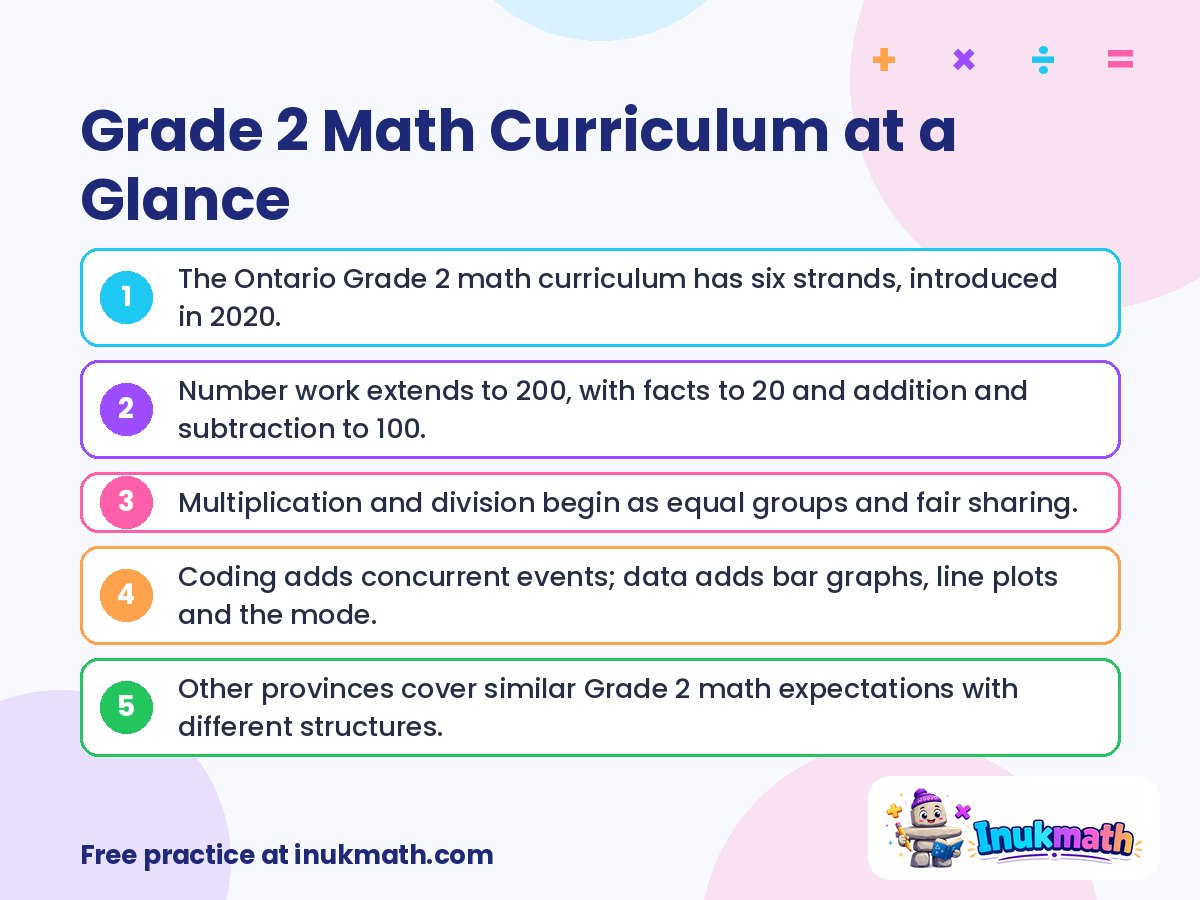
- The Ontario Grade 2 math curriculum has six strands, introduced in 2020.
- Number work extends to 200, with facts to 20 and addition and subtraction to 100.
- Multiplication and division begin as equal groups and fair sharing.
- Coding adds concurrent events; data adds bar graphs, line plots and the mode.
- Other provinces cover similar Grade 2 math expectations with different structures.
Table of Contents
- What Is the Grade 2 Math Curriculum?
- What Are the 6 Strands of the Ontario Grade 2 Math Curriculum?
- How Is Grade 2 Different From Grade 1 in the Curriculum?
- How Does the Grade 2 Math Curriculum Compare Across Provinces?
- What Does a Grade 2 Child Learn Each Term?
- What Grade 2 Math Expectations Surprise Parents Most?
- How Is Grade 2 Math Reported in Ontario?
- How Does the Curriculum Support Math Confidence?
- What Do the Mathematical Processes Look Like in Grade 2?
- What Should Parents Ask the Teacher?
- What Do Teachers Wish Parents Knew About the Curriculum?
- How Can You Support the Grade 2 Math Curriculum at Home?
- What Does a 4-Week Strand Rotation Look Like?
- Try It: 8 Questions Based on Grade 2 Math Expectations
- What Are Common Misunderstandings About the Curriculum?
- How Do You Know Your Child Is Meeting Expectations?
- What Comes After the Grade 2 Math Curriculum?
- Frequently Asked Questions About the Grade 2 Math Curriculum
- Conclusion: Know the Map, Support the Journey
What Is the Grade 2 Math Curriculum?
The Grade 2 math curriculum is the official set of expectations a province publishes for Grade 2 mathematics. It describes what students should know and be able to do by the end of the year, guiding lessons, assessments and report cards.
In Ontario, it’s part of The Ontario Curriculum, Grades 1–8: Mathematics (2020). Each strand has overall expectations (big goals) and specific expectations (detailed skills).
Provincial Curriculum Grade 2: Why It Varies
Education is a provincial responsibility in Canada, so each province writes its own provincial curriculum for Grade 2. The core ideas overlap, but structure, vocabulary and sequence differ.
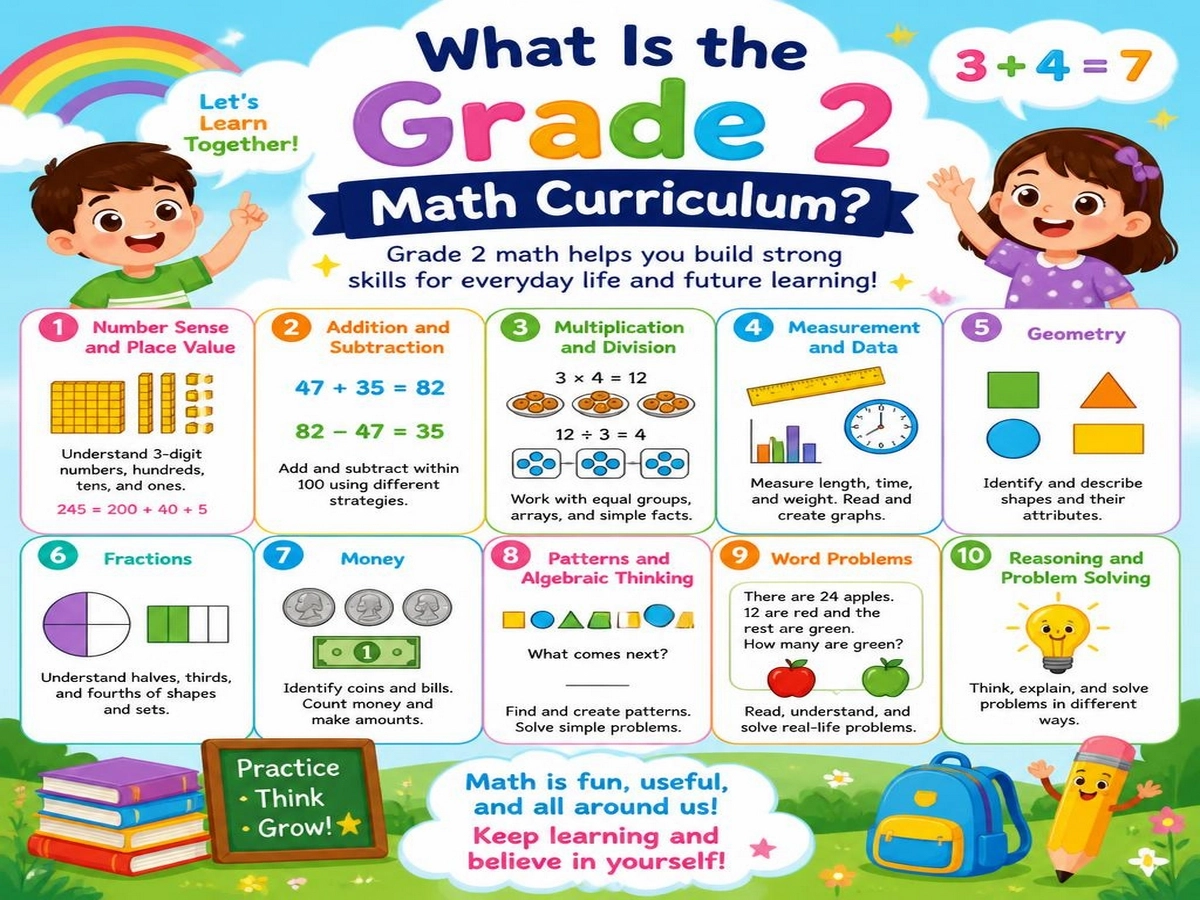
What Are the 6 Strands of the Ontario Grade 2 Math Curriculum?
The six strands of the Ontario Grade 2 math curriculum are: A. Social-Emotional Learning Skills in Mathematics and the Mathematical Processes; B. Number; C. Algebra; D. Data; E. Spatial Sense; and F. Financial Literacy. Strand A is woven through all the others.
Strand A: Social-Emotional Learning and Math Processes
Children build skills like persistence, coping with challenges and seeing themselves as math learners. They also use the mathematical processes: problem solving, reasoning, communicating, connecting, representing, selecting tools and reflecting.
Strand B: Number
The Number strand is the heart of Grade 2 math expectations:
- Read, represent, compose, decompose, compare and order whole numbers to 200.
- Count to 200, including by 20s, 25s and 50s.
- Describe what makes a number even or odd.
- Use drawings to solve fair-share problems with up to 10 items among 2, 3, 4 and 6 sharers; recognize one third equals two sixths.
- Recall addition facts to 20 and related subtraction facts.
- Use mental math, including estimation, to add and subtract to 50.
- Add and subtract numbers that add up to no more than 100.
- Represent multiplication as repeated equal groups and division of up to 12 items as equal sharing.
Related guides: place value, math facts, regrouping, fractions, division.
Strand C: Algebra
- Identify and describe repeating, growing and shrinking patterns; determine pattern rules.
- Describe patterns among numbers to 100.
- Explore equality and use symbols for unknown values.
- Write, read and alter code with sequential and concurrent events.
Related guides: patterning, equations, coding.
Strand D: Data
- Sort data by two attributes using tables and Venn diagrams.
- Collect data and organize it in tally tables.
- Display data in concrete graphs, pictographs, line plots and bar graphs using one-to-one correspondence.
- Identify the mode.
- Use impossible, possible and certain to describe likelihood of complementary events.
Related guides: bar graphs, tally charts, probability.
Strand E: Spatial Sense
- Sort and identify 2D shapes by sides, side lengths, angles and lines of symmetry.
- Create and interpret simple maps; describe positions and movements.
- Explain the relationship between centimeters and meters; measure and draw lengths, starting from zero.
- Use units of time to describe how long events take.
Related guides: symmetry, location and movement, measuring length.
Strand F: Financial Literacy
- Identify different ways of representing the same amount of money up to 200¢ with coins and up to $200 with coins and bills.
Related guide: Grade 2 financial literacy.
How Is Grade 2 Different from Grade 1 in the Curriculum?
The Grade 2 math curriculum builds directly on Grade 1, but the jump is significant. Numbers grow from 50 to 200, facts grow from 10 to 20 and children begin formal two-digit addition and subtraction.
| Area | Grade 1 | Grade 2 |
|---|---|---|
| Numbers | To 50 | To 200 |
| Facts | To 10 | To 20 |
| Operations | Mental math to 20 | Add and subtract to 100; mental math to 50 |
| Fractions | Halves and fourths | Thirds and sixths added |
| Coding | Sequential events | Sequential and concurrent events |
| Data | Concrete graphs, pictographs | Bar graphs, line plots, mode |
| Money | Coins to 50¢, bills to $50 | Amounts to 200¢ and $200 |
Knowing these differences helps parents understand why Grade 2 can feel like a big step, and why solid Grade 1 foundations matter. See our Grade 1 math curriculum guide for comparison.

How Does the Grade 2 Math Curriculum Compare Across Provinces?
The Grade 2 math curriculum across Canada shares core skills: place value, addition and subtraction strategies, patterns, shapes, measurement and data. Provinces differ in number ranges, organization and newer topics.
| Province | Structure | Grade 2 highlights |
|---|---|---|
| Ontario | Six strands (2020) | Numbers to 200, facts to 20, concurrent coding, money to $200 |
| British Columbia | Big ideas, competencies, content | Numbers to 100, addition and subtraction strategies, patterns |
| Alberta | New K-6 curriculum (rollout began 2022) | Strong foundational number focus |
| Quebec | Two-year cycles | Grades 1 and 2 form one cycle |
| Atlantic provinces | Outcomes-based | Similar number, pattern and shape outcomes |
Sources: BC mathematics curriculum and Alberta’s new K-6 curriculum.

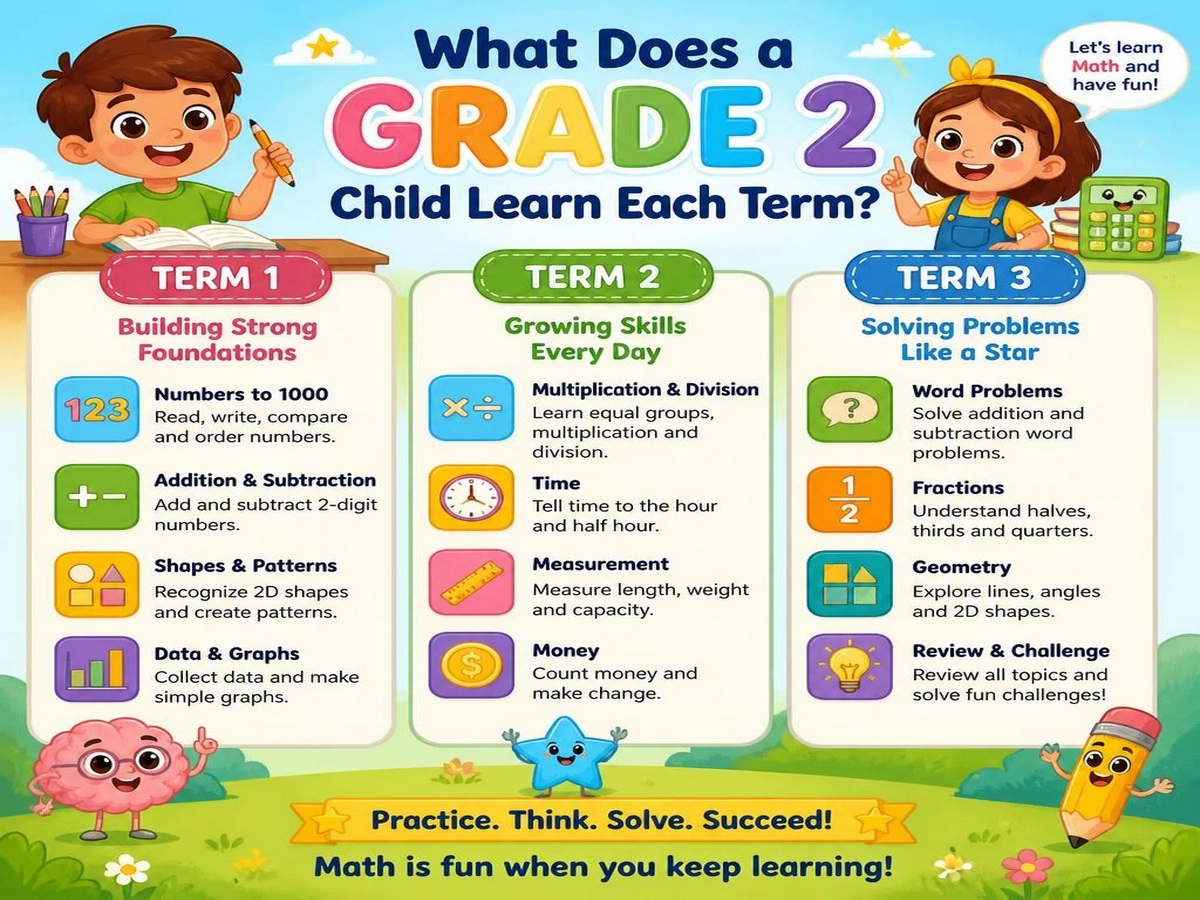
What Does a Grade 2 Child Learn Each Term?
Many Canadian classrooms follow a similar Grade 2 flow: number and facts in fall, operations and patterns in winter, fractions, data and geometry in spring, measurement, money and review in June. Teachers vary, so ask about your child’s class.
| Term | Typical focus | Home support |
|---|---|---|
| Fall | Counting to 200, place value, facts to 20, even and odd | Place value games, fact games |
| Winter | Two-digit addition and subtraction, regrouping, patterns, coding | Number lines, regrouping with coins |
| Spring | Fractions, division, data, symmetry, 3D and 2D shapes | Fair sharing, surveys, shape hunts |
| Late spring | Measurement, money, review | Measuring at home, store play |
What Grade 2 Math Expectations Surprise Parents Most?
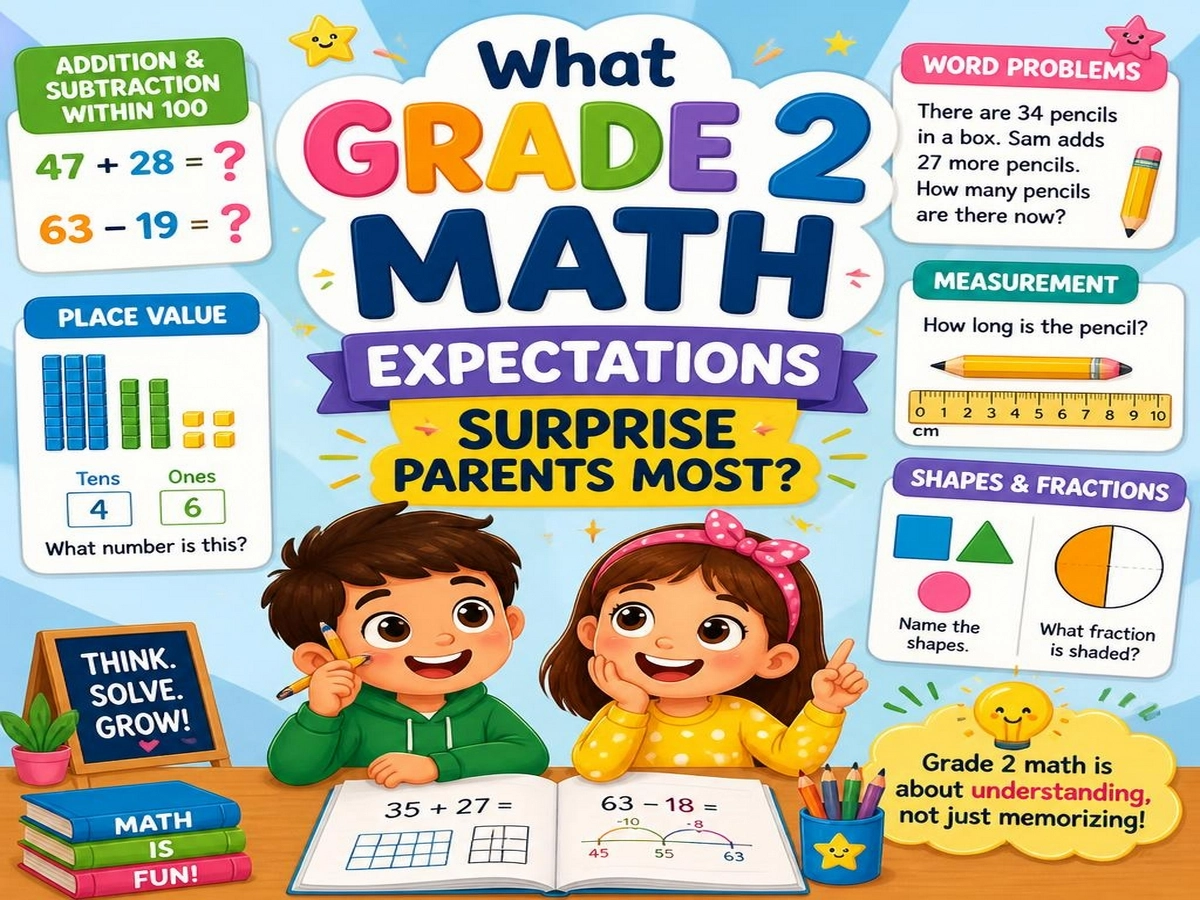
Several Grade 2 math expectations surprise parents because they weren’t part of math when they were in school, or because they appear earlier than expected.
- Coding with concurrent events. Many parents didn’t code at all in elementary school.
- Fractions with thirds and sixths. Fair sharing among 3 and 6 starts in Grade 2.
- The equal sign as “the same as.” Equations like 8 + 5 = 10 + 3 are common.
- Line plots and the mode. Simple statistics begin early.
- Social-emotional learning. Confidence and persistence are written into the curriculum.
Knowing about these parts of the Grade 2 math curriculum ahead of time helps you respond with curiosity instead of surprise when they show up in homework.
How Is Grade 2 Math Reported in Ontario?
In Ontario, Grade 2 math is reported through a fall progress report and two report cards, usually in February and June. Report cards use four achievement levels, with Level 3 as the provincial standard.
- Level 1: limited achievement
- Level 2: some achievement, approaching the standard
- Level 3: considerable achievement; the provincial standard
- Level 4: thorough achievement, beyond the standard
Our post on Ontario report card math levels explains more.

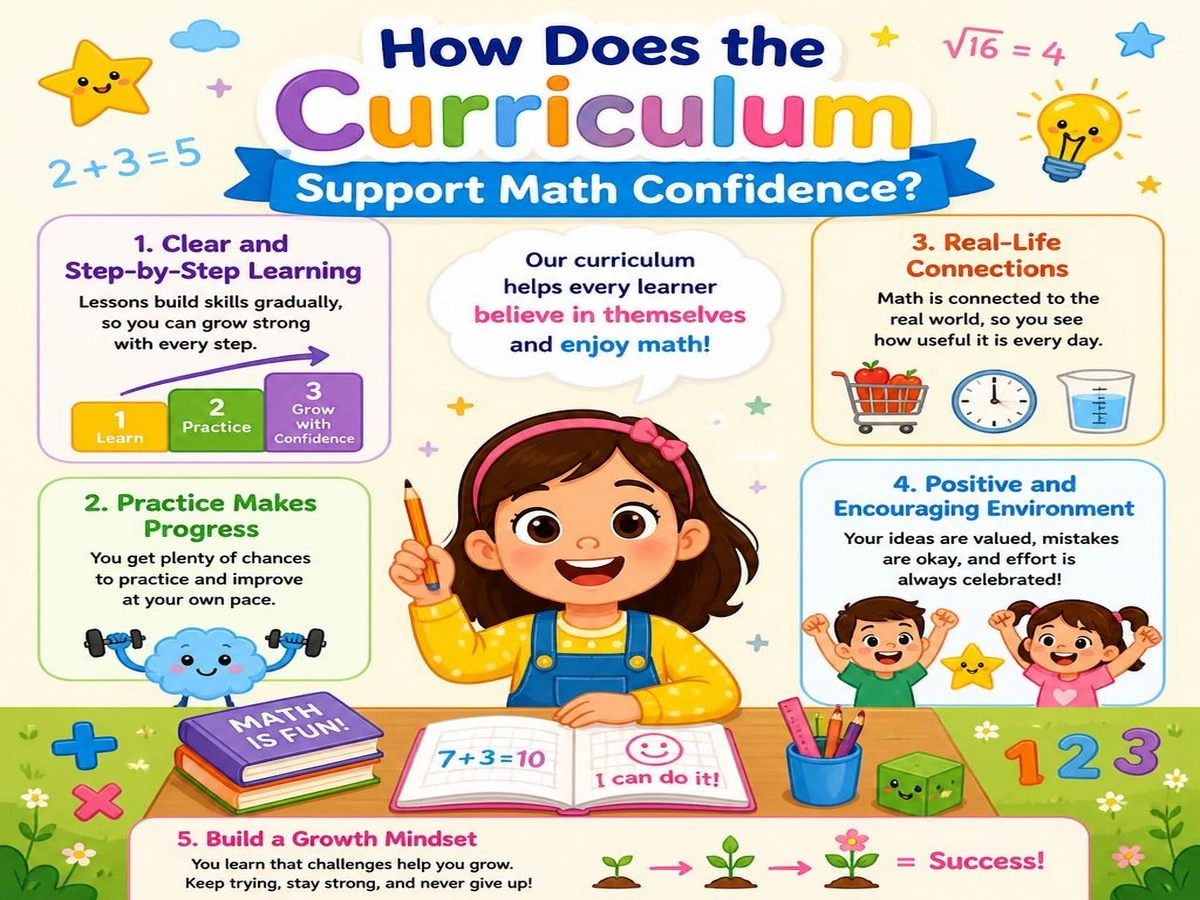
How Does the Curriculum Support Math Confidence?
The Ontario Grade 2 math curriculum treats confidence and persistence as skills, not just personality traits. Strand A asks teachers to help children manage stress, stay motivated and build a positive math identity.
At home, support this by:
- Praising effort and strategies.
- Normalizing mistakes.
- Avoiding negative math talk.
- Celebrating persistence.
Research by Ramirez and colleagues (2013) found math anxiety can appear in first and second graders, so these habits matter.
What Do the Mathematical Processes Look Like in Grade 2?
The mathematical processes are the ways children do math across every strand. In Grade 2, they look like this:
- Problem solving: figuring out how to share 10 crackers among 4 friends.
- Reasoning: explaining why 52 − 17 needs regrouping.
- Reflecting: checking an answer with estimation.
- Connecting: linking skip counting by 25s to quarters.
- Communicating: explaining a strategy to a classmate.
- Representing: showing 146 with blocks, a drawing and expanded form.
- Selecting tools: choosing a number line or base ten blocks.
What Should Parents Ask the Teacher?
Good questions help you understand how the Grade 2 math curriculum looks in your child’s classroom, and how the Grade 2 math curriculum is being paced this year.
- “Which strand are you working on now?”
- “What strategies are you teaching for two-digit addition?”
- “Which tools does my child use in class?”
- “Where is my child strong, and where could they use more practice?”
- “How can I support math at home?”
What Do Teachers Wish Parents Knew About the Curriculum?
Teachers often wish parents knew that the Grade 2 math curriculum values understanding and explanation alongside correct answers. Strategies like number lines and regrouping with blocks are intentional.
- Understanding first.
- Explaining matters.
- New strands are real math.
- Confidence is part of the curriculum.
A Quick Story
A parent sees homework asking for “two ways to solve 38 + 25.” She wonders why one way isn’t enough. After reading about the curriculum, she realizes flexibility is the goal: her daughter’s number line jumps and blocks both show real understanding. She starts asking, “Can you show me another way?”
How Can You Support the Grade 2 Math Curriculum at Home?
Support the Grade 2 math curriculum at home with short daily practice across all strands, games, everyday math talk and a few worksheets each week. Fifteen minutes a day is plenty.
- Number: place value with coins, fact games.
- Algebra: growing patterns with blocks, robot coding games.
- Data: family surveys and bar graphs.
- Spatial sense: measuring, maps, symmetry art.
- Financial literacy: coin combinations and store play.
InukMath organizes Grade 2 lessons, worksheets and games by strand.
What Does a 4-Week Strand Rotation Look Like?
A 4-week rotation covers every strand of the Grade 2 math curriculum, with number practice woven throughout.
| Week | Strand focus | Daily number warm-up |
|---|---|---|
| 1 | Algebra (patterns, equations, coding) | Counting to 200 |
| 2 | Data (surveys, bar graphs, mode) | Facts to 20 |
| 3 | Spatial sense (symmetry, measuring, maps) | Skip counting by 25s |
| 4 | Financial literacy (money to $200) | Mental math to 50 |
Try It: 8 Questions Based on Grade 2 Math Expectations
Answers follow.
- Write 172 in expanded form.
- 9 + 8 = ___
- 46 + 37 = ___
- Share 12 cookies among 4 friends. How many each?
- Find the rule: 5, 10, 15, 20.
- What is the mode: red 4, blue 7, green 3?
- How many centimeters are in a meter?
- Show $1 with quarters.
Answers: 1) 100 + 70 + 2; 2) 17; 3) 83; 4) 3; 5) start at 5, add 5; 6) blue; 7) 100; 8) 4 quarters.
Myths vs. Facts About the Grade 2 Math Curriculum
| Myth | Fact |
|---|---|
| Grade 2 math is just addition and subtraction. | It spans six strands, including coding and financial literacy. |
| Strategies replace basic facts. | Strategies lead to fact fluency. |
| Every province teaches the same thing. | Core skills overlap, but structures differ. |
| Level 3 means average. | Level 3 is the provincial standard. |
What Are Common Misunderstandings About the Curriculum?
Common misunderstandings include thinking Grade 2 is only arithmetic, rushing ahead to multiplication facts, misreading achievement levels and dismissing coding and financial literacy.
- Arithmetic only. Six strands matter.
- Rushing times tables. Equal groups come first.
- Level confusion. Level 3 is the standard.
- Dismissing new strands. Coding and money are real math.
- Ignoring confidence. It’s part of the curriculum.
Common Mistake
Drilling Grade 3 times tables in Grade 2 to “get ahead.” The Grade 2 curriculum builds the meaning of multiplication through equal groups first. Facts come in Grade 3.
How Do You Know Your Child Is Meeting Expectations?
Your child is likely meeting Grade 2 math expectations when they can work with numbers to 200, recall facts to 20, add and subtract to 100, share fairly into thirds and sixths, describe patterns, make bar graphs and show money amounts in different ways.
Checklist
- Reads and compares numbers to 200
- Recalls facts to 20
- Adds and subtracts two-digit numbers
- Describes growing and shrinking patterns
- Makes a bar graph and finds the mode
- Shows money amounts in different ways
What Comes After the Grade 2 Math Curriculum?
The Grade 3 curriculum extends numbers to 1,000, adds multiplication and division facts for 2, 5 and 10, explores equivalent fractions, area and perimeter, coding with loops and making change. Ontario students also write the EQAO assessment in Grade 3.
- Grade 3: Grade 3 math curriculum and Canadian Grade 3 math.
- Overview: our post on the Ontario math curriculum by grade.
Future Trends
Canadian curricula continue to emphasize foundational skills, coding, financial literacy and math identity. Expect continued updates and more family resources.
Frequently Asked Questions About the Grade 2 Math Curriculum
What is in the Grade 2 math curriculum in Ontario?
Six strands: social-emotional learning and processes, number, algebra, data, spatial sense and financial literacy.
What are the main Grade 2 math expectations?
Numbers to 200, facts to 20, addition and subtraction to 100, equal groups, fair sharing, patterns, coding, data, geometry, measurement and money.
Is the Ontario Grade 2 math curriculum the same as other provinces?
No, but core skills overlap. Each province writes its own curriculum.
What does Level 3 mean?
Level 3 is the provincial standard, showing considerable achievement.
Do Grade 2 students learn multiplication?
They represent multiplication as equal groups. Times tables come in Grade 3.
What coding do Grade 2 students do?
Code with sequential and concurrent events.
What is what grade 2 learns in math, in short?
Bigger numbers, faster facts, two-digit operations, equal groups, fractions, patterns, coding, data, geometry, measurement and money.
How can I support the curriculum at home?
Short daily practice across strands, games, math talk and some worksheets.
Where can I read the official curriculum?
The Ontario Ministry of Education publishes it online; other provinces publish theirs too.
Conclusion: Know the Map, Support the Journey
The Grade 2 math curriculum is your roadmap for a big year of growth. In Ontario, six strands cover number, algebra, data, spatial sense, financial literacy and social-emotional skills. Understanding what’s expected helps you support the right skills at the right time.
Explore the whole year in our Canadian Grade 2 math guide, and see how the curriculum connects across grades in our Canadian math practice roadmap.
Practice every strand, the easy way. InukMath organizes free Grade 2 lessons, worksheets and games by curriculum strand. Join free today and explore our Grade 2 hub.
Sources and Further Reading
- Ontario Ministry of Education, The Ontario Curriculum: Mathematics, Grades 1 to 8 (2020)
- BC Ministry of Education, Mathematics K-9 curriculum
- Government of Alberta, New K-6 curriculum: how we got here
- Ramirez et al. (2013), Math anxiety, working memory, and math achievement in early elementary school, Journal of Cognition and Development