
Grade 2 Measuring Length: Centimeters, Meters and Smart Benchmarks
Grade 2 measuring length is the year children move from comparing lengths and using non-standard units like paper clips to measuring with real units: centimeters and meters. In the Ontario curriculum, Grade 2 students explain the relationship between centimeters and meters, use benchmarks to estimate lengths, and measure and draw lengths in centimeters and meters using a measuring tool, recognizing the impact of starting at points other than zero.
That last part matters. One of the most common Grade 2 measurement mistakes is starting a ruler at 1 instead of 0. Learning why it matters builds real understanding of what a ruler actually measures.
This guide explains Grade 2 measuring length, centimeters versus meters, how to use a ruler correctly, body benchmarks, eight easy activities, the start-at-one mistake and how measurement grows into Grade 3.
Quick Answer
Grade 2 measuring length means measuring and drawing lengths in centimeters and meters with a ruler or meter stick, starting at zero, using measurement benchmarks (like a fingernail for 1 cm and a big step for 1 m) for estimating length, and knowing that 100 centimeters make 1 meter. Kids learn best by estimating first, then measuring real objects.
Key Takeaways
- Grade 2 measuring length uses centimeters for small objects and meters for longer distances.
- 100 centimeters equal 1 meter.
- Rulers must start at zero, not at the end of the ruler or at 1.
- Body benchmarks help children estimate before measuring.
- Estimating first, then measuring, builds strong measurement sense.
Table of Contents
- What Is Grade 2 Measuring Length?
- Why Does Grade 2 Measuring Length Matter?
- How Do You Use a Ruler Correctly?
- What Is the Start-at-One Mistake?
- What Are Good Measurement Benchmarks?
- 8 Easy Grade 2 Measuring Length Ruler Activities That Work
- How Does Grade 2 Measuring Length Connect to Place Value?
- What Is a Fun Family Measuring Challenge?
- How Do Centimeters and Meters Compare?
- Is Measurement Taught the Same Way Across Canada?
- What Should Parents Say During Measuring?
- What Do Teachers Wish Parents Knew About Measuring Length?
- How Can Everyday Life Build Measurement Skills?
- How Can You Adapt Measuring for Different Learners?
- What Does a 4-Week Measuring Length Plan Look Like?
- Try It: 8 Grade 2 Measuring Length Practice Questions
- What Are Common Grade 2 Measuring Length Mistakes?
- How Do You Know Your Child Understands Measuring Length?
- Where Does Grade 2 Measuring Length Lead?
- Frequently Asked Questions About Grade 2 Measuring Length
- Conclusion: Start at Zero, Measure the World
What Is Grade 2 Measuring Length?
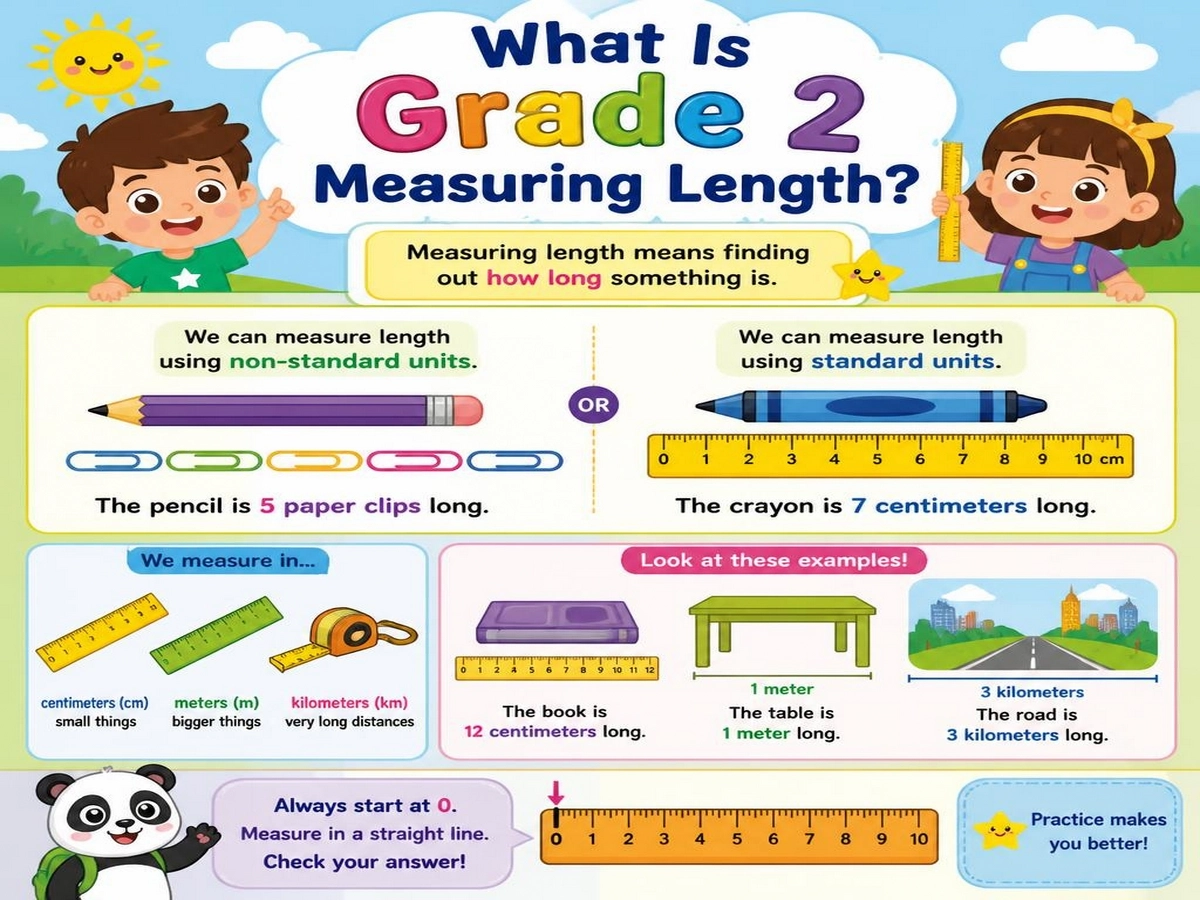
Grade 2 measuring length is finding how long, wide, tall or far something is using standard units, mainly centimeters and meters. Children use rulers, meter sticks and measuring tapes, and they learn to estimate before measuring.
The Ontario mathematics curriculum Spatial Sense strand asks Grade 2 students to explain the relationship between centimeters and meters as units of length, use benchmarks to estimate lengths, and measure and draw lengths in centimeters and meters using a measuring tool, recognizing the impact of starting at points other than zero.
Centimeters and Meters
| Unit | Symbol | About the size of | Use for |
|---|---|---|---|
| Centimeter | cm | Width of a fingernail | Pencils, books, toys |
| Meter | m | A big step, a door width | Rooms, hallways, playgrounds |
100 centimeters = 1 meter. Canada uses the metric system, so these are the units children see on rulers, signs and packaging.
Standard vs. Non-Standard Units
Non-standard units, like paper clips or hand spans, vary in size. Standard units, like centimeters, are the same everywhere. Grade 2 explains why standard units matter: everyone gets the same answer.
Why Does Grade 2 Measuring Length Matter?
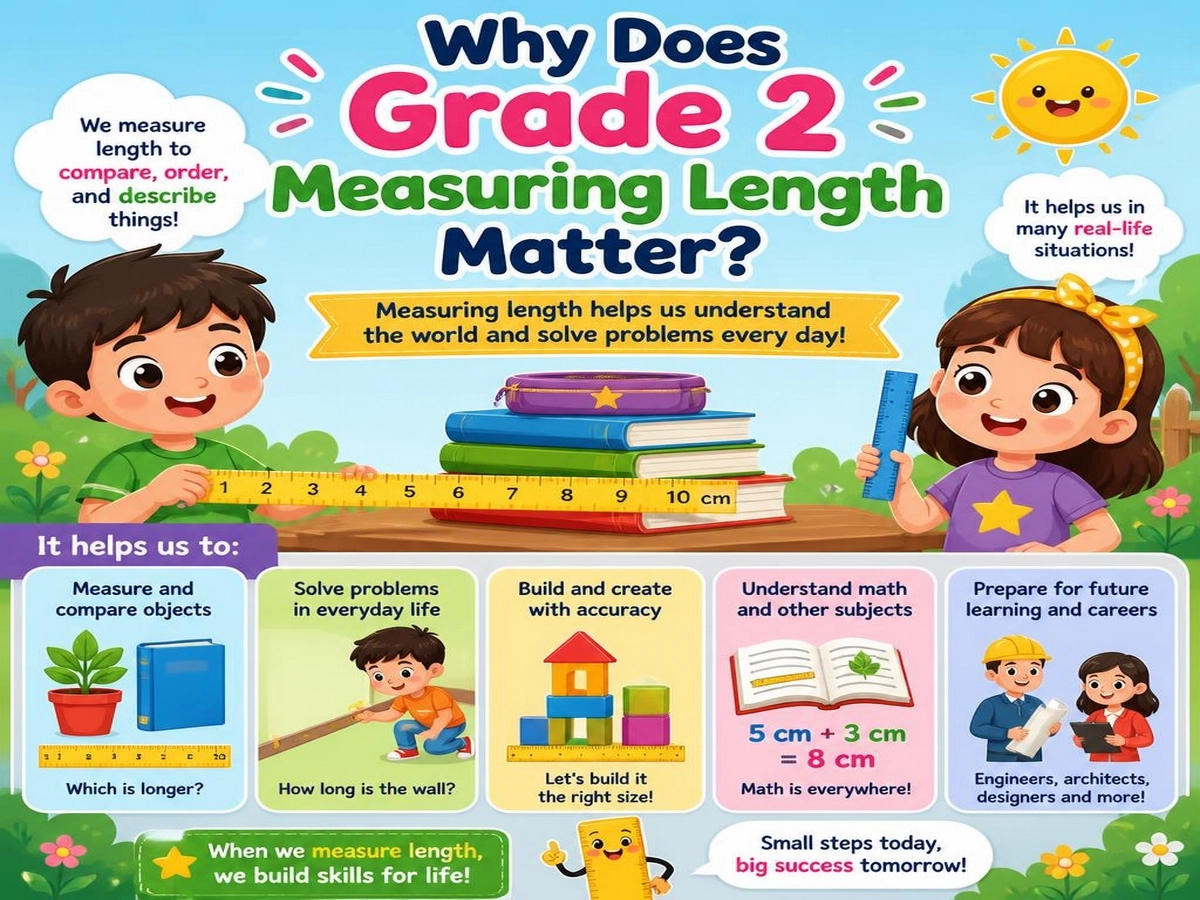
Grade 2 measuring length matters because measurement connects numbers to the real world, builds estimation skills, supports place value (100 cm in a meter) and prepares children for perimeter and area in Grade 3.
- Real-world math. Measuring furniture, plants and distances.
- Estimation. Benchmarks build a feel for size.
- Number sense. 100 cm = 1 m connects to hundreds.
- Precision. Reading rulers carefully.
- Future skills. Perimeter, area and scale drawings.
The Institute of Education Sciences recommends teaching measurement through a developmental progression, from comparing to non-standard units to standard units. Grade 2 is where standard units take center stage.
How Do You Use a Ruler Correctly?
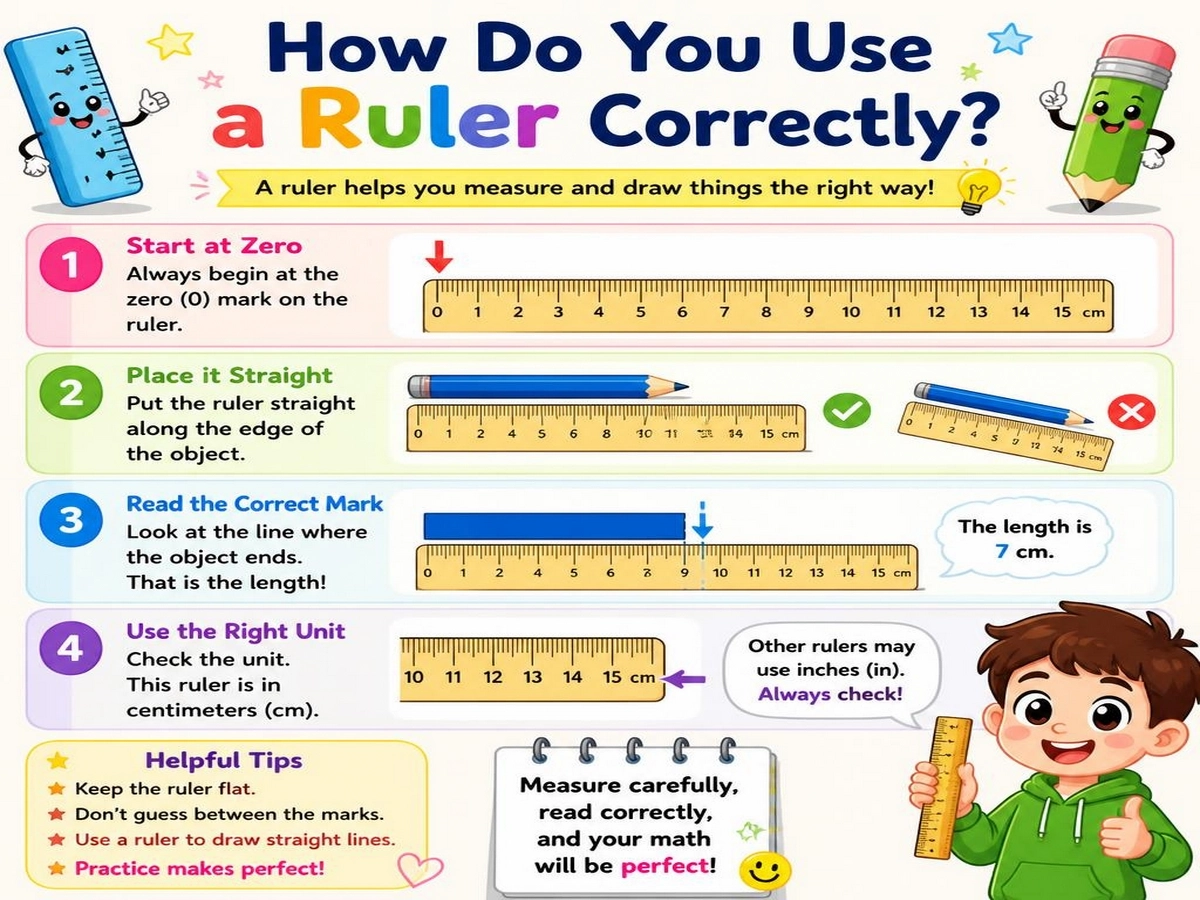
To use a ruler correctly, line up one end of the object with the zero mark, keep the ruler straight along the object, read the number where the object ends and include the unit in the answer.
- Find zero. On many rulers, zero isn’t at the very edge.
- Line up. Place the object’s end exactly at zero.
- Keep it straight. The ruler should run along the object.
- Read the end. Look at the mark where the object stops.
- Say the unit. “12 centimeters,” not just “12.”
Expert Tip
Have your child draw a big arrow pointing to the zero mark on their ruler. Many rulers have a small gap before zero, which confuses children.
Inuk Math’s Grade 2 lessons on length and standard vs. non-standard units model correct ruler use.
What Is the Start-at-One Mistake?
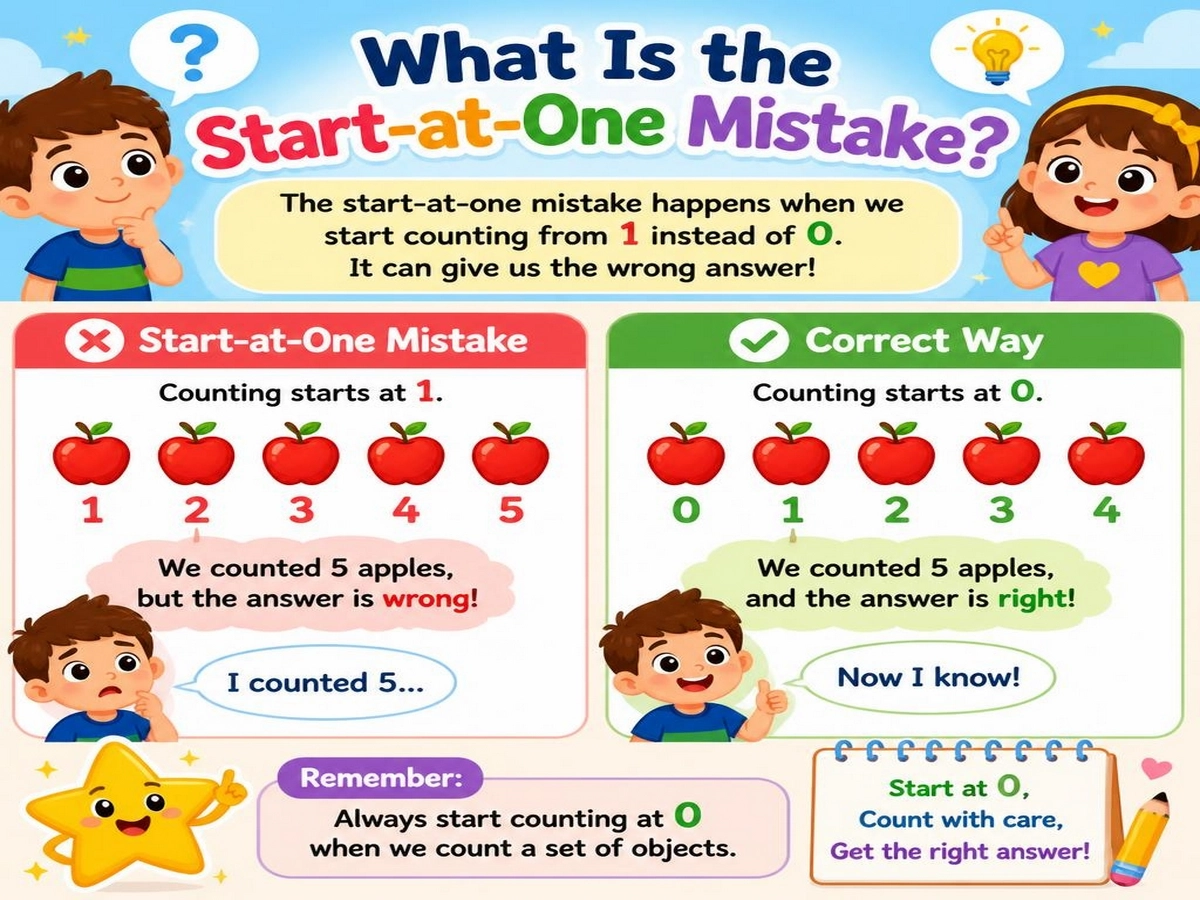
The start-at-one mistake happens when children line up an object with the 1 mark instead of 0. The result is one centimeter too long. Some children also start at the edge of the ruler, which may not be zero.
| Starting point | Object ends at | Child’s answer | Actual length |
|---|---|---|---|
| 0 | 8 | 8 cm | 8 cm |
| 1 | 9 | 9 cm | 8 cm |
| 3 | 11 | 11 cm | 8 cm |
Turning the Mistake Into Learning
Ask children to measure an object starting at 3, then subtract: 11 − 3 = 8. This shows that length is the distance between marks, not just the final number. It’s exactly what the Ontario expectation means by “recognizing the impact of starting at points other than zero.” Our Grade 2 number line guide helps here, because a ruler is really a number line.
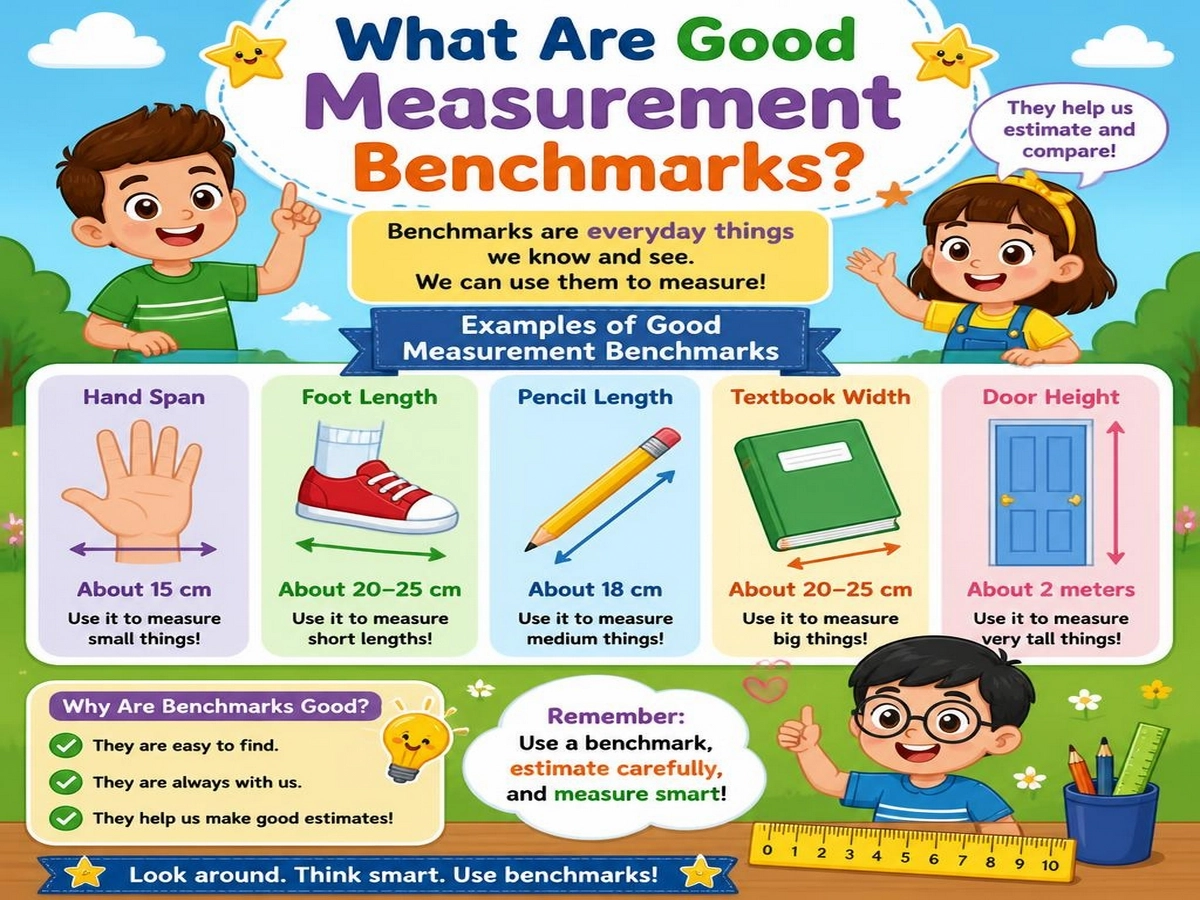
What Are Good Measurement Benchmarks?
Measurement benchmarks are familiar objects or body parts that are about one unit long. They help children estimate lengths before measuring.
| Benchmark | About |
|---|---|
| Width of a fingernail | 1 cm |
| Width of a hand (palm) | 8 to 10 cm |
| Length of a new crayon | 9 to 10 cm |
| A big step | 1 m |
| Height of a door handle from the floor | about 1 m |
| Arm span (Grade 2 child) | a bit more than 1 m |
Children should find their own benchmarks by measuring their fingers, hands and steps, and they should re-measure every few months as they grow. Personal benchmarks make estimating length much easier.
8 Easy Grade 2 Measuring Length Ruler Activities That Work
These eight activities build accurate measuring and estimating.
1. Estimate, Then Measure
Pick 5 small objects. Estimate each length in centimeters, then measure. How close were you?
2. Body Benchmarks
Measure your fingernail, hand span and step. Record them as personal benchmarks.
3. Meter Hunt
Cut a string 1 meter long. Find things longer than, shorter than and about 1 meter.
4. Broken Ruler Challenge
Measure objects starting at 4 or 5 instead of 0. Subtract to find the real length.
5. Draw a Line
“Draw a line 7 cm long.” Then 12 cm. Check with a partner.
6. Room Measuring
Use a meter stick or tape to measure a room’s length in meters.
7. Toy Lineup
Measure toy cars and order them from shortest to longest.
8. Growth Chart
Measure family heights in centimeters and record them on a door frame.
How Does Grade 2 Measuring Length Connect to Place Value?
Grade 2 measuring length connects to place value because 100 centimeters make 1 meter, just as 100 ones make 1 hundred. A meter stick is like a giant number line from 0 to 100.
- 1 m = 100 cm, like 1 hundred = 100 ones.
- 10 cm is like a ten; ten of them make a meter.
- A length of 135 cm is 1 meter and 35 centimeters, like 1 hundred, 3 tens and 5 ones.
Pointing out this connection helps children see measurement and number as one system. It also makes converting between meters and centimeters feel logical rather than like a rule to memorize. See Grade 2 place value for more.

What Is a Fun Family Measuring Challenge?
A family measuring challenge turns Grade 2 measuring length into a game everyone can play. Each person estimates, then measures, and the closest estimate wins a point.
| Item | Your estimate | Actual length | Difference |
|---|---|---|---|
| Spoon | |||
| Your shoe | |||
| Kitchen table | |||
| Longest jump | |||
| Hallway |
Over a few weeks, track whose estimates improve the most. Children love beating their grown-ups, and every round sharpens their benchmarks.

How Do Centimeters and Meters Compare?
Centimeters are small units for short lengths; meters are bigger units for longer lengths. There are 100 centimeters in 1 meter, which connects measurement to place value.
| Length | In centimeters | In meters |
|---|---|---|
| A pencil | about 18 cm | less than 1 m |
| A desk | about 120 cm | a bit more than 1 m |
| A door height | about 200 cm | about 2 m |
| A classroom | about 800 cm | about 8 m |
Choosing the Right Unit
Ask: “Would you measure a hallway in centimeters or meters?” Meters, because centimeters would give a huge number. Choosing sensible units is an important Grade 2 measuring length skill.
Is Measurement Taught the Same Way Across Canada?
Measurement in centimeters and meters is taught across Canada because Canada uses the metric system. Most provinces introduce standard metric units of length in Grade 2 or 3.
- Ontario: centimeters and meters, benchmarks and starting at zero in Grade 2.
- British Columbia: the BC curriculum introduces direct and standard metric measurement in the primary years.
- Other provinces: metric length units are typical in Grade 2 or 3.
What Should Parents Say During Measuring?
Use these prompts for Grade 2 measuring length.
- “Where’s the zero on your ruler?”
- “About how long do you think it is?”
- “Would you use centimeters or meters?”
- “How close was your estimate?”
- “What if we start at 3? How long is it then?”
What Do Teachers Wish Parents Knew About Measuring Length?
Teachers often wish parents knew that Grade 2 measuring length is about understanding units, not just reading numbers. Estimating first and starting at zero are the two biggest habits to build.
- Estimate before measuring.
- Start at zero.
- Always say the unit.
- Choose sensible units.
A Quick Story
A child measures a crayon and says it’s 10 cm. Her dad notices she started at 1. He asks her to measure again starting at 0. “Oh, it’s 9 cm.” He then asks her to try starting at 5. “It ends at 14… 14 minus 5 is 9! It’s still 9!” She’s discovered that length is the distance between marks.
How Can Everyday Life Build Measurement Skills?
Everyday life offers constant Grade 2 measuring length practice.
- Cooking: measure a carrot before chopping.
- Gardening: measure plant growth weekly.
- Crafts: cut ribbon or paper to exact lengths.
- Furniture: measure whether a toy box fits in a corner.
- Sports: measure how far you can jump.
How Can You Adapt Measuring for Different Learners?
Adapt Grade 2 measuring length practice to each child.
Hands-On Learners
Measure real objects around the house.
Visual Learners
Use colored rulers and draw lines of given lengths, then compare them side by side.
Learners Who Need More Time
Start with whole centimeters and short objects under 15 cm, like crayons and erasers.
Learners Ready for More
Measure in meters and centimeters (1 m 25 cm), or compare heights of family members.
What Does a 4-Week Measuring Length Plan Look Like?
A 4-week Grade 2 measuring length plan builds from benchmarks to rulers to meters to estimation.
| Week | Focus | Activities | Goal by Friday |
|---|---|---|---|
| 1 | Benchmarks | Body Benchmarks | Knows personal 1 cm and 1 m benchmarks |
| 2 | Using a ruler | Estimate Then Measure, Draw a Line | Measures from zero accurately |
| 3 | Meters | Meter Hunt, Room Measuring | Measures in meters |
| 4 | Starting points | Broken Ruler Challenge | Measures from any starting point |
Try It: 8 Grade 2 Measuring Length Practice Questions
Answers follow.
- How many centimeters are in 1 meter?
- Would you measure a pencil in cm or m?
- Would you measure a hallway in cm or m?
- A crayon starts at 0 and ends at 9. How long is it?
- A crayon starts at 2 and ends at 11. How long is it?
- Which is about 1 cm: a fingernail or a hand?
- Is a door about 2 m or 2 cm tall?
- Which is longer: 50 cm or 1 m?
Answers: 1) 100; 2) cm; 3) m; 4) 9 cm; 5) 9 cm; 6) a fingernail; 7) 2 m; 8) 1 m.
Myths vs. Facts About Measuring Length
| Myth | Fact |
|---|---|
| Rulers start at the edge. | Many rulers have a gap before zero. |
| The end number is always the length. | Only if you start at zero. |
| Meters and centimeters are unrelated. | 100 cm = 1 m. |
| Estimating is guessing. | Benchmarks make estimates reasonable. |
What Are Common Grade 2 Measuring Length Mistakes?
Common Grade 2 measuring length mistakes include starting at 1, starting at the ruler’s edge, forgetting units, choosing the wrong unit and letting the ruler slide.
- Starting at 1. Start at zero.
- Edge confusion. Find the zero mark.
- No units. Always say cm or m.
- Wrong unit. Small objects in cm, big in m.
- Sliding ruler. Hold it steady.
Common Mistake
Reading only the end number without checking the start. If the object doesn’t start at zero, the end number isn’t the length.
How Do You Know Your Child Understands Measuring Length?
Your child understands Grade 2 measuring length when they can measure and draw lengths in centimeters and meters, start at zero, explain that 100 cm equals 1 m, use benchmarks to estimate and measure from other starting points correctly.
Checklist
- Measures from zero accurately
- Draws lines of given lengths
- Explains 100 cm = 1 m
- Estimates with benchmarks
- Measures correctly from a non-zero start
Practice with Grade 2 practice questions.
Where Does Grade 2 Measuring Length Lead?
Grade 2 measuring length leads to Grade 3 perimeter, area in square units, measuring distance and choosing appropriate units.
- Grade 2 connections: estimation and mass and capacity.
- Grade 3: Grade 3 measurement and our post on Grade 3 perimeter and area practice.
- Big picture: Canadian Grade 2 math and Canadian math practice.
Future Trends
Measurement apps on phones can measure lengths with the camera, but hands-on rulers and meter sticks remain essential for understanding units. The Education Endowment Foundation recommends practical contexts for maths, and measuring is one of the most practical skills there is.
Frequently Asked Questions About Grade 2 Measuring Length
What is Grade 2 measuring length?
Measuring and drawing lengths in centimeters and meters using rulers and meter sticks.
How many centimeters are in a meter?
100 centimeters.
Why must a ruler start at zero?
Because length is measured from the start of the object. Starting at 1 adds an extra centimeter.
What are measurement benchmarks?
Familiar objects or body parts about one unit long, like a fingernail for 1 cm.
How do I teach using a ruler?
Find zero, line up the object, keep the ruler straight, read the end and say the unit.
What is estimating length?
Making a reasonable guess about length using benchmarks before measuring.
Do Grade 2 kids use inches?
In Canada, Grade 2 focuses on metric units: centimeters and meters.
What if my child starts at 1?
Show the difference by measuring both ways, then teach subtracting the start from the end.
What comes after Grade 2 measuring length?
Grade 3 perimeter, area and more measurement units.
Conclusion: Start at Zero, Measure the World
Grade 2 measuring length gives children real units to describe the world. Teach centimeters and meters, insist on starting at zero, build personal benchmarks and always estimate first. These habits create confident, accurate measurers ready for Grade 3.
For more measurement ideas, see our post on Grade 2 time and measurement practice.
Measure with confidence. InukMath offers free Grade 2 measurement lessons, worksheets and practice questions. Join free and explore our Grade 2 worksheets.
Sources and Further Reading
- Ontario Ministry of Education, The Ontario Curriculum: Mathematics, Grades 1 to 8 (2020)
- Institute of Education Sciences, Teaching Math to Young Children practice guide (2013)
- BC Ministry of Education, Mathematics K-9 curriculum
- Education Endowment Foundation, Improving Mathematics in the Early Years and Key Stage 1