Grade 2 Time and Measurement Practice: 6 Fun Activities
Grade 2 time and measurement practice tends to expose a strange gap in young learners: a child can count flawlessly to 100, yet still stare blankly at a clock trying to figure out what “quarter past” means. Having spent years supporting Ontario’s Primary Division classrooms, I’ve noticed this unit doesn’t fail because of weak number sense — it fails because clocks, rulers, and scales all use their own separate logic that doesn’t map neatly onto regular counting. That disconnect is exactly where most confusion starts, and it’s completely fixable with the right kind of hands-on practice.
This guide walks through what Ontario’s Grade 2 curriculum expects around time and measurement, why both trip kids up, and six practical activities to build real confidence at home.
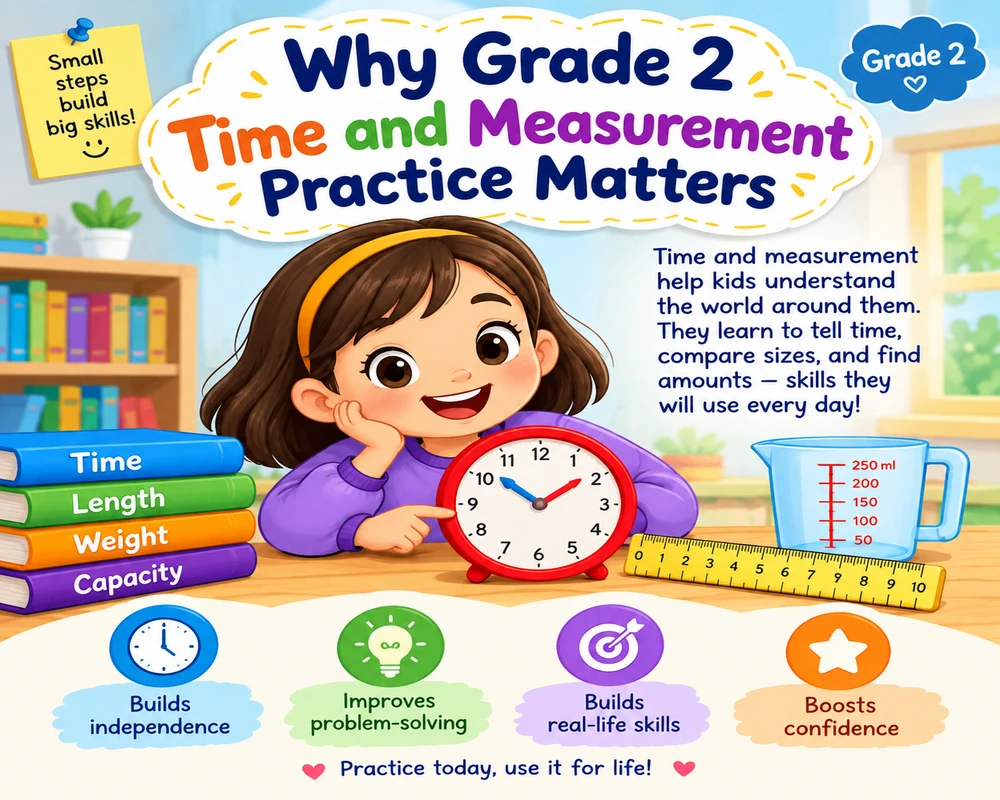
Why Grade 2 Time and Measurement Practice Matters
Time and measurement both fall under Ontario’s Spatial Sense strand, and Grade 2 is where students move from the informal comparisons of Grade 1 toward genuinely reading tools — clocks, rulers, and scales — with real precision. This is a meaningful jump. Comparing “which is longer” by eye is intuitive; reading that a ruler shows 14 centimetres requires understanding an entirely different kind of number system.
This matters because Grade 2 time and measurement practice isn’t just about memorizing that 60 minutes make an hour. It’s about building comfort with tools that behave differently from the base-10 number system kids have used everywhere else in math so far.
What the Ontario Curriculum Expects in Grade 2
By the end of Grade 2, students are generally expected to:
- Tell time to the nearest half hour and quarter hour, on both analog and digital clocks
- Understand the relationship between hours and minutes
- Measure length, height, and distance using standard units (centimetres, metres)
- Compare and order objects by mass using a balance scale
- Compare and order containers by capacity
- Solve simple problems involving elapsed time in familiar contexts (like the length of a school day)
Notice that formal elapsed-time calculations across the hour aren’t fully expected yet — that becomes a bigger focus in Grade 3 and 4. Grade 2 time and measurement practice is really about building fluency with the tools themselves first.
Telling Time: Building Real Clock Fluency
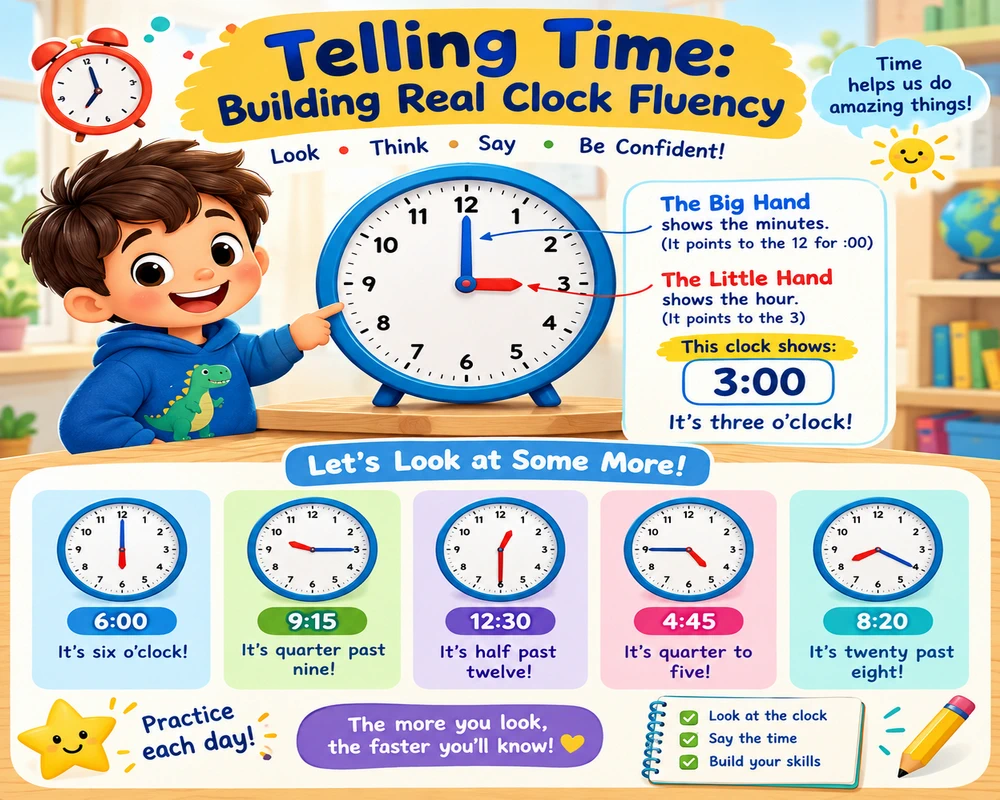
Understanding the Two Hands
A common early mix-up is confusing which hand shows the hour and which shows the minutes, especially since the hour hand moves so slowly it barely seems to move at all. Practicing with a real clock, and physically moving the hands together, helps far more than a printed worksheet with a static clock face.
Practice Questions: Reading the Clock
- The short hand points to 3, and the long hand points to 6. What time is it?
- The short hand points to 8, and the long hand points to 12. What time is it?
- The short hand is between 4 and 5, and the long hand points to 3. What time is it?
Answers: 1) 3:30 2) 8:00 3) 4:15
A Simple Home Activity: Build Your Own Clock
Use a paper plate, a brass fastener, and two strips of paper cut to different lengths for the hands. Having your child physically set the clock to different times — “show me 2:30,” “show me 7:00” — builds far more genuine understanding than passively reading a printed clock.
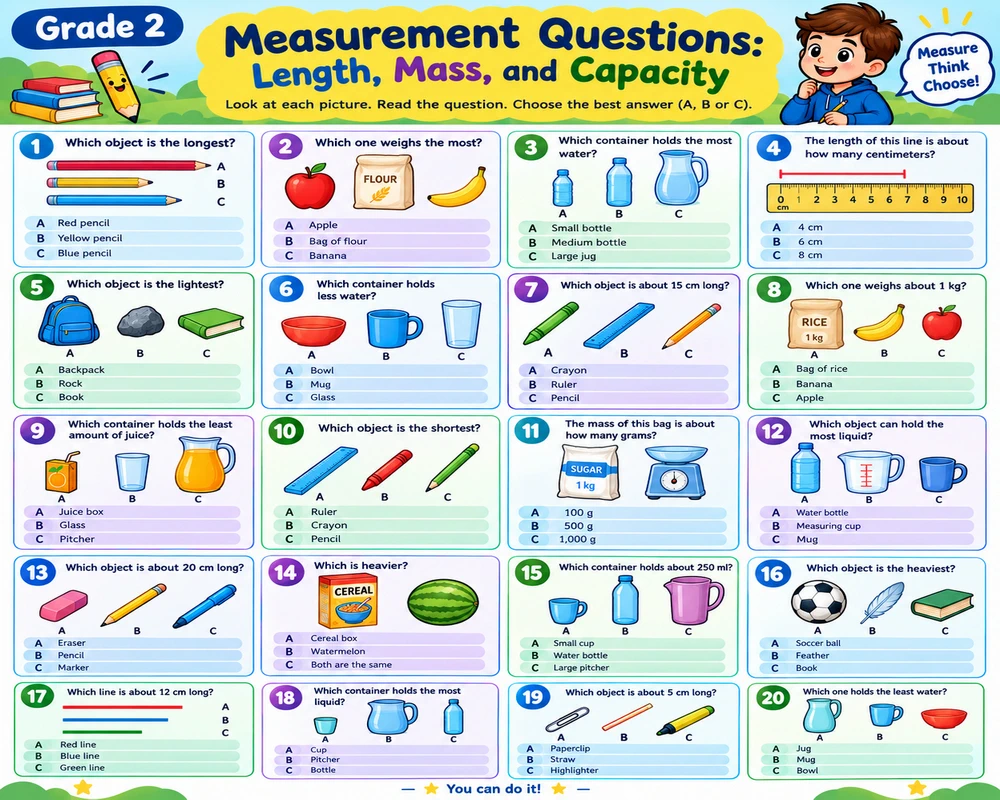
Grade 2 Measurement Questions: Length, Mass, and Capacity
Measuring Length With Standard Units
Grade 2 introduces centimetres and metres as real, standard tools — a shift from the non-standard units (paperclips, hand spans) used in Grade 1.
| Object | Estimated Length | Actual Measurement |
|---|---|---|
| Pencil | Guess first | Measure with a ruler |
| Book | Guess first | Measure with a ruler |
| Table | Guess first | Measure with a measuring tape |
Having your child estimate before measuring — and then checking how close their guess was — builds genuine number sense about what a centimetre or metre actually feels like in real life.
Comparing Mass on a Balance Scale
- If a toy car balances evenly with 8 blocks on a scale, and a toy truck balances with 12 blocks, which toy is heavier?
- A ball weighs the same as 5 marbles. Is the ball heavier or lighter than 8 marbles?
Answers: 1) The toy truck 2) Lighter
Comparing Capacity
- A small cup holds 4 scoops of water. A large cup holds 9 scoops. Which cup holds more?
- If you pour water from a full small cup into an empty large cup, will the large cup be completely full?
Answers: 1) The large cup 2) No, it will only be partly full
Real-Life Word Problems for Time and Measurement
- School starts at 9:00 and recess is at 10:30. How many hours pass between the start of school and recess?
- A ribbon is 24 centimetres long. Another ribbon is 18 centimetres long. How much longer is the first ribbon?
- A movie starts at 3:00 and lasts one and a half hours. What time does it end?
Answers: 1) 1.5 hours 2) 6 centimetres 3) 4:30
6 Fun Activities for Grade 2 Time and Measurement Practice
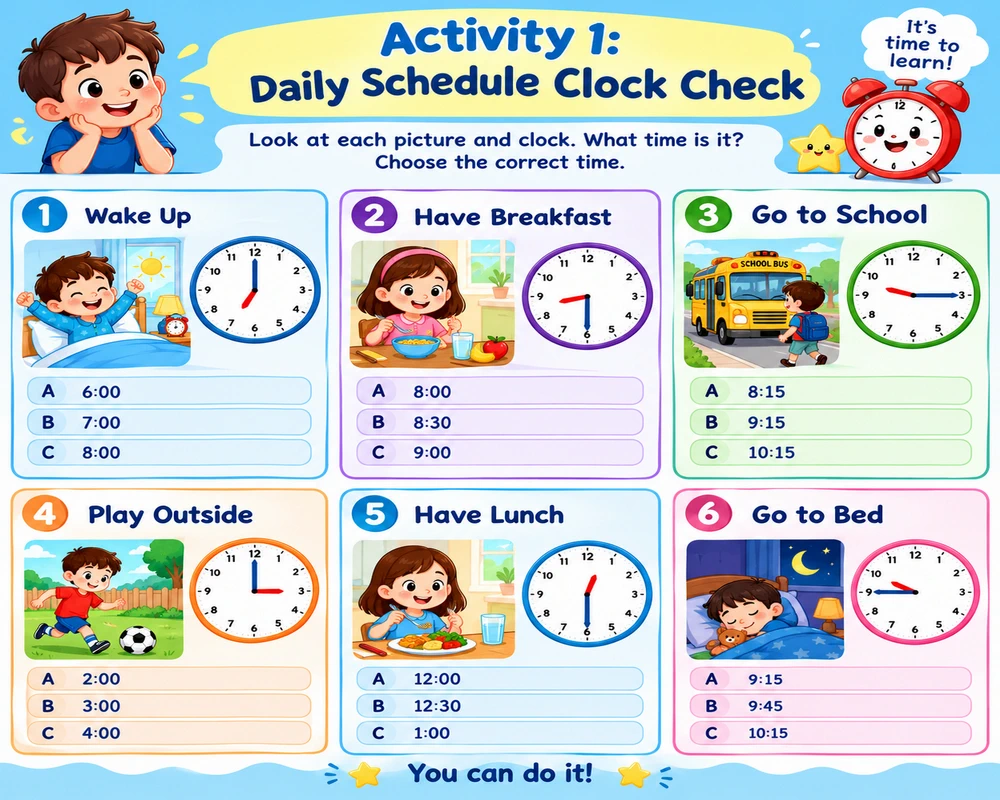
Activity 1: Daily Schedule Clock Check
Each morning, have your child check the real clock and identify what time it is, connecting it to a daily routine (“it’s 7:30, time to leave for school”).
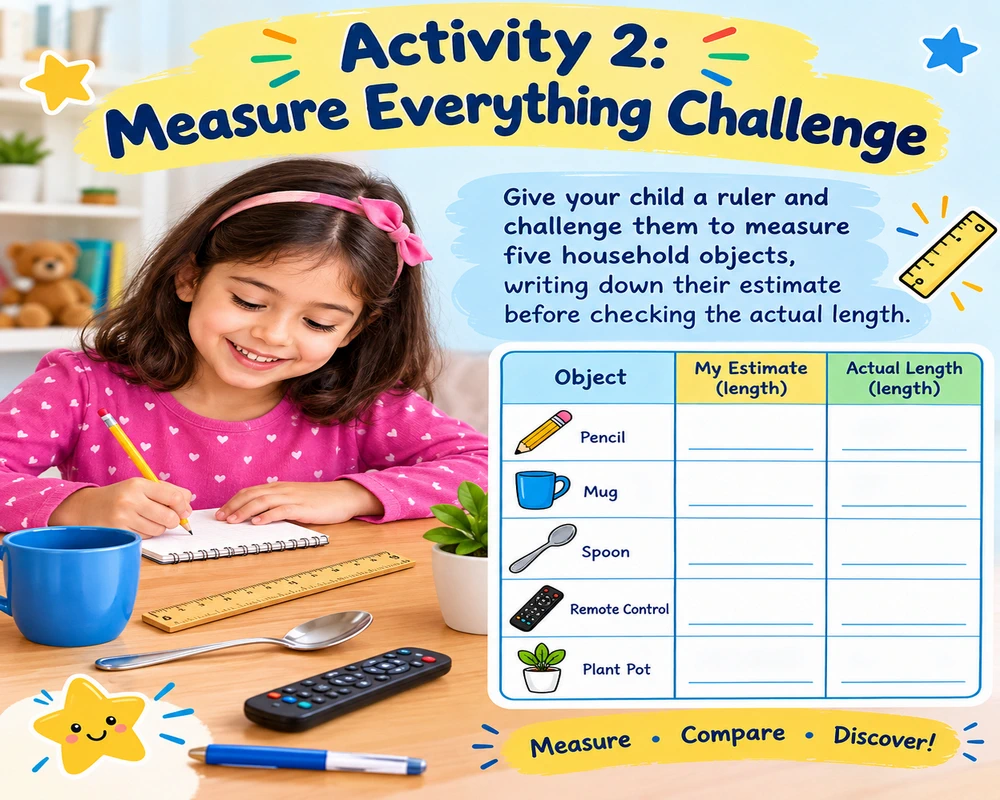
Activity 2: Measure Everything Challenge
Give your child a ruler and challenge them to measure five household objects, writing down their estimate before checking the actual length.
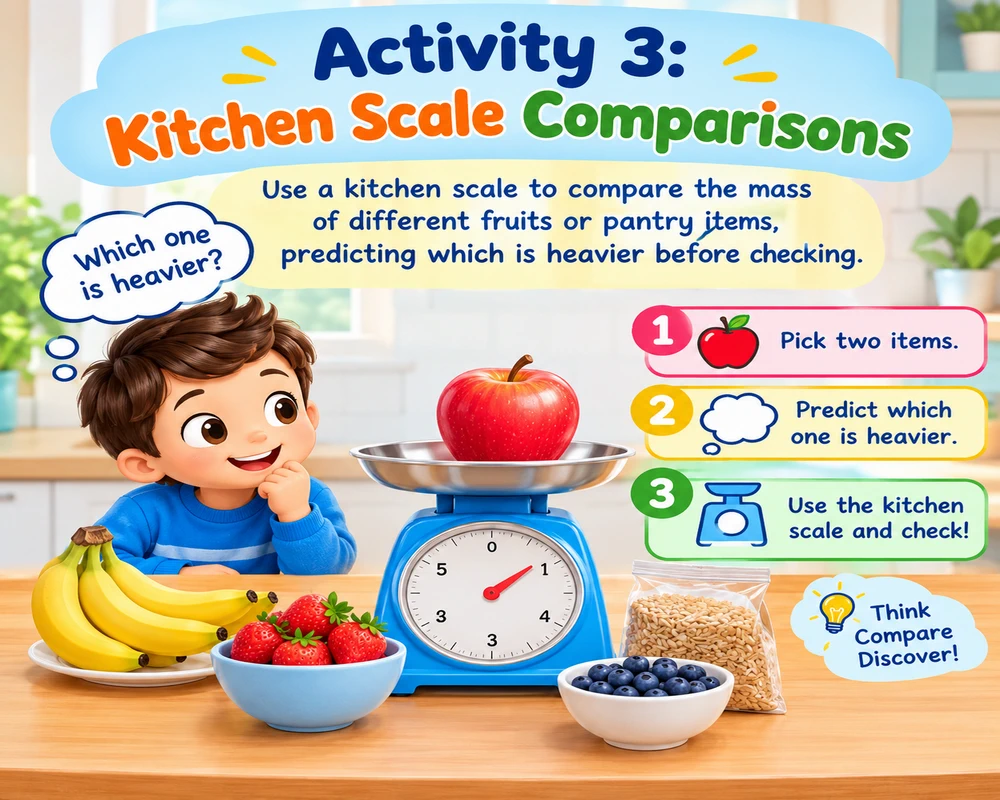
Activity 3: Kitchen Scale Comparisons
Use a kitchen scale to compare the mass of different fruits or pantry items, predicting which is heavier before checking.
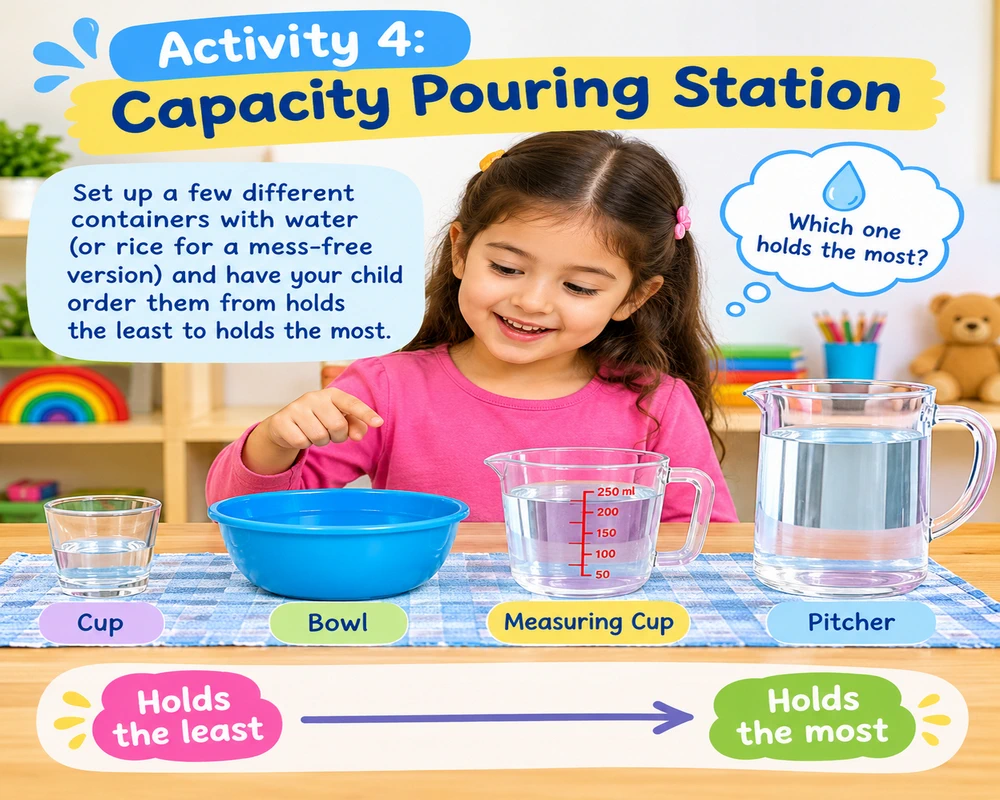
Activity 4: Capacity Pouring Station
Set up a few different containers with water (or rice for a mess-free version) and have your child order them from holds-the-least to holds-the-most.
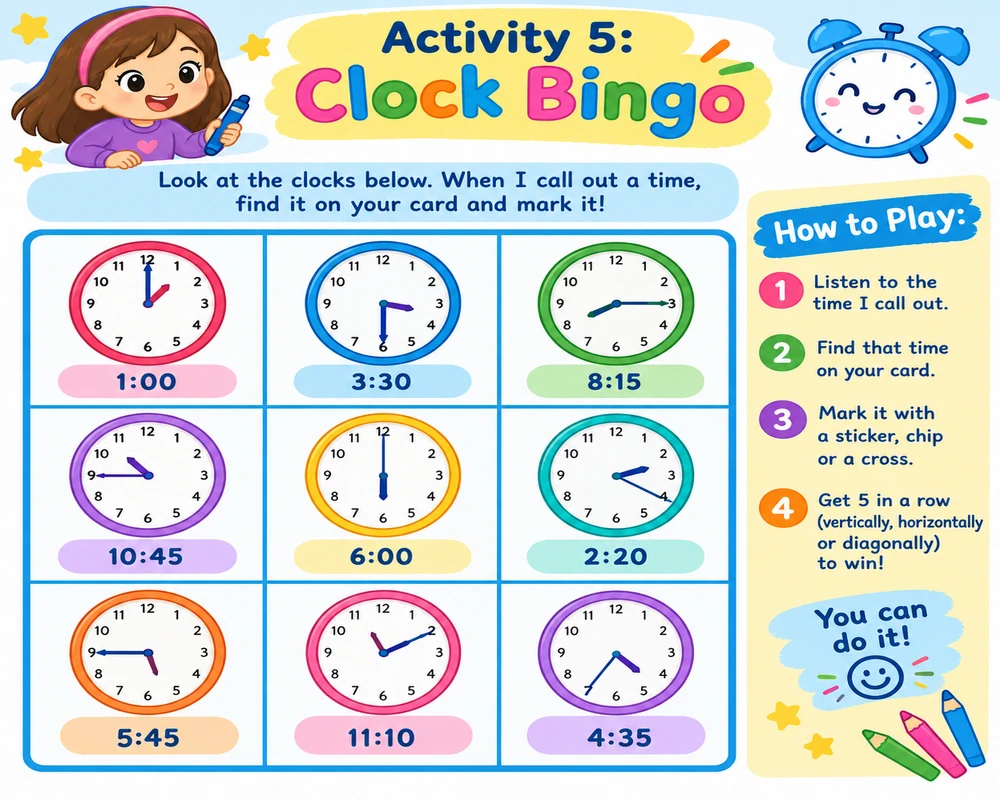
Activity 5: Clock Bingo
Draw a simple bingo grid with different clock times, then call out times for your child to find and mark, reinforcing quick time recognition.
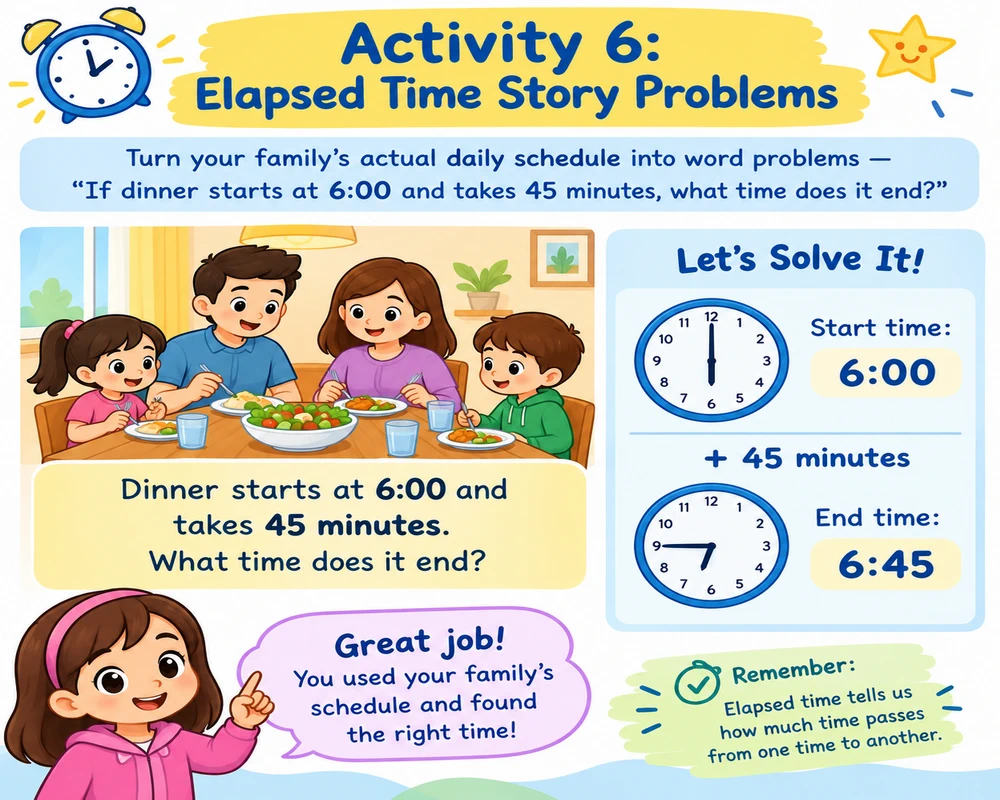
Activity 6: Elapsed Time Story Problems
Turn your family’s actual daily schedule into word problems — “if dinner starts at 6:00 and takes 45 minutes, what time does it end?”
Common Mistakes in Grade 2 Time and Measurement Practice
Confusing the Hour and Minute Hands
This remains the most common clock-reading error at this age. Physically moving the hands on a paper clock, rather than just observing a printed one, tends to resolve it fastest.
Estimating Without Any Reference Point
Kids sometimes guess measurements wildly because they have no internal sense of what a centimetre or metre actually looks like. Repeated estimate-then-measure practice builds this reference point over time.
Forgetting Units When Comparing
A child might correctly compare two numbers but forget to state the unit (centimetres versus metres), leading to answers that don’t actually make sense. Encouraging full-sentence answers (“the ribbon is 6 centimetres longer”) reinforces this habit.
Conclusion: Building Real-World Math Confidence
Grade 2 time and measurement practice teaches something genuinely practical — skills your child will use every single day for the rest of their life, from reading a clock to following a recipe. Give this unit plenty of hands-on, real-object practice, and the discomfort with clocks and rulers tends to disappear within just a few weeks of consistent effort.
Try building a paper plate clock together tonight, or measure a few objects around the house before bed. A few minutes of playful Grade 2 time and measurement practice like this build understanding no worksheet alone can match.
Frequently Asked Questions
1. What time-telling skills should a Grade 2 student have?
Students should be able to tell time to the nearest half hour and quarter hour on both analog and digital clocks by the end of Grade 2.
2. Why does my child confuse the hour and minute hands?
This is very common, since the hour hand moves so slowly it’s easy to overlook. Practicing with a real, movable clock face helps far more than a static printed one.
3. What measurement units are introduced in Grade 2?
Grade 2 introduces standard units like centimetres and metres for length, moving beyond the non-standard units (like paperclips) used in Grade 1.
4. How can I help my child estimate measurements more accurately?
Consistent estimate-then-measure practice builds a genuine internal sense of scale over time — there’s no shortcut beyond repeated, hands-on comparison.
5. Does Grade 2 cover elapsed time across the hour mark?
Only informally, using familiar routines. Full elapsed-time calculations across hour boundaries become a bigger focus in Grade 3 and 4.
6. How much should we practice time and measurement at home?
About 10-15 minutes, a few times a week, tends to be enough, especially when built into everyday routines like checking the clock or cooking.
7. How does this unit connect to later grades?
It builds the tool-reading fluency that supports more precise measurement, unit conversion, and elapsed time calculations in Grade 3 and beyond.
Time and measurement is just one part of a full Grade 2 year that also covers addition, subtraction, money, and shapes. For the complete picture, our Grade 2 math practice hub brings every topic together in one place.
Interactive clock and measurement tools make these concepts far easier to visualize than static worksheets alone. TVO Learn, Ontario’s own educational platform, offers free digital tools for practicing exactly these skills, making a great follow-up once your child has practiced with real clocks and rulers at home.