
Grade 3 Perimeter and Area Practice: 7 Genius Tips
Grade 3 perimeter and area practice tends to introduce a confusion that sounds almost too simple to cause real trouble: two measurements of the exact same rectangle, one measured around the outside, one measured across the inside, and suddenly a student who’s rock-solid on multiplication starts mixing up which formula applies where. Having spent years supporting Ontario’s Junior Division classrooms, I’ve found this mix-up rarely reflects weak math skill. It’s almost always a sign that the difference between “around” and “inside” hasn’t been made physically concrete yet.
This guide walks through what Ontario’s Grade 3 curriculum expects around perimeter and area, why these two measurements get confused so often, and seven genius tips to build lasting clarity at home.
Why Grade 3 Perimeter and Area Practice Trips Kids Up
Perimeter and area fall under Ontario’s Spatial Sense strand, and Grade 3 is where both become formal, measurable concepts rather than the informal size comparisons used in earlier grades. Perimeter measures the distance around the outside edge of a shape; area measures the amount of surface covered inside it. Both use the same rectangle, but they answer genuinely different questions.
This matters because Grade 3 perimeter and area practice done through memorized formulas alone — without a physical, visual understanding of what each measurement actually represents — tends to produce exactly the kind of formula mix-ups families run into constantly.

What the Ontario Curriculum Expects in Grade 3
By the end of Grade 3, students are generally expected to:
- Measure and calculate the perimeter of simple shapes, including rectangles
- Understand area as the amount of surface covered by a shape
- Calculate area by counting square units within a grid
- Compare shapes that have the same area but different perimeters, or vice versa
- Solve simple real-world problems involving perimeter and area
Notice that formal multiplication-based area formulas aren’t the main focus yet — counting square units comes first, building the conceptual groundwork that formulas will later rest on. Grade 3 perimeter and area practice grounded in this counting approach tends to produce far more durable understanding.
Perimeter: Measuring Around the Outside
What Perimeter Actually Measures
Perimeter is the total distance around a shape’s outer edge — imagine walking along the border of a garden or fence line. It’s found by adding up the length of every side.
| Shape | Side Lengths | Perimeter |
|---|---|---|
| Rectangle | 6 cm, 4 cm, 6 cm, 4 cm | 20 cm |
| Square | 5 cm on each side | 20 cm |
Perimeter Practice Questions
- A rectangle has sides of 8 cm and 5 cm. What is its perimeter?
- A square has sides of 7 cm. What is its perimeter?
- A garden is 10 m long and 6 m wide. How much fencing is needed to go all the way around it?
Answers: 1) 26 cm 2) 28 cm 3) 32 m
Area: Measuring the Inside Surface
Counting Square Units First
Before introducing any formula, Grade 3 students should be comfortable finding area by literally counting the squares that fit inside a shape drawn on a grid. This builds a genuine physical sense of what area represents.
Area Practice Questions
- A rectangle on a grid covers 4 rows of 5 squares each. What is its area?
- A rectangular room measures 6 units by 3 units on a grid. What is its area?
- A rug covers 24 square units and has a width of 4 units. What is its length?
Answers: 1) 20 square units 2) 18 square units 3) 6 units
7 Genius Tips for Mastering Perimeter and Area
Tip 1: Use the “Fence vs. Grass” Analogy
Perimeter is like the fence around a yard; area is like the grass covering the inside. This simple, memorable image helps kids instantly recall which measurement is which.

Tip 2: Count Squares Before Using Formulas
Let your child physically count square units on grid paper before introducing length × width as a shortcut. The formula makes far more sense once the counting process is genuinely understood.

Tip 3: Build Real Rectangles With Objects
Arrange tiles, blocks, or even sticky notes into a rectangle, then have your child both count the perimeter (outer edges) and the area (total squares) of the same shape.

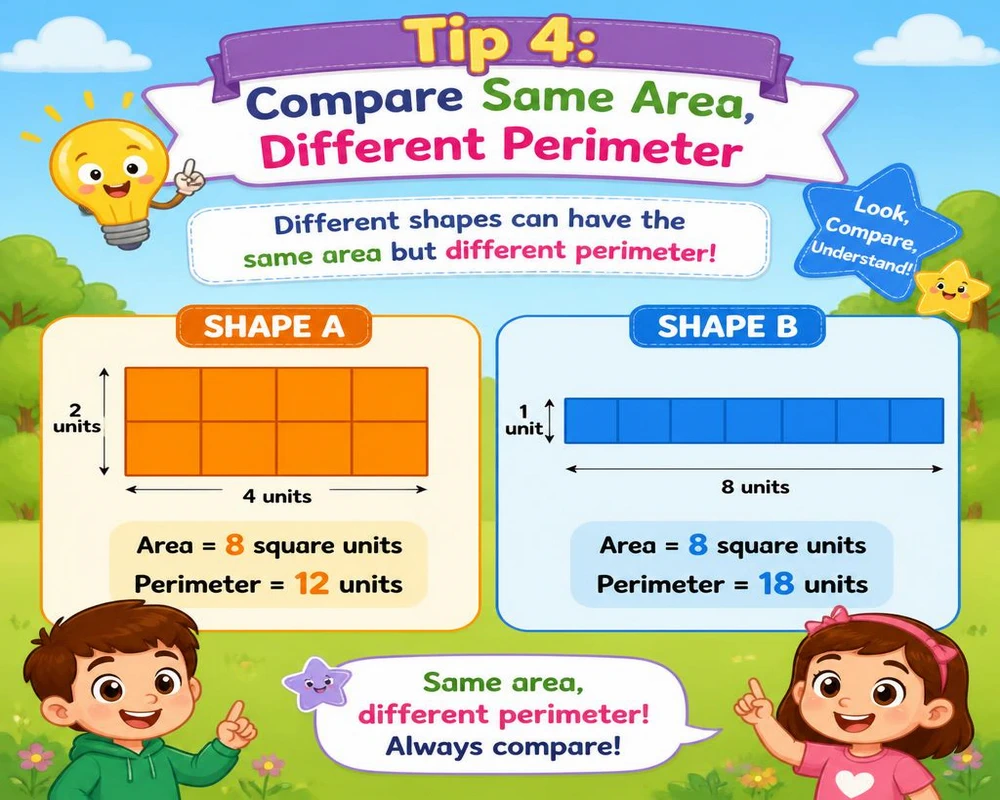
Tip 4: Compare Same Area, Different Perimeter
Show your child two different rectangles that both cover 12 square units but have different perimeters. This directly challenges the assumption that area and perimeter always move together.
Tip 5: Practice With Real Household Measurements
Measuring a real room, table, or rug and calculating both its perimeter and area connects the concept to something tangible and immediately useful.

Tip 6: Label Every Answer With Correct Units
Perimeter is measured in simple units (cm, m); area is measured in square units (cm², m²). Reinforcing this distinction from the very beginning prevents a common later confusion.

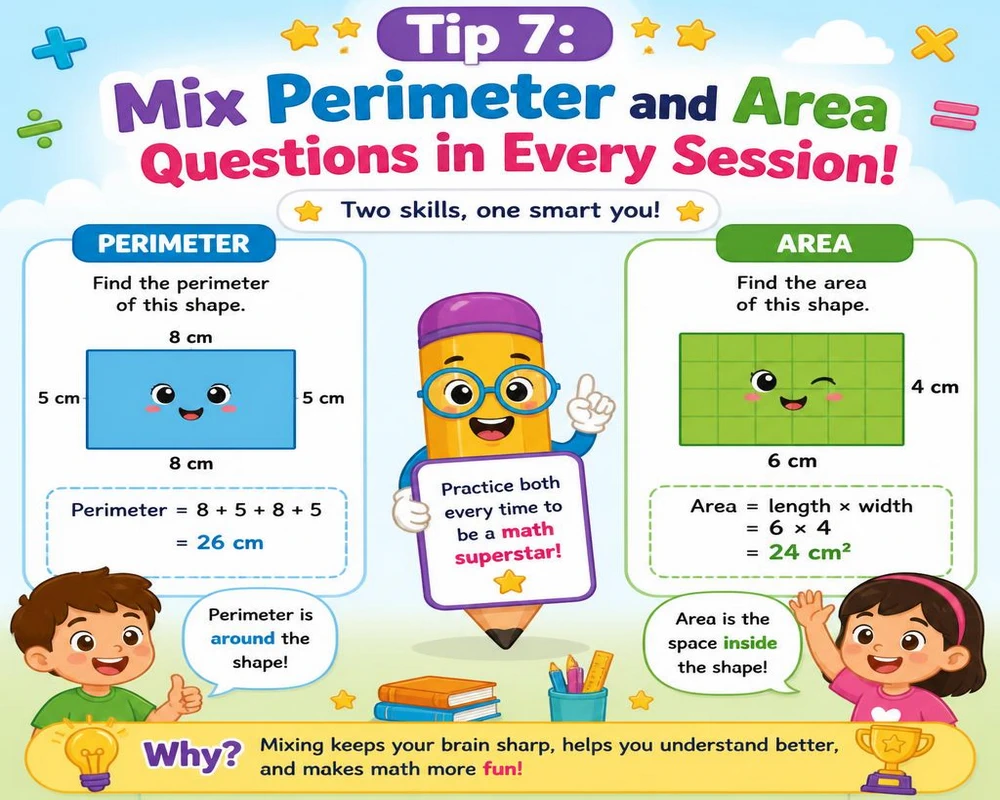
Tip 7: Mix Perimeter and Area Questions in Every Session
Practicing both types together, rather than one at a time, forces your child to actively identify which measurement a question is actually asking for. Each tip below targets a different piece of Grade 3 perimeter and area practice, so combining several together builds far more flexible understanding than repeating just one approach.
Real-Life Word Problems
- A rectangular sandbox is 3 m long and 2 m wide. What is its area?
- A picture frame needs trim around all four sides. If the frame is 30 cm by 20 cm, how much trim is needed?
- A vegetable patch covers 18 square metres and is 3 metres wide. How long is it?
Answers: 1) 6 square metres 2) 100 cm 3) 6 metres
Common Mistakes in Grade 3 Perimeter and Area
Mixing Up Which Formula to Use
This is, by far, the most common error in this unit. Returning to the “fence vs. grass” analogy, or physically tracing the perimeter versus shading the area, resolves this faster than repeated formula memorization.
Forgetting to Include All Sides When Finding Perimeter
Some students only add two sides of a rectangle instead of all four, forgetting that opposite sides also need to be counted. Physically tracing the entire outline with a finger helps prevent this.
Leaving Off the Correct Units
Writing “20” instead of “20 cm” for perimeter, or “20” instead of “20 cm²” for area, is a small but meaningful error worth correcting consistently from the start. Nearly every mistake in Grade 3 perimeter and area practice comes down to confusing which measurement a question is actually asking for, not a genuine gap in calculation skill.
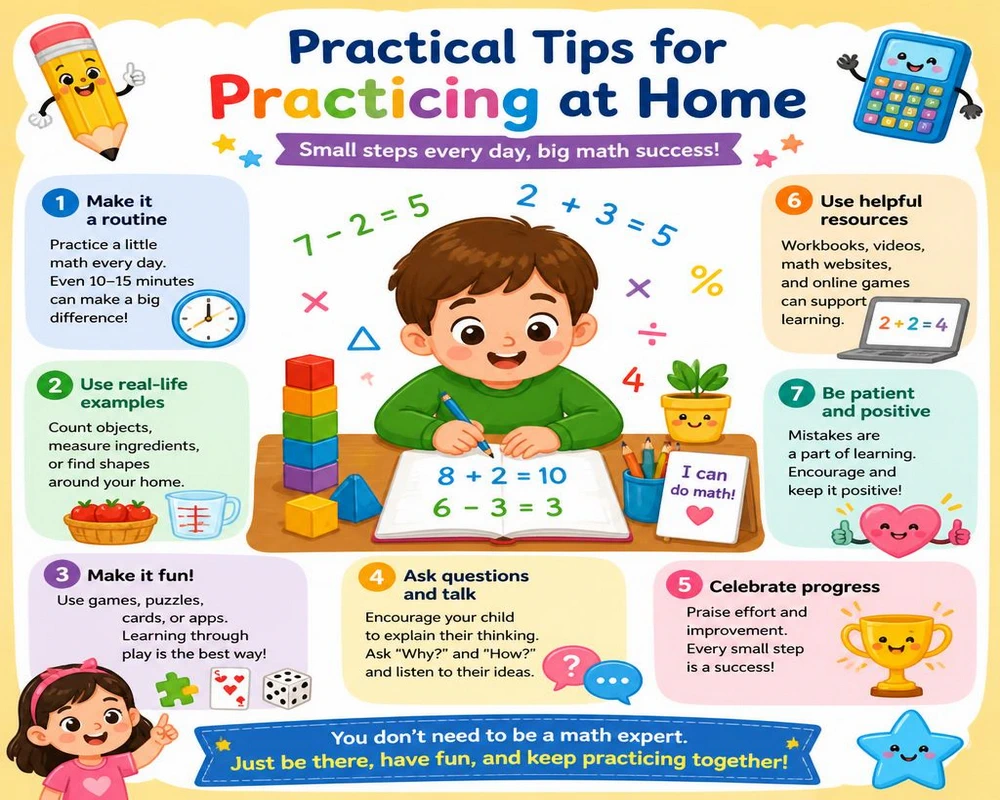
Practical Tips for Practicing at Home
Measure Real Rooms and Furniture
A tape measure and any real room in your house turn Grade 3 perimeter and area practice into a genuinely hands-on, meaningful activity.
Use Grid Paper for Area Practice
Drawing shapes on grid paper and counting squares keeps the concept visual and concrete for as long as your child needs before moving to formulas.
Keep Sessions Short and Varied
Ten to fifteen minutes mixing both perimeter and area questions, a few times a week, builds stronger, more flexible understanding than practicing one skill in isolation.
Conclusion: Two Measurements, Two Clear Meanings
Grade 3 perimeter and area practice becomes far less confusing once both concepts have a genuine physical anchor — the fence around the outside, the grass covering the inside. With consistent, hands-on practice using real objects and grid paper, most students move past the perimeter-area mix-up within just a few weeks.
Measure a real table or rug tonight and calculate both its perimeter and area together. A few minutes of hands-on practice like this build understanding no worksheet alone can match. Consistent Grade 3 perimeter and area practice, anchored in real objects rather than memorized formulas, gives your child a foundation that lasts well beyond this one unit.
Frequently Asked Questions
1. What is the difference between perimeter and area?
Perimeter measures the distance around the outside edge of a shape, while area measures the amount of surface covered inside it.
2. Why does my child mix up perimeter and area formulas?
This is extremely common and usually means the physical difference between the two measurements hasn’t been made concrete yet. The “fence vs. grass” analogy tends to resolve this quickly.
3. Does Grade 3 use the length × width formula for area?
Grade 3 begins with counting square units directly on a grid, building toward the formula as a natural shortcut once counting is genuinely understood.
4. How can I practice area without grid paper?
Arranging real tiles, blocks, or sticky notes into a rectangle works just as well, letting your child physically count the units.
5. Can two shapes have the same area but different perimeters?
Yes, and demonstrating this directly is one of the best ways to challenge the assumption that the two measurements always move together.
6. How much perimeter and area practice should we do at home?
About 10-15 minutes, a few times a week, mixing both types of questions, tends to build the strongest, most flexible understanding.
7. How does this connect to later grades?
It builds the foundation for more complex area and perimeter work involving irregular shapes, as well as volume concepts introduced in later grades.
Perimeter and area is one part of a full Grade 3 year that also covers multiplication, division, and fractions. For the complete picture, our Grade 3 math practice hub brings every topic together in one place.
Interactive geometry tools make perimeter and area far easier to visualize than static worksheets alone. Mathies, Ontario’s free suite of digital math tools, includes grid-based area and perimeter tools built for exactly this stage of learning.