
Ontario Math Curriculum Explained in Plain English
Short answer: The Ontario math curriculum is a Ministry of Education document that organizes what students learn into five content areas called “strands,” each broken into broad “overall expectations” and more detailed “specific expectations,” alongside a set of thinking skills called the “mathematical processes.” Once you know these five or six terms, most of the jargon on report cards and school newsletters stops feeling mysterious. This Ontario Math Curriculum Explained in Plain English guide walks through exactly what each term means and how the pieces fit together, grade by grade.
Key takeaways:
- The Ontario math curriculum is organized into five strands, each with overall and specific expectations that build year over year.
- The 2020 revision added a Financial Literacy strand and integrated coding directly into the curriculum for the first time.
- Report card language like “achievement chart,” “learning goals,” and “success criteria” all trace back to specific curriculum terms.
- Understanding the terminology helps parents interpret report cards, ask better questions at conferences, and support learning at home.
What Is the Ontario Math Curriculum, Really?
At its core, the Ontario math curriculum is a single public document published by the Ministry of Education that every publicly funded school board in the province — public and Catholic alike — is required to follow. It sets out what students are expected to know and be able to do in math from Grade 1 through Grade 8, and it’s the same document whether your child attends a school in Toronto, Thunder Bay, or Ottawa. This Ontario Math Curriculum Explained in Plain English resource exists because the document itself, while thorough, is written in formal policy language that isn’t always easy for a busy parent to parse on a Tuesday night before a report card conversation.
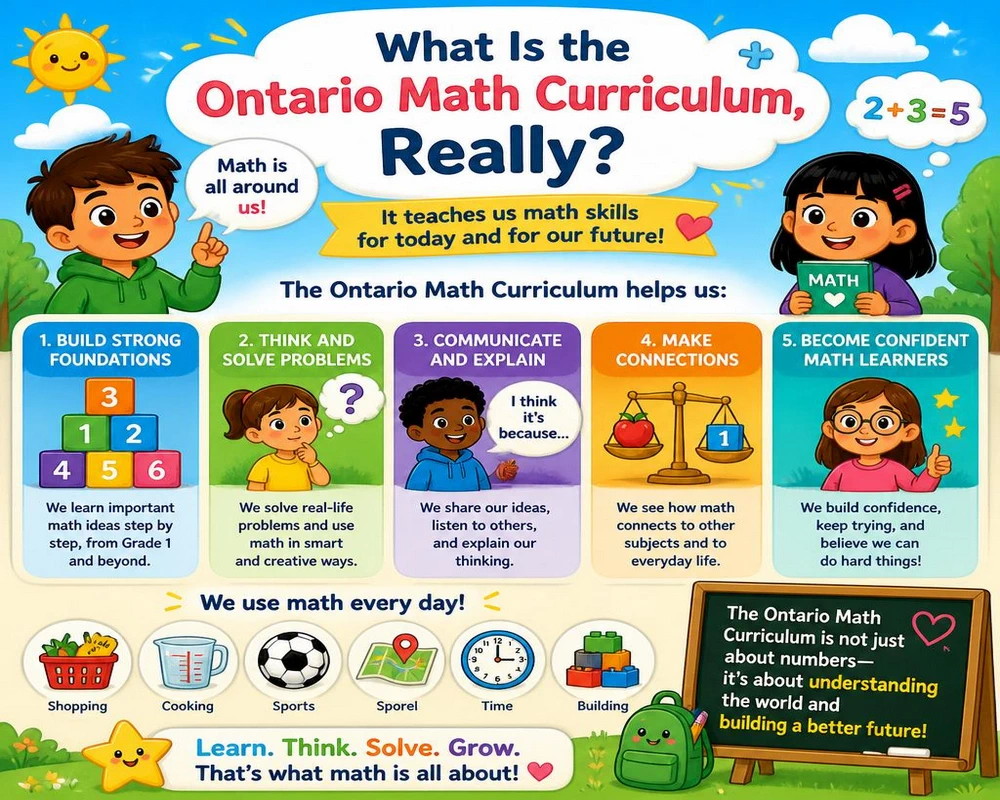
Ontario Math Curriculum Simplified: The Big Picture
Ontario math curriculum simplified comes down to one central idea: everything a student learns in math class is organized under five broad content areas, called strands, and each strand is further broken down into specific skills expected at each grade level.
The Five Strands of the Ontario Math Curriculum
- Number: counting, place value, operations, fractions, decimals, and number sense generally.
- Algebra: patterns, variables, equations, and — since the 2020 revision — coding and computational thinking.
- Data: collecting, organizing, displaying, and interpreting data, plus probability.
- Spatial Sense: geometry, measurement, and understanding shapes and space.
- Financial Literacy: money concepts, budgeting, and consumer and civic awareness, added as its own strand in the 2020 revision.
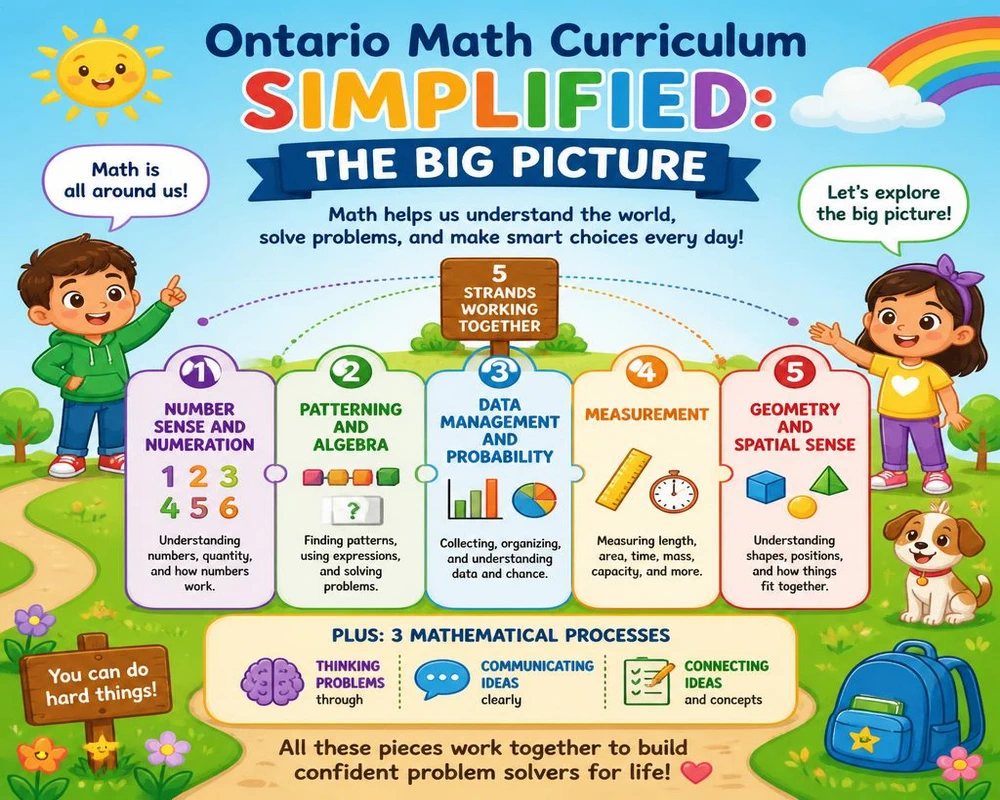
Math Curriculum Jargon Explained for Parents
Beyond the five strands, a handful of recurring terms make up most of the math curriculum jargon explained for parents that shows up on report cards, newsletters, and parent-teacher interviews. The table below breaks down the most common ones in plain language.
| Term | What It Actually Means |
|---|---|
| Overall expectation | A broad learning goal for the year within a strand (e.g., “represent and solve problems involving multiplication”) |
| Specific expectation | A detailed, concrete skill that supports the broader overall expectation |
| Mathematical processes | Seven thinking skills — problem solving, reasoning, reflecting, connecting, communicating, representing, and selecting tools — used across every strand |
| Learning goal | A student-friendly version of the expectation, often shared at the start of a lesson |
| Success criteria | The specific, observable signs a teacher (and student) can use to tell if the learning goal was met |
| Achievement chart | The province-wide rubric used to assess and report student achievement across four categories of thinking, communication, application, and knowledge |

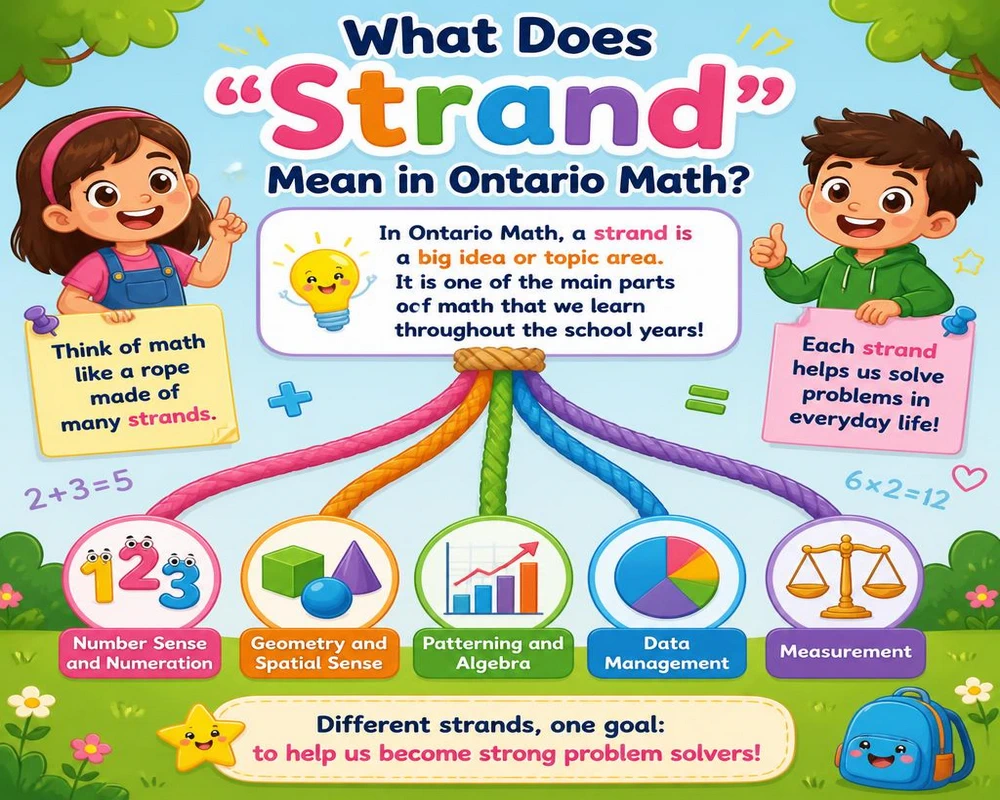
What Does “Strand” Mean in Ontario Math?
What does “strand” mean in Ontario math is one of the most common questions parents ask, and the answer is simpler than it sounds: a strand is just one of the five major content categories the entire curriculum is organized around — Number, Algebra, Data, Spatial Sense, and Financial Literacy. Every specific skill your child learns fits into one of these five buckets, and report cards often reference strand names directly (for example, a comment about “strong progress in the Number strand” is referring to counting, operations, and number sense skills specifically, not overall math ability).
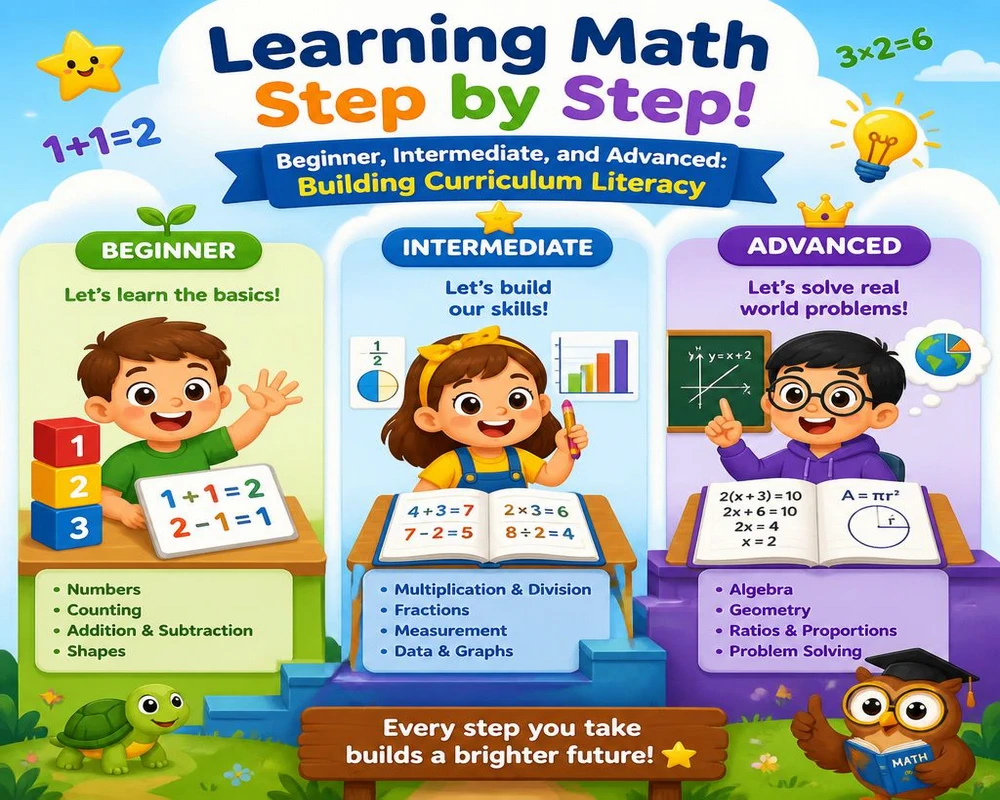
Beginner, Intermediate, and Advanced: Building Curriculum Literacy
Beginner level: learn the five strand names — Number, Algebra, Data, Spatial Sense, and Financial Literacy — since almost every other curriculum term connects back to one of these five categories.
Intermediate level: understand the difference between overall and specific expectations, and recognize the achievement chart’s four categories (knowledge, thinking, communication, application) when reading a report card.
Advanced level: follow how expectations within a strand build across grades, so you can anticipate what comes next and reinforce foundational skills before they become a gap. An Ontario Math Curriculum Explained in Plain English mindset treats this progression as a roadmap rather than a mystery.
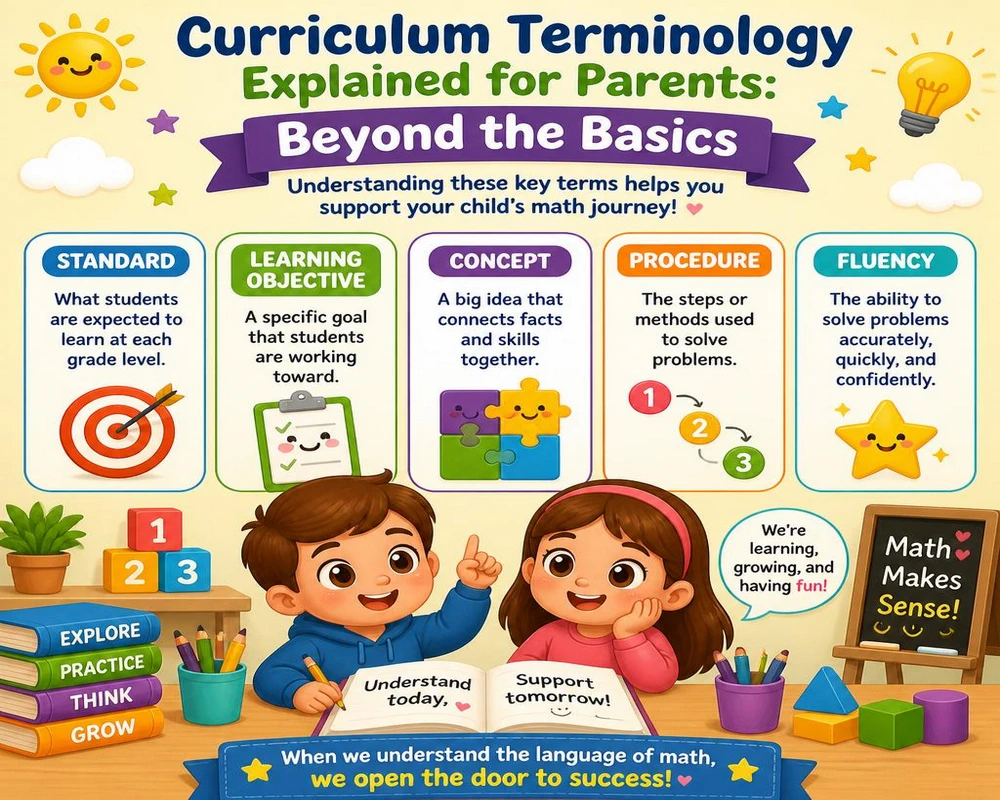
Curriculum Terminology Explained for Parents: Beyond the Basics
Once the five strands and the core assessment terms are familiar, a few more pieces of curriculum terminology explained for parents round out the picture and make report card comments and school communication much easier to interpret.
- Grounding in real-life contexts: a Ministry emphasis on connecting math concepts to real, meaningful situations rather than abstract drills alone.
- Coding and computational thinking: introduced starting in Grade 1 under the Algebra strand, this covers sequencing instructions and recognizing patterns in code, not formal computer programming.
- Social-emotional learning skills in mathematics: a curriculum expectation that students develop confidence, perseverance, and a healthy relationship with math, assessed alongside content knowledge.
- De-streaming: the 2021 policy removing Academic and Applied tracks in Grade 9, connected to but distinct from the elementary curriculum itself.
These extra terms round out most of the vocabulary a parent needs to follow along confidently — which is really the whole point of an Ontario Math Curriculum Explained in Plain English resource.
How the Curriculum Document Is Organized by Grade
The full curriculum document repeats the same five-strand structure for every grade from 1 through 8, with the specific expectations becoming more advanced as students progress. This consistent structure is actually one of the most helpful things to understand: once you know how Grade 3 is organized, Grade 4 will look immediately familiar, just with more advanced content within the same five strands.
| Grade Band | What Typically Changes |
|---|---|
| Grades 1-3 | Foundational number sense, basic operations, introductory patterning and simple data collection |
| Grades 4-6 | Multi-digit operations, fractions and decimals in depth, introductory algebra, more complex data and probability |
| Grades 7-8 | Integers, proportional reasoning, linear relations, and preparation for the transition to secondary math |
For a closer look at what’s covered in a specific year, InukMath’s grade-by-grade guides from Grade 1 Math Ontario through Grade 6 Math Ontario break down expectations without the policy language.

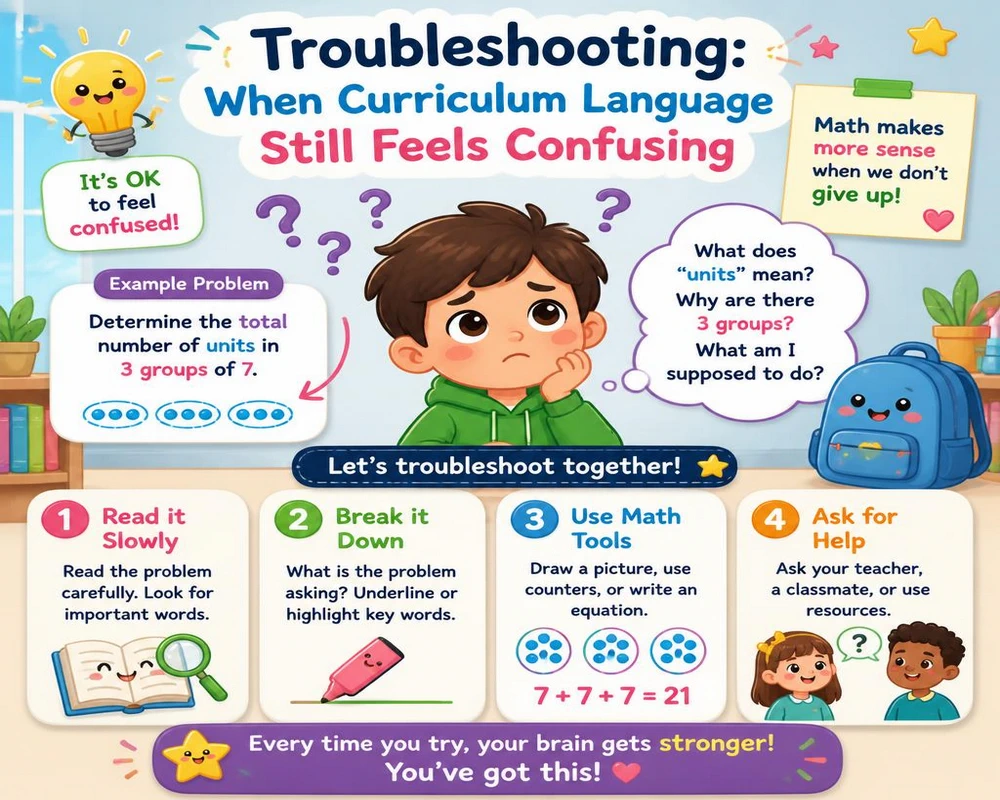
Troubleshooting: When Curriculum Language Still Feels Confusing
The report card comment doesn’t match any term I recognize
Ask the teacher directly which strand and expectation the comment relates to — teachers are generally happy to translate a specific comment back into plain language on request.
My child’s teacher uses different terms than what I’ve read online
Some variation in everyday classroom language is normal; the official curriculum document is the authoritative source, and most classroom terminology maps back to it even when the exact wording differs slightly.
I still don’t understand what “strand” means after reading the definition
Think of it as a subject-within-a-subject: just as “science” might be split into biology and chemistry, “math” is split into five strands, and every specific skill belongs to exactly one of them.
Why Ontario Revised the Math Curriculum in 2020
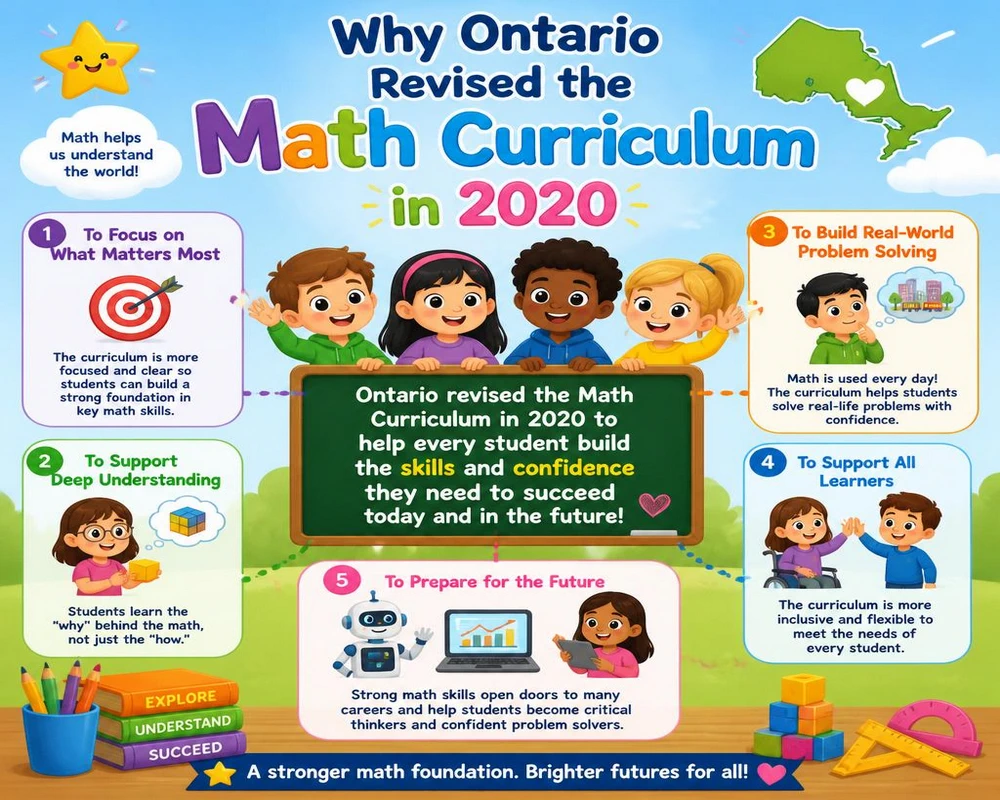
The 2020 revision was the first major update to Ontario’s elementary math curriculum in over a decade, driven partly by consistently below-target EQAO math results and partly by a recognized need to modernize content for a digital, financially complex world. The two headline changes — a dedicated Financial Literacy strand and the integration of coding — reflect that modernization directly, and the broader emphasis on real-life application throughout the document reflects lessons learned from the previous curriculum’s more abstract approach. Understanding this context is part of what makes an Ontario Math Curriculum Explained in Plain English approach useful: the terminology isn’t arbitrary, it reflects specific, documented policy decisions.
This policy background is a core part of any genuine Ontario Math Curriculum Explained in Plain English explanation, since the terminology and structure follow directly from these documented decisions rather than being arbitrary.
How This Shows Up on Your Child’s Report Card
Report card comments draw directly from curriculum language, so a comment like “demonstrates a solid understanding of place value within the Number strand, with an emerging ability to apply this understanding to multi-step word problems” is really just plain-language reporting against a specific expectation, translated through the achievement chart’s four categories: knowledge and understanding, thinking, communication, and application. Recognizing this pattern makes report card comments far less cryptic and gives parents a clear, specific starting point for a conversation with the teacher.
Recognizing this pattern is often the single most practical payoff of an Ontario Math Curriculum Explained in Plain English approach — it turns vague report card language into something specific and actionable.
Common Misconceptions About the Ontario Math Curriculum
- “Discovery math” and “new math” are official curriculum terms. They aren’t — these are informal, often critical labels applied by media and parents to certain teaching approaches; the curriculum document itself doesn’t use these terms.
- Every school teaches the strands in the same order. They don’t — the curriculum sets what must be covered by year’s end, not the order or pacing, which is left to teacher and school discretion.
- A strong report card in one strand means strong overall math ability. Not necessarily — a student can be strong in Number and still developing in Spatial Sense, since these are assessed somewhat independently.
The questions below round out this Ontario Math Curriculum Explained in Plain English guide with answers to the specific questions parents ask most often.
Frequently Asked Questions
What are the five strands of the Ontario math curriculum?
Number, Algebra, Data, Spatial Sense, and Financial Literacy. Financial Literacy became its own dedicated strand in the 2020 curriculum revision.
What’s the difference between an overall expectation and a specific expectation?
An overall expectation is a broad yearly goal within a strand, while specific expectations are the detailed, concrete skills that build toward that broader goal.
Is coding really part of the elementary math curriculum now?
Yes — coding and computational thinking were added under the Algebra strand starting in Grade 1, focusing on sequencing and pattern recognition rather than formal programming languages.
Why does my child’s report card mention “mathematical processes”?
The seven mathematical processes (problem solving, reasoning, reflecting, connecting, communicating, representing, and selecting tools) are thinking skills used across every strand, and teachers often reference them when describing how a student approaches a problem, not just whether they got the right answer.
Does the curriculum explain teaching methods, or just what’s taught?
Primarily the latter — the curriculum document focuses on expected learning outcomes (the “what”), while individual teachers and schools generally have discretion over specific instructional methods (the “how”).
Where can I read the actual Ontario math curriculum document?
It’s published publicly by the Ontario Ministry of Education and is available in full on the Ministry’s curriculum and resources website.
Is the curriculum the same for public and Catholic schools?
Yes — both publicly funded systems follow the identical Ministry of Education math curriculum. For more on where the two systems do and don’t differ, see InukMath’s guide on Catholic School Math Curriculum Ontario Differences.
How often does Ontario update its math curriculum?
Major revisions are infrequent — the 2020 update was the first substantial overhaul in more than a decade, though smaller clarifications and supporting resources are released more often.
Does understanding curriculum terminology actually help my child at home?
Yes — knowing what a strand or expectation refers to helps you interpret report cards accurately, ask more specific questions at conferences, and understand which skills to reinforce with everyday practice.
Are the Financial Literacy and Algebra strands really new?
Financial Literacy is a genuinely new, dedicated strand as of the 2020 revision; Algebra existed before but was significantly expanded to include coding and computational thinking for the first time.
Is there a simple way to check what my child should know by the end of the year?
Yes — InukMath’s grade-specific guides summarize the key expectations for each strand by grade in plain language, which is often faster than reading the full Ministry document directly.
Conclusion
An Ontario Math Curriculum Explained in Plain English approach really comes down to a small, learnable vocabulary: five strands, two levels of expectations, seven mathematical processes, and a four-category achievement chart. Once those pieces click into place, report cards, school newsletters, and parent-teacher conferences become far easier to follow, and it becomes much easier to have a specific, informed conversation about exactly how your child is progressing.
For a closer look at how EQAO results connect to this same curriculum framework, see InukMath’s guide on How to Read an EQAO Score Report Ontario.