
Grade 1 Math Manipulatives: Which Tools Help and How to Use Them at Home
Grade 1 math manipulatives are physical objects children use to see, touch and move math ideas: linking cubes, ten frames, rekenreks, counters, base ten blocks, pattern blocks, coins and more. They turn abstract numbers into something concrete, which is exactly what six- and seven-year-olds need.
Manipulatives aren’t toys and they aren’t a crutch. Used well, they build understanding that lasts long after the blocks are put away. Used poorly, they become a distraction. The difference lies in choosing the right tool and connecting it to pictures and numbers.
This guide explains why Grade 1 math manipulatives work, the 10 best tools for home learning, budget swaps from your kitchen, how to use the concrete-pictorial-abstract approach, common mistakes and digital alternatives.
Quick Answer
The best Grade 1 math manipulatives are ten frames, linking cubes, a rekenrek, two-color counters, bundling sticks or base ten blocks, a number line, a hundred chart, pattern blocks, dice and Canadian coins. Use them to introduce ideas, then connect them to drawings and numbers through the concrete-pictorial-abstract approach. Household items work just as well as store-bought tools.
Key Takeaways
- Grade 1 math manipulatives make abstract ideas concrete.
- Research supports manipulatives when they’re used purposefully and linked to symbols.
- Ten frames, linking cubes and rekenreks are the top three tools.
- The concrete-pictorial-abstract sequence moves kids from objects to numbers.
- Kitchen items like pasta, egg cartons and coins make great free manipulatives.
Table of Contents
- What Are Grade 1 Math Manipulatives?
- Do Grade 1 Math Manipulatives Really Work?
- What Is the Concrete Pictorial Abstract Approach?
- What Are the 10 Best Grade 1 Math Manipulatives for Home?
- What Are Budget Swaps for Math Manipulatives?
- How Do You Use Manipulatives Well at Home?
- Are Grade 1 Math Manipulatives Used Across Canada?
- What Should Parents Say When Using Manipulatives?
- What Do Teachers Wish Parents Knew About Manipulatives?
- How Can Everyday Life Provide Manipulatives?
- How Can You Adapt Manipulatives for Different Learners?
- What Does a 4-Week Manipulatives Plan Look Like?
- Try It: 8 Grade 1 Manipulatives Practice Tasks
- What Are Common Manipulatives Mistakes?
- How Do You Know Manipulatives Are Helping?
- How Do Manipulatives Change in Grade 2 and Grade 3?
- Frequently Asked Questions About Grade 1 Math Manipulatives
- Conclusion: Touch It, See It, Understand It
What Are Grade 1 Math Manipulatives?
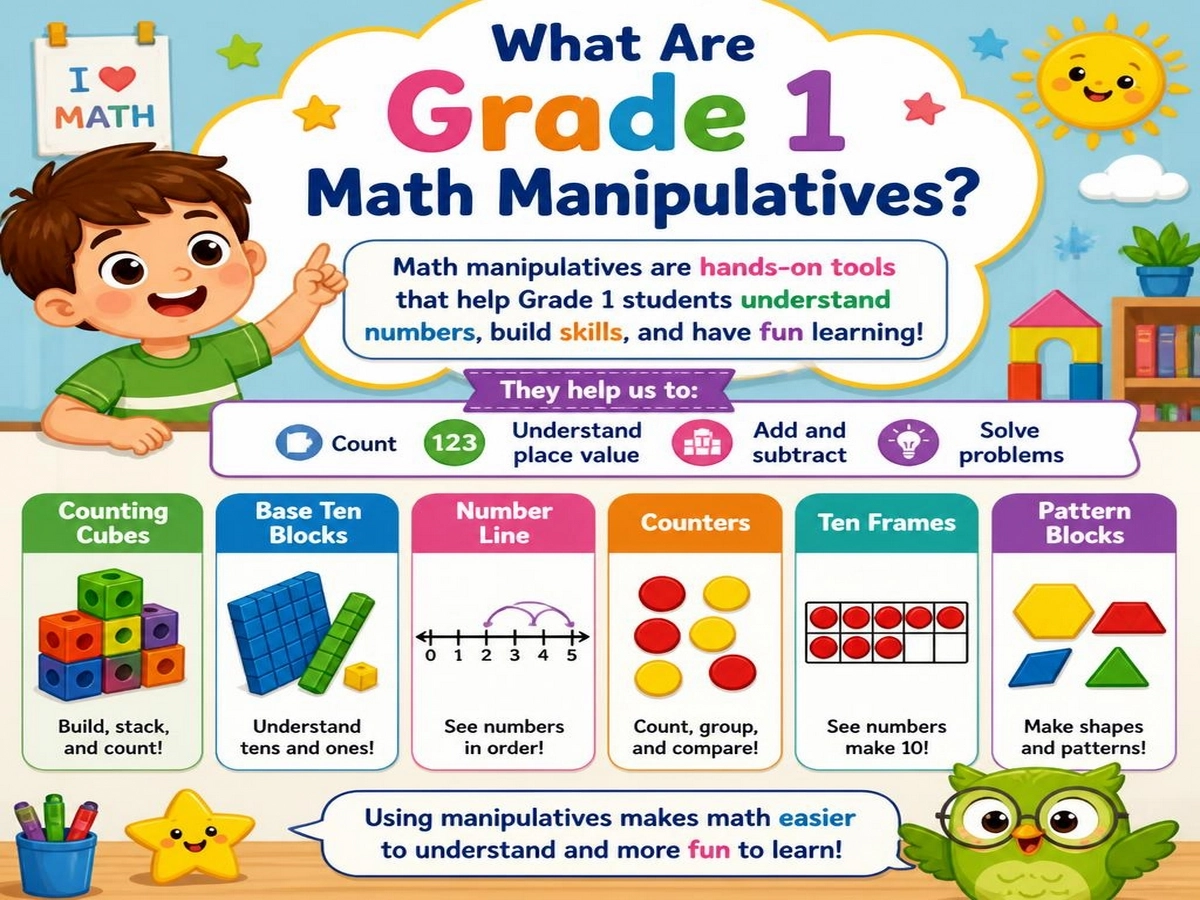
Grade 1 math manipulatives are hands-on math tools children can touch and move to represent numbers, shapes and operations. They let children build, split, compare and count quantities physically before working with numbers on paper.
Common examples include linking cubes, ten frames, rekenreks (bead counting racks), two-color counters, base ten blocks, pattern blocks, number lines and coins. Ontario’s curriculum repeatedly asks children to use “a variety of tools and strategies,” and manipulatives are the tools it means. See the Ontario mathematics curriculum for examples across strands.
Hands-On Math Tools vs. Toys
A toy becomes a math tool when it’s used to represent a math idea. LEGO bricks are toys; LEGO towers of ten are a place value tool. The purpose makes the difference.
Do Grade 1 Math Manipulatives Really Work?
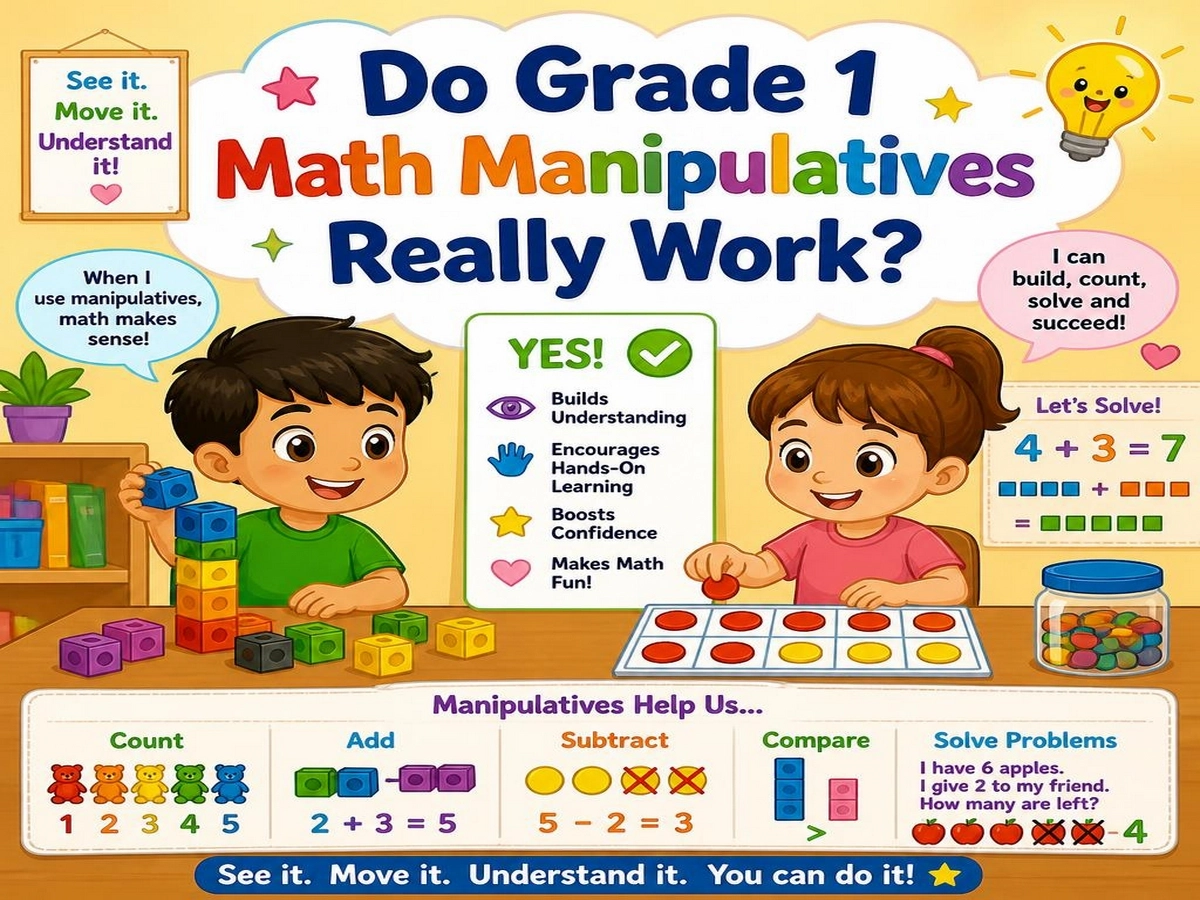
Yes, Grade 1 math manipulatives work when they’re used purposefully, for enough time and connected to pictures and symbols. Research shows modest but meaningful benefits, especially for young learners and for building understanding of number and operations.
A meta-analysis by Carbonneau, Marley and Selig (2013) reviewed 55 studies and found that teaching with concrete manipulatives produced small-to-moderate improvements in learning compared with abstract instruction alone. The effect depended on how manipulatives were used: clear guidance and connections to symbols mattered.
The Education Endowment Foundation’s early maths guidance similarly recommends using manipulatives and representations to develop understanding, while making sure children connect them to abstract math.
When Manipulatives Help Most
- Introducing a new concept
- Correcting a misconception
- Supporting children who are struggling
- Showing why a strategy works
What Is the Concrete Pictorial Abstract Approach?
The concrete pictorial abstract approach (often called CPA) is a three-stage teaching sequence: children first work with real objects (concrete), then with drawings or diagrams (pictorial), then with numbers and symbols only (abstract). It helps children build understanding before memorizing procedures.
| Stage | What it looks like | Example: 8 + 5 |
|---|---|---|
| Concrete | Real objects | Use 8 red and 5 blue cubes; move 2 blue to make 10 |
| Pictorial | Drawings, ten frames, number lines | Draw two ten frames: one full, one with 3 |
| Abstract | Numbers and symbols | 8 + 5 = 8 + 2 + 3 = 13 |
Children often move back and forth between stages. That’s normal and healthy. The goal is for the abstract stage to make sense because of the concrete and pictorial experiences.

What Are the 10 Best Grade 1 Math Manipulatives for Home?
The 10 best Grade 1 math manipulatives for home learning are ten frames, linking cubes, a rekenrek, two-color counters, bundling sticks, a number line, a hundred chart, pattern blocks, dice and Canadian coins. Each targets key Grade 1 skills.

1. Ten Frames
A 2-by-5 grid that shows numbers in relation to 5 and 10. Essential for subitizing, number bonds and making 10. See our guide to Grade 1 ten frames.
2. Linking Cubes
Snap-together cubes for building towers, comparing lengths, making patterns and grouping tens. Among the most versatile tools.
3. Rekenrek
A rekenrek is a counting rack with two rows of 10 beads, each split into 5 red and 5 white. It helps children see numbers in groups of five and ten, which speeds up counting and facts.
4. Two-Color Counters
Counters that are red on one side and yellow on the other. Shake and spill them to explore number bonds.
5. Bundling Sticks or Base Ten Blocks
Popsicle sticks bundled in tens (or base ten blocks) show tens and ones.
6. Number Line
A line with numbers 0 to 20 or 0 to 50. Great for counting on, counting back and comparing.
7. Hundred Chart
A 10-by-10 grid (or 1 to 50 for Grade 1) that shows number patterns and skip counting.
8. Pattern Blocks
Colorful geometric shapes for patterns, symmetry and composing shapes.
9. Dice and Dominoes
Dot patterns build subitizing and quick addition. Perfect for Grade 1 math games.
10. Canadian Coins
Real nickels, dimes, quarters, loonies and toonies for skip counting, comparing and money skills.
What Are Budget Swaps for Math Manipulatives?
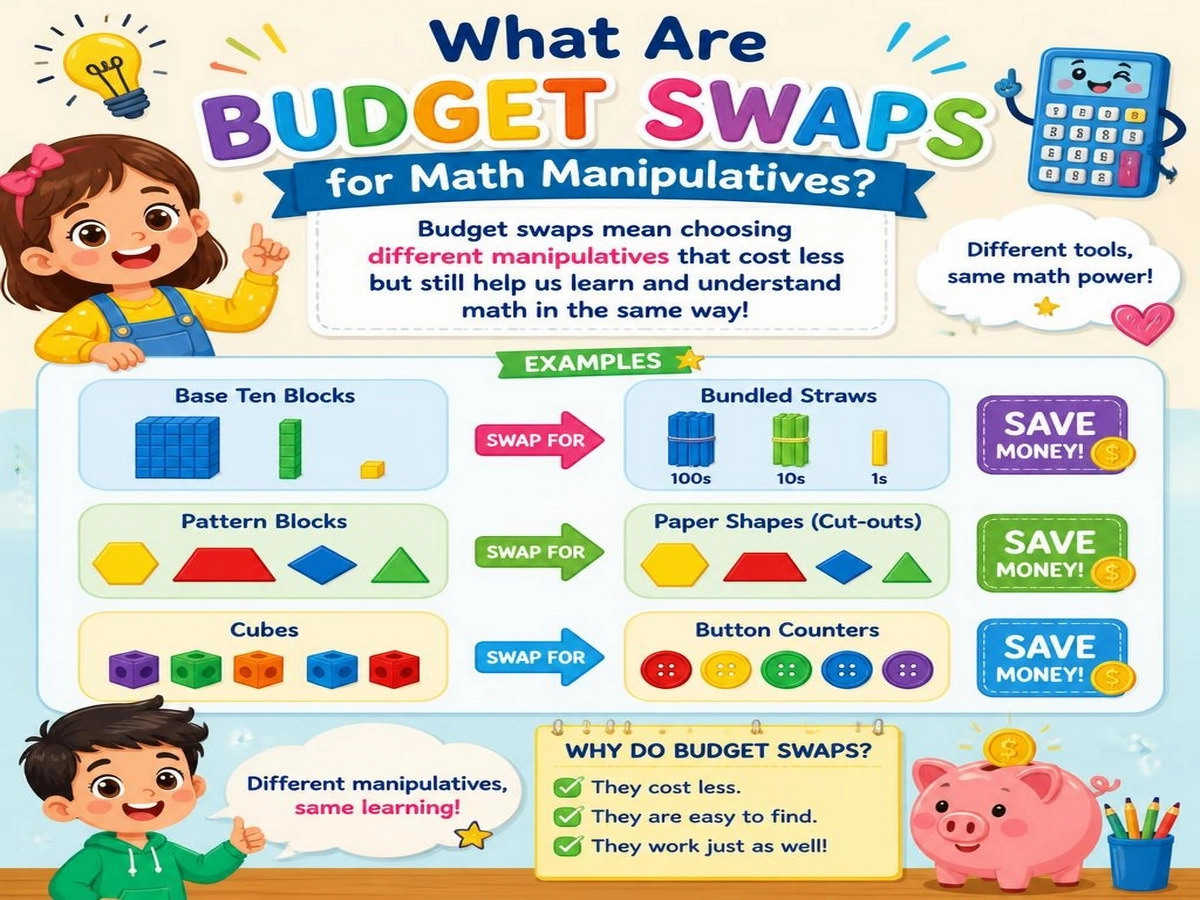
You don’t need to buy expensive kits. Many Grade 1 math manipulatives can be made from household items at little or no cost.
| Store-bought tool | Budget swap |
|---|---|
| Ten frame | Egg carton with two cups taped off, or a drawn grid |
| Linking cubes | LEGO bricks |
| Two-color counters | Coins (heads and tails) or beans painted on one side |
| Base ten blocks | Popsicle sticks with elastic bands, or pasta in cups |
| Rekenrek | Beads on two pipe cleaners (5 red, 5 white each) |
| Pattern blocks | Paper shapes cut from cereal boxes |
| Number line | Masking tape on the floor |
| Pan balance | Coat hanger with two cups |
Digital Manipulatives
Free digital tools like those on mathies, an Ontario-funded site, offer virtual ten frames, counters and base ten blocks. They’re handy when physical tools aren’t available, though physical handling remains valuable for young children.
How Do You Use Manipulatives Well at Home?
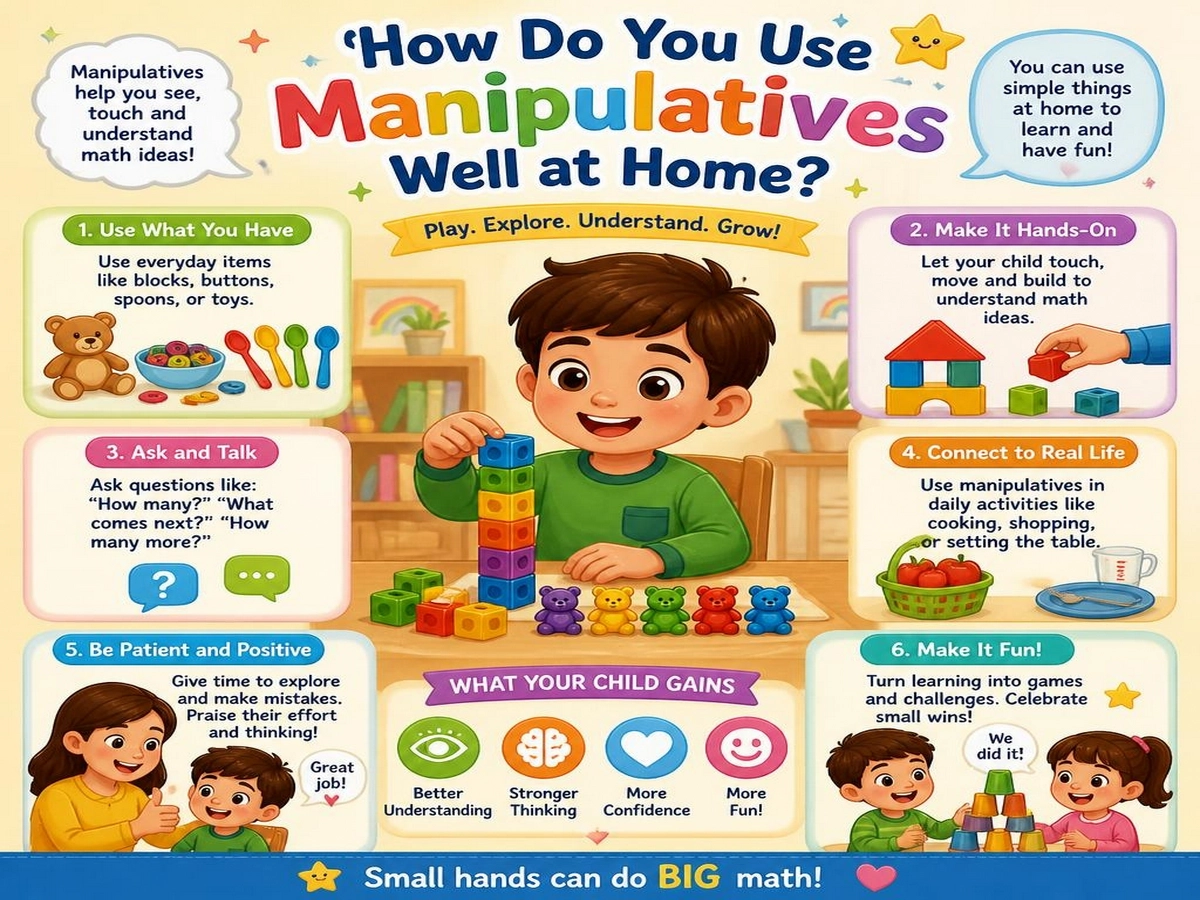
Use Grade 1 math manipulatives well by choosing one tool for one idea, modeling first, asking your child to explain, connecting to drawings and numbers, and putting tools away when understanding is secure.
- Match the tool to the idea. Ten frames for making 10; bundling sticks for tens and ones.
- Model briefly. Show how to use the tool for one example.
- Let your child try. Give them problems to solve with the tool.
- Ask “How did the tool help?” Explanations build understanding.
- Draw it. Sketch what the tool showed.
- Write the numbers. Connect to equations.
- Fade the tool. Use it less as understanding grows.
Expert Tip
Give children a minute of free play with new manipulatives before the math starts. Curiosity satisfied means focus improves.
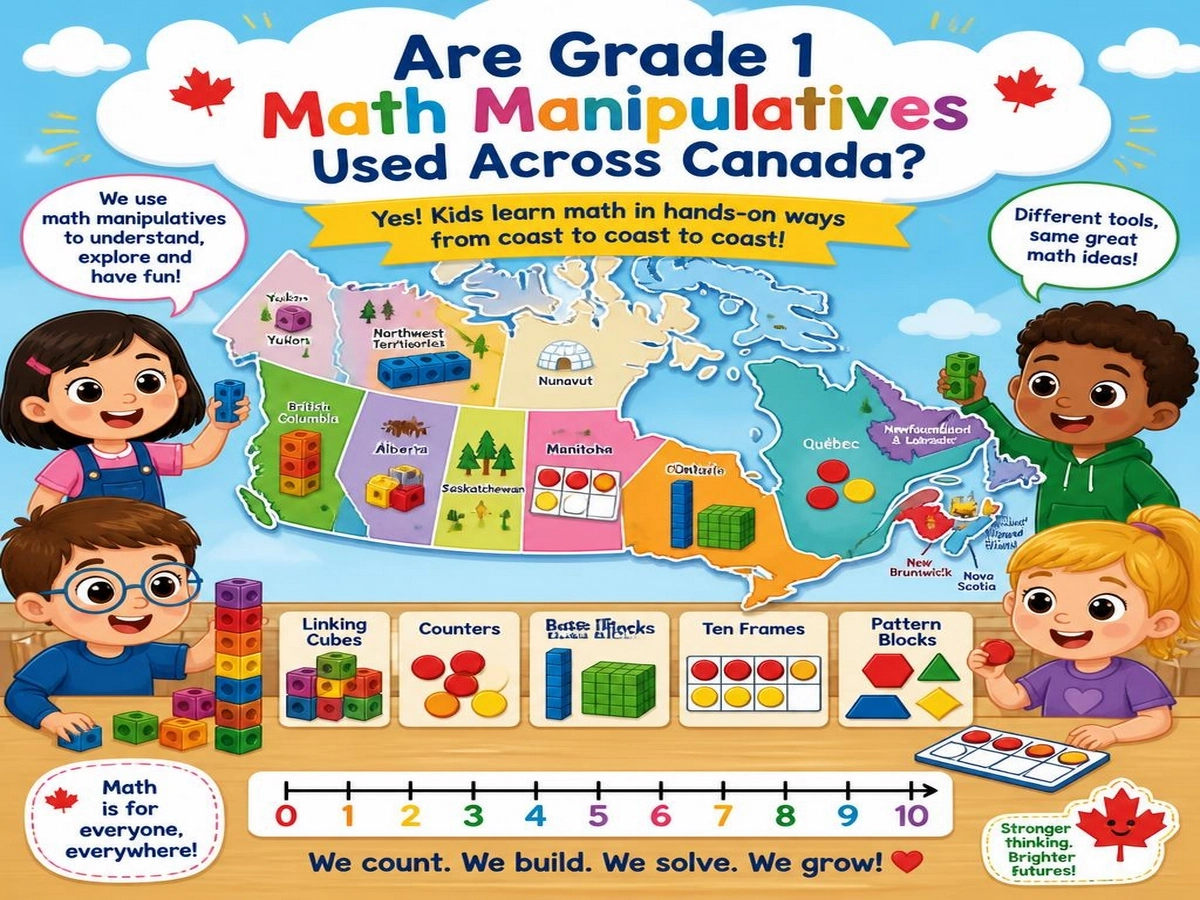
Are Grade 1 Math Manipulatives Used Across Canada?
Grade 1 math manipulatives are used in classrooms across Canada, because every provincial curriculum asks young children to use concrete materials and models. The tools may vary slightly from school to school, but ten frames, linking cubes, counters and base ten materials are common everywhere.
- Ontario: expectations repeatedly mention using “a variety of tools and strategies,” and Ontario teachers often use rekenreks and ten frames in Grade 1.
- British Columbia: the BC curriculum encourages concrete, pictorial and symbolic representations in the primary years.
- Alberta, the Prairies and Atlantic Canada: concrete materials are standard in early number instruction.
That means Grade 1 math manipulatives you use at home will feel familiar to your child at school, wherever you live. If you’re unsure which tools the class uses, ask the teacher. Matching tools at home and school makes practice smoother.
What Should Parents Say When Using Manipulatives?
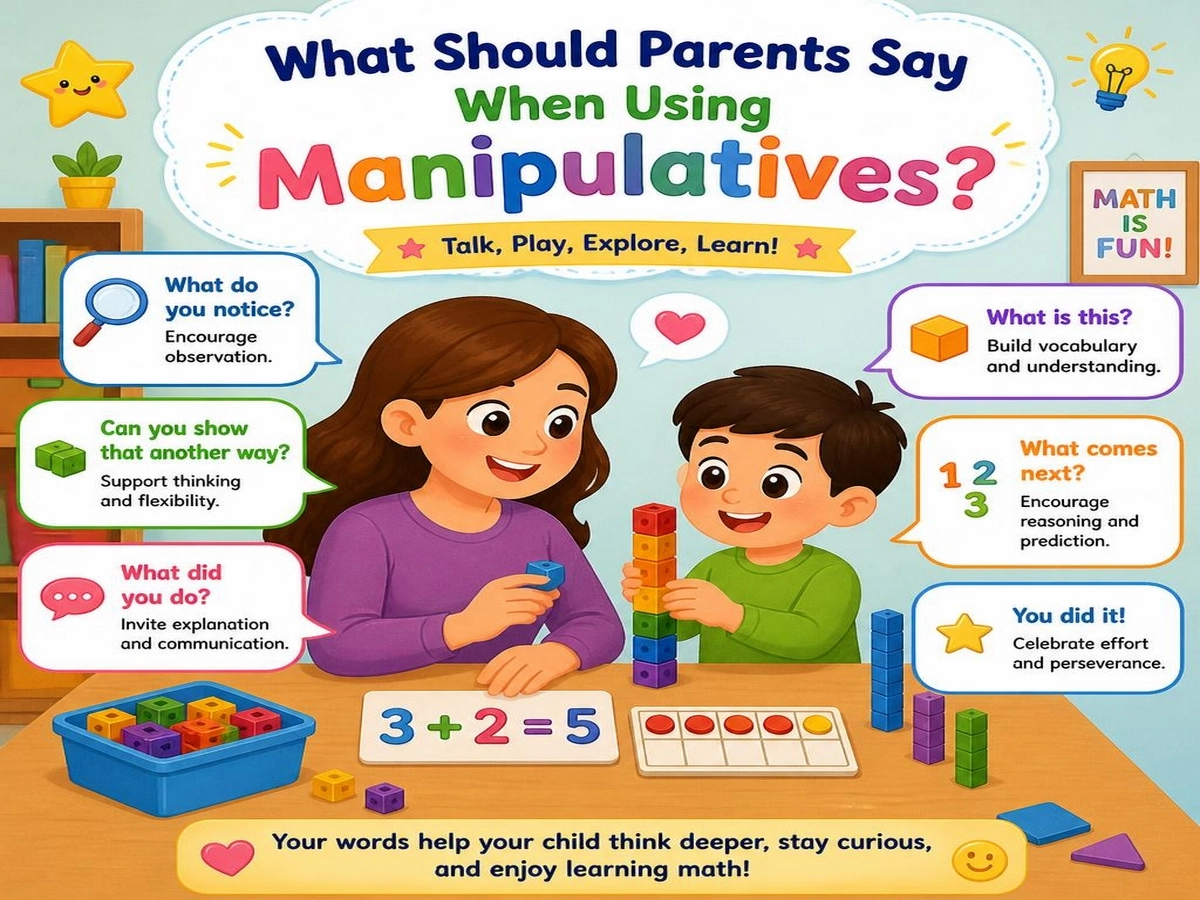
The right questions turn objects into thinking tools. Use these prompts.
- “Can you show me 14 with the cubes?”
- “How does the ten frame help you see the answer?”
- “Can you draw what you built?”
- “What number sentence matches your blocks?”
- “Do you still need the cubes, or can you picture it?”
What Do Teachers Wish Parents Knew About Manipulatives?
Teachers often wish parents knew that Grade 1 math manipulatives aren’t “baby tools” or cheating. They’re how strong understanding is built, and even older students use them for new ideas.
- Tools support thinking. Using cubes is real math.
- Connection matters. Always link objects to numbers.
- Less is more. One tool at a time.
- Kitchen items work. No need for expensive kits.
A Quick Story
A child struggles with “making 10” until her mom brings out an egg carton with two cups taped off. She fills 8 cups with cereal and immediately sees “2 more to make 10.” Within a week, she’s solving 8 + 5 in her head by picturing the egg carton. The tool built the picture; the picture built the strategy.
How Can Everyday Life Provide Manipulatives?
Everyday life is full of free Grade 1 math manipulatives.
- Kitchen: pasta, beans, cereal, egg cartons, measuring cups
- Playroom: LEGO, blocks, toy cars, beads
- Wallet: coins
- Outdoors: rocks, sticks, leaves, pinecones
- Office: paper clips, sticky notes, rubber bands
How Can You Adapt Manipulatives for Different Learners?
Adapt Grade 1 math manipulatives by choosing tools that suit your child’s learning style and needs.
Tactile Learners
The best Grade 1 math manipulatives for tactile learners are linking cubes, playdough and counters.
Visual Learners
Visual learners love Grade 1 math manipulatives like ten frames, rekenreks and colorful pattern blocks.
Learners Who Need More Support
Use bigger objects, fewer at a time and one tool consistently. Children who find math hard often benefit most from Grade 1 math manipulatives, because the objects carry some of the thinking load while understanding grows.
Learners Ready for More
Use base ten blocks for numbers beyond 50 or pattern blocks to compose new shapes. Challenge them to invent a problem and show the solution with a tool, then explain it to a sibling or stuffed animal.
What Does a 4-Week Manipulatives Plan Look Like?
A 4-week Grade 1 math manipulatives plan introduces one main tool per week, connected to a key skill.
| Week | Tool | Skill | Connection to symbols |
|---|---|---|---|
| 1 | Ten frames | Subitizing, making 10 | Write number bonds |
| 2 | Linking cubes | Comparing, patterns | Write comparisons |
| 3 | Bundling sticks | Tens and ones | Write two-digit numbers |
| 4 | Coins | Skip counting, money | Write amounts in ¢ |
Try It: 8 Grade 1 Manipulatives Practice Tasks
Use the tools named. Sample answers follow.
- Show 7 on a ten frame. How many empty spaces?
- Build a tower of 6 cubes and one of 9. How many more is the taller tower?
- Show 23 with bundling sticks.
- Use counters to show two ways to make 8.
- On a rekenrek, show 12. How did you slide the beads?
- Use pattern blocks to make an AB pattern.
- Count 4 dimes by 10s.
- Find 15 on a hundred chart. What’s 10 more?
Sample answers: 1) 3; 2) 3 more; 3) 2 bundles and 3 sticks; 4) 5 and 3, 6 and 2 (any); 5) 10 on the top row, 2 on the bottom; 6) any repeating AB pattern; 7) 40¢; 8) 25.
Myths vs. Facts About Manipulatives
| Myth | Fact |
|---|---|
| Manipulatives are a crutch. | They build understanding when linked to symbols. |
| You need expensive kits. | Household items work well. |
| Older kids don’t need them. | Manipulatives help with any new concept. |
| Any use of manipulatives helps. | Purposeful, guided use is what works. |
What Are Common Manipulatives Mistakes?
Common Grade 1 math manipulatives mistakes include using too many tools at once, never connecting tools to numbers, using manipulatives only for play, and removing them too early.
- Too many tools. Use one at a time.
- No connection to symbols. Always draw and write.
- Play only. Give a clear math task.
- Removing too soon. Fade gradually.
- No talk. Ask children to explain.
Common Mistake
Leaving manipulatives as a separate activity from written math. The power comes from connecting the cubes to the equation. Always ask, “What number sentence matches what you built?”
How Do You Know Manipulatives Are Helping?
Manipulatives are helping when your child can explain math ideas using the tools, draw what they built, connect it to numbers and gradually solve problems without the tools.
Checklist
- Uses tools to solve problems
- Explains what the tool shows
- Draws a picture of the model
- Writes the matching number sentence
- Solves similar problems without the tool
How Do Manipulatives Change in Grade 2 and Grade 3?
In Grade 2, base ten blocks extend to hundreds, fraction pieces appear and rulers become measurement tools. In Grade 3, arrays, fraction strips and geoboards support multiplication, fractions and area.
- Grade 1 connections: ten frames, tens and ones and number bonds.
- Big picture: our Canadian Grade 1 math guide and Canadian math practice roadmap.
- Homeschooling families: our post on homeschool math in Ontario covers tool kits too.
Future Trends
Digital manipulatives are becoming more sophisticated and widely available, especially for home learning. The best approach blends physical and digital tools, always connected to pictures and numbers.
Frequently Asked Questions About Grade 1 Math Manipulatives
What are Grade 1 math manipulatives?
They’re hands-on tools like ten frames, linking cubes, rekenreks, counters and coins that help children understand math concepts.
Do manipulatives really help kids learn math?
Yes. Research shows they help, especially when used purposefully and connected to pictures and symbols.
What is a rekenrek?
A rekenrek is a counting rack with two rows of 10 beads, grouped in fives, that helps children see numbers in groups.
What are linking cubes used for?
Building towers, comparing lengths, making patterns, grouping tens and exploring addition and subtraction.
What is the concrete pictorial abstract approach?
It’s a teaching sequence that moves from real objects to drawings to numbers, building understanding step by step.
Can I make manipulatives at home?
Yes. Egg cartons, pasta, coins, LEGO and popsicle sticks make excellent free tools.
Are digital manipulatives as good as physical ones?
They’re helpful, especially for practice, but physical tools are valuable for young children’s first experiences.
When should my child stop using manipulatives?
Fade them gradually as your child can explain and solve problems without them. Bring them back for new concepts.
Which manipulatives should I buy first?
Start with ten frames (printable), linking cubes or LEGO, and real coins. These cover most Grade 1 skills.
Conclusion: Touch It, See It, Understand It
Grade 1 math manipulatives help children see math before they write it. Choose a few key tools, use them purposefully, connect them to pictures and numbers and fade them as understanding grows. Your kitchen probably already has everything you need.
Explore the full year in our Canadian Grade 1 math guide, and find more hands-on ideas in our Canadian math practice roadmap.
Pair hands-on tools with great practice. InukMath offers free Grade 1 lessons, games and printable worksheets that connect manipulatives to math. Join free and explore our Grade 1 worksheets.
Sources and Further Reading
- Ontario Ministry of Education, The Ontario Curriculum: Mathematics, Grades 1 to 8 (2020)
- Carbonneau, Marley & Selig (2013), A meta-analysis of the efficacy of teaching mathematics with concrete manipulatives, Journal of Educational Psychology
- Education Endowment Foundation, Improving Mathematics in the Early Years and Key Stage 1
- mathies: Ontario math learning tools
- BC Ministry of Education, Mathematics K-9 curriculum