
Grade 1 Ten Frames: The Simple Tool That Builds Powerful Number Sense
Grade 1 ten frames are simple 2-by-5 grids that hold up to ten counters, and they’re one of the most powerful number sense tools a young child can use. A ten frame shows any number from 0 to 10 in relation to 5 and 10, so children can “see” that 7 is 5 and 2 more, or 3 less than 10, without counting one by one.
Teachers across Canada use ten frames daily in kindergarten and Grade 1, and for good reason. They build subitizing, number bonds, making 10, addition and subtraction strategies and early place value, all with one humble grid.
This guide explains what Grade 1 ten frames are, why they work, nine powerful ten frame activities, how to use double ten frames for numbers to 20, common mistakes and how ten frame thinking grows in later grades.
Quick Answer
Grade 1 ten frames are 2-by-5 grids that help children see numbers to 10 as parts of 5 and 10. They build subitizing (seeing amounts instantly), number bonds, making 10 with ten frames and early addition and subtraction. Two ten frames together show numbers to 20 and introduce tens and ones.
Key Takeaways
- Grade 1 ten frames show numbers in relation to 5 and 10.
- They build subitizing, so kids recognize amounts without counting.
- Empty spaces show “how many more to make 10.”
- Double ten frames extend thinking to 20 and early place value.
- Flashing ten frames briefly is one of the best number sense activities.
Table of Contents
- What Are Grade 1 Ten Frames?
- Why Do Grade 1 Ten Frames Work So Well?
- What Is Subitizing and Why Does It Matter?
- 9 Powerful Grade 1 Ten Frames Activities for Number Sense
- How Do You Use Double Ten Frames for Numbers to 20?
- Are Ten Frames Used Across Canada?
- What Should Parents Say During Ten Frame Practice?
- What Do Teachers Wish Parents Knew About Ten Frames?
- How Can Everyday Life Use Ten Frame Thinking?
- How Can You Adapt Ten Frames for Different Learners?
- What Does a 4-Week Ten Frames Plan Look Like?
- Try It: 8 Grade 1 Ten Frames Practice Questions
- What Are Common Ten Frame Mistakes?
- How Do You Know Your Child Has Mastered Ten Frames?
- How Does Ten Frame Thinking Grow Later?
- Frequently Asked Questions About Grade 1 Ten Frames
- Conclusion: Ten Boxes, Endless Number Sense
What Are Grade 1 Ten Frames?
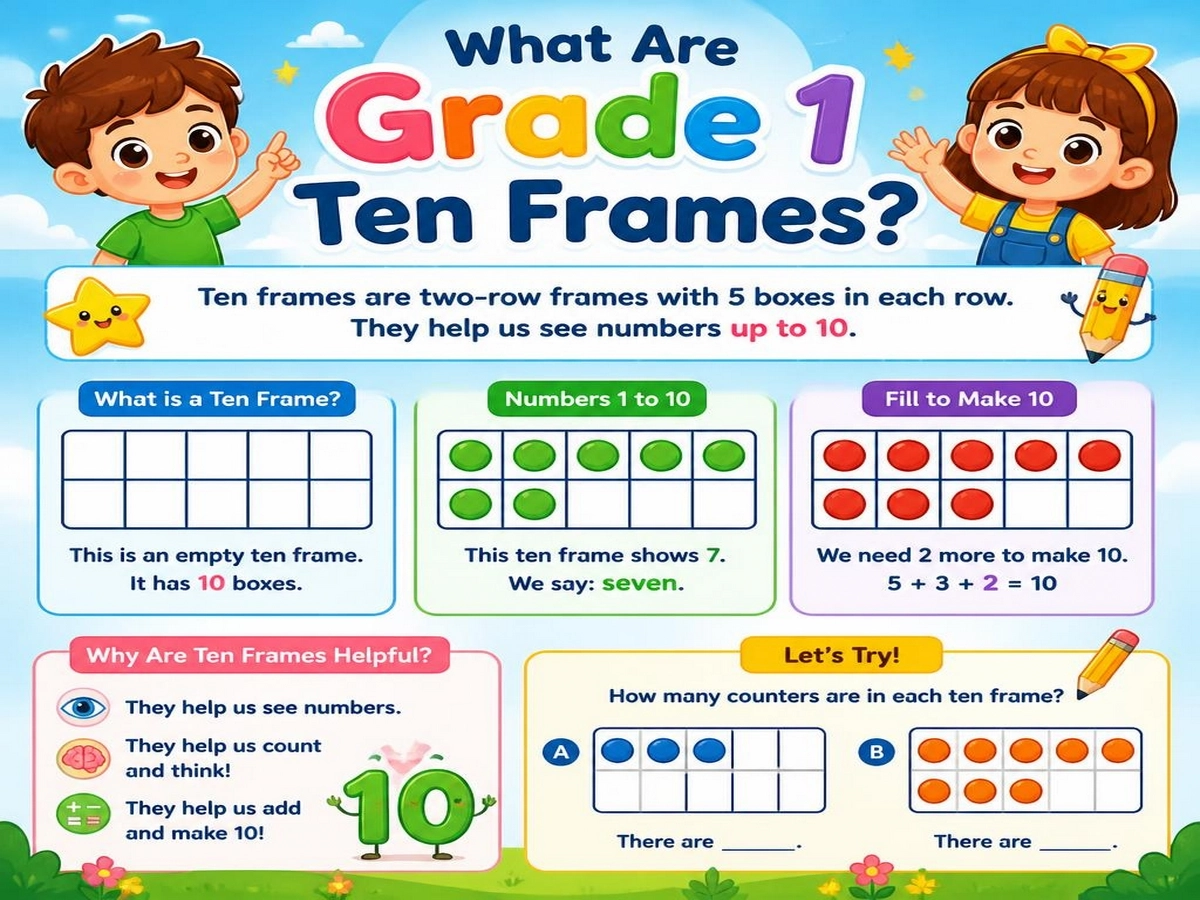
Grade 1 ten frames are rectangular grids with two rows of five boxes. Children place counters in the boxes, filling the top row first from left to right, then the bottom row. The structure makes it easy to see how many counters there are, how many are missing to make 10 and how a number relates to 5.
The Ontario mathematics curriculum asks Grade 1 students to compose and decompose numbers, recall facts to 10 and use mental math strategies within 20. Ten frames are one of the “variety of tools” teachers use to meet all three expectations.
Why the 5 and 10 Structure Matters
Our number system is built on tens, and our hands are built on fives. Ten frames combine both. When children see 8 on a ten frame, they notice a full row of 5 plus 3 more, and only 2 empty spaces. That’s three facts at once: 5 + 3 = 8, 8 + 2 = 10 and 10 − 2 = 8.
Number Sense Tools Compared
Ten frames sit alongside other number sense tools like rekenreks, number lines and hundred charts. Ten frames are the best starting point for numbers to 10 and 20.
Why Do Grade 1 Ten Frames Work So Well?
Grade 1 ten frames work because they make number structure visible. Children stop counting by ones and start seeing groups, which is the foundation of number sense, fact fluency and place value.
The Learning Trajectories research by Douglas Clements and Julie Sarama identifies subitizing, recognizing small amounts instantly, as a key early skill, and ten frames are a classic tool for building it. A meta-analysis of manipulatives by Carbonneau, Marley and Selig (2013) found that concrete tools improve learning when they’re used with clear purpose, which describes good ten frame practice perfectly.
Ten frames help children:
- Subitize. Recognize amounts without counting.
- Learn number bonds. See parts that make 10.
- Make 10. Spot empty spaces instantly.
- Add and subtract. Model problems visually.
- Understand teen numbers. One full frame plus extras.

What Is Subitizing and Why Does It Matter?
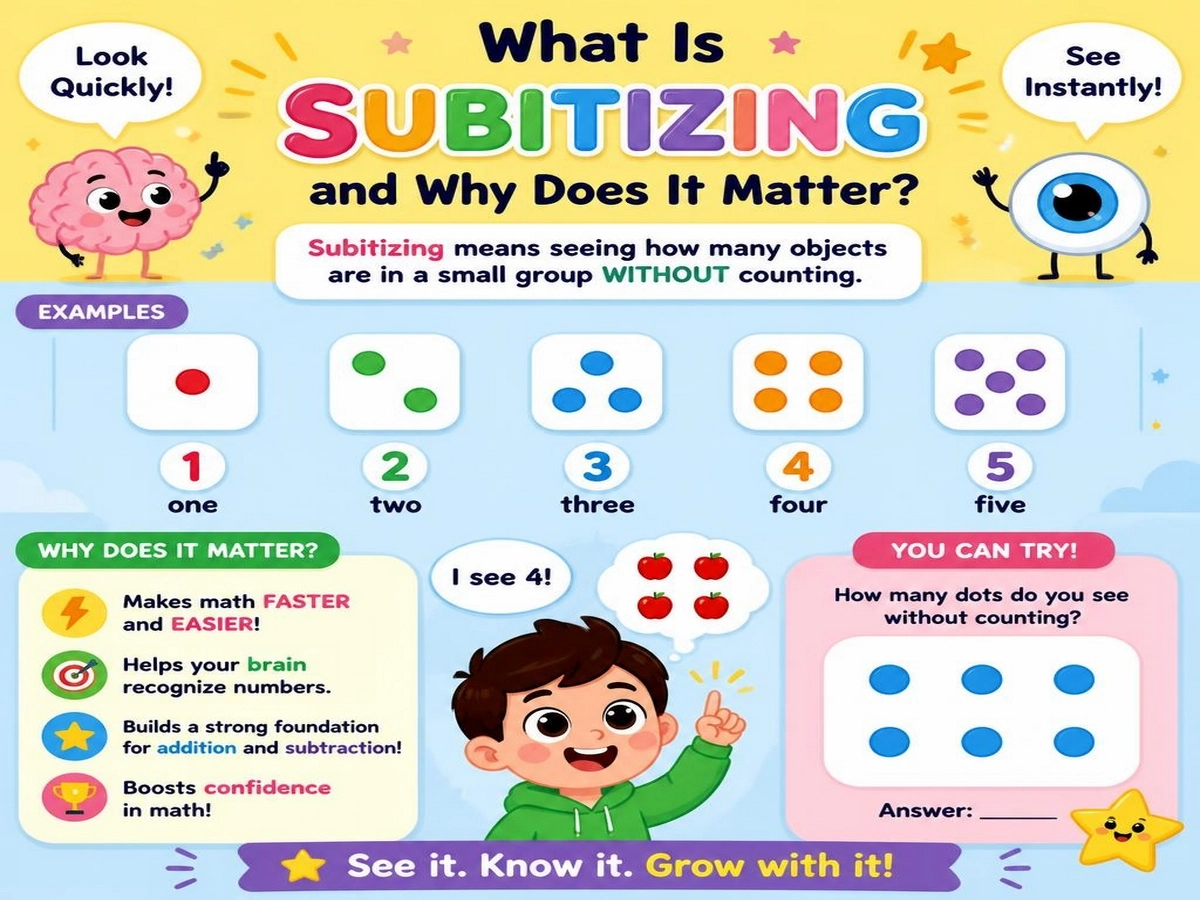
Subitizing is recognizing how many objects are in a small group instantly, without counting. Adults subitize up to about 4 or 5 items naturally, and with structured arrangements like ten frames, children learn to “see” larger amounts like 7 or 9 quickly.
There are two kinds:
- Perceptual subitizing: instantly seeing 1 to 4 items.
- Conceptual subitizing: seeing larger amounts as combined parts, like 8 as “5 and 3.”
Ten frames build conceptual subitizing, which is directly linked to fact fluency. A child who sees 9 as “one less than 10” will solve 9 + 4 much faster.
9 Powerful Grade 1 Ten Frames Activities for Number Sense
These nine ten frame activities build subitizing, number bonds and making 10. Most need only a printed or drawn ten frame and some counters.

1. Flash and Say
Flash a ten frame card for two seconds, then hide it. “How many did you see? How did you see it?” This is the single best subitizing activity.
2. Fill It Up
Roll a die and add that many counters to a ten frame. Keep rolling until the frame is full. “How many more do you need?”
3. Make 10 Match
Lay out ten frame cards face up. Find pairs that make 10, like a 6 card and a 4 card. This builds making 10 with ten frames.
4. Ten Frame War
Each player flips a ten frame card. The bigger number wins. Players say how they know without counting.
5. How Many Empty?
Show a ten frame with 7 counters. Ask only, “How many empty spaces?” This targets the “missing part” thinking behind subtraction.
6. Two-Color Stories
Use red and yellow counters. “There are 6 red and 3 yellow. How many altogether?” Then, “How many more to make 10?”
7. Egg Carton Frame
Cut two cups off a dozen egg carton to make a 2-by-5 frame. Fill it with pom-poms or cereal. Great for kitchen math.
8. Double Ten Frame Teens
Use two ten frames. Fill one completely and add some to the second. “Ten and 4 more is 14.” This builds teen number understanding.
9. Ten Frame Bingo
Make bingo cards with numerals. Flash ten frames; players cover the matching number.
How Do You Use Double Ten Frames for Numbers to 20?
Double ten frames place two ten frames side by side to show numbers up to 20. A full first frame shows 10, and the second frame shows the extra ones, making teen numbers clear: 16 is one full ten and 6 more.
| Number | First frame | Second frame | What kids see |
|---|---|---|---|
| 12 | Full (10) | 2 | Ten and 2 |
| 15 | Full (10) | 5 (full top row) | Ten and 5 |
| 18 | Full (10) | 8 | Ten and 8, or 2 less than 20 |
| 20 | Full (10) | Full (10) | Two tens |
Using Double Frames for Addition
For 8 + 5, put 8 in the first frame and 5 in the second. Move 2 counters to fill the first frame. Now it’s 10 + 3 = 13. Children physically see the making 10 strategy. Our guide to Grade 1 number bonds explains this strategy in detail.

Are Ten Frames Used Across Canada?
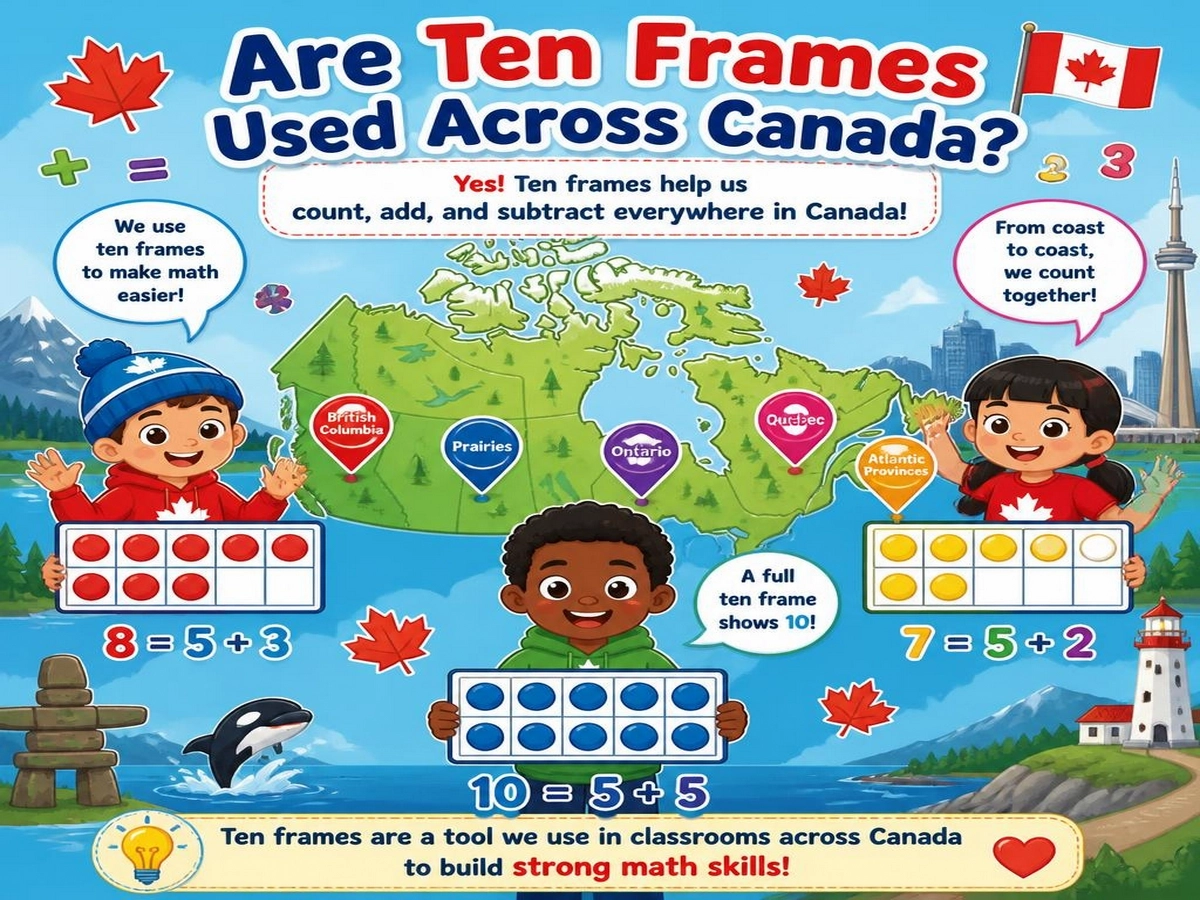
Ten frames are used in classrooms across Canada, from Ontario to British Columbia to the Atlantic provinces. They appear in many Canadian math resources and teacher guides as a core early number tool.
- Ontario: ten frames support Grade 1 expectations on composing numbers and facts to 10.
- British Columbia: the BC curriculum emphasizes visualizing numbers and decomposing them, which ten frames support.
- Other provinces: ten frames are a standard tool in primary classrooms.
Because they’re so widely used, Grade 1 ten frames practice at home matches what your child sees at school, wherever you live.
What Should Parents Say During Ten Frame Practice?
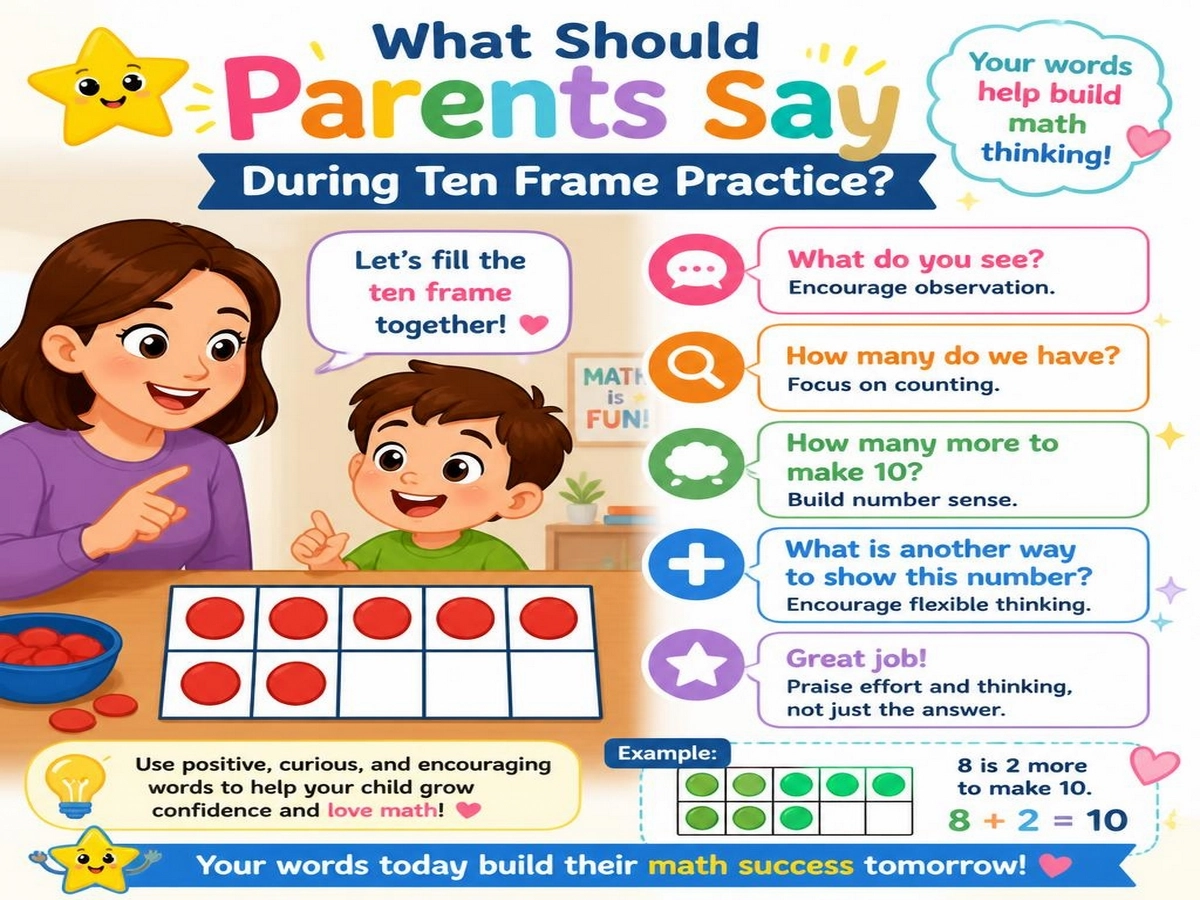
Simple, consistent questions help children reason with ten frames. Use these prompts.
- “How many do you see? How did you see it so fast?”
- “How many more to make 10?”
- “How many are in the top row? The bottom row?”
- “Is this more or less than 5?”
- “Can you show me 7 a different way?”
What Do Teachers Wish Parents Knew About Ten Frames?
Teachers often wish parents knew that Grade 1 ten frames are not just for counting, and that a few minutes of flashing frames each day can transform how quickly a child thinks about numbers. Their real power is helping children see numbers without counting, which is the bridge to fact fluency.
- Flash, don’t count. Brief flashes encourage seeing, not counting.
- Fill top row first. Consistency helps children see the 5 structure.
- Ask about empty spaces. That’s where subtraction and making 10 live.
- Connect to equations. Write the number sentence after each frame.
A Quick Story
A child always counts every counter one by one. His dad starts flashing ten frame cards for just two seconds. At first, he guesses. Within a week, he says, “That’s 8, because there are 2 empty.” He’s no longer counting; he’s seeing. That’s the shift ten frames are designed to create.

How Can Everyday Life Use Ten Frame Thinking?
Everyday life is full of ten frame shapes. Spot them together to strengthen Grade 1 ten frames thinking.
- Egg cartons: a dozen is 10 plus 2, or two rows of 6.
- Muffin tins: count filled and empty cups.
- Parking lots: rows of spaces, some filled.
- Ice cube trays: how many cubes are left?
- Fingers: two hands are a natural ten frame.
How Can You Adapt Ten Frames for Different Learners?
Adapt Grade 1 ten frames by changing materials, number ranges and speed.
Hands-On Learners
Build Grade 1 ten frames from egg cartons, then fill them with pom-poms and real counters.
Visual Learners
Printed Grade 1 ten frames cards with bright dots work best for visual learners.
Learners Who Need More Time
Start with 5-frames (one row of five), then move to Grade 1 ten frames once numbers to 5 feel easy.
Learners Ready for More
Use double ten frames for numbers to 20, or ask for several ways to show the same number.
What Does a 4-Week Ten Frames Plan Look Like?
A 4-week Grade 1 ten frames plan moves from building numbers to flashing to making 10 to teen numbers.
| Week | Focus | Activities | Goal by Friday |
|---|---|---|---|
| 1 | Building numbers | Fill It Up, Egg Carton Frame | Builds any number to 10 |
| 2 | Subitizing | Flash and Say, Ten Frame War | Names amounts without counting |
| 3 | Making 10 | Make 10 Match, How Many Empty? | Says partners to 10 instantly |
| 4 | Teen numbers | Double Ten Frame Teens | Explains 14 as ten and 4 |
Try It: 8 Grade 1 Ten Frames Practice Questions
Imagine or draw each ten frame. Answers follow.
- A ten frame has 6 counters. How many empty spaces?
- The top row is full and the bottom has 2. What number is it?
- How many more to make 10 if there are 3?
- A double ten frame shows one full frame and 5 more. What number?
- A ten frame has 9. What’s 9 + 1?
- Show 7 as “5 and ___.”
- A frame has 4 red and 3 yellow. How many altogether?
- 8 + 5: move 2 to make 10. What’s left over?
Answers: 1) 4; 2) 7; 3) 7; 4) 15; 5) 10; 6) 2; 7) 7; 8) 3, so 8 + 5 = 13.
Myths vs. Facts About Ten Frames
| Myth | Fact |
|---|---|
| Ten frames are just counting boards. | Their main job is helping kids see numbers without counting. |
| Kids outgrow ten frames quickly. | They support facts, teens and place value for years. |
| The order of filling doesn’t matter. | Filling the top row first makes the 5 structure clear. |
| You need to buy ten frames. | A drawn grid or egg carton works perfectly. |
What Are Common Ten Frame Mistakes?
Common Grade 1 ten frames mistakes include filling boxes randomly, always counting one by one, never connecting frames to equations and moving to double frames too early.
- Random filling. Fill the top row left to right, then the bottom.
- Counting every time. Flash frames to encourage seeing.
- No equations. Write the number sentence.
- Rushing to 20. Master 10 first.
- Skipping talk. Ask “How did you see it?”
Common Mistake
Leaving ten frames visible for too long during flash games. If children have time to count, they won’t develop subitizing. Two seconds is plenty.
How Do You Know Your Child Has Mastered Ten Frames?
Your child has mastered Grade 1 ten frames when they can name amounts on a ten frame without counting, say how many more make 10, build numbers to 20 on double frames and use ten frame pictures in their head to solve facts.
Checklist
- Names amounts 0 to 10 on a flashed frame
- Says partners to 10 instantly
- Builds teen numbers on double frames
- Uses making 10 for problems like 9 + 4
- Explains what they “see” in a frame
Check progress with our Grade 1 practice questions.
How Does Ten Frame Thinking Grow Later?
Ten frame thinking grows into mental math with numbers to 20 in Grade 1, two-digit addition in Grade 2 and multiplication arrays in Grade 3. The habit of seeing numbers in groups of 5 and 10 never stops being useful.
- Grade 1 connections: number bonds, math facts, mental math and manipulatives.
- Grade 2: Grade 2 doubles facts and number line strategies.
- Big picture: Canadian Grade 1 math and Canadian math practice.
Future Trends
Digital ten frames are popular in classrooms and apps, letting teachers flash frames quickly. Free tools like those on mathies offer virtual ten frames. Physical frames remain essential for first learning.
Frequently Asked Questions About Grade 1 Ten Frames
What are Grade 1 ten frames?
Grade 1 ten frames are 2-by-5 grids that hold up to ten counters, helping children see numbers in relation to 5 and 10.
How do ten frames help with math?
They build subitizing, number bonds, making 10, addition, subtraction and teen number understanding.
What is subitizing?
Subitizing is recognizing how many objects there are without counting. Ten frames help children subitize larger amounts.
What are good ten frame activities?
Flash and Say, Fill It Up, Make 10 Match, Ten Frame War and Double Ten Frame Teens are favorites.
How do I make a ten frame at home?
Draw a 2-by-5 grid on paper or cut two cups off an egg carton.
What is making 10 with ten frames?
It’s filling one ten frame to 10 by moving counters from another group, which makes adding across 10 easier.
Should I fill the top row first?
Yes. Filling the top row left to right first makes the 5 and 10 structure clear.
What are double ten frames?
Two ten frames side by side, used to show numbers up to 20.
When should my child stop using ten frames?
When they can picture ten frames mentally to solve facts. Many children keep using them for teen numbers through Grade 1.
Conclusion: Ten Boxes, Endless Number Sense
Grade 1 ten frames are simple, cheap and incredibly effective. Use them to build numbers, flash them to build subitizing, find empty spaces to make 10 and pair two frames for teen numbers. With a few minutes a day, your child will start seeing numbers instead of counting them.
Explore the full year in our Canadian Grade 1 math guide, and find more number sense tools in our Canadian math practice roadmap. For more addition ideas, try our post on Grade 1 addition practice.
Build number sense with ten frames. InukMath offers free Grade 1 lessons, games and printable worksheets with ten frames. Join free and explore our Grade 1 games.
Sources and Further Reading
- Ontario Ministry of Education, The Ontario Curriculum: Mathematics, Grades 1 to 8 (2020)
- Clements & Sarama, LearningTrajectories.org
- Carbonneau, Marley & Selig (2013), A meta-analysis of the efficacy of teaching mathematics with concrete manipulatives, Journal of Educational Psychology
- BC Ministry of Education, Mathematics K-9 curriculum
- mathies: Ontario math learning tools