
Grade 1 3D Objects: Cubes, Cones, Cylinders and Spheres Made Simple
Grade 1 3D objects are the solid shapes children see and handle every day: cubes, spheres, cones, cylinders, rectangular prisms and pyramids. In the Ontario curriculum, Grade 1 students sort three-dimensional objects and two-dimensional shapes by one attribute at a time, build three-dimensional objects and identify the two-dimensional shapes contained within structures and objects.
Kids already know a lot about 3D objects. They know a ball rolls and a block stacks. Grade 1 helps them name what they notice, sort objects by their properties and connect solid objects to the flat shapes on their faces.
This guide explains what Grade 1 3D objects include, the key vocabulary, eight hands-on activities, how to sort 3D shapes, common mix-ups, and how geometry grows in Grades 2 and 3.
Quick Answer
Grade 1 3D objects include cubes, spheres, cones, cylinders, rectangular prisms and pyramids. Children sort them by one attribute (rolls or stacks, flat or curved faces), build them with blocks or clay and find 2D shapes on their faces, like squares on a cube. Real objects from home are the best teaching tools.
Key Takeaways
- Grade 1 3D objects include cubes, spheres, cones, cylinders, prisms and pyramids.
- Children sort 3D shapes by one attribute at a time.
- Faces, edges and vertices are useful words, even if not required yet.
- Every 3D object has 2D shapes on its faces.
- Everyday objects like cans, boxes and balls make the best examples.
Table of Contents
- What Are Grade 1 3D Objects?
- Why Do Grade 1 3D Objects Matter?
- How Do Kids Learn About 3D Objects Step by Step?
- 8 Hands-On Grade 1 3D Objects Activities Kids Will Love
- What Are Faces, Edges and Vertices?
- How Do You Sort 3D Shapes in Grade 1?
- Are 3D Objects Taught the Same Way Across Canada?
- What Do Teachers Wish Parents Knew About 3D Objects?
- What Should Parents Say During 3D Shape Play?
- How Can Everyday Life Build 3D Shape Skills?
- How Can You Adapt 3D Objects Activities for Different Learners?
- Try It: 8 Grade 1 3D Objects Practice Questions
- What Are Common Grade 1 3D Objects Mistakes?
- How Do You Know Your Child Understands 3D Objects?
- How Do 3D Objects Grow in Grade 2 and Grade 3?
- Frequently Asked Questions About Grade 1 3D Objects
- Conclusion: Touch, Test and Talk About Shapes
What Are Grade 1 3D Objects?
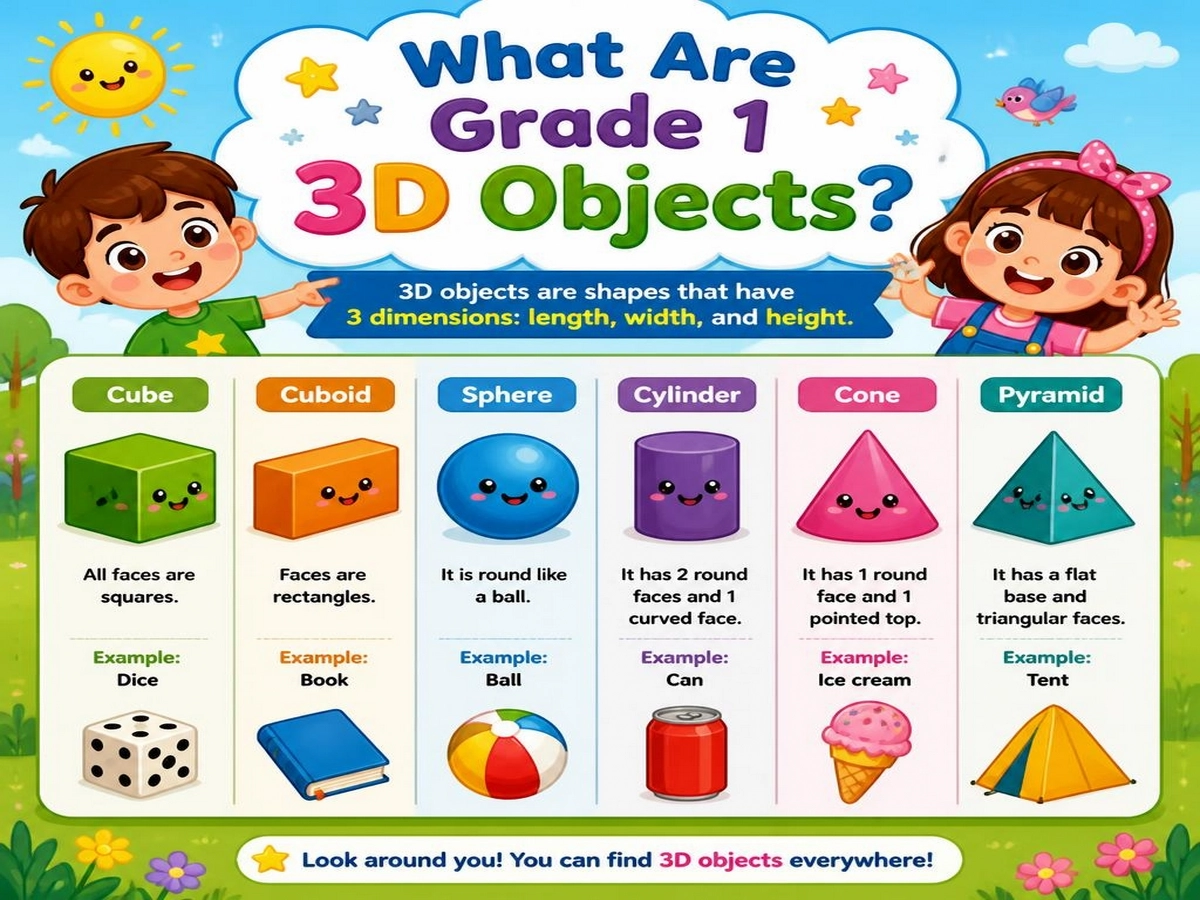
Grade 1 3D objects are solid shapes that have length, width and height. Unlike flat 2D shapes, you can hold them, stack them and roll them. Common examples include cubes (dice), spheres (balls), cylinders (cans), cones (ice cream cones), rectangular prisms (cereal boxes) and pyramids.
The Ontario mathematics curriculum Spatial Sense strand asks Grade 1 students to:
- Sort three-dimensional objects and two-dimensional shapes according to one attribute at a time, and identify the sorting rule.
- Construct three-dimensional objects, and identify two-dimensional shapes contained within structures and objects.
- Construct and describe 2D shapes and 3D objects that have matching halves.
3D Shapes for Kids: The Main Six
| 3D object | Everyday example | Rolls? | Stacks? | Flat faces |
|---|---|---|---|---|
| Cube | Die, sugar cube | No | Yes | 6 squares |
| Rectangular prism | Cereal box, brick | No | Yes | 6 rectangles |
| Sphere | Ball, orange | Yes | No | None |
| Cylinder | Soup can, paper towel roll | Yes (on its side) | Yes (on its flat face) | 2 circles |
| Cone | Ice cream cone, party hat | Yes (in a circle) | Sometimes | 1 circle |
| Pyramid | Tent, some roofs | No | Sometimes | Triangles and a base |
Solids and Shapes: What’s the Difference?
“Solids” (or 3D objects) are things you can hold. “Shapes” (2D) are flat outlines, like drawings on paper. A cube is a solid; a square is a shape. The square is one face of the cube.

Why Do Grade 1 3D Objects Matter?
Grade 1 3D objects matter because they build spatial reasoning, geometry vocabulary and the ability to describe and compare objects. Spatial skills are strongly linked to later success in math and science.
Spatial reasoning helps children:
- Visualize. Picture objects from different angles.
- Describe. Use precise words like “flat,” “curved” and “corner.”
- Sort and classify. Group objects by properties.
- Build. Plan and construct structures.
- Solve problems. Figure out how pieces fit together.
The Institute of Education Sciences early math practice guide recommends teaching geometry through a developmental progression, starting with recognizing and describing shapes before analyzing properties. The Learning Trajectories research follows the same path for 3D shapes.
How Do Kids Learn About 3D Objects Step by Step?
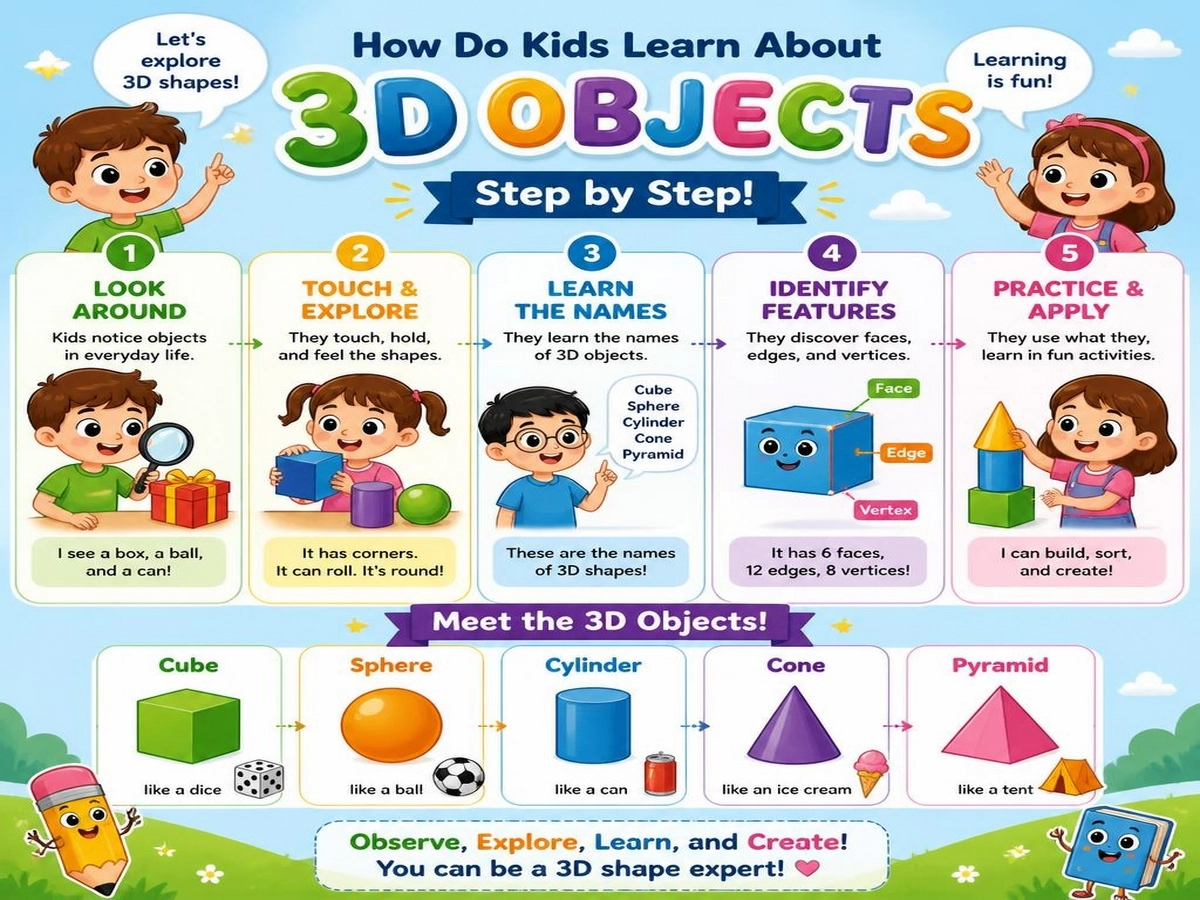
Kids learn Grade 1 3D objects by handling real objects, naming them, describing their properties, sorting them by one attribute, building them and finding 2D shapes on their faces.
- Explore real objects. Collect cans, boxes, balls and cones.
- Name them. “This is a cylinder.”
- Describe properties. “It has two flat circles and a curved side.”
- Sort by one attribute. Rolls vs. doesn’t roll.
- Build. Make objects from clay, blocks or straws.
- Find faces. Trace faces onto paper to see 2D shapes.
Expert Tip
Let children test properties. “Does it roll? Does it stack? Does it slide?” Testing is more memorable than being told.
InukMath’s Grade 1 3D solids lesson and 2D shapes lesson show how solid objects and flat shapes connect.
8 Hands-On Grade 1 3D Objects Activities Kids Will Love
These eight activities make Grade 1 3D objects concrete, memorable and fun.

1. Kitchen Shape Hunt
Search the kitchen for 3D objects. Find a cylinder (can), rectangular prism (box), sphere (orange) and cone (funnel). Sort them on the table.
2. Roll, Stack, Slide
Test each object: does it roll, stack or slide? Record results in a simple chart. This is sorting 3D shapes by properties.
3. Face Tracing
Trace each face of a box, can and block on paper. Which 2D shapes appear? A can gives circles; a box gives rectangles.
4. Playdough Builders
Make a sphere, cube, cylinder and cone from playdough. Talk about how you shaped each one.
5. Mystery Bag
Put a 3D object in a bag. Your child feels it without looking and describes it. “It has a point and a flat circle… a cone!”
6. Build a Town
Use boxes, cans and cones to build a town. Name each object used. Which shapes make good roofs? Good towers?
7. Straw and Marshmallow Frames
Build cube and pyramid frames with straws (or toothpicks) and mini marshmallows. Count the corners and edges.
8. Shape Riddles
“I have 6 square faces. What am I?” (cube) “I roll and have no flat faces.” (sphere) Kids love making up their own riddles too.
What Are Faces, Edges and Vertices?
Faces, edges and vertices are the parts of 3D objects. A face is a flat or curved surface, an edge is where two faces meet and a vertex is a corner where edges meet. Grade 1 children can begin using these words informally.
- Face: a surface. A cube has 6 flat faces.
- Edge: a line where two faces meet. A cube has 12 edges.
- Vertex (plural: vertices): a corner. A cube has 8 vertices.
Kid-friendly versions: faces are “sides you can touch,” edges are “lines you can run your finger along,” and vertices are “pointy corners.” The formal terms become more important in Grades 2 and 3.

How Do You Sort 3D Shapes in Grade 1?
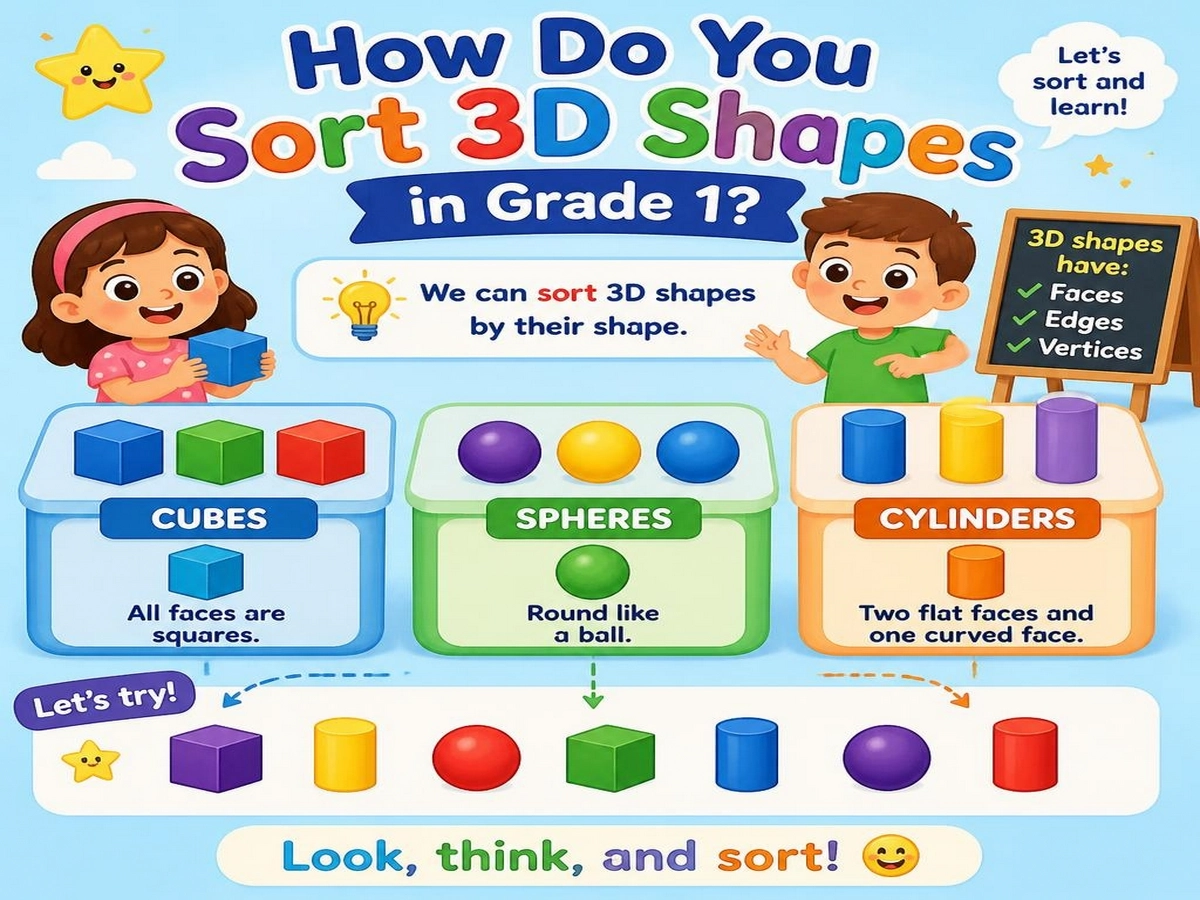
To sort 3D shapes in Grade 1, choose one attribute, such as “rolls” or “has a point,” and put each object into a group that fits the rule. Then explain the sorting rule in words.
Common sorting rules:
- Rolls / doesn’t roll
- Has flat faces / has curved surfaces
- Has corners / no corners
- Stacks / doesn’t stack
- Has a point / no point
Ask your child to sort the same objects in two different ways. Then challenge: “I sorted these. Can you guess my rule?” This builds flexible thinking about properties.
Are 3D Objects Taught the Same Way Across Canada?
Grade 1 3D objects are taught similarly across Canada, with children naming, describing, sorting and building solid shapes in the primary grades. Vocabulary varies slightly, with some provinces using “3D objects” and others “solids” or “3D shapes.”
- Ontario: sorting by one attribute, constructing objects and finding 2D shapes within them.
- British Columbia: the BC curriculum includes describing and sorting 3D objects in the primary years.
- Other provinces: most introduce 3D objects in Grade 1 or 2 through exploration and sorting.
The words differ a little, but the ideas are the same everywhere. Practice with real objects at home supports learning in any province.

What Do Teachers Wish Parents Knew About 3D Objects?
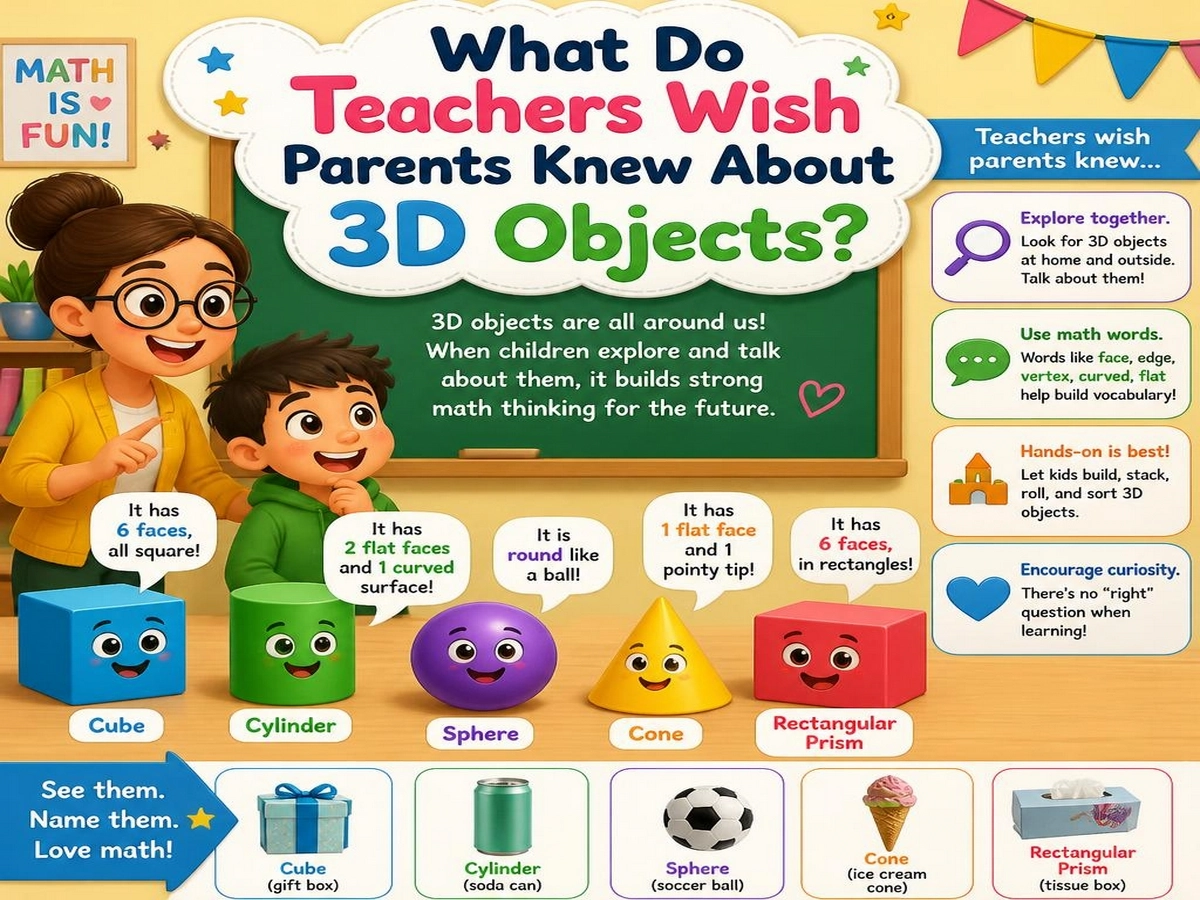
Teachers often wish parents knew that Grade 1 3D objects are best learned by touching and testing, not by memorizing names from a worksheet. Real objects create real understanding.
- Use household items. Cans, boxes and balls are perfect.
- Focus on properties. “Why does it roll?” matters more than the name.
- Connect 2D and 3D. Trace faces to show the link.
- Accept kid language. “Pointy” is fine before “vertex.”
A Quick Story
A child insists a can is a circle. His mom asks him to roll the can across the table, then trace its end on paper. “Oh! The circle is just the end part. The whole can is a cylinder!” Handling the object made the difference between 2D and 3D obvious.
What Should Parents Say During 3D Shape Play?
Simple, consistent language helps children describe what they notice. Use these prompts while your child explores Grade 1 3D objects.
- “What do you notice about this object? Is it flat or curved?”
- “Can you find its faces, edges and vertices? Run your finger along an edge.”
- “Will it roll? Will it stack? Let’s test it.”
- “What flat shape do you see on this side?”
- “Can you find something else in the room with the same shape?”
These questions encourage children to look closely, test their ideas and use precise words. They also make shape talk part of everyday play rather than a separate lesson.
How Can Everyday Life Build 3D Shape Skills?
Everyday life is full of 3D objects, and naming them during routines builds Grade 1 3D objects knowledge naturally.
- Grocery store: “Find a cylinder (can) and a rectangular prism (box).”
- Playground: “Is the slide tunnel a cylinder?”
- Bath time: “Which toys float? What shapes are they?”
- Building blocks: “Which shapes make the tallest tower?”
- Snack time: “Is a grape a sphere?”
How Can You Adapt 3D Objects Activities for Different Learners?
Adapt Grade 1 3D objects activities with building for hands-on learners, drawings for visual learners, fewer shapes for those who need time and more challenging properties for advanced learners.
Hands-On Learners
Build towns, towers and frames. Let them test every object.
Visual Learners
Use picture cards matching objects to photos. Trace faces in different colors.
Learners Who Need More Time
Start with 3 shapes: cube, sphere, cylinder. Add more once these are secure.
Learners Ready for More
Count faces, edges and vertices. Compare a cube with a rectangular prism. Build nets (flat patterns that fold into boxes).
A Sample 3D Objects Week
| Day | Ten-minute activity |
|---|---|
| Monday | Kitchen Shape Hunt |
| Tuesday | Roll, Stack, Slide test |
| Wednesday | Face Tracing |
| Thursday | Playdough Builders |
| Friday | Shape Riddles and Mystery Bag |
Try It: 8 Grade 1 3D Objects Practice Questions
Use real objects or pictures. Answers follow.
- What 3D object is a soup can?
- What 3D object is a ball?
- Which rolls: a cube or a sphere?
- What 2D shape is on each face of a cube?
- What 2D shape is at the end of a cylinder?
- Name an object at home shaped like a rectangular prism.
- Which 3D object has a point and one circle face?
- Sort these: ball, die, can. Which ones roll?
Answers: 1) cylinder; 2) sphere; 3) sphere; 4) square; 5) circle; 6) cereal box, book or brick (any); 7) cone; 8) ball and can roll; the die doesn’t.
Myths vs. Facts About 3D Objects
| Myth | Fact |
|---|---|
| A can is a circle. | A can is a cylinder; its ends are circles. |
| Kids must memorize faces, edges and vertices in Grade 1. | Grade 1 focuses on sorting, building and describing. |
| Worksheets are the best way to learn shapes. | Handling real objects builds stronger understanding. |
| 3D and 2D shapes are separate topics. | 2D shapes appear as faces of 3D objects. |
What Are Common Grade 1 3D Objects Mistakes?
Common Grade 1 3D objects mistakes include confusing 2D and 3D names, mixing up cubes and rectangular prisms, calling every round object a circle and sorting by more than one attribute at once.
- 2D vs. 3D names. Say “sphere” for balls, “circle” for flat drawings.
- Cube vs. prism. A cube has all square faces; a box usually has rectangles.
- Circle confusion. Round 3D objects are spheres or cylinders, not circles.
- Mixing attributes. Sort by one rule at a time.
- Orientation errors. A pyramid on its side is still a pyramid.
Common Mistake
Using only pictures to teach 3D objects. Children need to hold, roll and stack real objects to understand their properties.
How Do You Know Your Child Understands 3D Objects?
Your child understands Grade 1 3D objects when they can name common solids, describe their properties, sort them by one attribute, build simple objects and identify 2D shapes on their faces.
Checklist
- Names cube, sphere, cylinder, cone and rectangular prism
- Describes whether objects roll, stack or slide
- Sorts objects by one attribute and explains the rule
- Identifies 2D shapes on faces
- Builds a simple 3D object
Try our Grade 1 practice questions for quick shape checks.
How Do 3D Objects Grow in Grade 2 and Grade 3?
In Grade 2, children describe 3D objects using faces, edges and vertices more formally and compare prisms and pyramids. In Grade 3, they identify 2D shapes and 3D objects within structures and build models from descriptions.
- Grade 1 connections: Grade 1 symmetry and positional language.
- Grade 2: Grade 2 3D shapes.
- Grade 3: Grade 3 geometry.
Future Trends
Classrooms increasingly use 3D modeling apps and building kits alongside traditional blocks. The Education Endowment Foundation recommends using manipulatives purposefully, and nothing beats real objects for early geometry.
Frequently Asked Questions About Grade 1 3D Objects
What 3D objects do Grade 1 students learn?
Cubes, spheres, cylinders, cones, rectangular prisms and pyramids are the main Grade 1 3D objects.
What’s the difference between 2D and 3D shapes?
2D shapes are flat, like drawings. 3D objects are solid and can be held. 2D shapes appear on the faces of 3D objects.
Do Grade 1 kids need to know faces, edges and vertices?
They can start using these words, but the main Grade 1 focus is sorting, building and describing properties.
How do I teach 3D shapes for kids at home?
Use household objects. Test whether they roll, stack or slide, trace their faces and play shape riddles.
What does sorting 3D shapes mean?
It means grouping objects by one property, like “rolls” or “has flat faces,” and explaining the rule.
Is a can a circle?
No. A can is a cylinder. Its two ends are circles.
How are 3D objects connected to 2D shapes?
The faces of 3D objects are 2D shapes. A cube’s faces are squares; a cylinder’s ends are circles.
What’s a good 3D objects game?
Mystery Bag and Shape Riddles are favorites. They build vocabulary and reasoning about properties.
What comes after Grade 1 3D objects?
Grade 2 and Grade 3 explore faces, edges, vertices and more complex objects like prisms and pyramids.
Conclusion: Touch, Test and Talk About Shapes
Grade 1 3D objects come alive when children can touch, test and talk about them. Collect real objects, sort them by properties, build them and trace their faces. These simple activities build strong spatial reasoning and the vocabulary children need for later geometry.
Explore the full year in our Canadian Grade 1 math guide, see how geometry grows in our Canadian math practice roadmap, and find more shape ideas in our post on Grade 1 shapes and patterns practice.
Build shape smarts. InukMath offers free Grade 1 geometry lessons, games and printable worksheets. Join free and explore our Grade 1 worksheets.
Sources and Further Reading
- Ontario Ministry of Education, The Ontario Curriculum: Mathematics, Grades 1 to 8 (2020)
- Institute of Education Sciences, Teaching Math to Young Children practice guide (2013)
- Clements & Sarama, LearningTrajectories.org
- BC Ministry of Education, Mathematics K-9 curriculum
- Education Endowment Foundation, Improving Mathematics in the Early Years and Key Stage 1