
Grade 2 Math Games: Fun Ways to Practice Facts, Place Value and More
Grade 2 math games are one of the best ways to build fact fluency, place value, mental math and confidence. Second graders need lots of practice with facts to 20, numbers to 200 and two-digit addition and subtraction, and games deliver that practice in a way that feels like fun instead of homework.
Not all games are equal, though. The best Grade 2 math games require math on every turn, can be adjusted for difficulty and spark conversations about strategies.
This guide explains why games work, what makes a great Grade 2 math game, twelve fun card, dice and board games, online options, how to play smart, common mistakes and a weekly game plan.
Quick Answer
The best Grade 2 math games are quick, math-rich and adjustable: card games for math like Make 20 and Place Value War, dice games for addition and subtraction, board games with numbered paths, and short, curriculum-aligned online math games. Play 10 to 15 minutes a day, talk about strategies, and rotate games to practice facts, place value, money and geometry.
Key Takeaways
- Grade 2 math games build facts to 20, place value and mental math.
- The best games require math on every turn.
- Card and dice games are cheap, flexible and highly effective.
- Board games with linear number paths strengthen number sense.
- Strategy talk during games deepens learning.
Table of Contents
- What Are Grade 2 Math Games?
- Why Do Grade 2 Math Games Work So Well?
- What Makes a Great Grade 2 Math Game?
- 12 Fun Grade 2 Math Games That Build Real Skills
- Which Card Games for Math Work Best in Grade 2?
- How Do Online Math Games Fit In?
- How Do Grade 2 Math Games Support Regrouping and Two-Digit Math?
- How Can Grade 2 Math Games Build Confidence?
- What Are the Best Canadian Math Practice Games for Grade 2?
- How Do You Play Math Games Smart?
- What Should Parents Say During Math Games?
- What Do Teachers Wish Parents Knew About Math Games?
- How Can Everyday Life Become a Math Game?
- How Can You Adapt Math Games for Different Learners?
- What Does a Weekly Math Games Plan Look Like?
- Try It: 8 Quick Grade 2 Math Game Challenges
- What Are Common Grade 2 Math Games Mistakes?
- How Do You Know Games Are Working?
- Where Do Grade 2 Math Games Lead?
- Frequently Asked Questions About Grade 2 Math Games
- Conclusion: Play Your Way to Grade 2 Success
What Are Grade 2 Math Games?
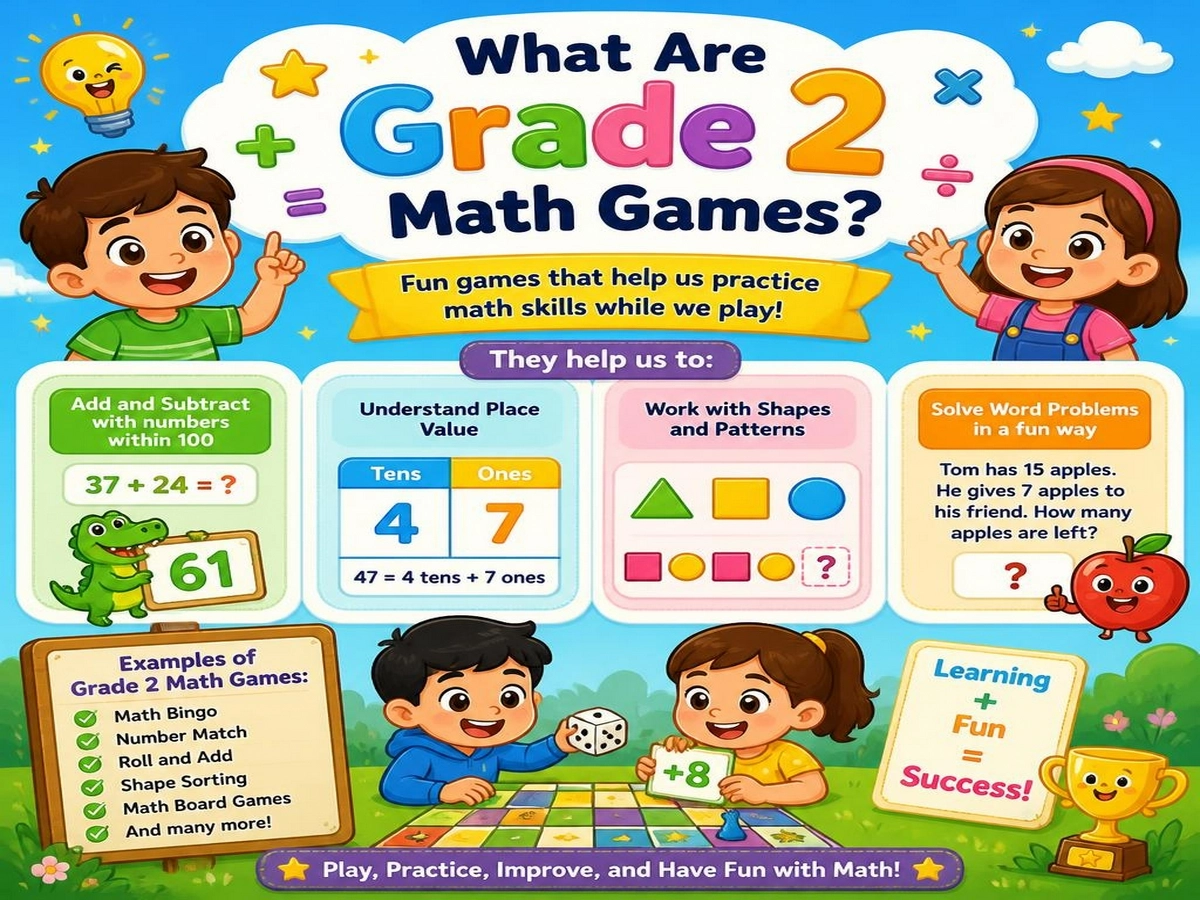
Grade 2 math games are games designed or adapted to practice Grade 2 math skills: facts to 20, numbers to 200, place value, two-digit addition and subtraction, money, patterns, data and geometry. They include card games, dice games, board games, movement games and online games.
A math game is different from just any game because the math is central: every turn requires counting, calculating, comparing or reasoning.
Math Games for Second Grade: What to Practice
| Skill | Game type |
|---|---|
| Facts to 20 | Card and dice addition games |
| Place value to 200 | Place Value War, dice building |
| Mental math | Target number games |
| Money | Coin games and store play |
| Geometry | Shape hunts and riddles |
| Data | Dice tally games |
Why Do Grade 2 Math Games Work So Well?
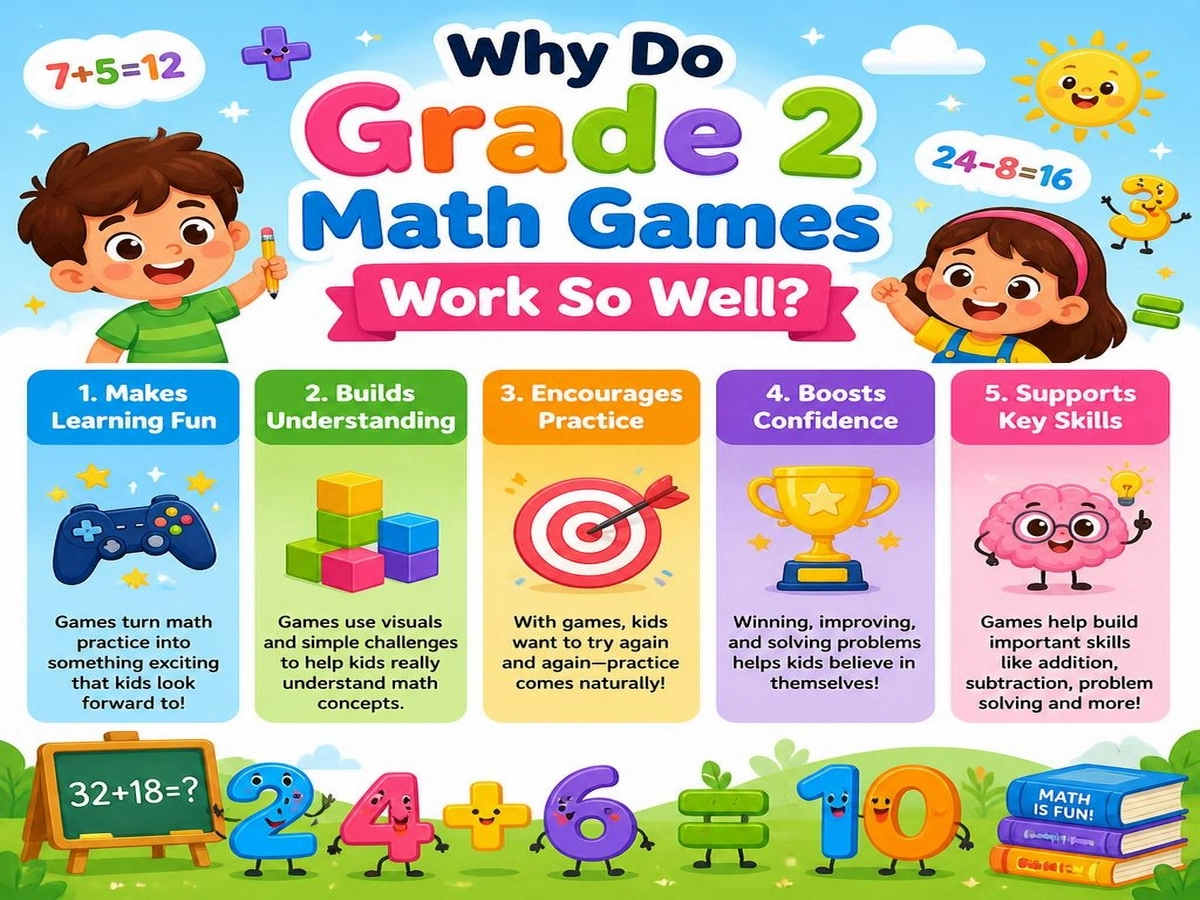
Grade 2 math games work because they combine high repetition, motivation, immediate feedback and social learning. Children practice skills dozens of times without boredom, and games encourage persistence and strategy talk.
Research supports games. Ramani and Siegler (2008) found that young children who played a linear number board game improved their number knowledge, with gains lasting weeks later. The Education Endowment Foundation recommends games, including board games, to build early number understanding. And the review by Dunlosky and colleagues (2013) found distributed practice highly effective, which is exactly what short daily games provide.
What Makes a Great Grade 2 Math Game?
A great Grade 2 math game is quick to learn, requires math on every turn, takes 10 to 15 minutes, includes strategy or choice and can be made easier or harder.
| Feature | Why it matters |
|---|---|
| Math every turn | Maximizes practice |
| Short rounds | Fits attention spans |
| Simple rules | More time for math |
| Adjustable difficulty | Grows with your child |
| Strategy | Builds reasoning |
| Social | Encourages talk |

12 Fun Grade 2 Math Games That Build Real Skills
These twelve Grade 2 math games cover the key skills of the year. Most need only cards, dice, coins or paper.

1. Make 20 (Facts)
Lay out cards. Find pairs that make 20, using face cards as 10. Builds facts to 20.
2. Double Dice Battle (Facts)
Each player rolls two dice and adds. Higher sum wins. Use 10-sided dice for harder facts.
3. Place Value War (Place Value)
Each player flips three cards (1 to 9, with hundreds limited to 1 or 2) and makes the largest number possible. Greater number wins.
4. Target 50 (Mental Math)
Roll dice and add to get as close to 50 as possible without going over.
5. Subtraction Race (Subtraction)
Start at 100. Roll two dice, make a two-digit number and subtract. First to reach 0 exactly wins.
6. Coin Collector (Money)
Roll a die and collect that many nickels, dimes or quarters. First to $2 wins. See Grade 2 financial literacy.
7. Doubles Snap (Doubles)
Flip cards; say the double for each. Snap matching cards. See Grade 2 doubles facts.
8. Hundred Chart Race (Number Sense)
Roll and move on a hundred chart, adding 10 when you land on a multiple of 5.
9. Even or Odd? (Number Sense)
Flip two cards and add. If the sum is even, Player A gets a point; if odd, Player B.
10. Shape Riddles (Geometry)
Describe a 3D shape by its properties; others guess.
11. Pattern Builder (Patterns)
One player starts a growing pattern; the other continues it and states the rule.
12. Dice Tally (Data)
Roll a die 30 times, tally results and make a bar graph.
Which Card Games for Math Work Best in Grade 2?
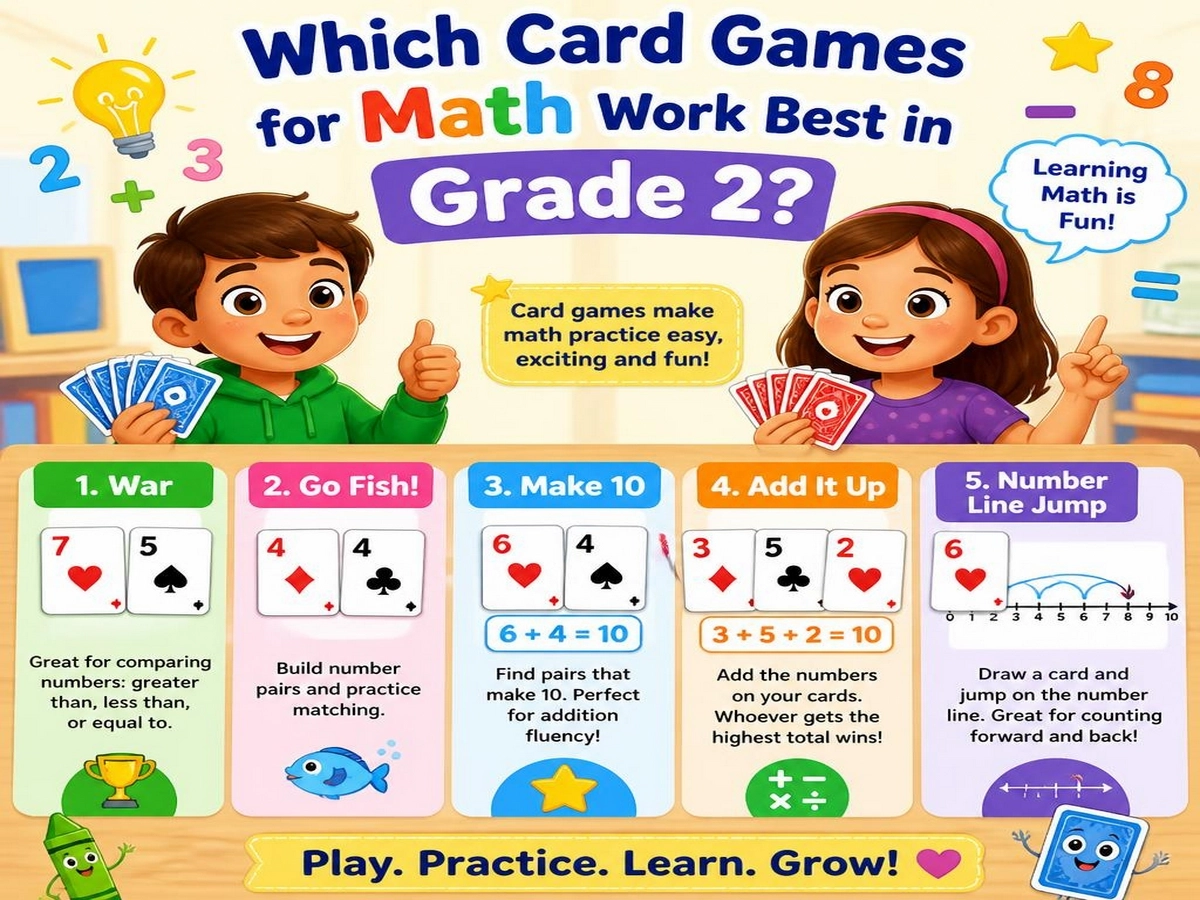
The best card games for math in Grade 2 use a regular deck (face cards as 10, aces as 1) to practice addition, subtraction, comparing and place value. Cards are cheap, portable and endlessly flexible.
| Card game | Skill | How to play |
|---|---|---|
| Make 20 | Facts to 20 | Find pairs that add to 20 |
| Place Value War | Place value | Make the biggest number |
| Subtraction War | Subtraction | Subtract two cards; bigger difference wins |
| Go Fish to 10 | Number bonds | Ask for the card that makes 10 |
| Closest to 100 | Mental math | Make two-digit numbers that add close to 100 |
How Do Online Math Games Fit In?
Online math games can be a helpful part of Grade 2 practice when they’re short, curriculum-aligned and focused on math rather than rewards. They offer instant feedback and adaptive difficulty.
Pros:
- Immediate feedback
- Adaptive levels
- Engaging visuals
Cons:
- Screen time
- Some games are mostly animation with little math
- Less conversation than family games
The Canadian Paediatric Society recommends a family media plan and prioritizing educational, interactive content. InukMath’s Grade 2 games are aligned with the Ontario curriculum, and our post on free Ontario curriculum-aligned math games lists more options.

How Do Grade 2 Math Games Support Regrouping and Two-Digit Math?
Grade 2 math games can make two-digit addition and subtraction, including regrouping, far less intimidating. When children build and trade numbers in a game, they practice the exact skills that cause the most trouble on worksheets.
- Race to 100: roll two dice, add the sum as ones (cubes or cents), and trade 10 ones for a ten whenever you can. First to 10 tens (100) wins.
- Race to Zero: start with 100 (ten dimes). Roll and subtract, trading a dime for 10 cents when needed.
- Closest to 100: draw four cards, make two two-digit numbers and add them to get as close to 100 as possible.
- Number Line Jumps: roll to decide jump sizes on an open number line and race to 100.
These games give children dozens of regrouping experiences in a single session. Pair them with our Grade 2 regrouping guide for a full approach.

How Can Grade 2 Math Games Build Confidence?
Grade 2 math games build confidence because they give children many small successes, a low-pressure setting and a chance to see their skills improve over time. For children who feel anxious about math, games can be a gentle way back in.
- Start easy. Choose a game your child can win sometimes.
- Play cooperatively. Work together against a target.
- Celebrate strategies. “You used doubles! Smart.”
- Notice progress. “Last week you counted on fingers; now you just know it.”
- Let them teach. Ask your child to explain the rules to a sibling.
Confidence grows when children feel capable. Games are one of the easiest ways to create that feeling every day.

What Are the Best Canadian Math Practice Games for Grade 2?
The best Canadian math practice games use familiar Canadian contexts like loonies, toonies, hockey and metric measurement. Familiar contexts make games more meaningful.
- Loonie Toss: toss coins at targets labeled with values; add your score.
- Hockey Card Place Value: use jersey numbers to compare and order.
- Snow Day Countdown: subtract days on the calendar to winter break.
- Maple Leaf Dice: roll and color maple leaves; first to 50 wins.
- Metric Measure-Off: estimate lengths in centimeters, then measure; closest wins.
How Do You Play Math Games Smart?
Play Grade 2 math games smart by choosing games that match current skills, keeping sessions short, talking about strategies, letting children explain their moves and mixing games across topics.
- Match the skill. Practice what’s being taught in class.
- Keep it short. 10 to 15 minutes.
- Ask “how did you know?”
- Adjust difficulty. Use bigger numbers or more dice.
- Rotate games. Keep it fresh.
Expert Tip
Play cooperatively sometimes. Working together toward a target, like reaching exactly 100, keeps games fun for children who get upset about losing.
What Should Parents Say During Math Games?
The right words turn a game into deeper learning. Use these prompts while playing Grade 2 math games.
- “How did you figure that out so fast?”
- “Is there another way to make 20?”
- “What do you need to roll to win?”
- “Which card should you keep? Why?”
- “Can you check my answer?”
Asking children to check your answers is especially powerful. They love catching a grown-up’s “mistake,” and they practice the math carefully while doing it.
What Do Teachers Wish Parents Knew About Math Games?
Teachers often wish parents knew that Grade 2 math games are real practice, and that the conversation during games is as valuable as the game itself.
- Games are practice. Not just a reward.
- Talk strategies. “How did you add that so fast?”
- Math-rich games only. Avoid luck-only games.
- Play regularly. Short and often.
A Quick Story
A child who dreads fact worksheets begs to play Make 20 every night. After three weeks, her teacher notices she answers facts to 20 faster in class. “We’ve just been playing cards,” her mom says. The cards did the drilling, and nobody cried.
How Can Everyday Life Become a Math Game?
Everyday moments can become quick Grade 2 math games.
- Car rides: “I’m thinking of a number between 50 and 100…”
- Grocery store: estimate totals and compare.
- Dinner: “Double the number of forks.”
- Walks: add house numbers together.
- Waiting rooms: play Twenty Questions with numbers.
How Can You Adapt Math Games for Different Learners?
Adapt Grade 2 math games for each child.
Learners Who Need Support
Use smaller numbers, play cooperatively and focus on one skill. Grade 2 math games with ten frames or counters on the table give extra support without slowing the fun.
Active Learners
Choose Grade 2 math games with movement, like hopscotch facts and target throws.
Visual Learners
Use ten frames, hundred charts and colorful cards. A visible score chart helps visual learners track progress during longer games, and seeing their totals climb is motivating too.
Learners Ready for More
Add a third die, use three-digit numbers or add strategic choices. Challenge them to invent a new rule that makes a favorite game harder, then test whether it works.
What Does a Weekly Math Games Plan Look Like?
A weekly Grade 2 math games plan rotates skills so children practice everything.
| Day | Game | Skill |
|---|---|---|
| Monday | Make 20 | Facts |
| Tuesday | Place Value War | Place value |
| Wednesday | Target 50 | Mental math |
| Thursday | Coin Collector | Money |
| Friday | Child’s choice | Mixed |
Try It: 8 Quick Grade 2 Math Game Challenges
Answers follow.
- Which two cards make 20: 7, 13, 9, 11?
- Make the biggest number with 1, 6 and 4.
- Roll 6 and 5. What’s the sum?
- You have 35. How much more to reach 50?
- What’s double 9?
- How much are 4 quarters?
- Is 17 + 4 even or odd?
- What’s 100 − 25?
Answers: 1) 7 and 13, or 9 and 11; 2) 164; 3) 11; 4) 15; 5) 18; 6) $1; 7) odd (21); 8) 75.
Myths vs. Facts About Math Games
| Myth | Fact |
|---|---|
| Games are just for fun. | Good games build real skills. |
| Any game is educational. | Math-rich games work best. |
| Online games are always better. | Card and dice games are equally powerful. |
| Kids must always win to enjoy games. | Cooperative games and losing sometimes build resilience. |
What Are Common Grade 2 Math Games Mistakes?
Common Grade 2 math games mistakes include luck-only games, sessions that are too long, no strategy talk, games that are too hard and too much screen time.
- Luck-only games. Choose math-rich games.
- Too long. Keep to 15 minutes.
- No talk. Ask about strategies.
- Too hard. Adjust numbers.
- Too many screens. Balance with hands-on games.
Common Mistake
Using games only as a reward after “real work.” Games are real work in Grade 2. Make them part of daily practice.
How Do You Know Games Are Working?
Games are working when your child’s facts get faster, place value improves, they explain strategies and they ask to play.
Checklist
- Answers facts faster
- Builds and compares numbers to 200
- Explains strategies
- Shows progress on practice questions
- Asks to play math games
Check progress with Grade 2 practice questions.
Where Do Grade 2 Math Games Lead?
In Grade 3, games shift to multiplication facts, fractions and three-digit numbers. The same principles, short, frequent and math-rich, still apply.
- Grade 1 roots: Grade 1 math games.
- Grade 2 connections: math facts, mental math and place value.
- Grade 3: Grade 3 math games.
Future Trends
Game-based learning keeps growing, with more adaptive apps and classroom game stations. But simple card and dice games remain some of the most effective, affordable tools available.
Frequently Asked Questions About Grade 2 Math Games
What are the best Grade 2 math games?
Make 20, Place Value War, Target 50, Coin Collector and Doubles Snap are excellent choices.
Do math games really help?
Yes. Research shows games build number knowledge and provide motivating, frequent practice.
What are good card games for math?
Make 20, Place Value War, Subtraction War and Closest to 100.
Are online math games good for Grade 2?
Yes, in short sessions with curriculum-aligned content.
How long should kids play math games?
10 to 15 minutes a day works well.
What are math games for second grade that practice place value?
Place Value War, dice building and hundred chart races.
How can I make a game more educational?
Require math every turn and talk about strategies.
What if my child gets upset when losing?
Play cooperative games and celebrate effort.
What are Canadian math practice games?
Games with Canadian contexts like loonies, hockey and metric units.
Conclusion: Play Your Way to Grade 2 Success
Grade 2 math games make practice joyful and effective. Choose math-rich games, keep sessions short, talk about strategies and rotate skills. Your child will build facts, place value and mental math while having fun.
Explore the full year in our Canadian Grade 2 math guide, and find more ideas in our Canadian math practice roadmap.
Start playing today. InukMath offers free Grade 2 math games, lessons and worksheets aligned with the Canadian curriculum. Join free and play our Grade 2 games.
Sources and Further Reading
- Ramani & Siegler (2008), Promoting broad and stable improvements in low-income children’s numerical knowledge through playing number board games, Child Development
- Education Endowment Foundation, Improving Mathematics in the Early Years and Key Stage 1
- Dunlosky et al. (2013), Improving students’ learning with effective learning techniques, Psychological Science in the Public Interest
- Canadian Paediatric Society, Digital media: Promoting healthy screen use in school-aged children (reaffirmed 2025)