
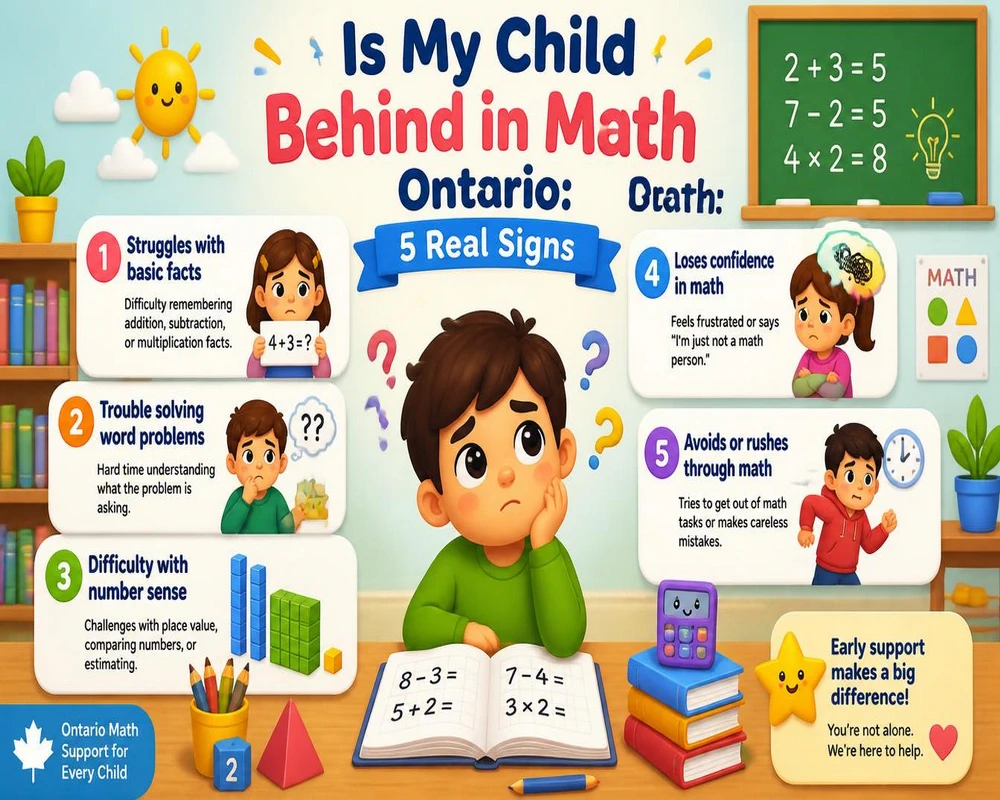
Is My Child Behind in Math Ontario: 5 Real Signs
“Is my child behind in math Ontario schools expect at this age?” is one of the most searched, most anxious questions a parent types into Google late at night, usually right after a confusing homework session or a report card comment that felt vaguer than it should have. The honest answer is that “behind” is a genuinely fuzzy word until it’s broken into specific, checkable signs — and most of what triggers parental worry turns out to be either completely normal or easily fixed once identified clearly.
This guide walks through five real, concrete signs that answer the question is my child behind in math Ontario families actually need answered, plus what to do next for each one.
Why “Is My Child Behind in Math Ontario” Is the Wrong Question to Start With
Before diagnosing anything, it helps to reframe the question itself. Asking is my child behind in math Ontario-wide, as a single yes-or-no question, ignores that a child can be completely on track in four strands and genuinely behind in just one. Ontario’s curriculum organizes math into five distinct strands — Number, Algebra, Data, Spatial Sense, and Financial Literacy — and struggling with fractions specifically says nothing about whether that same child is behind in geometry or data management. A more useful version of is my child behind in math Ontario parents should actually ask is: behind in exactly which strand, and by how much?
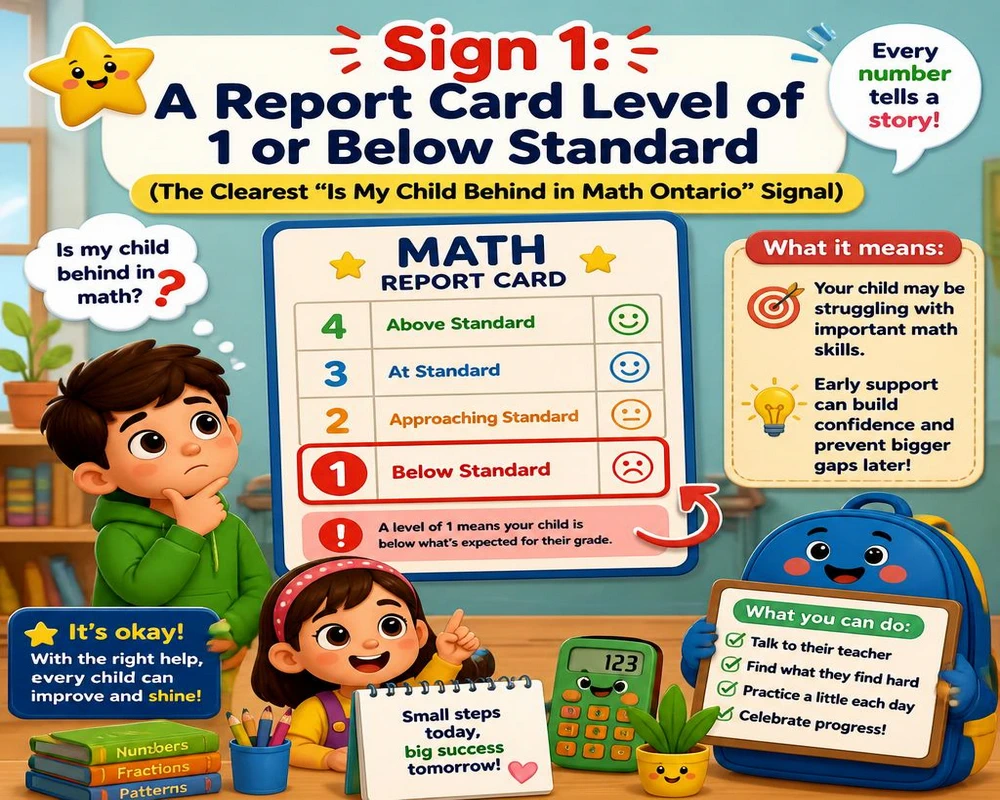
Sign 1: A Report Card Level of 1 or Below Standard (The Clearest “Is My Child Behind in Math Ontario” Signal)
What to Look For
Ontario’s report cards use a four-level scale, and Level 3 represents the actual provincial standard for that grade. A Level 1, or an R code specifically, is the clearest, most official signal available that a specific strand needs real attention.
This four-level framework comes directly from Ontario’s official Growing Success assessment policy. The Ontario Ministry of Education’s assessment and reporting page outlines exactly what each level represents and how teachers determine it.
What This Actually Means
This is the single most reliable answer to is my child behind in math Ontario schools provide, since it’s the province’s own formal measurement, not a parent’s subjective impression. Ask the teacher which specific strand drove the lower level before assuming the whole subject needs work.
Sign 2: Consistent Difficulty With the Previous Grade’s Foundational Skills
What to Look For
A Grade 4 student who still counts on fingers for basic addition facts, or a Grade 6 student who can’t confidently multiply single digits, is showing a gap in material that should already be automatic from an earlier grade.
What This Actually Means
New grade content assumes previous-grade skills are solid. If foundational facts from a year or two earlier are still shaky, that gap — not the current material — is usually the real source of visible struggle.
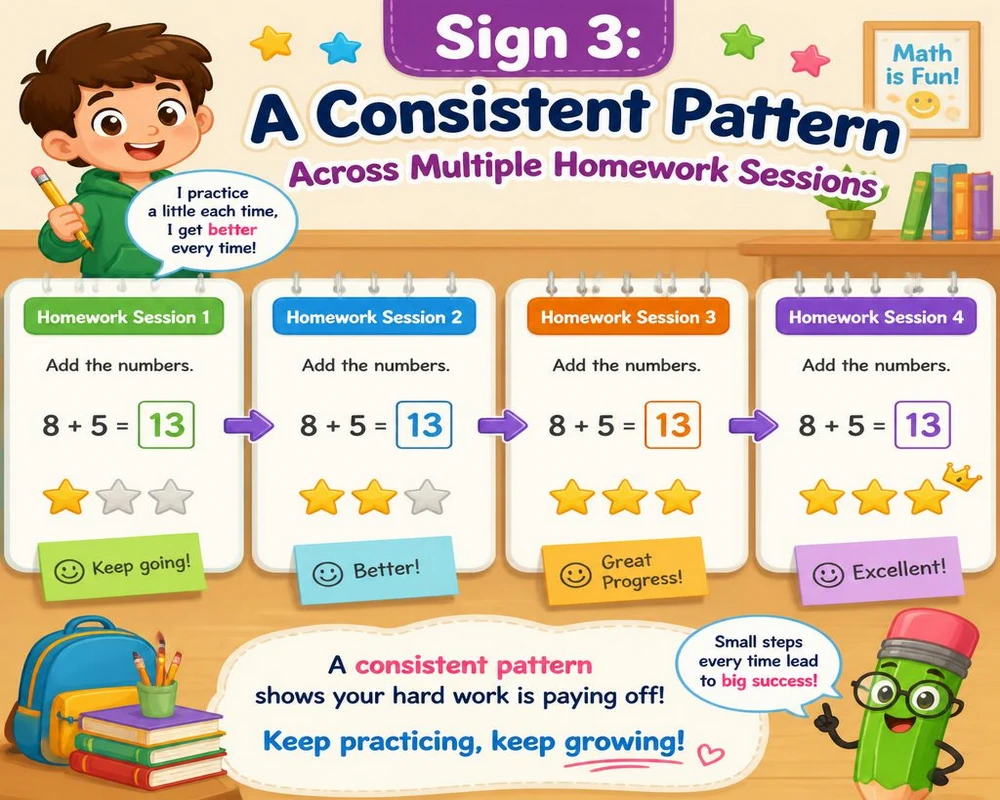
Sign 3: A Consistent Pattern Across Multiple Homework Sessions
What to Look For
One hard night with a confusing worksheet means very little on its own. The same type of question causing genuine difficulty across several separate sessions, spread over a couple of weeks, is a much stronger signal.
What This Actually Means
Isolated struggle is normal and expected. A repeating pattern, specifically tied to one topic rather than math in general, is what actually distinguishes a real gap from an ordinary rough patch.
Sign 4: Teacher Comments Flagging the Same Concern More Than Once
What to Look For
A single report card comment about needing more practice in one area is common and often not urgent. The same specific concern repeated across two or more consecutive reporting periods deserves real attention.
What This Actually Means
Teachers see a child across an entire class of peers and have genuine comparative context a parent doesn’t. A repeated, specific comment carries real weight and is one of the clearer answers to is my child behind in math Ontario parents can get directly from the classroom.
Sign 5: Visible Anxiety or Avoidance Specifically Around Math
What to Look For
A child who’s genuinely confident in other subjects but consistently tenses up, stalls, or avoids anything math-related specifically may be signaling a gap through behavior rather than through grades alone.
What This Actually Means
Avoidance often builds well before it shows up clearly on paper. This sign can appear earlier than a report card level would, making it a genuinely useful early warning worth taking seriously even without a formal grade attached to it yet. Of all five signs covered in this guide, this one is often the earliest indicator that the answer to is my child behind in math Ontario families are searching for is starting to shift.

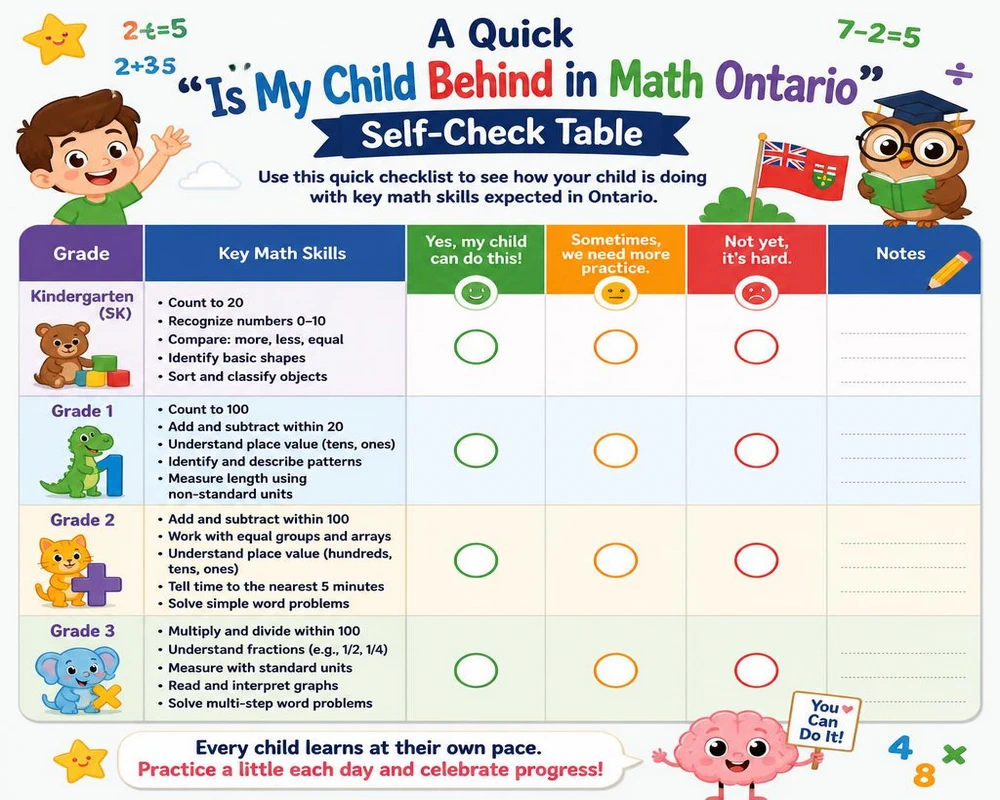
A Quick “Is My Child Behind in Math Ontario” Self-Check Table
| Sign Observed | Level of Concern | Suggested Next Step |
|---|---|---|
| Only one of the five signs, mild | Low | Monitor over the next reporting period |
| Two or three signs together | Moderate | Targeted practice on the specific strand, brief teacher check-in |
| Four or more signs, or Sign 1 (Level 1/R) | High | Direct conversation with the teacher, consider additional support |
What Genuinely Isn’t a Sign for “Is My Child Behind in Math Ontario”
A Single Hard Homework Night
Every student, regardless of overall skill, hits an occasionally confusing worksheet. One difficult session says almost nothing on its own.
Slower Speed on a New Topic
Brand new material naturally takes longer to process than familiar material. Slower pace on something genuinely new isn’t the same as struggling with something that should already be mastered.
Comparing to an Older Sibling
Every child develops at a different pace, even within the same family. A younger sibling moving through a topic differently than an older one did isn’t inherently a red flag.
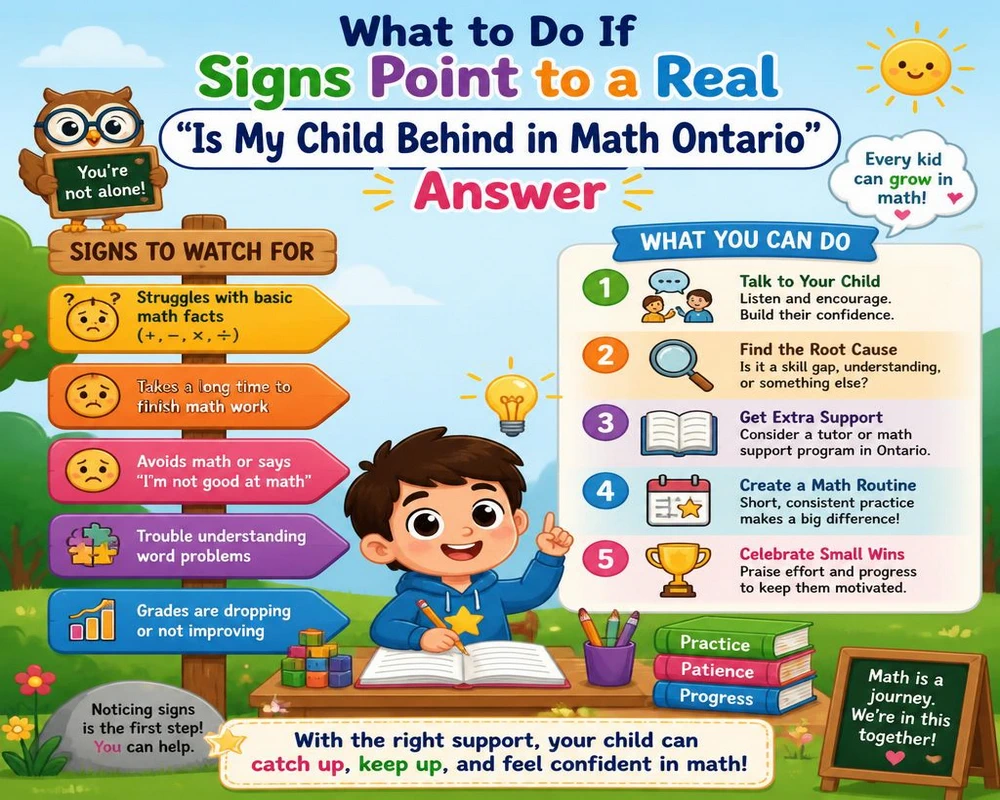
What to Do If Signs Point to a Real “Is My Child Behind in Math Ontario” Answer
Identify the Specific Strand, Not Just “Math” Generally
Vague worry about “math” overall is hard to act on. A specific, named gap — fraction operations, multiplication facts, a particular strand — is immediately actionable in a way general concern isn’t. This distinction is really the heart of answering is my child behind in math Ontario families ask, since “behind in math” as a whole is almost never the actual, precise situation.
Talk to the Teacher With Specifics
Bringing a specific pattern observed at home, rather than a general worry, tends to produce a far more useful conversation and a clearer plan from the teacher’s side.
Start With Consistent, Targeted Practice
Once the specific gap is identified, short, focused practice sessions on exactly that skill tend to close a gap faster than broad, unfocused review across everything. This targeted approach, rather than a vague sense of needing “more math practice overall,” is what actually moves the needle once the real answer to is my child behind in math Ontario families are checking for has been narrowed down to something specific.
Frequently Asked Questions
1. Is my child behind in math Ontario schools expect if they got a Level 2 on their report card?
A Level 2 means approaching the provincial standard, which is a real but usually manageable gap, not an urgent crisis — targeted practice on the specific flagged strand tends to help answer is my child behind in math Ontario parents worry about at this level.
2. How can I check Ontario grade-level math expectations myself?
Reviewing the specific expectations for your child’s current grade, strand by strand, gives a concrete benchmark to compare actual performance against, rather than relying on vague impressions.
3. Should I worry after just one difficult homework session?
Generally no. A single hard night is common and expected; the signal worth acting on is a repeated, specific pattern across multiple sessions.
4. Does struggling with one strand mean my child is behind overall?
Not necessarily. Ontario’s curriculum covers five distinct strands, and a genuine gap in one, like fractions, doesn’t automatically mean weakness across geometry, data, or other areas.
5. How quickly can a real math gap be closed with targeted practice?
This varies by child and the specific gap, but consistent, focused practice on exactly the right skill often shows measurable improvement within a few weeks to a couple of months.
6. Is anxiety around math a sign of being behind, or something separate?
It can be either. Sometimes anxiety follows a genuine skill gap; sometimes it exists independently of actual ability. Either way, it’s worth taking seriously as its own signal.
7. Where can I find practice that targets a specific identified gap?
Our Ontario math practice platform organizes lessons by grade and specific strand, making it straightforward to focus practice exactly where a report card or teacher comment points.
Explore grade-specific practice through our Grade 1 through Grade 6 math practice hubs, or see our Ontario math curriculum by grade guide to confirm exactly what your child’s grade currently expects. Answering is my child behind in math Ontario families ask starts with these concrete benchmarks, not vague comparison to other kids.
For more on how report card levels translate into these signs, see our Ontario Report Card Math Levels Explained guide.