
Grade 2 Number Line Strategies: Adding and Subtracting With Jumps
Grade 2 number line strategies help children add and subtract two-digit numbers by making jumps on a line, usually an “open” number line with only the numbers they need. To add 38 + 25, a child starts at 38, jumps 20 to 58, then jumps 5 to 63. The jumps show their thinking clearly, and over time they move into the child’s head as mental math.
Number lines are one of the most common tools in Canadian Grade 2 classrooms. Parents who learned stacking and carrying sometimes find them unfamiliar, but they build exactly the place value and number sense that makes later math easier.
This guide explains what a Grade 2 number line is, how open number lines work for addition and subtraction, eight powerful strategies, worked examples, common mistakes and how number line thinking grows into Grade 3.
Quick Answer
A Grade 2 number line is a tool for adding and subtracting by jumping. On an open number line, children mark only the numbers they need: for number line addition, start at one number and jump forward by tens and ones; for number line subtraction, jump back or count up between the numbers. Kids choose friendly jumps like 10, 20 or “to the next ten.”
Key Takeaways
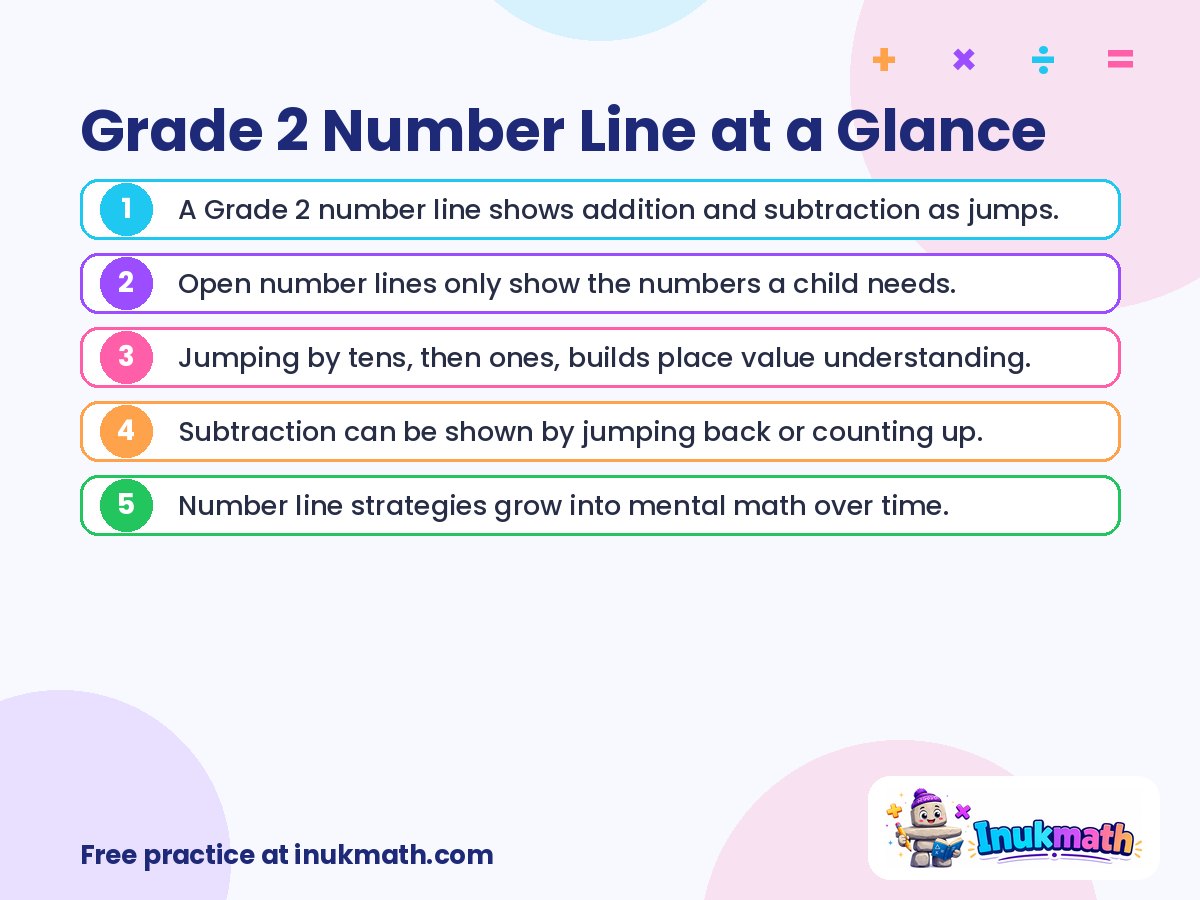
- A Grade 2 number line shows addition and subtraction as jumps.
- Open number lines only show the numbers a child needs.
- Jumping by tens, then ones, builds place value understanding.
- Subtraction can be shown by jumping back or counting up.
- Number line strategies grow into mental math over time.
Table of Contents
- What Is a Grade 2 Number Line?
- Why Are Grade 2 Number Line Strategies So Useful?
- How Does Number Line Addition Work?
- How Does Number Line Subtraction Work?
- 8 Powerful Grade 2 Number Line Strategies for Adding and Subtracting
- Which Number Line Strategy Works Best?
- How Do Grade 2 Number Line Strategies Help With Word Problems?
- How Do Number Lines Compare With Other Strategies?
- Are Number Lines Used Across Canada?
- What Should Parents Say During Number Line Practice?
- What Do Teachers Wish Parents Knew About Number Lines?
- How Can Everyday Life Use Number Line Thinking?
- How Can You Adapt Number Line Practice for Different Learners?
- What Does a 4-Week Number Line Plan Look Like?
- Try It: 8 Grade 2 Number Line Practice Questions
- What Are Common Grade 2 Number Line Mistakes?
- How Do You Know Your Child Understands Number Lines?
- Where Does Number Line Thinking Lead?
- Frequently Asked Questions About Grade 2 Number Line Strategies
- Conclusion: Jump Your Way to Mental Math
What Is a Grade 2 Number Line?
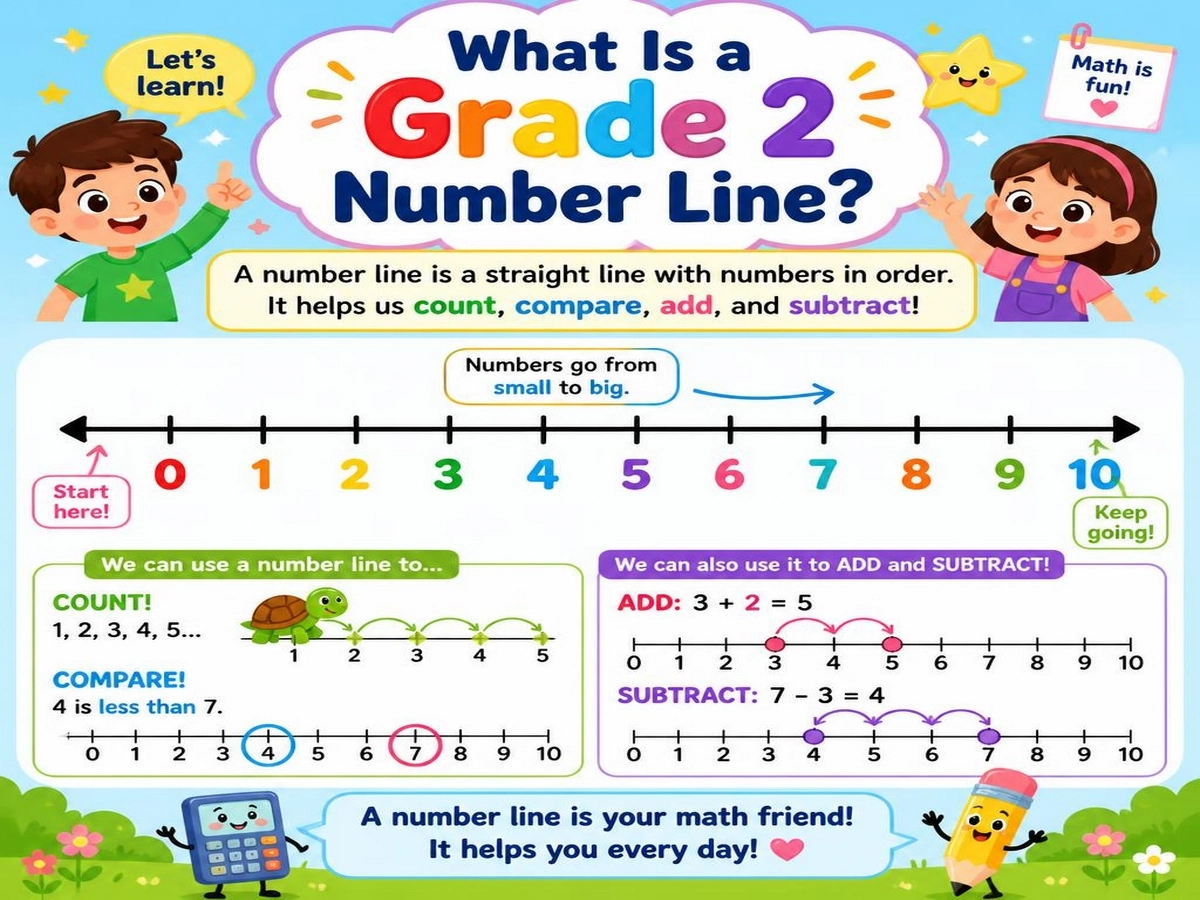
A Grade 2 number line is a straight line with numbers placed in order, used to show counting, adding, subtracting and comparing. In Grade 2, children use two kinds: marked number lines (with every number or every ten labeled) and open number lines (blank lines where they mark only the numbers they need).
The Ontario mathematics curriculum asks Grade 2 students to use objects, diagrams and equations to solve addition and subtraction problems to 100, and to use mental math strategies to add and subtract to 50. Number lines are one of the most useful diagrams for both.
What Is an Open Number Line?
An open number line is a blank line with no scale. Children write the starting number, draw jumps and label each jump’s size. It’s flexible: a jump of 20 can look as big or small as you like, which keeps the focus on reasoning.
Why Number Lines Work
Number lines connect numbers to distance and position. That helps children see that 38 and 63 are 25 apart, and that adding is moving forward while subtracting is moving back or finding the gap.
Why Are Grade 2 Number Line Strategies So Useful?
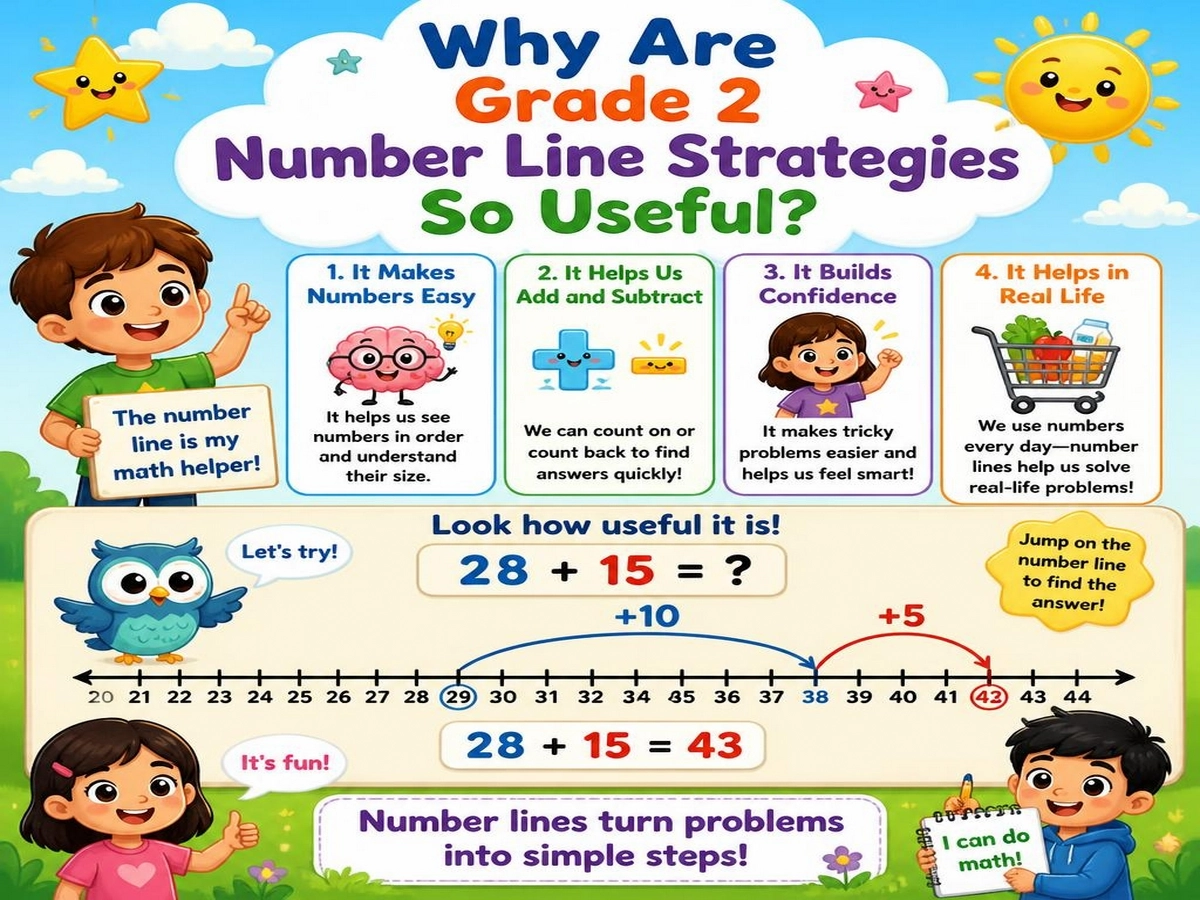
Grade 2 number line strategies are useful because they make thinking visible, build place value understanding, support mental math, help children check answers and show that subtraction can mean finding a difference.
- Visible thinking. Teachers and parents can see each step.
- Place value. Jumping by tens reinforces tens and ones.
- Flexibility. Many paths lead to the answer.
- Mental math. Jumps become mental steps.
- Subtraction as difference. Counting up shows the gap.
Research by Siegler and Booth (2004) found that children’s ability to represent numbers on a number line relates to their math achievement. Using number lines for operations strengthens that mental model.
How Does Number Line Addition Work?
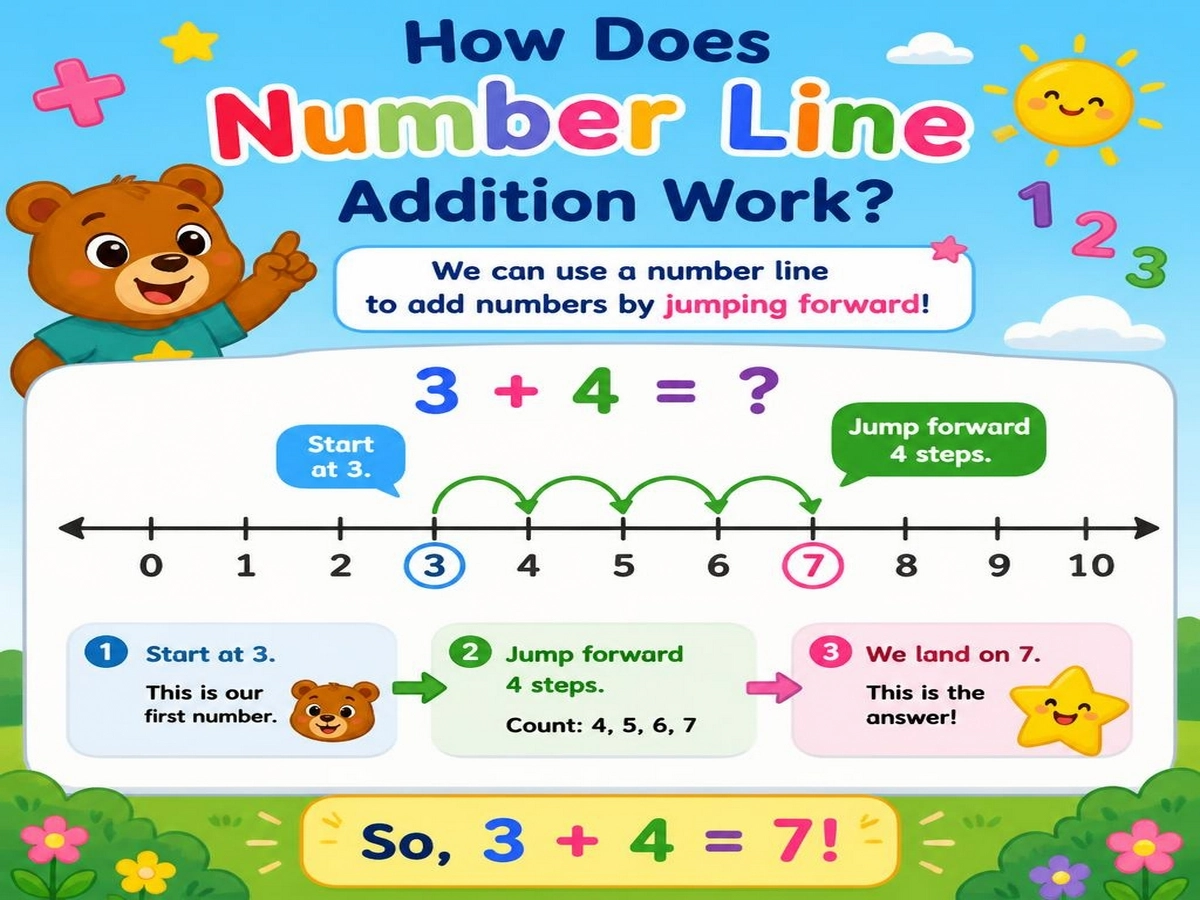
Number line addition works by starting at one number and jumping forward by the other number in friendly chunks, usually tens first, then ones. The landing point is the answer.
Example: 38 + 25
- Draw a line and mark 38.
- Jump +20 to 58.
- Jump +5 to 63.
- Answer: 63.
Example: 47 + 36 (Jump to the Next Ten)
- Start at 47.
- Jump +3 to 50 (friendly ten).
- Jump +30 to 80.
- Jump +3 to 83.
- Answer: 83.
Jumping to the next ten first is a powerful strategy because it creates friendly numbers.
How Does Number Line Subtraction Work?
Number line subtraction works in two ways: jumping back from the larger number or counting up from the smaller number to the larger one. Children choose based on which is easier.
Jumping Back: 63 − 27
- Start at 63.
- Jump −20 to 43.
- Jump −3 to 40.
- Jump −4 to 36.
- Answer: 36.
Counting Up: 63 − 58
- Start at 58.
- Jump +2 to 60.
- Jump +3 to 63.
- Total jumps: 2 + 3 = 5.
- Answer: 5.
Counting up works best when the numbers are close together.
Expert Tip
Ask your child to label every jump with its size. Labels make it easy to add up the jumps and spot mistakes.

8 Powerful Grade 2 Number Line Strategies for Adding and Subtracting
These eight strategies cover most two-digit addition and subtraction problems in Grade 2.
1. Jump by Tens, Then Ones
38 + 25: +20, then +5.
2. Jump to the Next Ten
47 + 36: +3 to 50, then +33.
3. Big Jump, Then Adjust
29 + 34: +30 to 59, then −1 = 58 (compensation).
4. Jump Back by Tens, Then Ones
63 − 27: −20, then −7.
5. Jump Back to a Friendly Ten
63 − 27: −3 to 60, −20 to 40, −4 to 36.
6. Count Up to Find the Difference
63 − 58: +2 to 60, +3 to 63. Difference: 5.
7. Count Up by Tens
72 − 38: +2 to 40, +30 to 70, +2 to 72. Total: 34.
8. Compare Two Numbers
“How far apart are 25 and 61?” Count up: +5 to 30, +30 to 60, +1 to 61. Answer: 36.
Which Number Line Strategy Works Best?
The best Grade 2 number line strategy depends on the numbers. Jump by tens when numbers are friendly, jump to the next ten when ones would cross a ten, and count up when subtracting numbers that are close together.
| Problem | Best strategy | Jumps |
|---|---|---|
| 34 + 23 | Tens then ones | +20, +3 → 57 |
| 46 + 28 | Next ten | +4 to 50, +24 → 74 |
| 39 + 25 | Next ten | +1 to 40, +24 → 64 |
| 75 − 32 | Back by tens then ones | −30, −2 → 43 |
| 71 − 68 | Count up | +2, +1 → 3 |
| 64 − 29 | Back to friendly ten, or back 30 then +1 | −30 → 34, +1 → 35 |
Sometimes a strategy feels awkward for a particular pair of numbers, and switching to another makes life easier. For 39 + 25, jumping to the next ten (40) is quicker than jumping by tens first. Encourage your child to try a second path when the first gets messy.

How Do Grade 2 Number Line Strategies Help With Word Problems?
Grade 2 number line strategies help with word problems because the line shows what’s happening in the story. A child can see whether they’re adding more, taking away or finding a gap between two numbers.
- Adding more: “Ava had 36 stickers and got 25 more.” Start at 36, jump 25.
- Taking away: “There were 54 birds; 18 flew away.” Start at 54, jump back 18.
- Finding a gap: “Noah has 47 cards. Mia has 62. How many more does Mia have?” Count up from 47 to 62.
The “finding a gap” problems are where number lines really shine. Many children think every subtraction story means “take away,” but comparison stories make much more sense as a distance between two points. Drawing a quick Grade 2 number line turns a confusing story into a clear picture. For more practice, our post on Grade 2 word problems offers plenty of examples.
How Do Number Lines Compare With Other Strategies?
Number lines are one of several Grade 2 strategies, alongside base ten blocks, split strategy and the column method. Each has strengths.
| Strategy | Strengths | Limits |
|---|---|---|
| Open number line | Shows thinking, builds mental math | Can get messy with many jumps |
| Base ten blocks | Concrete, shows regrouping | Slow for larger numbers |
| Split into tens and ones | Quick, clear place value | Subtraction can be tricky |
| Column method | Efficient for larger numbers | Easy to follow without understanding |
Children benefit from knowing several strategies. See Grade 2 regrouping and Grade 2 mental math.
Are Number Lines Used Across Canada?
Number lines are used in classrooms across Canada from kindergarten onward. Open number lines are especially common in Grade 2 and Grade 3 for addition and subtraction.
- Ontario: number lines support addition and subtraction to 100 and mental math to 50.
- British Columbia: the BC curriculum encourages visual models for addition and subtraction.
- Other provinces: number lines are standard in primary math resources.
What Should Parents Say During Number Line Practice?
Use these prompts during Grade 2 number line practice.
- “Where will you start?”
- “Can you jump by a ten first?”
- “What’s the next friendly ten?”
- “How big was each jump?”
- “Could you count up instead?”
What Do Teachers Wish Parents Knew About Number Lines?
Teachers often wish parents knew that number lines aren’t a slow detour. They build the mental math skills that make later calculation fast and flexible.
- Jumps show thinking. Mistakes are easy to find.
- There’s more than one path. Different jumps can give the same answer.
- They fade into mental math. Children eventually picture the line.
- They support subtraction. Counting up is powerful.
A Quick Story
A parent watches her daughter draw a number line for 46 + 27. “Why not just stack them?” she asks. Her daughter explains: “46, jump 4 to 50, then 23 more is 73.” The next day, she solves 58 + 25 without drawing anything: “2 to 60, then 23 more, 83.” The number line had moved into her head.
How Can Everyday Life Use Number Line Thinking?
Everyday life offers Grade 2 number line moments.
- Thermometers: “It was 8 degrees; now it’s 15. How much warmer?”
- Rulers and tape measures: distances between marks.
- Road trips: “We’re at km 45; the exit is at km 72. How far?”
- Page numbers: “From page 38 to 60, how many pages?”
How Can You Adapt Number Line Practice for Different Learners?
Adapt Grade 2 number line practice to your child.
Active Learners
Tape a number line on the floor and physically jump.
Visual Learners
Use colored jumps for tens and ones.
Learners Who Need More Time
Start with marked number lines to 100 before open lines. Let your child place a finger on the start number and physically move along each jump while saying it aloud.
Learners Ready for More
Use number lines for three-digit numbers or find the fewest jumps possible.
What Does a 4-Week Number Line Plan Look Like?
A 4-week Grade 2 number line plan builds from marked lines to open lines to subtraction strategies.
| Week | Focus | Activities | Goal by Friday |
|---|---|---|---|
| 1 | Marked number lines | Jumping by 10s and 1s | Adds 2-digit numbers on a marked line |
| 2 | Open number lines for addition | Tens then ones, next ten | Draws open-line addition |
| 3 | Subtraction by jumping back | Back by tens, friendly tens | Solves 2-digit subtraction |
| 4 | Counting up | Difference problems | Uses counting up for close numbers |
Try It: 8 Grade 2 Number Line Practice Questions
Use an open number line. Answers follow.
- 34 + 25
- 47 + 28
- 56 + 30
- 63 − 21
- 72 − 45
- 81 − 78
- How far from 26 to 60?
- 39 + 39
Answers: 1) 59; 2) 75; 3) 86; 4) 42; 5) 27; 6) 3; 7) 34; 8) 78.
Myths vs. Facts About Number Lines
| Myth | Fact |
|---|---|
| Number lines are slower than stacking. | They build mental math that becomes very fast. |
| There’s only one correct set of jumps. | Many paths lead to the same answer. |
| Subtraction always means jumping back. | Counting up is often easier. |
| Number lines are only for little kids. | They help with bigger numbers, fractions and decimals later. |
What Are Common Grade 2 Number Line Mistakes?
Common Grade 2 number line mistakes include not labeling jumps, jumping the wrong direction, miscounting jump totals and using too many tiny jumps.
- Unlabeled jumps. Write the size of each jump.
- Wrong direction. Forward for adding, back for subtracting (or counting up).
- Adding jumps incorrectly. Total the jumps carefully when counting up.
- Tiny jumps. Use tens and friendly numbers.
- Forgetting the start. Always mark the starting number.
Common Mistake
Insisting children draw a number line for every problem forever. Number lines are a bridge. Once a child can picture the jumps, let them solve mentally.
How Do You Know Your Child Understands Number Lines?
Your child understands Grade 2 number line strategies when they can add and subtract two-digit numbers with open number lines, choose efficient jumps, use counting up for close numbers and eventually picture the jumps in their head.
Checklist
- Adds 2-digit numbers on an open number line
- Subtracts by jumping back
- Counts up to find differences
- Labels jumps clearly
- Solves some problems mentally
Practice with Grade 2 practice questions.
Where Does Number Line Thinking Lead?
Number line thinking leads to mental math with three-digit numbers, rounding in Grade 3, measurement scales and later fractions and decimals on number lines.
- Grade 2 connections: mental math, estimation and hundreds chart.
- Grade 3: Grade 3 rounding and Grade 3 addition.
- Big picture: Canadian Grade 2 math and Canadian math practice.
Future Trends
Digital number lines with draggable jumps are popular in classrooms. The Education Endowment Foundation and the Institute of Education Sciences both recommend using visual representations to build understanding, and number lines are among the most versatile.
Frequently Asked Questions About Grade 2 Number Line Strategies
What is a Grade 2 number line?
A line with numbers used to show counting, adding, subtracting and comparing, often drawn as an open number line.
What is an open number line?
A blank line where children mark only the numbers they need and draw labeled jumps.
How does number line addition work?
Start at one number and jump forward by the other, usually tens first, then ones.
How does number line subtraction work?
Jump back from the larger number, or count up from the smaller number to find the difference.
What does jumping on a number line mean?
Moving forward or backward by a chosen amount, like +10 or −5, to solve a problem.
Why do teachers use number lines?
They make thinking visible and build place value and mental math.
Is the number line slower than the column method?
At first, but it builds understanding that leads to fast mental math.
When should my child stop drawing number lines?
When they can picture the jumps in their head and explain their thinking.
How do number lines help with word problems?
They show what’s happening in the story, like finding a gap or adding more.
Conclusion: Jump Your Way to Mental Math
Grade 2 number line strategies turn addition and subtraction into jumps your child can see, explain and eventually picture mentally. Practice jumping by tens, jumping to friendly tens, counting up and choosing efficient paths. These skills build strong number sense for Grade 3 and beyond.
For more two-digit practice, try our post on Grade 2 two-digit addition and subtraction.
Master number line strategies. InukMath offers free Grade 2 lessons, worksheets and practice questions. Join free and explore our Grade 2 worksheets.
Sources and Further Reading
- Ontario Ministry of Education, The Ontario Curriculum: Mathematics, Grades 1 to 8 (2020)
- Siegler & Booth (2004), Development of numerical estimation in young children, Child Development
- BC Ministry of Education, Mathematics K-9 curriculum
- Education Endowment Foundation, Improving Mathematics in the Early Years and Key Stage 1
- Institute of Education Sciences, Teaching Math to Young Children practice guide (2013)