
Grade 2 Mental Math: Strategies for Adding and Subtracting to 50 in Your Head
Grade 2 mental math is the ability to add and subtract numbers up to 50 in your head, using smart strategies instead of paper or counting by ones. In the Ontario curriculum, Grade 2 students use mental math strategies, including estimation, to add and subtract whole numbers that add up to no more than 50, and they explain the strategies they used.
Mental math is where number sense really shows. A child who can solve 38 + 20 by thinking “38, 48, 58” or 29 + 15 by thinking “30 + 15 − 1” is using place value, facts and flexible thinking all at once.
This guide explains what Grade 2 mental math involves, nine smart strategies kids actually use, quick daily drills, common errors and how mental math grows into Grade 3.
Quick Answer
Grade 2 mental math means adding and subtracting to 50 in your head using strategies like adding tens, making 10, doubles, splitting into tens and ones, compensation (adjusting to friendly numbers) and counting up to subtract. Kids build it through short daily number talks, explaining their thinking and practicing with games.
Key Takeaways
- Grade 2 mental math covers adding and subtracting to 50 without paper.
- Adding tens first is one of the most powerful strategies.
- Compensation turns hard numbers into friendly ones.
- Explaining strategies is part of the Ontario expectation.
- Daily five-minute number talks build mental math quickly.
Table of Contents
- What Is Grade 2 Mental Math?
- Why Does Grade 2 Mental Math Matter?
- How Do Kids Learn Grade 2 Mental Math Step by Step?
- 9 Smart Grade 2 Mental Math Strategies Kids Actually Use
- Which Mental Math Strategy Works for Which Problem?
- What Does a Grade 2 Mental Math Number Talk Look Like at Home?
- How Do Number Lines Support Grade 2 Mental Math?
- Is Mental Math Taught the Same Way Across Canada?
- What Should Parents Say During Mental Math Practice?
- What Do Teachers Wish Parents Knew About Mental Math?
- How Do Daily Mental Math Drills Help?
- How Can Everyday Life Build Mental Math?
- How Can You Adapt Mental Math for Different Learners?
- What Does a 4-Week Mental Math Plan Look Like?
- Try It: 8 Grade 2 Mental Math Practice Questions
- What Are Common Grade 2 Mental Math Mistakes?
- How Do You Know Your Child Is Strong at Mental Math?
- Where Does Grade 2 Mental Math Lead?
- Frequently Asked Questions About Grade 2 Mental Math
- Conclusion: Think in Tens, Not Ones
What Is Grade 2 Mental Math?
Grade 2 mental math is solving addition and subtraction problems in your head by using known facts, place value and strategies. Grade 2 children work with sums and differences up to 50, such as 27 + 16, 45 − 20 or 33 + 9.
The Ontario mathematics curriculum asks Grade 2 students to “use mental math strategies, including estimation, to add and subtract whole numbers that add up to no more than 50, and explain the strategies used.” Explanation is part of the expectation.
Mental Math to 50
Mental math to 50 is a step up from Grade 1’s mental math to 20. Children now combine facts with place value: adding tens, then ones, and adjusting to make friendly numbers.
Mental Math vs. Written Methods
Mental math relies on understanding and flexibility. Written methods, like column addition, are useful for bigger numbers. In Grade 2, mental math builds the understanding that makes written methods meaningful later.

Why Does Grade 2 Mental Math Matter?
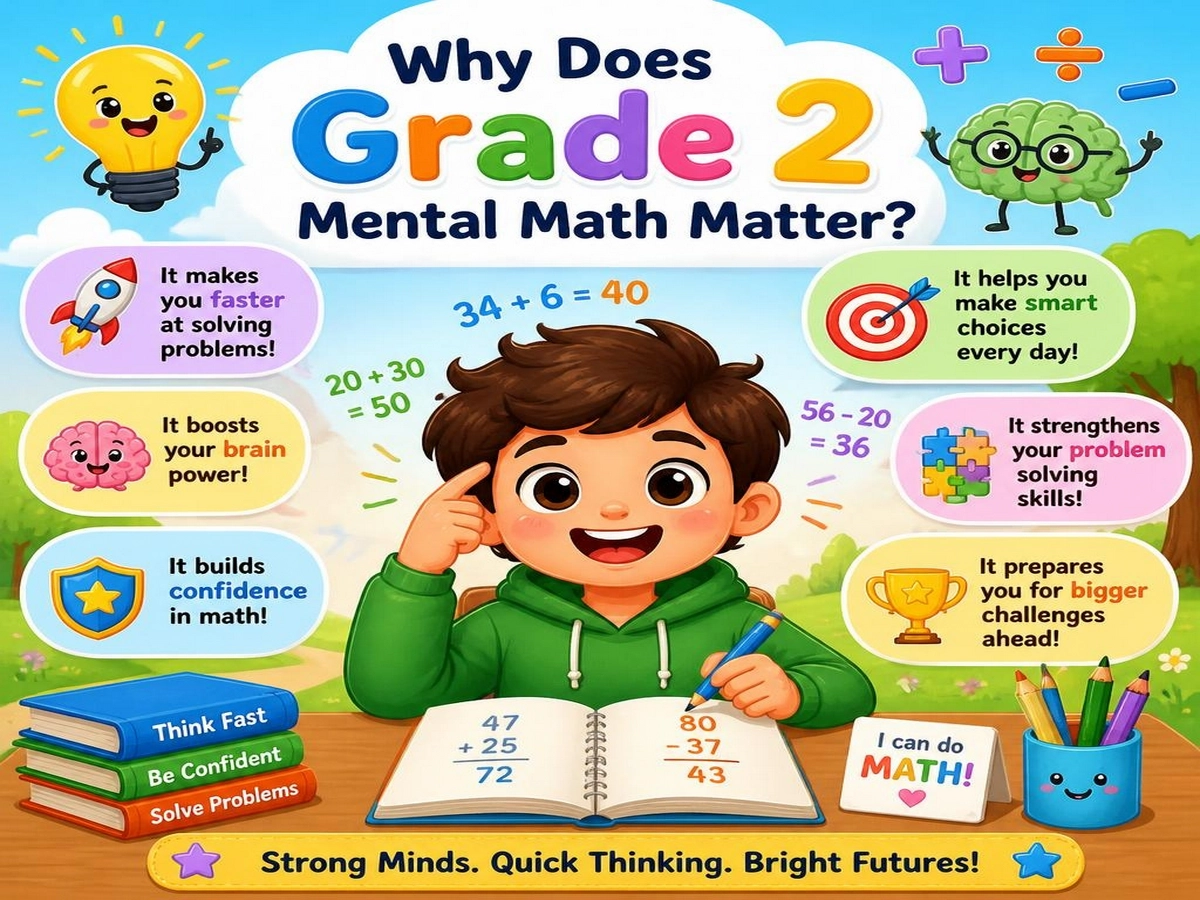
Grade 2 mental math matters because it builds number sense, speeds up calculation, supports estimation and prepares children for two-digit and three-digit operations. Strong mental math users can check answers, spot errors and solve problems flexibly.
- Number sense. Children understand how numbers break apart and combine.
- Speed. Many problems are faster in your head.
- Estimation. Mental math helps judge whether answers make sense.
- Confidence. Children feel capable with numbers.
- Foundation for later grades. Grade 3 mental math builds directly on Grade 2.
The review by Dunlosky and colleagues (2013) found that short, spaced practice is highly effective, which is why five-minute daily number talks work so well. And because research by Maloney and colleagues (2015) shows that adult math anxiety can affect children’s learning, keep mental math playful and positive.
How Do Kids Learn Grade 2 Mental Math Step by Step?
Kids learn Grade 2 mental math by first strengthening facts to 20, then adding and subtracting tens, then combining tens and ones, then using compensation and friendly numbers, and finally choosing efficient strategies for each problem.
- Facts to 20. Quick recall makes everything else easier.
- Adding tens. 30 + 20, 47 + 10.
- Tens and ones. 34 + 12 = 34 + 10 + 2.
- Making 10. 28 + 5 = 28 + 2 + 3.
- Compensation. 29 + 14 = 30 + 14 − 1.
- Choosing. “Which strategy is easiest for this one?”
Expert Tip
Run a five-minute “number talk” each day: one problem, thinking time, then share strategies. Children learn as much from hearing other strategies as from finding their own.

9 Smart Grade 2 Mental Math Strategies Kids Actually Use
These nine mental math strategies grade 2 students use cover nearly every problem to 50. Teach them one at a time.

1. Adding Tens
Add tens first: 23 + 20 = 43. Adding tens changes only the tens digit.
2. Split Into Tens and Ones
34 + 12: 30 + 10 = 40, 4 + 2 = 6, so 46.
3. Jump Strategy
Start with one number and jump the other in parts: 34 + 12 = 34 + 10 + 2 = 46.
4. Make 10
28 + 5: 28 + 2 = 30, then + 3 = 33.
5. Compensation
29 + 14: think 30 + 14 = 44, then subtract 1 = 43. This compensation strategy turns awkward numbers into friendly ones.
6. Doubles and Near Doubles
25 + 25 = 50; 24 + 25 = 49. See Grade 2 doubles facts.
7. Count Up to Subtract
43 − 38: count up from 38 to 40 (2), then to 43 (3), so 5.
8. Subtract Tens
47 − 20: take away 2 tens: 27.
9. Use Friendly Numbers
45 − 19: subtract 20 to get 25, then add 1 back: 26.
Which Mental Math Strategy Works for Which Problem?
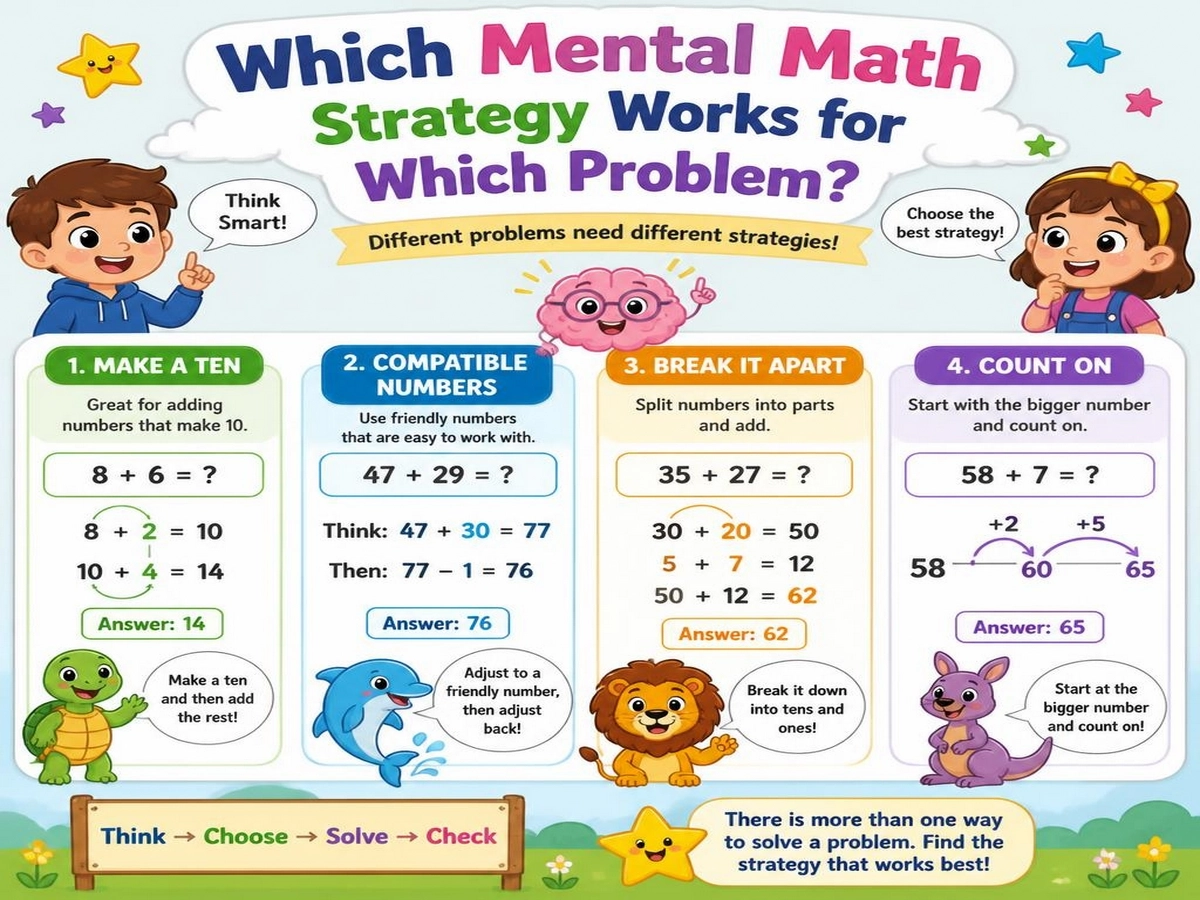
Different strategies suit different numbers. Adding tens works for multiples of ten, compensation works when one number is close to a ten, and counting up works when the numbers being subtracted are close together.
| Problem | Best strategy | Thinking |
|---|---|---|
| 26 + 30 | Adding tens | 26, 36, 46, 56 |
| 33 + 14 | Split into tens and ones | 30 + 10, 3 + 4: 47 |
| 38 + 6 | Make 10 | 38 + 2 + 4 = 44 |
| 19 + 27 | Compensation | 20 + 27 − 1 = 46 |
| 25 + 24 | Near doubles | 25 + 25 − 1 = 49 |
| 41 − 38 | Count up | 38 to 41 is 3 |
| 50 − 19 | Friendly numbers | 50 − 20 + 1 = 31 |
Encourage your child to look at the numbers first and choose a strategy, rather than always using the same one. Asking “What do you notice about these numbers?” before solving is a simple habit that builds smart choices.
What Does a Grade 2 Mental Math Number Talk Look Like at Home?
A Grade 2 mental math number talk is a five-minute conversation built around one or two problems. It’s simple to run at home, even at the dinner table, and it builds both strategies and explanation skills.
- Write or say a problem, like 29 + 15.
- Give quiet thinking time. Ask your child to show a thumb when they have an answer.
- Collect the answer without saying whether it’s right.
- Ask “How did you solve it?” Listen carefully.
- Record the strategy. Sketch it on a number line or write it as steps.
- Ask for another way. “Could you solve it differently?”
- Share your own strategy. Children love hearing how grown-ups think.
Sample Number Talk Strings
| Day | Problem string | Strategy it builds |
|---|---|---|
| Monday | 20 + 15, 21 + 15, 19 + 15 | Compensation |
| Tuesday | 30 + 12, 34 + 12, 38 + 12 | Adding tens, then ones |
| Wednesday | 25 + 25, 25 + 24, 26 + 25 | Near doubles |
| Thursday | 40 − 20, 40 − 19, 41 − 19 | Friendly numbers |
| Friday | 44 − 38, 50 − 47, 33 − 29 | Count up to subtract |
Strings of related problems help children notice patterns and borrow strategies from one problem to the next. That’s the heart of Grade 2 mental math.

How Do Number Lines Support Grade 2 Mental Math?
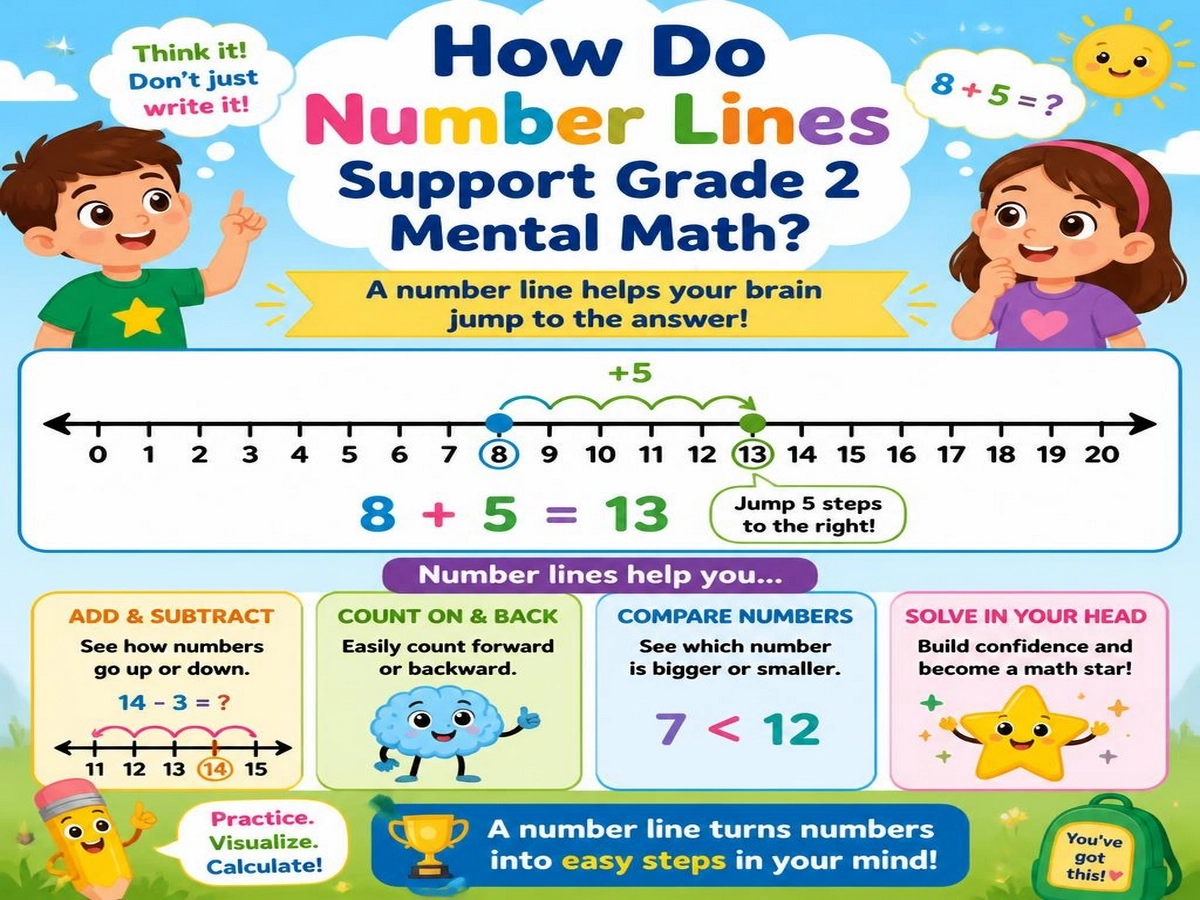
Open number lines support Grade 2 mental math by giving children a quick sketch of their thinking. For 27 + 15, a child draws a line, starts at 27, jumps 10 to 37, then 3 to 40 and 2 to 42. Over time, the drawing moves into their head.
Number lines also make subtraction visible: for 43 − 17, jump back 10 to 33, then 3 to 30, then 4 to 26. Our Grade 2 number line strategies guide explores this in depth.
Is Mental Math Taught the Same Way Across Canada?
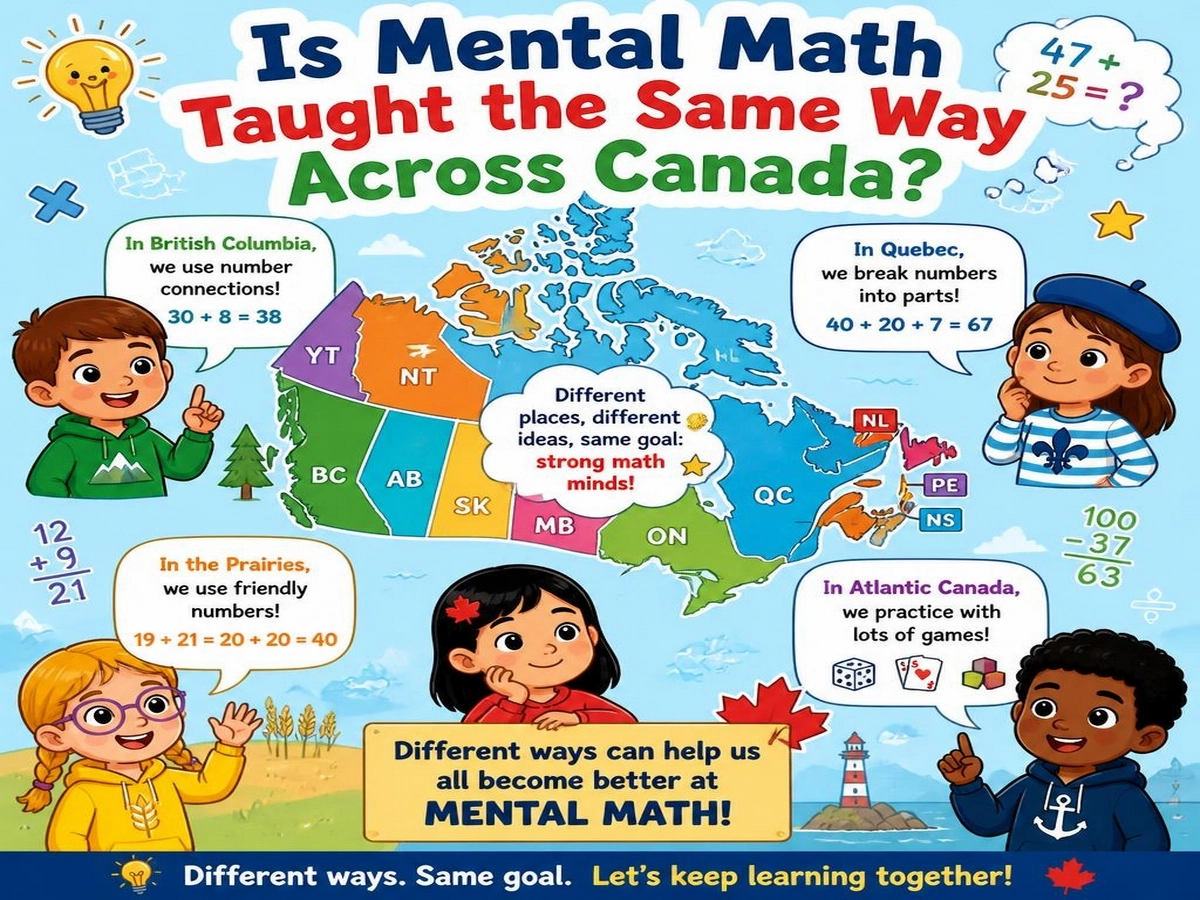
Mental math is taught across Canada with similar strategy-based approaches. Ontario sets Grade 2 mental math to 50, while other provinces focus on similar ranges with strategies like making 10, doubles and adding tens.
- Ontario: mental math to 50, with explanation of strategies.
- British Columbia: the BC curriculum emphasizes flexible addition and subtraction strategies.
- Other provinces: strategy-based mental math is standard in Grade 2.
What Should Parents Say During Mental Math Practice?
Use these prompts to build Grade 2 mental math thinking.
- “How did you figure that out?”
- “Is there another way?”
- “Which number is close to a ten?”
- “Can you add the tens first?”
- “Does your answer make sense? About how much should it be?”
What Do Teachers Wish Parents Knew About Mental Math?
Teachers often wish parents knew that Grade 2 mental math values flexible thinking over one “right” method. They also wish families would ask children to explain rather than just checking answers.
- Many strategies are valid.
- Explanations matter.
- Facts to 20 are the foundation.
- Short and daily beats long and rare.
A Quick Story
A child solves 29 + 16 by counting on 16 times and loses track. His dad asks, “What if 29 were 30?” The child thinks: “30 + 16 is 46… but I added 1 extra, so 45!” He’s invented compensation. Next time, he uses it on 39 + 12 without help.
How Do Daily Mental Math Drills Help?
Quick daily mental math drills, done as games or number talks, build speed and confidence. The key is short, varied and positive practice, not long timed sheets.
- Number of the Day: “Make 47 in five different ways.”
- Ten More, Ten Less: “What’s 10 more than 36? 10 less?”
- Strategy Strings: 20 + 15, 21 + 15, 19 + 15. Notice the pattern.
- Car Math: quick oral problems during drives.
- Make 50: “What do I add to 27 to make 50?”
How Can Everyday Life Build Mental Math?
Everyday life offers constant Grade 2 mental math practice.
- Shopping: “We have 45 cents. The sticker costs 20. How much left?”
- Time: “It’s 15 minutes until dinner. After 10 more minutes, how long is left?”
- Sports: keep score in your head.
- Reading: “You’ve read 23 pages. How many to 40?”
How Can You Adapt Mental Math for Different Learners?
Adapt Grade 2 mental math practice to each child.
Visual Learners
Use number lines and hundreds charts, then fade them. A quick sketch on a whiteboard is a great middle step between the chart and pure mental math.
Learners Who Need More Time
Strengthen facts to 20 and adding tens before compensation. Use a hundreds chart to show adding 10 as moving down one row, then gradually remove the chart so your child pictures it.
Learners Ready for More
Try mental math to 100, three addends or problems like 48 + 37.
Talkative Learners
Number talks where they explain to you or a sibling. Let them be the teacher and ask you to solve a problem their way. Teaching a strategy is one of the best ways to master it.
What Does a 4-Week Mental Math Plan Look Like?
A 4-week Grade 2 mental math plan builds strategies one at a time.
| Week | Strategy | Daily drill | Goal by Friday |
|---|---|---|---|
| 1 | Adding and subtracting tens | Ten More, Ten Less | Adds/subtracts tens instantly |
| 2 | Split into tens and ones | Number of the Day | Solves 2-digit + 2-digit to 50 |
| 3 | Make 10 and compensation | Strategy Strings | Uses compensation for +9, +19 |
| 4 | Subtraction strategies | Count up, friendly numbers | Subtracts within 50 mentally |
Try It: 8 Grade 2 Mental Math Practice Questions
Answers follow.
- 24 + 20 = ___
- 33 + 14 = ___
- 28 + 7 = ___
- 19 + 23 = ___
- 46 − 20 = ___
- 42 − 39 = ___
- 25 + 24 = ___
- 50 − 18 = ___
Answers: 1) 44; 2) 47; 3) 35; 4) 42; 5) 26; 6) 3; 7) 49; 8) 32.
Myths vs. Facts About Mental Math
| Myth | Fact |
|---|---|
| Mental math is just memorization. | It’s flexible thinking with strategies. |
| There’s one right method. | Many strategies work; choose the efficient one. |
| Kids should do math on paper first. | Mental math builds understanding for later written methods. |
| Speed matters most. | Accuracy and explanation come first. |
What Are Common Grade 2 Mental Math Mistakes?
Common Grade 2 mental math mistakes include counting by ones instead of using strategies, adding ones to tens, forgetting to adjust after compensation and losing track of steps.
- Counting by ones. Encourage adding tens.
- Mixing places. 34 + 20 is not 36.
- Forgetting to adjust. After 30 + 14, subtract the extra 1.
- Too many steps. Use simpler strategies.
- No estimate. Check if the answer makes sense.
Common Mistake
Insisting on one method for every problem. Flexible thinkers choose strategies based on the numbers. Let children explain their choices.
How Do You Know Your Child Is Strong at Mental Math?
Your child is strong at Grade 2 mental math when they add and subtract to 50 mentally, explain strategies, choose efficient strategies and estimate whether answers make sense.
Checklist
- Adds and subtracts tens mentally
- Solves 2-digit problems to 50 in their head
- Uses compensation or making 10
- Explains strategies
- Checks with estimation
Where Does Grade 2 Mental Math Lead?
Grade 2 mental math leads to mental math with larger numbers in Grade 3, three-digit addition and subtraction, and multiplication strategies.
- Grade 1 roots: Grade 1 mental math.
- Grade 2 connections: Grade 2 math facts, estimation, hundreds chart.
- Grade 3: Grade 3 mental math.
Future Trends
Number talks are increasingly common in Canadian classrooms. The Education Endowment Foundation highlights the value of mathematical talk, and mental math is one of the best places to build it.
Frequently Asked Questions About Grade 2 Mental Math
What is Grade 2 mental math?
Adding and subtracting numbers up to 50 in your head using strategies, and explaining your thinking.
What are mental math strategies grade 2 students use?
Adding tens, splitting into tens and ones, making 10, compensation, doubles, counting up and friendly numbers.
What is adding tens?
Adding multiples of ten by changing only the tens digit: 34 + 20 = 54.
What is the compensation strategy?
Adjusting a number to make it friendly, then correcting: 29 + 14 = 30 + 14 − 1.
How high does mental math go in Grade 2?
In Ontario, mental math in Grade 2 involves numbers that add up to no more than 50.
How do I practice mental math at home?
Use five-minute number talks, car math, Number of the Day and Ten More, Ten Less games.
Should my child write down mental math?
Quick sketches like number lines help at first. Over time, encourage solving in their head.
What if my child keeps counting by ones?
Strengthen facts and adding tens. Model strategies and ask, “Is there a faster way?”
How does mental math help with word problems?
Fast calculation frees attention for understanding the problem and checking the answer.
Conclusion: Think in Tens, Not Ones
Grade 2 mental math helps children think in tens and friendly numbers instead of counting by ones. Teach strategies one at a time, run short daily number talks, ask for explanations and encourage flexible choices. With practice, your child will solve problems to 50 confidently in their head.
Explore the full year in our Canadian Grade 2 math guide, see more strategies in our Canadian math practice roadmap, and practice two-digit work with our post on Grade 2 two-digit addition and subtraction.
Build mental math power. InukMath offers free Grade 2 lessons, games and practice questions. Join free and explore our Grade 2 practice questions.
Sources and Further Reading
- Ontario Ministry of Education, The Ontario Curriculum: Mathematics, Grades 1 to 8 (2020)
- Dunlosky et al. (2013), Improving students’ learning with effective learning techniques, Psychological Science in the Public Interest
- Maloney et al. (2015), Intergenerational effects of parents’ math anxiety, Psychological Science
- BC Ministry of Education, Mathematics K-9 curriculum
- Education Endowment Foundation, Improving Mathematics in the Early Years and Key Stage 1