
How to Read an EQAO Score Report Ontario: A Complete Parent Guide
Short answer: An EQAO Individual Student Report shows your child’s achievement level (1 to 4) in reading, writing, and math, compares it to the provincial standard (Level 3), and breaks results down by strand or sub-skill. Learning How to Read an EQAO Score Report Ontario parents receive each year mostly comes down to understanding three things: what the levels mean, how your child compares to the provincial standard, and which specific skill areas the report is telling you to pay attention to.
Key takeaways:
- EQAO reports use a 4-level achievement scale, with Level 3 representing the provincial standard.
- Grade 3 and Grade 6 reports cover reading, writing, and math; Grade 9 reports cover math only.
- The report breaks results into skill categories (strands), not just one overall score.
- A result below Level 3 is a starting point for a conversation with the teacher, not a cause for alarm on its own.
What Is EQAO and Why Does the Report Matter?
Before diving into the sections and levels, it helps to understand where the report comes from — that context makes the rest of this How to Read an EQAO Score Report Ontario guide easier to apply to your own child’s document.
EQAO stands for the Education Quality and Accountability Office, an arm’s-length Ontario government agency that administers standardized assessments in Grade 3, Grade 6, and Grade 9 across every publicly funded school in the province — Catholic, public, English, and French. Every family whose child writes the assessment receives an Individual Student Report a few months later, which is the document this guide focuses on.
The report matters because it’s one of the few standardized, province-wide snapshots of your child’s academic progress, independent of individual teacher grading style. It’s not a full picture of your child’s ability — a single assessment on a given day never is — but it’s a useful data point alongside report cards and teacher feedback.

Understanding EQAO Individual Student Report: The Main Sections
This section is the heart of How to Read an EQAO Score Report Ontario mails home each year, since almost every question parents have traces back to one of these three parts.
Understanding EQAO individual student report layouts starts with knowing the report has three core parts: an overall achievement level, a breakdown by strand or question type, and a comparison to school, board, and provincial averages.
Section 1: Overall Achievement Level
This is the headline number — a level from 1 to 4 (sometimes shown as “Below Level 1” for students who did not yet meet Level 1 expectations). This single number summarizes your child’s overall performance on the assessment for that subject.
Section 2: Strand or Skill Breakdown
Below the overall level, the report breaks results into specific categories — for math, this typically includes Number Sense, Measurement and Geometry, Patterning and Algebra, and Data Management and Probability (strand names have been updated periodically to reflect curriculum changes). This section shows you exactly where your child is strong and where they may need support.
Section 3: Comparison Data
The report shows how your child’s results compare to their school average, board average, and the provincial average, giving useful context for interpreting an individual score.

EQAO Score Meaning Grade 3 6: What the Levels Actually Represent
EQAO score meaning grade 3 6 assessments follow the same four-level scale used on Ontario report cards, which is intentional — EQAO’s levels are designed to align directly with the achievement levels teachers already use.
| Level | What It Means | Report Card Equivalent |
|---|---|---|
| Level 4 | Achievement well above the provincial standard | A range (90-100%) |
| Level 3 | The provincial standard — solid, grade-appropriate achievement | B range (70-79%) |
| Level 2 | Approaching the provincial standard | C range (60-69%) |
| Level 1 | Below the provincial standard, with significant support likely needed | D range (50-59%) |
A common misconception is assuming Level 3 is just “average” or “middling.” In fact, Level 3 is explicitly defined by the Ministry of Education and EQAO as the target achievement level for that grade — it represents solid, expected performance, not a mediocre result. A Level 3 is genuinely good news.

What Does EQAO Report Show for Math Specifically?
What does EQAO report show for math includes a level for overall math achievement plus a breakdown across the specific math strands tested that year. Because the math curriculum was updated in 2020 to include a financial literacy strand, more recent EQAO assessments (2022 onward) reflect updated question categories that include basic financial literacy concepts alongside traditional number, geometry, and data strands.
Multiple Choice vs Open Response Questions
EQAO math assessments include both multiple-choice questions and open-response questions that require your child to show their work. The Individual Student Report sometimes indicates performance separately across these two question types, which can reveal whether a student struggles more with quick recall (multiple choice) or with explaining their reasoning in writing (open response) — two genuinely different skills.

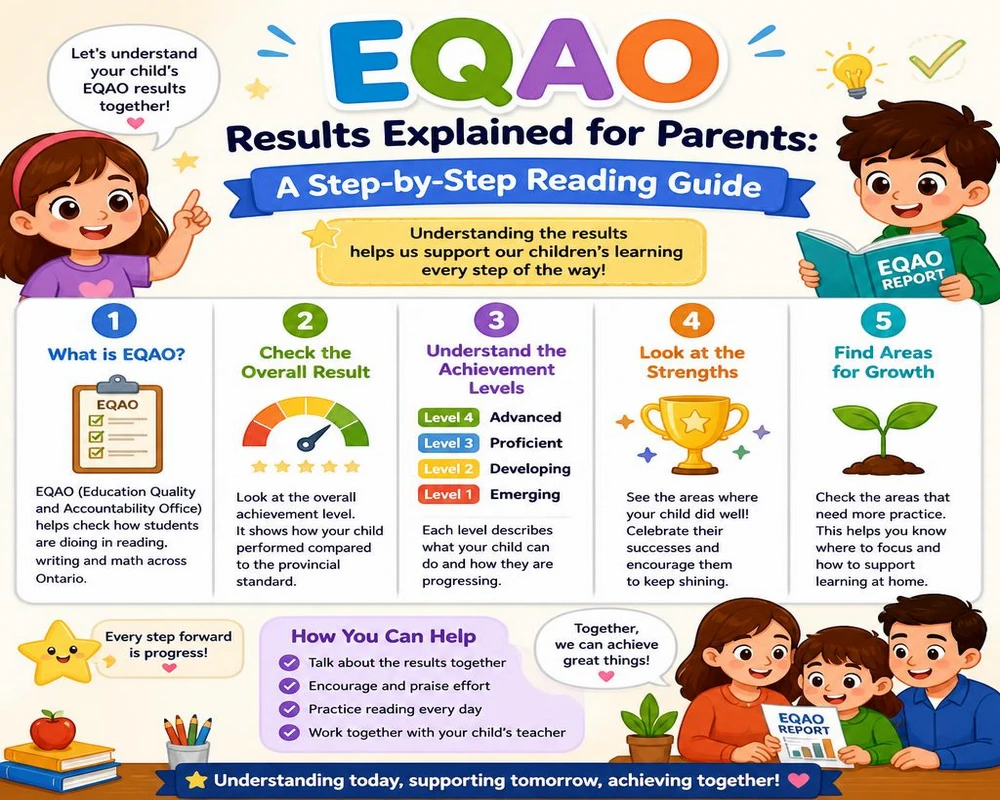
EQAO Results Explained for Parents: A Step-by-Step Reading Guide
Here’s a step-by-step approach to EQAO results explained parents find easiest to follow when the report first arrives:
- Start with the overall level for each subject tested (reading, writing, math for Grade 3/6; math only for Grade 9).
- Check the strand breakdown to see if performance is even across areas or concentrated in one weak spot.
- Compare to the provincial average shown on the report, keeping in mind this is one data point, not a full verdict.
- Cross-reference with the report card from the same school year — if EQAO and report card results tell a similar story, that’s a strong, consistent signal; if they diverge significantly, it’s worth asking the teacher why.
- Identify one or two specific action items, such as extra practice in a particular strand, rather than reacting to the overall level alone.
Once the four levels make sense, the rest of learning How to Read an EQAO Score Report Ontario is really just applying that same scale to each strand shown in the breakdown.
What If My Child Scored Below Level 3?
A result below Level 3 is common and not a reason to panic — EQAO’s own provincial data consistently shows a meaningful percentage of students at each grade level scoring at Level 1 or 2 in any given year, particularly in math following pandemic-related learning disruptions that Ontario’s education sector has been actively working to address through targeted supports since 2022.
Practical next steps if your child scored below the provincial standard:
- Request a meeting with your child’s teacher to discuss the specific strand areas of weakness shown in the report
- Ask whether school-based intervention or small-group support is available
- Consider whether targeted practice at home, focused on the specific strand identified, would help
- Remember that EQAO is one assessment on one day — a strong classroom performance pattern throughout the year still matters more for your understanding of your child’s actual ability
Knowing what to do next is really the last piece of How to Read an EQAO Score Report Ontario families need, and it applies whether your child scored above or below the provincial standard.

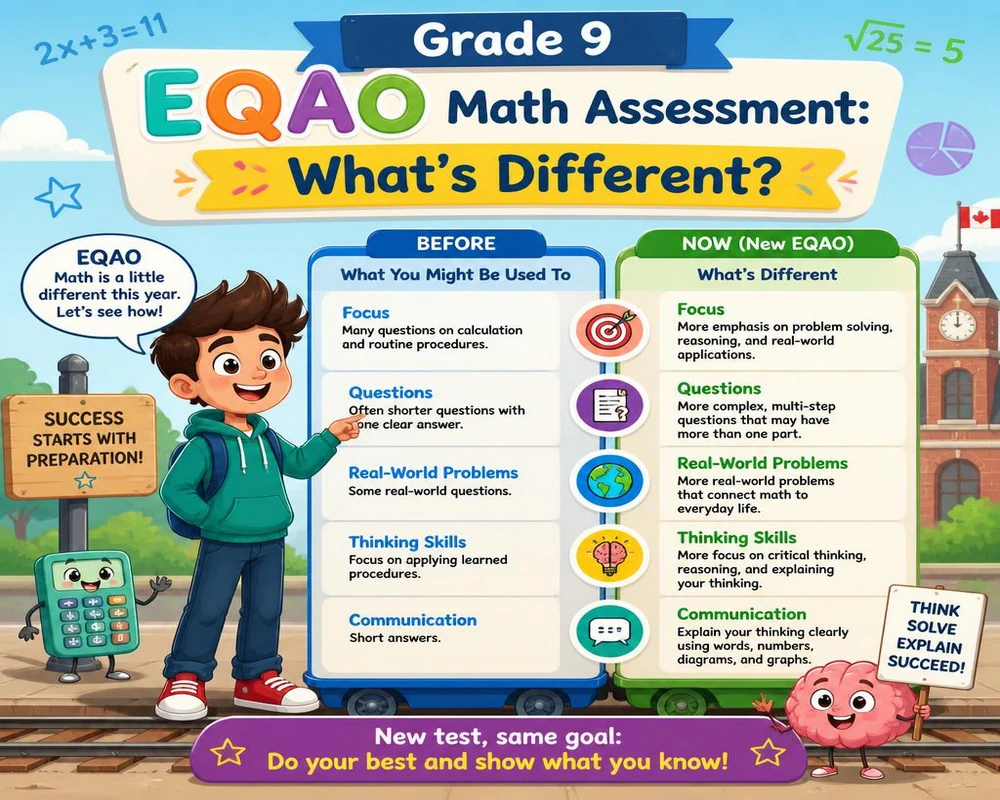
Grade 9 EQAO Math Assessment: What’s Different
The Grade 9 EQAO math assessment differs from the Grade 3 and 6 versions in a few important ways. As of the province’s shift completed in the 2021-2022 school year, the Grade 9 assessment moved from a separate paper-based test to a set of online assessment questions embedded directly into students’ math coursework over the semester, rather than a single sit-down test. This means the Grade 9 report reflects performance gathered throughout the course rather than a single test day.
EQAO Assessment Format: Paper vs Online Testing
Ontario has been transitioning EQAO assessments from paper-based to online delivery over the past several years, a shift accelerated after 2020. As of the most recent administrations through 2025 and into 2026, Grade 3 and Grade 6 assessments are increasingly delivered online in many schools, while some schools retain paper options depending on technology readiness. This shift doesn’t change how to interpret the report itself — the achievement levels and strand breakdown remain structured the same way regardless of how the test was delivered — but it’s worth knowing if your child’s school mentions “online EQAO” versus “paper EQAO” in communications.

Expert Tips for Reading Your Report Quickly
After reviewing hundreds of these reports with families, a few practical shortcuts consistently help:
- Read the strand breakdown before the overall level. The overall level is an average; the strand data tells you the actual story.
- Keep last year’s report for comparison if your child has taken EQAO before — a year-over-year trend is more informative than a single snapshot.
- Don’t compare siblings’ reports directly. Each child’s report reflects their own performance on their own assessment day; using one child’s results as a benchmark for another isn’t a fair or useful comparison.
- Note the date of the assessment relative to when concepts were taught — a topic covered right before testing versus early in the year can affect results independent of true mastery.

How Schools and Boards Use EQAO Data
Beyond the individual report your family receives, EQAO data is aggregated at the school and board level and used for school improvement planning, resource allocation decisions, and public accountability reporting. This aggregate data is publicly available on the EQAO website, which is also how you can look up a specific school’s historical performance trends if you’re evaluating schools.
Beginner, Intermediate, and Advanced: Reading the Report at Every Level
Not every parent needs — or wants — the same depth of analysis. Here’s how How to Read an EQAO Score Report Ontario guidance breaks down by how much detail you want:
Beginner: Just the Headline
If you only have two minutes, look at the overall achievement level for each subject and note whether it’s at or above Level 3. That alone tells you whether your child is on track for the provincial standard.
Intermediate: Strand-by-Strand
If you have ten minutes, review the strand breakdown to identify any specific weak area — this is usually the most actionable part of the report for planning extra practice at home.
Advanced: Multi-Year Trend Analysis
If your child has multiple years of EQAO data (Grade 3 and Grade 6, for example), compare trends across strands over time. A consistent weakness in one strand across multiple assessment years is a stronger signal than a single low result and is worth raising proactively with the school.
Clearing up these misconceptions is often the last step in truly mastering How to Read an EQAO Score Report Ontario sends home, since misreading the report causes more parent anxiety than the actual results usually warrant.
Common Misconceptions About EQAO Reports
- Misconception: EQAO results determine report card grades. Reality: EQAO is a separate, independent assessment; it does not feed directly into report card marks.
- Misconception: A low EQAO score means a learning disability. Reality: EQAO performance can be affected by many factors including test anxiety, an off day, or a temporary gap in one strand — it is not a diagnostic tool. If persistent struggles are suspected, a proper assessment process, as covered in InukMath’s Math Anxiety vs Math Learning Disability guide, is the appropriate next step.
- Misconception: Schools with lower EQAO averages are automatically worse schools. Reality: school-level EQAO averages are influenced by many demographic and contextual factors and should be interpreted alongside other information, not in isolation.
Frequently Asked Questions
When do EQAO score reports come out in Ontario?
EQAO Individual Student Reports are typically distributed to families in the fall following the spring assessment — so a Grade 3 assessment written in May or June is usually reported to families by around September or October of the following school year.
Is Level 3 on the EQAO report a good score?
Yes. Level 3 represents the provincial standard — the Ministry of Education’s defined target for grade-appropriate achievement. It is not a “middling” score; it reflects solid, expected performance for that grade.
Do all Ontario schools participate in EQAO testing?
Yes, all publicly funded schools in Ontario — public, Catholic, English, and French — are required to participate in EQAO assessments in Grades 3, 6, and 9.
Can I see how my child’s specific school performs on EQAO over time?
Yes, the EQAO website publishes historical, school-level results publicly, which lets you review multi-year trends for any specific Ontario school.
What should I do if I don’t understand my child’s EQAO report?
Contact your child’s teacher or the school office — they can walk through the specific sections of the report with you and connect the results to what they’ve observed in class throughout the year.
Does EQAO test the same math skills as the classroom curriculum?
Yes, EQAO assessments are built directly from the Ontario curriculum expectations for the relevant grade, so results should reasonably reflect what’s been taught in class that year.
Why did my child’s EQAO score not match their report card grade?
This can happen for several reasons: EQAO is a single-day assessment while report cards reflect a full term of ongoing work, test-day factors like anxiety or fatigue can affect EQAO performance, and the two assessments measure slightly different things even when strand-aligned.
Can a student opt out of EQAO testing in Ontario?
Parents can request an exemption in specific circumstances, such as for students with certain special education needs, through their school’s special education process, though EQAO participation is otherwise expected for all eligible students.
What’s the fastest way to learn How to Read an EQAO Score Report Ontario schools send home?
Start with the overall achievement level, then move straight to the strand breakdown — those two sections alone answer most of the practical questions parents have, and mastering just those two sections is the fastest way to get comfortable with How to Read an EQAO Score Report Ontario mails home every year.
Does a low EQAO score affect high school placement in Ontario?
EQAO results are not used directly for course placement decisions; those are based on classroom performance, teacher recommendation, and report card history. EQAO is an independent, additional data point rather than a gatekeeping test.
Conclusion: Turning the Report Into Action
You now have the complete picture of How to Read an EQAO Score Report Ontario schools distribute every fall — the levels, the strands, the comparisons, and what to actually do with each piece.
Now that you know How to Read an EQAO Score Report Ontario schools send home each fall, the report should feel far less like a mysterious grid of numbers and far more like a useful, specific tool. Start with the overall level, dig into the strand breakdown for specifics, compare it against the report card from the same year, and turn any gaps into one or two concrete next steps rather than a source of stress. If a pattern of below-standard results persists across more than one year, that’s worth a direct conversation with your child’s teacher about additional support — but a single report, read correctly, is simply information, not a verdict on your child’s potential.
For grade-specific practice that lines up with what EQAO actually tests, explore InukMath’s guides for Grade 1 Math Ontario through Grade 6 Math Ontario.