
Helping ESL Students with Math Word Problems Ontario
Math word problems trip up a lot of kids, but for a child who’s still building English fluency, the challenge multiplies. The math itself might be well within reach — your child may be perfectly capable of dividing 24 by 6 — but if the question is wrapped in unfamiliar vocabulary and sentence structure, the math gets lost behind the language. This guide focuses specifically on Helping ESL Students with Math Word Problems Ontario classrooms assign, with strategies that work whether you’re fluent in English yourself or navigating the material in a second language alongside your child.
Quick answer: the most effective approach to Helping ESL Students with Math Word Problems Ontario teachers assign combines a focused signal-word vocabulary list, a step-by-step reading method, and open communication with the school’s ESL support team.
Why Word Problems Are Uniquely Hard for English Language Learners
Straightforward computation — adding, subtracting, multiplying numbers presented numerically — relies relatively little on language. Word problems are different. A child has to read and comprehend a full sentence or paragraph, identify which numbers matter and which are just context, recognize keywords that signal an operation (words like “altogether,” “left,” “each,” “difference”), and then translate all of that into a math expression before ever starting to calculate.
For English language learners math word problems become as much a reading comprehension task as a math task. A student who is mathematically capable in their home language can still struggle significantly here — not because the math is hard, but because English vocabulary and sentence structure are getting in the way of showing what they actually know.

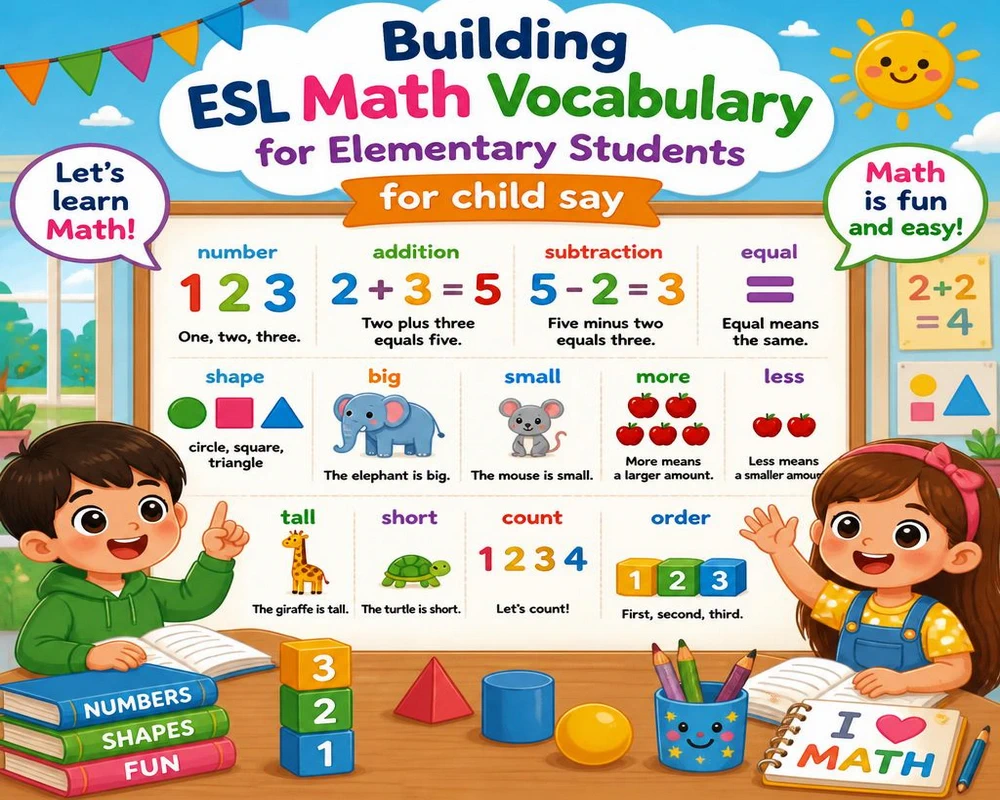
Building ESL Math Vocabulary for Elementary Students
A focused, manageable list of recurring word-problem vocabulary tends to help more than trying to cover every possible math term at once. Useful categories of ESL math vocabulary elementary students benefit from practicing specifically:
Addition Signal Words
altogether, in total, combined, sum, both, increased by
Subtraction Signal Words
left, remaining, difference, how many more, fewer, decreased by
Multiplication Signal Words
each, every, times, groups of, in all
Division Signal Words
shared equally, split, per, divided among, each group
Making a simple visual reference chart with these words, grouped by operation and kept visible during homework time, gives a child something concrete to check against instead of trying to recall the meaning from memory under pressure.
Building this vocabulary is one of the most effective early steps in Helping ESL Students with Math Word Problems Ontario teachers assign, since it gives a child something concrete to check against.
A Step-by-Step Approach for Word Problems
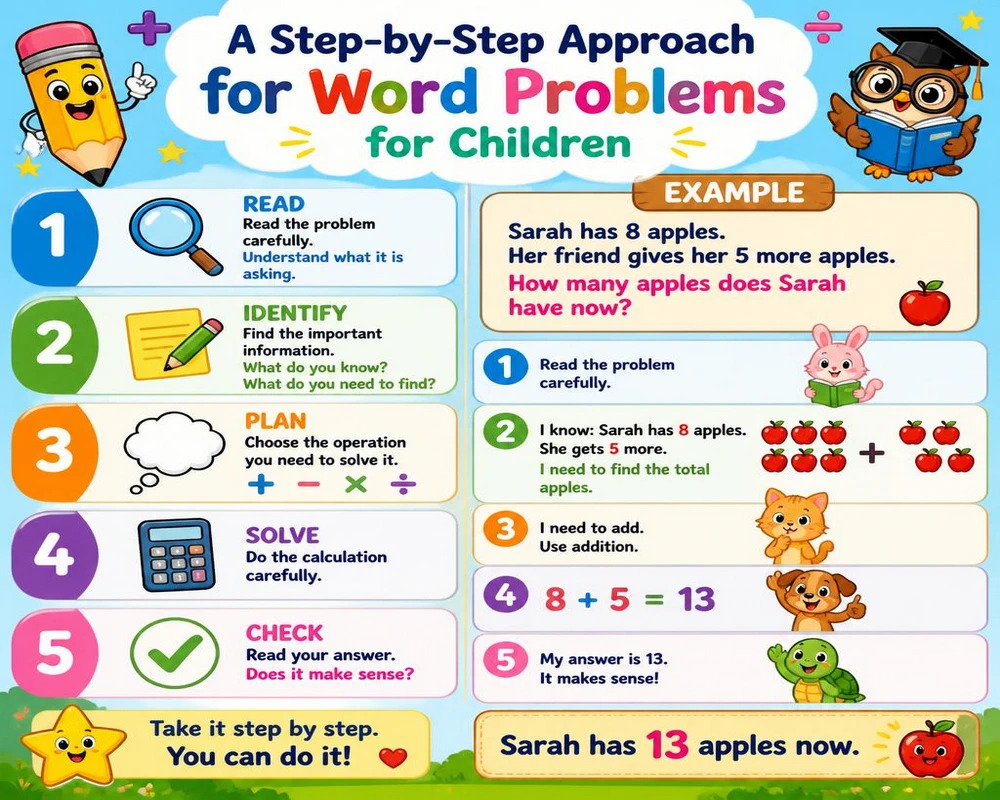
This structured method works well for many math word problems newcomer students encounter, because it separates the language task from the math task instead of asking a child to do both at once:
- Read the problem twice. The first read is just for general sense; the second is to hunt for numbers and key vocabulary.
- Underline the numbers. This makes clear exactly what quantities are involved before any calculation begins.
- Circle the signal word. Using the vocabulary chart above, identify which operation the sentence is pointing toward.
- Restate the question in the simplest possible words. If your child can say “How many are left?” in their own words, they’ve usually understood the question even if some of the surrounding sentence was unclear.
- Draw it, if helpful. A simple picture or diagram of the situation described often bridges the language gap entirely, letting the math happen visually.
- Solve, then re-read the question one more time to check the answer actually addresses what was asked.
Translating Math Vocabulary Between Languages
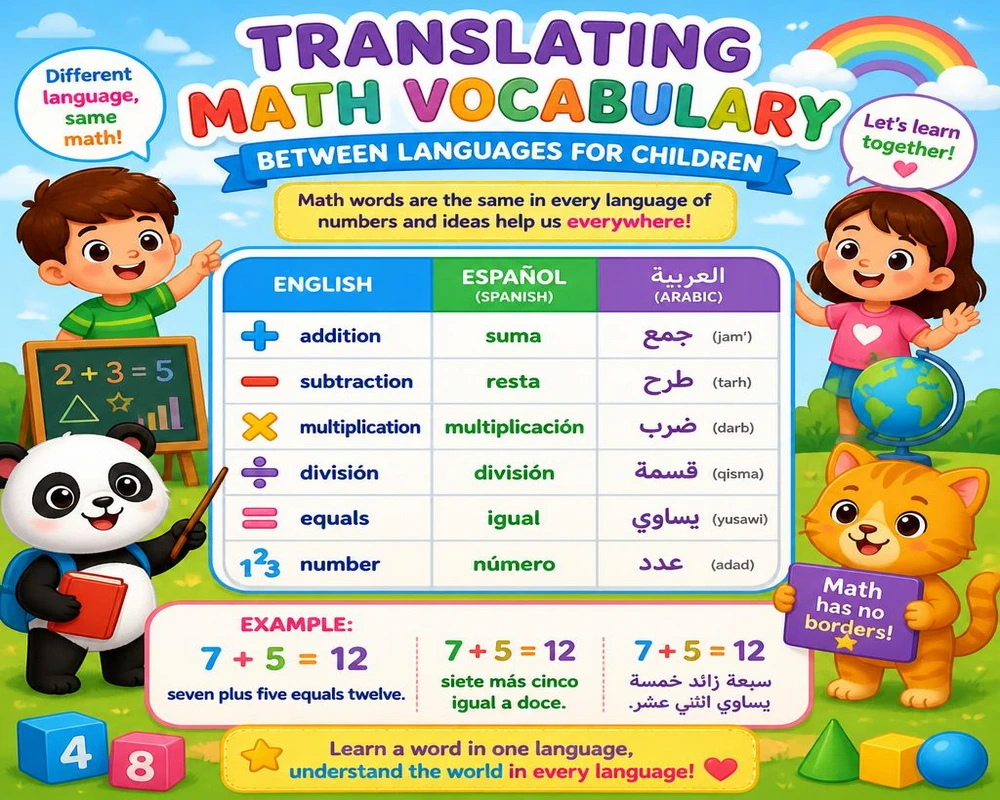
For families more comfortable in a language other than English, translating math vocabulary Ontario parents rely on can genuinely help — but with one important caveat. Directly translating a word problem sentence-by-sentence sometimes produces awkward or confusing results, because idioms and phrasing don’t always carry over cleanly between languages.
A more effective approach is often to discuss the underlying math situation in your home language first — making sure your child understands what’s actually happening in the problem — and then separately work on connecting that understanding to the specific English vocabulary and phrasing used in the original question. This keeps the math concept and the English language skill as two distinct, manageable pieces rather than one tangled task.
Bilingual math vocabulary lists and picture dictionaries, some of which are produced specifically for Ontario ESL programming, can be a useful bridge tool for this. The provincial ESL and ELD curriculum policy document, referenced by Ontario school boards, outlines how language support is meant to be integrated across subjects including math — worth asking your child’s ESL teacher whether the school has translated glossaries available.
Watching for these specific traps is another practical piece of Helping ESL Students with Math Word Problems Ontario that goes beyond general vocabulary building.
Common Word Problem Traps for English Language Learners
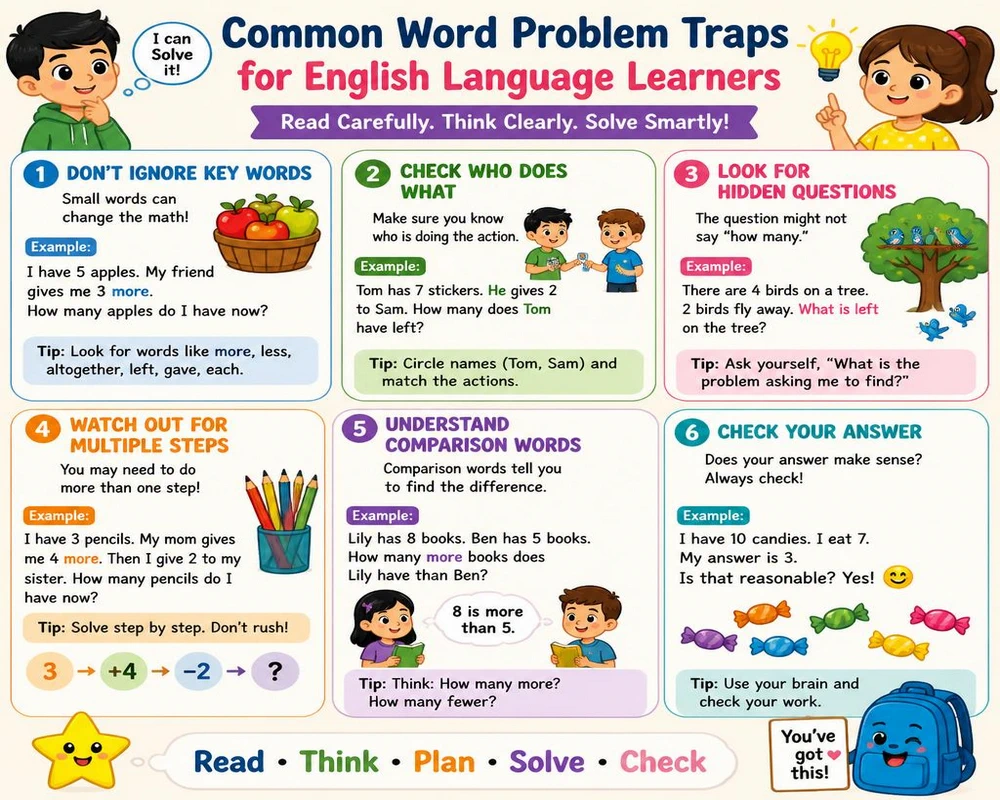
A few specific patterns in English math vocabulary cause repeated confusion for ESL students, and knowing them ahead of time helps you watch for them during homework:
Words That Mean Different Things in Everyday vs. Math Context
Words like “table,” “product,” “difference,” and “volume” have one meaning in everyday conversation and a completely different, specific meaning in math class. A child who has learned the everyday meaning of “difference” as “not the same” may not automatically connect it to subtraction.

Comparative Phrasing
Phrases like “how many more,” “how much less,” and “times as many” require understanding a comparison between two quantities, which is grammatically more complex than a straightforward addition or subtraction statement — and is one of the last word-problem structures many ESL students master.
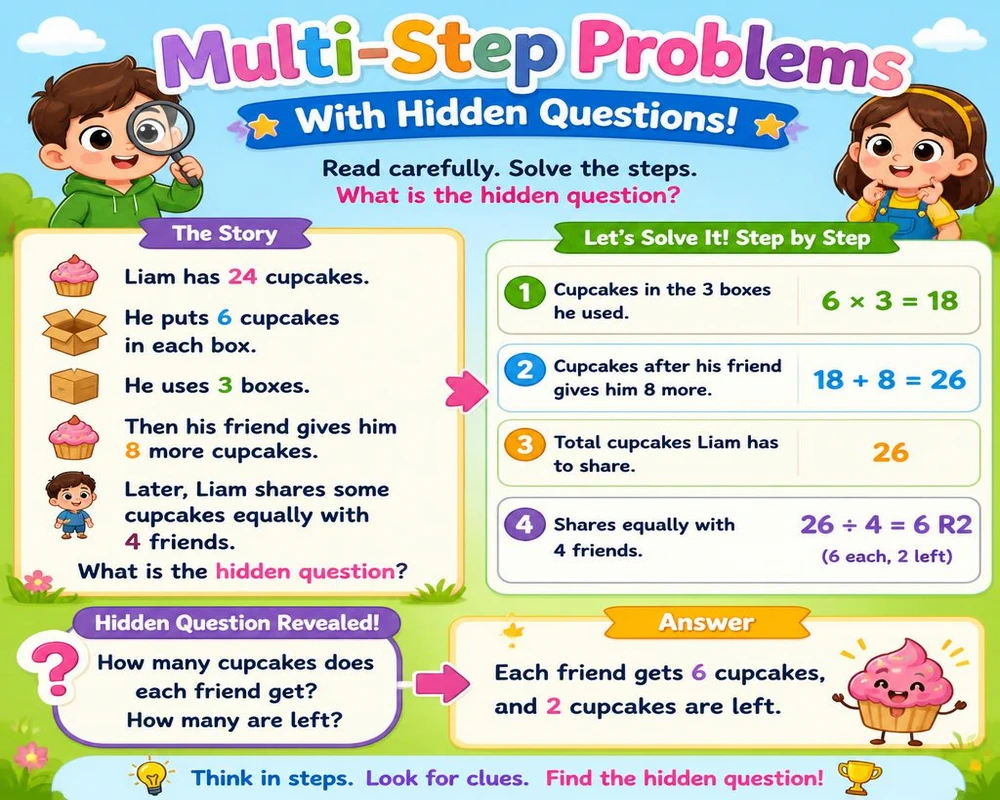
Multi-Step Problems With Hidden Questions
A word problem that requires two operations — find a subtotal, then use it to answer the actual question — can be especially difficult, because the “real” question is often buried at the very end of the paragraph, after several sentences of context a language learner may still be processing.
Practicing these specific patterns in isolation, rather than only working through full mixed-practice worksheets, often builds confidence faster because it removes the guesswork of which pattern is at play.
Working With Your Child’s Teacher
Ontario schools generally provide ESL support as part of regular programming for English language learners, and math class is one of the areas where accommodations can genuinely help — extra time, simplified language versions of word problems, or visual supports, for example. A few useful questions to ask your child’s teacher or ESL support staff:
- Are simplified-language versions of word problems available for math assessments?
- Does the school have bilingual math vocabulary resources for our home language?
- Is extra time or a scribe/reader accommodation available for math tests where language is a barrier?
The professional association TESL Ontario also maintains resources on English language learner support that can help parents understand what kind of classroom accommodations are typical and reasonable to ask about.
Consistent, low-pressure practice at home is what actually turns these strategies for Helping ESL Students with Math Word Problems Ontario into lasting skill rather than a one-time exercise.

Practicing at Home Without Overwhelming Your Child
- Start with short, one-sentence word problems before building up to multi-step ones
- Use real objects from around the house to physically act out a word problem before writing anything down
- Keep a running vocabulary list your child adds to themselves as new signal words come up
- Celebrate correctly identifying the operation, even if the final calculation has an error — that’s genuine progress in the language skill, separate from arithmetic

Frequently Asked Questions
Should I translate word problems fully into my home language for my child?
It can help for building initial understanding, but it’s worth also working through the original English version so your child builds familiarity with the specific vocabulary and phrasing they’ll see on school assessments.
How long does it typically take for word problem skills to catch up to computation skills?
This varies a lot by individual student and by how much English exposure a child has outside of school, but many ESL students see meaningful improvement in word-problem comprehension within one to two school years of consistent, focused vocabulary practice.
Are ESL accommodations available specifically for math tests in Ontario?
Yes — Ontario schools generally provide language-based accommodations for English language learners across subjects, including math, though the specific supports available depend on the school and board. It’s worth asking your child’s teacher directly what’s in place.
What’s the first step in Helping ESL Students with Math Word Problems Ontario at home?
Start with the signal-word vocabulary chart described above — it’s the single fastest way to make progress in Helping ESL Students with Math Word Problems Ontario teachers assign, before moving on to the full step-by-step method.
Final Thoughts
The math ability is very often already there — what’s missing is a bridge between that ability and the English vocabulary wrapped around it. A structured approach to word problems, a focused vocabulary list, and open communication with your child’s teacher can close that gap steadily over time. For a broader look at supporting newcomer families in Ontario schools, see InukMath’s Newcomer Families guide.