
Ontario Math Curriculum Myths Parents Still Believe
Short answer: Many of the most common claims about Ontario math education — that “discovery math” is an official curriculum, that calculators have replaced basic facts, that the curriculum no longer requires memorization, or that Ontario abandoned traditional methods entirely — don’t hold up against the actual Ministry of Education curriculum document. The Ontario Math Curriculum Myths Parents Still Believe tend to come from media shorthand and dinner-table conversation rather than the curriculum itself, and separating the two helps parents evaluate their child’s math education more accurately.
Key takeaways:
- “Discovery math” is not an official Ontario curriculum term or approach — it’s an informal, often critical label for certain teaching styles.
- The current curriculum explicitly requires both conceptual understanding and fluency with standard algorithms and basic facts.
- The 2020 revision responded directly to concerns about EQAO scores, adding structure rather than removing it.
- Understanding what the curriculum actually says is more useful than relying on secondhand claims about what it supposedly removed.
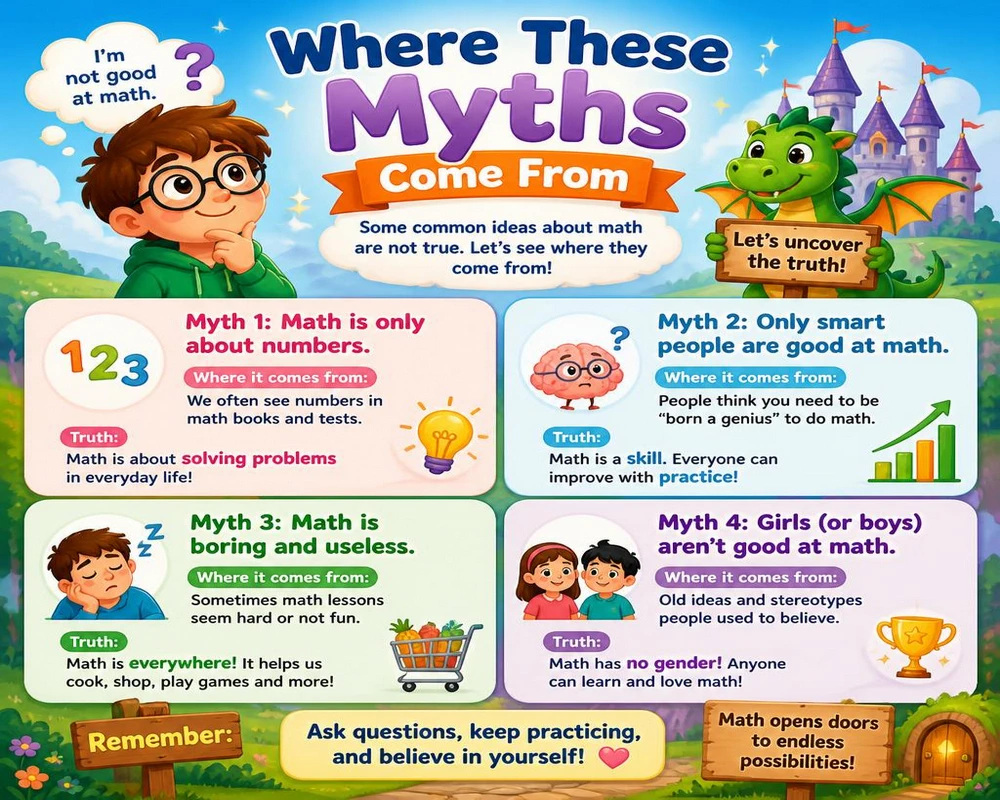
Where These Myths Come From
Most Ontario Math Curriculum Myths Parents Still Believe trace back to a real, well-documented period of below-target EQAO math results in the 2010s, media coverage that used “discovery math” as a catch-all explanation, and genuine differences in how individual teachers implement the same curriculum. Once a phrase like “discovery math” enters common usage, it tends to stick around long after the specific practices it referred to have changed — which is exactly what happened here.
The sections below work through each of the specific Ontario Math Curriculum Myths Parents Still Believe one at a time, comparing the common claim against what the curriculum document actually says.
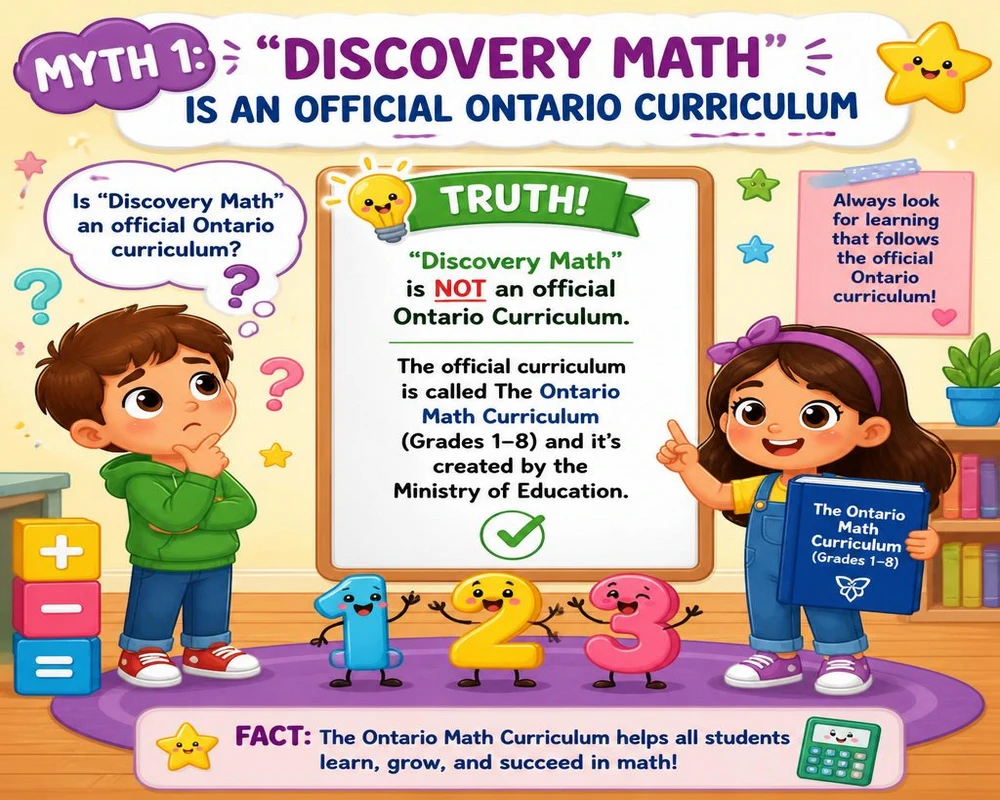
Myth 1: “Discovery Math” Is an Official Ontario Curriculum
This is likely the single most persistent of the common misconceptions Ontario math curriculum discussions run into. “Discovery math” — the idea that students should discover mathematical concepts entirely through open-ended exploration, with minimal direct instruction — is not a term that appears anywhere in the official Ontario math curriculum document. It’s a media and public-commentary label applied to certain instructional practices, not an official Ministry policy or program.
Searching the full text of the current Ontario elementary math curriculum turns up no reference to “discovery math” as a named approach or program. What the document does contain is a mix of expectations around conceptual understanding, procedural fluency, and problem solving — all three, not one to the exclusion of the others. Framing this balanced approach as “discovery math” oversimplifies a document that, on close reading, explicitly calls for direct instruction, guided practice, and independent application at different points, depending on the specific expectation being taught.
Myth 2: The Curriculum No Longer Requires Memorizing Basic Facts
Among the math curriculum myths debunked most often by a close reading of the actual document, this one is easy to check: the current curriculum explicitly includes expectations around recalling multiplication and division facts and applying standard algorithms for operations. Conceptual understanding and procedural fluency are both required — the curriculum was never written to replace one with the other.

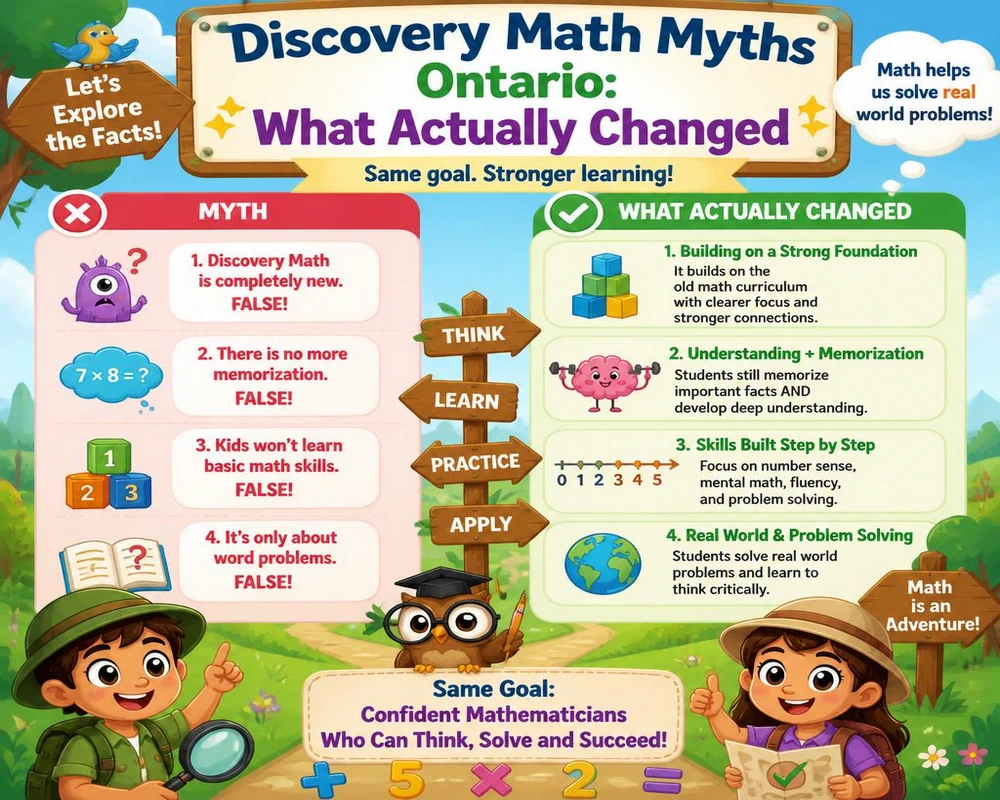
Discovery Math Myths Ontario: What Actually Changed
The real story behind discovery math myths Ontario parents have heard is more nuanced than “the province removed traditional math.” What actually happened is that the 2020 curriculum revision responded to years of public and EQAO-driven concern by adding more explicit structure: clearer expectations, an emphasis on both conceptual understanding and fluency, and new content (Financial Literacy, coding) rather than a wholesale rejection of direct instruction.
What the 2020 Revision Actually Added
- A dedicated Financial Literacy strand, covering budgeting, saving, and consumer awareness.
- Coding and computational thinking integrated into the Algebra strand starting in Grade 1.
- More explicit language throughout the document connecting concepts to real-life, practical applications.
- Continued and reinforced expectations for fluency with basic facts and standard algorithms.
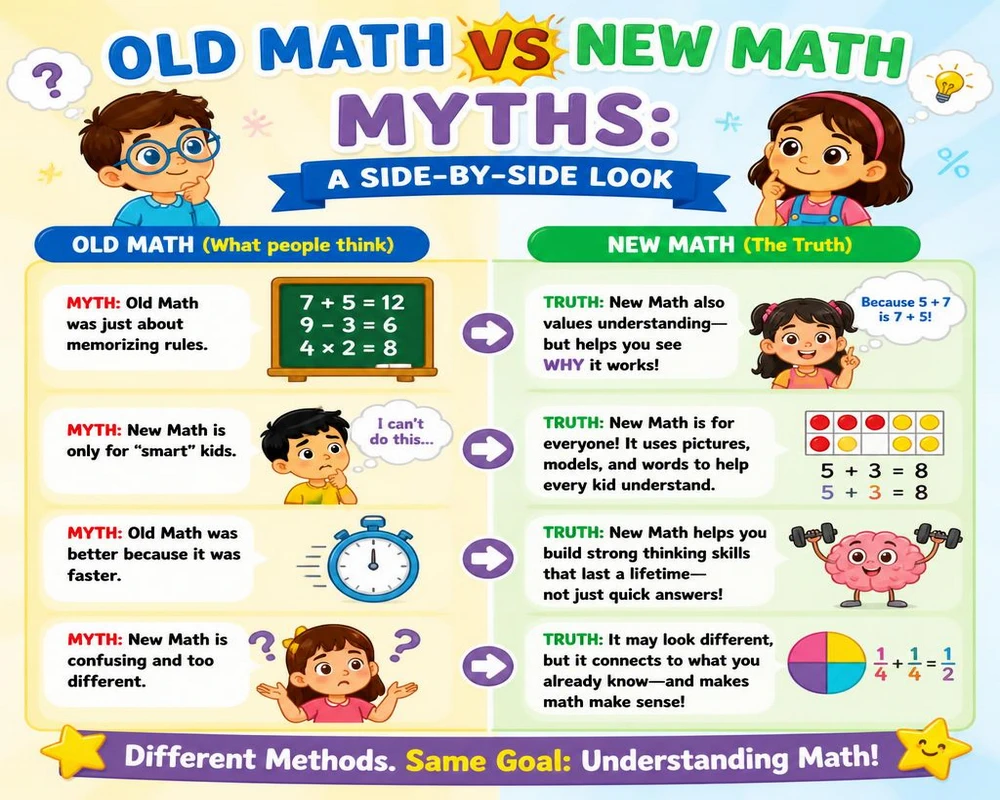
Old Math vs New Math Myths: A Side-by-Side Look
The old math vs new math myths debate tends to frame the two as opposites, but a direct comparison shows more overlap than most people assume.
| Claim | What the Curriculum Actually Says |
|---|---|
| “New math skips memorization” | Basic fact fluency and standard algorithms remain explicit curriculum expectations |
| “Old math didn’t teach understanding” | Conceptual understanding has long been part of Ontario’s curriculum; it’s not a recent addition |
| “New math is only about exploration” | The curriculum sets expected outcomes, not a mandated teaching method — individual teachers choose their instructional approach |
| “Old math worked better for everyone” | EQAO results before the 2020 revision showed persistent gaps that prompted the update in the first place |
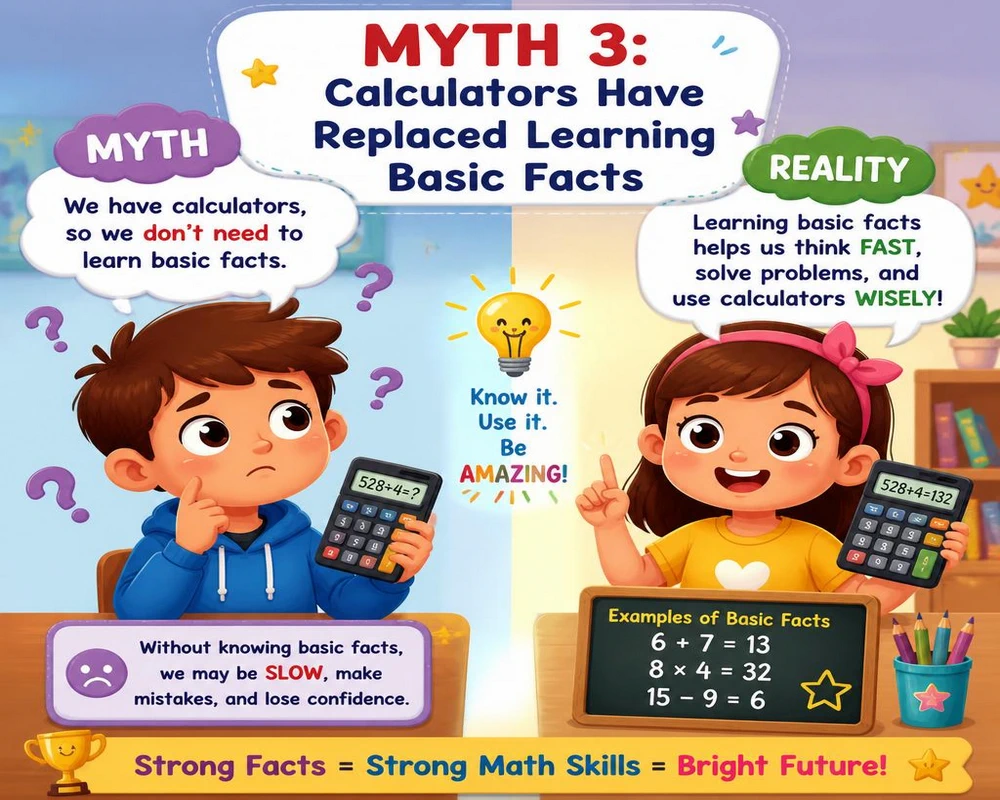
Myth 3: Calculators Have Replaced Learning Basic Facts
Calculator use is permitted at specific points in the curriculum, primarily to support problem-solving on more complex, multi-step tasks — it is not a substitute for learning basic facts, which remain an explicit, assessed expectation in the early grades. This is one of the Ontario Math Curriculum Myths Parents Still Believe most strongly, often because it conflates calculator availability during certain classroom activities with the actual, separately assessed expectation to know facts fluently.
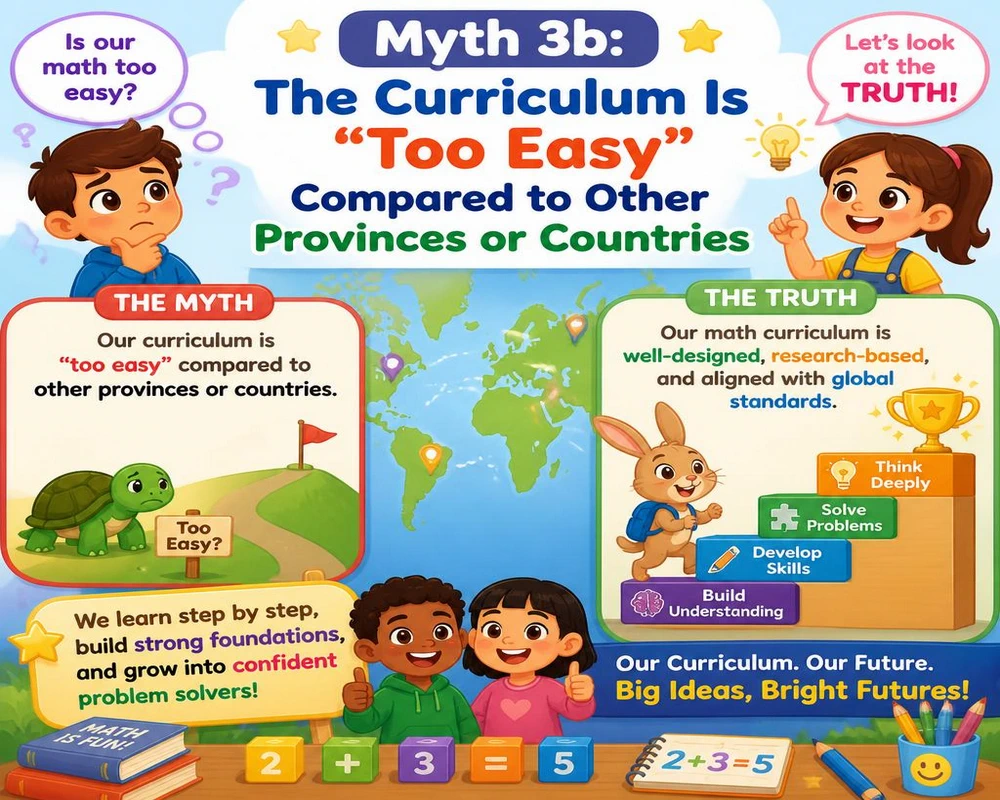
Myth 3b: The Curriculum Is “Too Easy” Compared to Other Provinces or Countries
Cross-jurisdiction comparisons are genuinely complicated, since curricula differ in structure, sequencing, and what’s assessed at which grade, making direct “easier or harder” comparisons unreliable without a detailed strand-by-strand analysis. Ontario’s 2020 revision specifically added content — Financial Literacy and coding — that many other jurisdictions’ elementary curricula do not yet include, which complicates any simple claim that Ontario’s curriculum is behind or lagging.
Myth 4: Every School Teaches Math the Same Way
The curriculum sets what must be taught, not how it must be taught — instructional style genuinely does vary between teachers and schools, even though all are working from the same expectations. This variation is sometimes mistaken for inconsistency in the curriculum itself, when it actually reflects the professional discretion the curriculum intentionally leaves to teachers.
This variation between classrooms is real and worth understanding, but it’s a separate issue from the curriculum itself — one more of the Ontario Math Curriculum Myths Parents Still Believe comes from conflating the two.
Myth 5: The Curriculum Hasn’t Changed Since the 1990s
In fact, the 2020 revision was a substantial update — the most significant in over a decade — adding an entire new strand and integrating digital-age skills like coding for the first time. Assuming the curriculum is static ignores a well-documented, publicly announced policy change that directly affects what’s taught in classrooms today.
Beginner, Intermediate, and Advanced: Fact-Checking Curriculum Claims
Beginner level: before repeating a claim about Ontario math education, check whether it refers to an official curriculum term or an informal media label.
Intermediate level: compare the claim against the actual expectations listed in the Ministry’s curriculum document, which is publicly available.
Advanced level: distinguish between curriculum content (what must be taught) and instructional practice (how an individual teacher chooses to teach it), since most Ontario Math Curriculum Myths Parents Still Believe confuse the two.
How This Connects to the Grade 9 De-Streaming Reform
Some of the confusion around elementary curriculum myths gets tangled up with a separate, later policy change: the 2021 de-streaming of Grade 9 math, which removed the Academic and Applied course tracks. While related in spirit — both reforms responded to concerns about equity and achievement gaps — they are distinct policies affecting different grade levels, and conflating the two is another common source of confusion. For a detailed look at that specific transition, see InukMath’s guide on Ontario Grade 8 to Grade 9 Math Transition.
Why These Myths Persist
Myths about curriculum content tend to persist because they’re simpler and more emotionally resonant than the underlying policy details, because media coverage from a decade ago still circulates in parent forums and conversations, and because individual classroom experiences — which genuinely do vary — get generalized into claims about the entire provincial curriculum. Recognizing this pattern is a useful first step toward evaluating any specific claim more carefully.
How to Evaluate a New Curriculum Claim Yourself
- Identify the specific claim. Is it about curriculum content, an assessment policy, or a teaching method? These are three different things governed differently.
- Check whether the term is official. Search the actual curriculum document, publicly available from the Ministry of Education, for the specific term or claim.
- Consider the source and its date. A claim from a 2015 news article may not reflect the substantially revised 2020 curriculum.
- Separate policy from practice. Even where the curriculum is clear, individual classroom implementation can vary — that’s a real phenomenon, but it’s different from the curriculum itself being unclear or contradictory.
Applying this framework consistently is the most reliable way to sort genuine Ontario math curriculum facts vs myths from outdated or oversimplified claims that continue to circulate.
Troubleshooting: What to Do When You Hear a New Claim
A friend told me the curriculum banned timed tests
The curriculum doesn’t dictate specific assessment formats like timed tests one way or another; this is a teacher- and school-level instructional decision, not a provincial policy.
I read that Ontario ranks worst in Canada for math
Provincial rankings shift year to year and depend heavily on which assessment and grade level is being cited; checking the specific EQAO results referenced, rather than a general claim, gives a much clearer picture.
My child’s teacher said something that contradicts what I read online
Teachers work directly with the curriculum daily and are generally a more reliable source for how it’s actually implemented in your child’s specific classroom than secondhand online claims.
A Quick Reference for Busy Parents
| You Heard | What’s More Accurate |
|---|---|
| “Discovery math is the official curriculum” | Not an official term; the curriculum balances conceptual understanding, fluency, and problem solving |
| “Kids don’t memorize facts anymore” | Basic fact fluency is an explicit, assessed curriculum expectation |
| “The curriculum hasn’t changed in decades” | Substantially revised in 2020, adding Financial Literacy and coding |
| “Every classroom teaches it identically” | Content is standardized; instructional method varies by teacher |
Keeping a quick reference like this on hand makes it easier to respond accurately the next time one of these Ontario Math Curriculum Myths Parents Still Believe comes up in conversation.
Common Misconceptions Recap
- “Discovery math” is not an official curriculum term.
- Basic facts and standard algorithms remain explicit curriculum expectations.
- The curriculum sets outcomes, not mandated teaching methods.
- The curriculum was substantially updated in 2020, not left unchanged for decades.
Frequently Asked Questions
Is “discovery math” used anywhere in the official Ontario curriculum document?
No — it does not appear as an official term. It’s an informal label applied by media and public commentary to certain instructional practices.
Does the Ontario curriculum still require memorizing multiplication tables?
Yes — fluency with basic facts, including multiplication and division, remains an explicit expectation in the curriculum.
Did Ontario remove standard algorithms from the math curriculum?
No — standard algorithms for addition, subtraction, multiplication, and division are explicitly included as curriculum expectations.
Why do people still blame “discovery math” for low EQAO scores?
The label became widely used during a period of genuine concern over EQAO results in the 2010s, and it has persisted in public conversation even as the curriculum itself was substantially revised in 2020.
Is it true that every Ontario school teaches math identically?
No — while all schools follow the same curriculum expectations, individual teachers have discretion over specific instructional methods, which is why classroom experiences can vary.
Has the Ontario math curriculum actually been updated recently?
Yes — the 2020 revision was a substantial update, adding a Financial Literacy strand and integrating coding into the Algebra strand for the first time.
Where can I check a specific claim against the real curriculum?
The Ontario Ministry of Education publishes the full curriculum document publicly, and InukMath’s grade-specific guides summarize expectations in plain language for a faster check.
Do these myths affect how EQAO results should be interpreted?
Understanding what the curriculum actually requires helps put EQAO results in proper context — see InukMath’s guide on How to Read an EQAO Score Report Ontario for more detail.
Is the Grade 9 de-streaming reform the same thing as the elementary curriculum myths discussed here?
No — de-streaming is a separate 2021 secondary-level policy change affecting Grade 9 course structure, while the myths discussed here concern the elementary (Grades 1-8) math curriculum specifically.
What’s the single most reliable way to check if something I heard is true?
Compare the specific claim directly against the current curriculum document’s actual expectations, published by the Ontario Ministry of Education, rather than relying on secondhand summaries or older media coverage.
Conclusion
Most Ontario Math Curriculum Myths Parents Still Believe come from outdated media shorthand, generalized classroom experiences, or a genuine but understandable confusion between curriculum content and individual teaching style. Reading the actual curriculum expectations — or a plain-language summary of them — is a far more reliable way to understand what your child is being taught than relying on secondhand claims. For a full plain-language breakdown of curriculum terms and structure, see InukMath’s companion guide, Ontario Math Curriculum Explained in Plain English.