
Grade 2 Multiplication Introduction Ontario: 6 Simple Steps
Grade 2 multiplication introduction Ontario classrooms offer usually starts with something that doesn’t even look like math on the surface — a picture of three bags, each holding four apples. No times sign in sight, no formal equation, just a question: “how many apples altogether?” Having spent years supporting Ontario’s Primary Division classrooms, I’ve found this quiet, informal start is exactly the right approach, even though many parents expect multiplication to arrive with times tables and memorization right away.
This guide walks through exactly how Ontario’s curriculum introduces multiplication in Grade 2, why starting with equal groups matters so much, and six simple steps to build genuine understanding at home.
Why This Grade 2 Multiplication Introduction Ontario Approach Works
Ontario’s 2020 math curriculum doesn’t ask Grade 2 students to memorize multiplication facts or learn the times symbol formally — that comes in Grade 3. Instead, Grade 2 focuses on building the underlying concept: that multiplication is really just a faster way of adding equal groups together.
This matters because a Grade 2 multiplication introduction Ontario teachers use effectively skips straight to memorized facts often produces students who can recite “3 times 4 is 12” without understanding what that actually means. Starting with equal groups and skip counting builds a foundation that memorization alone never provides.
What the Ontario Curriculum Expects in Grade 2
By the end of Grade 2, students are generally expected to:
- Understand multiplication informally as combining equal groups
- Represent equal groups using objects, drawings, or arrays
- Skip count by 2s, 5s, and 10s as an early multiplication strategy
- Solve simple problems involving equal groups without using formal multiplication notation
- Recognize repeated addition as connected to combining equal groups
Notice that the multiplication symbol itself isn’t required yet. A genuine Grade 2 multiplication introduction Ontario students receive stays entirely conceptual, built on skills they already have — counting and addition — rather than introducing something brand new all at once.

Understanding Equal Groups
What “Equal Groups” Really Means
The core idea behind all multiplication is groups of the same size. Before any numbers get involved, a child should be comfortable recognizing and creating equal groups with real objects.
A simple home activity: give your child 12 small objects (buttons, blocks, crackers) and ask them to arrange them into groups of 3. How many groups did they make? This single, hands-on activity is the entire concept of multiplication in physical form.
Equal Groups Practice Questions
- There are 4 baskets with 2 apples in each basket. How many apples are there altogether?
- There are 3 boxes with 5 crayons in each box. How many crayons are there in total?
- If you have 6 groups of 2 stickers, how many stickers do you have?
Answers: 1) 8 apples 2) 15 crayons 3) 12 stickers
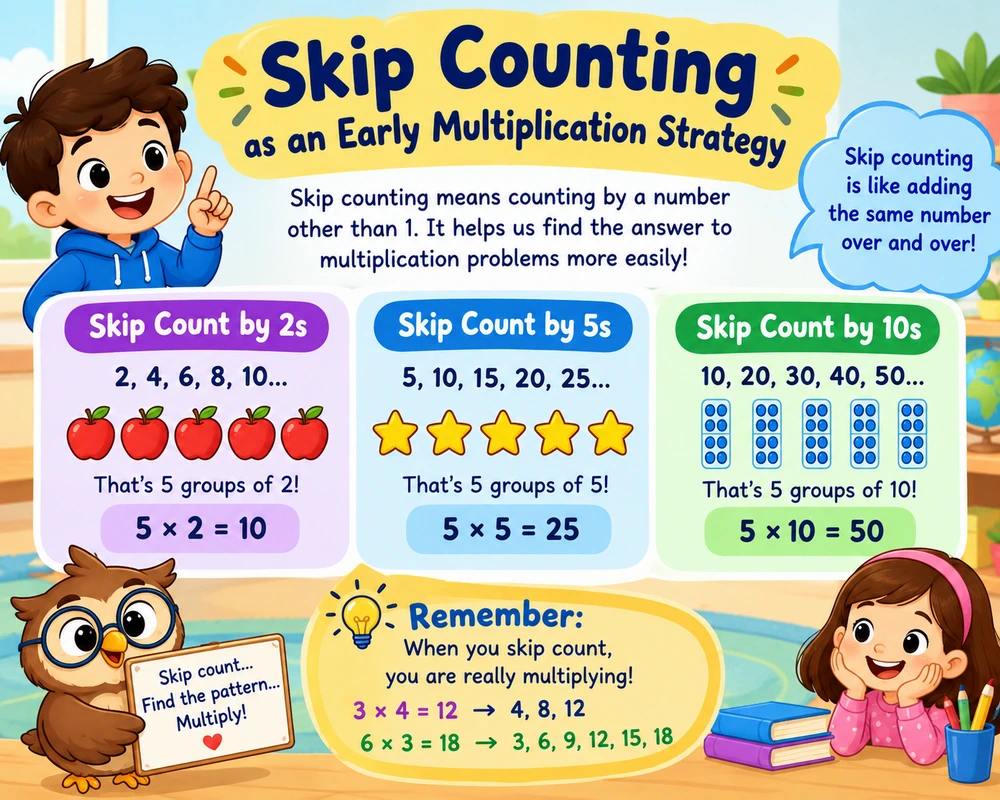
Skip Counting as an Early Multiplication Strategy
Connecting Skip Counting to Groups
Skip counting isn’t just a separate number sense skill — it’s directly connected to multiplication. Counting “2, 4, 6, 8” while pointing to four separate pairs of objects is, in essence, multiplying 4 by 2 without ever using the word.
Skip Counting Practice Questions
- Skip count by 5s to find the total of 4 groups of 5: 5, 10, ___, ___
- Skip count by 2s to find the total of 5 groups of 2: 2, 4, ___, ___, ___
Answers: 1) 15, 20 2) 6, 8, 10
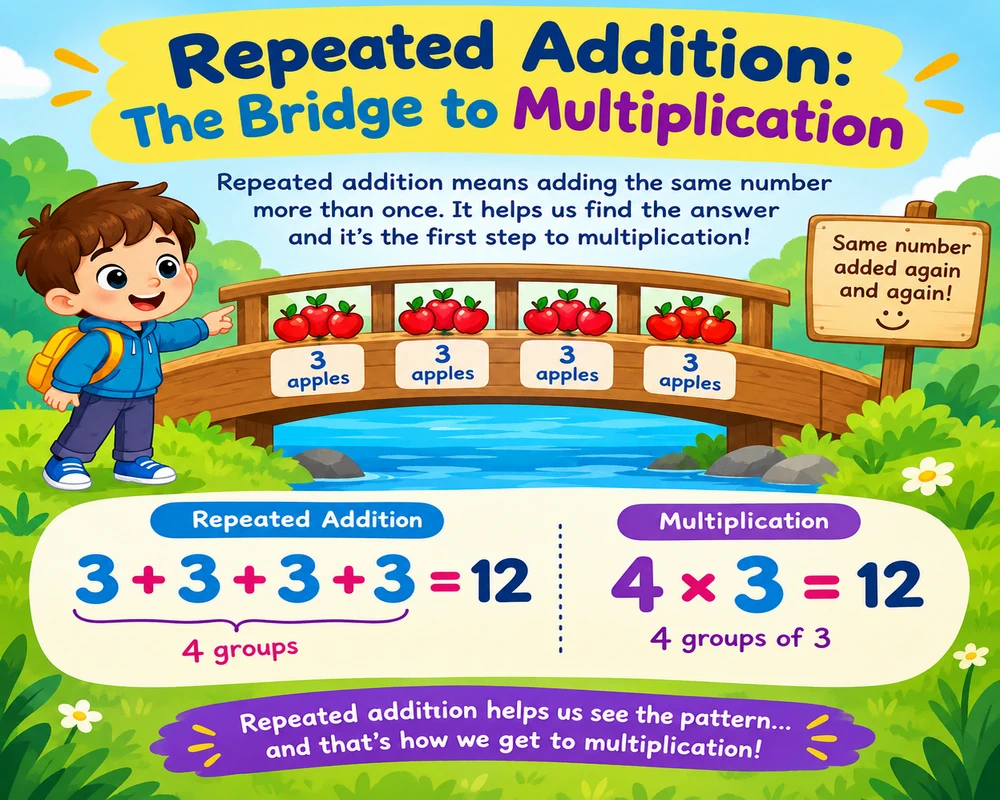
Repeated Addition: The Bridge to Multiplication
Before introducing multiplication vocabulary at all, connecting equal groups to repeated addition builds a natural bridge students already understand.
- Write 3 + 3 + 3 + 3 as a repeated addition problem. How many groups of 3 are there, and what is the total?
- If you have 5 + 5 + 5, how many groups of 5 are there, and what is the total?
Answers: 1) 4 groups of 3, total 12 2) 3 groups of 5, total 15
6 Simple Steps for a Grade 2 Multiplication Introduction
Step 1: Build Equal Groups With Real Objects
Start with something concrete — buttons, blocks, or snacks — and have your child physically create equal groups before any numbers get written down.

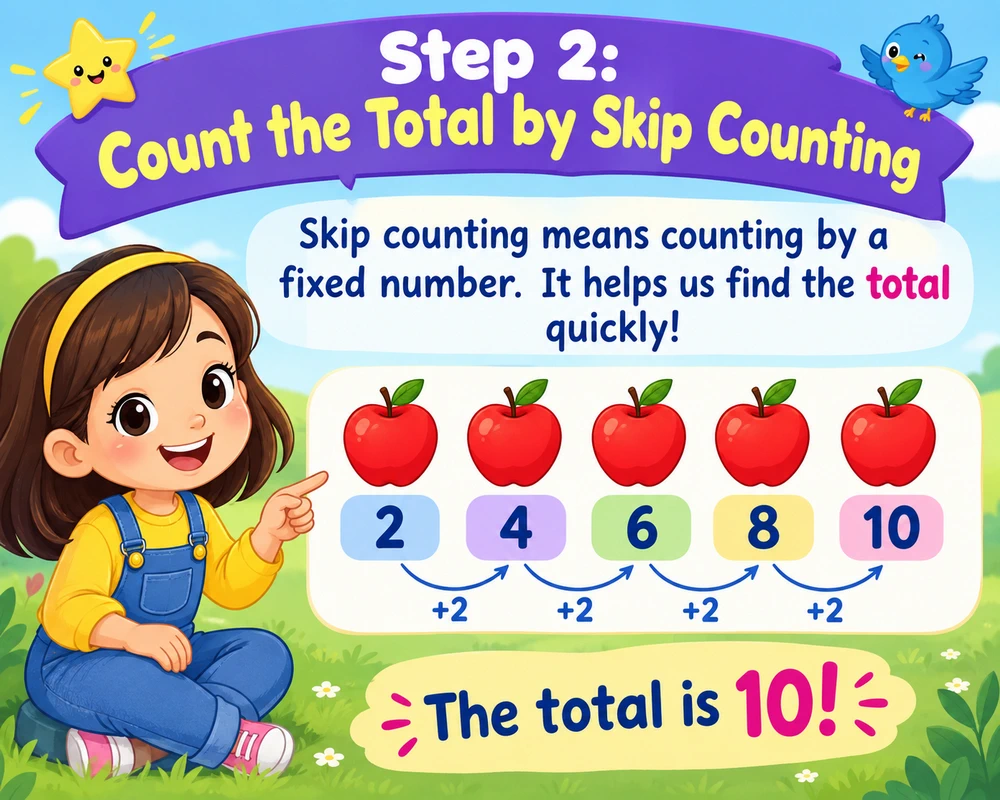
Step 2: Count the Total by Skip Counting
Once the groups are built, count the total using skip counting rather than counting each object individually one by one.
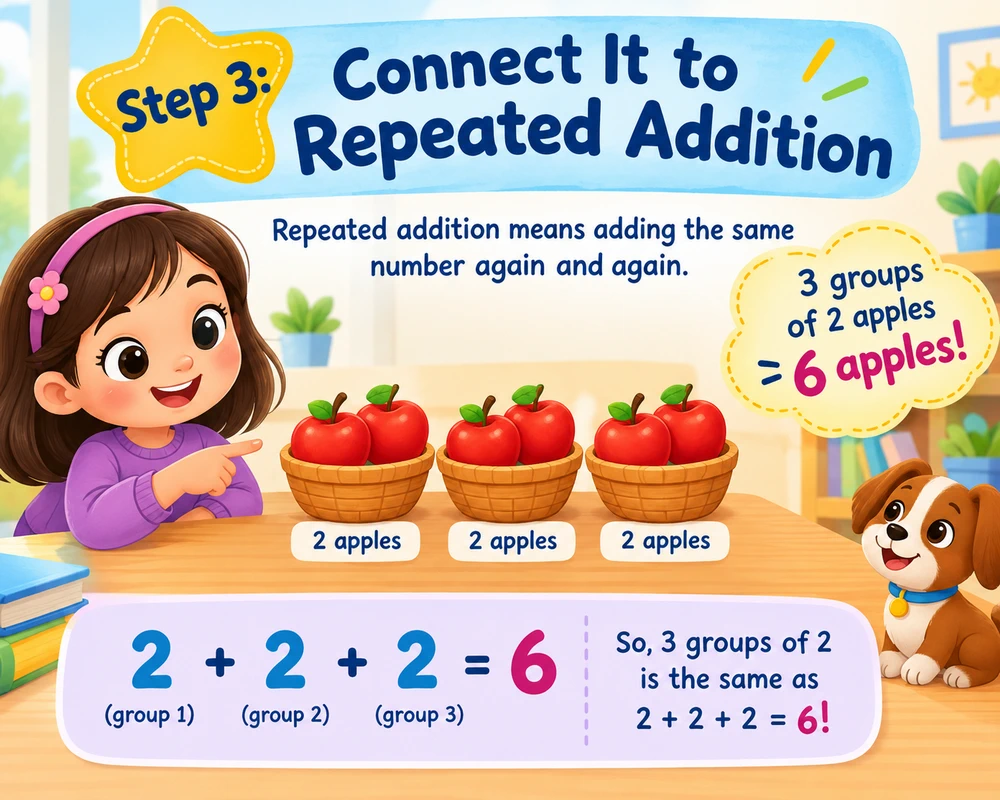
Step 3: Connect It to Repeated Addition
Write out the repeated addition sentence that matches what was just built (like 4 + 4 + 4), reinforcing that this is simply a faster way to add.
Step 4: Draw Simple Arrays
Have your child draw the same equal groups as neat rows and columns (an array), which becomes an important visual model for multiplication in later grades.

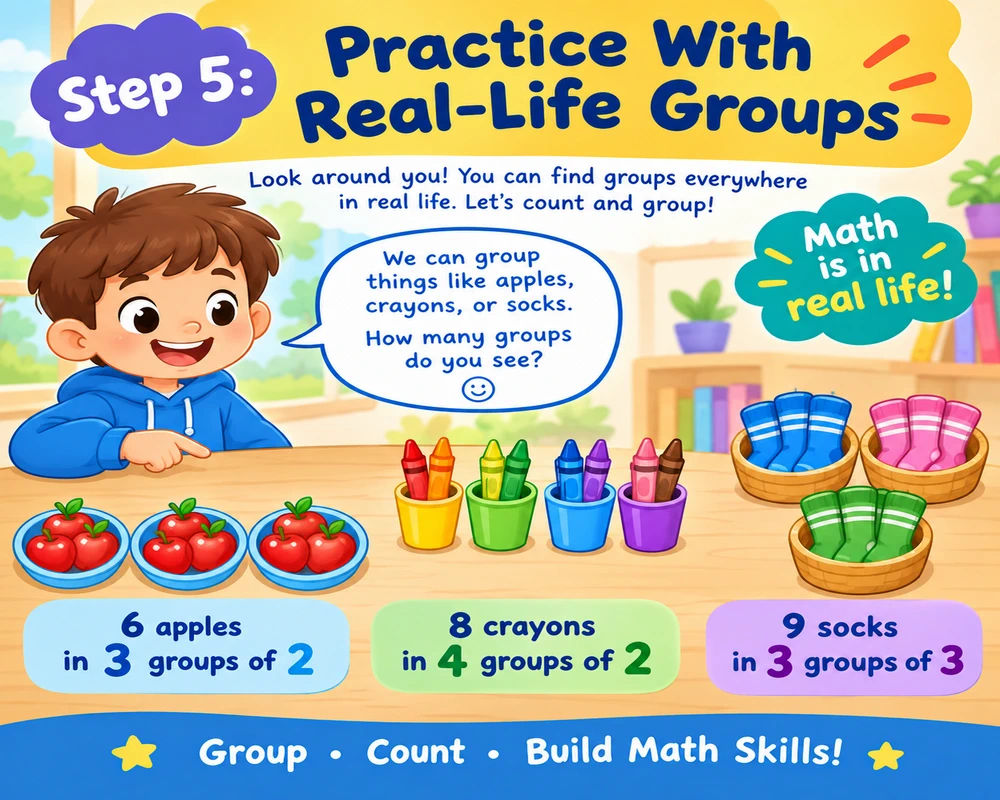
Step 5: Practice With Real-Life Groups
Egg cartons, muffin tins, and packs of juice boxes all naturally show equal groups, making this Grade 2 multiplication introduction Ontario families can build entirely around everyday objects.
Step 6: Keep It Playful, Not Formal
Avoid introducing the multiplication symbol or vocabulary like “times” too early. Let the concept settle first through groups and skip counting before any formal notation appears.
Following this Grade 2 multiplication introduction Ontario approach step by step, rather than skipping ahead to formal facts, gives your child the strongest possible foundation.

Real-Life Word Problems
- A muffin tin has 3 rows with 4 muffins in each row. How many muffins are there in total?
- Malik has 5 bags of marbles, with 3 marbles in each bag. How many marbles does he have altogether?
- A pack of juice boxes has 2 rows of 4 boxes. How many juice boxes are in the pack?
Answers: 1) 12 muffins 2) 15 marbles 3) 8 juice boxes
Common Mistakes in Early Multiplication Understanding
Counting Groups Instead of the Total Items
Some students count the number of groups (like “4 groups”) instead of the total number of items inside all the groups combined. Reinforcing the actual question — “how many altogether?” — helps redirect this.
Skip Counting Inconsistently
A child might skip count correctly at first, then lose the pattern partway through. Slower, more deliberate practice, pointing to each group while counting, helps build consistency.
Jumping to Memorized Facts Too Early
Some families push formal times tables before the concept of equal groups has really settled. This often creates a child who can recite facts without understanding what they represent, which causes problems later when facts are forgotten.
Most confusion during a Grade 2 multiplication introduction Ontario students go through comes from moving too fast, not from any real gap in ability.
Practical Tips for Practicing at Home
Use Snacks and Everyday Objects
Crackers, grapes, or small toys naturally divide into equal groups, making practice feel like play rather than a lesson.
Look for Equal Groups Everywhere
Egg cartons, wheels on cars, and rows of tiles all offer natural opportunities to point out equal groups during everyday moments.
Keep Sessions Short and Concrete
Ten to fifteen minutes of hands-on group-building, a few times a week, tends to build far stronger early multiplication understanding than any worksheet alone.
Conclusion: Building a Real Foundation Before Formal Multiplication
A thoughtful Grade 2 multiplication introduction Ontario students receive doesn’t rush toward times tables — it builds patiently through equal groups, skip counting, and repeated addition, using skills your child already has. Give this foundation genuine time and hands-on attention now, and formal multiplication in Grade 3 will feel like a natural next step rather than a completely new challenge.
Grab a handful of small objects tonight and build a few equal groups together, counting the total by skip counting. This kind of playful practice builds real understanding no worksheet alone can match.
A well-paced Grade 2 multiplication introduction Ontario families support at home, built on hands-on practice rather than rushed memorization, sets up years of confident math thinking.
Frequently Asked Questions
1. Does Grade 2 formally teach multiplication facts?
No, formal multiplication facts and the times symbol are typically introduced in Grade 3. Grade 2 focuses on the underlying concept using equal groups and skip counting.
2. What are “equal groups,” and why do they matter?
Equal groups are sets containing the same number of items, and they form the core concept behind all multiplication — combining several equal groups to find a total.
3. How is skip counting connected to multiplication?
Skip counting by a number, like counting by 3s, is essentially multiplying by that number without using formal multiplication language or symbols yet.
4. Should I teach my child the multiplication symbol early?
It’s generally better to wait until the concept of equal groups feels solid, since introducing formal symbols too early can lead to memorization without real understanding.
5. What household objects work well for practicing equal groups?
Almost anything works — crackers, blocks, egg cartons, or muffin tins are all excellent, low-cost options for building equal groups.
6. How does repeated addition connect to multiplication?
Repeated addition, like 4 + 4 + 4, represents the exact same idea as multiplication — combining equal groups — just written out in full rather than using a shorter multiplication notation.
7. How does this early introduction help in Grade 3?
It builds the conceptual foundation that makes formal multiplication facts and the multiplication symbol feel like a natural extension of something already understood, rather than a brand-new topic.
Multiplication is just one piece of a full Grade 2 year that also covers addition, subtraction, money, time, and measurement. For the complete picture, our Grade 2 math practice hub brings every topic together in one place.
Visual, hands-on multiplication tools make equal groups far easier to understand than abstract worksheets alone. TVOKids, Ontario’s own children’s education platform, offers free games built around grouping and counting that pair well with this stage of learning.