
Grade 1 Counting Worksheet Ontario Printable
Counting looks like the simplest math skill a child learns, but Grade 1 is actually where it gets demanding. Kids arrive from Kindergarten able to recite numbers in order, and then Grade 1 asks them to do something harder: count objects accurately, recognize numbers out of sequence, and start understanding what those numbers actually represent. This Grade 1 Counting Worksheet Ontario Printable is built around exactly what that transition looks like, with practice questions and an answer key you can use at the kitchen table tonight.
Quick answer: this Grade 1 Counting Worksheet Ontario Printable covers counting to 50, counting by 2s/5s/10s, and number recognition, matched to what Ontario Grade 1 classrooms teach — print it, gather some small objects, and you’re ready to start practicing tonight.
What the Ontario Grade 1 Curriculum Expects
Under the Ontario grade 1 number curriculum, students are expected to count forward by 1s, 2s, 5s, and 10s to 100, count backward from 20, and represent numbers using objects, pictures, and symbols. Counting to 50 accurately and without skipping numbers is one of the earlier milestones most classrooms target in the first half of the year, which is why practice at this stage matters — it’s the foundation the rest of Grade 1 number work sits on.
A child who can count to 50 confidently, and who can start a count from any number rather than always starting at one, is generally on pace. A child who consistently skips numbers in the 13–19 range, or who loses track past 30, usually benefits from short, repeated practice rather than one long session.

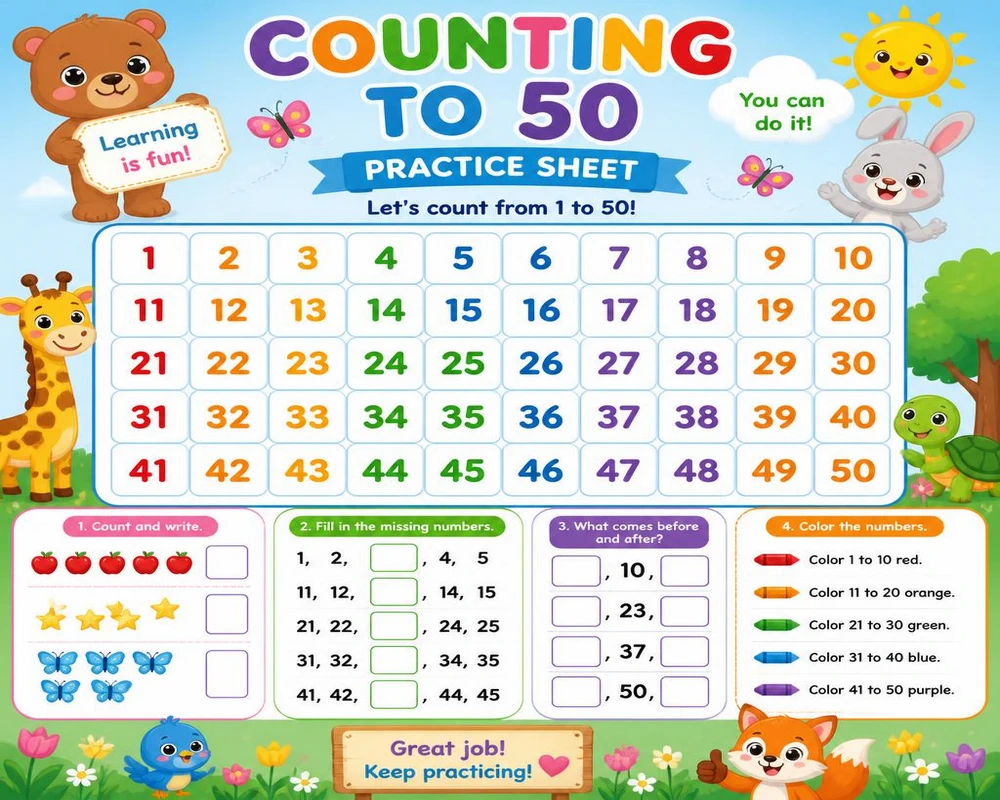
Counting to 50 Practice Sheet
Use this counting to 50 practice sheet section for hands-on counting. Gather 50 small objects — buttons, dry pasta, coins, anything you have around the house — and work through these prompts together.
- Count out 12 objects and line them up in a row. Count them out loud.
- Starting from 23, count forward to 30.
- Count backward from 15 to 10.
- Group 20 objects into pairs. How many pairs are there?
- Count by 5s from 5 to 50.
- Count by 10s from 10 to 50.
Grade 1 Number Worksheet: Fill-in-the-Blank Practice
This section works as a written grade 1 number worksheet pdf alternative — have your child fill in the missing numbers, either on paper or out loud.
- 27, 28, ___, 30, 31
- 44, ___, 46, 47, ___
- ___, 11, 12, ___, 14
- 5, 10, ___, 20, ___, 30
- 38, 39, 40, ___, ___
These questions round out the counting-forward-and-backward portion of this Grade 1 Counting Worksheet Ontario Printable, and they’re worth repeating on different days with different starting numbers until your child answers without hesitation.

Number Recognition Practice
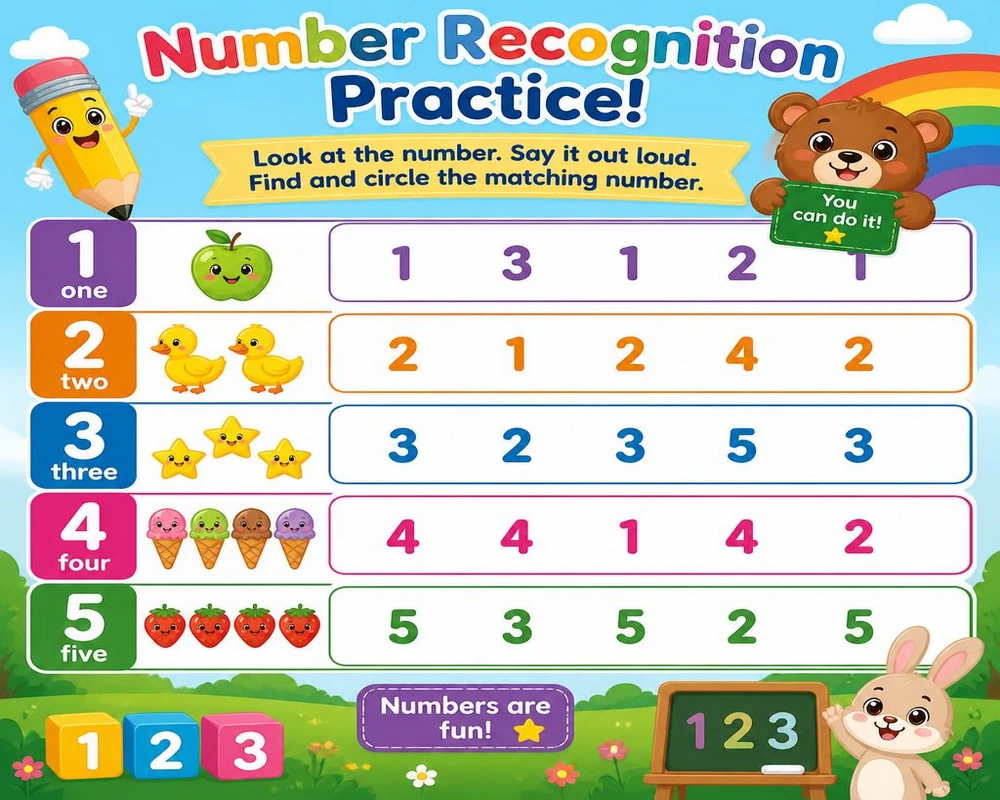
Counting out loud is only half the skill — Grade 1 students also need to recognize a written number and match it to a quantity. Try this with your child:
- Write the numbers 14, 22, 35, and 48 on separate cards. Ask your child to read each one aloud.
- Say a number between 1 and 50 and ask your child to write it down.
- Show a group of 17 objects and ask your child to count them, then write the number.
Answer Key
Use this key to check every section of the Grade 1 Counting Worksheet Ontario Printable above.
- 12 objects counted aloud one by one
- 23, 24, 25, 26, 27, 28, 29, 30
- 15, 14, 13, 12, 11, 10
- 10 pairs
- 5, 10, 15, 20, 25, 30, 35, 40, 45, 50
- 10, 20, 30, 40, 50
- 29
- 45 and 48
- 10 and 13
- 15 and 25
- 41 and 42
Counting Forward and Backward From Any Number
Beyond counting from 1, Ontario Grade 1 students are also expected to start a count from any given number — not just the beginning. This is a slightly different skill than reciting the sequence from memory, because it requires actually understanding where a number sits within the larger sequence rather than just repeating a memorized chant.
- Start counting at 8 and count forward to 16.
- Start counting at 33 and count forward to 40.
- Start counting at 19 and count backward to 12.
- What number comes right before 30?
- What number comes right after 49?
Answers: 8, 9, 10, 11, 12, 13, 14, 15, 16 | 33, 34, 35, 36, 37, 38, 39, 40 | 19, 18, 17, 16, 15, 14, 13, 12 | 29 | 50
If your child can answer these fluently, without needing to restart the count from 1 each time, that’s a strong sign their number sense — not just their memorized counting sequence — is developing well.

Where Grade 1 Students Usually Get Stuck
Keep an eye out for these three patterns while your child works through the Grade 1 Counting Worksheet Ontario Printable:
The Teens
Numbers 13 through 19 trip up more Grade 1 students than any other range, largely because the English names don’t follow a clean pattern the way twenty-one, twenty-two do. “Thirteen” and “thirty” sound alike, and “fifteen” doesn’t obviously connect to “five” the way “sixteen” connects to “six.” Extra repetition in this specific range pays off more than general counting practice.
Crossing a Decade
Going from 29 to 30, or 39 to 40, is a common stumble point because the pattern resets. Counting by 10s first (10, 20, 30, 40, 50) before layering in the numbers between each decade tends to help.
Counting Objects vs. Reciting Numbers
Some children can recite “one, two, three, four, five” quickly but lose track when actually pointing at five separate objects. If this happens, slow the counting down and have your child physically move each object as they count it — this one-to-one correspondence is a specific skill Ontario classrooms watch for early in the year.
Working through the full Grade 1 Counting Worksheet Ontario Printable a couple of times a week, rather than only relying on classroom practice, is usually what turns hesitant counting into confident, automatic counting.

A Few Low-Effort Ways to Practice at Home
This free grade 1 math worksheet doesn’t need to be the only counting practice your child gets. A few ideas that fit easily into daily routines:
- Count stairs out loud while walking up or down them
- Count the number of items in the grocery cart before checkout
- Set a timer and see how high your child can count in one minute
- Count backward from 20 as part of a countdown game before starting an activity
Short, repeated bursts of counting practice — even just two or three minutes at a time — tend to build fluency faster than one long sit-down session, especially for six- and seven-year-olds whose attention spans are still developing.

Frequently Asked Questions
By what point in Grade 1 should my child count to 50?
Most Ontario Grade 1 classrooms expect comfortable counting to 50 by the midpoint of the school year, with counting to 100 by 2s, 5s, and 10s developing through the second half.
My child can count out loud but struggles to write numbers. Is that normal?
Yes — spoken counting typically develops slightly ahead of written number formation in Grade 1. Continued practice writing numbers alongside verbal counting usually closes that gap over the year.
What if my child still struggles with counting past 20 later in the year?
If counting to 20 remains inconsistent well into the second term, it’s worth mentioning to your child’s teacher, who can check whether extra in-class support or a closer look at number sense would help.
How often should we use this Grade 1 Counting Worksheet Ontario Printable?
Two or three short sessions a week, five to ten minutes each, tends to build counting fluency faster than one long weekly session — and this Grade 1 Counting Worksheet Ontario Printable is designed to be reused with new objects or starting numbers each time.
Final Note
Counting fluency in Grade 1 sets up nearly everything that follows — addition, subtraction, and place value all lean on a child’s ability to count accurately and flexibly. A little consistent practice with worksheets like this one, mixed with counting moments built into everyday routines, is usually all it takes to move a hesitant counter into a confident one. For the full year’s curriculum and more practice, visit the Grade 1 Math Ontario hub on InukMath.
Related Ontario Math Resources
- Grade 2 Math Ontario
- Ontario Ministry of Education — Elementary Mathematics Curriculum (official grade 1 number sense expectations)