
Grade 1 Shapes and Patterns Practice
Ask a six-year-old what comes next in the pattern “red, blue, red, blue, red…” and most will answer instantly. Ask them why a triangle is still a triangle even when it’s flipped upside down, and you’ll often get a much longer pause. Grade 1 shapes and patterns practice sits at this exact intersection — some of it feels almost intuitive to kids, while other parts genuinely stretch how they think about the world around them. Having spent years working alongside Ontario’s Primary Division classrooms, I’ve found this unit is often underestimated simply because patterns feel playful, when really it’s laying groundwork for algebraic thinking years down the road.
This guide walks through what Ontario’s Grade 1 curriculum expects around shapes and patterns, why both matter more than they seem, and how to build genuine understanding at home.
Why Grade 1 Shapes and Patterns Practice Matters So Much
Shapes fall under Ontario’s Spatial Sense strand, while patterns live under Algebra — and pairing them in the same unit isn’t an accident. Both skills are really about recognizing structure: shapes ask a child to notice properties (sides, corners, curves), while patterns ask them to notice repetition and sequence. Together, they build the kind of structural thinking that eventually supports everything from multiplication tables to solving for an unknown number.
Grade 1 shapes and patterns practice is also one of the more visual, hands-on units in the early curriculum, which makes it a genuinely enjoyable place to build confidence — assuming a child gets past a few common misconceptions first.

What the Ontario Curriculum Expects in Grade 1
By the end of Grade 1, students are generally expected to:
- Identify and describe common 2D shapes (circle, square, triangle, rectangle) by their properties
- Recognize that a shape’s orientation (rotated, flipped) doesn’t change what shape it is
- Identify and describe simple 3D solids (cube, sphere, cone, cylinder)
- Sort shapes based on one or more attributes
- Identify, describe, and extend repeating patterns
- Create their own simple patterns using objects, sounds, or movements
- Identify the “core” (the smallest repeating unit) of a pattern

Shapes Practice: Beyond Just Naming Them
Describing Shapes by Properties, Not Just Appearance
A common gap at this age is naming a shape correctly but not being able to say why it’s that shape. Ontario’s curriculum wants more than recognition — it wants students describing properties like number of sides and corners.
| Shape | Sides | Corners |
|---|---|---|
| Circle | 0 | 0 |
| Triangle | 3 | 3 |
| Square | 4 | 4 |
| Rectangle | 4 | 4 |
A useful home question: “How do you know this is a triangle and not a square?” Encouraging an answer like “because it has three sides” builds far deeper understanding than simply naming the shape correctly.
Shapes Look Different, But Stay the Same
One of the trickier ideas in Grade 1 shapes practice is that rotating or flipping a shape doesn’t change what it is. A triangle sitting on its point is still a triangle. Try drawing the same shape in several different orientations and asking your child to confirm it’s still the same shape each time.

Introducing 3D Solids
Grade 1 also introduces simple 3D shapes. Real household objects work far better here than pictures — a ball for a sphere, a can for a cylinder, a cereal box for a cube.

Grade 1 Patterns Practice Questions
Extending Repeating Patterns
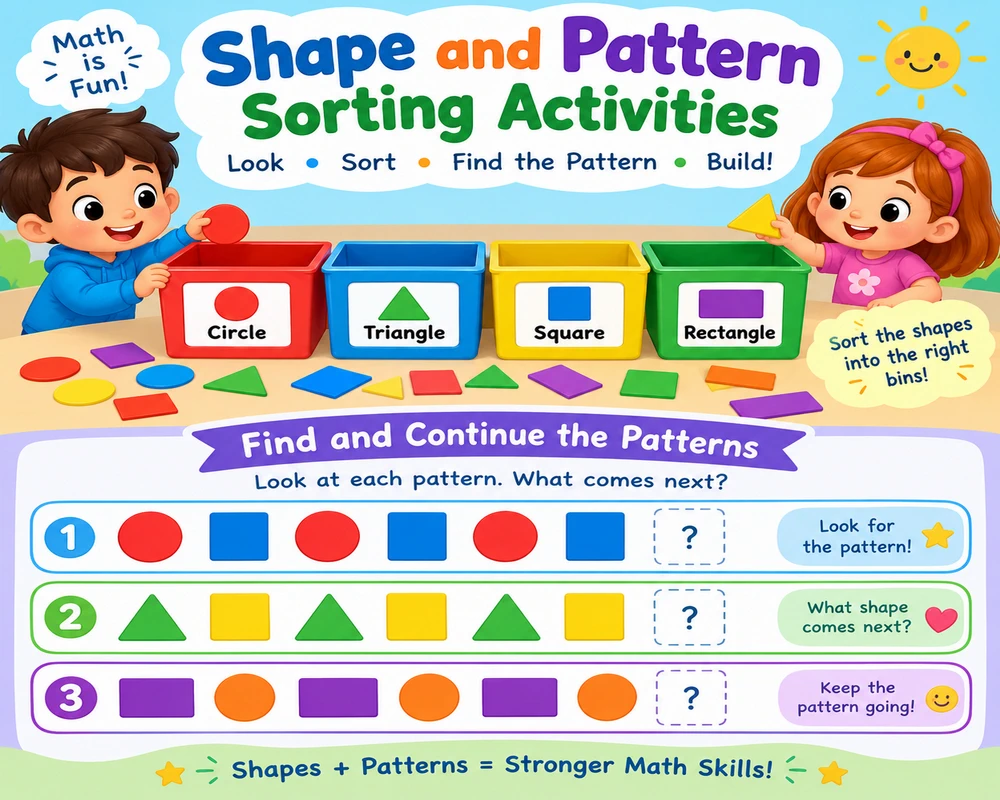
- Red, blue, red, blue, red, ___
- Circle, circle, square, circle, circle, square, ___
- Clap, stomp, stomp, clap, stomp, stomp, ___
Answers: 1) Blue 2) Circle 3) Clap
Identifying the Pattern Core
The “core” is the smallest repeating chunk of a pattern.
- What is the core of this pattern: yellow, green, yellow, green, yellow, green?
- What is the core of this pattern: 1, 2, 3, 1, 2, 3, 1, 2, 3?
- What is the core of this pattern: up, up, down, up, up, down?
Answers: 1) Yellow, green 2) 1, 2, 3 3) Up, up, down
Creating New Patterns
Ask your child to invent their own repeating pattern using objects around the house — buttons, crayons, blocks — and then explain what the core is. This flips the exercise from following instructions to genuine creative reasoning, which tends to reveal whether the concept has really clicked.

Shape and Pattern Sorting Activities
Sort by One Attribute
Give your child a mixed pile of shapes (cut from paper or from a toy set) and ask them to sort by a single property — all the four-sided shapes together, for example.
Sort by Two Attributes at Once
Once one-attribute sorting feels easy, raise the challenge: sort by both shape and colour at the same time (all the red squares together, all the blue circles together). This small jump builds real flexibility in how kids categorize information. This kind of hands-on Grade 1 shapes and patterns practice turns an abstract concept into something your child can literally touch and rearrange.
Real-Life Word Problems for Shapes and Patterns
- Look at the tiles on your kitchen floor or a nearby fence. Can you find a repeating pattern?
- Sam is building a necklace with beads in the pattern blue, yellow, blue, yellow. If he uses 10 beads total, how many will be blue?
- Name three round objects and three objects with straight sides that you can find in your home.
Answers: 1) Answers will vary based on the real pattern observed 2) 5 beads 3) Answers will vary

Common Mistakes in Shapes and Patterns Practice
Thinking a Rotated Shape Is a “Different” Shape
This is easily the most common misconception in Grade 1 shapes practice. Repeated exposure to the same shape in multiple orientations, rather than a single verbal explanation, tends to resolve it fastest.
Losing Track of the Pattern Core
Some students correctly continue a pattern but can’t identify its core when asked directly. Practice pointing to where the pattern “starts over” as a simple, physical way to locate the core.
Confusing 2D and 3D Vocabulary
Kids sometimes call a sphere a “circle” or a cube a “square,” since the 2D and 3D versions look related. Comparing them side by side — a paper circle next to a ball — helps make the distinction concrete.

Practical Tips for Practicing at Home
Go on a Shape Hunt
Walk through your home or neighbourhood and challenge your child to spot five different shapes in everyday objects — a stop sign, a window, a wheel.
Build Patterns Into Daily Routines
Clapping patterns, patterns in laying the table, or patterns in a bedtime song all count as genuine Grade 1 patterns practice, without ever feeling like schoolwork.
Use Building Blocks or LEGO
Constructing simple structures naturally reinforces 3D shape vocabulary, since kids are physically handling cubes, cylinders, and other solids as they build.
Keep Practice Playful and Short
Ten to fifteen minutes of shapes and patterns exploration, a few times a week, is genuinely enough at this age — especially when it’s built into play rather than treated as separate homework.
Playful, game-based practice tends to stick best at this age. TVOKids, Ontario’s own children’s education platform, offers free shape and pattern games designed specifically for young learners, making it a natural next step once your child has practiced with real objects at home.

Conclusion: Building Structure Into Early Math Thinking
Grade 1 shapes and patterns practice may look like simple play on the surface, but it’s quietly building the structural thinking your child will lean on for years — from recognizing multiplication patterns to solving equations much later on. Give both shapes and patterns real, hands-on attention now, and that foundation pays off in ways that aren’t always obvious right away.
Try a quick shape hunt or a clapping pattern game with your child tonight. A few minutes of playful practice like this does more for long-term understanding than any worksheet alone.
Shapes and patterns are just one part of a full Grade 1 year that also covers counting, addition, and early money skills. For the complete picture, our Grade 1 math practice hub brings every topic together in one place.
Consistent Grade 1 shapes and patterns practice at home, even in short playful bursts, builds exactly the kind of structural thinking your child will lean on for years.
Frequently Asked Questions
1. What shapes should a Grade 1 student recognize?
Students should identify common 2D shapes like circles, squares, triangles, and rectangles, along with simple 3D solids like cubes, spheres, cones, and cylinders.
2. Why does my child think a rotated shape is a different shape?
This is a very common misconception at this age. Repeated exposure to the same shape shown in different orientations usually resolves it faster than explanation alone.
3. What is the “core” of a pattern?
The core is the smallest repeating unit within a pattern — for example, in “red, blue, red, blue,” the core is simply “red, blue.”
4. How can I practice patterns without worksheets?
Everyday routines work well — clapping rhythms, patterns in music, or even the way objects are arranged on a shelf all count as genuine pattern practice.
5. Is it normal for my child to confuse 2D and 3D shape names?
Yes, this is common since related 2D and 3D shapes look similar. Comparing a real object side by side with its flat counterpart helps clarify the difference.
6. How much shapes and patterns practice should we do at home?
Around 10-15 minutes, a few times a week, tends to be enough, especially when woven into everyday play rather than treated as separate homework.
7. How does this unit connect to later math topics?
Pattern recognition builds directly into algebraic thinking in later grades, while shape properties support geometry and spatial reasoning throughout elementary school.