
Ontario Grade 4 Fractions Practice: 5 Breaking Points
Somewhere in the third week of the fractions unit, a parent usually sends the same message to a teacher: “He was doing so well, and now suddenly none of it makes sense.” Nothing sudden actually happened. What happened is the curriculum quietly crossed a line — from fractions as pictures you shade, into fractions as numbers you compare, order, and eventually add. That line is invisible on the page but very real in a nine-year-old’s head, and it’s exactly where Ontario Grade 4 fractions practice starts breaking down for most families.
I’ve watched this pattern repeat across enough Ontario classrooms to map it precisely. There isn’t one fractions problem. There are five specific breaking points, each with its own fix, and most worksheets treat them as a single undifferentiated skill.
Breaking Point 1: The Denominator Confusion
A child who’s spent years learning that bigger numbers mean bigger quantities suddenly meets 1/8, which is smaller than 1/4. Every instinct built from whole-number counting says the opposite should be true.
The fix: Physical proof beats explanation here, every time. Fold one piece of paper into quarters, an identical piece into eighths, and hold them side by side. One shaded piece from the eighths sheet is visibly smaller. No amount of verbal reasoning does what thirty seconds with real paper does instantly.
Quick check: Which is greater, 1/6 or 1/3? (Answer: 1/3 — fewer, larger pieces)

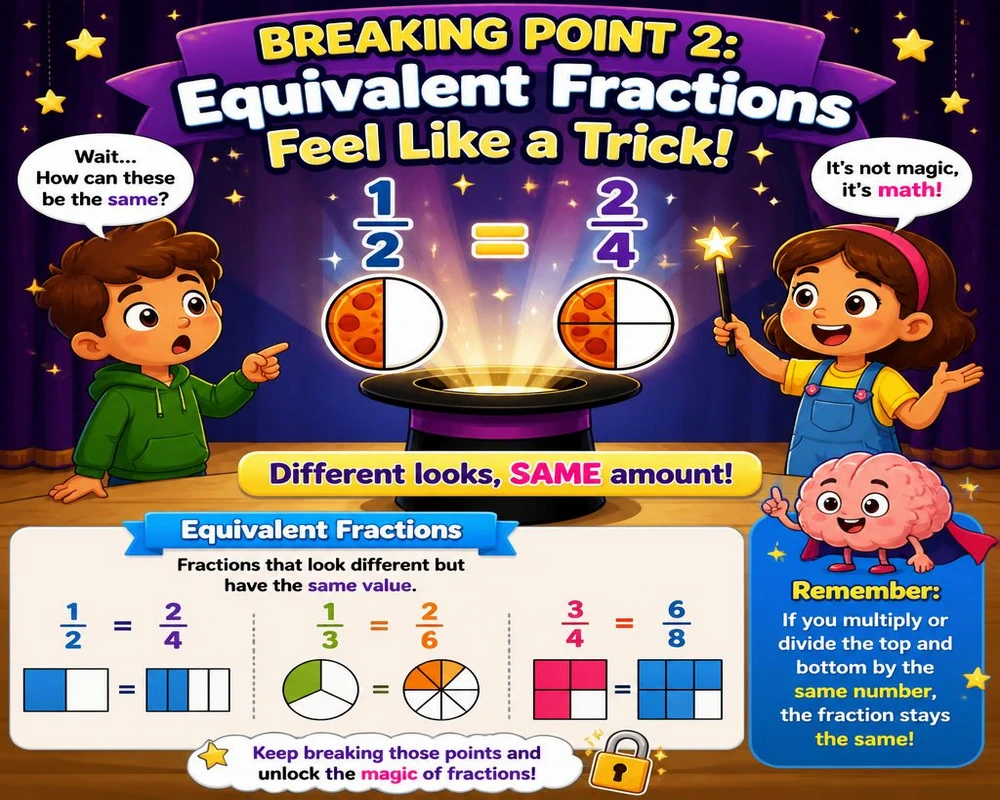
Breaking Point 2: Equivalent Fractions Feel Like a Trick
Ontario Grade 4 fractions practice introduces the idea that 2/4 and 1/2 are the exact same amount, written two different ways. To an eight- or nine-year-old, this can feel less like math and more like a magic trick with no explanation.
The fix: Multiply both the numerator and denominator by the same number, and show why with a picture — cutting each of the 2 halves into 2 smaller pieces gives 4 total pieces, and now 2 of them are shaded instead of 1. Same amount, more pieces.
| Original | Multiply By | Equivalent |
|---|---|---|
| 1/2 | ×2 | 2/4 |
| 1/3 | ×3 | 3/9 |
| 2/5 | ×2 | 4/10 |
Quick check: Find an equivalent fraction for 3/4. (Answer: 6/8, or any fraction found by multiplying both numbers by the same value)
Breaking Point 3: Fractions Greater Than One Whole
Up to this point, a fraction has always meant “part of one thing.” Ontario Grade 4 fractions practice introduces improper fractions and mixed numbers — the idea that 5/4 represents more than a single whole, which contradicts everything a fraction has meant so far.
The fix: Use real, countable wholes. Four pizza slices out of 4 equals one whole pizza. A fifth slice from a second pizza makes 5/4, or one whole pizza plus 1/4 of another. Converting between 5/4 and 1 1/4 becomes obvious once it’s pizza, not just numbers.
Quick check: Write 7/4 as a mixed number. (Answer: 1 3/4)

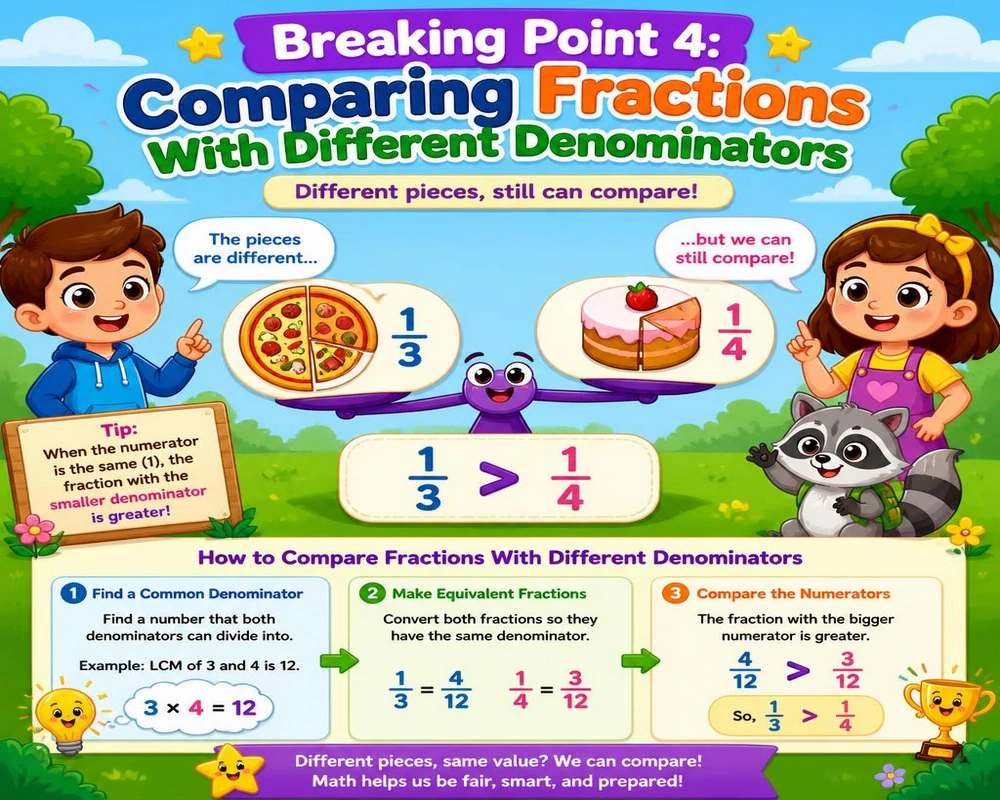
Breaking Point 4: Comparing Fractions With Different Denominators
Comparing 3/4 and 5/8 requires holding two different “sizes of pieces” in mind at once — a genuine cognitive jump from comparing fractions that already share a denominator.
The fix: Visual fraction strips, lined up directly beneath each other, make the comparison visible without requiring any calculation. Formal common-denominator methods can wait until this visual comparison feels solid.
Quick check: Which is greater, 2/3 or 3/5? (Answer: 2/3)
Breaking Point 5: Fractions of a Group, Not Just a Shape
Everything up to now likely involved a single shape — a circle, a rectangle, a pizza. Ontario Grade 4 fractions practice also asks students to find a fraction of a set, like 3/4 of 12 marbles, which requires an entirely different mental model.
The fix: Physically divide a group of countable objects into equal piles first. For 3/4 of 12, split 12 objects into 4 equal groups of 3, then count how many groups (3 of the 4) the question actually asks for — 9 objects.
Quick check: What is 2/5 of 15? (Answer: 6)

A Complete Practice Set
This mixed practice set draws on all five breaking points covered above, giving Ontario Grade 4 fractions practice a genuine final check before moving on to real-life problems.
Mixed Practice Questions
- Order from smallest to largest: 1/2, 1/8, 1/4
- Find an equivalent fraction for 2/3
- Write 9/4 as a mixed number
- Which is greater: 3/5 or 4/7?
- What is 3/8 of 24?
Answers: 1) 1/8, 1/4, 1/2 2) 4/6 (or any equivalent) 3) 2 1/4 4) 4/7 5) 9

Real-Life Word Problems
- A cake is cut into 8 slices. If 5 slices are eaten, what fraction is left?
- Priya has 20 stickers, and 1/4 of them are gold. How many gold stickers does she have?
- A recipe uses 3/4 cup of flour. Is this more or less than a full cup?
Answers: 1) 3/8 2) 5 stickers 3) Less

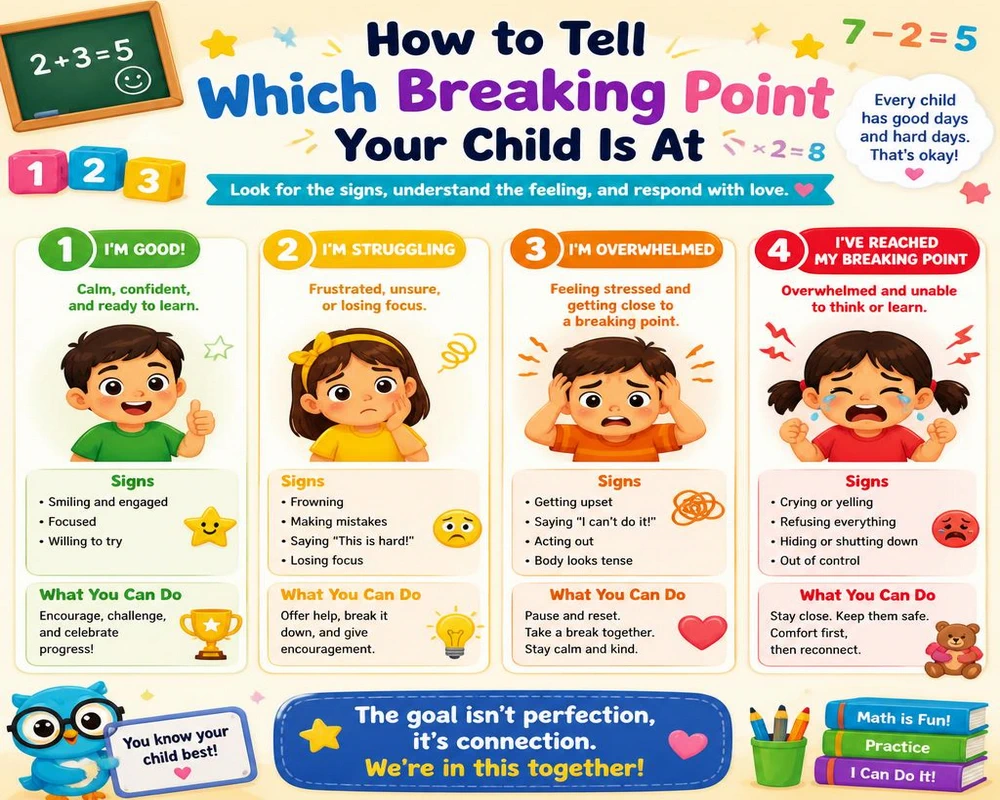
How to Tell Which Breaking Point Your Child Is At
Treating Ontario Grade 4 fractions practice as five separate diagnostics, rather than one broad review, saves real time and avoids re-teaching concepts your child has already mastered.
Rather than reviewing fractions from the beginning every time, use the five quick checks above as a fast diagnostic. Wherever the answer comes slowly or incorrectly is exactly where to focus — there’s no need to re-teach a concept your child has already solidly mastered.
This diagnostic approach matters because Ontario Grade 4 fractions practice isn’t actually one skill that a child either “gets” or “doesn’t get.” It’s five separate, sequential ideas, and a gap in an earlier one quietly undermines everything built on top of it.
What Doesn’t Help
Rushing through Ontario Grade 4 fractions practice as a single lesson, rather than five distinct steps, is exactly what causes the “he was doing so well” moment so many parents describe.
- Jumping straight to abstract rules. “Find a common denominator” means nothing without the visual comparison work first.
- Treating all five breaking points as one lesson. Rushing through denominator size, equivalence, improper fractions, comparison, and fractions of a group in a single session overwhelms far more than it teaches.
- Avoiding fractions greater than one. Some families skip mixed numbers as “too advanced,” but Ontario’s curriculum expects genuine comfort with them by year’s end.

Frequently Asked Questions
1. Why does my child understand fractions with pictures but not with numbers alone?
This usually means the visual and abstract representations haven’t been fully connected yet. Keep using visual models even after your child seems comfortable with the numbers, until both feel equally natural.
2. Is it normal for equivalent fractions to feel confusing?
Yes, this is one of the most common sticking points in Ontario Grade 4 fractions practice specifically because it challenges the assumption that different numbers must represent different amounts.
3. When should my child move from visual comparison to formal common denominators?
Only once comparing fractions using visual models feels genuinely easy and automatic — rushing the formal method before then tends to produce memorized steps without real understanding.
4. What’s the difference between an improper fraction and a mixed number?
They represent the same value in two different forms — 5/4 is an improper fraction, and 1 1/4 is the equivalent mixed number, both meaning one whole plus one extra quarter.
5. How much fractions practice should we do at home each week?
About 15 minutes, three to four times a week, tends to work well, especially when focused on whichever specific breaking point the diagnostic check identifies.
6. Are fractions of a group harder than fractions of a shape?
For many students, yes, since it requires a different mental model — dividing a countable group into equal piles rather than dividing one continuous shape.
7. How does this connect to Grade 5?
Grade 5 builds directly on Grade 4 fraction fluency to introduce decimals and early ratio work, so gaps at this stage tend to resurface as bigger struggles the following year.
Fractions are one part of a full Grade 4 year that also includes long division, geometry, and measurement. Our Grade 4 math practice hub covers every topic in one place.
Interactive fraction models make these five breaking points far easier to work through than static worksheets alone. Mathies, Ontario’s free suite of digital math tools, includes fraction strips and visual models built for exactly this stage of learning.