
Grade 6 Geometry and Spatial Sense Practice: 5-Minute Check
Five questions. Five minutes. That’s genuinely all it takes to find out which parts of Grade 6 geometry and spatial sense practice your child has already mastered and which parts still need real attention. Rather than reviewing an entire unit from the beginning, this quick Grade 6 geometry and spatial sense practice check points directly at the gap, so practice time goes exactly where it’s needed instead of everywhere at once.
Work through all five questions below, check the answers, and use the results to decide where to focus.
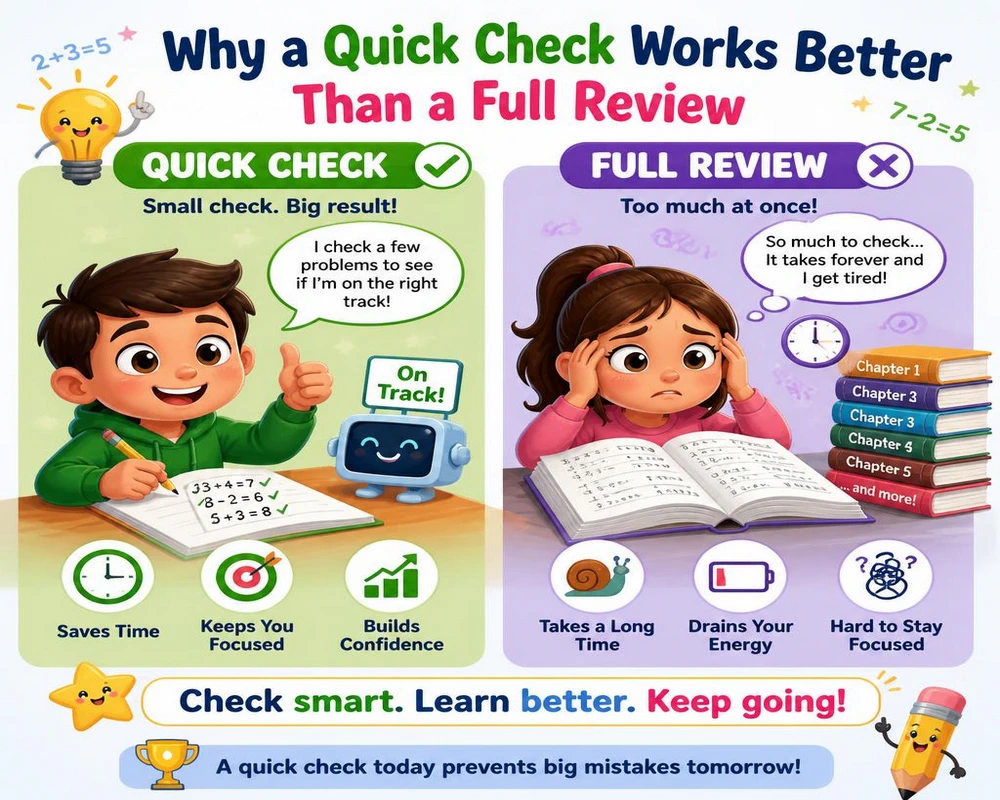
Why a Quick Check Works Better Than a Full Review
Ontario’s curriculum expects Grade 6 students to work with angle relationships, classify shapes by increasingly specific properties, perform transformations, and plot points on a coordinate grid. That’s a genuinely wide range packed into one strand, and most students are already solid on two or three of these Grade 6 geometry and spatial sense practice skills while genuinely needing help with just one or two others.
This matters because generic Grade 6 geometry and spatial sense practice tends to spend equal time on everything, which wastes effort on skills that are already secure. A five-question check identifies the real gap in minutes, not hours.
What the Ontario Curriculum Expects in Grade 6
By the end of Grade 6, students are generally expected to:
- Identify and calculate complementary and supplementary angles
- Determine the sum of interior angles in a triangle and use it to find missing angles
- Classify and compare 2D shapes using increasingly specific properties
- Perform and describe translations, reflections, and rotations on a coordinate grid
- Plot and interpret points in all four quadrants of a coordinate grid
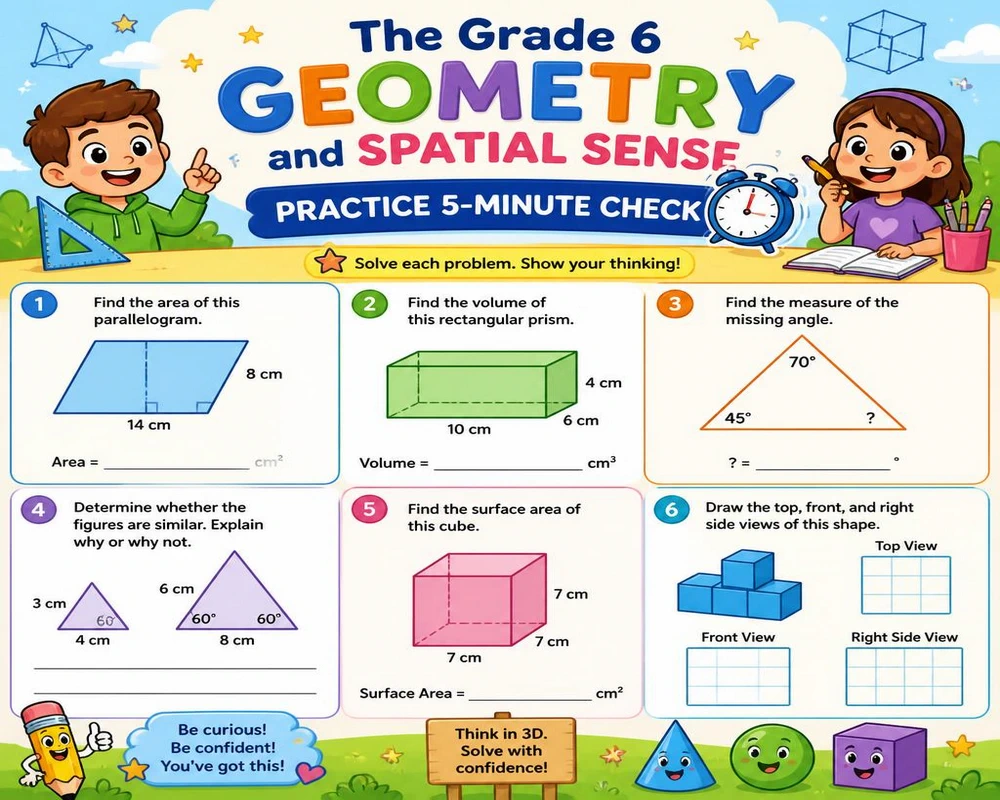
The Grade 6 Geometry and Spatial Sense Practice 5-Minute Check
Question 1: Complementary and Supplementary Angles
Two angles are complementary. One measures 35 degrees. What is the other angle?
A second pair of angles is supplementary. One measures 110 degrees. What is the other angle?
Answers: 55 degrees (90 − 35) 70 degrees (180 − 110)
Question 2: Missing Angles in a Triangle
A triangle has two angles measuring 50 degrees and 65 degrees. What is the third angle?
Answer: 65 degrees (180 − 50 − 65)
Question 3: Classifying Shapes by Specific Properties (Grade 6 Geometry and Spatial Sense Practice)
Name a quadrilateral that has four equal sides but does not necessarily have four right angles.
Answer: A rhombus
Question 4: Reflections on a Coordinate Grid
This question is a common Grade 6 geometry and spatial sense practice checkpoint: a point is located at (3, 4). What are its coordinates after being reflected over the x-axis? Over the y-axis?
Answers: (3, −4) for a reflection over the x-axis (−3, 4) for a reflection over the y-axis
Question 5: Plotting Points in All Four Quadrants
Without drawing it, describe which quadrant the point (−5, 3) is located in.
Answer: The second quadrant, since the x-coordinate is negative and the y-coordinate is positive
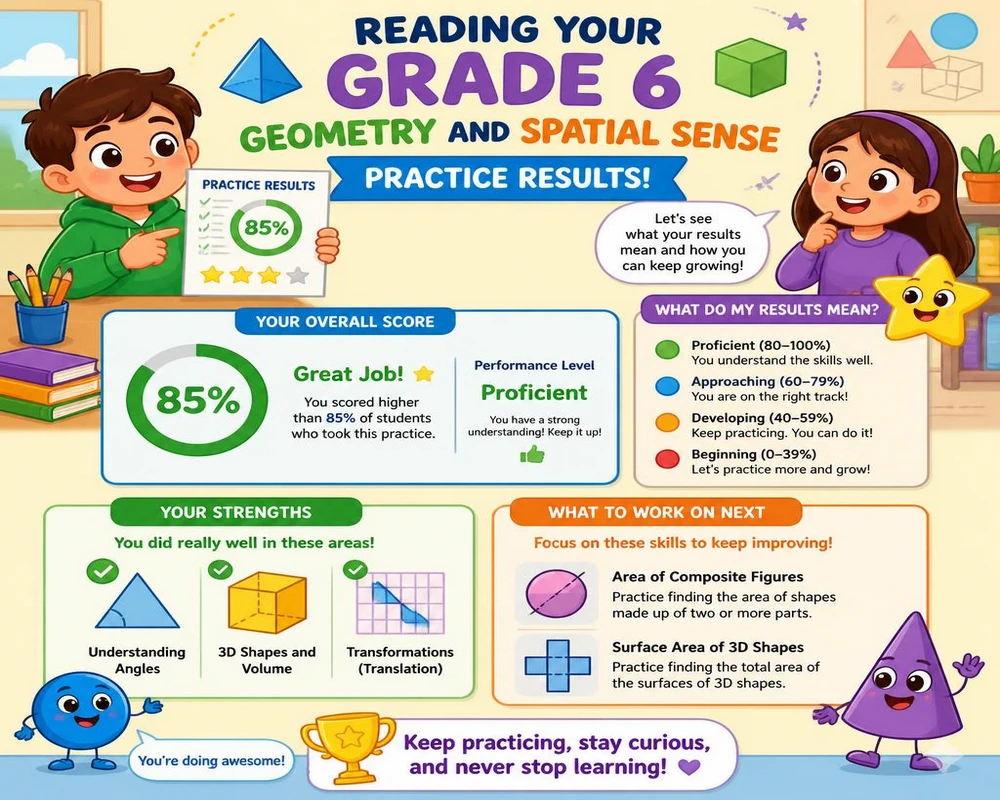
Reading Your Grade 6 Geometry and Spatial Sense Practice Results
Each question in this Grade 6 geometry and spatial sense practice check maps to one specific skill. A wrong or hesitant answer points directly to where to focus, without needing to review everything else.
| Question | Skill Being Tested | If Missed, Focus On |
|---|---|---|
| 1 | Complementary/supplementary angles | Angle pair relationships and how they sum |
| 2 | Triangle angle sum | The rule that triangle angles always total 180 degrees |
| 3 | Shape classification | Sorting shapes by specific properties, not just appearance |
| 4 | Reflections | How coordinates change when a shape flips over an axis |
| 5 | Coordinate quadrants | Reading positive and negative coordinate signs correctly |
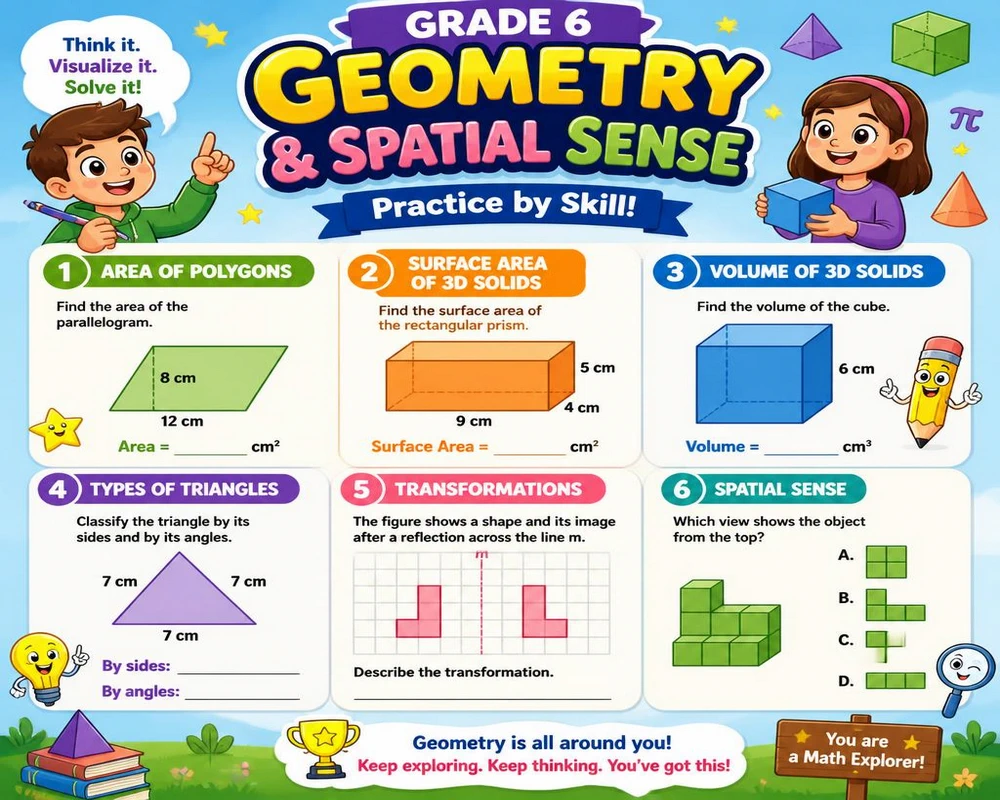
Targeted Grade 6 Geometry and Spatial Sense Practice by Skill
If Question 1 Was Missed: More Angle Pair Practice
- Two angles are complementary. One is 62 degrees. What is the other?
- Two angles are supplementary. One is 75 degrees. What is the other?
Answers: 1) 28 degrees 2) 105 degrees
If Question 2 Was Missed: More Triangle Angle Practice
- A triangle has angles of 90 degrees and 35 degrees. What is the third angle?
- A triangle has three equal angles. What is the measure of each one?
Answers: 1) 55 degrees 2) 60 degrees each
If Question 3 Was Missed: More Shape Classification Practice
- Name a quadrilateral with exactly one pair of parallel sides.
- What distinguishes a rectangle from a rhombus?
Answers: 1) A trapezoid 2) A rectangle has four right angles, while a rhombus has four equal sides, and neither property guarantees the other
If Question 4 or 5 Was Missed: More Coordinate Geometry Practice
- Reflect the point (2, 5) over the x-axis.
- Which quadrant contains the point (4, −2)?
Answers: 1) (2, −5) 2) The fourth quadrant
Real-Life Word Problems for Grade 6 Geometry and Spatial Sense Practice
- A roof forms two angles where it meets a wall. If one angle is 125 degrees, and the two angles together form a straight line, what is the other angle?
- A triangular garden bed has two known angles of 40 degrees and 70 degrees. What is the third angle?
- A video game character starts at (0, 0) and moves to (−3, 4). Which quadrant did the character move into?
Answers: 1) 55 degrees 2) 70 degrees 3) The second quadrant
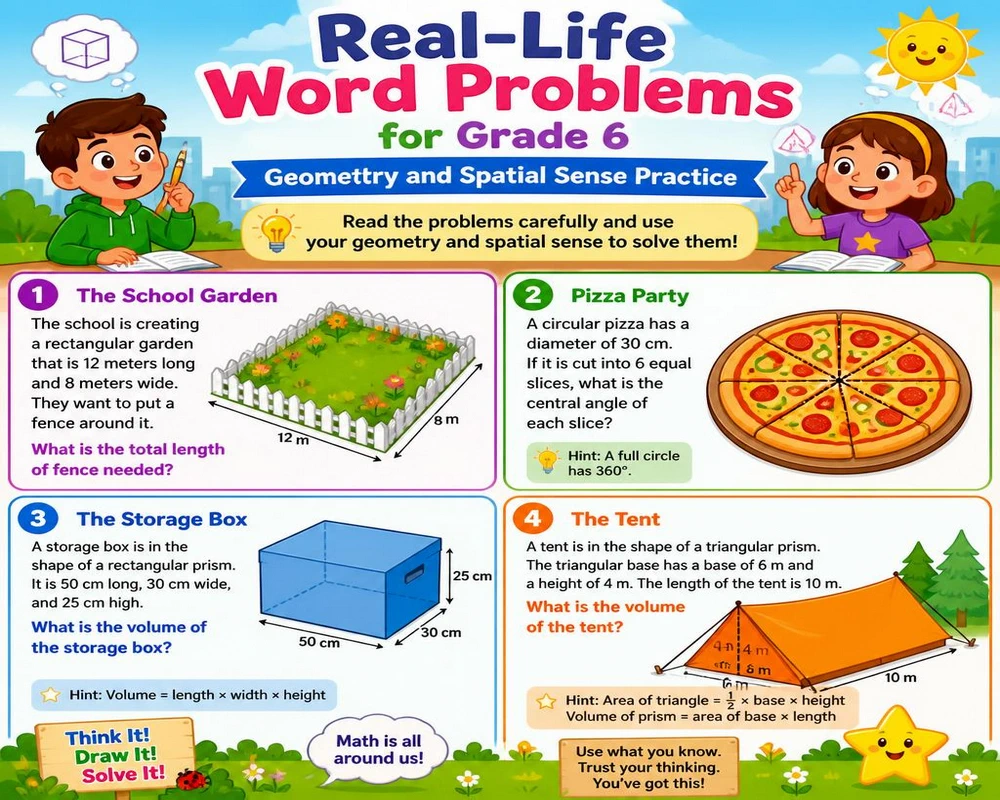
Common Mistakes in Grade 6 Geometry and Spatial Sense Practice
Three specific errors account for most of the confusion in Grade 6 geometry and spatial sense practice, and all three are worth watching for directly.
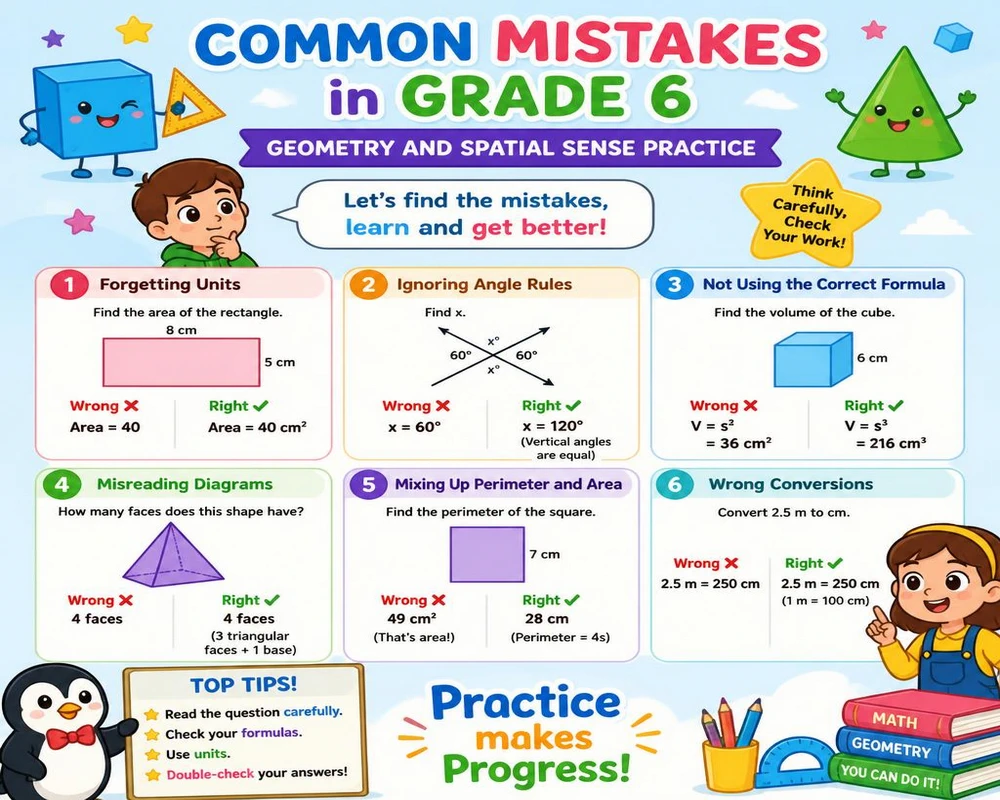
Mixing Up Complementary and Supplementary
Since both involve adding two angles to reach a fixed total, students frequently confuse which pair sums to 90 and which sums to 180. A quick memory anchor helps: “c” for complementary comes before “s” for supplementary in the alphabet, just as 90 comes before 180.
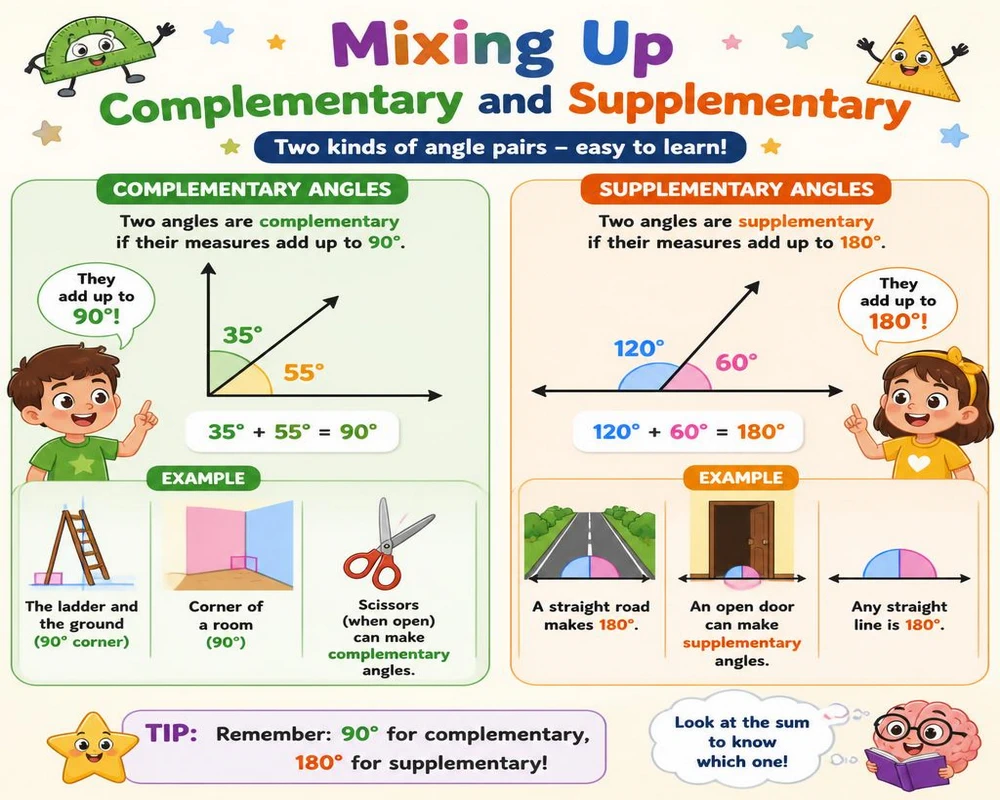
Forgetting That Triangle Angles Always Total 180
Some students try to guess a missing triangle angle rather than subtracting the two known angles from 180. Reinforcing this fixed rule resolves the issue immediately, every time it comes up.
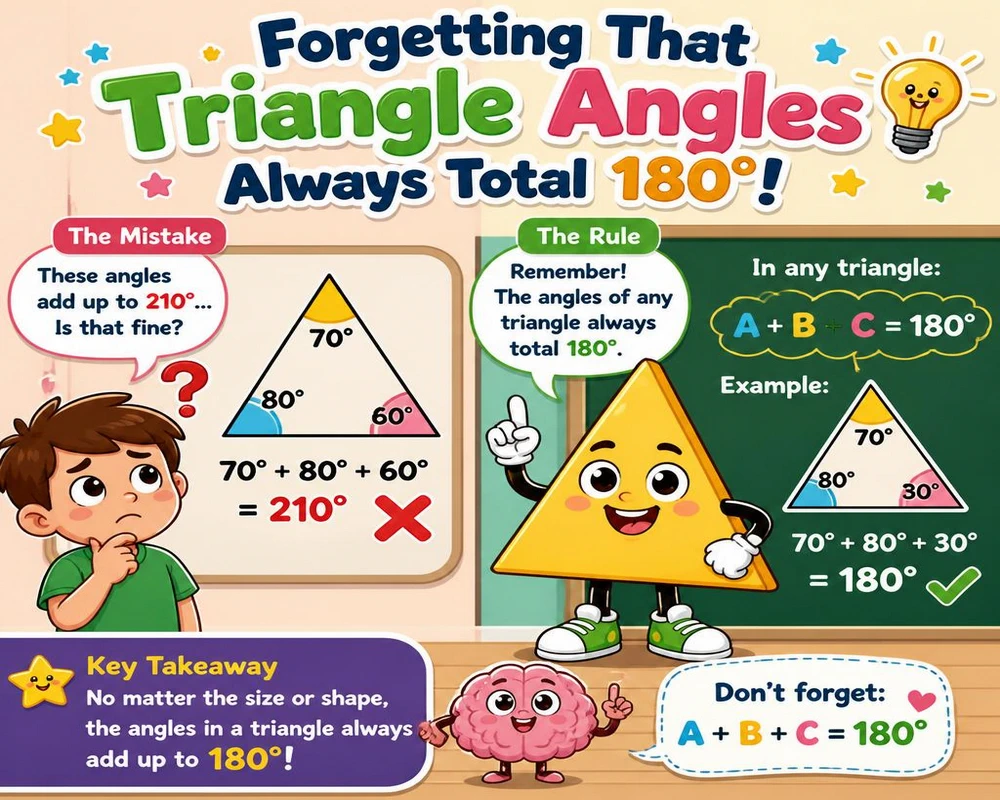
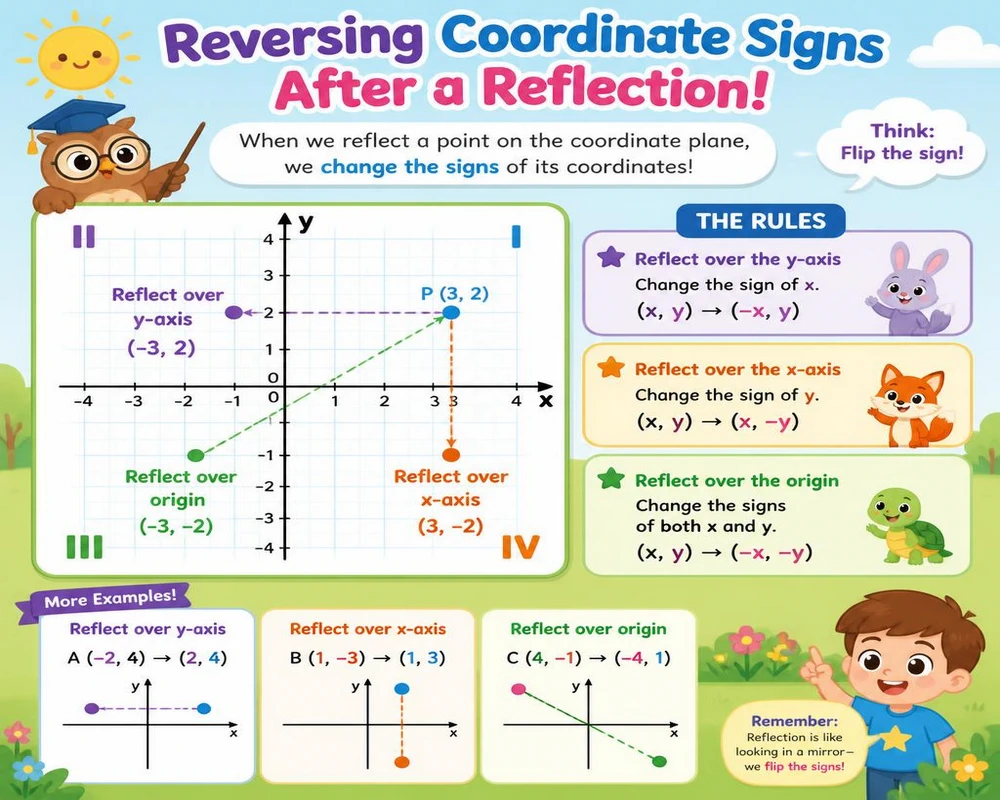
Reversing Coordinate Signs After a Reflection
Reflecting over the x-axis changes the sign of the y-coordinate, not the x-coordinate, and students often reverse which one flips. Physically folding a piece of graph paper along the axis being used makes this visible rather than something to memorize.
Frequently Asked Questions
1. What’s the difference between complementary and supplementary angles?
This question anchors nearly every Grade 6 geometry and spatial sense practice session on angles. Complementary angles add up to 90 degrees, while supplementary angles add up to 180 degrees. Both describe a relationship between two angles, not a property of a single angle alone.
2. Why do triangle angles always add up to 180 degrees?
This is a fixed geometric property true for every triangle, regardless of its shape or size, and it’s one of the most useful facts in Grade 6 geometry and spatial sense practice for finding missing angles.
3. How can I help my child with coordinate reflections?
Physically folding graph paper along the axis being reflected over makes the coordinate change visible and concrete, rather than something to memorize as an abstract rule during Grade 6 geometry and spatial sense practice sessions.
4. What’s the difference between a rhombus and a rectangle?
A rhombus has four equal sides, while a rectangle has four right angles. A shape can be one, both (a square), or neither, depending on its specific properties.
5. How do I read coordinates in negative quadrants?
The sign of each coordinate tells you the direction: negative x means left of the origin, and negative y means below it, which together determine the quadrant.
6. How much geometry practice should we do at home?
About 15-20 minutes, a few times a week, tends to work well for Grade 6 geometry and spatial sense practice, especially when focused specifically on whichever skill this 5-minute check identifies as weak.
7. How does this connect to Grade 7?
Grade 7 builds directly on angle relationships and coordinate geometry with more complex transformations and formal geometric proofs.
Geometry and spatial sense is one part of a full Grade 6 year that also includes ratios, integers, and financial literacy. This 5-minute Grade 6 geometry and spatial sense practice check is designed to be revisited every few weeks to track real progress. Our Grade 6 math practice hub covers every topic in one place.
Interactive geometry tools make angle relationships and coordinate transformations far easier to visualize than static worksheets alone. Mathies, Ontario’s free suite of digital math tools, includes protractors and coordinate grid tools built for exactly this stage of learning.