
Grade 6 Fractions Questions: The Multiplication Paradox
Every Grade 6 student walks into fraction multiplication with the same deeply held assumption: multiplying makes numbers bigger. It’s been true their entire math life — 3 × 4 is bigger than either 3 or 4. Then 1/2 × 1/4 shows up, and the answer, 1/8, is smaller than both numbers being multiplied. This isn’t a trick or an exception. It’s a genuine mathematical paradox that Grade 6 fractions questions are specifically designed to help students work through, and understanding why it happens matters far more than just memorizing the procedure.
This guide explains the paradox directly, walks through multiplying and dividing fractions with real questions, and shows exactly why the usual “bigger” and “smaller” intuitions flip once fractions smaller than one are involved.
Why This Paradox Sits at the Heart of Grade 6 Fractions Questions
Ontario’s curriculum expects Grade 6 students to multiply and divide fractions, including fractions by whole numbers and fractions by other fractions. This is a genuine shift from the addition and subtraction of fractions covered in Grade 5, and it’s exactly where the “multiplying makes bigger” assumption behind so many Grade 6 fractions questions stops holding up.
This matters because Grade 6 fractions questions that only ask for a memorized procedure — multiply straight across, flip and multiply for division — miss the chance to build real number sense. A student who understands why 1/2 of 1/4 is smaller than either piece has a far deeper grasp than one who’s only memorized the steps.
What the Ontario Curriculum Expects in Grade 6
By the end of Grade 6, students are generally expected to:
- Multiply a fraction by a whole number
- Multiply a fraction by another fraction
- Divide a whole number by a fraction
- Divide a fraction by another fraction
- Solve real-world problems involving fraction multiplication and division

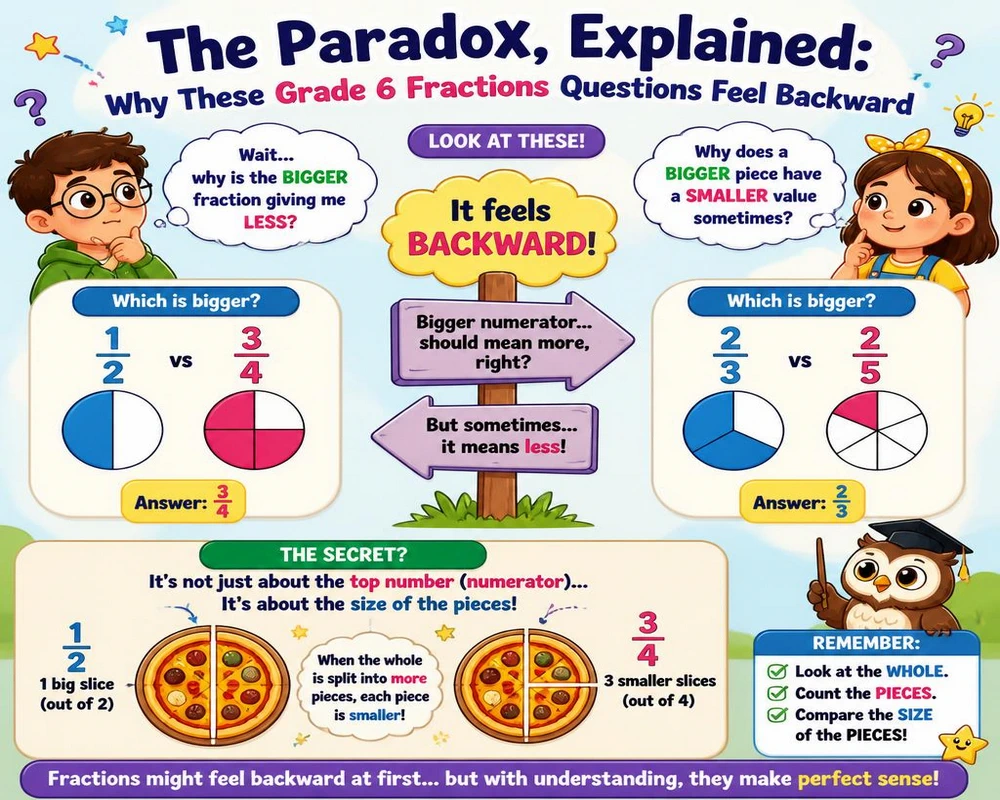
The Paradox, Explained: Why These Grade 6 Fractions Questions Feel Backward
Multiplying by a fraction smaller than 1 doesn’t combine groups the way whole-number multiplication does — it takes a fraction of a fraction, which produces something smaller than either starting piece. Picture 1/2 of a pizza, then taking 1/4 of that remaining half. You end up with a smaller slice than either the half or the original quarter would have been on their own.
Seeing It Visually
Imagine a rectangle representing one whole. Shade 1/2 of it. Now shade 1/4 of that already-shaded half. The overlapping, double-shaded region — representing 1/2 × 1/4 — covers just 1/8 of the original rectangle. The answer is genuinely smaller than either fraction you started with.
Multiplying Fractions: Grade 6 Fractions Questions Practice
These first Grade 6 fractions questions focus specifically on multiplication, starting with fraction-by-fraction problems before moving to fraction-by-whole-number.
Fraction by Fraction
- 1/2 × 1/4 = ___
- 3/4 × 2/3 = ___
- 2/3 × 3/5 = ___
- 5/6 × 2/5 = ___
Answers: 1) 1/8 2) 1/2 3) 2/5 4) 1/3
Fraction by Whole Number
- 1/3 × 6 = ___
- 2/5 × 10 = ___
Answers: 1) 2 2) 4

The Reverse Paradox: Dividing Fractions in Grade 6 Fractions Questions
Dividing usually makes numbers smaller — but dividing by a fraction smaller than 1 does the opposite, producing an answer bigger than the number you started with. This is the mirror image of the multiplication paradox, and it trips up students for exactly the same reason.
Why Dividing by a Fraction Increases the Answer
Dividing by 1/4 asks “how many quarters fit into this amount?” Since a quarter is small, a lot of them fit into even a modest starting number — which is why the answer comes out larger, not smaller.
Grade 6 Fractions Questions: Dividing Practice
- 1/2 ÷ 1/4 = ___
- 3/4 ÷ 1/2 = ___
- 7/8 ÷ 1/4 = ___
- 3/5 ÷ 3/10 = ___
Answers: 1) 2 2) 3/2 3) 7/2 4) 2
Whole Number Divided by a Fraction
- 2 ÷ 1/3 = ___
- 4 ÷ 2/3 = ___
Answers: 1) 6 2) 6

Putting Both Paradoxes Side by Side
| Operation | Example | Result Compared to Start |
|---|---|---|
| Multiply by a fraction < 1 | 1/2 × 1/4 = 1/8 | Smaller |
| Divide by a fraction < 1 | 1/2 ÷ 1/4 = 2 | Larger |
Notice these two Grade 6 fractions questions use the exact same numbers, 1/2 and 1/4, but produce opposite kinds of results depending on the operation. This side-by-side comparison is one of the clearest ways to make the paradox stick.

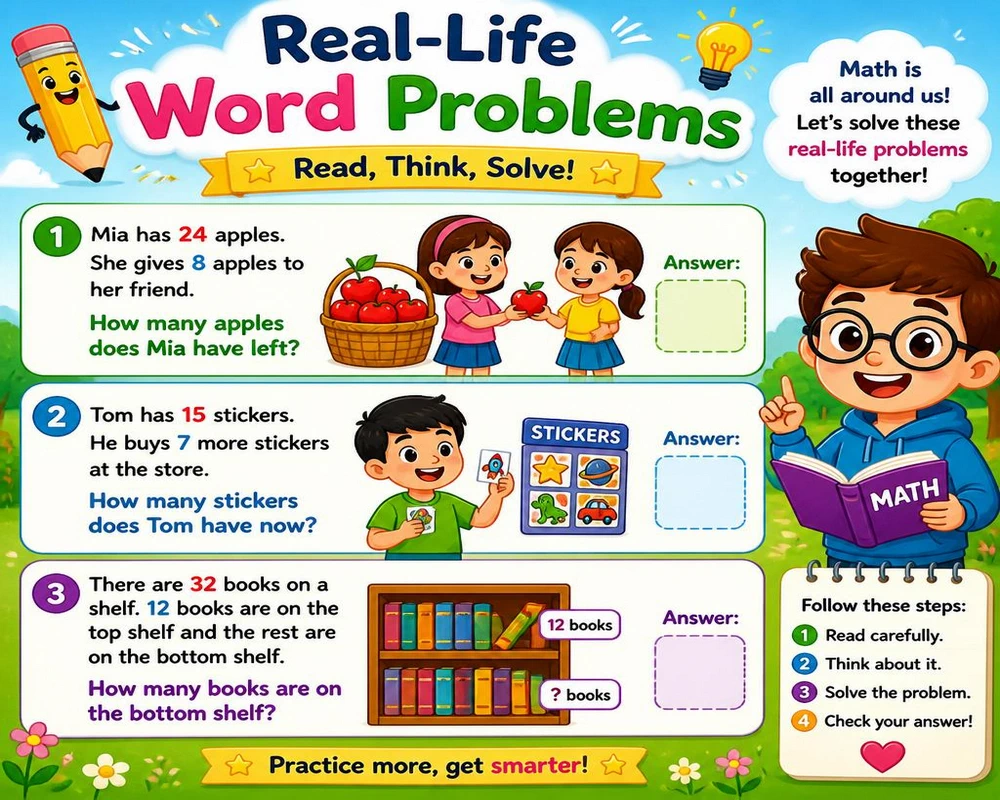
Real-Life Word Problems
These final Grade 6 fractions questions connect both the multiplication and division paradoxes to situations your child might actually encounter, which tends to make the underlying logic feel more intuitive than pure numbers alone.
- A recipe needs 2/5 of 5/8 of a cup of sugar remaining in the bag. How much sugar is that?
- A board is 3/4 of a metre long. It needs to be cut into pieces that are each 1/4 of a metre. How many pieces can be cut?
- A pitcher holds 4 litres of juice. Each glass holds 2/3 of a litre. How many full glasses can be poured?
Answers: 1) 1/4 cup 2) 3 pieces 3) 6 glasses
Common Mistakes in Grade 6 Fractions Questions
Three specific errors account for most of the wrong answers in Grade 6 fractions questions involving multiplication and division.

Expecting Multiplication to Always Increase the Value
This is the exact misconception this guide is built around. Reinforcing the pizza or rectangle model directly addresses it, rather than just presenting the multiplication rule as an isolated procedure.
Forgetting to Flip the Second Fraction When Dividing
Dividing fractions requires multiplying by the reciprocal of the second fraction, and skipping this step produces a completely different, incorrect answer. Practicing the “keep, change, flip” phrase alongside real examples helps this stick.

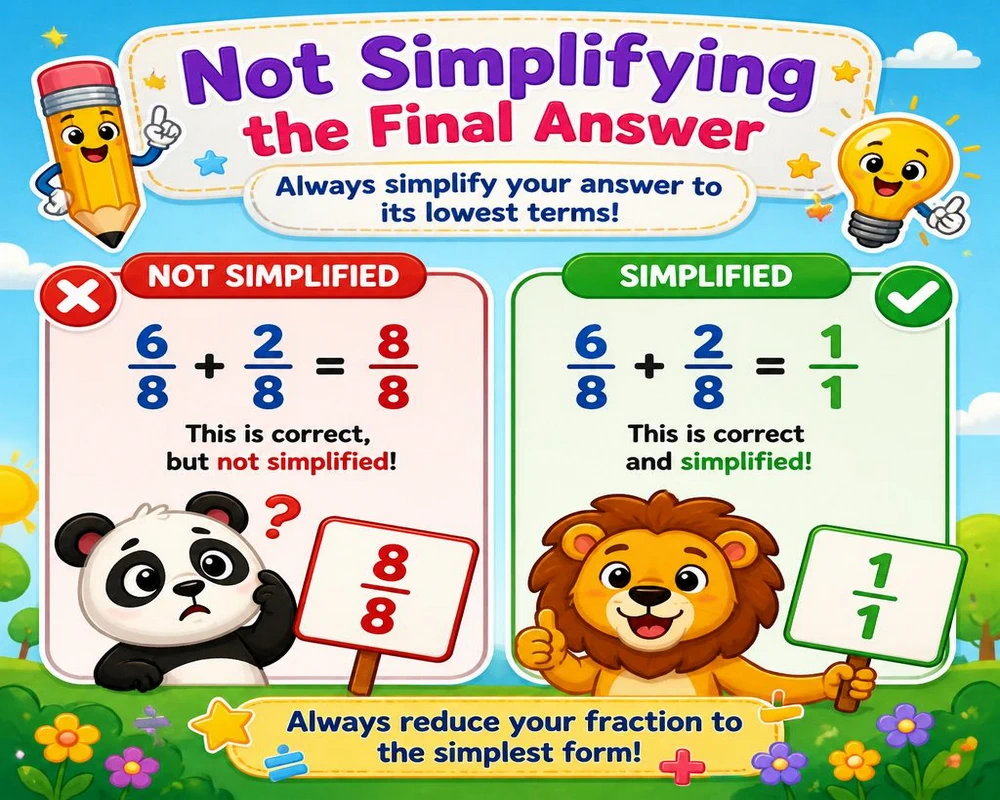
Not Simplifying the Final Answer
Leaving an answer as 2/8 instead of simplifying to 1/4 is a small but consistent error worth catching, especially since Grade 6 fractions questions on assessments typically expect fully simplified results.
Frequently Asked Questions
1. Why does multiplying fractions sometimes make the answer smaller?
This is the central idea behind these Grade 6 fractions questions. When both fractions are smaller than 1, multiplying takes a fraction of a fraction, which produces something smaller than either starting piece — the opposite of what whole-number multiplication does.
2. Why does dividing by a fraction make the answer bigger?
Dividing by a small fraction asks how many of that small piece fit into the starting amount, and since the piece is small, many of them fit, producing a larger result.
3. What does “keep, change, flip” mean for dividing fractions?
Keep the first fraction as is, change division to multiplication, and flip the second fraction to its reciprocal, then multiply as usual.
4. How can I help my child visualize fraction multiplication?
Shading overlapping regions of a rectangle, representing “a fraction of a fraction,” makes the smaller result visible and concrete rather than a rule to memorize.
5. Do Grade 6 fractions questions include mixed numbers?
Yes, though converting a mixed number to an improper fraction first is usually the cleanest way to multiply or divide it alongside another fraction.
6. How much fraction practice should we do at home?
About 15-20 minutes, a few times a week, tends to work well, especially when multiplication and division are practiced side by side to reinforce the contrast between them.
7. How does this connect to Grade 7?
Grade 7 builds on fraction multiplication and division with more complex expressions and eventually algebraic fractions involving variables.
Fractions are one part of a full Grade 6 year that also includes ratios, integers, and probability. Understanding this paradox is one of the more conceptually rewarding parts of Grade 6 fractions questions, since it reshapes how multiplication and division are understood more broadly. Our Grade 6 math practice hub covers every topic in one place.
Interactive fraction models make this exact paradox easier to visualize than static worksheets alone. Mathies, Ontario’s free suite of digital math tools, includes fraction strips and area models built for exactly this stage of learning.