
Grade 5 Geometry and Spatial Sense Practice: Ranked
After years of working through Grade 5 geometry and spatial sense practice with Ontario students, one pattern shows up more reliably than almost anything else in elementary math: the exact same five confusions, in roughly the exact same order of frequency, classroom after classroom. This isn’t a list of possible mistakes. It’s a ranked list, from the confusion that trips up nearly everyone to the one that only catches a smaller group — and knowing the ranking tells you exactly where to spend your limited practice time.
Here are all five, ranked, with the fix for each — and this exact ranking is what makes targeted Grade 5 geometry and spatial sense practice so much more efficient than a generic review.
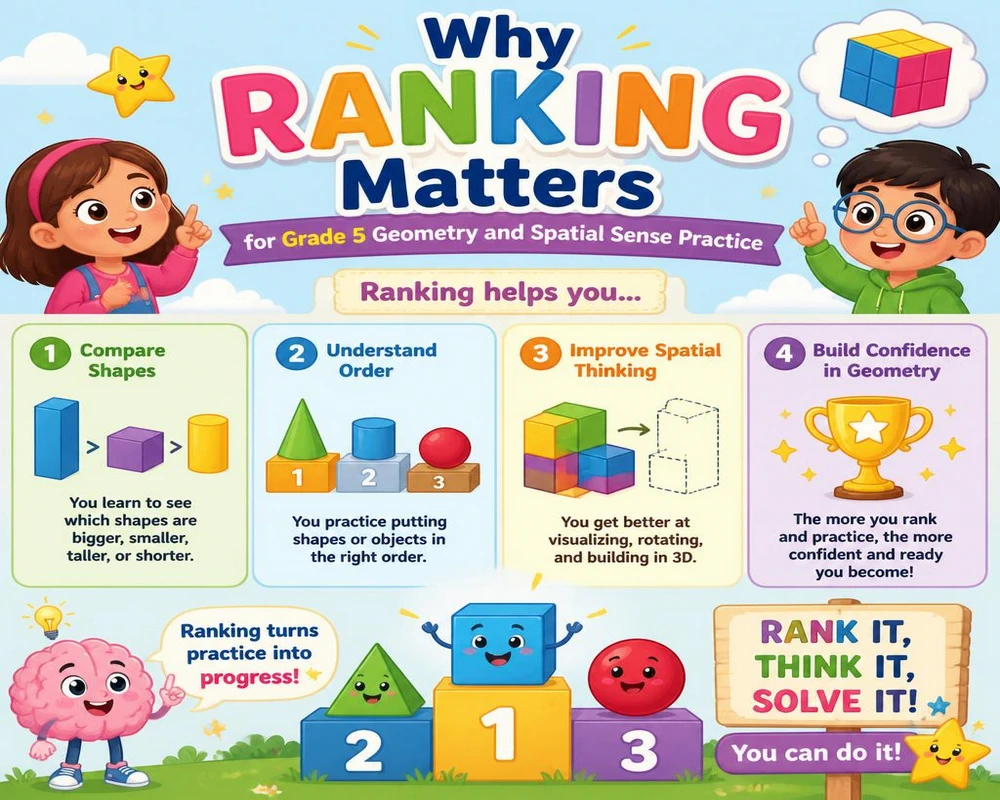
Why Ranking Matters for Grade 5 Geometry and Spatial Sense Practice
Ontario’s curriculum expects Grade 5 students to work with angle measurement, classify triangles and quadrilaterals by their properties, build and interpret nets of 3D solids, and work with coordinate grids — a genuinely wide range of skills packed into one strand. Generic Grade 5 geometry and spatial sense practice tends to treat all of these as equally likely to cause trouble. They aren’t.
This matters because time spent reviewing a confusion that rarely happens is time not spent on the one that happens constantly. Ranking these five by actual frequency turns Grade 5 geometry and spatial sense practice from a scattershot review into something genuinely targeted.
What the Ontario Curriculum Expects in Grade 5
By the end of Grade 5, students are generally expected to:
- Measure and construct angles using a protractor
- Classify and compare triangles and quadrilaterals by their properties
- Identify and construct nets of common 3D solids
- Plot and identify points on a simple coordinate grid
- Perform and describe simple transformations, including reflections and rotations
Every one of these expectations maps directly onto one of the five ranked confusions below, which is exactly why this ranking makes Grade 5 geometry and spatial sense practice so much more targeted than a generic review.

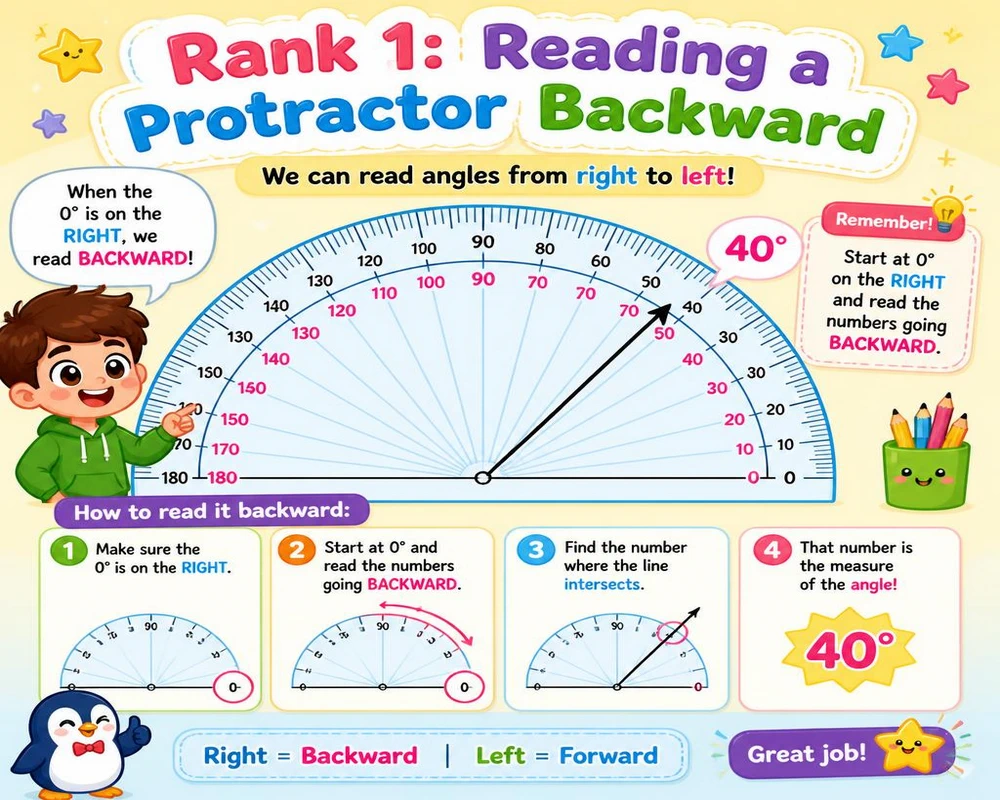
Rank 1: Reading a Protractor Backward
This is, by a wide margin, the most common issue in Grade 5 geometry and spatial sense practice, showing up in nearly every classroom and nearly every family’s practice sessions. Protractors have two number scales running in opposite directions, and students consistently read the wrong one, producing an answer that’s the supplement of the correct angle — 130 degrees instead of 50, for instance.
Practice Questions
- An angle measures 40 degrees on a protractor. If read on the wrong scale, what would the student likely write instead?
- Estimate first, then measure: is this angle closer to acute or obtuse before using a protractor?
The fix: Always estimate before measuring — does the angle look smaller or larger than a right angle? This single habit catches a wrong-scale reading immediately, since the estimate and the measurement will obviously conflict.
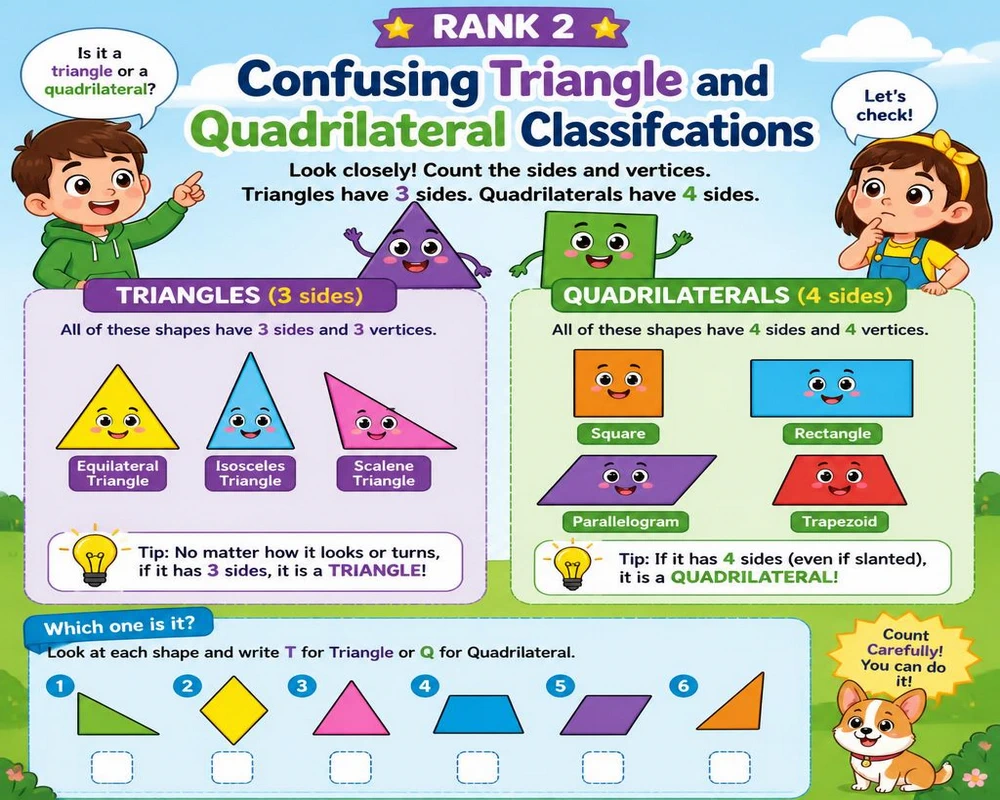
Rank 2: Confusing Triangle and Quadrilateral Classifications
The second most frequent issue in Grade 5 geometry and spatial sense practice, and one that shows up almost as often as the protractor mix-up, involves overlapping categories — a square is also a rectangle, a rectangle is also a parallelogram, but students often treat these as separate, unrelated shapes rather than nested categories.
Practice Questions
- Is every square a rectangle? Is every rectangle a square?
- Name a quadrilateral that is both a rhombus and a rectangle.
- Classify a triangle with sides of 5 cm, 5 cm, and 5 cm.
Answers: 1) Yes, and no 2) A square 3) Equilateral
The fix: Sort shapes by properties first (number of sides, equal sides, right angles), then name the shape, rather than naming by appearance alone.
Rank 3: Building 3D Solids From a Flat Net
Third on the list, and noticeably harder for most students than the first two ranks of Grade 5 geometry and spatial sense practice, is visualizing how a flat net folds into a 3D shape. This part of the strand asks students to mentally fold a 2D pattern, which is a genuinely demanding spatial skill.
Practice Questions
- A net has 6 identical squares. What 3D solid does it fold into?
- A net has 2 triangles and 3 rectangles. What 3D solid does it likely fold into?
Answers: 1) A cube 2) A triangular prism
The fix: Physically cut out and fold real nets before asking students to visualize the process purely in their heads. Mental folding gets easier only after enough hands-on folding has happened first.

Rank 4: Plotting Points on a Coordinate Grid Backward
Students frequently reverse the order of coordinates, moving up before moving across instead of the correct sequence. This confusion in Grade 5 geometry and spatial sense practice sessions is common but tends to resolve faster than the first three once identified.
Practice Questions
- Plot the point (3, 5) on a grid. Which number tells you how far to move right?
- What are the coordinates of a point 4 units right and 2 units up from the origin?
Answers: 1) The first number, 3 2) (4, 2)
The fix: Teach a simple memory phrase — “along the hallway, then up the stairs” — to reinforce that the first number always means horizontal movement.

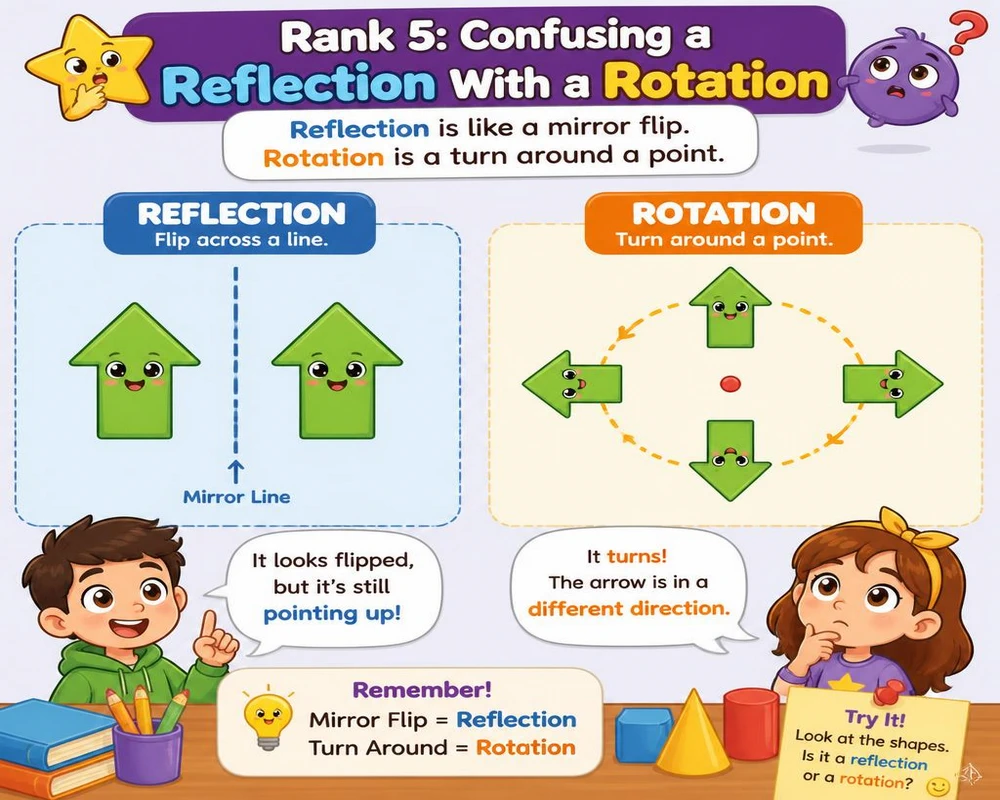
Rank 5: Confusing a Reflection With a Rotation
The least frequent of the five, but still worth addressing directly in Grade 5 geometry and spatial sense practice, is mixing up a flipped shape (reflection) with a turned shape (rotation), since both change a shape’s orientation without changing its size.
Practice Questions
- If a shape is flipped over a vertical line, is that a reflection or a rotation?
- If a shape is turned 90 degrees around a fixed point, is that a reflection or a rotation?
Answers: 1) Reflection 2) Rotation
The fix: Physically flip a paper shape for reflection, and physically spin it around a pinned point for rotation, so the two movements feel distinct rather than interchangeable. Even this least-frequent rank deserves a place in regular Grade 5 geometry and spatial sense practice, since it does show up eventually.
Using the Ranking to Focus Grade 5 Geometry and Spatial Sense Practice
Rather than spreading Grade 5 geometry and spatial sense practice evenly across all five areas, spend roughly double the time on Ranks 1 and 2 compared to Ranks 4 and 5. This isn’t about skipping the less common issues entirely — it’s about matching practice time to where confusion is actually most likely to occur.

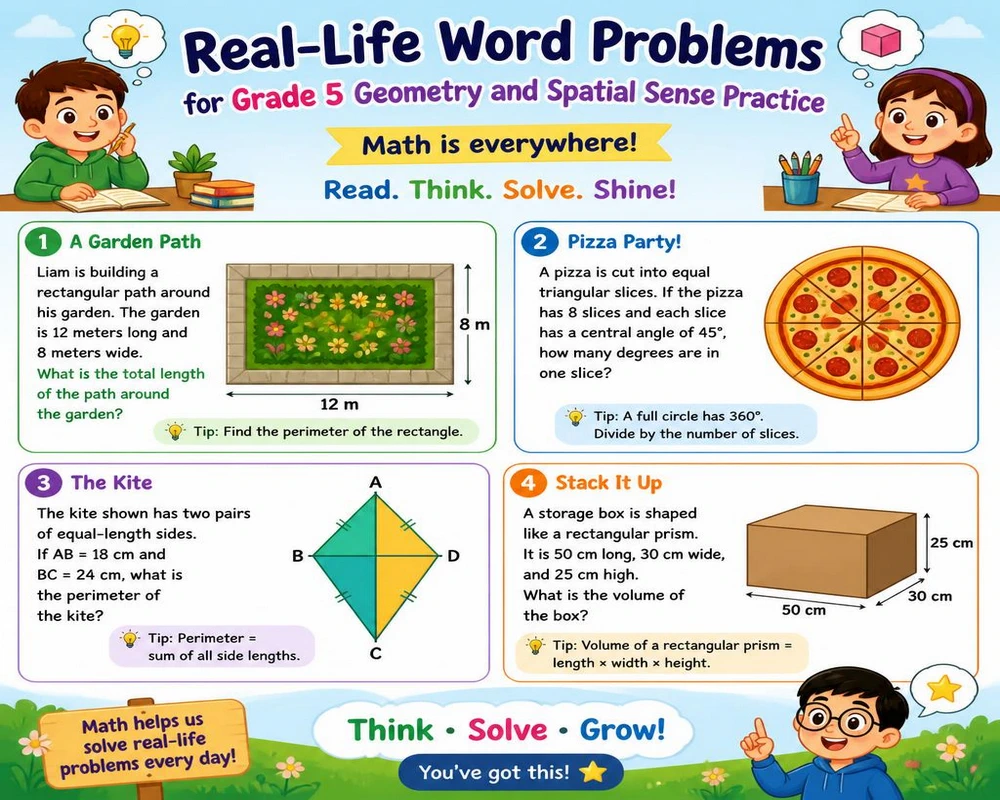
Real-Life Word Problems for Grade 5 Geometry and Spatial Sense Practice
- A ramp forms a 25-degree angle with the ground. Is this acute, right, or obtuse?
- A gift box needs a net with 6 rectangular faces. What 3D solid is this net for?
- A treasure map marks a point 5 units east and 3 units north of a starting point. What are its coordinates?
Answers: 1) Acute 2) A rectangular prism 3) (5, 3)
Frequently Asked Questions
1. What’s the single most common mistake in Grade 5 geometry and spatial sense practice?
Across Grade 5 geometry and spatial sense practice sessions, reading a protractor on the wrong scale, producing the supplement of the correct angle, is by far the most frequent issue students encounter.
2. Why does my child struggle to see that a square is also a rectangle?
This reflects a common gap in understanding nested shape categories. Sorting shapes by properties first, rather than naming them by appearance, helps build this understanding directly.
3. How can I help my child visualize 3D nets without special materials?
Cereal boxes, cardboard, or even paper cut into simple shapes work well for physically folding nets before asking your child to visualize the process mentally.
4. What’s an easy way to remember coordinate order?
A simple phrase like “along the hallway, then up the stairs” reinforces that the first number in a coordinate pair always represents horizontal movement.
5. Should I focus equally on all five areas of geometry, or prioritize?
Prioritizing the most frequent issues first, roughly doubling time spent on protractor reading and shape classification, tends to be a more efficient use of Grade 5 geometry and spatial sense practice time.
6. How much geometry and spatial sense practice should we do at home?
About 15-20 minutes, a few times a week, tends to work well, especially when focused on whichever rank is currently causing the most trouble.
7. How does this connect to Grade 6?
Grade 6 builds directly on this foundation with more complex angle relationships, surface area calculations, and coordinate geometry work.
Geometry and spatial sense is one part of a full Grade 5 year that also includes decimals, fractions, and algebra. Grade 5 geometry and spatial sense practice specifically connects directly to the broader Grade 5 curriculum. Our Grade 5 math practice hub covers every topic in one place.
Interactive geometry tools make these five common confusions in Grade 5 geometry and spatial sense practice far easier to work through than static worksheets alone. Mathies, Ontario’s free suite of digital math tools, includes protractors, nets, and coordinate grid tools built for exactly this stage of learning.