
Grade 4 Decimals Practice: 3 Myths Parents Believe
A parent recently told me she’d been drilling her son on decimal place value for two weeks straight, convinced he just needed more repetition. He didn’t. He needed one specific misconception corrected, and once it was, the worksheets that had felt impossible for two weeks suddenly took him ten minutes. This happens constantly with Grade 4 decimals practice, because most of the advice floating around is built on assumptions that sound reasonable but turn out to be quietly wrong.
Here are the three myths I run into most often when Grade 4 decimals practice stalls, and what’s actually true instead.
Myth 1: “Decimals Are Basically a New Kind of Number”
This is the myth that causes the most damage, because it’s usually unspoken — nobody says it out loud, but it shows up in how decimals get taught, as if they’re some entirely new category disconnected from everything a child already knows.
What’s actually true: A decimal is just a fraction wearing different clothes. The number 0.7 is exactly the fraction 7/10, and 0.25 is exactly 25/100. A child who already understands fractions has, whether they realize it or not, already done the hard conceptual work decimals require. Grade 4 decimals practice that starts by explicitly connecting to fractions your child already knows moves faster than practice that treats decimals as brand new.
| Decimal | Equivalent Fraction |
|---|---|
| 0.1 | 1/10 |
| 0.5 | 5/10, or 1/2 |
| 0.25 | 25/100, or 1/4 |
Try this: Ask your child to write 0.3 as a fraction, then 3/10 as a decimal. If both feel equally comfortable, this myth has already been avoided.

Myth 2: “Longer Decimals Are Always Bigger Numbers”
This one comes from a completely reasonable place — in whole numbers, more digits genuinely does mean a bigger number. 452 is bigger than 45. So when a child sees 0.45 next to 0.5, the instinct says 0.45 must be bigger, because it has more digits after the decimal point.
What’s actually true: It’s the exact opposite logic from whole numbers, and that contradiction is precisely why this trips up so many otherwise strong students. 0.5 is larger than 0.45, because 0.5 means five-tenths, while 0.45 means four-tenths and a bit more — but that “bit more” doesn’t make up for having fewer tenths overall.
Quick check questions:
- Which is greater: 0.6 or 0.45?
- Which is greater: 0.3 or 0.29?
- Order from smallest to largest: 0.7, 0.09, 0.5
Answers: 1) 0.6 2) 0.3 3) 0.09, 0.5, 0.7
The fix that actually works: Add trailing zeros so both numbers have the same number of decimal places before comparing — 0.45 becomes 0.45, and 0.5 becomes 0.50. Now the comparison is just 45 versus 50, which no longer fights against whole-number instincts.

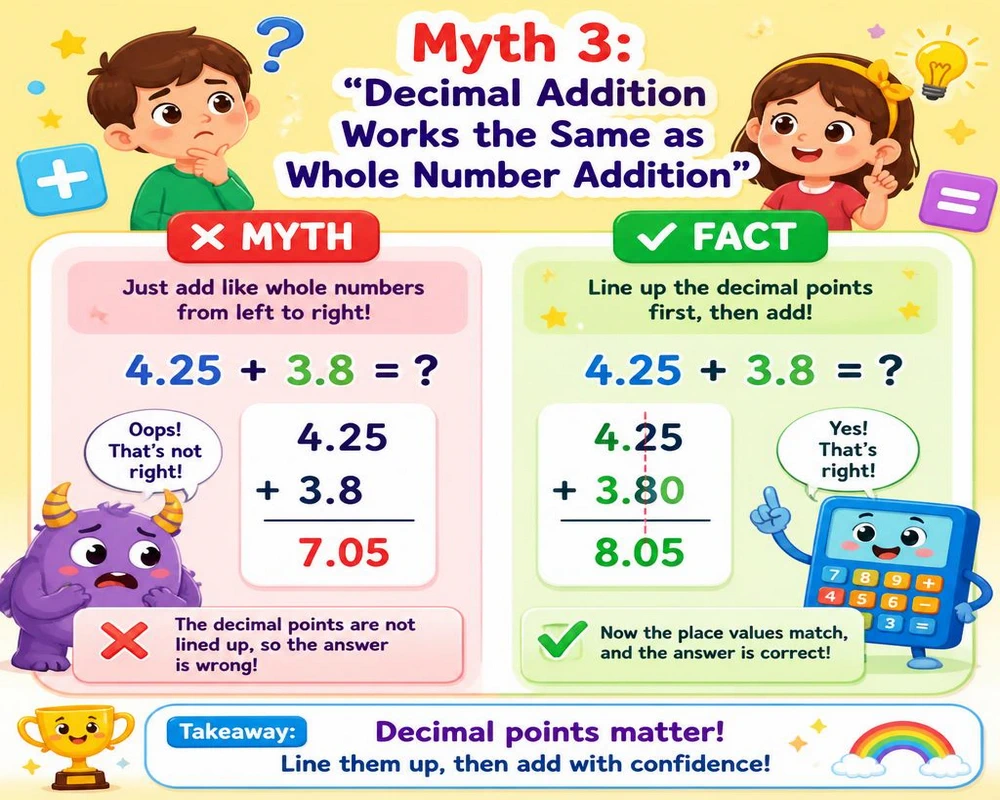
Myth 3: “Decimal Addition Works the Same as Whole Number Addition”
Technically true, but dangerously incomplete. This myth causes a specific, very common error: lining up digits on the right side of the numbers, the way you would with whole numbers, instead of lining up the decimal points.
What’s actually true: The decimal point is the anchor, not the right edge of the number. 3.5 + 2.75 goes wrong immediately if a child lines up the rightmost digits (5 under 5) instead of the decimal points.
Practice questions:
- 4.2 + 3.15 = ___
- 6.5 − 2.35 = ___
- 0.75 + 0.9 = ___
Answers: 1) 7.35 2) 4.15 3) 1.65
The fix: Before adding, have your child rewrite both numbers with the same number of decimal places, decimal points stacked directly on top of each other. This single habit prevents the majority of Grade 4 decimals practice errors related to addition and subtraction.
What the Ontario Curriculum Actually Expects
Grade 4 formally introduces decimal tenths, building toward hundredths later in Grade 5. By year’s end, students are generally expected to read, write, compare, and order decimal tenths, and to add and subtract simple decimal amounts — all of which rest directly on the three corrected myths above, not on anything more advanced.

A Real Diagnostic, Not Just More Worksheets
Before assigning a stack of generic Grade 4 decimals practice sheets, try these three questions and watch closely for hesitation, not just correctness:
- Write 0.6 as a fraction.
- Which is bigger: 0.4 or 0.38?
- Solve: 5.2 + 1.75
A wrong or hesitant answer on question 1 points to Myth 1. A wrong answer on question 2 points to Myth 2. A wrong or misaligned answer on question 3 points to Myth 3. There’s rarely a need to review everything — usually just one of these three ideas is doing all the damage.

Real-Life Word Problems
- A notebook costs $3.45 and a pen costs $1.60. How much do they cost together?
- Malik ran 2.5 kilometres on Monday and 1.75 kilometres on Tuesday. How far did he run in total?
- Which is a better price for the same item: $4.50 or $4.05?
Answers: 1) $5.05 2) 4.25 kilometres 3) $4.05

Why These Three Myths Matter More Than Extra Repetition
Grade 4 decimals practice that ignores these three specific misconceptions tends to produce a familiar, frustrating pattern — a child who seems to understand one day and completely forgets the next. That’s rarely forgetting. It’s usually one of these three myths quietly resurfacing under slightly different numbers. Correcting the actual misconception, rather than repeating the same practice format, is what makes the confusion stop returning.

Frequently Asked Questions
1. Why does my child confuse 0.45 and 0.5?
This is one of the most common decimal misconceptions, rooted in applying whole-number logic (more digits means bigger) to a system where it doesn’t hold. Adding trailing zeros to match decimal places before comparing resolves it directly.
2. Should I teach decimals before or after fractions?
After, if possible. A child who already understands fractions has a head start on decimals, since every decimal is simply a fraction written in a different form.
3. What’s the most common decimal addition mistake?
Lining up digits on the right side of the numbers instead of aligning the decimal points, which produces answers that look plausible but are actually incorrect.
4. How can I tell which of these three myths is affecting my child?
Use the three diagnostic questions in this guide. Hesitation or errors on a specific question point directly to the corresponding myth, saving time compared to reviewing everything from scratch.
5. Does Grade 4 cover decimal hundredths, or just tenths?
Grade 4 focuses primarily on decimal tenths, with hundredths becoming a bigger focus in Grade 5, building directly on this foundation.
6. How much decimals practice should we do at home?
About 15 minutes, three to four times a week, tends to work well, especially when focused on whichever specific myth the diagnostic identifies.
7. How does this connect to Grade 5?
Grade 5 extends decimal place value to hundredths and introduces decimal multiplication, so a shaky Grade 4 foundation in these three areas tends to resurface as a bigger struggle the following year.
Decimals are one part of a full Grade 4 year that also includes multiplication, long division, and geometry. Our Grade 4 math practice hub covers every topic in one place.
Visual decimal models make these three misconceptions far easier to correct than abstract explanation alone. Mathies, Ontario’s free suite of digital math tools, includes interactive decimal grids built for exactly this stage of learning.