
Grade 3 Multiplication Practice: 7 Amazing Strategies
Grade 3 multiplication practice tends to arrive with a lot of pressure attached — times tables, timed quizzes, flashcards flying across the kitchen table. Having spent years supporting Ontario’s Junior Division classrooms, I’ve watched this pressure backfire more often than it helps. Kids who memorize facts under stress tend to forget them just as quickly, while kids who understand what multiplication actually represents — equal groups, arrays, repeated addition — tend to hold onto facts far longer, even without drilling them constantly.
This guide walks through what Ontario’s Grade 3 curriculum expects around multiplication, why understanding beats memorization, and seven strategies that build real, lasting fluency.
Why Grade 3 Multiplication Practice Is a Turning Point
Grade 2 introduced multiplication informally through equal groups and skip counting, without ever using the multiplication symbol. Grade 3 is where that concept becomes formal — the times sign appears, multiplication facts get named and practiced directly, and students are expected to move toward genuine fluency with facts up to 10 × 10.
This matters because Grade 3 multiplication practice done well doesn’t abandon the conceptual groundwork from Grade 2 — it builds directly on top of it. A student who understands why 4 × 3 equals 12, rather than just recalling it, tends to reconstruct forgotten facts far more easily than one who only ever memorized isolated numbers.
What the Ontario Curriculum Expects in Grade 3
By the end of Grade 3, students are generally expected to:
- Recall multiplication facts up to 7 × 7, working toward fluency to 10 × 10
- Represent multiplication using arrays, equal groups, and number lines
- Understand multiplication as the inverse of division
- Apply multiplication facts to solve simple word problems
- Use skip counting and known facts to figure out unknown facts
Notice that recall is expected to come from understanding, using arrays and equal groups, rather than isolated memorization. Grade 3 multiplication practice built around these visual models tends to stick far better than flashcards alone.
Understanding Arrays: Multiplication You Can See
What an Array Actually Shows
An array arranges objects into neat rows and columns, making multiplication visually obvious. A 3-by-4 array — three rows of four objects — shows exactly what 3 × 4 means, without requiring a single fact to be memorized first.
| Array | Multiplication Fact | Total |
|---|---|---|
| 3 rows of 4 | 3 × 4 | 12 |
| 5 rows of 6 | 5 × 6 | 30 |
| 2 rows of 8 | 2 × 8 | 16 |
A simple home activity: use small objects like coins or buttons to build a 4-by-5 array, then ask your child to write the multiplication fact that matches it.

Grade 3 Multiplication Facts Practice
Basic Facts to 7 × 7
- 3 × 4 = ___
- 6 × 5 = ___
- 7 × 6 = ___
- 4 × 4 = ___
Answers: 1) 12 2) 30 3) 42 4) 16
Working Toward 10 × 10
- 8 × 9 = ___
- 9 × 7 = ___
- 10 × 6 = ___
Answers: 1) 72 2) 63 3) 60

7 Strategies for Grade 3 Multiplication Practice
Strategy 1: Build Facts With Arrays First
Before drilling a fact, build it physically as an array. This gives every multiplication fact a visual anchor rather than an isolated number to memorize.

Strategy 2: Use Skip Counting as a Bridge
A child who knows how to skip count by 6s already has a strategy for solving 6 × anything — they just need to count that many groups.

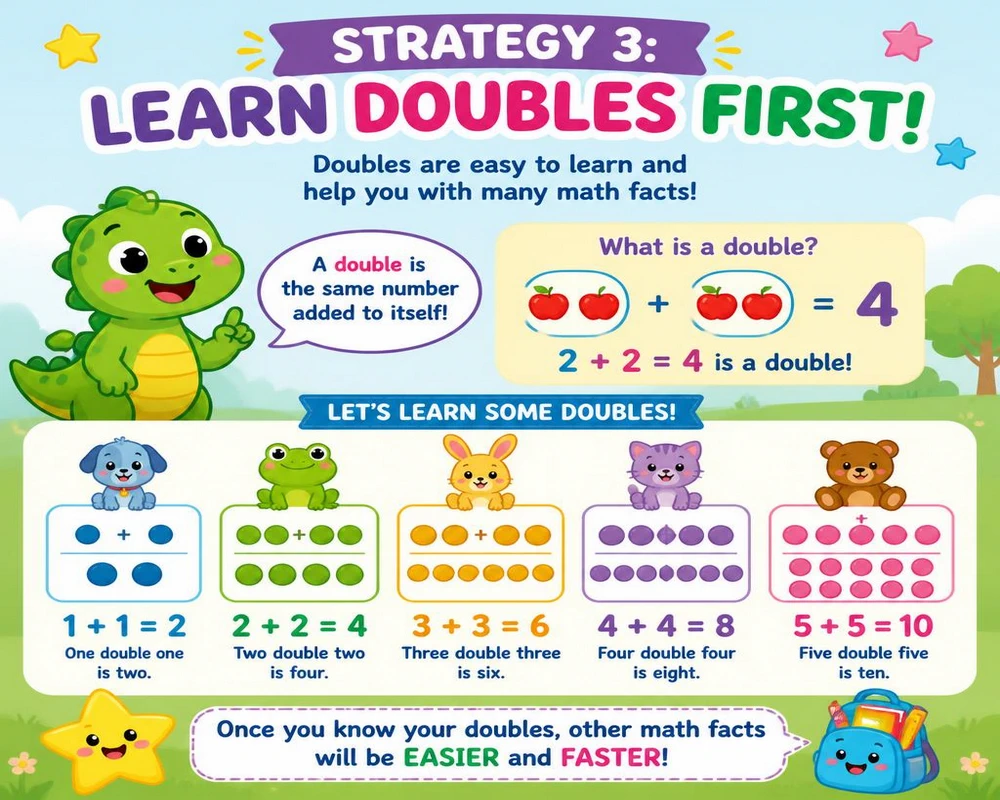
Strategy 3: Learn Doubles First
Facts like 2 × anything (doubles) tend to stick quickly and become a foundation for related facts, like using 2 × 6 to help figure out 4 × 6.
Strategy 4: Use the Commutative Property
Once a child knows 3 × 7, they already know 7 × 3 — multiplication gives the same answer in either order. Pointing this out explicitly cuts the number of facts to memorize roughly in half.

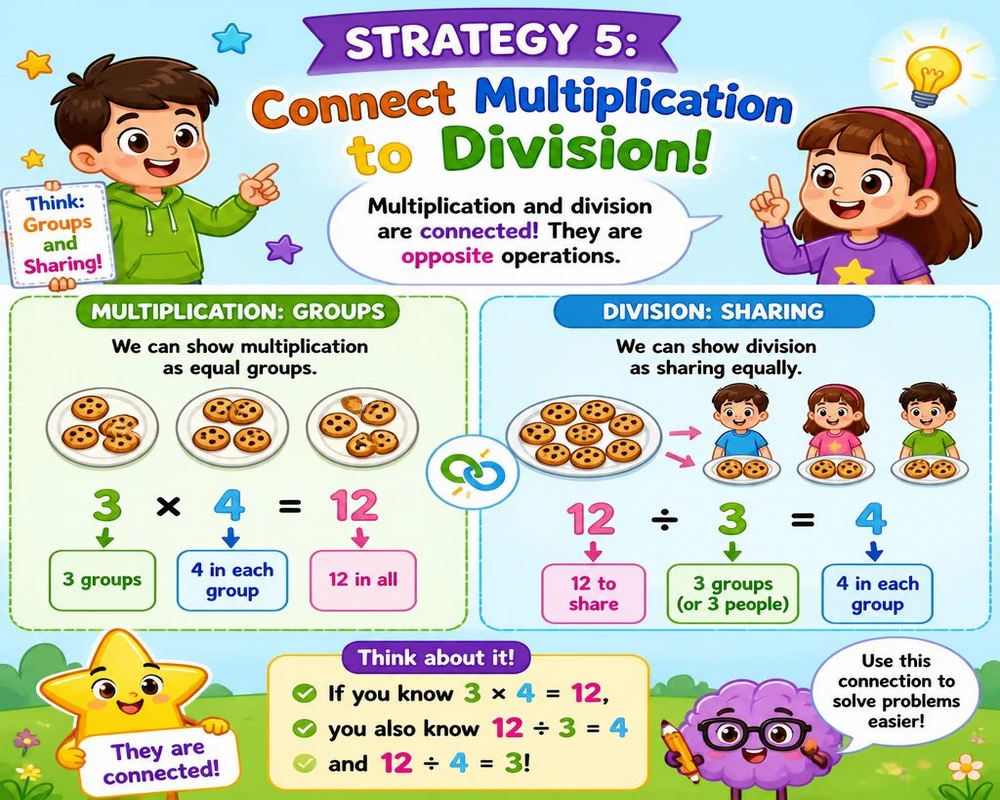
Strategy 5: Connect Multiplication to Division
Practicing fact families (like 4 × 5 = 20, so 20 ÷ 5 = 4) reinforces both operations at once and builds flexible number sense rather than two disconnected skills.
Strategy 6: Practice a Little, Often
Short, frequent sessions build stronger recall than long, infrequent ones. Five to ten minutes of focused Grade 3 multiplication practice most days of the week outperforms one long weekend session.

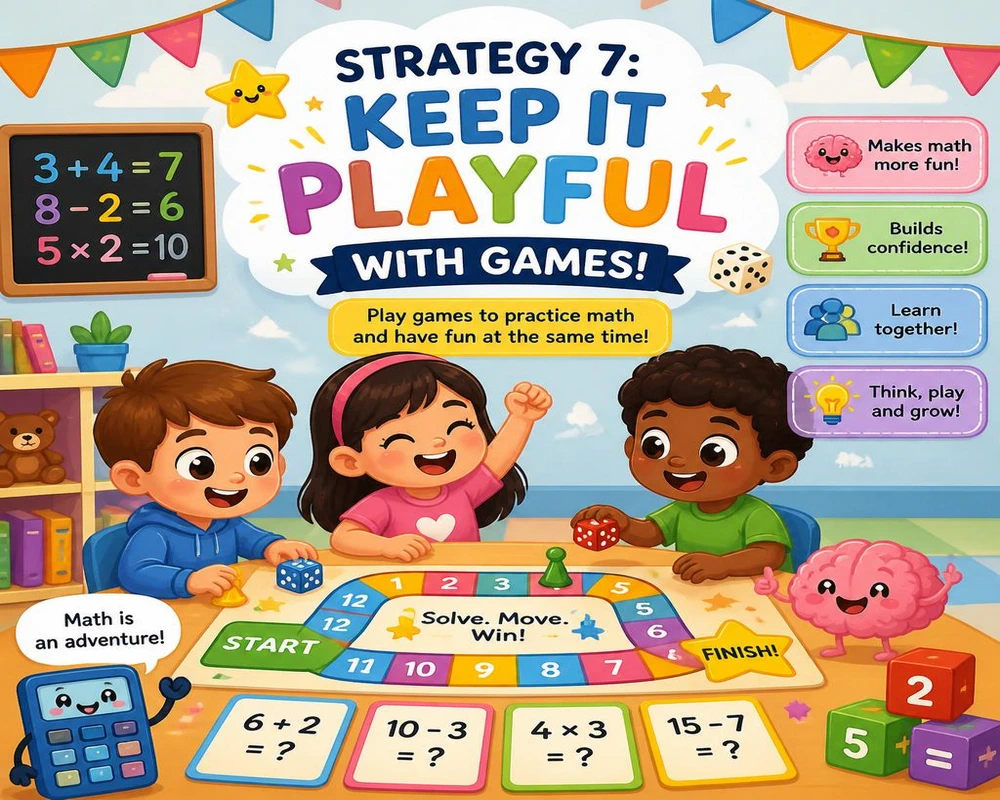
Strategy 7: Keep It Playful With Games
Dice games, card games, and simple multiplication bingo turn repetitive practice into something a child actually looks forward to, rather than dreads.
Real-Life Word Problems
- A classroom has 5 rows of desks with 6 desks in each row. How many desks are there in total?
- A baker makes 8 trays of muffins, with 6 muffins on each tray. How many muffins did the baker make?
- There are 7 packs of pencils, with 4 pencils in each pack. How many pencils are there altogether?
Answers: 1) 30 desks 2) 48 muffins 3) 28 pencils
Common Mistakes in Grade 3 Multiplication
Confusing Multiplication With Addition
Some students add the two numbers in a multiplication problem instead of multiplying, especially with smaller facts where the two answers might seem close. Returning to arrays clarifies the difference immediately.
Memorizing Facts Without Understanding
A child who has only memorized facts, without ever building them as arrays or equal groups, often struggles to recover a forgotten fact under pressure. Understanding gives a fallback strategy that pure memorization doesn’t.
Not Recognizing the Commutative Property
Some students treat 3 × 8 and 8 × 3 as entirely separate facts to memorize, doubling their workload unnecessarily. Explicitly demonstrating this with arrays turned sideways helps this concept click.
Practical Tips for Practicing at Home
Use Everyday Arrays
Muffin tins, egg cartons, and window panes are all natural, real-world arrays worth pointing out during everyday moments.
Keep Multiplication Facts Fresh With Quick Reviews
A quick, two-minute review of a few facts before starting other homework keeps recall sharp without requiring a dedicated study session every time.
Balance Understanding and Speed
Fluency matters, but accuracy built on genuine understanding should come first. Rushing toward speed before understanding is solid tends to backfire later.
Conclusion: Building Facts That Actually Stick
Grade 3 multiplication practice works best when it’s rooted in genuine understanding — arrays, equal groups, and the relationships between facts — rather than pure repetition alone. Students who build this foundation tend to hold onto their multiplication facts far longer, and recover forgotten ones far more easily, than those who only ever memorized numbers in isolation.
Build a quick array with buttons or coins tonight and connect it to the matching multiplication fact. A few minutes of hands-on practice like this build understanding no flashcard deck alone can match.
Frequently Asked Questions
1. What multiplication facts should a Grade 3 student know?
Students are generally expected to recall facts up to 7 × 7 confidently, while working steadily toward fluency with facts up to 10 × 10.
2. Why does my child forget multiplication facts so easily?
This often happens when facts were memorized without a visual model like arrays or equal groups behind them. Building understanding gives a fallback strategy for forgotten facts.
3. What is the commutative property, and why does it matter?
It means multiplication gives the same answer regardless of order (3 × 4 equals 4 × 3). Understanding this effectively cuts the number of facts a child needs to memorize in half.
4. How can I make multiplication practice less stressful?
Keep sessions short and game-based rather than timed and pressured, and always connect new facts to a visual model like an array before drilling them.
5. Should I use flashcards for multiplication practice?
Flashcards are fine as a supplement, but they work best after a fact has already been understood through arrays or equal groups, not as the very first introduction.
6. How much multiplication practice should we do at home?
Around five to ten minutes, most days of the week, tends to build stronger long-term recall than occasional long sessions.
7. How does multiplication connect to division?
They’re inverse operations, and practicing them together as fact families builds far more flexible number sense than treating them as two separate skills.
Multiplication is one part of a full Grade 3 year that also covers fractions and area, among other topics. For the complete picture, our Grade 3 math practice hub brings every topic together in one place.
Teachers across Ontario regularly share classroom-tested multiplication strategies through the Ontario Association for Mathematics Education, a professional network dedicated to improving math instruction across the province.