
Grade 6 Ratios and Rates Practice: 4 Places It Shows Up
A basketball player who makes 18 out of 24 free throws and one who makes 21 out of 28 have technically different numbers, but they’ve made exactly the same fraction of their shots. That’s a ratio, doing real work, outside of any math class. Grade 6 ratios and rates practice tends to feel abstract on a worksheet, but the moment a student notices it’s already hiding inside sports stats, recipes, price tags, and road trips, the whole topic gets a lot less intimidating.
This guide walks through four real places ratios and rates show up, with worked examples and practice questions for each, followed by what Ontario’s curriculum specifically expects this year.
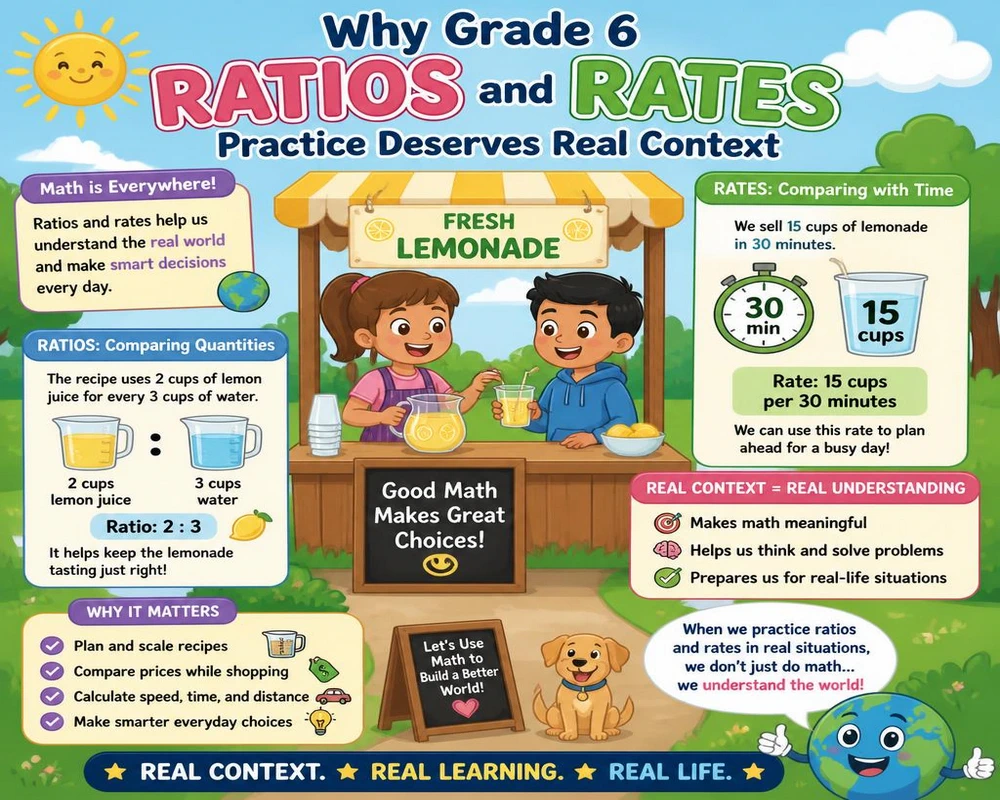
Why Grade 6 Ratios and Rates Practice Deserves Real Context
Ontario’s curriculum makes ratio a fully formal topic in Grade 6, building on the informal comparison work from Grade 5. Students are now expected to express ratios in simplified form, calculate unit rates, and use proportional reasoning to solve problems — skills that genuinely show up constantly once you know where to look, which is exactly the point of grounding Grade 6 ratios and rates practice in real situations.
This matters because Grade 6 ratios and rates practice grounded in real examples builds intuition that pure numbers alone rarely do. A student who’s compared two grocery prices using unit rate already understands the mechanics behind the abstract version of the same problem.
What the Ontario Curriculum Expects in Grade 6
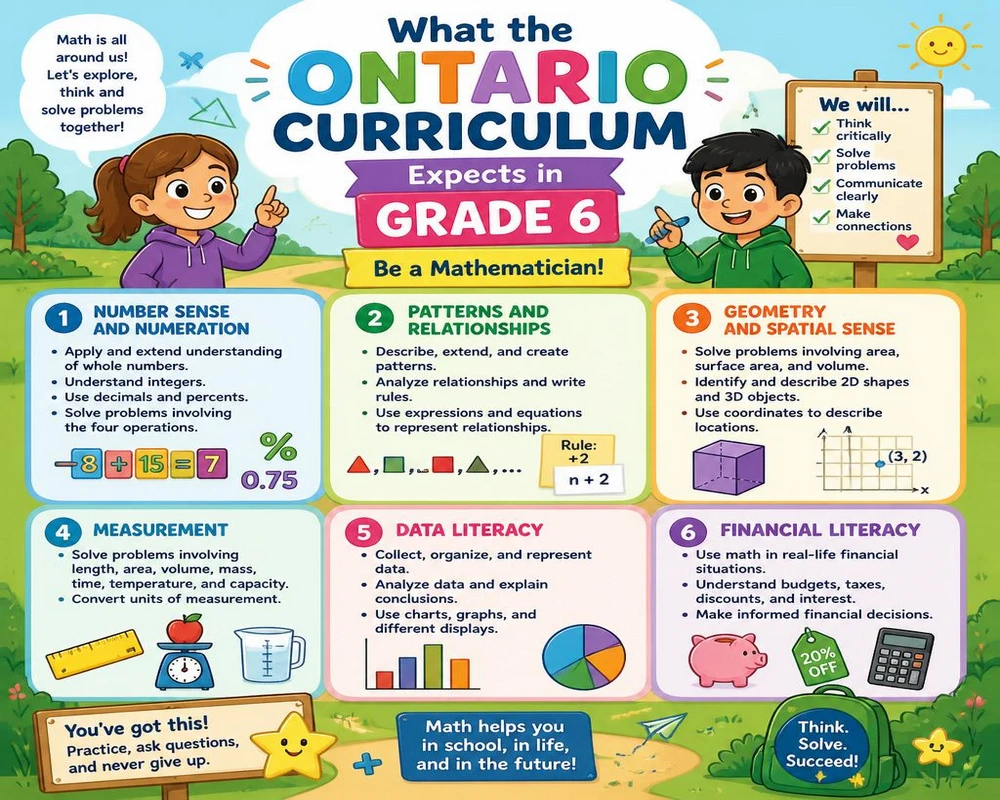
By the end of Grade 6, students are generally expected to:
- Represent and simplify ratios
- Determine equivalent ratios
- Calculate unit rates from a given rate
- Use ratios and rates to solve real-world problems
- Apply proportional reasoning to compare quantities
Place 1: Sports Statistics
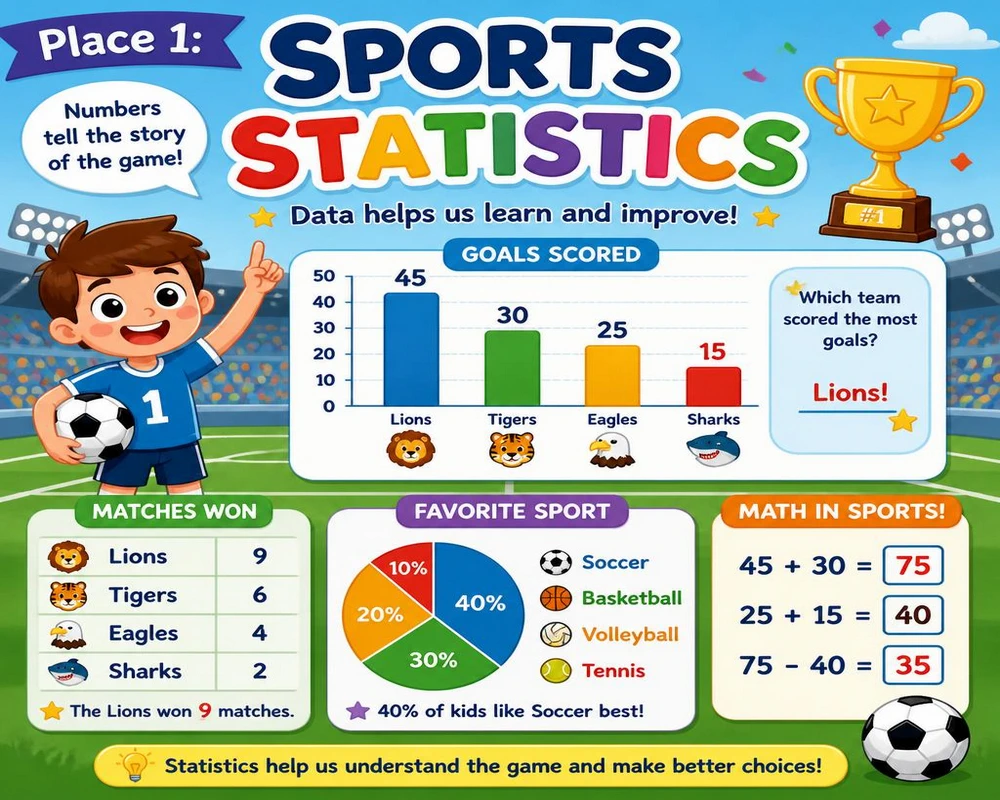
Free throw percentages, batting averages, and win-loss records are all ratios wearing a sports uniform, and this is one of the most natural entry points into Grade 6 ratios and rates practice for students who already follow a sport closely.
Worked Example
Here’s a real Grade 6 ratios and rates practice scenario, worked step by step. Player A makes 18 out of 24 free throws. Player B makes 21 out of 28. Who has the better ratio?
Simplify both: 18:24 simplifies to 3:4. 21:28 also simplifies to 3:4.
Answer: Both players have exactly the same ratio, even though their raw numbers look different.
Practice Questions
- A soccer team wins 12 out of 20 games. Simplify this ratio.
- Simplify the ratio 15:25.
- Are the ratios 4:6 and 6:9 equivalent?
Answers: 1) 3:5 2) 3:5 3) Yes, both simplify to 2:3
Place 2: Recipes and Cooking
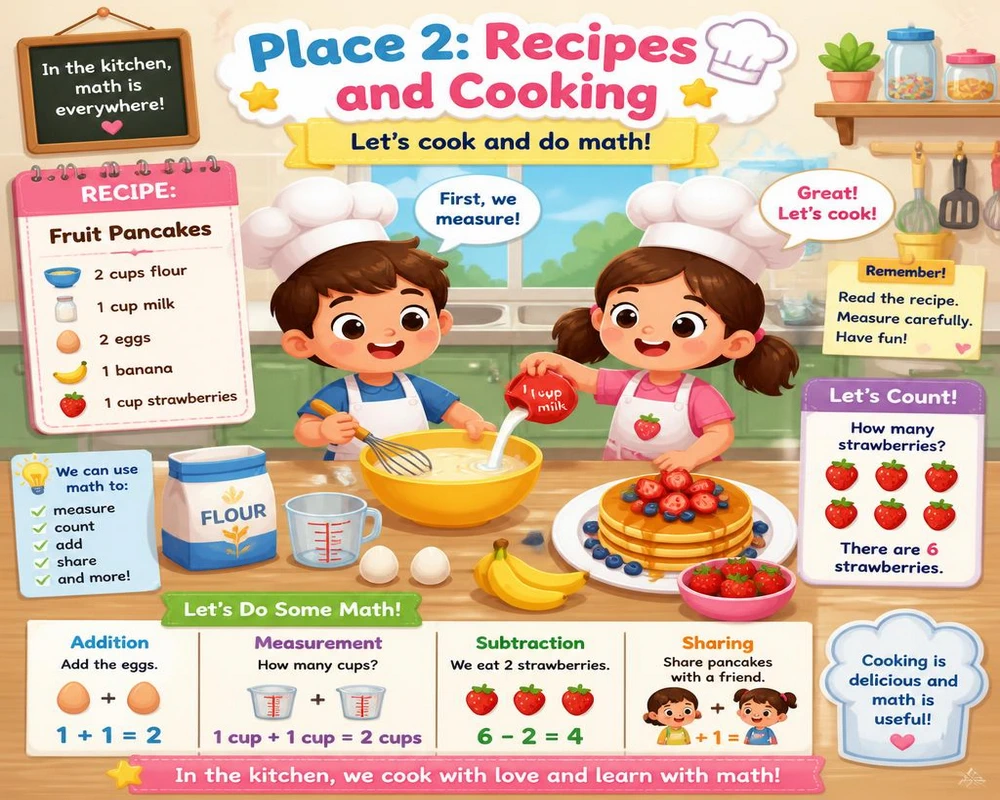
Scaling a recipe up or down is proportional reasoning in its most practical form, making it a genuinely useful entry point for Grade 6 ratios and rates practice at home, especially for families who cook together regularly.
Worked Example
A recipe uses a ratio of 2 cups of flour to 3 cups of sugar. If you want to triple the recipe, how much of each ingredient do you need?
Scale both parts by 3: 2 × 3 = 6 cups of flour. 3 × 3 = 9 cups of sugar.
Answer: 6 cups of flour to 9 cups of sugar, still in the same 2:3 ratio.
Practice Questions
- A recipe uses a 3:4 ratio of butter to sugar. If you use 9 cups of butter, how much sugar is needed?
- A juice recipe mixes 1 part concentrate to 4 parts water. How much water is needed for 3 parts concentrate?
Answers: 1) 12 cups of sugar 2) 12 parts water
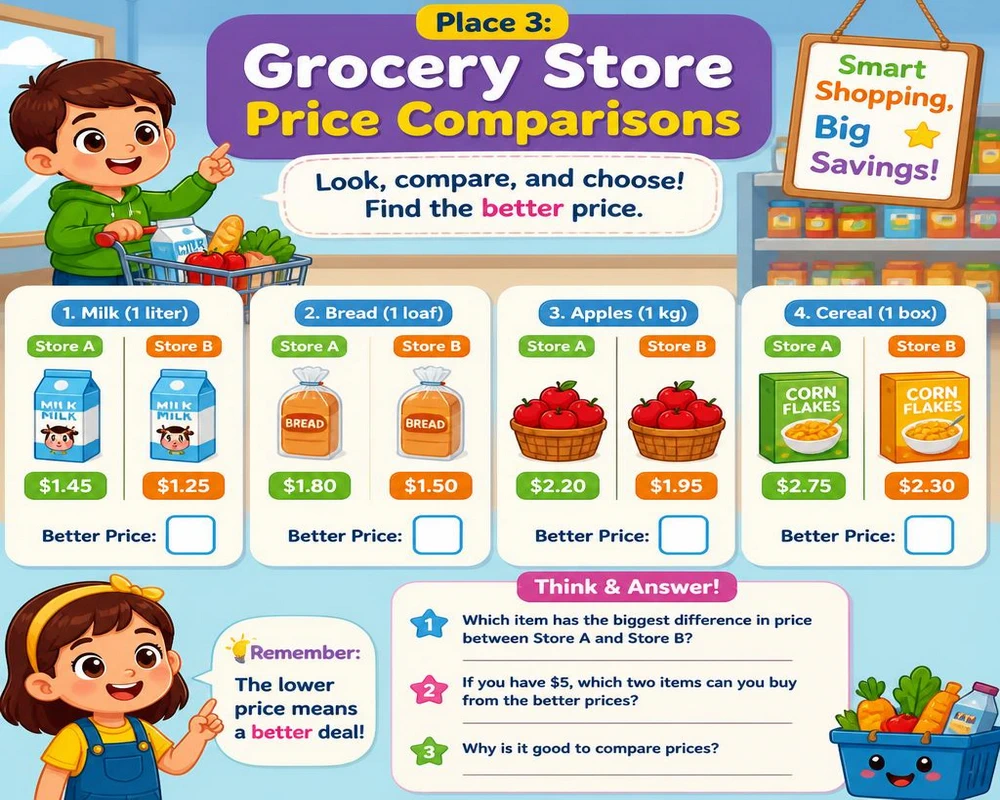
Place 3: Grocery Store Price Comparisons
Unit rate — the cost of a single item — is exactly what shopping smart requires, and it’s one of the clearest real-world applications of Grade 6 ratios and rates practice, since almost every shopping trip offers a genuine example to work through.
Worked Example
This next example is a staple of real Grade 6 ratios and rates practice: a 12-pack of juice boxes costs $3.60. An 8-pack costs $2.80. Which is the better deal per box?
Calculate unit rate for each: $3.60 ÷ 12 = $0.30 per box. $2.80 ÷ 8 = $0.35 per box.
Answer: The 12-pack is the better deal, at 5 cents less per box.
Practice Questions
- A 6-pack of granola bars costs $4.20. What is the unit rate per bar?
- Store A sells 10 apples for $5.00. Store B sells 8 apples for $4.40. Which store has the better unit rate?
Answers: 1) $0.70 per bar 2) Store A, at $0.50 per apple versus $0.55 per apple
Place 4: Speed and Travel
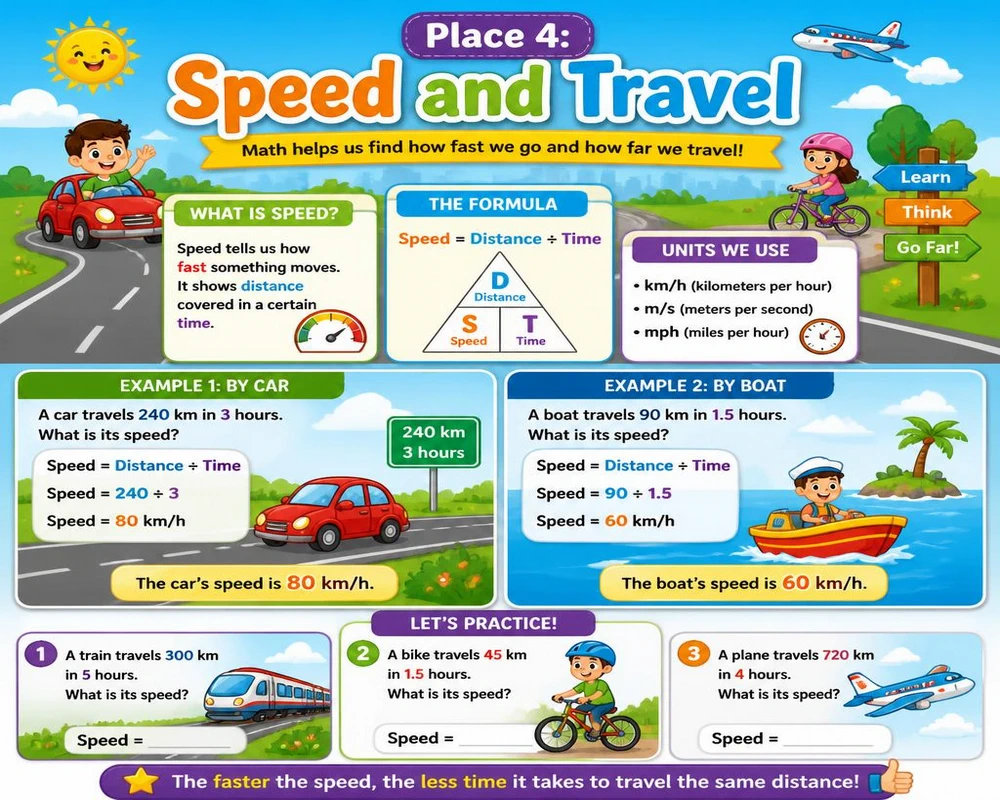
Speed is a rate — distance compared to time — and this final context for Grade 6 ratios and rates practice tends to be one of the most intuitive, since most students already have a feel for what “fast” and “slow” mean.
Worked Example
A car travels 180 km in 3 hours. What is its speed as a unit rate?
Divide distance by time: 180 ÷ 3 = 60 km/h.
Answer: The car is travelling at 60 kilometres per hour.
Practice Questions
- A cyclist travels 240 km in 4 hours. What is their speed in km/h?
- At a steady speed of 60 km/h, how long would it take to travel 300 km?
Answers: 1) 60 km/h 2) 5 hours
Connecting the Four Places
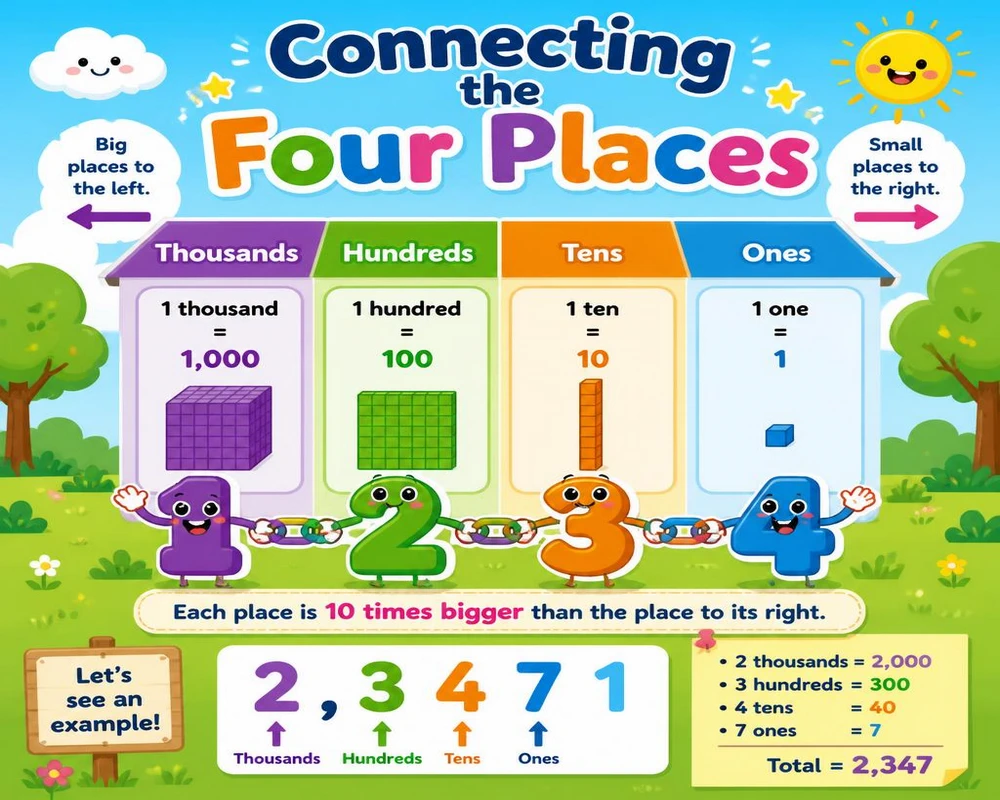
Notice that every one of these four real-life examples uses the exact same underlying skill: comparing two quantities, then simplifying or scaling that comparison. Grade 6 ratios and rates practice across sports, cooking, shopping, and travel is really just one skill applied to four different situations, which is exactly why practicing across all four builds more flexible understanding than repeating problems from just one context.
Common Mistakes in Grade 6 Ratios and Rates Practice
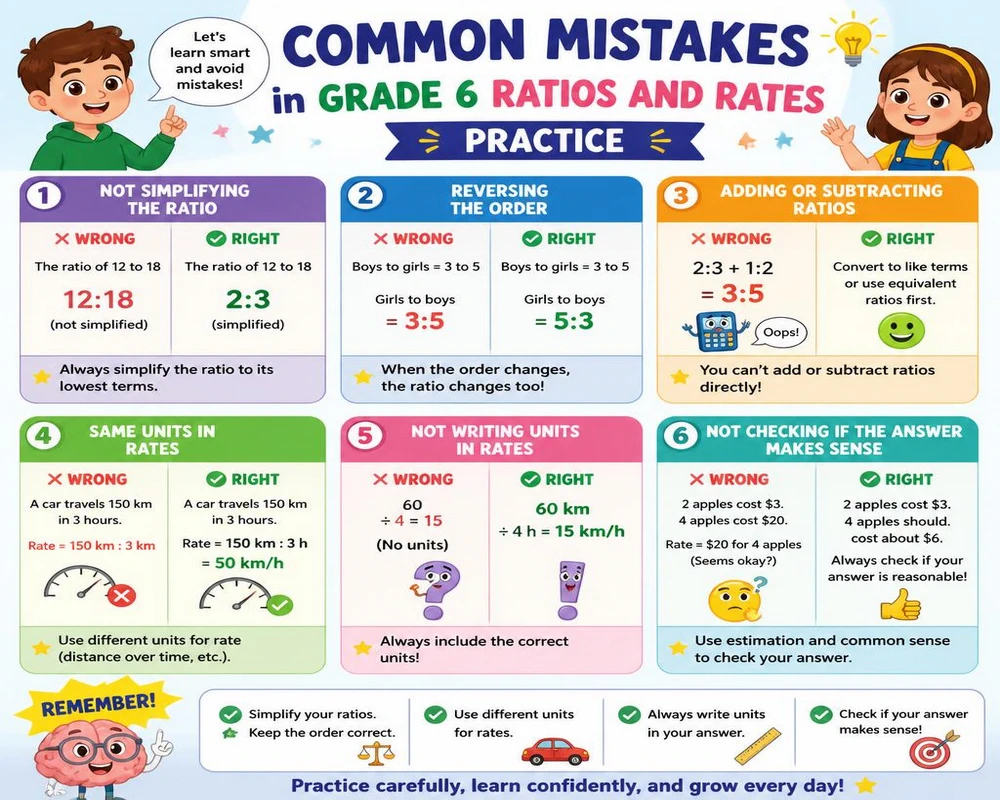
Three specific errors account for most of the confusion in Grade 6 ratios and rates practice, and all three are easy to catch once you know to look for them.
Simplifying Only One Side of a Ratio
Some students divide only the first number in a ratio, forgetting to divide the second by the same amount. Reinforcing that both numbers must be divided by the identical value keeps ratios accurate.
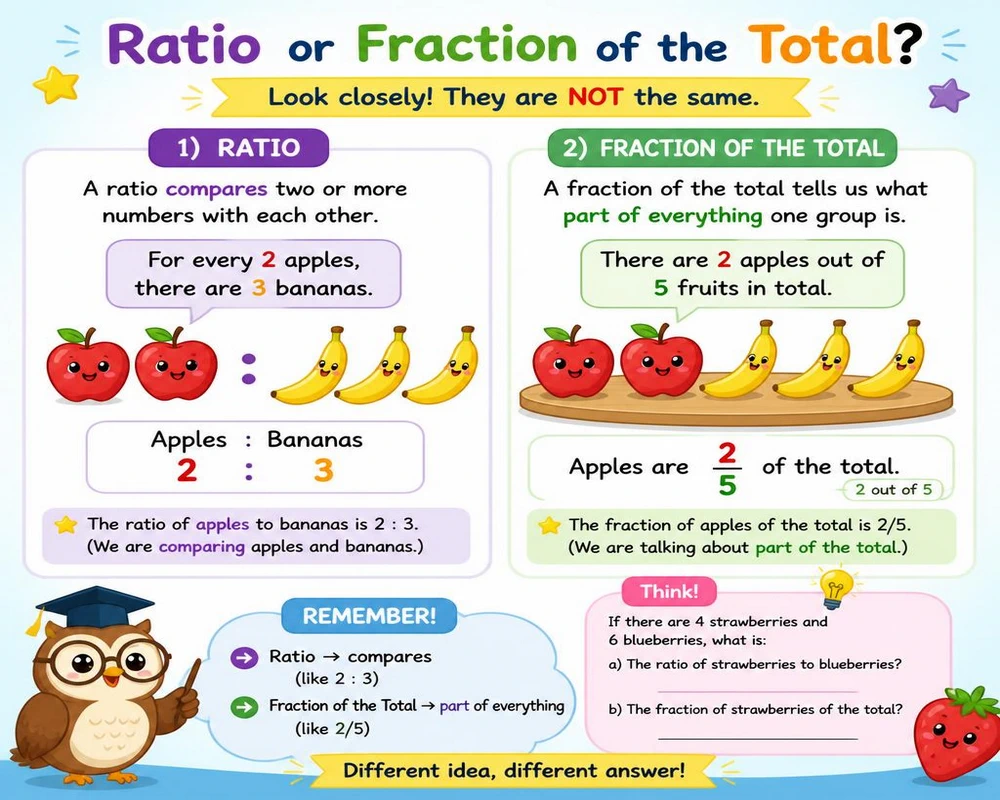
Confusing a Ratio With a Fraction of the Total
A ratio of 3:4 does not mean 3/4 of the total — it means 3 parts to 4 parts, out of 7 total parts combined. This distinction trips up a lot of Grade 6 ratios and rates practice sessions specifically.
Forgetting the Units in a Rate
Writing “60” instead of “60 km/h” loses essential information. Consistently including units reinforces that a rate always compares two different kinds of quantities.
Frequently Asked Questions
1. What’s the difference between a ratio and a rate?
A ratio compares two quantities of the same kind, like boys to girls in a class, while a rate compares two different kinds of quantities, like distance to time.
2. Why does a ratio of 3:4 not mean 3/4?
A 3:4 ratio means 3 parts compared to 4 parts, for a total of 7 parts, not 3 out of 4 total parts. This is one of the more common mix-ups in Grade 6 ratios and rates practice.
3. What is a unit rate, in simple terms?
It’s a rate expressed for a single unit, like the cost of one item or the speed for one hour, making different rates easy to compare directly.
4. How can I practice ratios without a worksheet?
Compare sports statistics, scale a recipe, calculate unit prices while grocery shopping, or figure out travel speed on a road trip — all genuine, real-world Grade 6 ratios and rates practice.
5. Why do my child’s simplified ratios sometimes come out wrong?
This usually happens when only one side of the ratio gets divided during Grade 6 ratios and rates practice. Both numbers must be divided by the same value to keep the ratio equivalent.
6. How much ratio and rate practice should we do at home?
About 15-20 minutes, a few times a week, tends to work well for Grade 6 ratios and rates practice, especially when rotating through the four real-life contexts covered in this guide.
7. How does this connect to later grades?
Ratios and rates form the foundation for proportional reasoning, percent problems, and eventually algebra involving variables in later grades.
Ratios and rates are one part of a full Grade 6 year that also includes integers, probability, and financial literacy. The four real contexts covered in this Grade 6 ratios and rates practice guide only scratch the surface of where this skill shows up. Our Grade 6 math practice hub covers every topic in one place.
Teachers across Ontario regularly share classroom-tested strategies for teaching ratios and proportional reasoning through the Ontario Association for Mathematics Education, a professional network dedicated to improving math instruction across the province.