
Boost Ontario Math Practice Grade 2 Skills: Numbers, Money & Measurement
Introduction
Imagine your seven-year-old confidently counting coins for a lemonade stand or measuring ingredients for cookies without hesitation. That’s the magic of strong foundational math skills. For parents and teachers across Ontario, Ontario math practice Grade 2 is the key to unlocking this confidence in young learners.
The Ontario mathematics curriculum emphasizes practical, real-world application, especially in Numbers, Money, and Measurement. This comprehensive guide delivers everything you need for effective Ontario math practice Grade 2 in 2026. From core concepts and hands-on activities to common challenges and assessment strategies, you’ll gain expert insights to support your child’s learning journey.
Whether you’re a parent supplementing schoolwork, a homeschooler, or an educator seeking fresh ideas, this article provides actionable value. We’ll explore Grade 2 math Ontario expectations, dive into money math Grade 2 Ontario, and cover measurement while weaving in Grade 2 math questions that build mastery. Let’s build young mathematicians ready for future success.
Understanding the Ontario Grade 2 Math Curriculum in 2026
The Ontario curriculum, updated in 2020 and still the foundation in 2026, prioritizes deep understanding over rote memorization. Number sense, financial literacy, and measurement connect math to everyday life.
Key Expectations for Numbers Strand
In Grade 2, students work with whole numbers up to 200. They represent, compare, order, and compose/decompose numbers using base ten blocks, number lines, and ten-frames.
- Read and write numbers to 200 in standard, expanded, and word form.
- Skip count by 2s, 5s, 10s, and 25s forward and backward.
- Compare numbers using greater than (>), less than (<), and equal to (=).
- Add and subtract within 100 using mental math strategies and regrouping.
These build fluency essential for later grades. Research from the Ontario Ministry and educational studies shows early number sense strongly predicts later math achievement. A 2024-2025 analysis of Ontario student data indicated students with strong primary number sense scored 25-30% higher in intermediate assessments.
Money Math Grade 2 Ontario: Building Financial Literacy
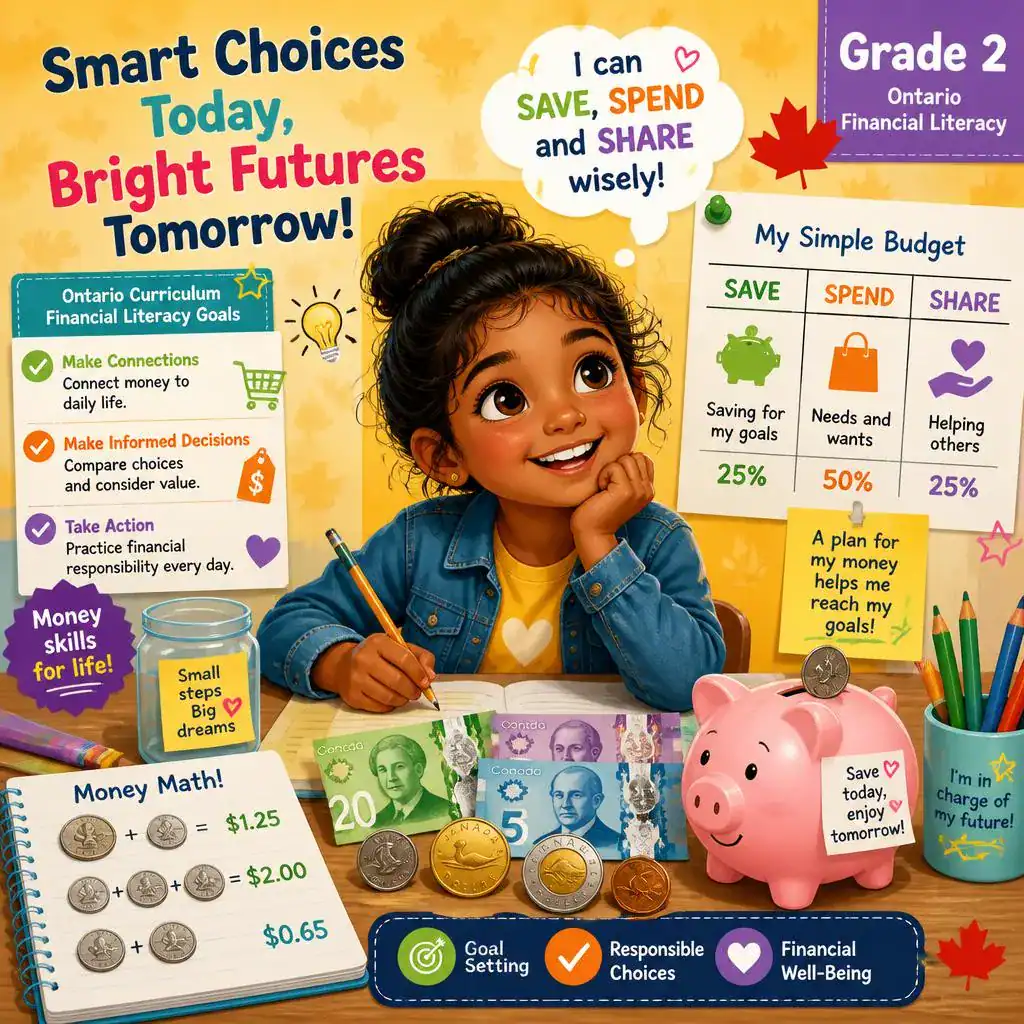
Financial literacy is a standout feature. Students recognize Canadian coins (pennies, nickels, dimes, quarters, loonies, toonies) and bills up to $100. They count, add, and make change for amounts up to $100.
Practical example: At a classroom “store,” a child buys a pencil for 35 cents with a loonie and calculates 65 cents change. This develops estimation, addition, and subtraction in context.
Measurement in Grade 2 Ontario
Students measure length using non-standard (paperclips, cubes) and standard units (centimetres, metres). They also explore time (to nearest five minutes), mass, capacity, and temperature.
- Compare and order objects by length, mass, or capacity.
- Tell time using analog and digital clocks.
- Use tools like rulers, scales, and thermometers accurately.
These concepts foster problem-solving and spatial reasoning.
Essential Ontario Math Practice Grade 2 Strategies for Success
Effective practice goes beyond worksheets. Blend conceptual understanding, procedural fluency, and application.
Hands-On Activities for Numbers
Use manipulatives daily:
- Build numbers to 200 with base ten blocks.
- Play “Number War” comparing cards.
- Create number lines for addition/subtraction stories.
Pro Tip: Incorporate storytelling. “Sam had 47 stickers and got 28 more…” encourages modeling with drawings or blocks.
Engaging Money Math Grade 2 Ontario Activities
- Set up a pretend store with priced items.
- Coin sorting and counting races.
- Word problems: “You have $1.25. How many 25-cent toys can you buy?”
According to educator resources, role-playing financial scenarios boosts engagement and retention significantly.
Measurement Practice Ideas
- Measure classroom objects in cm and m.
- Cooking activities for capacity and mass.
- Time-telling games with daily schedules.
Track progress with a “Math Growth Journal” where kids note achievements.
Grade 2 Math Questions: Sample Practice Sets
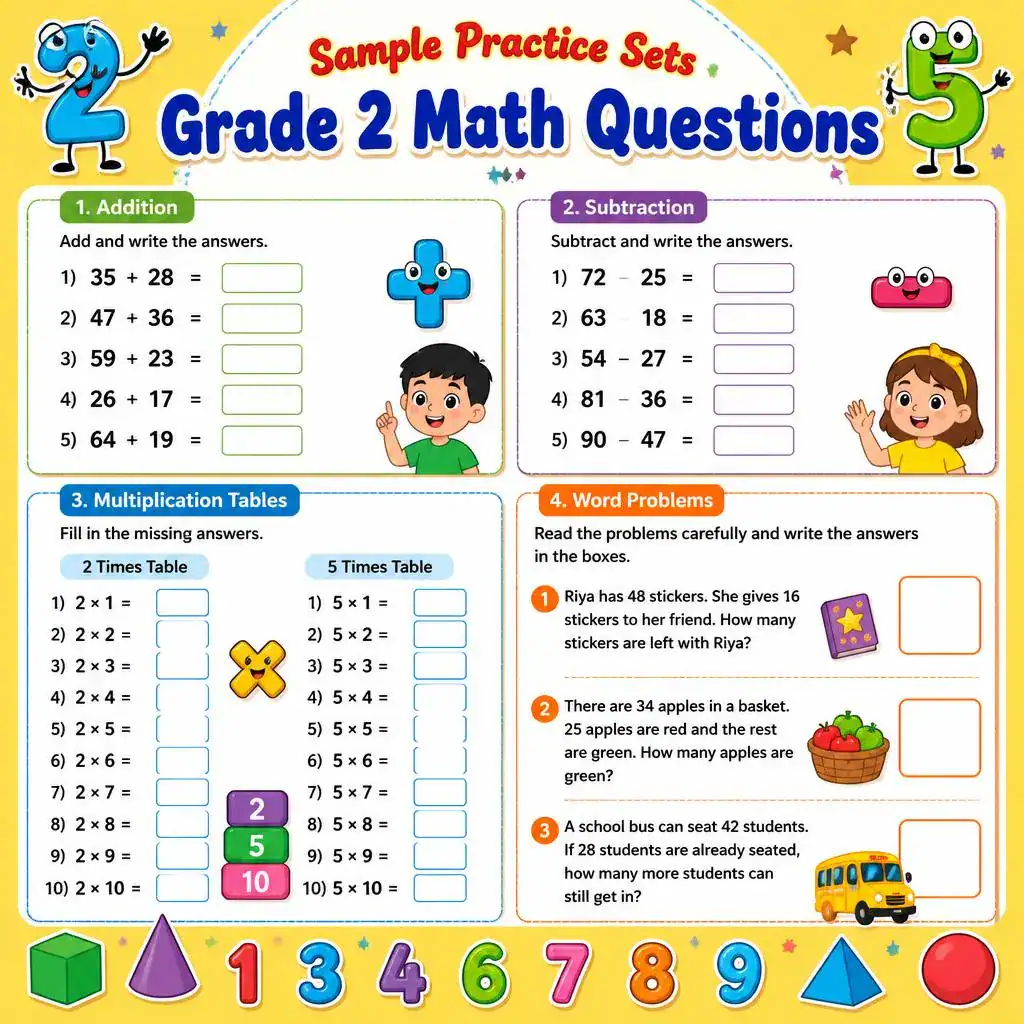
Here are curated examples mirroring Ontario expectations. Use them for daily practice.
Numbers Practice Questions
Addition/Subtraction:
- 56 + 37 = ?
- 84 – 29 = ? (Show regrouping)
Place Value:
- What is 142 in expanded form?
- Order these numbers: 89, 112, 75, 130.
Skip Counting:
- Count by 25s to 200 starting from 50.
Money Math Grade 2 Ontario Questions
- Count: 2 loonies, 3 quarters, 1 dime.
- You buy a snack for $1.45 with $2.00. What’s the change?
- Which combination makes exactly $3.00 using different coins?
Measurement Questions
- Measure a book in centimetres. How many would fit across a desk?
- What time is it if it’s 25 minutes after 3:00?
- Which is heavier: 500g of apples or 1 kg of feathers? Explain.
Solutions and explanations should accompany practice to reinforce learning.
Advanced Tips for Ontario Math Practice Grade 2 at Home
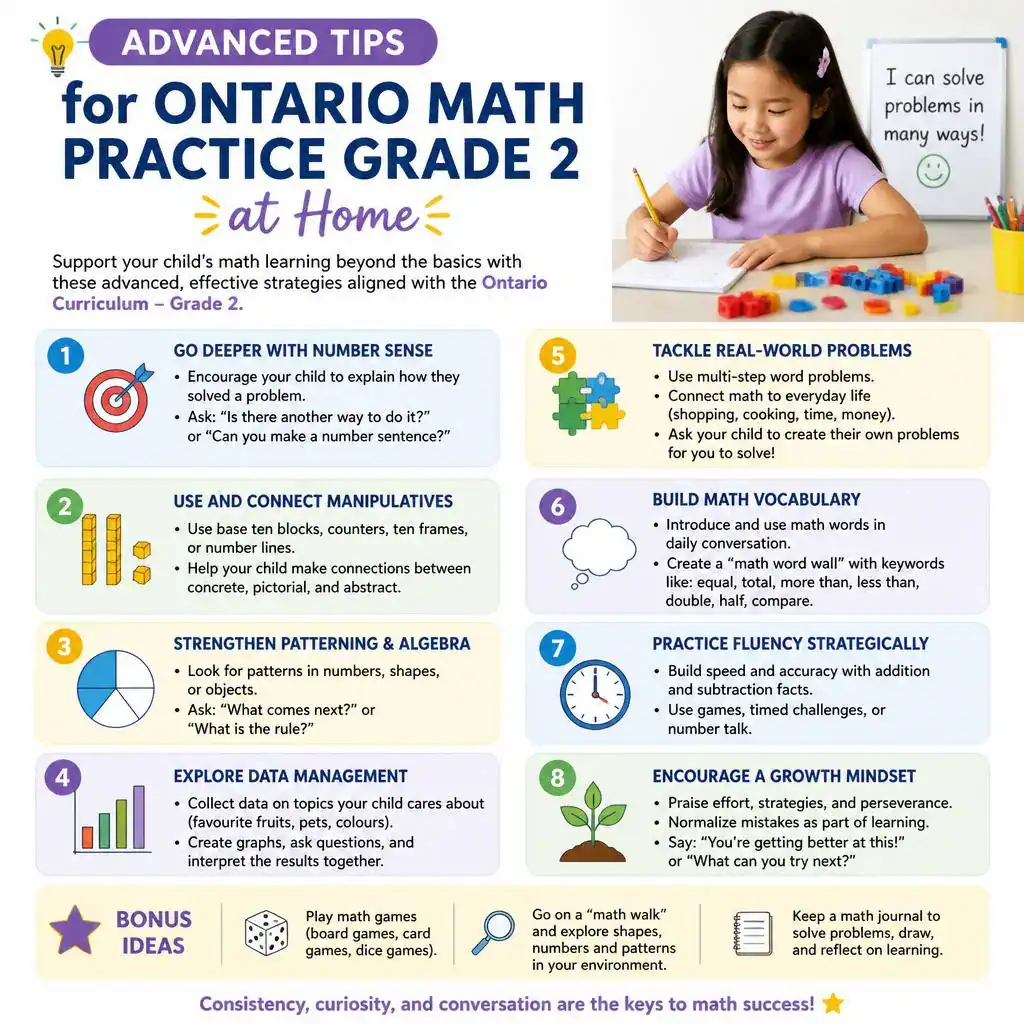
Differentiating Instruction
For advanced learners, introduce two-step problems or larger numbers. For those needing support, use more visuals and smaller steps.
Pros and Cons of Different Practice Methods:
| Method | Pros | Cons |
|---|---|---|
| Worksheets | Structured, easy tracking | Can feel repetitive |
| Games/Apps | Engaging, immediate feedback | Screen time concerns |
| Hands-on Projects | Deep understanding | Time-consuming to prepare |
Balance is key. Aim for 20-30 minutes daily.
Integrating Technology
While hands-on remains primary, apps aligned with Ontario curriculum offer adaptive practice. Combine with offline activities for best results.
Common Challenges in Grade 2 Math Ontario and How to Overcome Them
Many students struggle with regrouping in subtraction or telling time past the hour.
Solutions:
- Use concrete models before abstract symbols.
- Break down concepts with “I Do, We Do, You Do.”
- Celebrate small wins to build growth mindset.
A 2025 study on Canadian primary math noted consistent practice with real-world contexts reduces anxiety and improves outcomes by up to 40%.
Creating a Year-Long Ontario Math Practice Grade 2 Plan
Month 1-3 (Fall): Focus on numbers to 100, basic money recognition.
Month 4-6 (Winter): Introduce measurement, advanced addition/subtraction, financial scenarios.
Month 7-9 (Spring): Integrate all strands through projects like planning a class party (budgeting, measuring decorations, timing activities).
Month 10-12: Review and extension with Grade 2 math questions that combine topics.
Track with simple rubrics based on curriculum expectations.
Real-Life Applications: Why Ontario Math Practice Grade 2 Matters
Math isn’t just schoolwork—it’s life skills. Understanding money helps with allowance management. Measurement supports baking, building, and sports. These foundations prepare for STEM careers and informed citizenship.
Parents report children who master these early show greater confidence in problem-solving across subjects.
Conclusion
Ontario math practice Grade 2 in Numbers, Money, and Measurement lays the groundwork for lifelong success. By using engaging, curriculum-aligned methods, you empower your child to thrive. Start small today—grab some coins, a ruler, and begin exploring together.
FAQ: Ontario Math Practice Grade 2
1. What is the main focus of Ontario math practice Grade 2? The curriculum emphasizes number sense up to 200, financial literacy with Canadian currency, and measurement using standard units, all through problem-solving and real-life contexts.
2. How can I help with money math Grade 2 Ontario at home? Use real or play money for shopping simulations. Practice counting change and simple transactions daily.
3. Are there free worksheets for Grade 2 math Ontario? Yes, sites like OntarioMath.Support and teacher resource portals offer aligned materials. Search for specific strands.
4. How much daily practice is recommended? 15-30 minutes of quality practice is ideal, mixing hands-on and paper activities.
5. What if my child struggles with measurement? Start with non-standard units, progress to rulers, and use everyday objects. Visual aids help tremendously.
6. Does the 2026 curriculum differ much from previous years? Core expectations remain stable with continued emphasis on financial literacy and coding integration.
7. How do I assess progress in Grade 2 math questions? Observe problem-solving processes, use curriculum rubrics, and review portfolios of work.
8. Can games really improve math practice Grade 2 Canada? Absolutely. Games make practice fun, increasing motivation and retention according to educational research.