
Should My Child Repeat a Grade for Math Ontario? An Evidence-Based Guide
Short answer: In most cases, no — decades of educational research consistently show that grade retention rarely improves long-term academic outcomes and can carry social and emotional costs, which is why Ontario’s Ministry of Education and most school boards treat retention as a rare, carefully considered exception rather than a routine response to math struggles. Should My Child Repeat a Grade for Math Ontario parents ask this question about deserves a thoughtful, evidence-informed answer rather than a quick yes or no — this guide walks through what the research actually shows, how Ontario’s policy approaches retention, and the alternatives worth exploring first.
Key takeaways:
- Research on grade retention generally shows limited long-term academic benefit and potential social-emotional risks.
- Ontario schools use retention rarely and only after other interventions have been considered.
- Struggling specifically in math, without broader developmental concerns, is rarely addressed effectively by repeating an entire grade.
- Targeted interventions — tutoring, IEP accommodations, or a change in instructional approach — are generally recommended before considering retention.
Understanding Grade Retention Math Ontario Policy
Before weighing any specific decision, it helps to understand the broader landscape this decision sits within — which is exactly what the rest of this guide to Should My Child Repeat a Grade for Math Ontario families face is designed to walk through, step by step, starting with the policy context itself.
Grade retention math Ontario policy is governed by the Ministry of Education’s Growing Success assessment and evaluation framework, which emphasizes that promotion decisions should be based on a holistic view of a student’s development, not a single subject’s performance. Ontario’s general approach favors what’s sometimes called “social promotion with support” — moving a student forward with their same-age peers while providing additional academic support — over automatic retention based on academic struggles in one area.
This doesn’t mean retention never happens in Ontario — it does, in specific circumstances, particularly in the earliest grades and typically as a joint decision between parents, teachers, and school administration after other options have been considered. But it is treated as an exception requiring careful justification, not a default response to a report card showing math difficulty.

What the Research Actually Says About Holding a Child Back a Grade for Math Struggles
The question of holding child back a grade math struggles raises has been studied extensively over several decades, and the research consensus is more consistent than many parents realize.
Short-Term vs Long-Term Effects
Some studies show a modest short-term academic boost in the year immediately following retention — a retained student temporarily outperforms where they would have been in the next grade, since they’re repeating already-familiar material. However, multiple longitudinal studies have found this advantage frequently fades within two to three years as promoted peers catch up, while some research has linked retention to increased risk of later disengagement and higher dropout rates in high school.
Social and Emotional Considerations
Organizations including the National Association of School Psychologists in the United States have published position statements citing research associating grade retention with potential negative effects on self-esteem, peer relationships, and school engagement, particularly when a child is separated from their established social group. This is a significant consideration for elementary-age children, for whom peer relationships and social belonging are developmentally central.
Why Math-Specific Struggles Are a Special Case
Repeating an entire grade addresses every subject, not just the one causing difficulty. A child who is struggling specifically in math but performing at or above grade level in reading, writing, and other subjects may find that retention offers little benefit in the area of actual concern while introducing unnecessary disruption to areas where they were already succeeding.

Repeating a Grade Ontario Elementary: When It’s Actually Considered
Despite the general research picture, repeating a grade Ontario elementary schools do sometimes recommend it, typically in these more specific circumstances:
- Significant gaps across multiple subjects, not just math alone, suggesting broader developmental or foundational concerns.
- Very young students (Kindergarten or Grade 1) where an extra year of maturation, rather than academic remediation specifically, is the primary consideration.
- Extended absence or disrupted schooling (illness, family circumstances, or a significant gap in instruction) where a student has genuinely missed substantial foundational content.
- Parent and school agreement that the specific child’s needs are best served by additional time, following careful discussion and, ideally, input from a school psychologist or educational assessment.
Even in these situations, Ontario schools generally recommend exploring targeted support first, treating retention as a later-stage option rather than a first response.

The Math Struggles Grade Retention Decision: A Framework for Parents
If you’re facing the math struggles grade retention decision for your own child, here’s a structured way to think through it before assuming retention is the answer:
- Identify the specific nature of the struggle. Is it isolated to math, or part of a broader pattern? Is it related to a specific skill gap, a learning disability, or something else entirely (see InukMath’s guide on Math Anxiety vs Math Learning Disability for help distinguishing these)?
- Rule out or identify a learning difference. A formal psychoeducational assessment can clarify whether a specific learning disability, rather than general struggle, is driving the difficulty — and if so, retention typically isn’t the appropriate response; targeted support and accommodations through an IEP usually are.
- Explore targeted intervention first. Extra help sessions, a math tutor, summer learning programs, or a change in classroom accommodations often address a specific skill gap more directly and effectively than repeating an entire year.
- Weigh the social-emotional dimension seriously. Consider how your child would experience separation from their current peer group, and discuss this openly with them if they’re old enough to participate meaningfully in the conversation.
- Involve the school’s full team. A decision this significant benefits from input from the classroom teacher, the school principal, and where relevant, a school psychologist or special education resource teacher — not just a parent’s instinct alone.
Working through this framework with a level head, rather than reacting to a single difficult report card, is usually what leads to the most helpful outcome for your child regardless of what you ultimately decide.

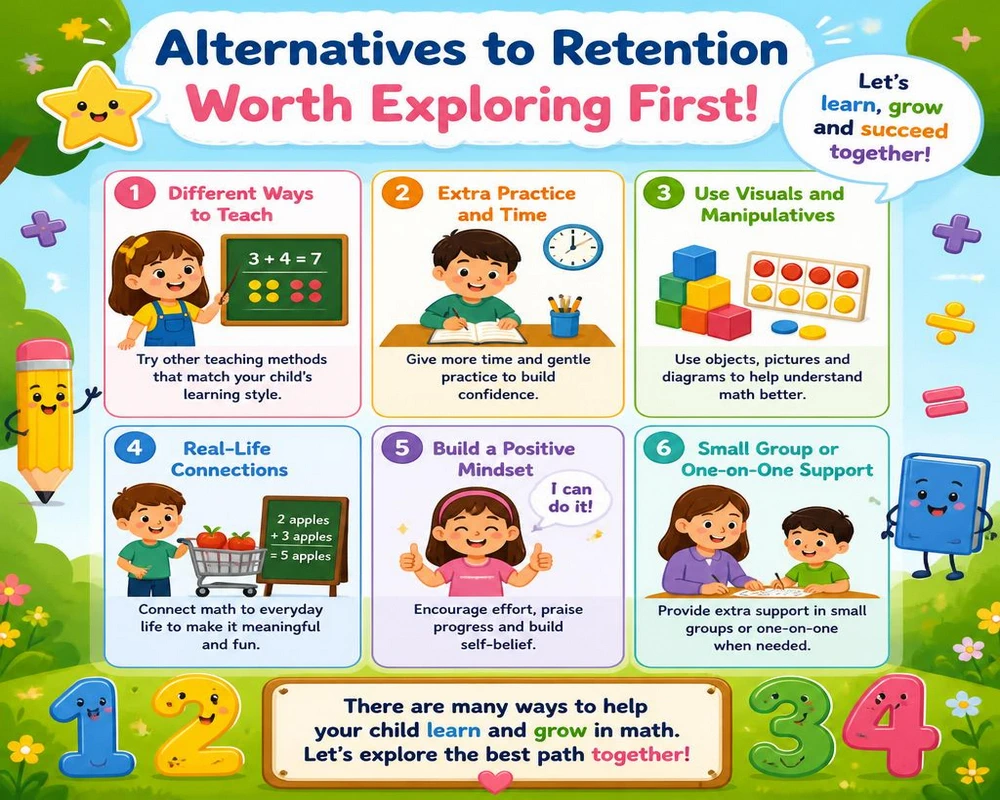
Alternatives to Retention Worth Exploring First
| Alternative | What It Involves | Best For |
|---|---|---|
| Targeted tutoring | One-on-one or small group instruction focused on specific skill gaps | Isolated skill gaps in an otherwise on-track student |
| IEP with accommodations | Formal plan with specific supports (extra time, modified assignments) | Students with an identified or suspected learning disability |
| Summer learning program | Focused review over the summer before the next grade | Students needing to consolidate specific foundational skills |
| In-class differentiation | Teacher-provided modified pacing or materials within the same classroom | Students who benefit from more time on a concept without repeating a full grade |
| Grade retention | Repeating the full grade with same-age content the following year | Rare cases involving multiple subject areas, very young students, or significant disrupted schooling |
Warning Signs vs Normal Struggle: A Practical Distinction
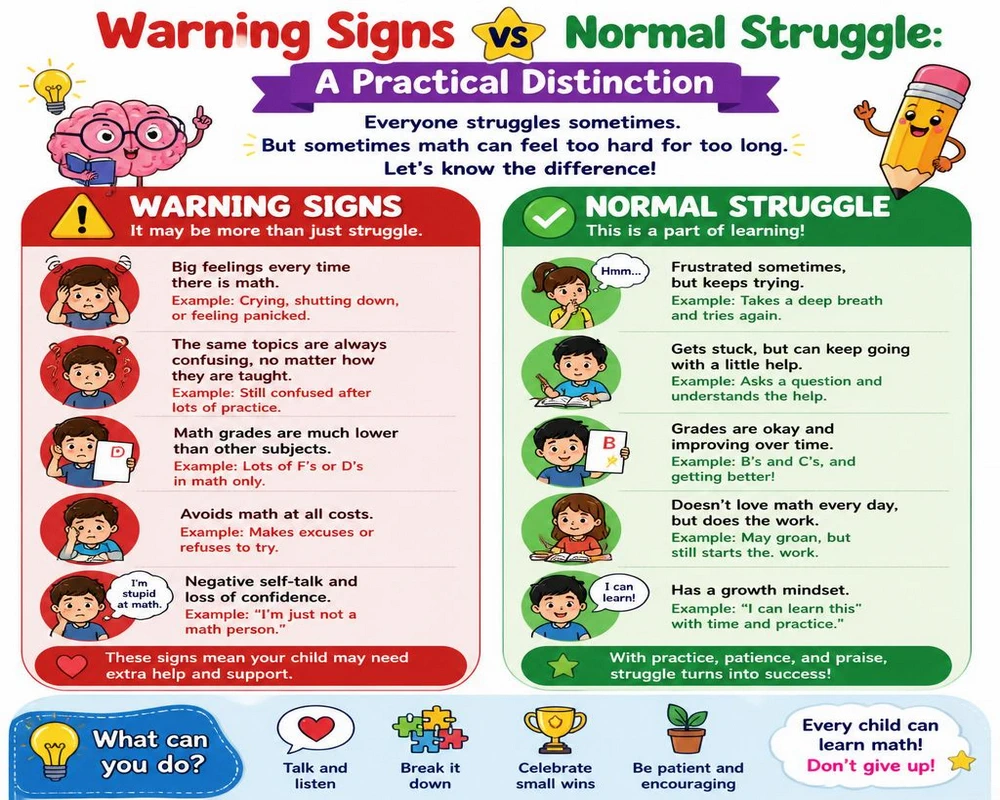
Part of what makes the Should My Child Repeat a Grade for Math Ontario question so stressful is uncertainty about whether a struggle is a normal part of learning or a sign of something more significant. A few distinctions that help:
Likely Normal Struggle
- Difficulty is limited to one or two specific topics (e.g., long division) rather than math broadly
- Performance improves with extra practice or a different explanation approach
- The struggle is new this year, not a long-standing pattern
Worth a Closer Look
- Difficulty spans most or all math topics consistently across the year
- Performance doesn’t improve despite consistent extra practice and support
- The pattern has persisted across multiple school years
- Math struggles are paired with similar difficulty in reading or other core subjects
The second list is where a more formal conversation about assessment, targeted intervention, or — in rare cases — retention becomes genuinely worth having with the school, rather than the first list, which usually responds well to more routine support.
How Ontario’s Approach to Retention Has Evolved
Ontario’s cautious approach to grade retention reflects a broader, decades-long shift in educational policy informed by accumulating research evidence. Through the 2010s and 2020s, the province’s Growing Success framework has increasingly emphasized differentiated instruction and targeted intervention within a student’s current grade as the preferred response to academic struggle, a trend consistent with policy directions in many other North American jurisdictions during the same period. This doesn’t mean retention has been eliminated as an option, but it reflects why Ontario teachers and administrators today are more likely to propose in-class support, tutoring, or an IEP before recommending retention as a first response to a math struggle specifically.

How to Talk to Your Child About This Decision
If retention does become a serious consideration, how it’s discussed with your child matters significantly for their emotional experience of the decision:
- Frame it in terms of building a stronger foundation, not punishment or failure.
- Involve your child’s own perspective and feelings in the conversation where age-appropriate.
- Maintain connections with current friends where possible, even after a grade change, to preserve some social continuity.
- Work with the school to plan a positive transition, including introducing the new classroom or teacher before the school year starts if possible.

What Other Ontario Parents Have Found Helpful
While every family’s situation is unique, a pattern shows up repeatedly among Ontario parents who have navigated a serious math struggle without resorting to retention: early, specific communication with the teacher, a willingness to pursue a formal assessment when a learning difference is suspected, and consistent, low-key practice at home focused on the specific skill gap rather than general “more math homework.” Families who successfully avoided the Should My Child Repeat a Grade for Math Ontario question altogether often credit catching the struggle early, in the first or second term, rather than waiting until report cards at year’s end forced the issue.

Frequently Asked Questions
Does Ontario have a formal grade retention policy?
Ontario’s Growing Success framework guides promotion and retention decisions, generally favoring promotion with additional support over retention, while leaving room for case-by-case decisions made jointly by parents and school staff in specific circumstances.
Is it common for Ontario students to repeat a grade because of math struggles alone?
No — retention based solely on struggles in one subject, particularly math, is relatively uncommon in Ontario’s current educational approach, which favors targeted support within the student’s current grade level.
What does the research say about the long-term effects of grade retention?
Most longitudinal research finds that any short-term academic benefit from retention tends to diminish over time, while some studies associate retention with increased risk of later disengagement, particularly when it occurs without addressing the underlying cause of the struggle.
Can a parent request grade retention for their child in Ontario?
Parents can raise the option and discuss it with the school, but the decision is generally a collaborative one involving the school’s professional judgment, not solely a parent’s unilateral choice, since it involves educational and developmental considerations beyond the family’s perspective alone.
What’s the difference between grade retention and an IEP?
Grade retention means repeating an entire grade year; an Individual Education Plan (IEP) provides specific accommodations or modifications within the student’s current, age-appropriate grade level — the two address struggles in fundamentally different ways.
Should I consider retention if my child is only struggling in math but doing fine elsewhere?
This scenario is generally considered a strong candidate for targeted math intervention rather than full-grade retention, since retention would affect subjects where the child is already succeeding without necessarily resolving the specific math gap.
How do I know if my child’s math struggle is serious enough to need intervention?
If the struggle persists for more than a few months despite typical classroom instruction, or is noticeably behind performance in other subjects, it’s worth raising with the teacher and considering a more formal evaluation of what specific support would help.
What’s the very first step if I’m genuinely considering the Should My Child Repeat a Grade for Math Ontario question?
Schedule a direct conversation with your child’s teacher to understand the specific nature and history of the struggle before assuming any particular solution — the teacher’s day-to-day observations are often the most useful starting data point.
Does grade retention affect a child’s confidence differently at different ages?
Younger children (Kindergarten to Grade 2) generally show less social-emotional disruption from retention than older elementary students, since peer group identity and social awareness of “being held back” become more pronounced with age.
Conclusion: A Decision That Deserves Care, Not Panic
If you’re asking Should My Child Repeat a Grade for Math Ontario schools recommend, the most important thing to know is that this decision — like most significant educational decisions — benefits from a calm, evidence-informed process rather than a fast, fear-driven choice. The research consistently points toward targeted, specific intervention as more effective than full retention for a struggle isolated to one subject, and Ontario’s own educational framework generally reflects that same evidence. Start by identifying exactly what’s driving the struggle, explore the alternatives in this guide with your child’s teacher, and treat retention as a option to weigh carefully alongside professional input, not a decision to make alone or in a hurry.
For related reading on identifying whether a math struggle reflects anxiety or a learning difference, see InukMath’s guide on Math Anxiety vs Math Learning Disability, and explore our grade-specific resources from Grade 1 Math Ontario through Grade 6 Math Ontario.