
Math Practice for Kids Who Struggle: A Parent Guide
There’s a particular kind of heartbreak in watching a bright, capable kid melt down over a worksheet full of addition problems. If you’ve lived through it — the tears at the kitchen table, the “I’m just bad at math” declarations, the homework battles that eat up your evenings — you already know that generic advice like “just practice more” doesn’t cut it. Effective math practice for kids who struggle looks nothing like the flashcard drills most of us grew up with. It’s slower, more strategic, and built around understanding why a child is stuck, not just what answer they got wrong.
I’ve spent years working with Ontario families and classroom teachers who are navigating exactly this challenge, and one thing has become clear: kids who struggle with math aren’t lacking intelligence — they’re usually missing a specific building block, and once that gap is found and filled, progress can happen surprisingly fast. This guide breaks down what actually works, grade by grade, using strategies grounded in the Ontario curriculum and real classroom experience. Whether your child is in Grade 1 just learning to count with meaning or in Grade 6 wrestling with fractions and ratios, you’ll find practical, usable guidance here.
Why Math Practice for Kids Who Struggle Looks Different
Struggling with math rarely means a child simply hasn’t practiced enough. More often, it means a foundational concept was missed somewhere along the way, and everything built on top of that gap feels shaky. Effective math help for struggling kids in Ontario starts with identifying exactly where that gap sits, rather than pushing forward with grade-level content the child isn’t ready to absorb yet.
Common Signs Your Child Is Struggling
Every child is different, but certain patterns show up again and again in classrooms and at home:
- Taking much longer than peers to complete basic calculations
- Avoiding math homework or becoming anxious before math class
- Relying heavily on finger-counting well past the grade where it’s expected
- Understanding a concept one day and seeming to “forget” it the next
- Strong verbal or reading skills paired with unexpected difficulty in numeracy
If several of these sound familiar, it’s worth stepping back and looking at foundational skills rather than assuming your child simply needs more repetition of grade-level work.
If a child’s struggle with math seems to go beyond ordinary frustration — persistent number reversals, extreme anxiety before math homework, or difficulty that doesn’t improve with practice — it may be worth exploring whether a learning difference like dyscalculia is at play. Learning Disabilities Association of Ontario’s LD@school offers free, practical resources for parents trying to understand what’s actually going on and how to support their child effectively.
What Ontario Curriculum Data Tells Us
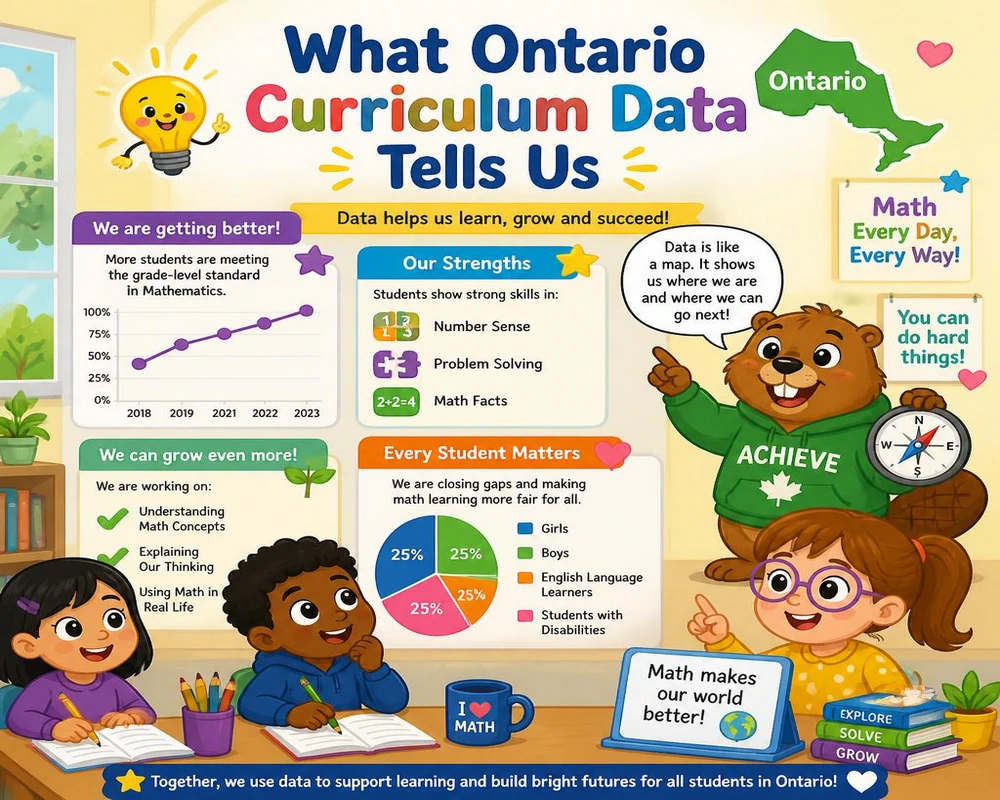
Provincial assessment data has consistently shown that a meaningful percentage of Ontario elementary students are not meeting the provincial standard in math, a trend that education researchers have flagged repeatedly between 2024 and 2026 as a priority area for intervention. What’s encouraging is that recent classroom research points to a clear pattern: students who receive targeted, small-group support in the specific skill they’re missing close gaps far faster than students given generic extra practice. This is the core idea behind good math difficulty Grade 1-6 intervention — precision matters more than volume.
Understanding Math Difficulty Grade 1-6: Age-by-Age Breakdown
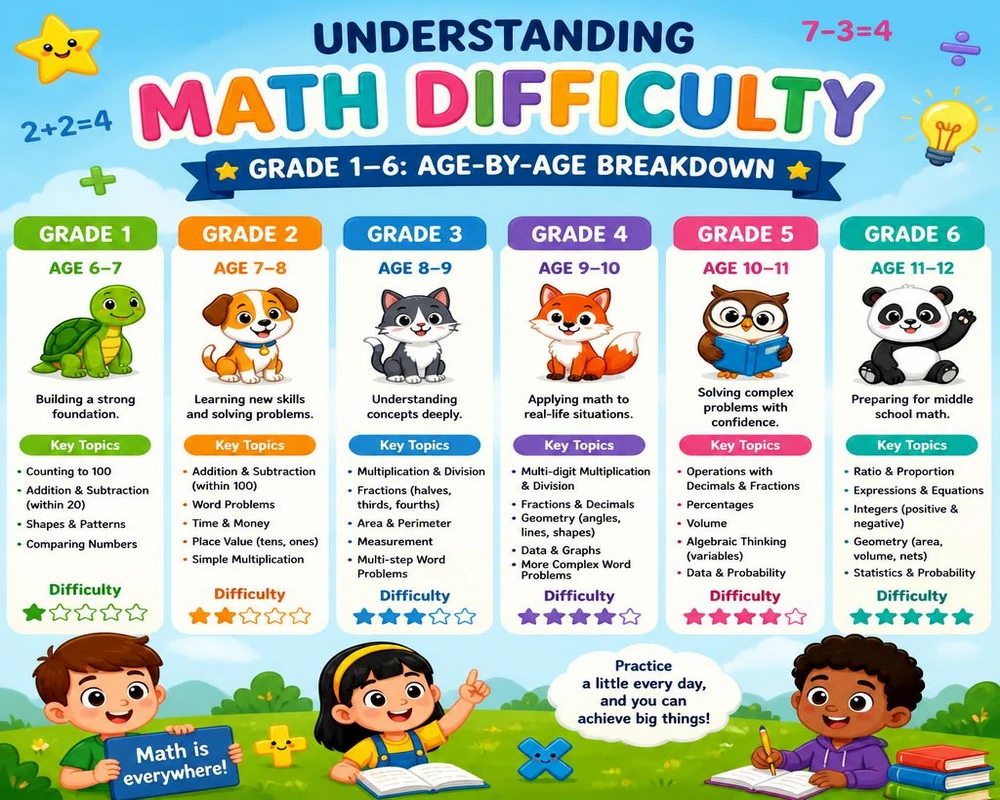
Math struggles look different depending on a child’s age, and the strategies that help shift significantly as kids move through elementary school.
Grades 1-3: Building Number Sense
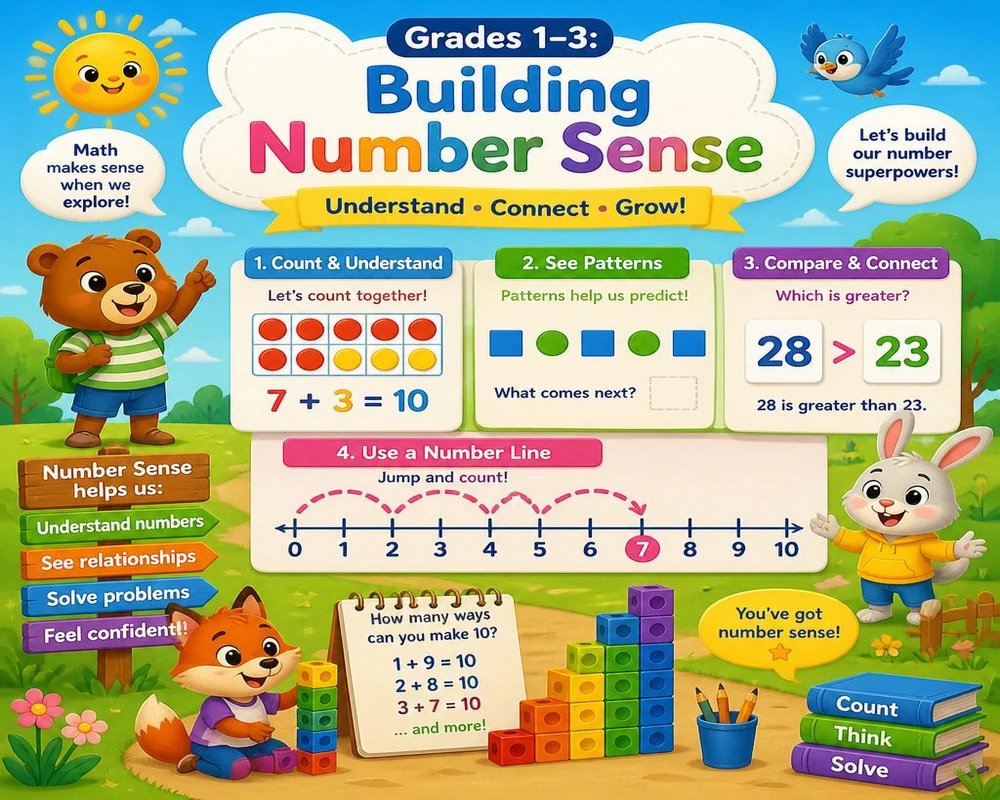
In the early grades, math difficulty Grade 1-6 issues usually trace back to number sense — a child’s intuitive feel for quantity, comparison, and the relationships between numbers. A student who hasn’t developed strong number sense might be able to recite counting sequences but struggle to understand that 7 is one more than 6, or that 10 can be broken into 4 and 6. At this stage, hands-on tools like counters, number lines, and ten-frames aren’t optional extras — they’re essential.
Grades 4-6: Bridging to Abstract Thinking
By Grade 4 through 6, the curriculum shifts toward more abstract reasoning: fractions, decimals, percentages, ratios, and multi-step word problems. This is often where previously “fine” students suddenly start struggling, because these topics demand a level of abstract thinking that can’t be faked with memorized procedures. A student who never truly understood place value in Grade 2, for instance, will likely hit a wall with decimals in Grade 5. Improve math skills Canada-wide research increasingly emphasizes revisiting these earlier foundations rather than simply re-teaching the current grade’s content louder and slower.
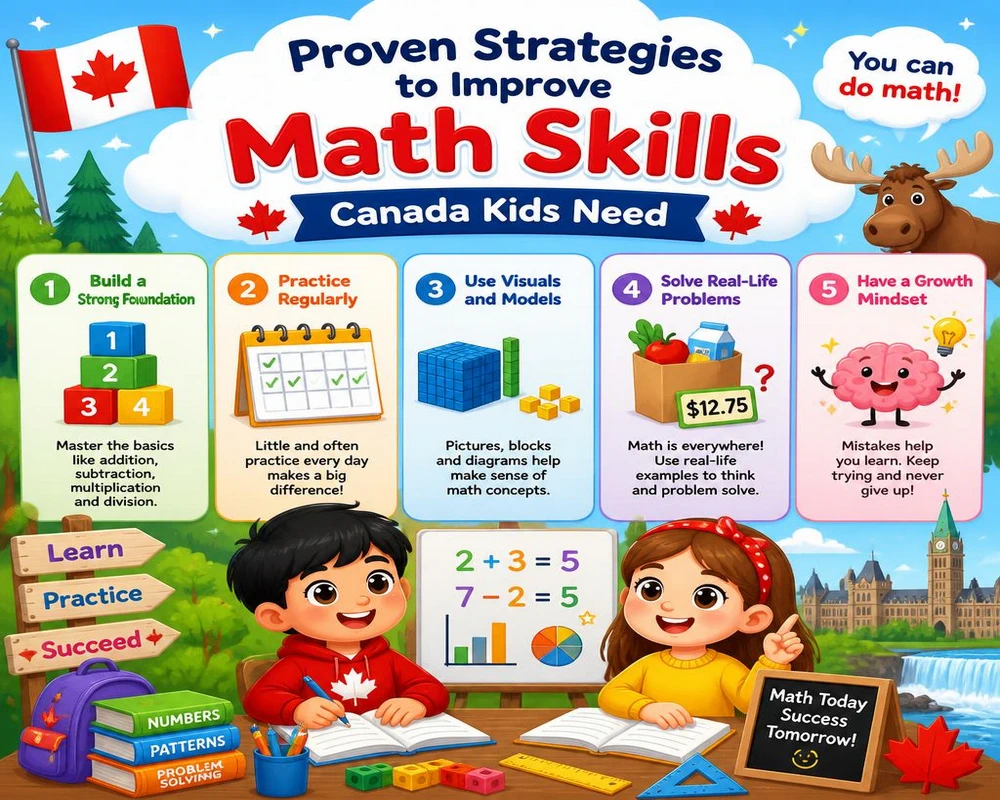
Proven Strategies to Improve Math Skills Canada Kids Need
Once you understand where the gap is, the next step is choosing strategies that actually close it — not just strategies that feel productive.
Multisensory Learning Techniques
Kids who struggle with abstract numbers often thrive when math becomes something they can touch, move, and see. Physical manipulatives — base-ten blocks, fraction tiles, dice, even everyday objects like buttons or coins — turn invisible math concepts into something concrete. Teachers who use multisensory approaches consistently report stronger retention among students who previously seemed “stuck,” and this aligns with broader research on how struggling learners process new information.
Breaking Problems into Small Steps
One of the most effective, and most underused, strategies is simply slowing down. Instead of presenting a full multi-step word problem, break it into its individual pieces: What is the question asking? What information do we already have? What’s the first small step? This approach reduces the cognitive load that often overwhelms struggling students and builds a habit of methodical thinking that pays off across every math topic.
The Role of Confidence and Mindset
It’s tempting to treat math struggles as a purely academic problem, but the emotional side matters just as much. A child who has decided “I’m bad at math” will often disengage before even attempting a problem, which compounds the original skill gap. Praising effort and strategy over speed and correctness — a shift supported by mindset research popularized by psychologist Carol Dweck and echoed in more recent Canadian classroom studies — helps rebuild the confidence struggling kids need to keep trying.
Math Support Elementary Ontario: Resources Parents Can Access
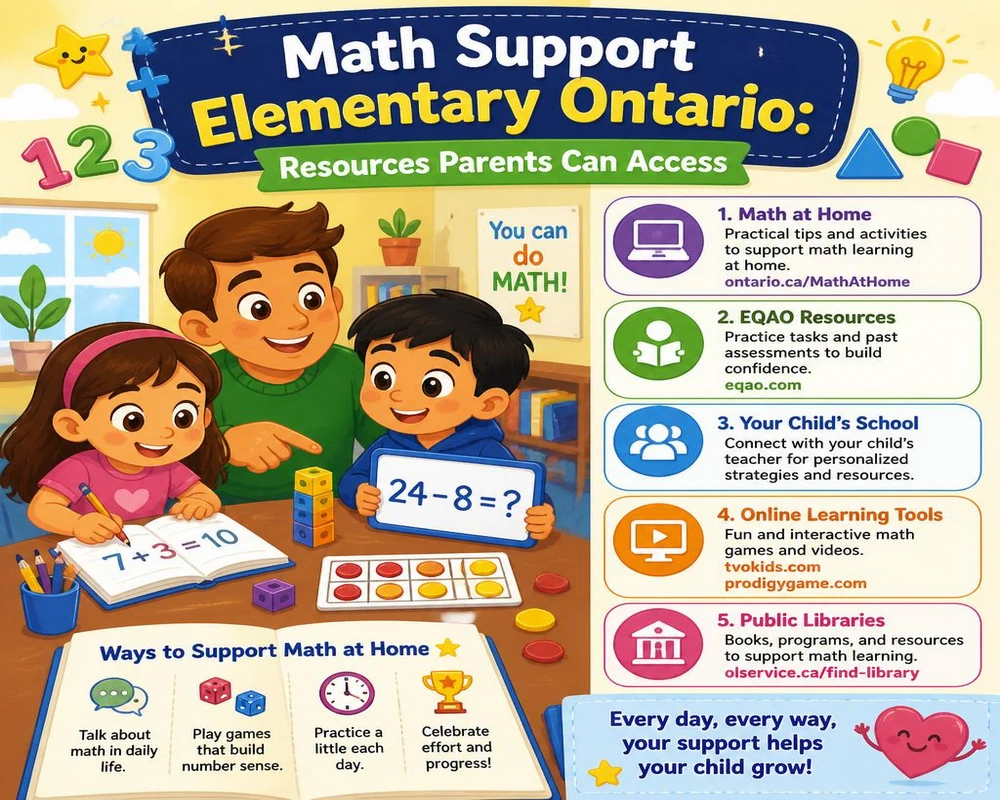
Parents don’t have to navigate this alone. Ontario offers a range of supports, both inside and outside the classroom, for families looking for math support elementary Ontario schools and communities provide.
In-School Supports
Most Ontario school boards offer some form of in-class or pull-out support for students who are behind grade-level expectations, often delivered by resource teachers or through small-group instruction. Parents can request an academic conversation with the classroom teacher to ask specifically what foundational skills are being targeted and how progress is being tracked. Don’t hesitate to ask for concrete examples of what’s being worked on — vague reassurances aren’t as useful as specifics.
At-Home Tools and Routines
Consistency at home makes a measurable difference. A few routines worth building:
- Short, daily sessions. Ten to fifteen minutes of focused practice most days of the week outperforms one long weekend session.
- Real-world math moments. Cooking, shopping, and even board games naturally reinforce number sense and problem-solving.
- Positive framing. Avoid language like “hurry up” or “this is easy” — it can increase anxiety rather than reduce it.
- Visual progress tracking. A simple sticker chart or checklist helps struggling kids see their own growth, which builds motivation.
When to Consider Tutoring
If gaps persist despite consistent effort at home and school, one-on-one tutoring — whether through a private tutor, a learning center, or a qualified older student — can provide the individualized pacing a busy classroom often can’t. The key is finding a tutor who focuses on understanding, not just answer-getting, and who communicates regularly with parents about specific skill progress.
Pros and Cons of Different Math Help Approaches
| Approach | Pros | Cons |
|---|---|---|
| In-school small group support | Free, curriculum-aligned, consistent | Limited availability depending on school resources |
| Private tutoring | Highly individualized, flexible pacing | Can be costly; quality varies widely |
| Online math programs | Convenient, often gamified and engaging | Can lack personalized diagnosis of specific gaps |
| Parent-led home practice | Builds routine, strengthens parent-child connection | Requires time and patience; parents may need guidance |
A Sample Weekly Practice Plan for Struggling Learners
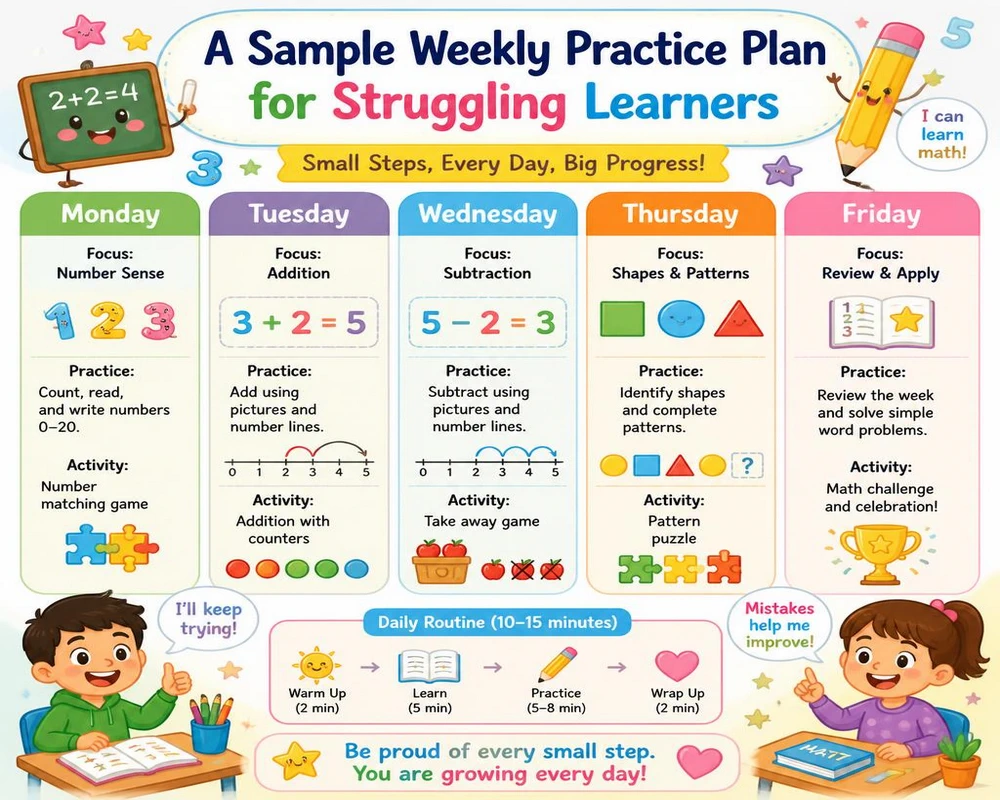
Structure removes decision fatigue and keeps practice sustainable. Here’s a simple weekly framework many Ontario families find manageable:
- Monday & Wednesday: 10-15 minutes reviewing a foundational skill gap (e.g., place value, basic facts)
- Tuesday & Thursday: 10-15 minutes of grade-level practice tied to current classroom topics
- Friday: A relaxed, game-based math activity to reinforce concepts without pressure
- Weekend: One real-world math activity, like cooking or shopping together
Working Effectively with Your Child’s Teacher
Parents often underestimate how much a short, well-prepared conversation with a teacher can change the trajectory of a struggling child’s year. Teachers see dozens of students every day, and while they’re trained to notice patterns, they can’t always dig deeply into every individual case without a nudge from home. Coming to a meeting with specific observations — “she can add two-digit numbers but freezes on word problems,” or “he seems fine with fractions on worksheets but can’t explain what a fraction actually means” — gives teachers something concrete to act on.
It also helps to ask direct questions rather than general ones. Instead of “how is my child doing in math,” try asking which specific expectation from the Ontario curriculum your child is currently working toward, and what skill would unlock the next step. Most teachers welcome this kind of engaged, specific curiosity, and it often leads to a more collaborative, targeted support plan than a vague check-in ever could.
Whatever grade your child is in, going back to fundamentals at a slower, more patient pace often makes the biggest difference. Our Ontario math practice platform breaks every grade level, from 1 through 6, into small, low-pressure lessons your child can revisit as many times as they need.
Moving Forward with Confidence
Every child who struggles with math today can become a confident math thinker tomorrow — but it takes the right kind of practice, not just more of it. By identifying the specific gap, using multisensory and step-by-step strategies, and pairing academic support with genuine encouragement, parents and teachers can turn around even long-standing math struggles. Start small this week: pick one foundational skill to revisit, spend ten focused minutes on it daily, and watch how quickly a little targeted attention begins to shift your child’s confidence. If you’re still seeing persistent struggle after a few weeks of consistent effort, reach out to your child’s teacher or a qualified tutor to get a clearer picture of exactly where the gap lies.
Frequently Asked Questions
1. How do I know if my child truly struggles with math or just needs more practice?
If your child understands a concept when it’s explained but can’t apply it independently, more practice may help. But if they seem confused by the concept itself even after multiple explanations, it’s likely a foundational gap that needs targeted attention rather than repetition.
2. What is the best math practice for kids who struggle with basic facts like addition and subtraction?
Short, frequent practice using visual tools like ten-frames or number lines tends to work better than timed drills, which can increase anxiety. Games that reinforce fact fluency in a low-pressure setting are also highly effective.
3. Is it normal for a child to struggle more in certain grades, like Grade 4 or 5?
Yes. Grades 4 through 6 introduce more abstract concepts like fractions and ratios, which often exposes gaps from earlier grades that weren’t as noticeable before. This is a common and predictable pattern, not a sign of a bigger problem.
4. How can I support math support elementary Ontario style at home without a teaching background?
You don’t need formal training — consistency and patience matter more. Use everyday activities like cooking and shopping, keep sessions short, and focus on effort and understanding rather than speed or correct answers.
5. When should I consider hiring a tutor for math difficulty Grade 1-6 concerns?
If your child continues to struggle despite consistent home and school support over several weeks, a tutor who specializes in diagnosing specific skill gaps can be a worthwhile investment.
6. Can math anxiety actually cause academic struggle, or is it just a symptom?
Both. Math anxiety can be a symptom of ongoing struggle, but it can also independently make it harder for a child to think clearly during math tasks, creating a cycle that needs to be addressed alongside the academic gap itself.
7. What role do online math programs play in helping struggling kids?
They can be a helpful supplement, especially for building fluency through repetition, but they generally can’t replace personalized diagnosis of specific gaps the way a teacher or tutor can.
8. How long does it typically take to improve math skills Canada kids struggle with?
It varies by child and the size of the gap, but many families see noticeable improvement in confidence and skill within six to eight weeks of consistent, targeted practice.