
How to Help Your Child with Math Ontario, Parent Guide Grade 1 to 6
Every parent wants to see their child succeed in school, but mathematics can sometimes feel overwhelming—for both children and adults. If you’ve ever wondered how to help your child with math Ontario, you’re certainly not alone. Thousands of Ontario parents ask the same question every year as they support their children’s learning from Grade 1 through Grade 6.
The good news is that you don’t need to be a math expert to make a significant difference. Research consistently shows that children perform better in mathematics when parents provide encouragement, create positive learning habits, and connect math to everyday life. Your attitude toward math can be just as important as the worksheets or homework your child completes.
This comprehensive Ontario parent math guide explains how to help your child with math Ontario using practical, evidence-based strategies aligned with the Ontario Mathematics Curriculum. Whether your child is just beginning to count in Grade 1 or tackling fractions and decimals in Grade 6, these techniques will help build confidence, improve understanding, and make learning math more enjoyable.
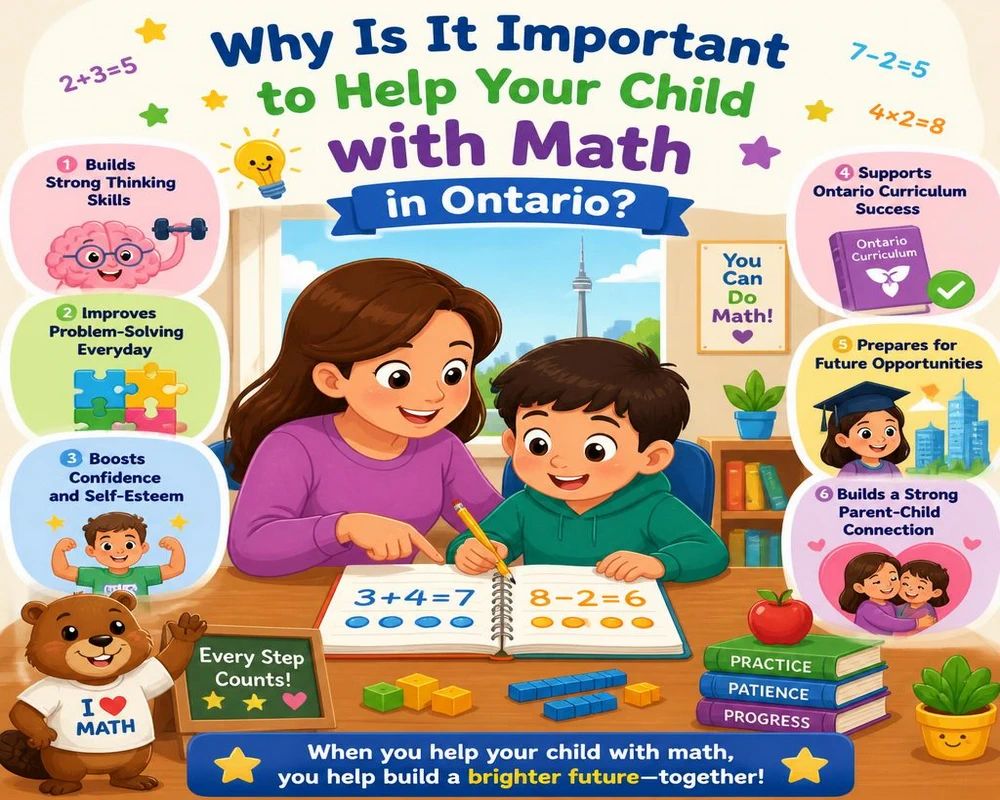
Why Is It Important to Help Your Child with Math in Ontario?
Quick Answer: Learning how to help your child with math Ontario gives children the confidence, problem-solving skills, and mathematical foundation they need for school and everyday life. Parent involvement is one of the strongest predictors of academic success.
Many parents believe mathematics is taught only in the classroom. In reality, children spend far more time at home than they do at school, making parents essential partners in the learning process.
Studies in education consistently show that children whose parents take an active interest in mathematics tend to:
- Develop stronger number sense.
- Feel more confident solving problems.
- Show greater persistence when work becomes challenging.
- Perform better on classroom assessments.
- Build positive attitudes toward mathematics.
Helping your child doesn’t mean sitting beside them for hours every evening. Often, short conversations, encouraging questions, and real-life math experiences have a greater impact than lengthy homework sessions.
Mathematics Is Everywhere
One of the easiest ways to help child math Canada is by showing that math exists beyond worksheets.
Children naturally use mathematics when they:
- Count money while shopping.
- Measure ingredients during cooking.
- Read clocks and calendars.
- Compare prices.
- Build with LEGO® bricks.
- Play board games.
- Keep score during sports.
- Estimate travel time.
When children recognize that math is useful in everyday life, they become more motivated to learn.
Building Confidence Matters More Than Perfection
One of the biggest barriers to success is math anxiety.
Children quickly notice when adults say things like:
- “I was never good at math.”
- “Math is too hard.”
- “I’m terrible with numbers.”
Although these comments may seem harmless, they can influence how children think about their own abilities.
Instead, try saying:
- “Let’s figure it out together.”
- “Mistakes help us learn.”
- “You’re improving every day.”
- “Show me how you solved it.”
Positive language encourages a growth mindset and helps children become resilient learners.
Key Takeaways
- Parent involvement improves math achievement.
- Everyday experiences provide valuable learning opportunities.
- Confidence grows through encouragement, not perfection.
- Small daily habits often produce the greatest long-term results.
Parental involvement in math doesn’t need to mean re-teaching the curriculum yourself — often it’s just about creating consistent, low-pressure opportunities to practice. People for Education, an independent Ontario-based research organization, publishes ongoing reports on what actually supports student achievement, including the specific role parents play at each grade level.
Understanding the Ontario Mathematics Curriculum
Quick Answer: Before learning how to help your child with math Ontario, parents should understand what children are expected to learn at each grade level. The Ontario Mathematics Curriculum focuses on conceptual understanding, reasoning, communication, and problem-solving.
Ontario schools emphasize understanding mathematical concepts rather than memorizing procedures.
Students are encouraged to explain their thinking, use multiple strategies, and connect mathematics to real-life situations.
The curriculum is organized into several interconnected strands, including:
- Number
- Algebra
- Data
- Spatial Sense
- Financial Literacy
- Social-Emotional Learning Skills in Mathematics
Rather than teaching isolated skills, teachers help students develop flexible mathematical thinking.
What Children Learn in Grades 1–6
| Grade | Main Learning Focus |
|---|---|
| Grade 1 | Counting, number sense, addition, subtraction, patterns |
| Grade 2 | Place value, mental math, measurement, data |
| Grade 3 | Multiplication, division, fractions, time |
| Grade 4 | Larger numbers, geometry, decimals, multiplication facts |
| Grade 5 | Fractions, decimals, volume, financial literacy |
| Grade 6 | Ratios, percentages, algebra, data analysis, problem-solving |
Understanding these expectations allows parents to provide age-appropriate support without creating unnecessary pressure.
Conceptual Understanding Comes First
A common misconception is that speed equals mathematical ability.
However, Ontario classrooms prioritize understanding over memorization.
For example, instead of simply memorizing that:
8 + 7 = 15
students explore multiple strategies, such as:
- Making ten.
- Counting on.
- Using doubles.
- Drawing models.
- Using manipulatives.
Children who understand why an answer works develop stronger long-term mathematical skills.
Key Takeaways
- The Ontario curriculum emphasizes understanding over memorization.
- Mathematical reasoning is just as important as correct answers.
- Parents should focus on learning, not speed.
How Do Children Learn Mathematics Best?
Quick Answer: Children learn mathematics most effectively through exploration, discussion, visual models, repetition, and meaningful real-world experiences.
Understanding how to help your child with math Ontario begins with recognizing that every child learns differently.
Some children are visual learners.
Others learn by moving, talking, building, or solving problems collaboratively.
Effective math instruction combines multiple learning approaches.
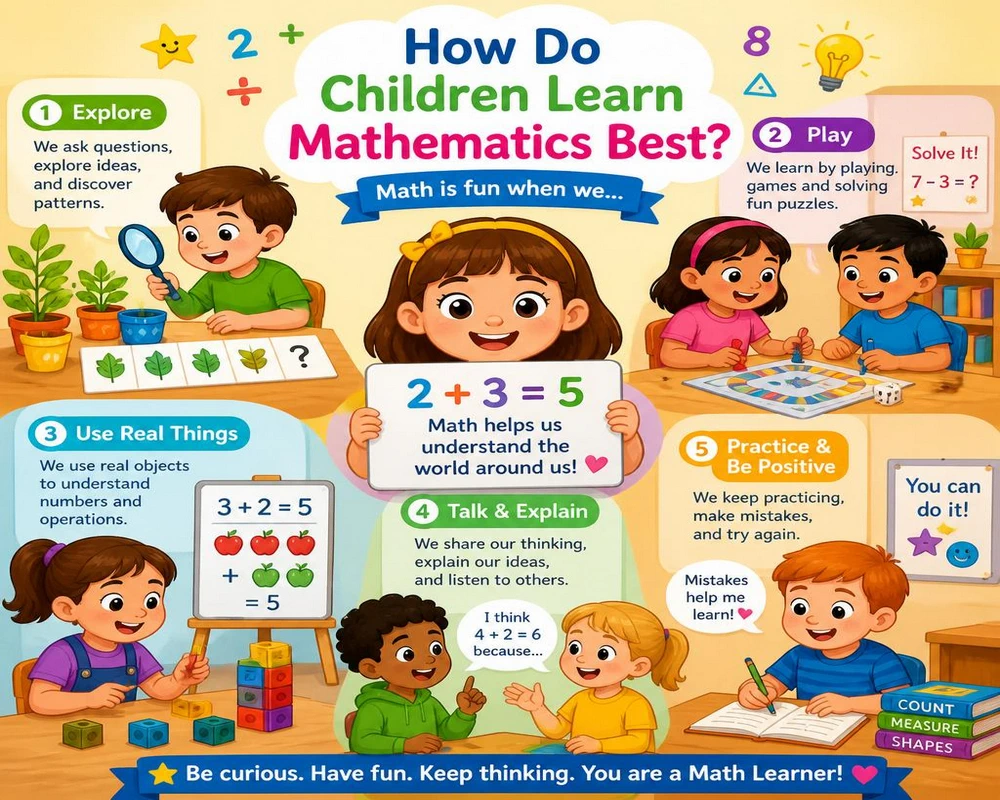
Learning Through Play
Young learners especially benefit from playful experiences.
Examples include:
- Board games
- Dice games
- Card games
- Puzzles
- Building blocks
- Tangrams
- Dominoes
- Math scavenger hunts
These activities develop logical thinking without feeling like formal lessons.
Visual Learning
Visual representations help children understand abstract concepts.
Useful tools include:
- Number lines
- Ten frames
- Base-ten blocks
- Fraction circles
- Hundreds charts
- Counters
- Pattern blocks
Visual models make mathematics concrete and easier to understand.
Learning by Talking
Encourage your child to explain their thinking.
Instead of asking only:
“What is the answer?”
Ask:
- Why?
- How did you know?
- Can you solve it another way?
- Which strategy worked best?
Talking about mathematics strengthens reasoning and communication skills.
Practice in Small Steps
Research suggests that 10–20 minutes of focused daily practice is generally more effective than one long weekly study session.
A balanced routine might include:
- Review yesterday’s learning.
- Practice one new skill.
- Play a short math game.
- Discuss one real-life math example.
Consistency builds confidence over time.
Key Takeaways
- Every child learns differently.
- Hands-on experiences improve understanding.
- Discussion strengthens reasoning.
- Short, regular practice is highly effective.
Create a Positive Math Environment at Home
Quick Answer: One of the best ways to learn how to help your child with math Ontario is by creating a home environment where mathematics feels enjoyable, safe, and relevant rather than stressful.
Children are more willing to tackle challenging problems when they know mistakes are part of learning.
Parents can support this by creating routines that encourage curiosity instead of fear.
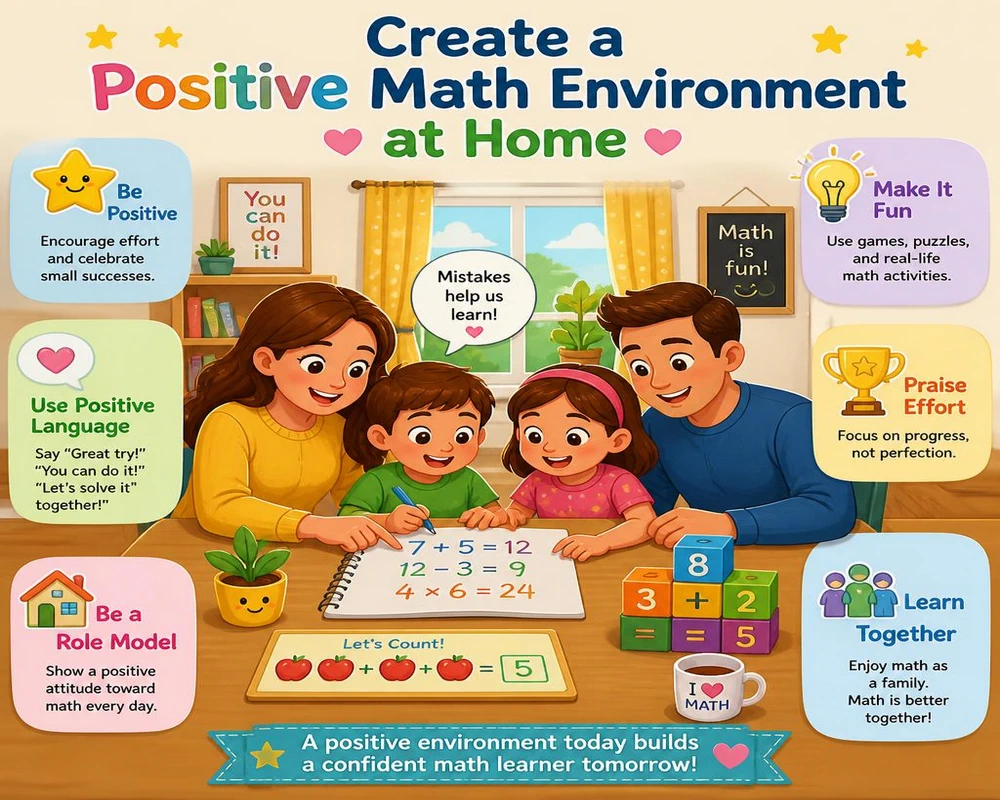
Celebrate Effort
Praise specific behaviors rather than natural ability.
Instead of:
“You’re so smart.”
Try:
- “I like how you kept trying.”
- “That was a creative strategy.”
- “You didn’t give up.”
- “You explained your thinking really well.”
This reinforces perseverance and a growth mindset.
Set Up a Math-Friendly Space
Create a small learning area with simple resources such as:
- Pencils
- Paper
- Number cards
- Dice
- Measuring cups
- Ruler
- Calculator (for exploration)
- Counters or LEGO® bricks
A dedicated space signals that learning is a regular part of family life.
Limit Pressure
Avoid turning every homework session into a test.
Instead:
- Ask questions.
- Offer hints.
- Encourage independent thinking.
- Take short breaks when frustration builds.
Children learn best when they feel supported rather than judged.
Daily Habits That Improve Math Skills
Quick Answer: If you’re wondering how to help your child with math Ontario, the most effective strategy is to build consistent daily math habits. Just 10–15 minutes of meaningful practice each day can significantly improve mathematical confidence and understanding.
Children don’t become strong mathematicians by completing occasional worksheets. Instead, they develop skills through frequent, enjoyable practice that fits naturally into everyday routines.
Parents often ask how to help without making math feel like extra homework. The answer is simple: make math part of daily life.

Start Every Day with a Math Question
A simple question can spark mathematical thinking.
Examples include:
- Which number comes after 48?
- What is half of 20?
- Which is greater: 37 or 43?
- How many minutes until dinner?
- If we buy three apples and two bananas, how many pieces of fruit do we have?
These quick conversations require only a few minutes but strengthen number sense every day.
Read Together Using Math Language
Many children’s books naturally include mathematical ideas.
While reading, ask questions such as:
- How many animals do you see?
- Which object is larger?
- Which shape is this?
- How many pages are left?
Combining literacy and mathematics strengthens both subjects simultaneously.
Encourage Mental Math
Mental math develops flexibility and confidence.
Instead of immediately reaching for paper, encourage children to think mentally.
Examples:
12 + 8
25 − 7
5 × 6
60 ÷ 10
As children grow older, gradually increase the level of challenge.
Celebrate Small Successes
Learning mathematics is a journey.
Celebrate milestones such as:
- Learning multiplication facts
- Counting confidently
- Solving a difficult problem
- Explaining a strategy clearly
Positive reinforcement encourages children to continue learning.
Daily Math Routine Example
| Time | Activity |
|---|---|
| 5 minutes | Review yesterday’s learning |
| 5 minutes | Practice one new concept |
| 5 minutes | Play a math game |
| 5 minutes | Discuss a real-life math example |
Key Takeaways
✔ Short daily practice is highly effective.
✔ Build math into everyday routines.
✔ Praise effort and perseverance.
✔ Focus on understanding rather than speed.
Grade-by-Grade Parent Strategies (Grades 1–6)
Quick Answer: Knowing how to help your child with math Ontario means adjusting your support to match your child’s developmental stage. Each grade introduces new mathematical ideas while reinforcing previous learning.
Grade 1
Children focus on:
- Counting
- Number sense
- Addition
- Subtraction
- Patterns
Parents can help by:
- Counting household objects
- Playing number games
- Reading number books
- Using number lines
- Practicing simple addition with toys
Grade 2
Students begin learning:
- Place value
- Mental math
- Measurement
- Money
- Time
Helpful activities include:
- Counting coins
- Measuring ingredients
- Reading clocks
- Estimating lengths
- Comparing numbers
Grade 3
Children explore:
- Multiplication
- Division
- Fractions
- Area
- Perimeter
Parents can support learning by:
- Using arrays with LEGO® bricks
- Sharing food equally
- Measuring rooms
- Playing multiplication games
Grade 4
Students expand their understanding of:
- Large numbers
- Multi-digit multiplication
- Decimals
- Geometry
Activities include:
- Reading large numbers
- Comparing prices
- Measuring household objects
- Exploring maps
Grade 5
Grade 5 introduces:
- Fractions
- Decimals
- Volume
- Financial literacy
Real-life experiences include:
- Grocery budgeting
- Measuring recipes
- Comparing discounts
- Calculating change
Grade 6
Students investigate:
- Ratios
- Percentages
- Algebraic thinking
- Data analysis
Parents can encourage:
- Budget planning
- Sports statistics
- Simple spreadsheets
- Real-world problem solving
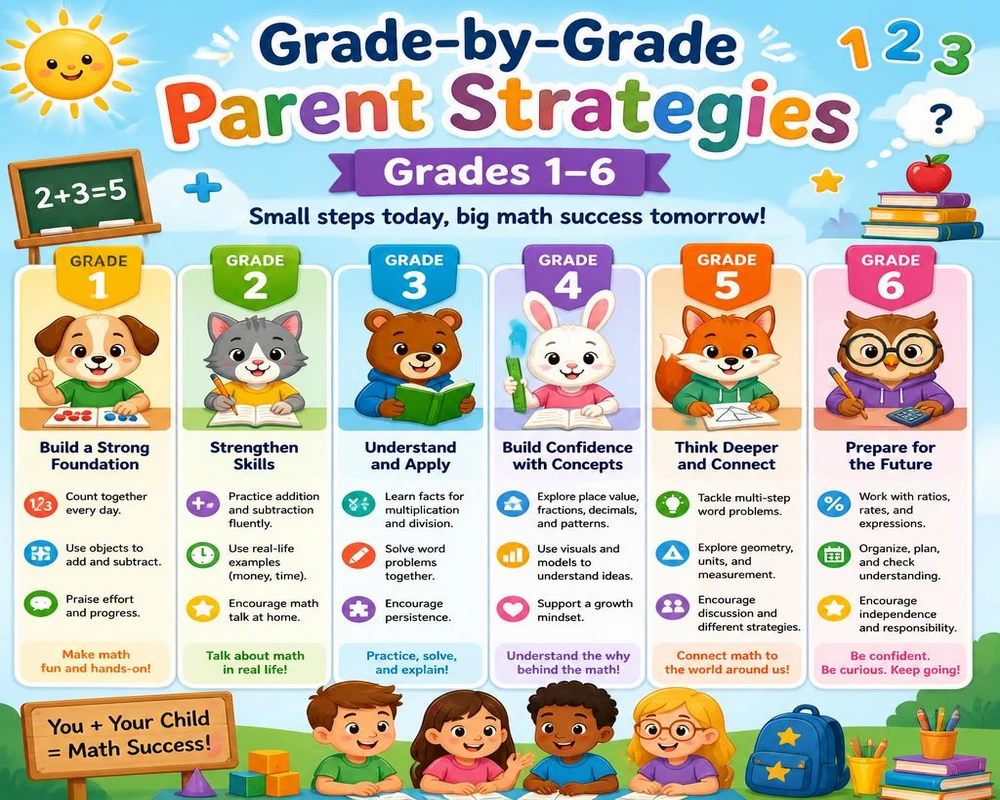
Comparison Table
| Grade | Main Focus | Parent Activity |
|---|---|---|
| 1 | Number Sense | Counting games |
| 2 | Place Value | Coin counting |
| 3 | Multiplication | LEGO arrays |
| 4 | Decimals | Shopping activities |
| 5 | Fractions | Cooking together |
| 6 | Percentages | Budget planning |
Key Takeaways
✔ Support should match your child’s grade level.
✔ Connect mathematics to everyday experiences.
✔ Build confidence before increasing difficulty.
Common Mistakes Parents Make When Helping with Math
Quick Answer: Even with the best intentions, parents sometimes use strategies that reduce confidence instead of building it. Understanding these mistakes is an important part of learning how to help your child with math Ontario effectively.

Focusing Only on Correct Answers
Mathematics isn’t just about getting the right answer.
The thinking process matters.
Ask:
“How did you solve it?”
rather than only:
“Is it correct?”
Teaching Different Methods Too Early
Parents often teach the methods they learned in school.
However, Ontario classrooms sometimes use different strategies that emphasize conceptual understanding.
Instead of replacing classroom methods, ask your child to explain what they learned at school.
This reinforces consistency and reduces confusion.
Comparing Children
Avoid statements such as:
- “Your brother was faster.”
- “Your friend already knows this.”
Every child learns at a different pace.
Comparison often increases anxiety rather than motivation.
Expecting Perfection
Mistakes are essential for learning.
When children make errors, treat them as opportunities for discussion.
Ask:
“What can we learn from this?”
instead of immediately correcting every mistake.
Doing the Homework
Helping is valuable.
Doing the work for your child is not.
Instead:
- Ask guiding questions.
- Offer hints.
- Encourage independent thinking.
This develops long-term problem-solving skills.
Common Mistakes Table
| Mistake | Better Approach |
|---|---|
| Giving answers immediately | Ask guiding questions |
| Focusing only on speed | Focus on understanding |
| Comparing children | Celebrate individual progress |
| Teaching outdated methods | Support classroom strategies |
| Expecting perfection | Encourage learning from mistakes |
Key Takeaways
✔ Encourage thinking.
✔ Build confidence.
✔ Support rather than solve.
✔ Respect your child’s learning pace.
Technology and Digital Tools for Math Learning
Quick Answer: Technology can be a powerful supplement when parents understand how to help your child with math Ontario by choosing high-quality, curriculum-aligned resources. Digital tools should enhance—not replace—hands-on learning.
Educational technology has transformed how children practice mathematics. Interactive games, adaptive quizzes, and visual simulations can make learning more engaging while providing immediate feedback.
However, not all apps are equally effective. The best digital resources encourage children to think, explain, and solve problems rather than simply tap the correct answer.

What to Look for in a Good Math Resource
Choose tools that:
- Align with the Ontario curriculum.
- Adapt to your child’s skill level.
- Encourage reasoning and problem-solving.
- Provide instant, constructive feedback.
- Include visual models and interactive activities.
- Track progress over time.
Avoid apps that rely only on repetitive drills or excessive rewards without building conceptual understanding.
Balance Screen Time with Hands-On Learning
Digital learning works best when combined with real-world experiences.
For example:
- Use an app to practice multiplication.
- Then build multiplication arrays with blocks.
- Practice fractions digitally.
- Then measure ingredients while cooking.
- Learn geometry online.
- Then identify shapes around your home.
Children retain concepts more effectively when they experience mathematics in multiple ways.
Suggested Technology Routine
A balanced daily routine might include:
- 10 minutes: Interactive math app
- 10 minutes: Hands-on activity
- 10 minutes: Real-life math conversation
- 5 minutes: Review or reflection
This combination supports both engagement and deep understanding.
Key Takeaways
✔ Choose curriculum-aligned digital resources.
✔ Combine technology with hands-on activities.
✔ Encourage discussion about what your child learns.
✔ Quality matters more than screen time.
Expert Tips to Help Your Child Succeed in Math
Quick Answer: If you truly want to know how to help your child with math Ontario, focus on developing mathematical thinking rather than memorizing procedures. The goal is to raise confident problem-solvers, not simply children who can complete worksheets.
Experienced educators agree that children learn mathematics best when they understand why something works—not just how to get the answer.
Below are evidence-based strategies recommended by mathematics educators and supported by current educational research.
Encourage a Growth Mindset
Children who believe they can improve through practice are more likely to persevere when math becomes challenging.
Instead of saying:
- “You’re good at math.”
Try saying:
- “You worked hard on that problem.”
- “Your strategy was creative.”
- “I like how you kept trying.”
- “Mistakes help your brain grow.”
This simple change encourages resilience and confidence.
Ask Open-Ended Questions
Rather than immediately correcting mistakes, encourage children to think.
Examples include:
- Why do you think that answer makes sense?
- Can you solve it another way?
- How would you explain it to a friend?
- What pattern do you notice?
- What happens if we change one number?
These conversations strengthen reasoning and communication skills.
Connect Math to Everyday Life
One of the most effective ways to practice how to help your child with math Ontario is by showing children that mathematics is useful every day.
Examples include:
- Estimating grocery costs
- Measuring ingredients while cooking
- Comparing prices during shopping
- Reading schedules
- Planning travel time
- Organizing sports statistics
- Budgeting allowance
- Measuring furniture before buying it
Children become more motivated when mathematics has a meaningful purpose.
Encourage Independent Problem Solving
When children struggle, avoid solving the problem immediately.
Instead:
- Give hints.
- Ask guiding questions.
- Encourage different strategies.
- Allow thinking time.
Developing independence is more valuable than finishing homework quickly.
Key Takeaways
✔ Build confidence before speed.
✔ Praise effort and persistence.
✔ Encourage reasoning.
✔ Connect math to everyday life.
✔ Let children think independently.
How Can Parents Monitor Their Child’s Progress?
Quick Answer: Parents don’t need formal tests to evaluate progress. Regular conversations and everyday activities often reveal whether children truly understand mathematical concepts.
Observe how your child approaches problems rather than focusing only on correct answers.
Ask questions like:
- Can you explain your thinking?
- Can you solve it differently?
- Why did you choose that strategy?
Understanding the reasoning process is often more important than the final answer.
Monthly Math Checklist
Use this checklist to monitor progress.
Number Sense
☐ Counts confidently
☐ Understands place value
☐ Compares numbers
☐ Estimates quantities
Operations
☐ Uses mental math
☐ Solves age-appropriate addition
☐ Solves subtraction accurately
☐ Understands multiplication concepts (older grades)
Problem Solving
☐ Explains reasoning
☐ Uses diagrams
☐ Checks answers
☐ Tries different strategies
Confidence
☐ Enjoys math activities
☐ Attempts challenging problems
☐ Doesn’t give up easily
☐ Asks thoughtful questions
Reviewing this checklist every few weeks helps identify strengths and areas for additional support.
Why Positive Parent Attitudes Matter
Quick Answer: Children often adopt the same attitude toward mathematics that they observe at home. A positive learning environment can significantly influence confidence and long-term achievement.
Research consistently shows that children notice how adults react to mathematics.
Parents who say:
- “Let’s solve it together.”
usually raise children who approach challenges with confidence.
Parents who frequently say:
- “I’m terrible at math.”
may unintentionally increase children’s anxiety.
Fortunately, changing your language is easy.
Instead of focusing on ability, focus on progress.
Celebrate:
- Persistence
- Curiosity
- Improvement
- Creative thinking
This creates a healthy mathematical mindset.
Every grade brings its own math challenges, from counting and addition in the early years to fractions, algebra, and financial literacy by Grade 6. Our Ontario math practice blog covers grade-specific strategies and practice questions for each of these stages, so you can find guidance tailored to exactly where your child is right now.
Frequently Asked Questions
1. How can I help my child with math if I’m not good at math?
You don’t need to be a math expert. Your encouragement, curiosity, and willingness to learn alongside your child are often more valuable than knowing every answer. Ask questions, explore strategies together, and use reliable curriculum-aligned resources when needed.
2. How much math practice should my child do each day?
Most elementary students benefit from 10–20 minutes of focused daily practice. Short, consistent sessions are generally more effective than occasional long study periods.
3. Should I correct every mistake?
No.
Mistakes are valuable learning opportunities.
Instead of immediately correcting errors, ask your child to explain their thinking and identify where their reasoning changed.
4. What if my child dislikes math?
Start with enjoyable, low-pressure activities.
Games, puzzles, cooking, shopping, sports statistics, and building projects all demonstrate that mathematics is useful and enjoyable.
5. Should I use worksheets every day?
Worksheets can reinforce skills, but they should be balanced with games, discussions, visual models, and real-world problem solving.
6. How do I know whether my child is meeting Ontario expectations?
Review your child’s classroom work, report cards, and teacher feedback. You can also compare their progress with the learning expectations outlined in the Ontario Mathematics Curriculum and observe how confidently they apply mathematical concepts in everyday situations.
7. What are the best resources for supporting math learning at home?
Choose high-quality resources that align with the Ontario curriculum, provide clear explanations, include interactive practice, and encourage conceptual understanding rather than rote memorization.
8. What’s the most important thing parents can do?
Create a positive environment where mistakes are welcomed, curiosity is encouraged, and mathematics becomes part of everyday family life.
Conclusion
Learning how to help your child with math Ontario isn’t about becoming a professional mathematics teacher—it’s about becoming your child’s biggest supporter.
By creating positive routines, encouraging curiosity, asking thoughtful questions, and connecting mathematics to everyday experiences, parents can make an enormous difference in their child’s academic journey.
Every conversation while grocery shopping, every board game played together, every recipe measured in the kitchen, and every encouraging word contributes to stronger mathematical thinking.
Remember that confidence develops gradually. Celebrate progress, embrace mistakes as opportunities to learn, and focus on understanding instead of perfection.
When children feel supported at home and challenged appropriately at school, they are far more likely to develop the problem-solving skills, resilience, and confidence they need—not only for mathematics but for lifelong learning.
Whether your child is just beginning Grade 1 or preparing for Grade 6, your involvement today can have a lasting impact on their future success.