
How Much Math Practice Per Week? 3 Honest Factors
Search “how much math practice per week” and every result gives a confident, specific number — fifteen minutes, twenty minutes, thirty minutes, take your pick. None of them are lying exactly, but none of them are being fully honest either. The real answer to how much math practice per week a child needs depends on three things that have nothing to do with a stopwatch: what’s happening in class right now, how the child is actually doing, and what the practice sessions actually look like.
This guide skips the fake-precise number and walks through the three factors that actually determine how much math practice per week makes sense for your specific child, plus the warning signs that tell you when to adjust up or down.
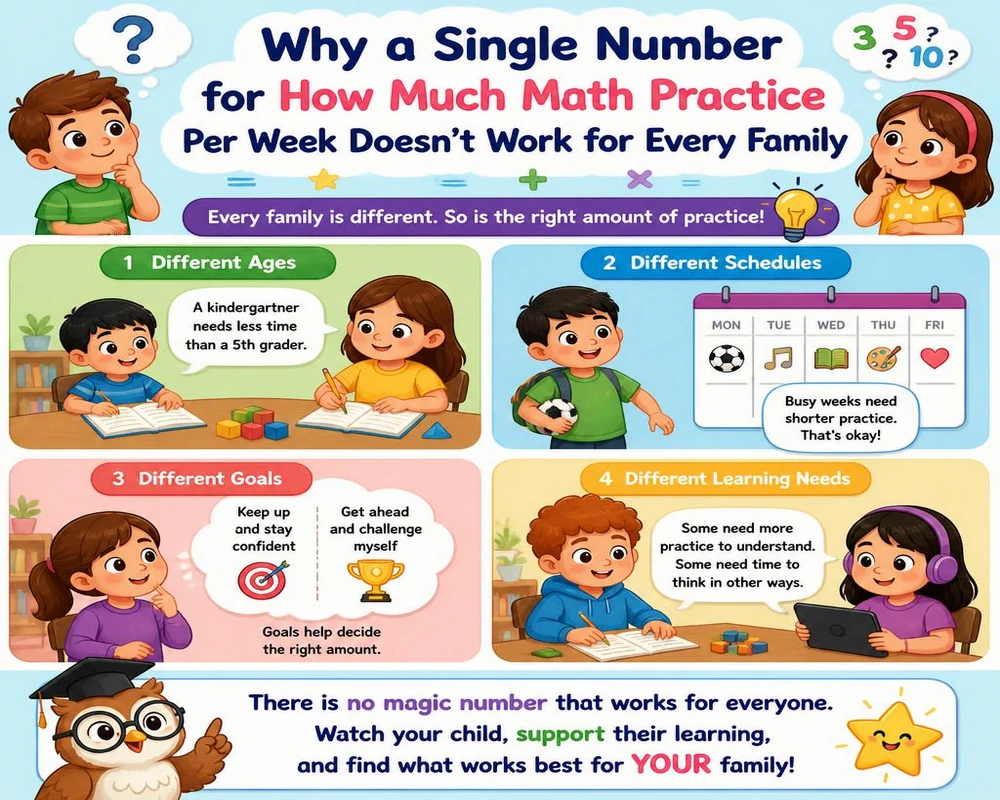
Why a Single Number for How Much Math Practice Per Week Doesn’t Work for Every Family
A child who’s confidently meeting grade expectations and a child who’s genuinely behind need very different amounts of practice, even in the same grade, same class, same week. Treating “how much math practice per week” as one universal number ignores this completely, and it’s exactly why so many families either over-schedule a child who’s already doing fine, or under-practice a child who’s genuinely struggling.
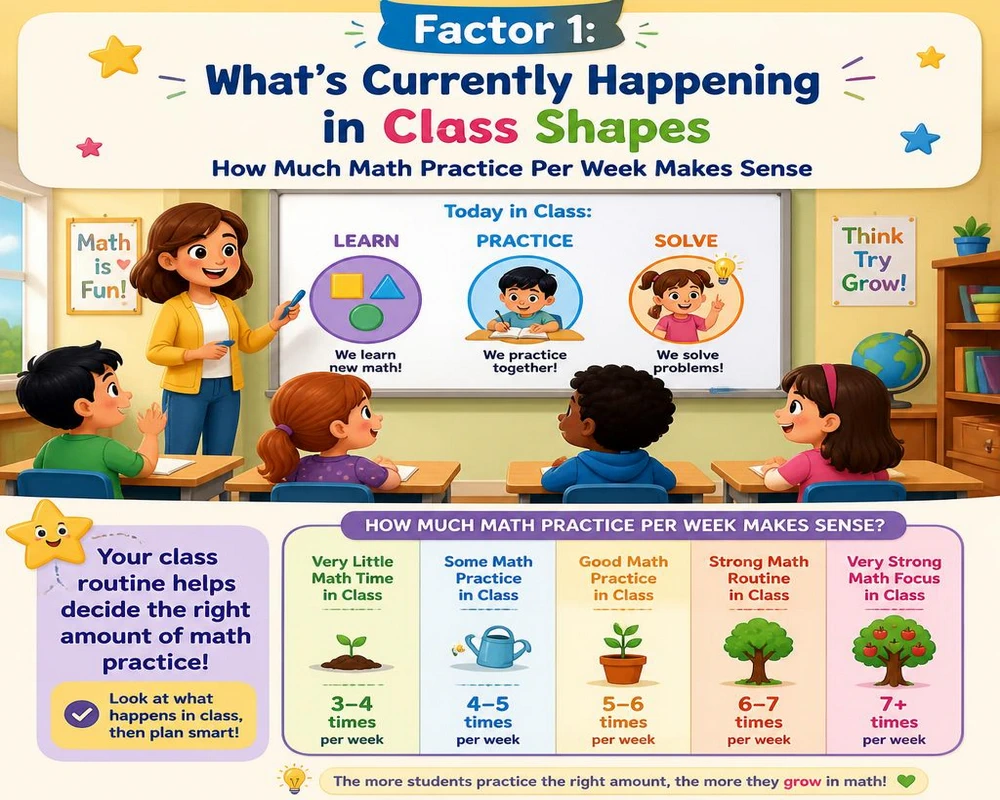
Factor 1: What’s Currently Happening in Class Shapes How Much Math Practice Per Week Makes Sense
New Concept Weeks Need More Reinforcement
When a class is midway through introducing long division or fraction operations, extra practice time at home genuinely helps cement a concept that’s still fresh and shaky. This is when leaning toward the higher end of any weekly range makes sense.
Review Weeks Need Far Less
If a class is simply reviewing before a unit test on material a child already understands well, piling on extra practice adds little value and risks turning math into a chore rather than something the child engages with willingly.
Ask the Teacher What’s Coming Up
A quick question about the next few weeks of the class schedule lets home practice actually align with what’s being taught, rather than guessing at what might be relevant.
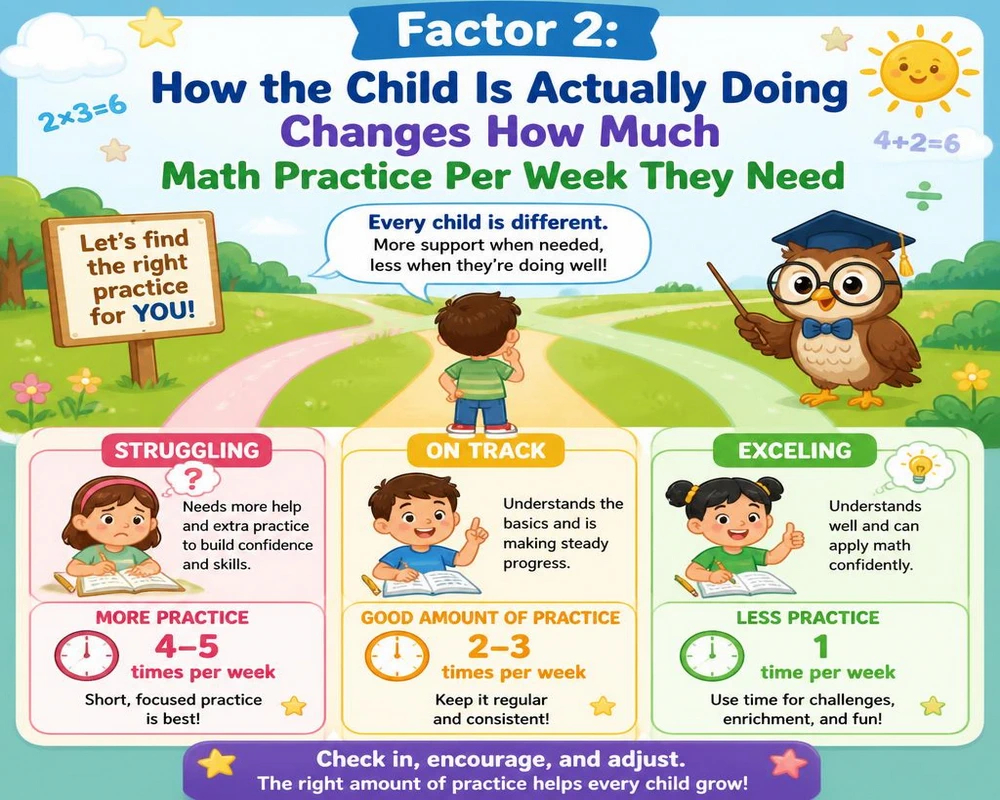
Factor 2: How the Child Is Actually Doing Changes How Much Math Practice Per Week They Need
Meeting Grade Expectations
A child comfortably meeting Ontario’s grade-level standard typically benefits from shorter, more occasional practice — enough to stay sharp, without turning into unnecessary repetition of material that’s already solid.
Approaching or Below Grade Expectations
A child who’s genuinely behind benefits from more frequent, shorter sessions rather than occasional long ones. Five focused sessions of ten minutes tend to build more lasting skill than one exhausting fifty-minute Sunday session.
Ahead of Grade Expectations
A child who’s already ahead doesn’t necessarily need more time — they often need more challenging material within the same amount of time, since simply repeating easy problems builds boredom more than skill.
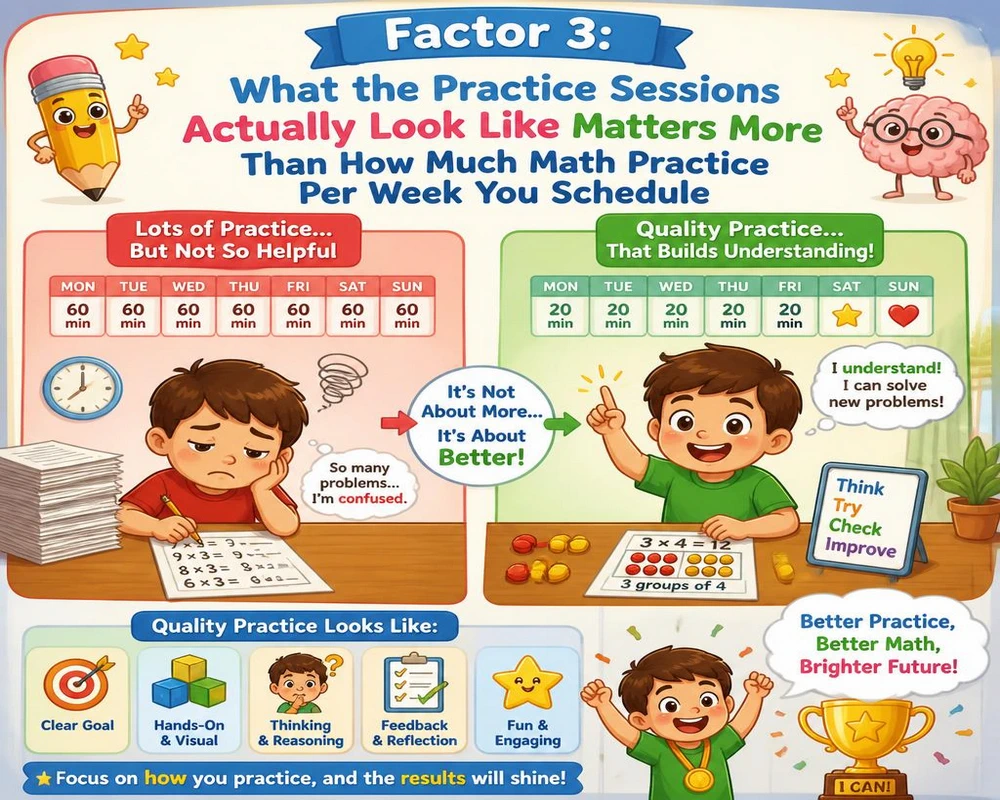
Factor 3: What the Practice Sessions Actually Look Like Matters More Than How Much Math Practice Per Week You Schedule
Quality Time Beats Quantity Time
Fifteen focused, engaged minutes genuinely outperform forty-five distracted minutes with a phone nearby and constant interruptions. If a family is deciding between shorter, focused sessions and longer, looser ones, focused wins almost every time.
This lines up with what researchers call “spaced practice” — the finding that several short, distributed study sessions build stronger long-term retention than one long, concentrated session, even when the total time is identical. The Ontario Association for Mathematics Education publishes classroom-tested guidance on pacing practice this way for elementary students specifically.
Passive Practice Doesn’t Count the Same
Watching a video about multiplication and actually solving multiplication problems are different activities, even though both feel like “math time.” When estimating how much math practice per week a child is genuinely getting, only the active, hands-on portion really counts toward skill-building.
Variety Extends Effective Practice Time
A single fifteen-minute session mixing a worksheet, a quick game, and a real-life example (like counting change) tends to hold attention — and therefore produce real learning — longer than fifteen straight minutes of the same repetitive question format.
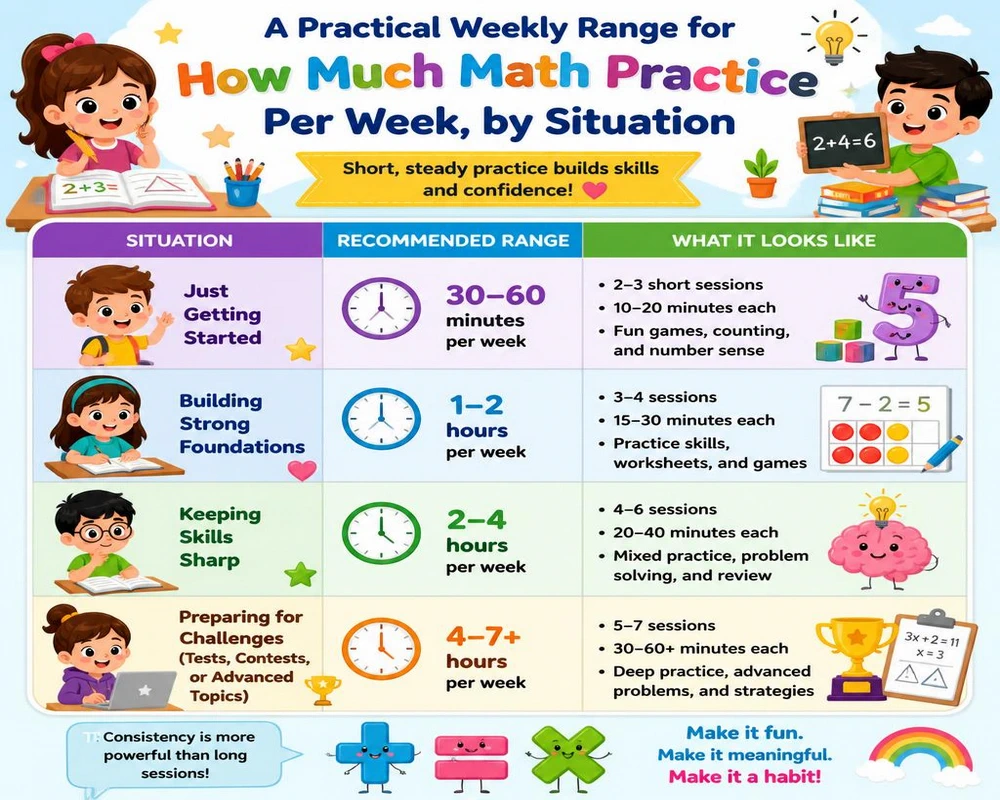
A Practical Weekly Range for How Much Math Practice Per Week, by Situation
| Situation | Rough Weekly Range | Session Pattern |
|---|---|---|
| Meeting expectations, no specific concerns | 45-60 minutes total | 3 sessions of 15-20 minutes |
| Struggling with a specific concept | 75-100 minutes total | 5 sessions of 15-20 minutes, focused on that concept |
| Ahead of grade level, wants a challenge | 45-60 minutes total | 3 sessions of 15-20 minutes, using harder material |
| Preparing for EQAO (Grade 3 or 6) | 60-90 minutes total | 4-5 sessions, mixing review with practice tests |
These ranges are starting points, not rules. Adjust up or down based on how a child is actually responding — genuine engagement and steady progress matter more than hitting a specific number of minutes.
Warning Signs You’re Doing Too Much
Even with a thoughtful answer to how much math practice per week your child needs, it’s worth watching for signs the current amount has tipped too far in either direction.
Math Time Consistently Ends in Tears or Shutdown
Occasional frustration with a hard problem is normal. Consistent, severe distress around math time specifically suggests the current amount or intensity of practice needs to come down, not up.
The Child Starts Avoiding or Delaying Practice Time
Active avoidance is usually a signal that practice sessions have become unpleasant enough to actively dread, which tends to work against building genuine confidence over time.
Performance Actually Gets Worse, Not Better
Overtired, over-drilled children sometimes perform worse than before extra practice started, since fatigue and resentment interfere with actual learning more than the extra repetition helps.
Warning Signs You’re Doing Too Little
The opposite problem is just as real. If your current how much math practice per week total feels minimal, these two signs suggest it’s time to increase it.
The Same Mistake Keeps Recurring Week After Week
If a specific error pattern never seems to resolve, that’s often a sign the current amount of focused practice on that particular skill isn’t quite enough, rather than a sign the child simply can’t grasp it.
Report Cards Show No Movement Over Multiple Terms
A level that stays flat across several reporting periods, despite the curriculum advancing, suggests current practice levels aren’t quite keeping pace with what’s being taught.
Frequently Asked Questions
1. Is there a real, research-backed answer to how much math practice per week is ideal?
Most guidance suggests roughly 45-90 minutes total per week, spread across several short sessions rather than one long one, though the right amount genuinely varies by child and current classroom content.
2. Should weekend practice look different from weekday practice?
Weekends often allow for slightly longer or more relaxed sessions, like a real-life math activity (cooking, shopping), while weekday sessions tend to work better as short and focused, fitting around homework and other commitments.
3. How can I tell if my child needs more practice time or a completely different approach?
If increasing how much math practice per week hasn’t improved results after a few weeks, the issue is more likely the type of practice than the amount — consider hands-on models, a different explanation style, or targeted help on one specific weak skill.
4. Does how much math practice per week change during EQAO years?
Slightly, and usually only in the months leading up to the assessment, when practice shifts toward test-style questions and reviewing the full range of strands covered.
5. Is daily practice better than a few longer sessions?
For most children, several shorter sessions spread across the week build stronger retention than one or two long sessions when working out how much math practice per week to schedule, since spaced-out practice tends to stick better than cramming.
6. What if my child resists any amount of math practice at home?
Start smaller than feels sufficient, even five minutes, and build up gradually. A short session that actually happens consistently beats an ambitious plan that gets abandoned after a week.
7. Should practice time increase every year as grades get harder?
Generally yes, since older grades cover more complex, multi-step material, but the increase should stay gradual and responsive to how the child is actually coping, not automatic.
Once you’ve settled on how much math practice per week works for your family, our Ontario math practice platform makes it easy to fill that time with lessons matched directly to your child’s current grade and specific curriculum expectations.
Explore grade-specific practice through our Grade 1 through Grade 6 math practice hubs.