Free Ontario Curriculum-Aligned Math Games: 7 Best Picks
A deck of cards, a handful of dice, and a shopping receipt can quietly cover more of Ontario’s math curriculum than an entire drawer of unused workbooks. Free Ontario curriculum-aligned math games don’t need to be complicated or expensive — the best ones use objects already sitting around the house, and they map directly onto specific strands your child is actually being taught right now. The trick is knowing which household game targets which skill, rather than playing something random and hoping it helps.
This guide walks through seven free Ontario curriculum-aligned math games, each one built from ordinary household items, with the exact grade range and curriculum strand each one supports.
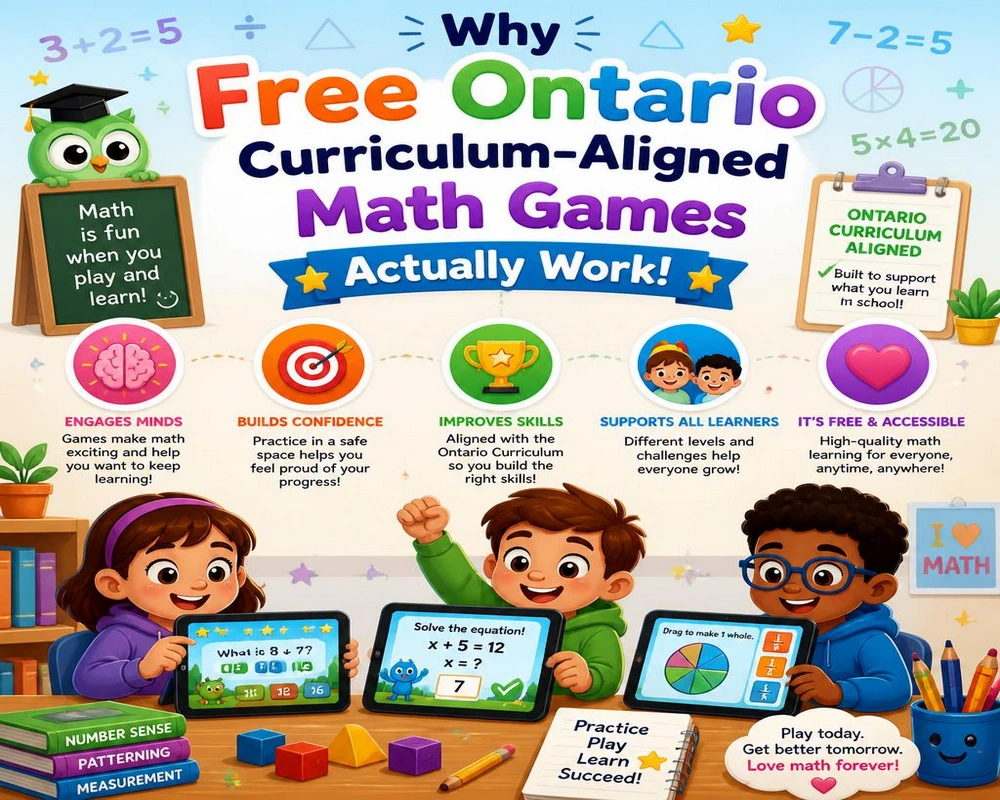
Why Free Ontario Curriculum-Aligned Math Games Actually Work
Ontario’s curriculum leans heavily on concrete, hands-on learning, especially in the earlier grades, before students transition to more abstract paper-based work. Games naturally deliver this kind of concrete practice — a dice roll or a card draw is inherently tactile in a way a worksheet rarely manages. This is exactly why free Ontario curriculum-aligned math games solve a real problem many families run into: keeping practice consistent without it turning into a nightly battle over sitting down with a workbook.
This matters because the Ontario curriculum specifically references games and hands-on activities as legitimate ways to build number sense, not just a fun add-on after the “real” learning happens. A well-chosen game genuinely counts as curriculum-aligned practice, not a break from it.
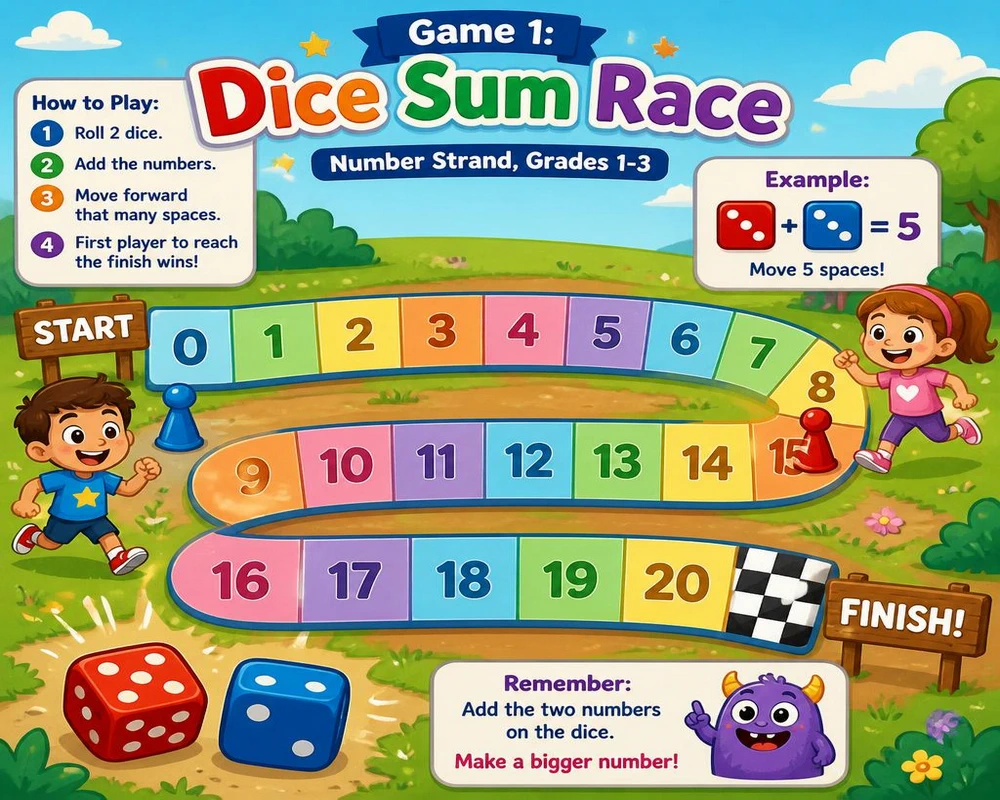
Game 1: Dice Sum Race (Number Strand, Grades 1-3)
What You Need
Two dice, paper, and a pencil for keeping score.
How to Play
Each player rolls both dice and adds the two numbers together. Whoever reaches a target total first, like 50, wins. Rolling two dice produces sums ranging from 2 to 12, giving young players constant addition practice without it ever feeling like a worksheet.
Curriculum Connection
This directly supports Grade 1 and 2 addition within 20, and can be adapted for Grade 3 by using three dice instead of two, pushing sums higher and adding a light challenge. It’s one of the simplest free Ontario curriculum-aligned math games to set up with zero prep.
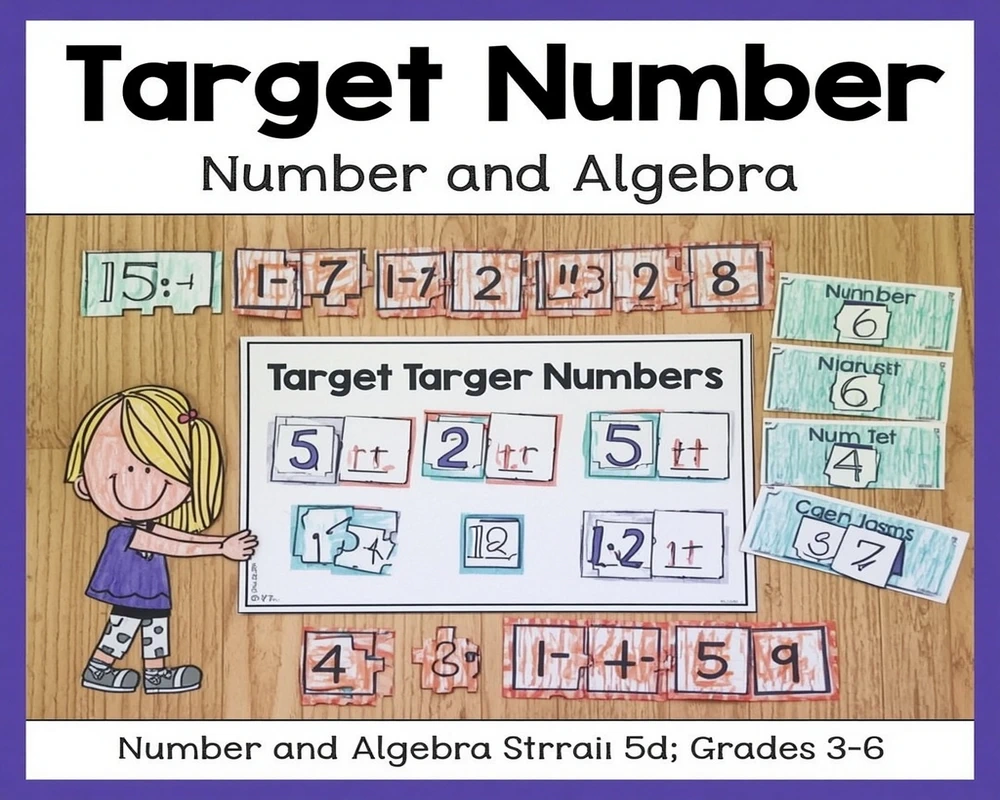
Game 2: Target Number (Number and Algebra Strands, Grades 3-6)
What You Need
A deck of playing cards (face cards removed).
How to Play
Draw three or four cards and try to combine them using addition, subtraction, multiplication, or division to reach a specific target number, like 24. For example, drawing a 3 and an 8 lets a player reach 24 through simple multiplication.
Curriculum Connection
This game is genuinely flexible across grades — younger students can use addition and subtraction only, while older students incorporate multiplication, division, and even order of operations for an extra challenge, making it one of the more adaptable free Ontario curriculum-aligned math games on this entire list.
Game 3: Grocery Receipt Detective (Number and Financial Literacy Strands, Grades 2-6)
What You Need
Any real grocery receipt from a recent shopping trip.
How to Play
Ask your child to find the two cheapest items, calculate the total cost of three specific items, or figure out which item had the best unit price. For instance, comparing an item priced at $6.00 for 2 units against one priced at $9.00 for 3 units reveals they’re actually the same unit price, a genuinely useful real-world lesson in disguise.
Curriculum Connection
This maps directly onto Financial Literacy expectations across every grade, from simple addition of prices in Grade 2 through unit rate comparisons that become formal in Grade 6, making this one of the most practical free Ontario curriculum-aligned math games for building real-world number sense.
Game 4: Shape Scavenger Hunt (Spatial Sense Strand, Grades 1-4)
What You Need
Nothing but your house and a notepad.
How to Play
Set a timer and challenge your child to find and list as many examples of a specific shape, or a specific number of shape types, as possible around the house — circles, rectangles, triangles, or even 3D solids like cylinders and cubes.
Curriculum Connection
This directly reinforces 2D and 3D shape identification and properties, a core Spatial Sense expectation from Grade 1 through Grade 4, before geometry becomes more formal with angles and coordinate grids. Among all the free Ontario curriculum-aligned math games here, this one requires the least setup.
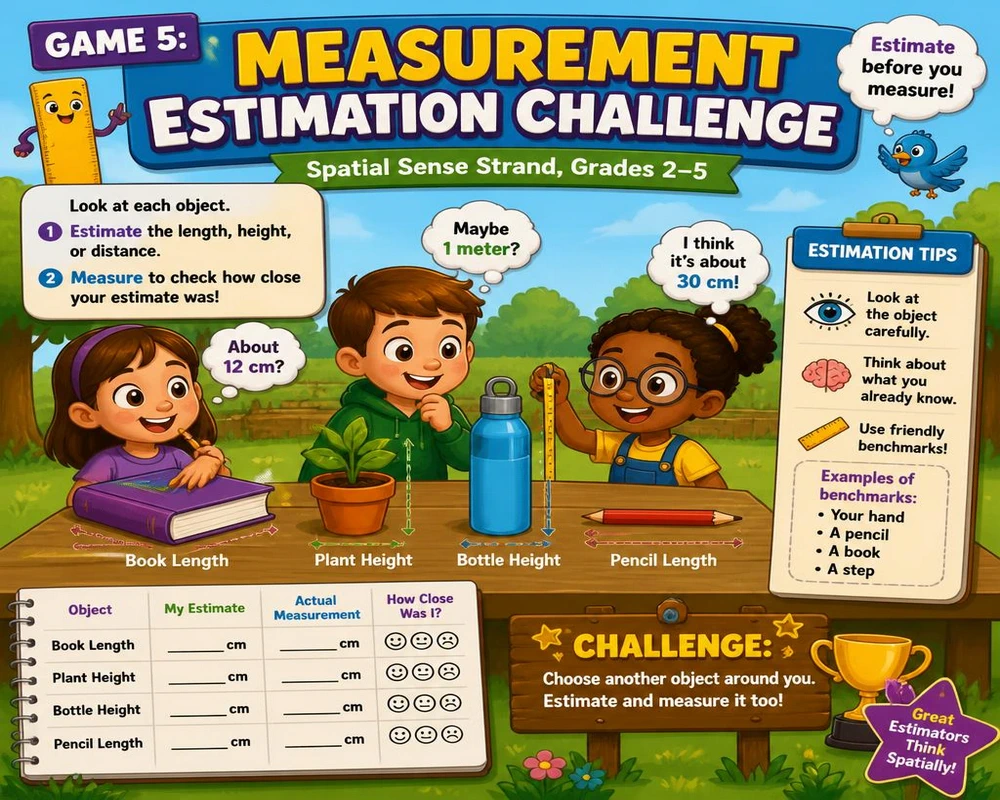
Game 5: Measurement Estimation Challenge (Spatial Sense Strand, Grades 2-5)
What You Need
A measuring tape or ruler, and a few household objects.
How to Play
Before measuring, each player guesses the length of an object — a table, a hallway, a book — then measures to check how close the estimate was. Converting between units, like confirming that 150 centimetres equals 1.5 metres, adds an extra layer for older grades.
Curriculum Connection
Estimating before measuring is explicitly called out in Ontario’s curriculum as a genuine skill, not just a guessing game, and unit conversion specifically becomes a formal expectation starting in Grade 4. This makes it a strong pick among free Ontario curriculum-aligned math games for building real number sense around measurement.
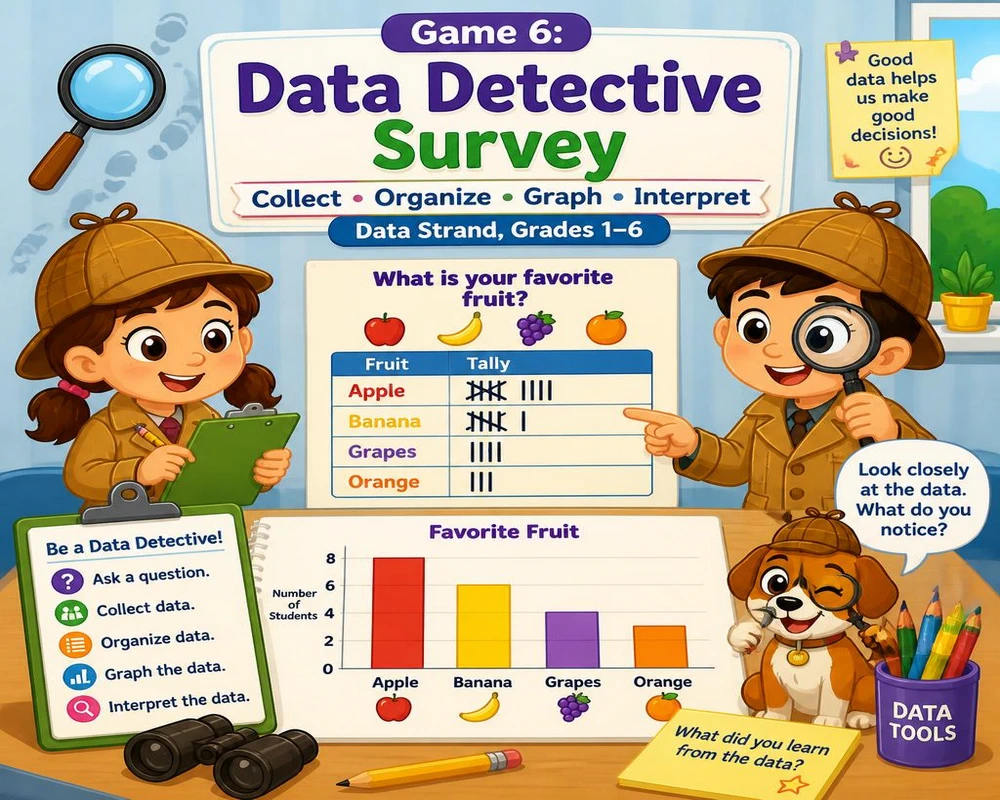
Game 6: Data Detective Survey (Data Strand, Grades 1-6)
What You Need
Paper for tallying, and willing family members to survey.
How to Play
Have your child pick a simple question (favourite season, favourite meal), survey five or more people, and build a simple graph or tally chart from the results. Older students can calculate percentages or convert results into a circle graph.
Curriculum Connection
Data collection and graphing appear at every grade level, growing from simple picture graphs in Grade 1 to circle graphs and calculated percentages by Grade 6, making this one of the most flexible free Ontario curriculum-aligned math games on this list.
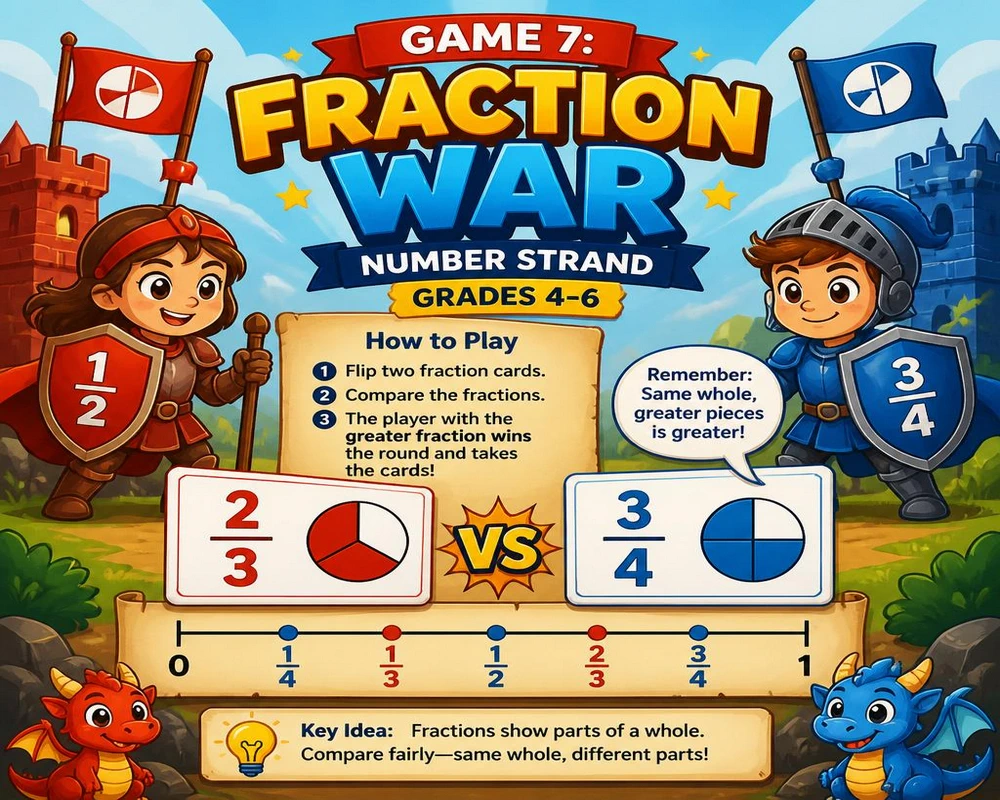
Game 7: Fraction War (Number Strand, Grades 4-6)
What You Need
A deck of playing cards.
How to Play
Deal two cards to each player to form a fraction (smaller card as numerator, larger as denominator). Whoever has the larger fraction wins that round, similar to the classic card game War. Comparing fractions with different denominators forces genuine mental comparison rather than guessing, making this one of the more mathematically rich free Ontario curriculum-aligned math games for older elementary students.
Curriculum Connection
This targets fraction comparison directly, a skill formalized in Grade 4 and deepened through Grade 5 and 6 as fraction operations become more complex.
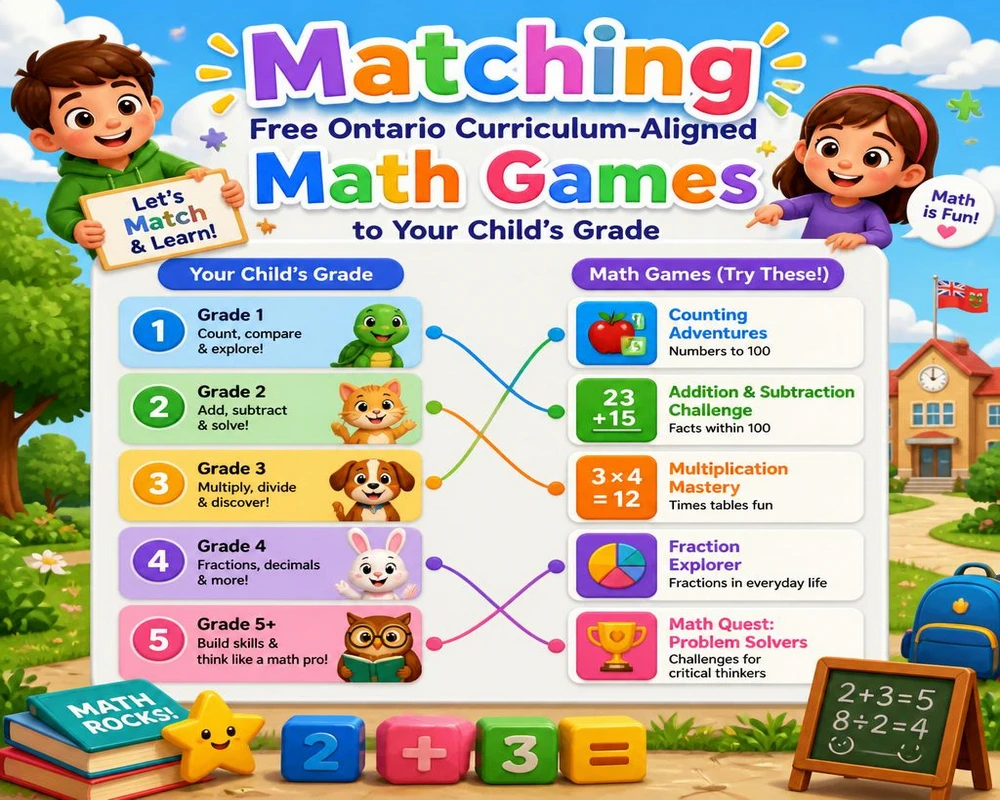
Matching Free Ontario Curriculum-Aligned Math Games to Your Child’s Grade
| Grade | Best Games From This List |
|---|---|
| Grade 1-2 | Dice Sum Race, Shape Scavenger Hunt, Data Detective Survey |
| Grade 3-4 | Target Number, Measurement Estimation Challenge, Shape Scavenger Hunt |
| Grade 5-6 | Fraction War, Target Number (with all four operations), Data Detective Survey (with percentages) |
Making Free Ontario Curriculum-Aligned Math Games Part of a Weekly Routine
Keep Sessions Short
Ten to fifteen minutes of genuine game play tends to build more consistent engagement than a longer session that starts to feel like a chore. Most free Ontario curriculum-aligned math games work perfectly well in that shorter window.
Rotate Games to Match Current Classroom Content
If a class is currently working on fractions, lean toward Fraction War that week. If data management is the current unit, the Data Detective Survey becomes the more relevant choice.
Let Your Child Choose Sometimes
Giving a child some say in which game to play, even among a curated list, builds genuine buy-in rather than practice feeling entirely imposed from outside.
Adjust Difficulty on the Fly
Most of these games scale up or down naturally — more dice, bigger target numbers, or additional operations — so the same basic game can stretch across several grades without needing to be replaced entirely.
Common Mistakes When Using Free Ontario Curriculum-Aligned Math Games
Even great free Ontario curriculum-aligned math games can fall flat if a few common pitfalls aren’t avoided.
Treating Every Game as Equally Valuable
Not every game targets the skill a child actually needs right now. Matching the game to the current curriculum focus, rather than picking whatever’s most fun in the moment, makes practice time more effective.
Making Games Too Competitive
Some children disengage entirely if losing feels too high-stakes. Adjusting the tone toward friendly and low-pressure, especially for a child prone to frustration, keeps the activity genuinely useful rather than stressful.
Skipping the “Why” Behind an Answer
Even in a game, briefly asking “how did you figure that out?” reinforces the reasoning process Ontario’s curriculum specifically values, rather than only rewarding speed or a lucky guess.
Frequently Asked Questions
1. Do these games really count as legitimate math practice?
Yes, Ontario’s curriculum explicitly recognizes hands-on, game-based learning as valid practice, particularly for building number sense and spatial reasoning in the earlier grades, which is exactly why free Ontario curriculum-aligned math games belong in a regular practice routine, not just as an occasional treat.
2. What age can start playing games like Dice Sum Race?
Most Grade 1 students, typically around age six, can play with light adult support, and the game scales naturally as addition skills grow.
3. How can I make these free Ontario curriculum-aligned math games harder as my child improves?
Add more dice or cards, raise the target number, or introduce additional operations like multiplication and division once addition and subtraction feel automatic.
4. Should game-based practice replace worksheets entirely?
Not necessarily, but blending both tends to work better than relying on just one format, since games build engagement while worksheets can reinforce written practice for assessments.
5. How do I know which strand my child needs the most practice in?
Recent report card comments or a quick conversation with the teacher usually point directly at the specific strand needing extra attention.
6. Can these games work for a child who’s anxious about math?
Often yes, since the low-pressure, playful format tends to feel less intimidating than a formal worksheet, though keeping the tone genuinely light matters more than usual for an anxious child. Free Ontario curriculum-aligned math games can be a gentle way back into confident practice.
7. Where can I find more structured practice to go alongside these games?
Our Ontario math practice platform offers curriculum-aligned lessons and questions by grade, which pair well with game-based practice at home.
For research-backed classroom strategies that inspired some of these game formats, the Ontario Association for Mathematics Education publishes free resources on hands-on math instruction for Ontario teachers and families alike.
Explore grade-specific practice through our Grade 1 through Grade 6 math practice hubs, or see our Ontario math curriculum by grade guide for a full breakdown of what each grade covers. These free Ontario curriculum-aligned math games work especially well alongside that structured practice, filling in the hands-on side of learning that a screen alone can’t fully replace.