
Ontario Math Homework Help: What to Say, Not Solve
The moment a parent picks up the pencil and starts solving, real Ontario math homework help quietly stops happening. It’s an easy trap to fall into — a child looks stuck, the answer seems obvious, and five minutes of frustration turns into a parent doing the thinking while the child watches. The homework gets finished. The understanding doesn’t. What actually counts as Ontario math homework help isn’t a parent who knows the answer. It’s a parent who knows the right question to ask next.
This guide skips the math itself and focuses on something more useful: exactly what to say, grade by grade, when a child is stuck, plus the handful of questions that work at every age.
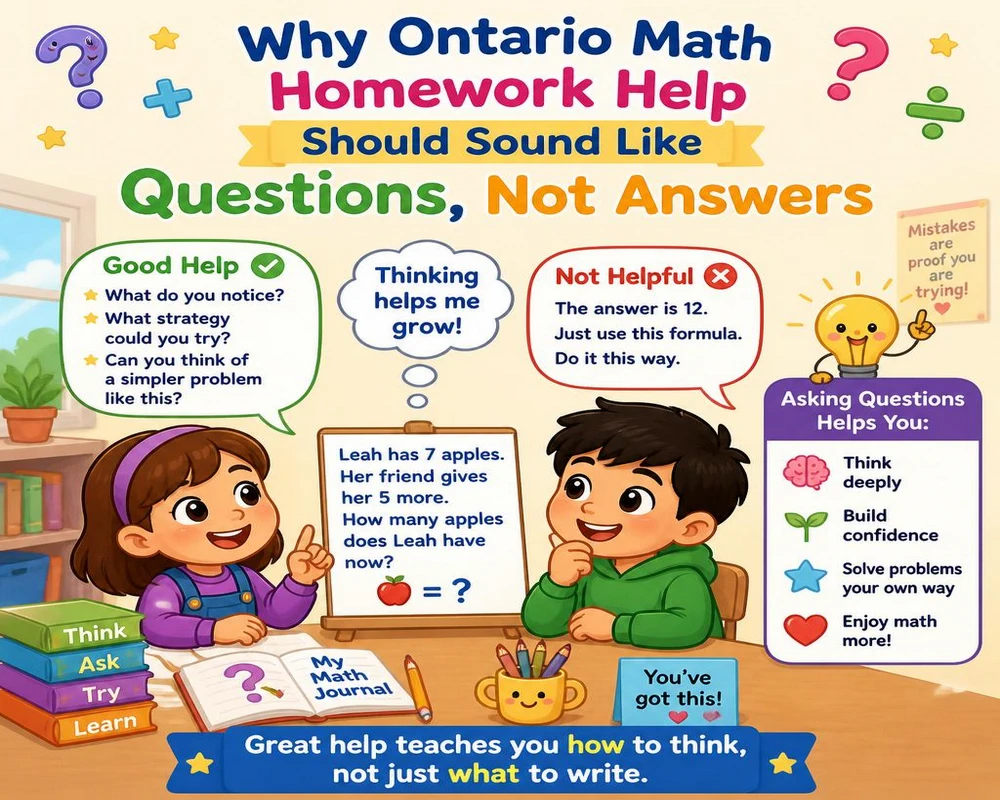
Why Ontario Math Homework Help Should Sound Like Questions, Not Answers
Ontario’s curriculum places heavy weight on the mathematical process — explaining reasoning, trying different strategies, checking whether an answer makes sense — not just arriving at a correct number. A parent who jumps in with the answer skips every one of those steps, which means the homework gets completed without the actual skill being practiced.
This matters because genuine Ontario math homework help is really about protecting a child’s own thinking process, even when it’s slower or messier than a parent solving it directly would be. The struggle itself, within reason, is where the learning happens, and it’s exactly what separates real Ontario math homework help from simply getting the worksheet finished.
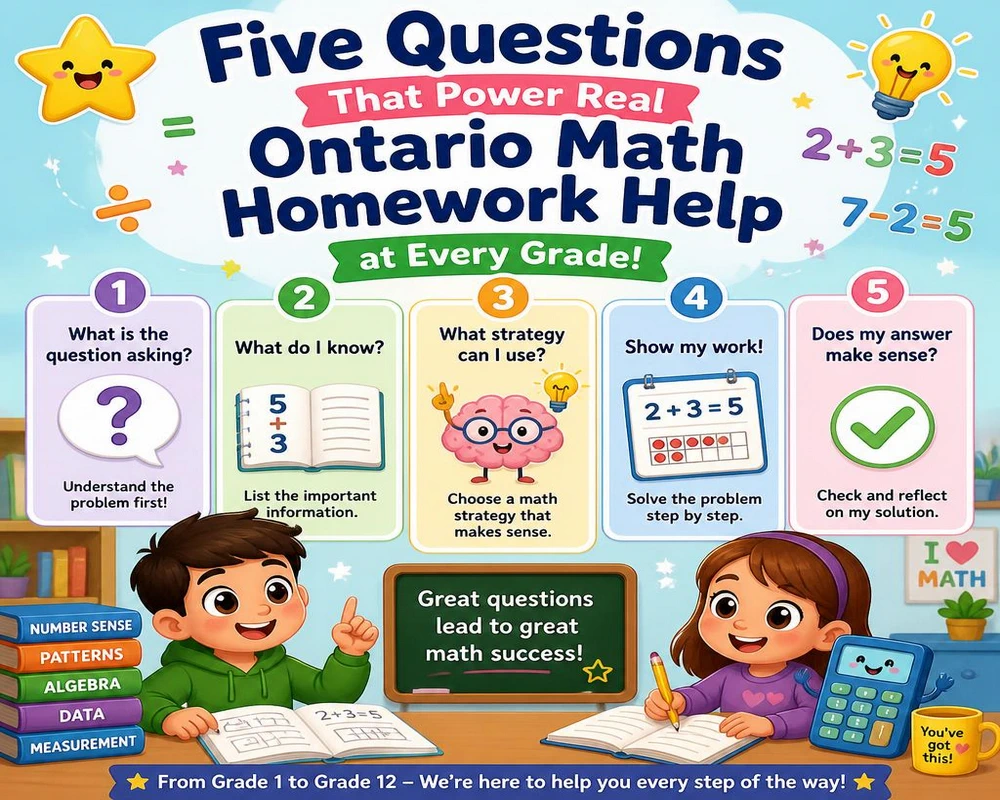
Five Questions That Power Real Ontario Math Homework Help at Every Grade
Before getting into grade-specific scripts, these five questions form the backbone of effective Ontario math homework help at any age, and they cost nothing to memorize.
- “Can you tell me what the question is actually asking?”
- “What do you already know that might help here?”
- “Can you show me using a drawing or objects?”
- “Does that answer seem reasonable to you?”
- “What’s one thing you’re sure of, even if you’re not sure of the whole answer?”
Notice none of these questions require a parent to know the math itself. That’s intentional — Ontario math homework help works even when a parent genuinely doesn’t remember how to solve the problem, because the goal is drawing out the child’s thinking, not supplying a parent’s.
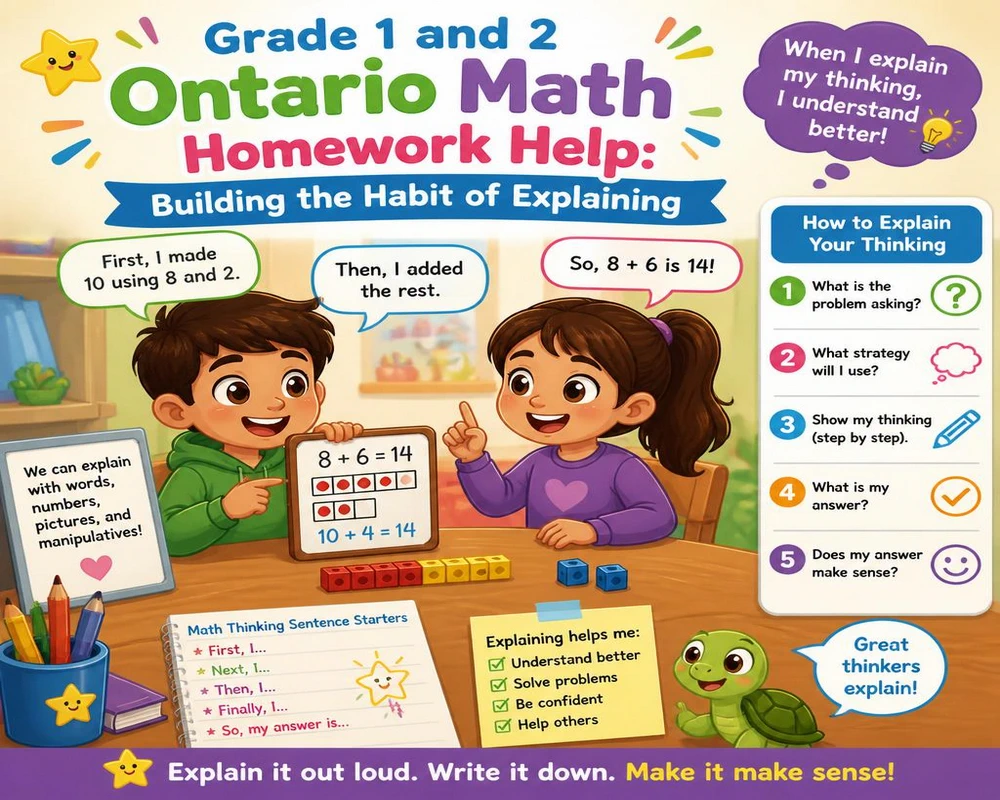
Grade 1 and 2 Ontario Math Homework Help: Building the Habit of Explaining
What Stuck Usually Looks Like
A young child often isn’t stuck on the math itself, but on translating a word problem into numbers, or losing track partway through counting.
What to Say
“Can you act this out with your fingers or some toys?” works especially well at this age, since Grade 1 and 2 students are still deeply reliant on concrete objects. Following up with “now what happened?” often reveals the answer was already there, just not yet written down.
What to Avoid
Resist the urge to count along out loud for them. A parent counting “1, 2, 3…” while a child watches passively removes the exact skill — independent counting — that the homework is meant to build.
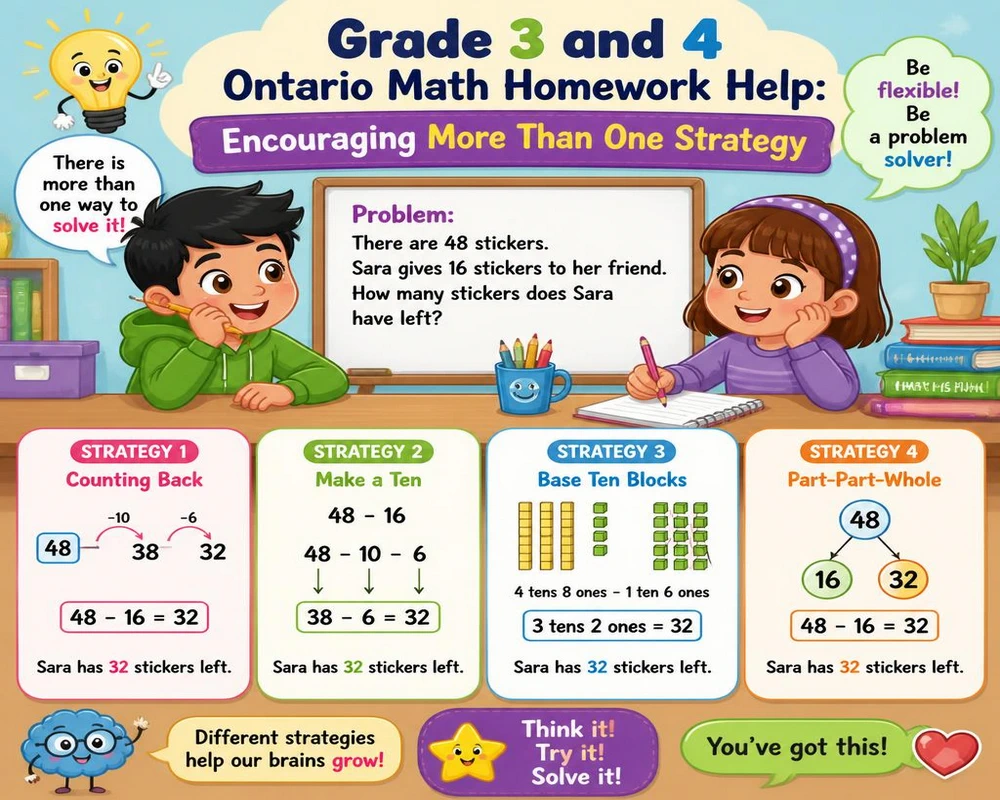
Grade 3 and 4 Ontario Math Homework Help: Encouraging More Than One Strategy
What Stuck Usually Looks Like
By Grade 3 and 4, a stuck child has often picked one strategy, hit a wall, and doesn’t know there’s another way in. Long division and multiplication facts are common sticking points here.
What to Say
“Is there a different way you could try this?” opens the door without giving anything away. If a child truly has no second strategy, “what if you used blocks or drew it out?” offers a nudge back toward something concrete without solving the step for them.
What to Avoid
Avoid saying “no, that’s wrong” the moment an error appears. Instead, “walk me through how you got that” often lets a child catch their own mistake mid-explanation, which builds far more independence than a correction from a parent.
Grade 5 and 6 Ontario Math Homework Help: Supporting Multi-Step Reasoning
What Stuck Usually Looks Like
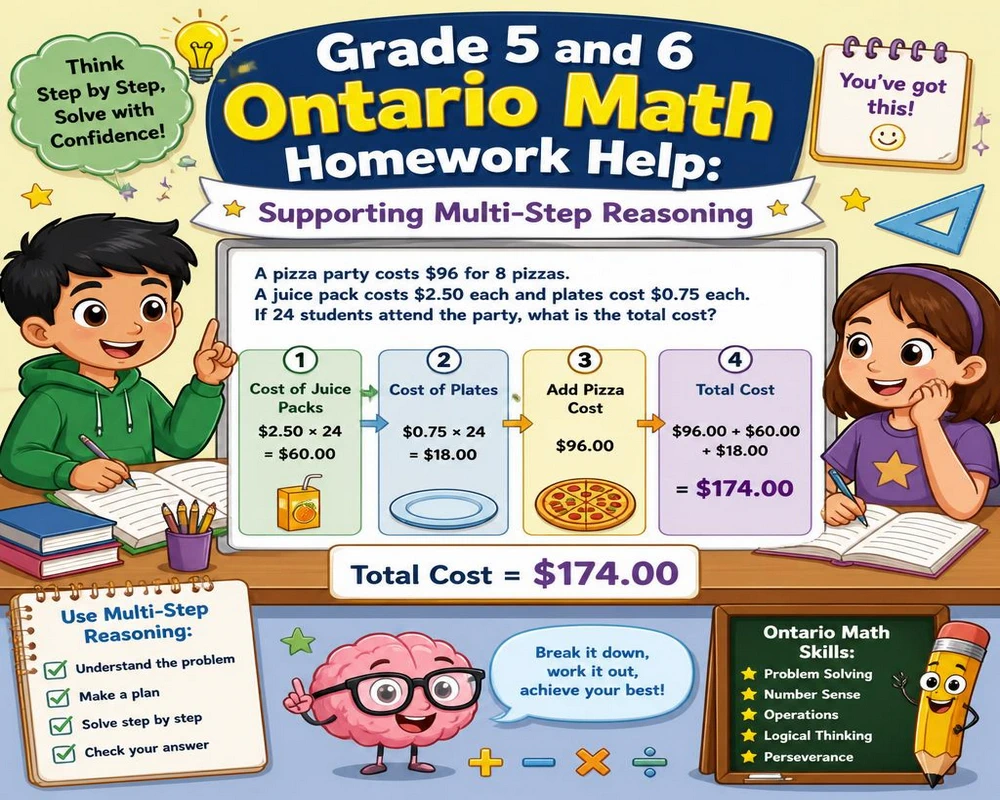
Grade 5 and 6 problems often combine several operations — fractions, percentages, ratios — in one question, and a stuck child has frequently lost track of which step comes next, not the individual calculations themselves.
What to Say
“What’s the very first thing this question is asking you to figure out?” helps break an overwhelming multi-step problem into a single first move. Once that’s answered, “okay, now what do you need next?” keeps the process moving one step at a time without a parent mapping out the whole solution.
What to Avoid
Avoid solving the first step yourself “just to get them started.” Even a small head start removes the exact planning skill — figuring out where to begin — that Grade 5 and 6 problems are specifically designed to build.
This approach lines up closely with what education researchers call “productive struggle” — the idea that letting a child grapple with a problem, with light guidance rather than direct answers, builds deeper understanding than immediate correction. The Ontario Association for Mathematics Education publishes classroom-tested strategies built around exactly this kind of questioning approach.
When Real Ontario Math Homework Help Means Stepping Back Entirely
Recognizing Genuine Frustration Versus Normal Struggle
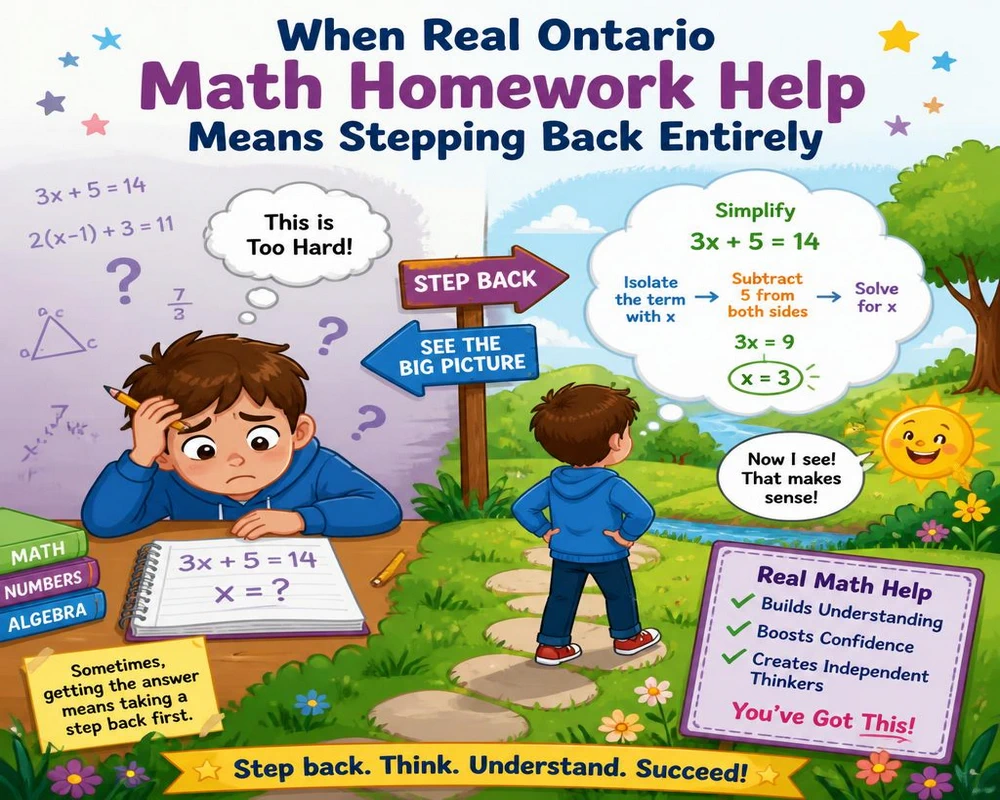
Some frustration is a healthy, expected part of working through a hard problem. Real distress — tears, shutting down, refusing to continue — is different, and it’s a sign to pause the homework rather than push through with more questions.
Taking a Break Is Still Homework Help
Stepping away for ten minutes, then returning with fresh eyes, often accomplishes more than continuing to push through frustration. This is a genuinely legitimate form of Ontario math homework help, even though it doesn’t look like active teaching in the moment. Effective Ontario math homework help sometimes means doing less, not more.
Knowing When to Contact the Teacher Instead
If the same type of question causes a stuck moment night after night, that’s no longer a homework-help situation — it’s a signal the underlying concept needs to be retaught, which is a teacher’s job, not a parent’s late-evening improvisation.
A Few Ground Rules That Make Ontario Math Homework Help Easier at Every Grade
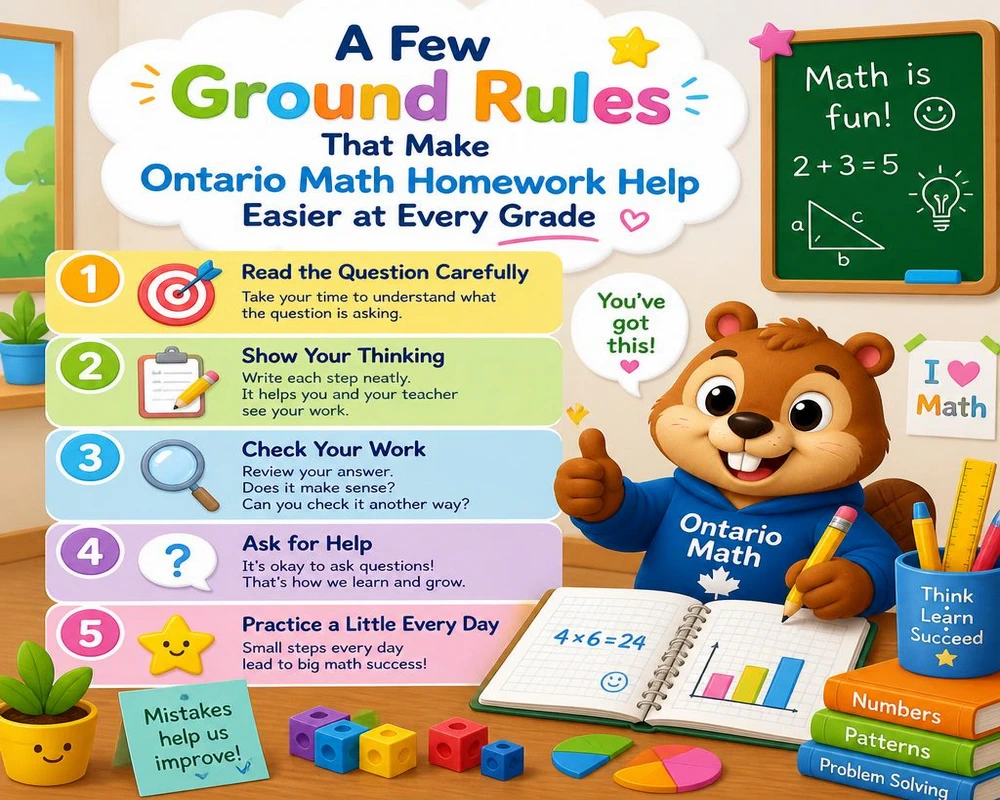
Keep Your Own Tone Calm, Especially If Math Wasn’t Your Strength
Children pick up on parental anxiety around math surprisingly easily. A calm “let’s figure this out together” carries far more weight than it might seem, even from a parent who genuinely doesn’t remember the material themselves.
Let Wrong Answers Sit for a Moment
Jumping in the instant an error appears trains a child to wait for correction rather than developing their own error-checking habits. A brief pause, paired with “does that seem right to you?”, builds far more self-sufficiency over time.
Praise the Process, Not Just the Final Answer
“I like how you tried a different way when the first one didn’t work” reinforces exactly the kind of flexible thinking Ontario’s curriculum is built around, regardless of whether that particular attempt led to the correct answer.
Frequently Asked Questions
1. What if I genuinely don’t remember how to do the math myself?
That’s completely fine. Effective Ontario math homework help relies on asking good questions, not supplying answers, so a parent’s own math background matters far less than many assume.
2. How long should a homework help session last before taking a break?
If genuine frustration builds for more than about ten minutes without progress, a short break tends to be more productive than continuing to push through.
3. Is it okay to just tell my child the answer sometimes?
Occasionally, especially near a deadline or when a child is exhausted, but making it a regular pattern removes the practice the homework was designed to provide. Genuine Ontario math homework help works best when telling the answer stays the exception, not the rule.
4. What if my child gets frustrated with my questions instead of just wanting the answer?
This is common, especially at first. Sticking with it consistently over time usually builds tolerance for the process, since children eventually recognize they’re capable of finding answers themselves.
5. Should homework help look different for a struggling student versus a strong one?
The same core questioning approach works for both, though a strong student might need less prompting and a struggling student might benefit from more concrete, hands-on suggestions within those same questions.
6. How can I tell if my child needs a tutor instead of homework help at home?
If the same specific concept causes repeated, significant struggle across multiple Ontario math homework help sessions despite genuine effort, that’s a reasonable signal to seek outside support alongside speaking with the teacher.
7. Does this approach change once a child reaches Grade 6 and prepares for Grade 7?
The same core questioning strategy holds, though Grade 6 and 7 problems increasingly reward a child who can plan multiple steps independently, so questions like “what’s your plan here?” become especially useful.
Effective Ontario math homework help works best alongside genuine curriculum understanding. Our Ontario math curriculum by grade guide breaks down exactly what each grade covers, so you know what a homework question is actually trying to teach.
Explore grade-specific practice questions through our Grade 1 through Grade 6 math practice hubs.