
Unlock Ontario Math Practice Grade 5: Decimals, Ratios & Algebra Excellence
Introduction
Imagine your fifth-grader breezing through decimal calculations at the grocery store, using ratios to mix the perfect lemonade recipe, or solving for unknowns in fun algebra puzzles. These capabilities flourish with dedicated Ontario math practice Grade 5.
Grade 5 bridges elementary foundations to more abstract thinking in the Ontario curriculum. Decimals Grade 5 Ontario build precision in numbers, ratios Grade 5 Ontario introduce proportional reasoning, and algebra lays groundwork for variables and equations. This in-depth guide offers parents, teachers, and homeschoolers everything needed to support Grade 5 math Ontario effectively in 2026.
With over 15 years crafting successful math experiences, I’ve packed this resource with practical advice, engaging examples, and proven strategies. You’ll gain tools to make learning enjoyable while delivering measurable growth. Let’s empower your child to excel.
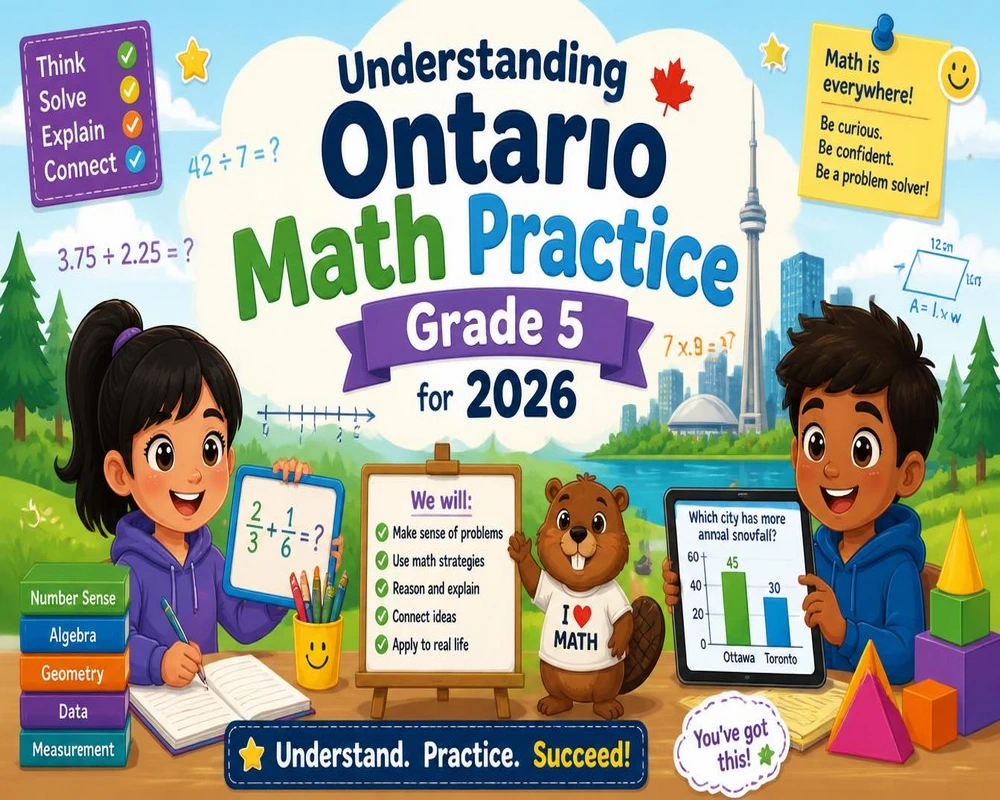
Understanding Ontario Math Practice Grade 5 for 2026
The Ontario curriculum emphasizes interconnected strands where decimals, ratios, and algebra shine. Students extend place value to thousandths, explore multiplicative relationships, and work with patterns and equations.
Recent 2024-2026 educational reports highlight that strong performance in these areas predicts better middle school outcomes. Consistent, meaningful practice is essential.
Mastering Decimals Grade 5 Ontario
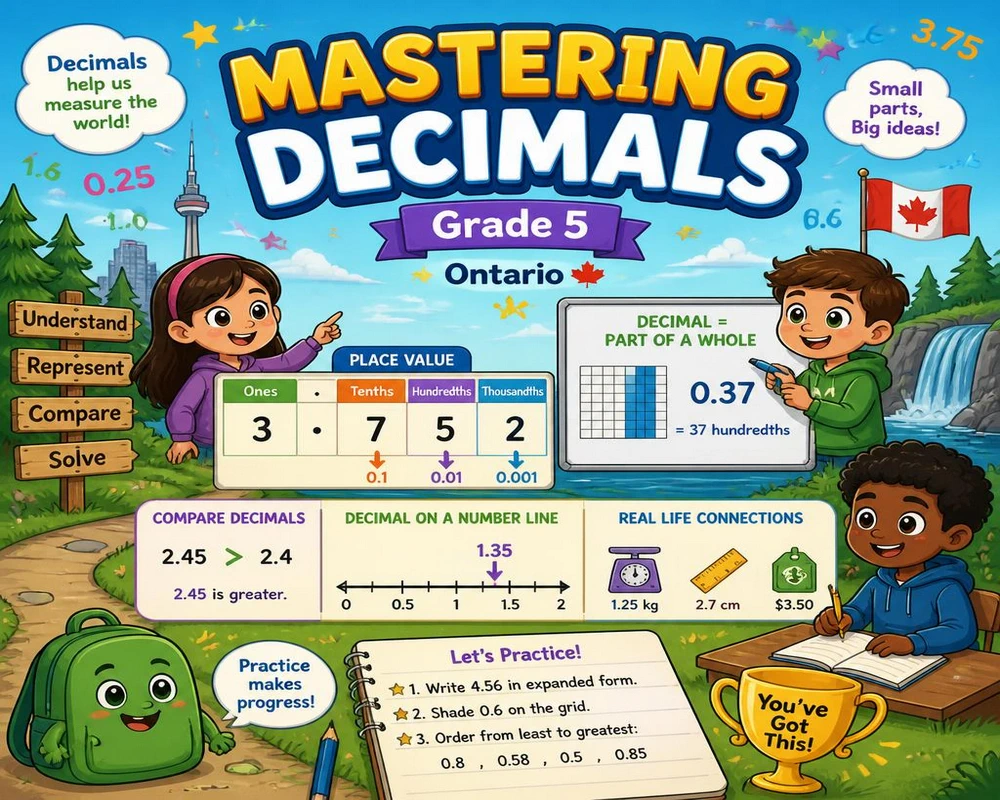
Decimals represent a major leap in number sense, connecting fractions and place value.
Key Expectations
- Read, represent, compare, and order decimals to thousandths.
- Add, subtract, multiply, and divide decimals using models and algorithms.
- Solve problems involving money and measurement with decimals.
Effective Teaching Methods:
- Use base ten blocks or money for concrete understanding.
- Practice with number lines and grids.
- Incorporate estimation before exact calculation.
Real-Life Example: Comparing prices per unit at the store or calculating total costs with tax.
Common Challenges and Solutions
Misaligning decimal points during operations trips many students. Combat this with grid paper, color-coding, and repeated “estimate then calculate” routines. A 2025 study noted visual aids improve decimal accuracy significantly.
Math Questions Grade 5 Sample:
- 4.56 + 3.789 = ?
- A ribbon is 2.75 meters long. If you cut 0.8 meters, how much remains?
Exploring Ratios Grade 5 Ontario
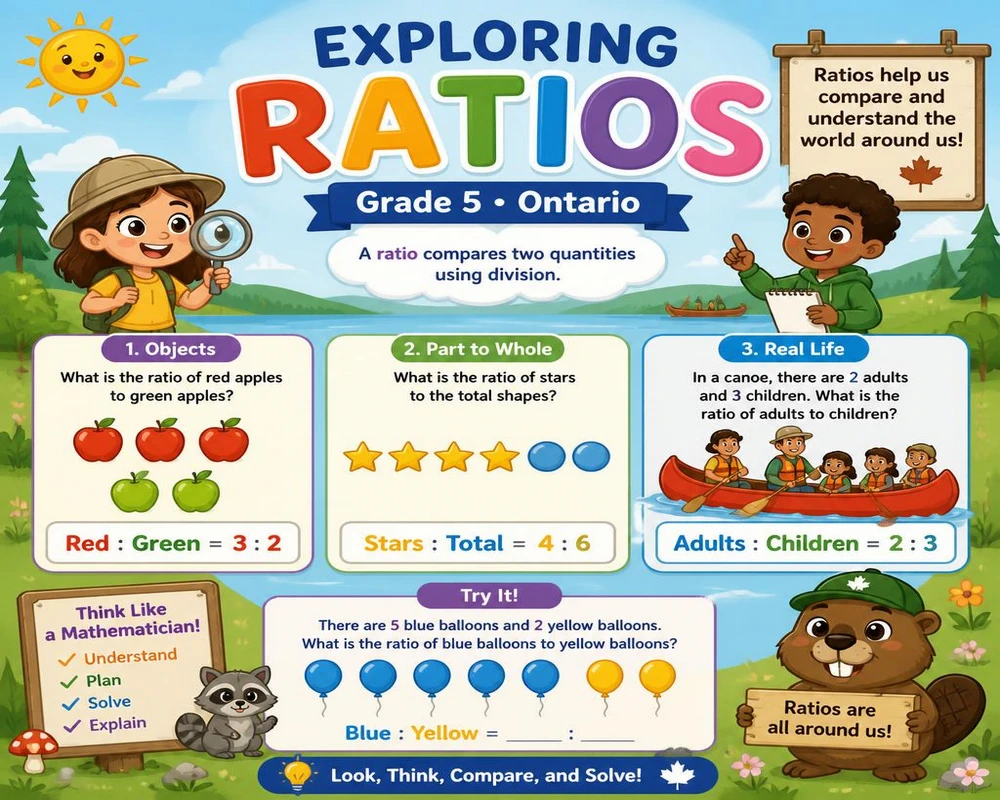
Ratios introduce proportional thinking crucial for rates, scaling, and percentages.
Core Concepts
- Understand and represent ratios in various forms (part-to-part, part-to-whole).
- Solve rate and proportion problems.
- Connect ratios to fractions, decimals, and percents.
Engaging Activities:
- Recipe scaling: Double a cookie recipe and discuss ratios.
- Map scales: “If 1 cm represents 5 km…”
- Sports statistics or mixing paints.
Story time: “The class is making slime. For every 3 cups of glue, they need 1 cup of borax. How much for 12 cups of glue?” This makes ratios tangible.
Linking to Other Topics
Show how ratios connect decimals (e.g., 3:4 = 0.75) and prepare for algebra.
Diving into Algebra in Grade 5 Math Ontario
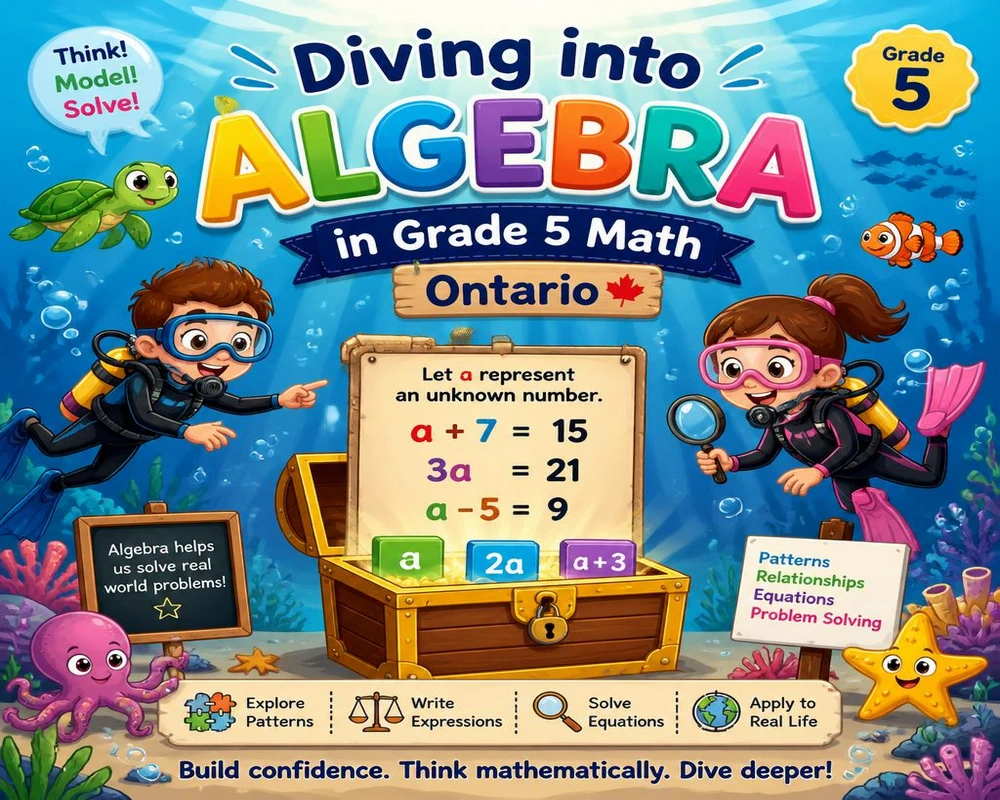
Algebra begins formally with patterns, variables, and simple equations.
Patterns and Relationships
- Extend and create patterns using all operations.
- Describe rules in words and with variables.
- Identify constant rates of change.
Equations and Variables
- Solve one-step equations.
- Use variables to represent unknowns.
- Model relationships with tables, graphs, and expressions.
Hands-On Ideas:
- Function machines or “guess my rule” games.
- Balance scales for equations.
- Growing patterns with tiles or drawings.
Pros and Cons of Algebra Introduction Approaches:
| Approach | Pros | Cons |
|---|---|---|
| Concrete Models | Builds intuition | Takes more time |
| Symbolic Manipulation | Efficient for solving | Can feel disconnected |
| Real-World Contexts | High engagement and relevance | Requires creative setup |
Balance all three for deep understanding.
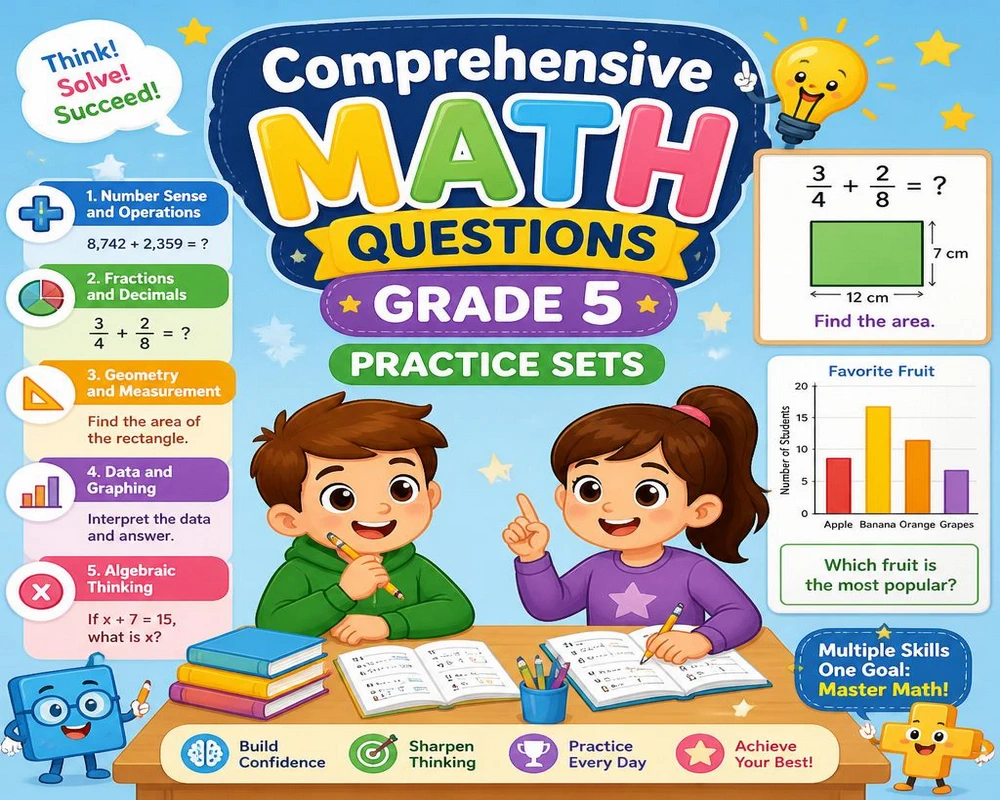
Comprehensive Math Questions Grade 5 Practice Sets
Use these to reinforce learning:
Decimals:
- Multiply 3.4 by 2.5.
- Order: 0.675, 0.67, 0.7, 0.685.
Ratios:
- The ratio of boys to girls is 3:5. If there are 24 boys, how many girls?
- Express 40% as a ratio and decimal.
Algebra:
- If n + 7 = 15, what is n?
- Create a pattern rule for: 3, 7, 11, 15…
Always discuss multiple solution paths and real connections.
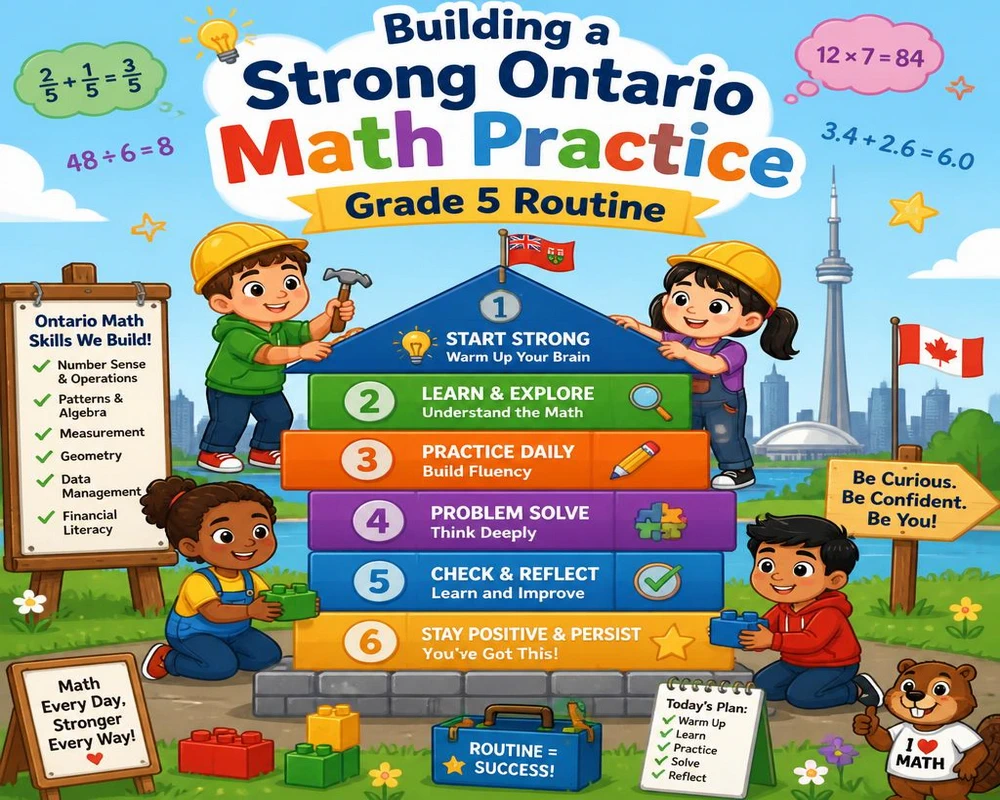
Building a Strong Ontario Math Practice Grade 5 Routine
Aim for 25-45 minutes daily with variety.
Suggested Weekly Plan:
- Monday: Decimal operations.
- Tuesday: Ratio problems and applications.
- Wednesday: Pattern exploration.
- Thursday: Equation solving and modeling.
- Friday: Mixed review and projects.
- Weekends: Family math challenges like budgeting or cooking.
Teachers across the province regularly share classroom-tested strategies for exactly this kind of content through the Ontario Association for Mathematics Education, a professional network dedicated specifically to improving math instruction across Ontario schools. Their resources offer a useful window into how decimals, ratios, and algebra are actually taught in Grade 5 classrooms.
Track progress in a journal and celebrate improvements.
Real-World Applications and Projects
- Budgeting with decimals for a dream vacation.
- Recipe ratios for baking.
- Algebraic thinking in coding simple programs or predicting patterns in nature.
These projects demonstrate math’s power and boost motivation.
Supporting Your Child’s Journey in Grade 5 Math Ontario
Address struggles promptly with targeted practice and positive encouragement. Collaborate with teachers and use quality resources.
Research consistently shows involved families see better attitudes and results in math.
Conclusion
Ontario math practice Grade 5 focusing on decimals, ratios, and algebra equips children with essential 21st-century skills. Implement these strategies, stay consistent, and enjoy watching your child gain confidence and curiosity.
Decimals, ratios, and algebra represent some of the most abstract thinking Grade 5 students encounter all year, building directly on the fraction and pattern work from earlier grades. For a complete view of everything else Grade 5 covers, our Grade 5 math practice hub brings every topic together with hands-on practice questions.
FAQ: Ontario Math Practice Grade 5
1. What are the main topics in Grade 5 math Ontario? Decimals to thousandths, ratios and rates, patterns, and introductory algebra with variables and equations.
2. How can parents help with decimals Grade 5 Ontario? Use money, measurements, and grocery shopping for practical practice. Focus on place value and estimation.
3. What are ratios Grade 5 Ontario? Comparisons of quantities, used in scaling, rates, and connecting to percents and fractions.
4. Is algebra introduced in Grade 5? Yes, through patterns, variables in expressions, and solving simple equations.
5. Where can I find math questions Grade 5? Curriculum resources, online platforms, and creating contextual problems from daily life.
6. How much practice time per day? 20-40 minutes of focused, engaging work yields the best results without overload.
7. Any major curriculum changes for 2026? Expect stability with continued integration of financial literacy, coding, and modeling.
8. What if my child finds ratios difficult? Start with concrete examples like sharing or recipes, use visuals, and build gradually to abstract problems.