
Ontario Math Practice Grade 1: Complete Parent Guide 2026
Every parent wants to see their child walk into school feeling confident, curious, and ready to learn. In Grade 1, math becomes much more than counting to ten—it lays the groundwork for logical thinking, problem-solving, and everyday decision-making. The habits children develop during this important year often shape their attitude toward mathematics for years to come.
If you’re looking for the most effective Ontario math practice Grade 1 resources, you’re in the right place. Whether your child needs extra support, wants additional challenges, or simply enjoys learning through games, consistent practice at home can make a remarkable difference.
Ontario’s updated elementary mathematics curriculum emphasizes understanding concepts rather than memorizing procedures. Children are encouraged to explain their thinking, solve real-world problems, recognize patterns, and develop confidence in their mathematical abilities. This approach prepares students not only for future grades but also for practical situations they’ll encounter every day.
This comprehensive guide explains exactly what Grade 1 students are expected to learn, how parents can support learning at home, which activities produce the best results, and how to make math enjoyable rather than stressful. You’ll also discover practical examples, expert recommendations, and evidence-based strategies aligned with the latest educational research.
What Is Ontario Math Practice Grade 1?
Ontario math practice Grade 1 refers to learning activities that reinforce the expectations outlined in the Ontario Ministry of Education’s Grade 1 Mathematics Curriculum. Rather than relying on repetitive drills, students explore mathematical ideas through conversation, hands-on experiences, visual models, and everyday situations.
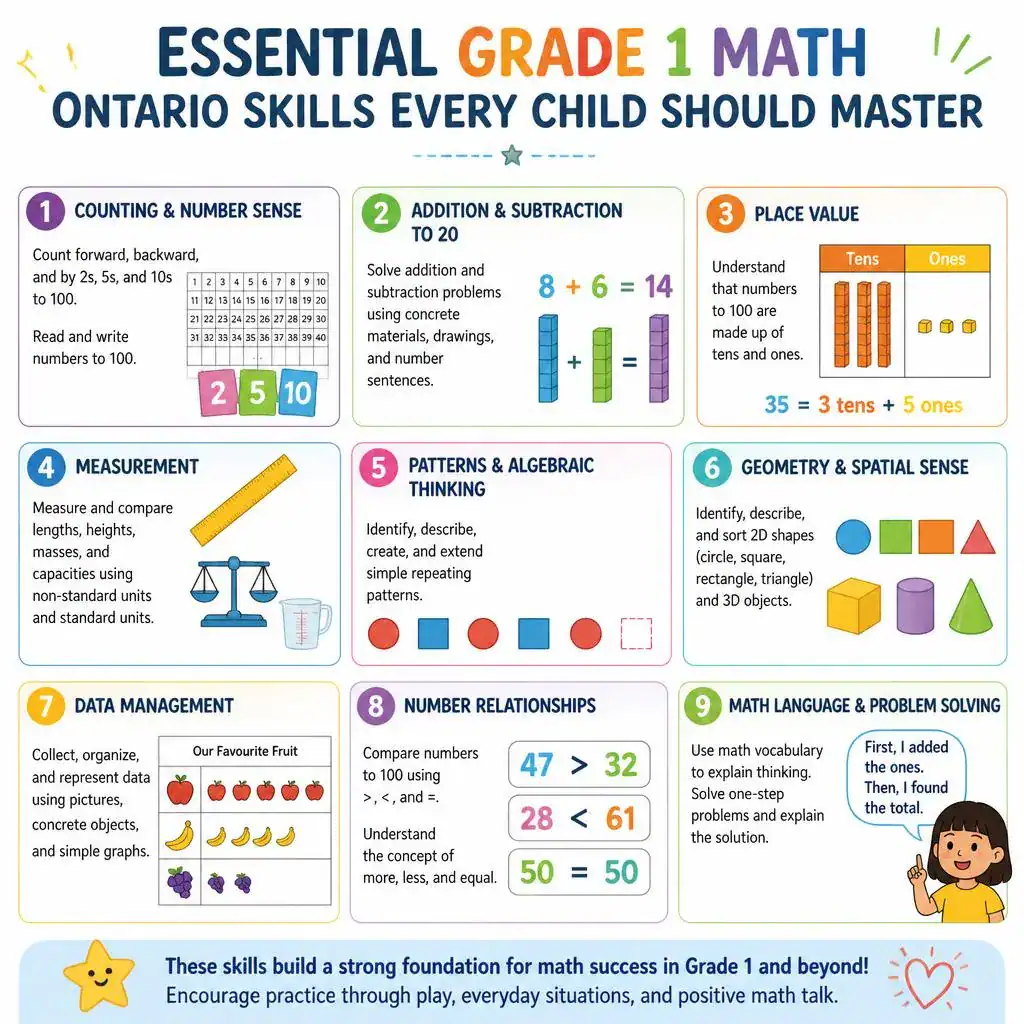
The goal is to help children understand why mathematical concepts work—not just how to calculate answers.
Effective practice includes:
- Counting objects
- Comparing numbers
- Solving simple word problems
- Recognizing patterns
- Measuring everyday items
- Working with shapes
- Understanding money
- Reading simple graphs
- Developing mental math strategies
Unlike traditional worksheets alone, successful Ontario math practice Grade 1 combines guided instruction with playful exploration.
Why Grade 1 Is a Critical Year
Research consistently shows that early mathematical understanding predicts later academic achievement.
A 2024 review published by the Organisation for Economic Co-operation and Development (OECD) found that students who develop strong number sense during the primary years perform significantly better in later mathematics and science courses.
Grade 1 introduces foundational ideas including:
- Number relationships
- Place value
- Addition and subtraction
- Mathematical communication
- Logical reasoning
- Pattern recognition
These concepts become building blocks for every future math topic.
Understanding the Ontario Grade 1 Math Curriculum
The Ontario curriculum is organized into several interconnected strands. Rather than teaching isolated skills, teachers integrate these concepts throughout the school year.
1. Number Sense
Students learn to:
- Count beyond 100
- Compare numbers
- Understand place value
- Recognize odd and even numbers
- Estimate quantities
- Represent numbers in different ways
Example:
Instead of asking:
“What is 14?”
Teachers may ask:
“Show me 14 using blocks, a number line, and a drawing.”
This develops deeper understanding.
2. Addition and Subtraction
Children begin solving problems such as:
- 8 + 5
- 16 − 9
- Missing numbers
- Number bonds
- Mental strategies
Rather than memorizing facts immediately, students learn multiple solution methods.
Example:
15 − 8
A child may think:
8 → 10 (+2)
10 →15 (+5)
Total = 7
This flexible thinking strengthens number sense.
3. Patterns and Algebra
Students identify:
- Repeating patterns
- Growing patterns
- Skip counting
- Simple equations
- Unknown numbers
Activities often include:
- Colored blocks
- Beads
- Shapes
- Music
- Movement
4. Measurement
Children compare:
- Length
- Weight
- Capacity
- Time
They also learn to:
- Read calendars
- Identify days
- Tell time to the hour and half-hour
- Compare objects
5. Geometry and Spatial Sense
Students explore:
- 2D shapes
- 3D figures
- Position words
- Symmetry
- Spatial reasoning
Examples include:
- Circles
- Squares
- Rectangles
- Cubes
- Cylinders
- Cones
6. Data Literacy
Students begin collecting information and creating:
- Picture graphs
- Bar graphs
- Tallies
Then they answer questions like:
- Which category has the most?
- Which has the least?
- How many altogether?
Why Daily Ontario Math Practice Grade 1 Matters
Many parents believe longer study sessions lead to better learning. Educational research suggests otherwise.
Short, consistent practice sessions—about 15 to 20 minutes per day—often produce stronger long-term results than occasional hour-long lessons.
Daily Ontario math practice Grade 1 helps children:
- Build confidence
- Improve memory retention
- Reduce math anxiety
- Develop problem-solving skills
- Strengthen logical reasoning
- Prepare for classroom lessons
- Make learning feel routine rather than stressful
Small daily successes accumulate into significant academic growth over time.
Confidence Comes Before Speed
One common mistake is encouraging children to answer quickly.
In reality, Ontario classrooms emphasize mathematical thinking over speed.
Parents should celebrate:
- Good reasoning
- Clear explanations
- Multiple solution strategies
- Persistence
instead of simply focusing on correct answers.
Essential Grade 1 Math Ontario Skills Every Child Should Master
The following table summarizes the key learning goals.
| Skill Area | Expected Grade 1 Outcome |
|---|---|
| Counting | Count forward and backward beyond 100 |
| Addition | Add within 20 confidently |
| Subtraction | Subtract within 20 using strategies |
| Place Value | Understand tens and ones |
| Patterns | Extend and create repeating patterns |
| Shapes | Identify common 2D and 3D shapes |
| Measurement | Compare length, weight, and capacity |
| Time | Read clocks to the hour and half-hour |
| Money | Recognize Canadian coins |
| Data | Interpret simple graphs |
These skills form the core of Grade 1 math Ontario learning expectations.
Fun Ontario Math Practice Grade 1 Activities at Home
Children learn best when math feels natural rather than forced.
Here are enjoyable activities parents can use every week.
1. Grocery Store Math
Ask questions like:
- Which apple costs more?
- Count five bananas.
- Which package is heavier?
- Estimate the total price.
Children quickly connect mathematics with real life.
2. Dice Games
Roll two dice.
Ask your child to:
- Add numbers
- Subtract numbers
- Compare numbers
- Find the larger number
This develops mental math effortlessly.
3. Building Block Challenges
Ask children to:
- Build towers of different heights
- Count blocks
- Compare lengths
- Create repeating color patterns
Spatial reasoning improves naturally.
4. Cooking Together
Cooking introduces:
- Counting
- Measuring
- Fractions
- Time
- Sequencing
For example:
“Can you measure one cup of flour?”
Children enjoy helping while learning practical mathematics.
5. Nature Walk Numbers
During a walk, ask children to find:
- Five red leaves
- Three round rocks
- Two tall trees
- Four birds
Outdoor learning increases engagement while reinforcing counting skills.
Sample Grade 1 Math Questions
Practicing a variety of Grade 1 math questions helps children become comfortable with different problem types they may encounter in class.
Here are a few examples:
Number Sense
- What number comes after 47?
- Count backward from 30 to 20.
- Which is greater: 18 or 21?
Addition
- 7 + 6 = ?
- 9 + 8 = ?
- Lily has 5 apples. Her friend gives her 4 more. How many apples does she have now?
Subtraction
- 15 − 7 = ?
- 12 − 5 = ?
- There are 10 birds in a tree. Three fly away. How many are left?
Patterns
- Complete the pattern: 🔴🔵🔴🔵 ___
- What comes next? 2, 4, 6, 8, ___
Measurement
- Which object is longer: a pencil or an eraser?
- Which container holds more water?
These open-ended and practical questions encourage children to think, explain, and apply their knowledge rather than simply memorize answers.
Creating an Effective Ontario Math Practice Grade 1 Routine
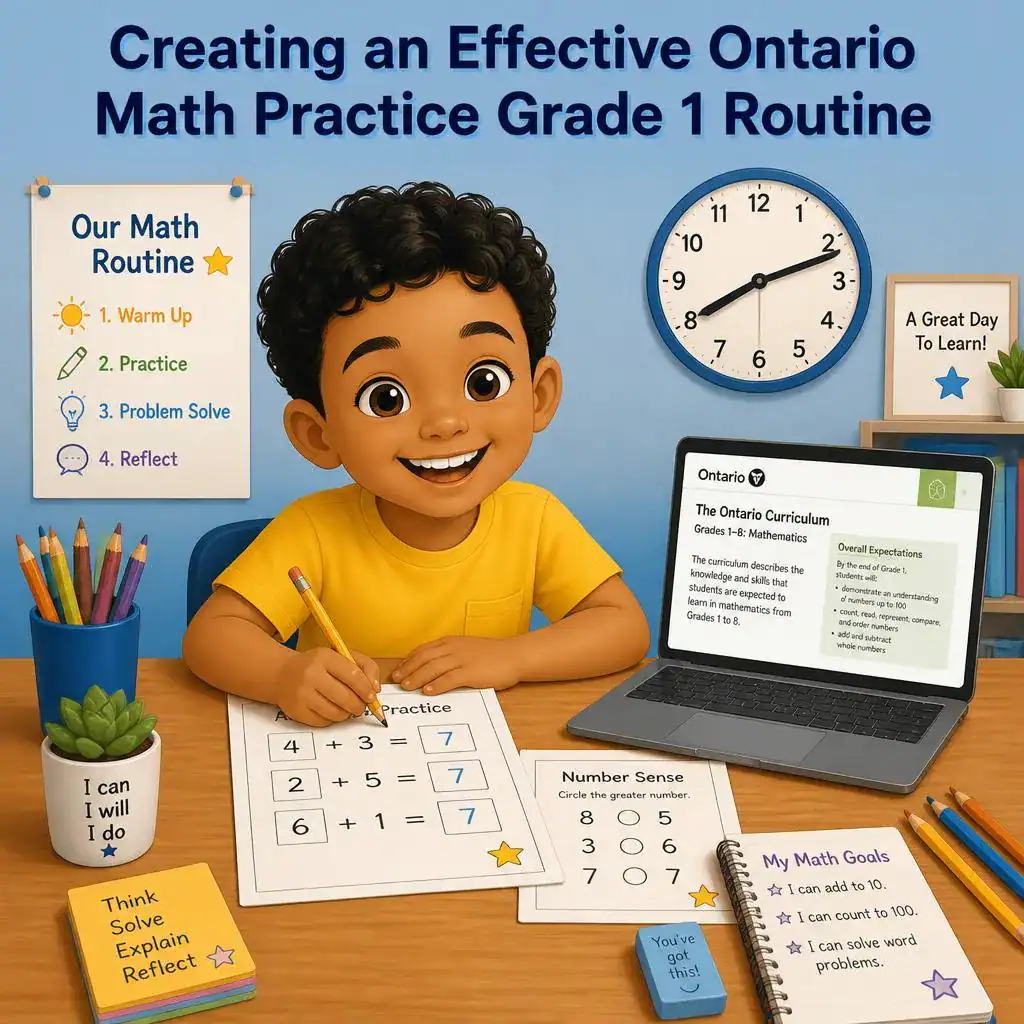
Consistency is far more important than lengthy study sessions. A child who practices Ontario math practice Grade 1 for just 15–20 minutes a day is often more successful than one who spends an hour on math only once a week.
The secret is to keep practice predictable, positive, and varied.
A Simple Weekly Math Schedule
The following plan aligns well with the expectations for Grade 1 math Ontario while keeping children engaged.
| Day | Focus | Activity |
|---|---|---|
| Monday | Number Sense | Counting games and number lines |
| Tuesday | Addition & Subtraction | Flash cards, dice games, word problems |
| Wednesday | Geometry | Shape hunt around the house |
| Thursday | Measurement | Measure household objects with rulers or blocks |
| Friday | Patterns & Algebra | Create patterns using toys or colored beads |
| Saturday | Real-Life Math | Grocery shopping, cooking, or budgeting activities |
| Sunday | Review | Fun quiz, board game, or math app |
This schedule balances review with new learning and prevents children from becoming overwhelmed.
Common Mistakes Parents Make During Ontario Math Practice Grade 1
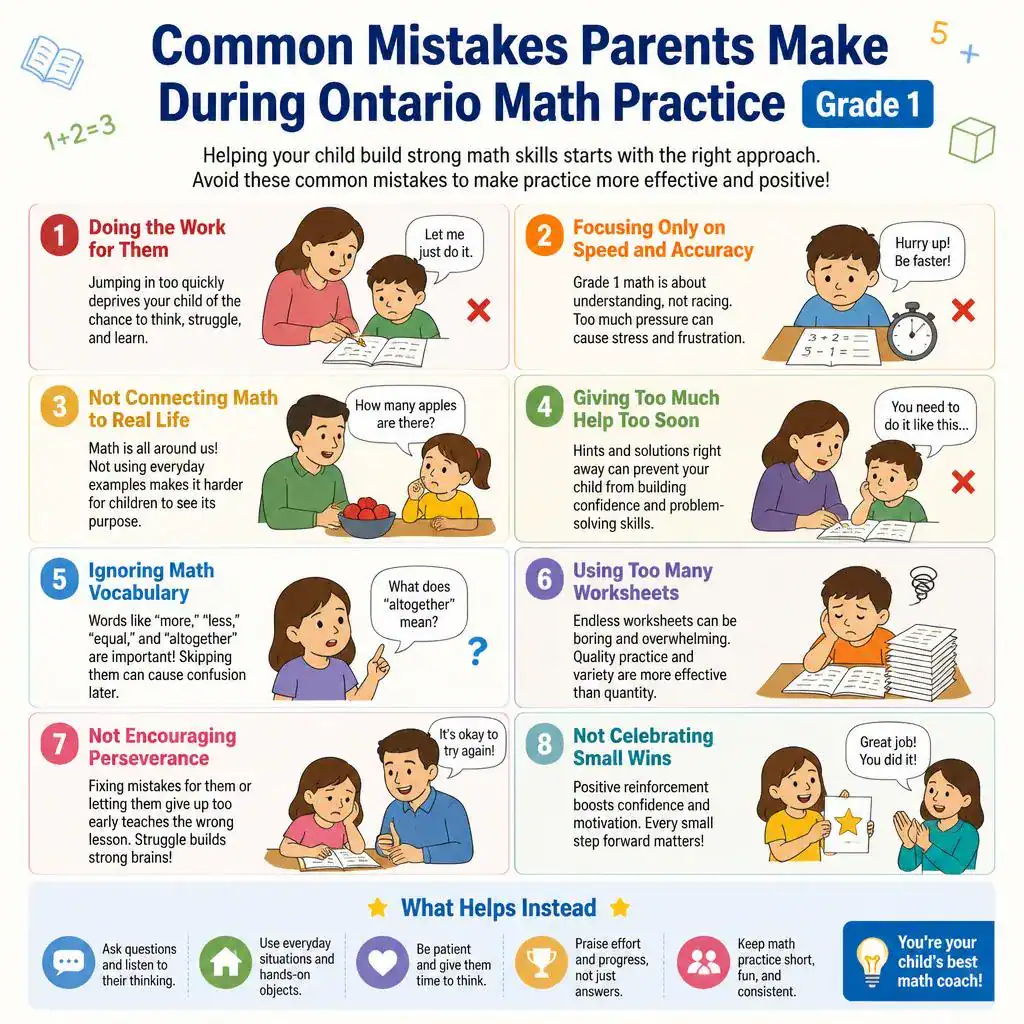
Even with the best intentions, parents sometimes make choices that can unintentionally slow a child’s progress.
Recognizing these common pitfalls can help make Ontario math practice Grade 1 more effective and enjoyable.
1. Focusing Only on Correct Answers
Ontario classrooms encourage children to explain how they reached an answer.
For example, instead of simply asking:
“What is 9 + 8?”
Ask:
“Can you show me another way to solve it?”
Children who explain their thinking develop stronger reasoning skills and deeper mathematical understanding.
2. Practicing for Too Long
Young children have limited attention spans.
A focused 20-minute session is usually much more productive than an hour of repetitive worksheets.
When children become tired, mistakes increase and confidence often decreases.
3. Comparing Children
Every child learns at a different pace.
Statements such as:
- “Your friend already knows this.”
- “Your brother learned this faster.”
can reduce motivation and increase math anxiety.
Instead, compare today’s progress with your child’s own previous performance.
4. Memorizing Without Understanding
Memorizing addition facts has value—but understanding why they work matters even more.
For example:
Instead of memorizing:
8 + 7 = 15
Help children discover:
- 8 + 2 = 10
- 10 + 5 = 15
This flexible thinking strengthens number sense.
5. Making Math Feel Like Punishment
Math should never become a consequence.
Avoid saying things like:
“If you don’t behave, you’ll do extra math.”
Children should associate mathematics with curiosity, confidence, and success—not stress.
The Best Home Resources for Grade 1 Math Ontario
Parents don’t need expensive tutoring programs to support math practice Grade 1. Many effective resources are already available at home.
Printable Worksheets
Well-designed worksheets can reinforce classroom learning when used in moderation.
Look for worksheets that include:
- Number bonds
- Ten frames
- Word problems
- Canadian money
- Patterns
- Measurement activities
- Picture graphs
Aim for quality over quantity—two thoughtful pages are often more beneficial than twenty repetitive ones.
Hands-On Learning Tools
Concrete materials help children visualize mathematical concepts.
Useful manipulatives include:
- Linking cubes
- Base-ten blocks
- Counters
- Dice
- Dominoes
- Number lines
- Playing cards
- Measuring tapes
- Pattern blocks
Many household items, such as buttons, LEGO® bricks, or pasta shapes, can also be used effectively.
Educational Games
Games transform practice into play.
Popular options include:
- Bingo with numbers
- Memory matching
- Uno
- Snakes and Ladders
- Domino games
- Card sorting activities
These games naturally develop counting, addition, comparison, and strategic thinking.
How Ontario Teachers Assess Grade 1 Mathematics
Many parents imagine traditional math tests with rows of arithmetic questions. However, assessment in Grade 1 math Ontario is much broader.
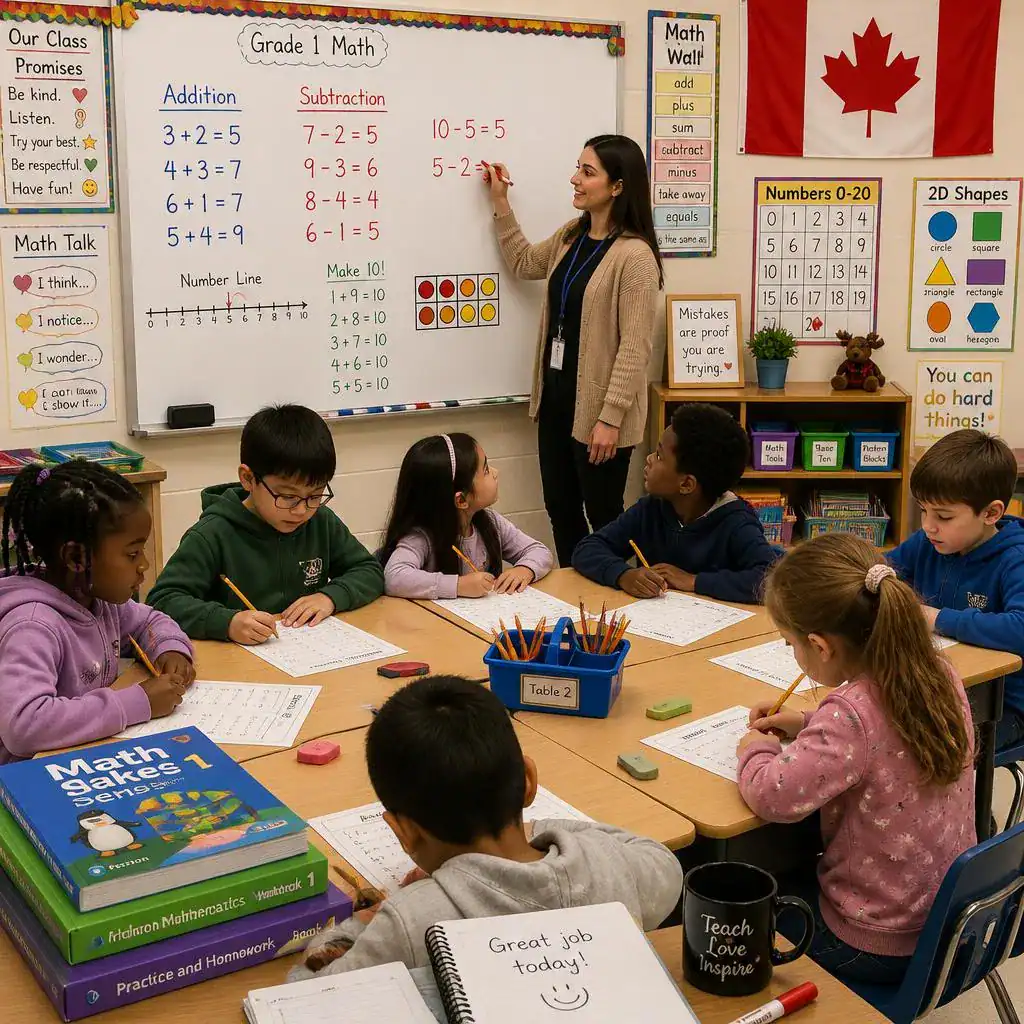
Teachers gather evidence through:
- Classroom observations
- Conversations with students
- Independent work
- Small-group activities
- Problem-solving tasks
- Learning journals
Children are often asked questions such as:
- “How did you solve that?”
- “Can you think of another strategy?”
- “Why does your answer make sense?”
The emphasis is on reasoning, communication, and conceptual understanding.
What Teachers Look For
Assessment typically focuses on whether a child can:
- Explain mathematical thinking
- Apply concepts to new situations
- Solve everyday problems
- Use mathematical vocabulary correctly
- Choose appropriate strategies
- Check their own work
Accuracy matters, but understanding is equally important.
Research-Based Strategies That Improve Math Achievement
Recent educational research continues to reinforce the importance of active, meaningful learning.
Spaced Practice
Studies published in 2024 found that reviewing mathematical concepts over multiple shorter sessions improves long-term retention more effectively than “cramming.”
Instead of completing 50 addition questions in one evening, children benefit more from practicing 10 questions over five days.
Retrieval Practice
Rather than constantly reviewing examples, ask children to recall information from memory.
For example:
“What strategies do you remember for adding 9?”
This strengthens memory pathways and improves confidence.
Visual Learning
Young learners understand mathematics more deeply when they see it represented visually.
Helpful tools include:
- Number lines
- Hundreds charts
- Ten frames
- Base-ten blocks
- Picture models
- Graphs
Visual models bridge the gap between concrete objects and abstract numbers.
Growth Mindset
Research in educational psychology consistently shows that children who believe they can improve through effort are more resilient learners.
Instead of saying:
“You’re so smart.”
Try:
“I’m proud of how hard you worked.”
This simple shift encourages persistence and reduces fear of mistakes.
Helping Children Who Struggle with Math Practice
Not every child learns mathematics at the same pace—and that’s perfectly normal.
If your child finds Ontario math practice Grade 1 challenging, focus on building understanding before increasing difficulty.
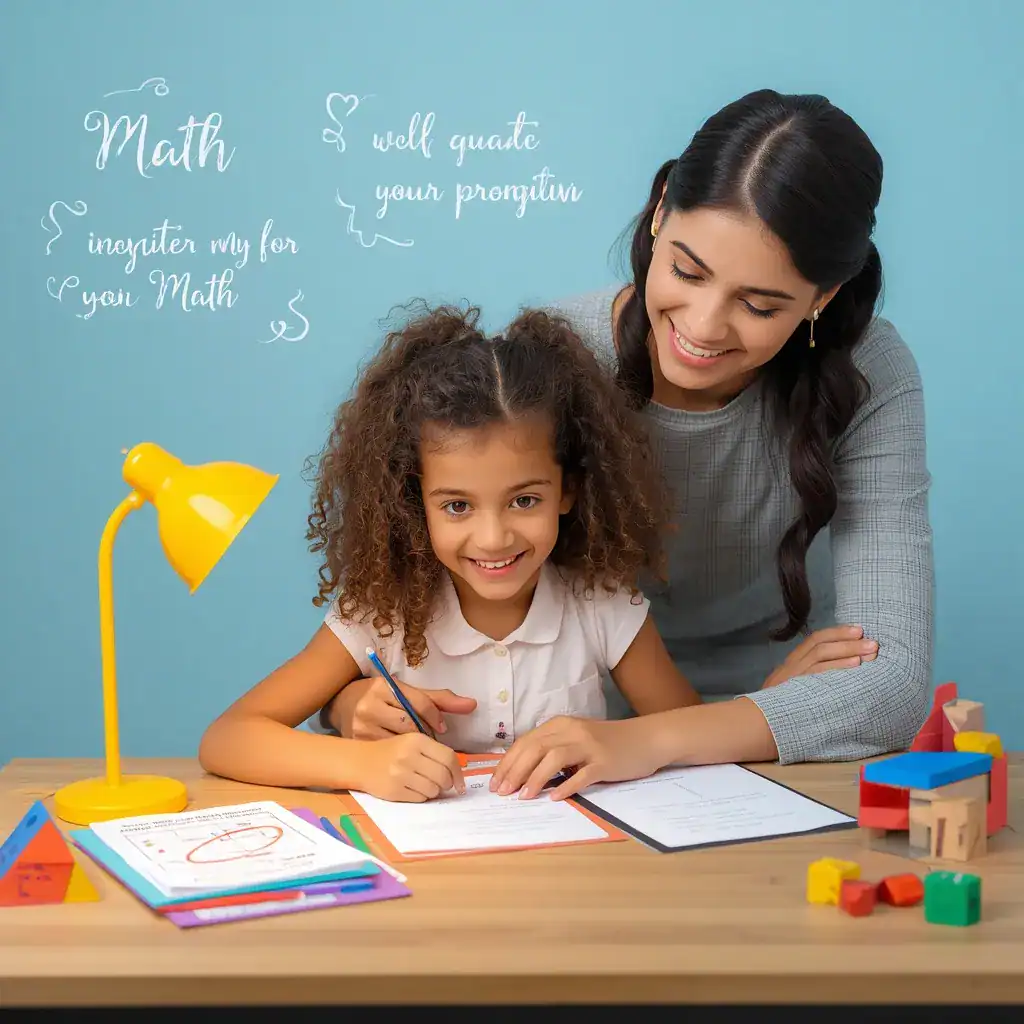
Break Problems into Smaller Steps
Instead of presenting ten questions at once, try one problem at a time.
For example:
Step 1: Count the objects.
Step 2: Write the number.
Step 3: Add one more.
This gradual approach prevents children from feeling overwhelmed.
Use Everyday Opportunities
Math is everywhere.
Ask questions like:
- How many forks do we need?
- Which glass is taller?
- How many steps to the mailbox?
- Which cereal box is heavier?
Real-life contexts make abstract concepts meaningful.
Celebrate Mistakes
Mistakes reveal how children think.
When an answer is incorrect, ask:
“What made you think that?”
This opens valuable conversations and helps identify misconceptions without damaging confidence.
Screen Time vs. Printable Practice: Which Is Better?
Parents often wonder whether digital learning or traditional worksheets produce better results.
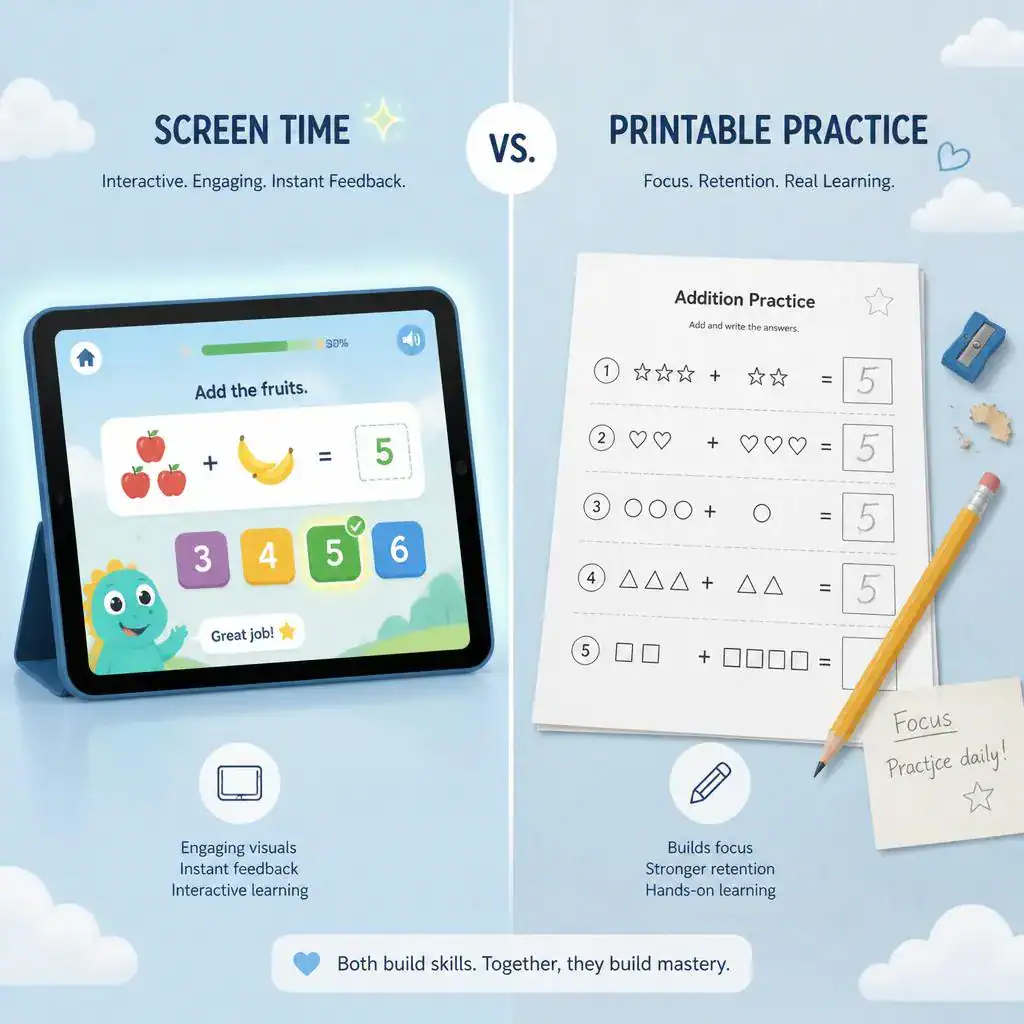
The answer is: both have advantages when used appropriately.
| Digital Activities | Printable Activities |
|---|---|
| Interactive feedback | Improves handwriting |
| Engaging animations | Fewer distractions |
| Adaptive difficulty | Better for showing work |
| Gamified learning | Encourages deeper thinking |
| Motivating rewards | Easier for parent review |
A balanced approach works best.
For example:
- Two days using an educational math app
- Three days with hands-on activities
- Two days using printable worksheets
This variety keeps learning fresh.
Building Confidence Through Positive Math Habits
Confidence often predicts success more than natural ability.
Parents can nurture positive attitudes by creating a supportive environment.
Try these simple habits:
- Praise effort rather than perfection.
- Encourage children to explain their reasoning.
- Let them solve problems independently before offering help.
- Celebrate small improvements.
- Read math-themed storybooks together.
- Use encouraging language like, “Let’s figure it out together.”
Over time, these habits help children view challenges as opportunities rather than obstacles.
Signs Your Child Is Ready for Grade 2 Math
By the end of Grade 1, many students can:
- Count well beyond 100.
- Add and subtract within 20 using multiple strategies.
- Recognize common 2D and 3D shapes.
- Read simple graphs.
- Measure and compare objects.
- Tell time to the hour and half-hour.
- Identify Canadian coins.
- Solve basic word problems independently.
- Explain how they reached an answer.
If your child demonstrates most of these skills consistently, they’re well prepared for the increasing complexity of Grade 2 mathematics.
Expert Tips to Make Ontario Math Practice Grade 1 More Effective
After working with elementary learners and analyzing the latest recommendations from mathematics educators, one thing is clear: children learn best when math becomes part of everyday life instead of a separate school subject.
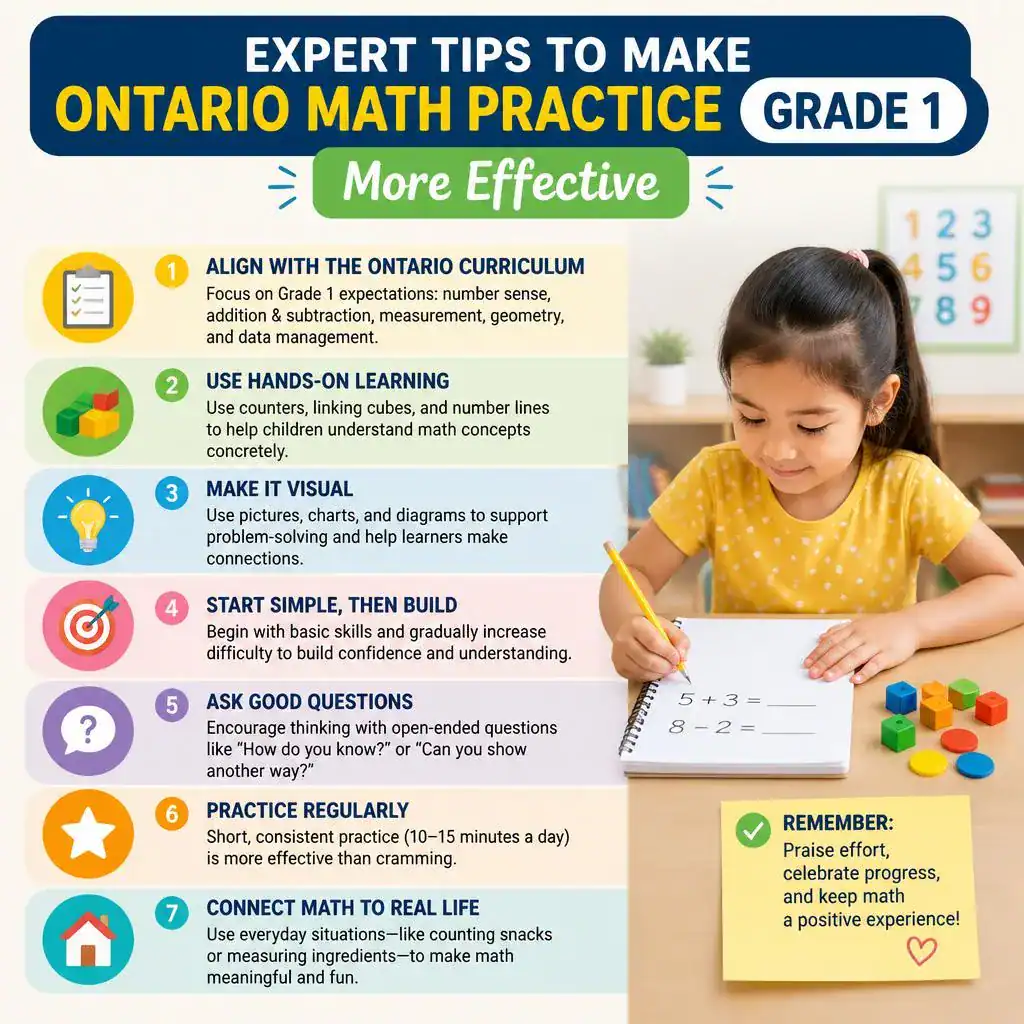
Here are some practical strategies that consistently help families get the most from Ontario math practice Grade 1.
Ask “Why?” Instead of “What’s the Answer?”
When your child solves a problem, encourage them to explain their thinking.
For example:
Parent: “How did you know 13 + 6 equals 19?”
Child: “I made 20 first by adding 7, then I took one away.”
This conversation strengthens mathematical reasoning far more than simply checking whether the answer is correct.
Use Positive Math Language
Children often adopt the attitudes they hear from adults.
Instead of saying:
- “I was never good at math.”
Try saying:
- “Math takes practice, and every mistake helps us learn.”
A positive mindset reduces anxiety and builds resilience.
Mix Easy and Challenging Problems
A good practice session includes both review and new learning.
For example:
- 5 familiar questions
- 2 slightly more difficult questions
- 1 fun challenge
This approach keeps confidence high while encouraging growth.
Keep Learning Playful
Young children thrive when learning feels like exploration rather than homework.
Try activities such as:
- Treasure hunts using numbers
- Board games with counting
- Building shapes with LEGO® bricks
- Measuring ingredients while baking
- Estimating the number of objects in a jar
- Outdoor scavenger hunts involving patterns and shapes
These experiences reinforce math practice kids Ontario in meaningful and memorable ways.
How Ontario Math Practice Grade 1 Builds Future Success
The skills children develop in Grade 1 extend far beyond mathematics.
Strong mathematical foundations support learning in many other areas, including:
- Science
- Technology
- Engineering
- Financial literacy
- Computer programming
- Data analysis
- Everyday decision-making
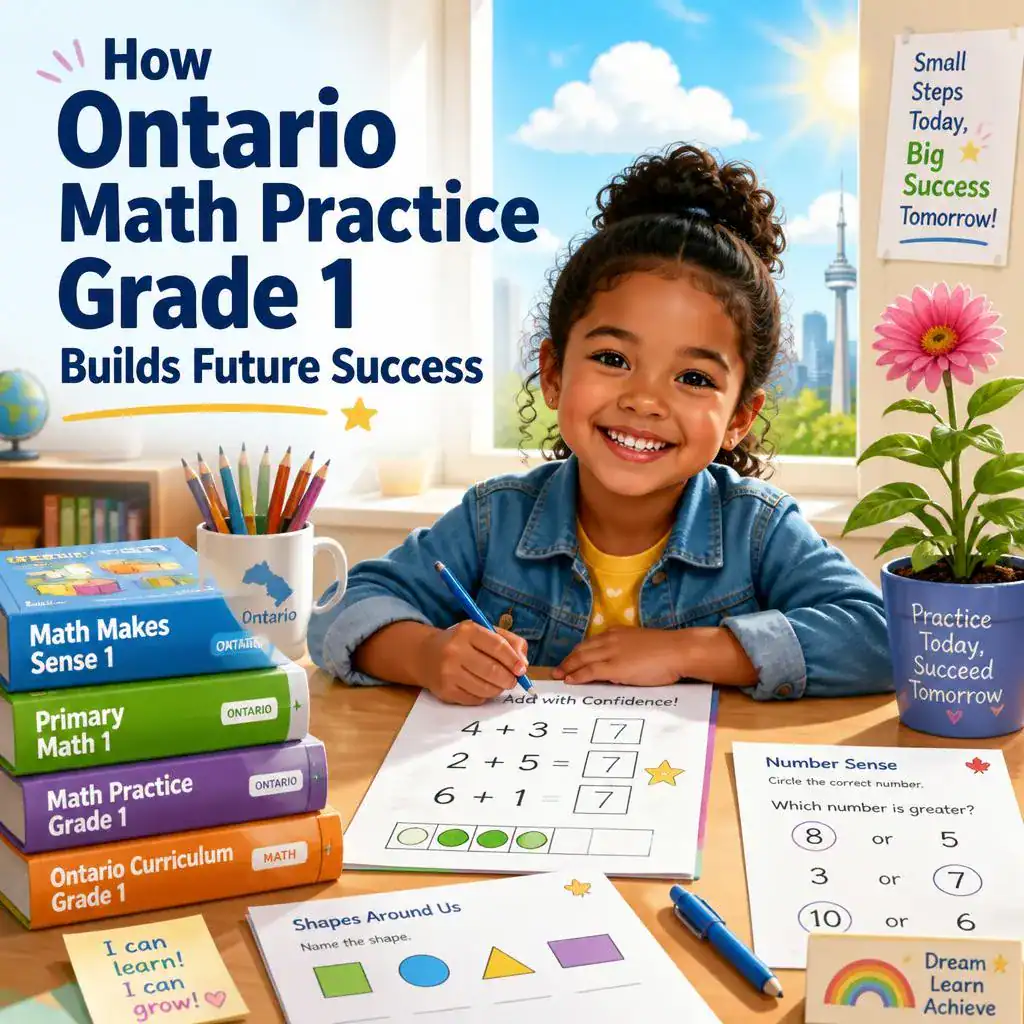
Children who understand numbers and patterns are often better prepared to solve problems, think critically, and approach challenges with confidence.
This is one reason the Ontario curriculum emphasizes conceptual understanding instead of rote memorization. By encouraging students to explain their reasoning and apply math in real-life situations, schools help build lifelong learning skills that support success across the curriculum. You can read Boost Ontario Math Practice Grade 2 Skills.
Frequently Asked Questions About Ontario Math Practice Grade 1
1. How much should my child practice math each day?
Most Grade 1 students benefit from 15–20 minutes of focused math practice on school days. Short, consistent sessions are generally more effective than occasional long study periods. The goal is to build confidence and maintain a positive attitude toward learning.
2. What topics should Grade 1 students know in Ontario?
Students should develop skills in:
- Number sense
- Place value
- Addition and subtraction within 20
- Patterns
- Measurement
- Geometry
- Time
- Canadian money
- Data collection and graphing
- Simple problem-solving
These topics reflect the expectations outlined in the Ontario elementary mathematics curriculum.
3. What are the best ways to practice math at home?
Children often learn best through everyday experiences.
Excellent activities include:
- Playing card and dice games
- Measuring ingredients while cooking
- Counting objects during shopping trips
- Solving simple word problems
- Using printable worksheets
- Exploring educational math apps
- Building with blocks or pattern pieces
Combining hands-on learning with structured review creates a balanced routine.
4. My child struggles with addition. What should I do?
Focus on understanding rather than memorization.
Use objects such as counters, blocks, or coins to model addition problems visually. Encourage your child to explain each step and celebrate progress instead of speed. If difficulties continue, speak with your child’s teacher to identify specific areas for additional support.
5. Are worksheets enough for Ontario math practice Grade 1?
No. Worksheets are useful for reinforcing skills, but they should be only one part of a well-rounded learning plan.
Children also benefit from:
- Hands-on manipulatives
- Real-life math experiences
- Games
- Mathematical conversations
- Outdoor exploration
- Interactive digital activities
Variety keeps children engaged and promotes deeper understanding.
6. How can I tell if my child is making progress?
Signs of progress include:
- Solving familiar problems with increasing confidence
- Explaining mathematical thinking clearly
- Using different strategies to find answers
- Completing everyday math tasks independently
- Showing curiosity about numbers and patterns
- Making fewer counting errors over time
Progress is not always measured by speed. Confidence and understanding are equally important.
7. What should I do if my child finds math frustrating?
Stay patient and keep sessions short.
Break larger problems into smaller steps, use games instead of drills, and praise effort rather than perfection. If frustration continues for an extended period, consult your child’s teacher to discuss additional strategies or resources that may be helpful.
8. Why is Ontario’s approach to mathematics different from traditional methods?
Ontario emphasizes conceptual understanding, communication, and problem-solving. Instead of simply memorizing procedures, students learn to explain their reasoning, explore multiple solution strategies, and apply mathematics to real-world situations. This approach helps children develop flexible thinking and prepares them for more advanced mathematical learning.
Conclusion
Building strong mathematical skills in Grade 1 doesn’t require expensive programs or hours of homework. What matters most is providing consistent, engaging, and meaningful opportunities to learn.
By following the principles of Ontario math practice Grade 1, parents can help children develop confidence, curiosity, and a genuine understanding of mathematics. Whether you’re counting coins at the grocery store, measuring ingredients in the kitchen, or solving a few Grade 1 math questions before bedtime, every small learning moment contributes to long-term success.
Remember that progress looks different for every child. Celebrate effort, encourage questions, and focus on understanding rather than speed. Over time, these habits will strengthen not only mathematical skills but also critical thinking, resilience, and a lifelong love of learning.
If you’re looking for additional Grade 1 math Ontario resources, printable worksheets, or engaging activities aligned with the Ontario curriculum, continue exploring trusted educational materials designed specifically for young learners. With the right support and regular Ontario math practice Grade 1, your child will be well prepared for Grade 2 and beyond.
Key Takeaways
- Daily Ontario math practice Grade 1 sessions of 15–20 minutes are highly effective.
- Focus on conceptual understanding, not just memorizing answers.
- Use everyday activities to make math meaningful and enjoyable.
- Encourage children to explain their reasoning and explore multiple solution strategies.
- Combine worksheets, games, manipulatives, and real-life experiences for balanced learning.
- Celebrate effort and progress to build confidence and reduce math anxiety.
- A strong Grade 1 foundation supports future success in mathematics, science, technology, and beyond.