Grade 6 Volume Rectangular Prisms Cubes: 7 Real Steps
Grade 6 Volume Rectangular Prisms Cubes Ontario work is exactly where a student who's confidently mastered surface area sometimes stalls completely, the moment volume shows up right next door in the same unit.A student who’s confidently mastered surface area sometimes stalls completely the moment volume shows up right next door in the same unit. The two concepts sound related, use some of the same numbers, and yet answer genuinely different questions — one measures the outside covering of a shape, the other measures the space filling it up. Grade 6 volume rectangular prisms cubes work covers exactly this skill, and getting the two ideas untangled from each other matters more than memorizing either formula in isolation.
This guide walks through Grade 6 volume rectangular prisms cubes concepts from the ground up, using the same real-object approach that made surface area click, plus fully worked practice questions with verified answers.
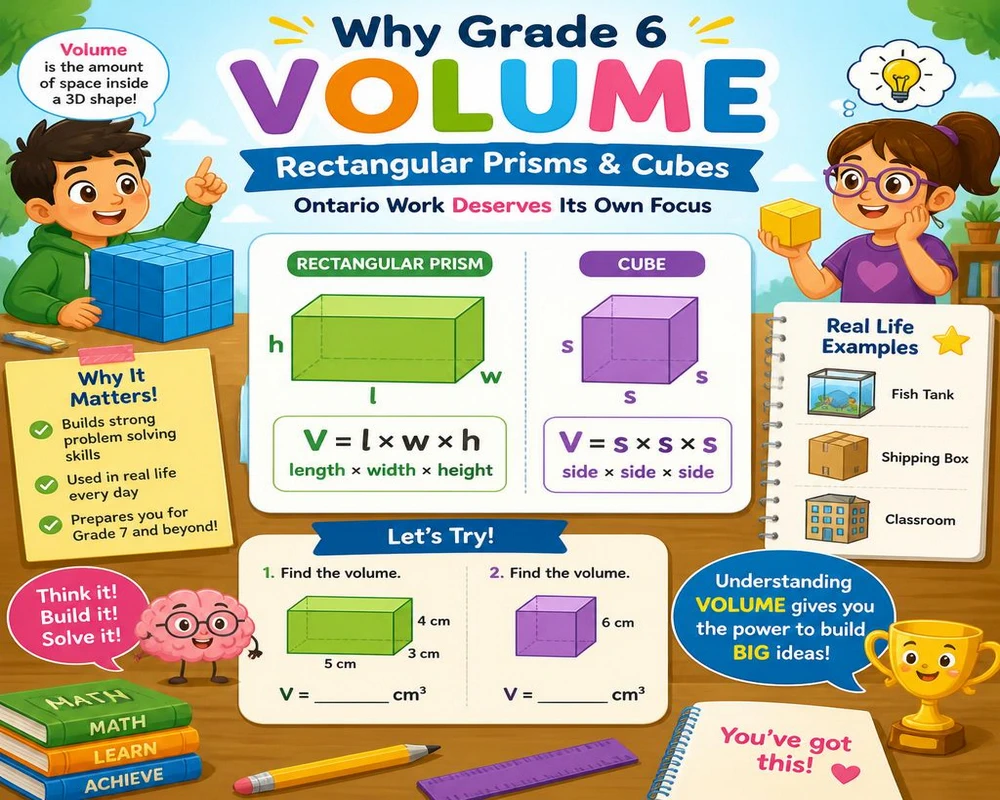
Why Grade 6 Volume Rectangular Prisms Cubes Ontario Work Deserves Its Own Focus
Ontario’s curriculum places volume alongside surface area within the Spatial Sense strand in Grade 6, expecting students to calculate the volume of rectangular prisms and cubes using cubic units, and to understand volume as a genuinely distinct measurement from area or surface area. Since both topics appear in the same unit, using nearly identical shapes, students frequently blend the two together rather than treating them as separate skills. This is exactly why Grade 6 volume rectangular prisms cubes practice benefits from a deliberate, step-by-step approach rather than jumping straight to a memorized formula.
What the Ontario Curriculum Expects in Grade 6
By the end of Grade 6, students are generally expected to:
- Understand volume as the amount of space a 3D shape occupies, measured in cubic units
- Calculate the volume of a rectangular prism by multiplying length, width, and height
- Calculate the volume of a cube using the same formula, since all three dimensions are equal
- Correctly use cubic units (cm³, m³) rather than square units
- Solve real-world problems involving volume, including finding a missing dimension
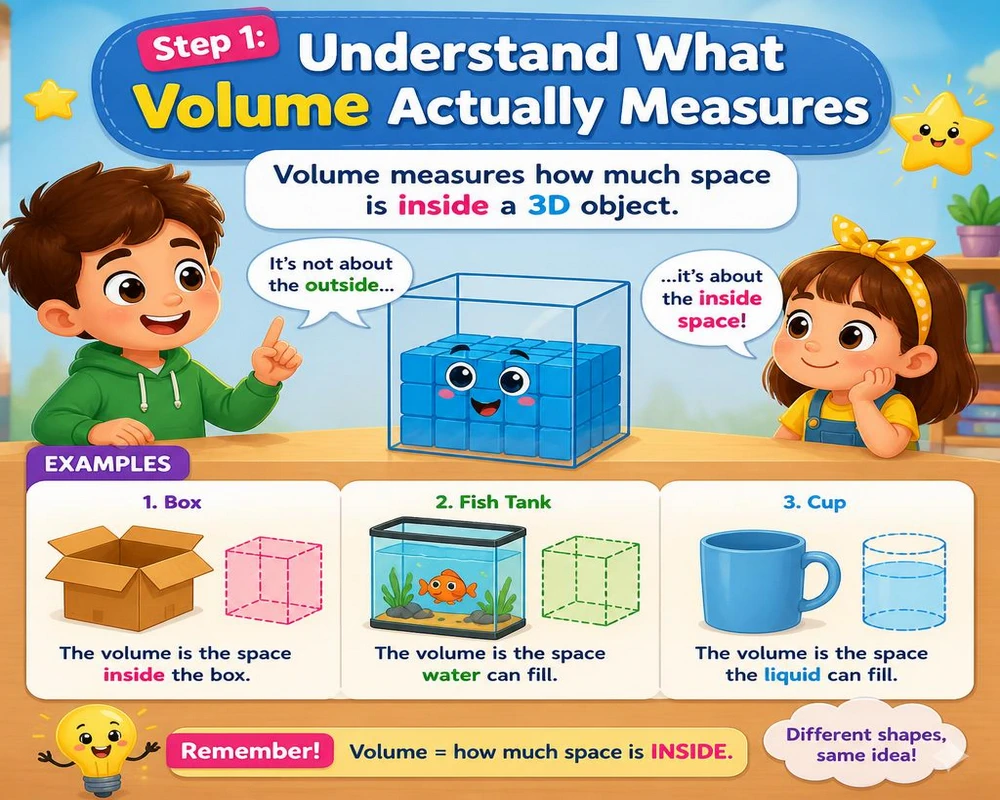
Step 1: Understand What Volume Actually Measures
Volume answers a different question than area or surface area entirely — not “how big is this shape’s surface,” but “how much space is inside this shape.” Filling a box with unit cubes and counting them is the most direct, physical way to understand this before any formula gets involved.
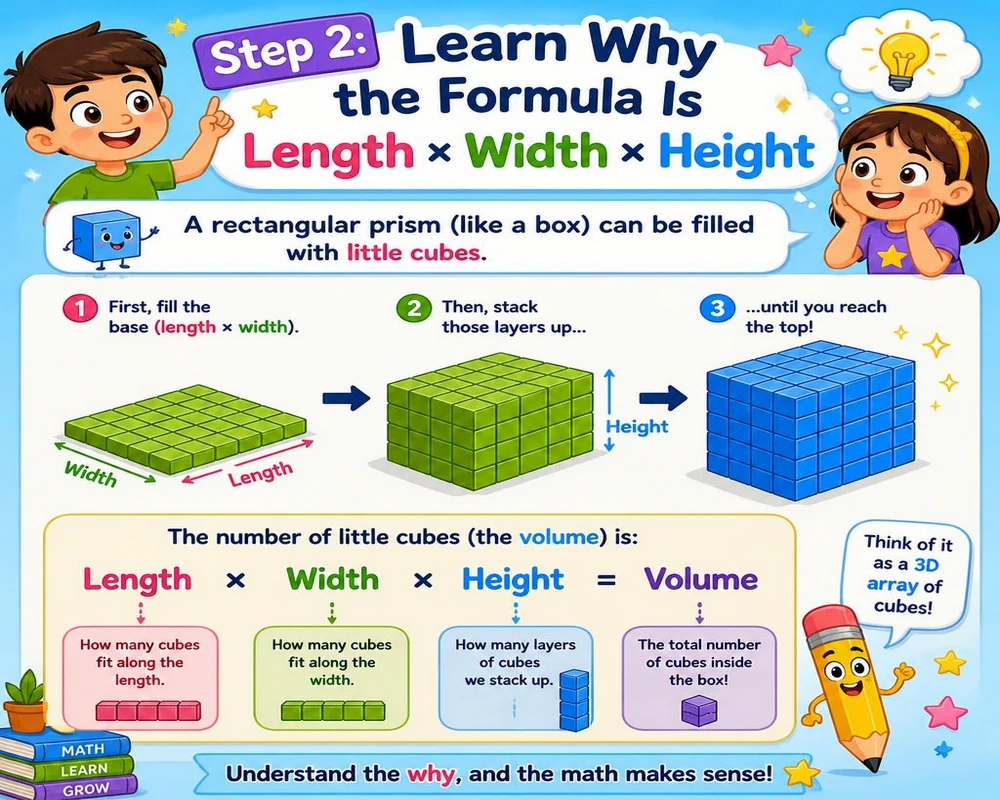
Step 2: Learn Why the Formula Is Length × Width × Height
The volume formula isn’t an arbitrary rule to memorize — it comes directly from counting layers. If a box’s base holds 20 unit cubes (length × width), and the box is 10 cubes tall, then 10 identical layers of 20 cubes each fills the whole box: 20 × 10 = 200 cubes total. Understanding this layering logic, rather than just multiplying three numbers together, is what makes Grade 6 volume rectangular prisms cubes work genuinely stick rather than fade after the test.
This worked example shows exactly how Grade 6 Volume Rectangular Prisms Cubes Ontario questions typically look on a real assessment.
Step 3: Work Through a Real Object
Worked Example: A Shipping Box
A shipping box measures 20 cm long, 15 cm wide, and 10 cm tall. What is its volume?
Calculation: 20 × 15 × 10 = 3,000 cm³
Answer: The box holds 3,000 cubic centimetres of space.
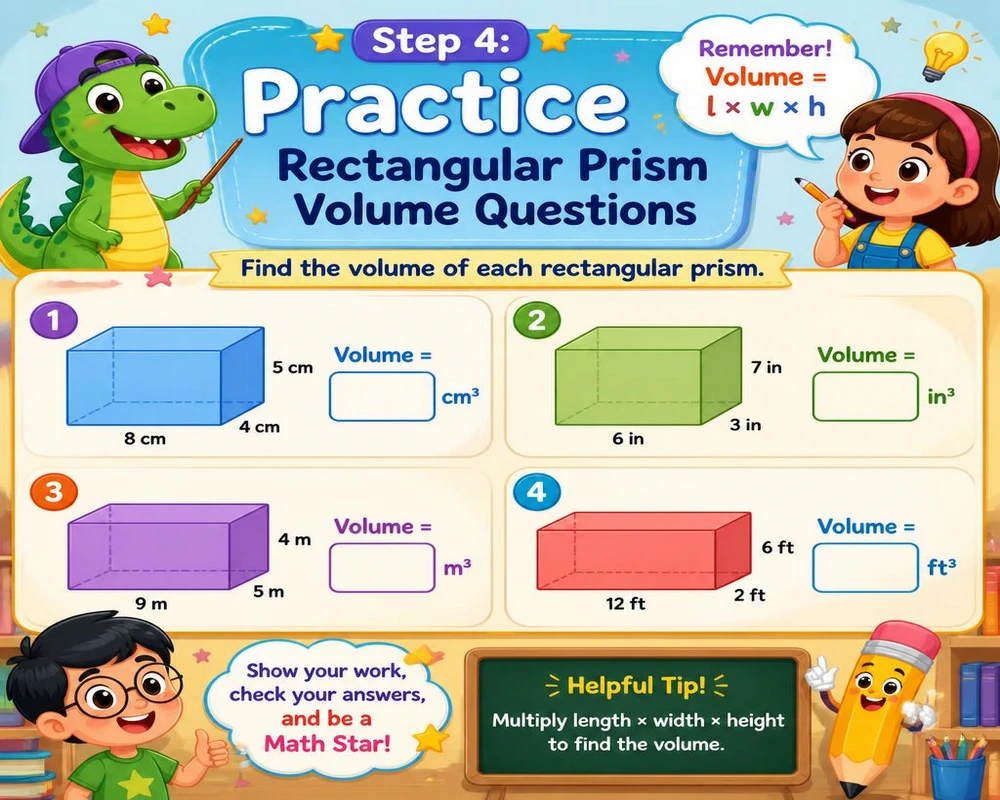
Step 4: Practice Rectangular Prism Volume Questions
These next two questions give more practice with Grade 6 Volume Rectangular Prisms Cubes Ontario problems using different dimensions.
- A box measures 8 cm by 5 cm by 4 cm. What is its volume?
- A container measures 12 cm by 6 cm by 3 cm. What is its volume?
Answers: 1) 160 cm³ 2) 216 cm³
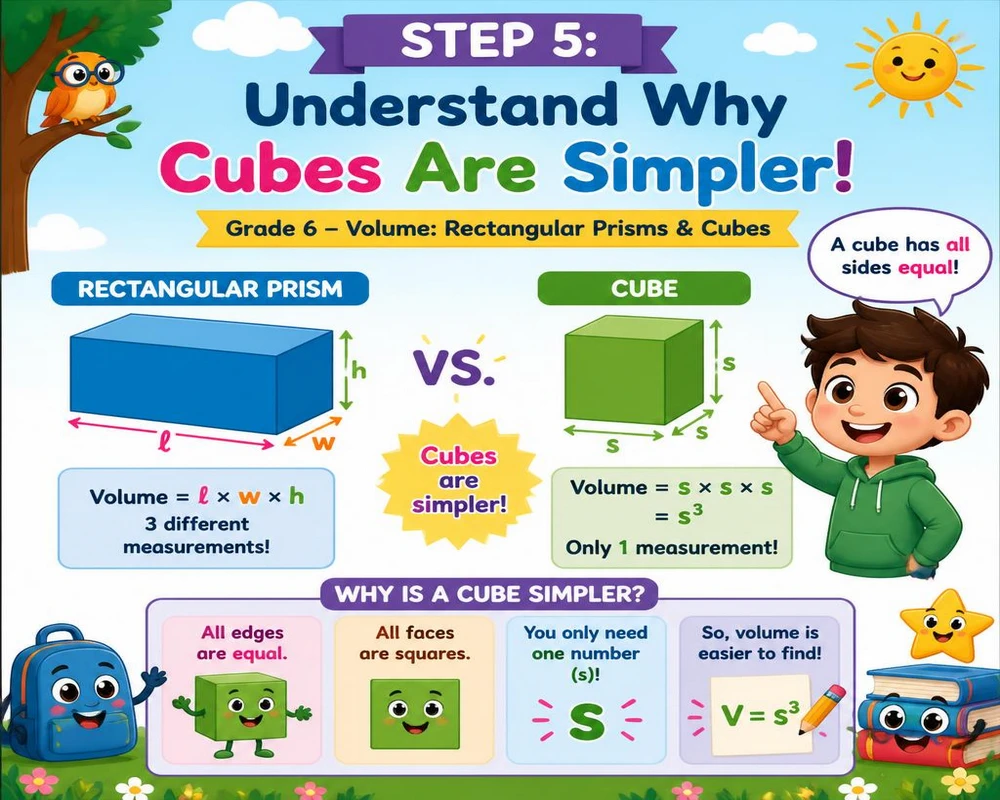
Step 5: Understand Why Cubes Are Simpler in Grade 6 Volume Rectangular Prisms Cubes Work
A cube is simply a rectangular prism where every side is identical, which means the volume formula simplifies to side × side × side, rather than requiring three different measurements.
Practice Questions
- A cube has sides of 6 cm. What is its volume?
- A cube has sides of 9 cm. What is its volume?
Answers: 1) 216 cm³ 2) 729 cm³
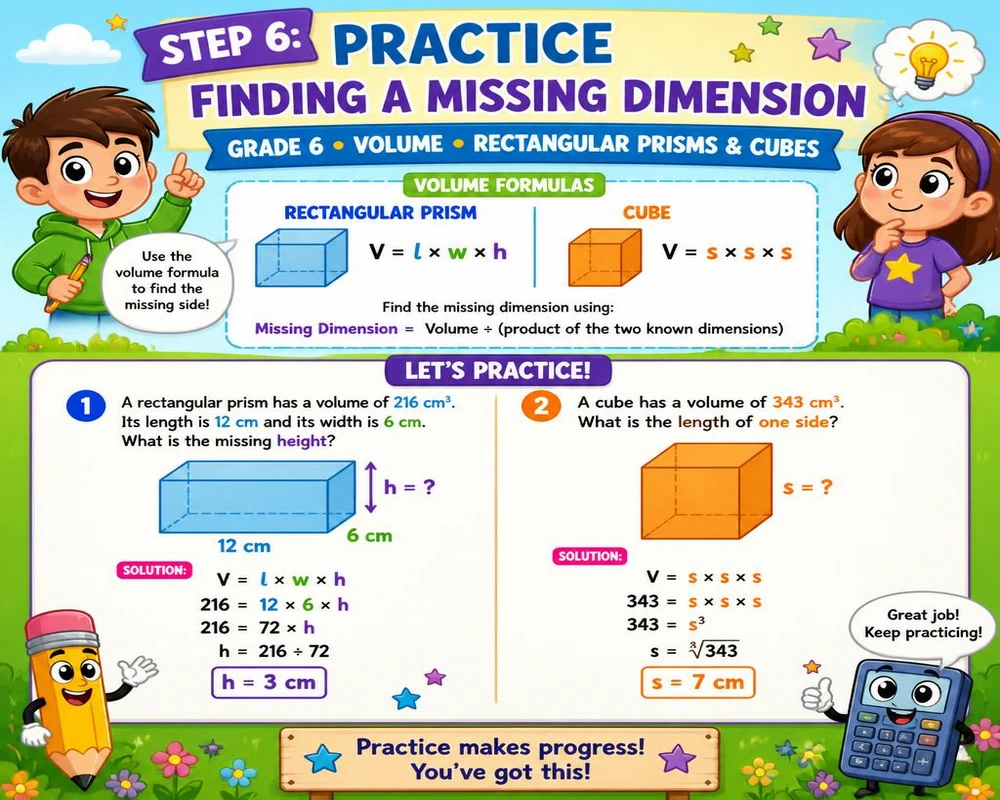
Step 6: Practice Finding a Missing Dimension in Grade 6 Volume Rectangular Prisms Cubes Problems
Once the basic formula feels solid, Grade 6 volume rectangular prisms cubes questions often flip the problem around, giving the total volume and two dimensions while asking for the third. This reverse-thinking step is genuinely one of the more challenging parts of the unit, since it requires dividing rather than multiplying.
Worked Example
A box has a volume of 240 cm³, a length of 8 cm, and a width of 5 cm. What is its height?
Calculation: 240 ÷ (8 × 5) = 240 ÷ 40 = 6 cm
Answer: The box is 6 cm tall.
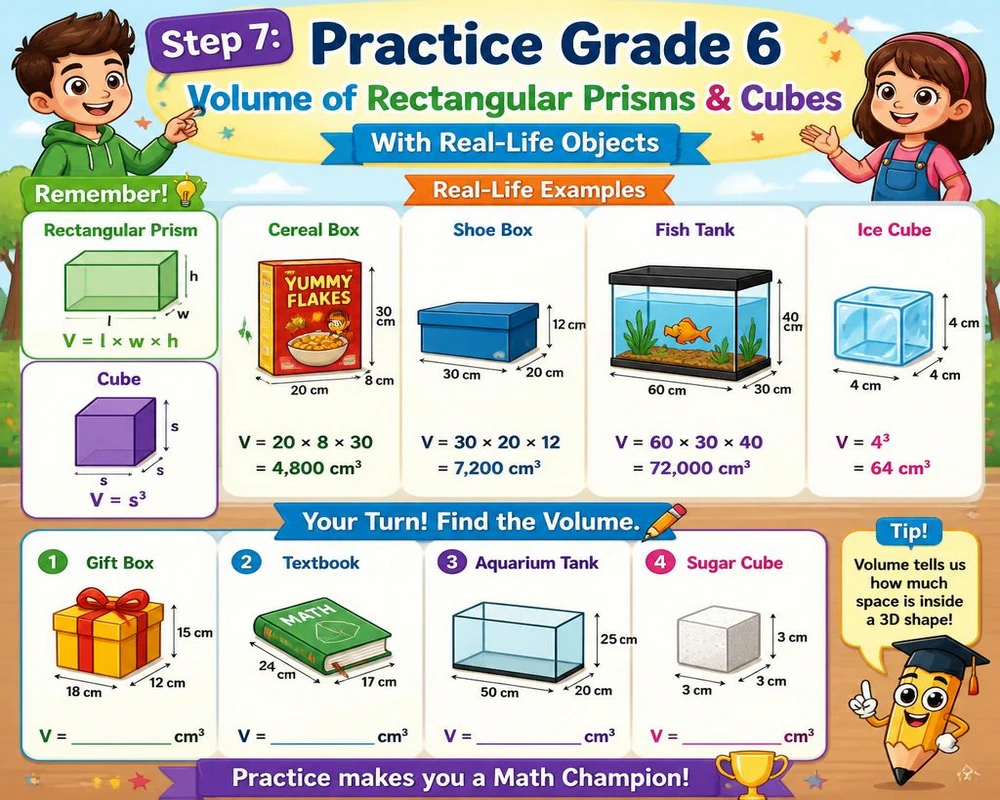
Step 7: Practice Grade 6 Volume Rectangular Prisms Cubes With Real-Life Objects
- A fish tank measures 40 cm by 25 cm by 30 cm. What is its volume in cubic centimetres, and how many litres of water does it hold (1,000 cm³ equals 1 litre)?
- A cube-shaped storage bin has sides of 2 metres. What is its volume?
- A sandbox measures 3 m long, 2 m wide, and 0.5 m deep. What is its volume?
Answers: 1) 30,000 cm³, which equals 30 litres 2) 8 m³ 3) 3 m³
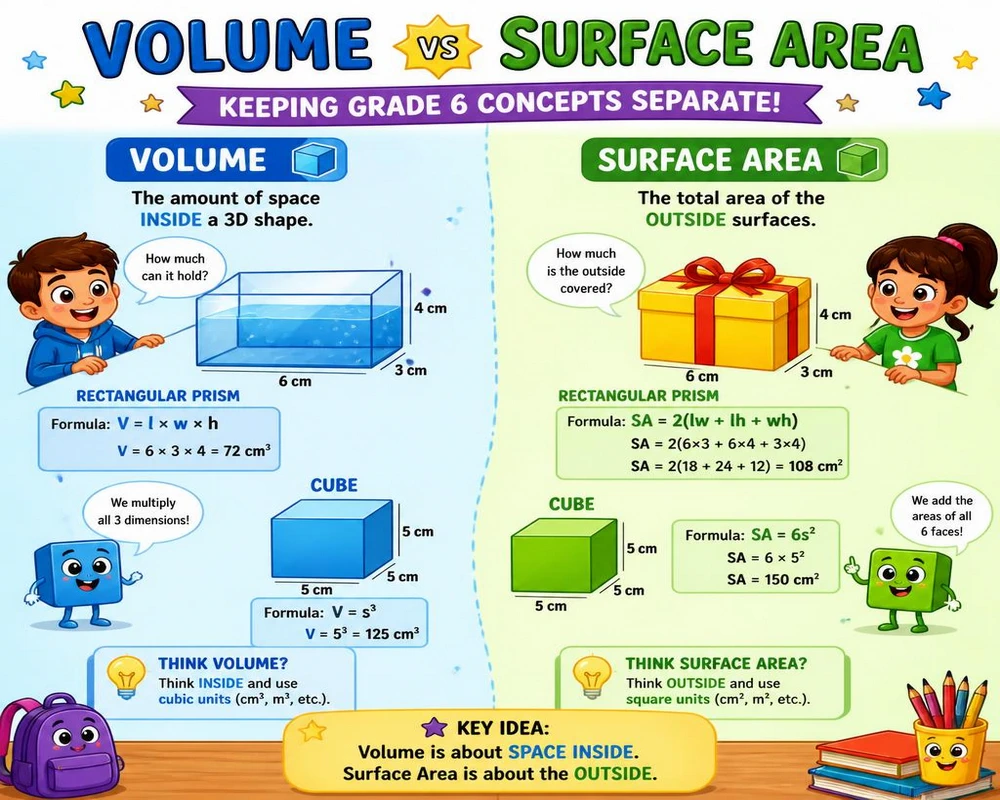
Volume vs Surface Area: Keeping Grade 6 Volume Rectangular Prisms Cubes Concepts Separate
This comparison table is one of the most useful tools for any Grade 6 Volume Rectangular Prisms Cubes Ontario student trying to keep the two concepts separate.
This side-by-side comparison is one of the most useful tools for keeping the two concepts distinct once both have been introduced in class.
| Question | Surface Area | Volume |
|---|---|---|
| What does it measure? | The outside covering of a shape | The space inside a shape |
| Units used | Square units (cm²) | Cubic units (cm³) |
| Real-world question | How much wrapping paper is needed? | How much water or sand fits inside? |
Keeping this table in mind while solving Grade 6 volume rectangular prisms cubes problems helps prevent the two concepts from blurring together, especially since both use the same shapes and similar-looking numbers.
Common Mistakes in Grade 6 Volume Rectangular Prisms Cubes Practice
Three specific errors account for most of the wrong answers seen in Grade 6 Volume Rectangular Prisms Cubes Ontario classrooms. Three specific errors account for most of the wrong answers seen in Grade 6 volume rectangular prisms cubes work.
Confusing Volume With Surface Area
Since both concepts appear in the same unit using identical shapes, students sometimes apply the surface area steps (finding and adding face areas) when the question actually asks for volume. Checking whether the question asks about “space inside” or “covering outside” resolves this quickly.
Using Square Units Instead of Cubic Units
Writing “cm²” instead of “cm³” is a small but meaningful error, since it signals a mix-up between area and volume even when the numerical answer itself is correct.
Forgetting to Divide When Finding a Missing Dimension
When given the volume and two dimensions, some students multiply instead of dividing to find the third dimension. Reinforcing that volume divided by the known base area gives the missing height helps prevent this.
Mastering Grade 6 Volume Rectangular Prisms Cubes Ontario curriculum expects alongside the existing surface area work rounds out the Spatial Sense strand completely.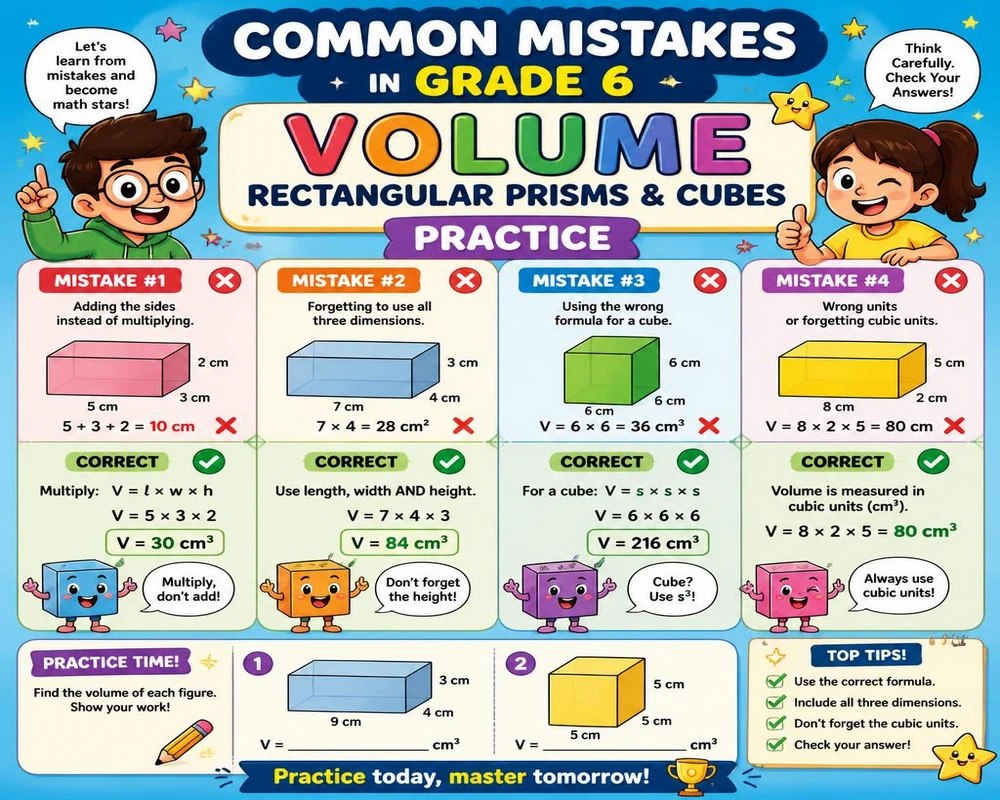
Frequently Asked Questions
1. What is the formula for the volume of a rectangular prism?
Volume equals length multiplied by width multiplied by height, expressed in cubic units like cm³ or m³. Within Grade 6 Volume Rectangular Prisms Cubes Ontario curriculum, volume equals length multiplied by width multiplied by height, expressed in cubic units like cm³ or m³.
2. How is the volume of a cube different from a rectangular prism?
A cube’s volume formula simplifies to side × side × side, since all three dimensions are identical, unlike a general rectangular prism with three different measurements.
3. Why do students confuse volume with surface area?
Both topics appear together in Grade 6 volume rectangular prisms cubes units using the same shapes, so without a clear conceptual anchor for each, it’s easy to apply the wrong set of steps to a given question.
4. What units should volume answers use?
Cubic units, written as cm³ or m³ depending on the original measurements, never square units like cm².
5. How can I help my child find a missing dimension?
Divide the total volume by the product of the two known dimensions to find the third, which is the reverse of the standard multiplication formula.
6. How much volume practice should we do at home?
About 15-20 minutes, a few times a week, tends to work well for Grade 6 volume rectangular prisms cubes practice, especially when paired with real boxes or containers around the house.
About 15-20 minutes, a few times a week, tends to work well for Grade 6 Volume Rectangular Prisms Cubes Ontario practice, especially when paired with real boxes or containers around the house.
7. How does this connect to Grade 7?
Grade 7 builds on volume with more complex composite shapes and triangular prisms, so a solid grasp of the basic rectangular prism and cube formulas now pays off directly.
Every Grade 6 Volume Rectangular Prisms Cubes Ontario student benefits from combining this step-by-step approach with the existing surface area lessons already covered this year.
Volume is one part of a full Grade 6 year that also includes surface area, ratios, and fractions. Mastering Grade 6 volume rectangular prisms cubes alongside the existing surface area work rounds out the Spatial Sense strand completely. Our Grade 6 math practice hub covers every topic in one place.
Interactive 3D modeling tools make volume far easier to visualize than static worksheets alone. Mathies, Ontario’s free suite of digital math tools, includes 3D solid tools built for exactly this stage of learning.