
Grade 6 Surface Area Practice: Build It, Then Calculate It
A flat cardboard net doesn’t look like much of anything until it folds into a box, and that single moment — watching six flat rectangles become one solid shape — is exactly what makes Grade 6 surface area practice finally click for a lot of students. Grade 6 surface area practice that skips straight to a formula misses this moment entirely, asking students to calculate the area of something they’ve never actually seen assembled.
This guide follows one real object, a cereal box, from its flat net all the way through a complete surface area calculation, then applies the same process to cubes and triangular prisms.
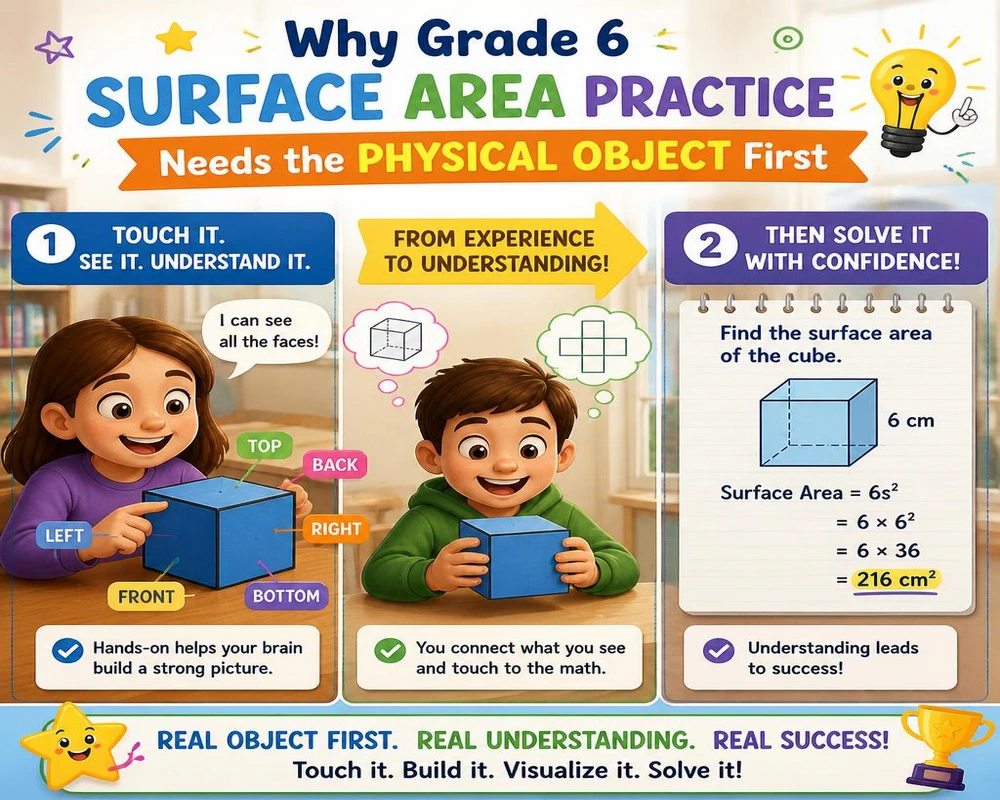
Why Grade 6 Surface Area Practice Needs the Physical Object First
Ontario’s curriculum expects Grade 6 students to calculate the surface area of rectangular prisms and other simple 3D solids by finding the area of each face and adding them together. This builds directly on the net-folding work from earlier grades, and skipping that physical connection tends to leave students applying a formula they don’t actually understand during Grade 6 surface area practice.
This matters because Grade 6 surface area practice is really just repeated area calculation, applied to every face of a shape, then added up. Students who already understand area of a rectangle are closer to this skill than they usually realize.
What the Ontario Curriculum Expects in Grade 6
By the end of Grade 6, students are generally expected to:
- Identify all the faces of a 3D solid from its net
- Calculate the area of each individual face
- Add face areas together to find total surface area
- Calculate surface area of rectangular prisms, cubes, and simple triangular prisms
- Solve real-world problems involving surface area
Following One Real Box From Net to Surface Area
The Object: A Cereal Box
A typical cereal box measures approximately 20 cm long, 7 cm wide, and 28 cm tall. Unfolded, it becomes a net of six rectangles — two of each size, since a rectangular prism always has three pairs of identical faces.
Step 1: Identify the Three Pairs of Faces
| Face Pair | Dimensions | Area of One Face |
|---|---|---|
| Top and bottom | 20 cm × 7 cm | 140 cm² |
| Front and back | 20 cm × 28 cm | 560 cm² |
| Two sides | 7 cm × 28 cm | 196 cm² |
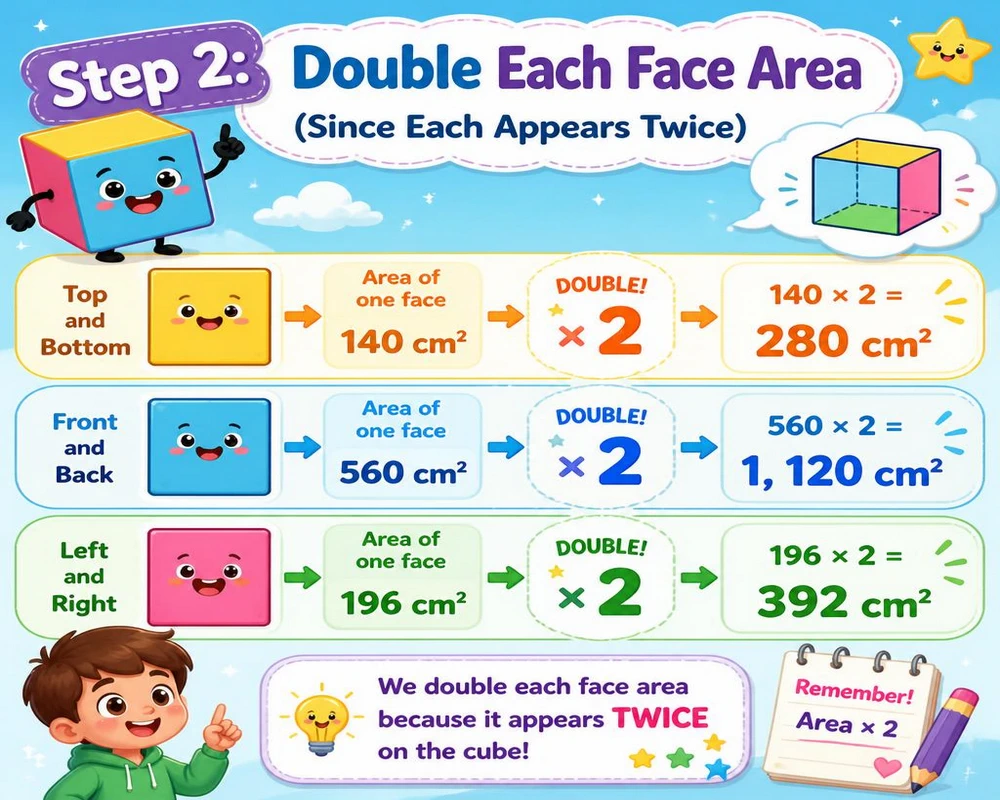
Step 2: Double Each Face Area (Since Each Appears Twice)
140 × 2 = 280 cm² 560 × 2 = 1,120 cm² 196 × 2 = 392 cm²
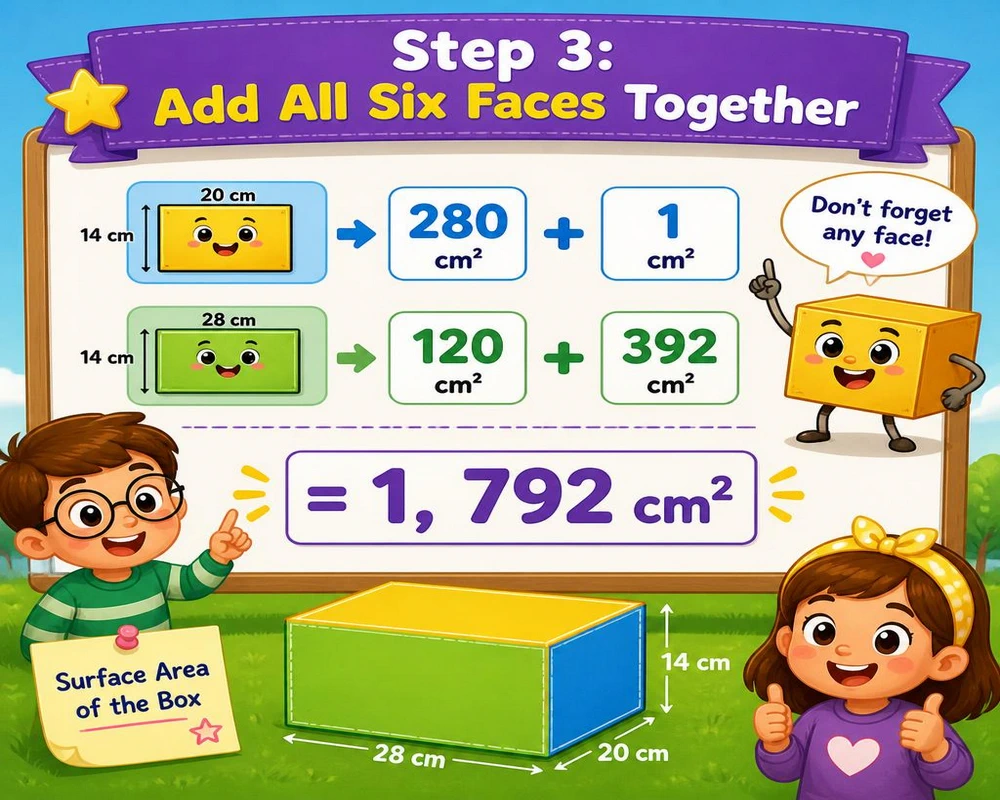
Step 3: Add All Six Faces Together
280 + 1,120 + 392 = 1,792 cm²
Total surface area of the cereal box: 1,792 cm²
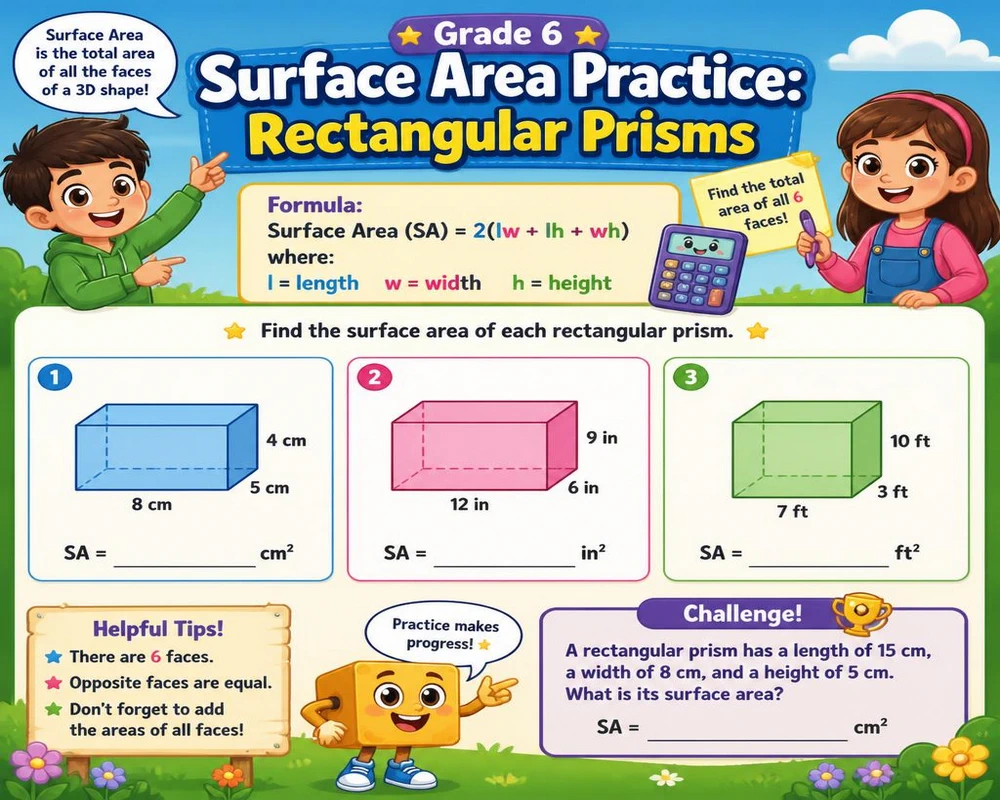
Grade 6 Surface Area Practice: Rectangular Prisms
These next Grade 6 surface area practice questions apply the exact same face-by-face process used with the cereal box above, just with different dimensions.
- A box measures 8 cm by 4 cm by 6 cm. What is its surface area?
- A box measures 10 cm by 3 cm by 5 cm. What is its surface area?
Answers: 1) 208 cm² 2) 190 cm²
Grade 6 Surface Area Practice: Cubes
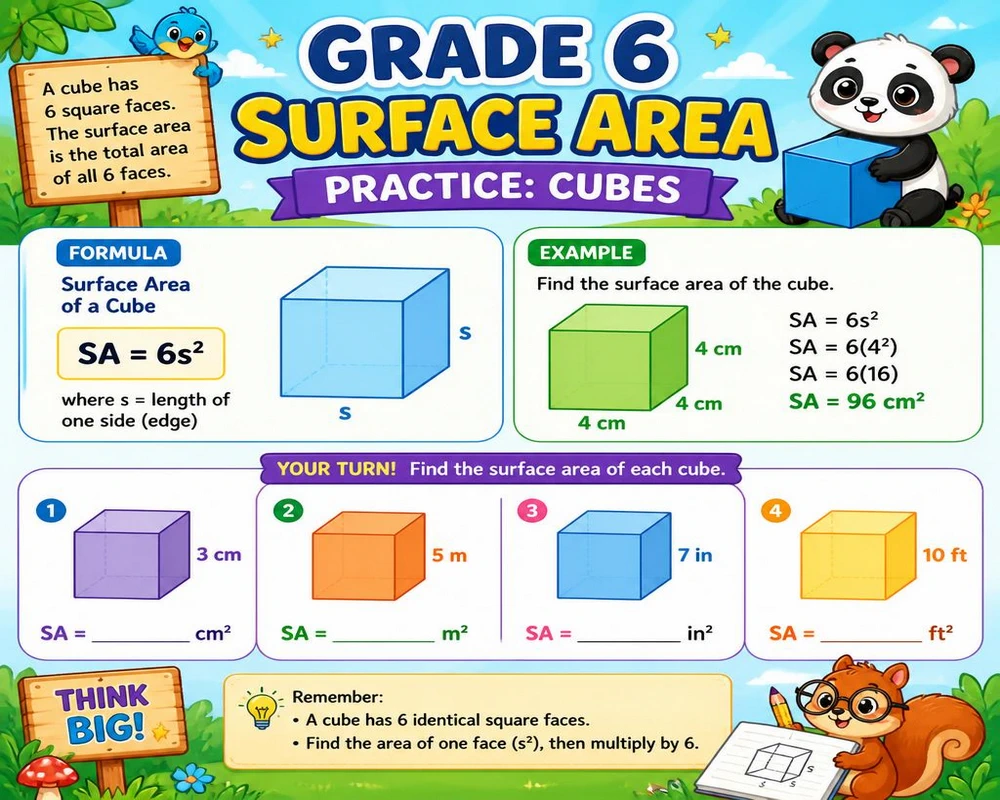
A cube is simply a rectangular prism where all six faces are identical squares, which makes this Grade 6 nets and surface area calculation genuinely simpler than the box example above.
Worked Example
Here’s how this Grade 6 surface area practice example works out: a cube has sides of 5 cm. Since all six faces are identical squares: one face = 5 × 5 = 25 cm². Total surface area = 25 × 6 = 150 cm².
Practice Questions
- A cube has sides of 4 cm. What is its surface area?
- A cube has sides of 7 cm. What is its surface area?
Answers: 1) 96 cm² 2) 294 cm²
Grade 6 Surface Area Practice: Triangular Prisms
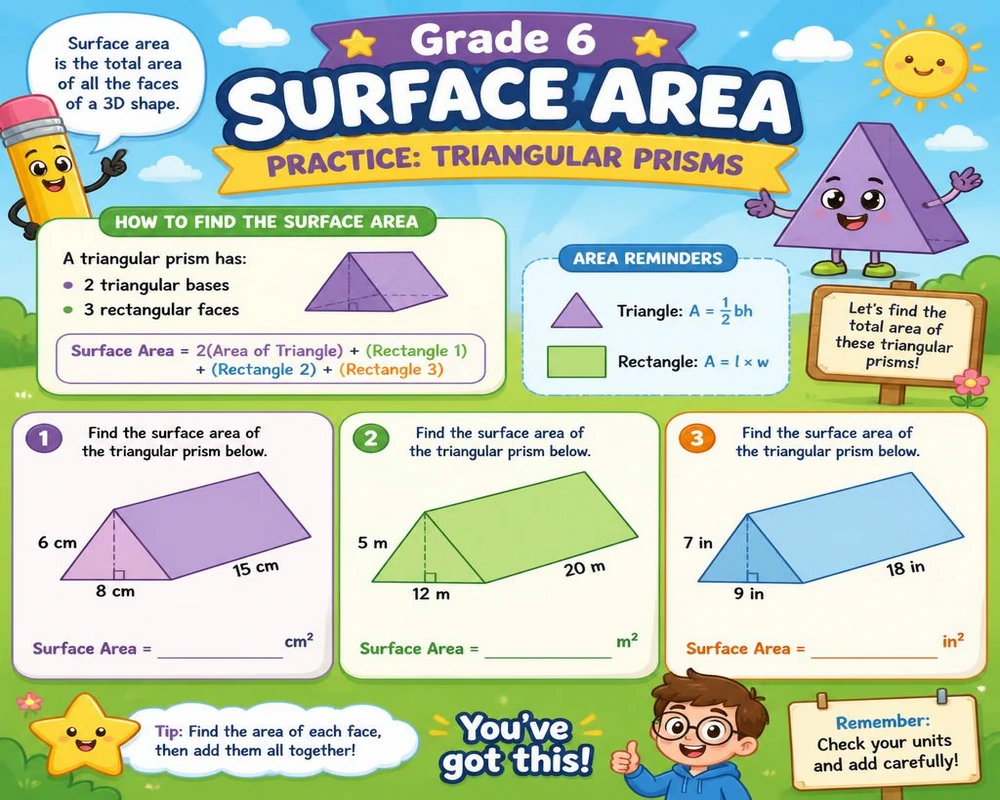
Triangular prisms add one extra layer to Grade 6 surface area practice, since two of the faces are triangles rather than rectangles.
Worked Example
A triangular prism has a triangular base with sides 3 cm, 4 cm, and 5 cm, a base of 3 cm and height of 4 cm, and the prism itself is 10 cm long.
Step 1 (two triangular ends): Area of one triangle = 0.5 × 3 × 4 = 6 cm². Two triangles = 12 cm².
Step 2 (three rectangular sides): (3 + 4 + 5) × 10 = 120 cm².
Step 3 (add everything together): 12 + 120 = 132 cm².
Total surface area: 132 cm²
Real-Life Word Problems for Grade 6 Surface Area Practice
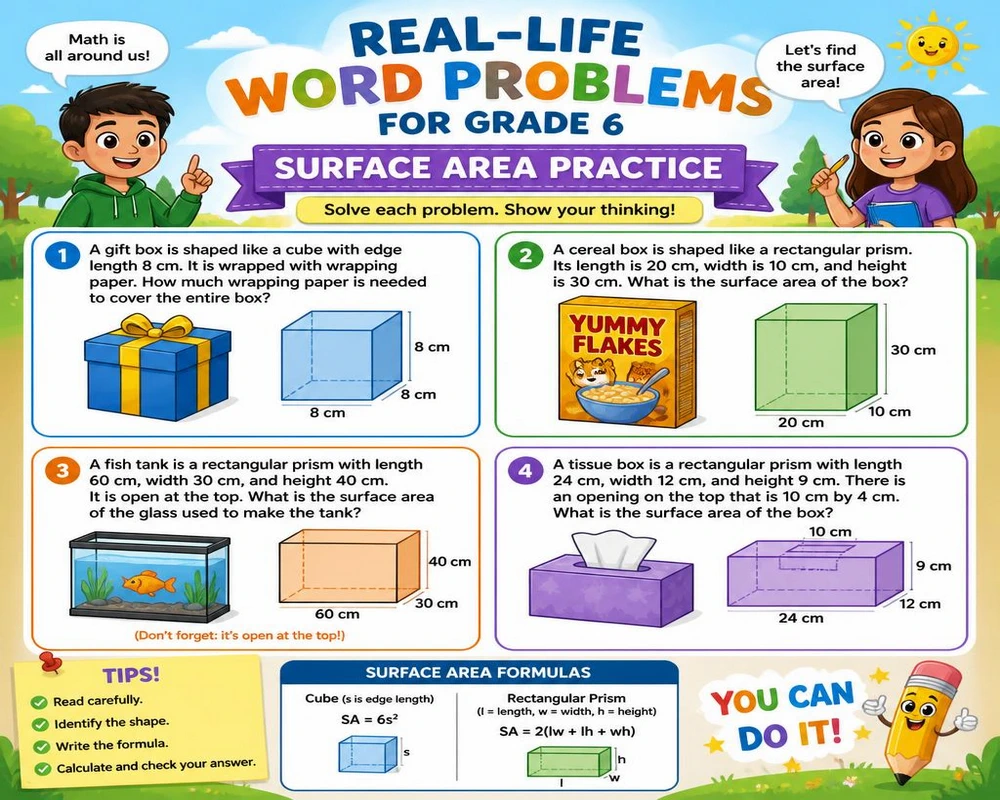
- A gift box measures 15 cm by 10 cm by 8 cm. How much wrapping paper is needed to cover it completely, assuming no overlap?
- A cube-shaped storage container has sides of 6 cm. What is its total surface area?
- A tent shaped like a triangular prism has triangular ends with sides 4 m, 4 m, and 6 m, a base of 6 m and height of 3 m, and is 5 m long. What is its total surface area?
Answers: 1) 700 cm² 2) 216 cm² 3) 88 m²
Common Mistakes in Grade 6 Surface Area Practice
Three specific errors account for most of the wrong answers seen in Grade 6 surface area practice.
Forgetting That Faces Come in Pairs
A very common error: calculating only three face areas instead of doubling each one for its matching opposite face. Returning to the physical net, and counting all six visible faces, prevents this directly.
Mixing Up Surface Area With Volume
Surface area measures the outside covering of a shape (in square units), while volume measures the space inside it (in cubic units). Consistently checking units — cm² versus cm³ — helps keep these two calculations distinct.
Missing a Face Entirely on Triangular Prisms
Students sometimes calculate the two triangular ends but forget one of the three rectangular sides. Physically tracing every face on a real net, one at a time, catches this reliably.
Frequently Asked Questions
1. What is surface area, in simple terms?
Surface area is the total area of every face on a 3D shape added together — essentially, how much material would be needed to cover the entire outside of the shape.
2. Why does Grade 6 surface area practice start with a net?
Seeing a shape unfolded into flat faces makes it possible to calculate each face’s area individually before adding them together, which builds genuine understanding rather than a memorized formula.
3. Why do rectangular prisms have three pairs of identical faces?
Each face has a matching, identical face directly opposite it, which is why every rectangular prism’s surface area calculation involves doubling three individual face areas.
4. How is a cube’s surface area different from a general rectangular prism’s?
Since all six faces of a cube are identical squares, the calculation simplifies to one face’s area multiplied by six, rather than adding three different face areas.
5. What’s the difference between surface area and volume?
Surface area measures the outside covering of a shape in square units, while volume measures the space inside it in cubic units — two genuinely different measurements often confused with each other.
6. How much surface area practice should we do at home?
About 15-20 minutes, a few times a week, tends to work well for Grade 6 surface area practice, especially when building real nets from cardboard or paper before calculating.
7. How does this connect to Grade 7?
Grade 7 builds on surface area with more complex composite shapes and introduces volume calculations for the same types of solids.
Surface area is one part of a full Grade 6 year that also includes ratios, fractions, and geometry. This build-then-calculate approach to Grade 6 surface area practice works well beyond just cereal boxes, once you start noticing rectangular prisms everywhere. Our Grade 6 math practice hub covers every topic in one place.
Interactive net-building tools make this exact process easier to explore than static worksheets alone. Mathies, Ontario’s free suite of digital math tools, includes 3D solid and net tools built for exactly this stage of learning.