
Grade 5 Probability Questions Ontario: 4 Real Experiments
Most Grade 5 probability questions Ontario worksheets present as pure theory — “what’s the chance of rolling a 4” — without ever putting an actual die in a child’s hand. That’s backward. Probability is one of the few math topics where running the real experiment takes less time than solving the abstract version, and the real results almost always teach something the theoretical answer alone can’t.
This guide walks through four real experiments, complete with actual results you can compare your own trials against, along with the Grade 5 probability questions Ontario’s curriculum expects students to answer using data like this.
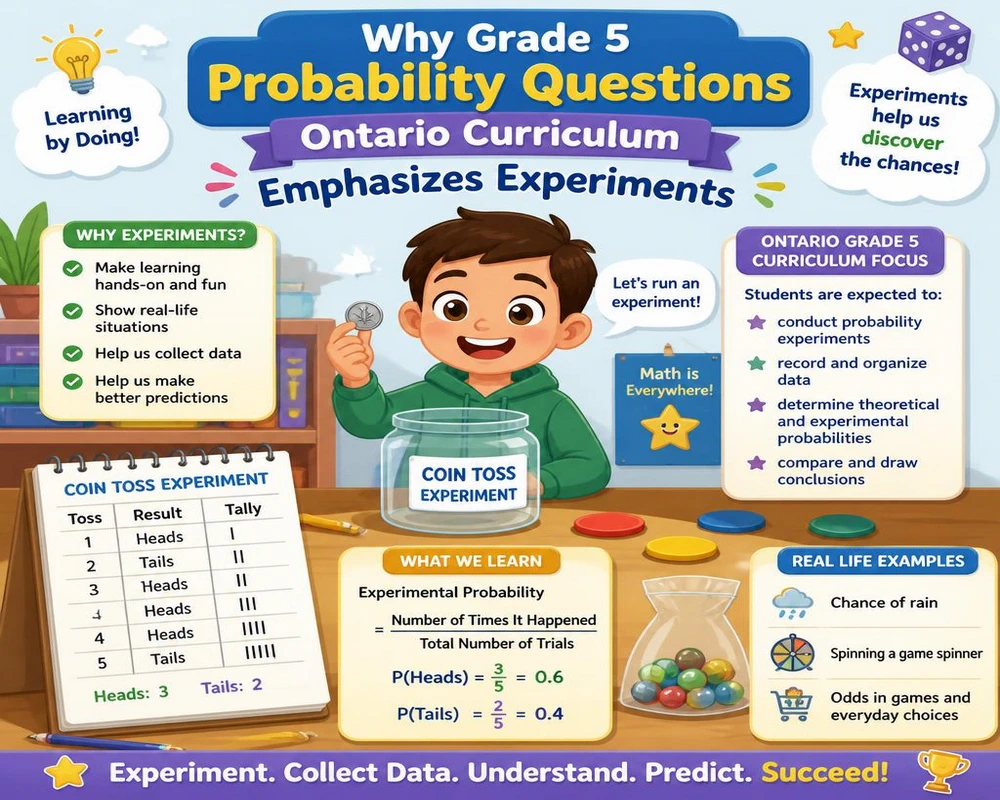
Why Grade 5 Probability Questions Ontario Curriculum Emphasizes Experiments
Ontario’s curriculum introduces probability formally in Grade 5 under the Data strand, asking students to express likelihood as a fraction between 0 and 1, and to compare theoretical probability (what should happen) against experimental probability (what actually happens when you try it). This comparison is exactly why Grade 5 probability questions Ontario assessments favor genuine experiments over pure calculation — and it only means anything once real trials have actually happened.
This matters because Grade 5 probability questions Ontario students see on assessments often ask directly about the gap between theoretical and experimental results. A student who has only ever calculated probability on paper, without running a real experiment, has no intuition for why that gap exists or how big it’s likely to be.
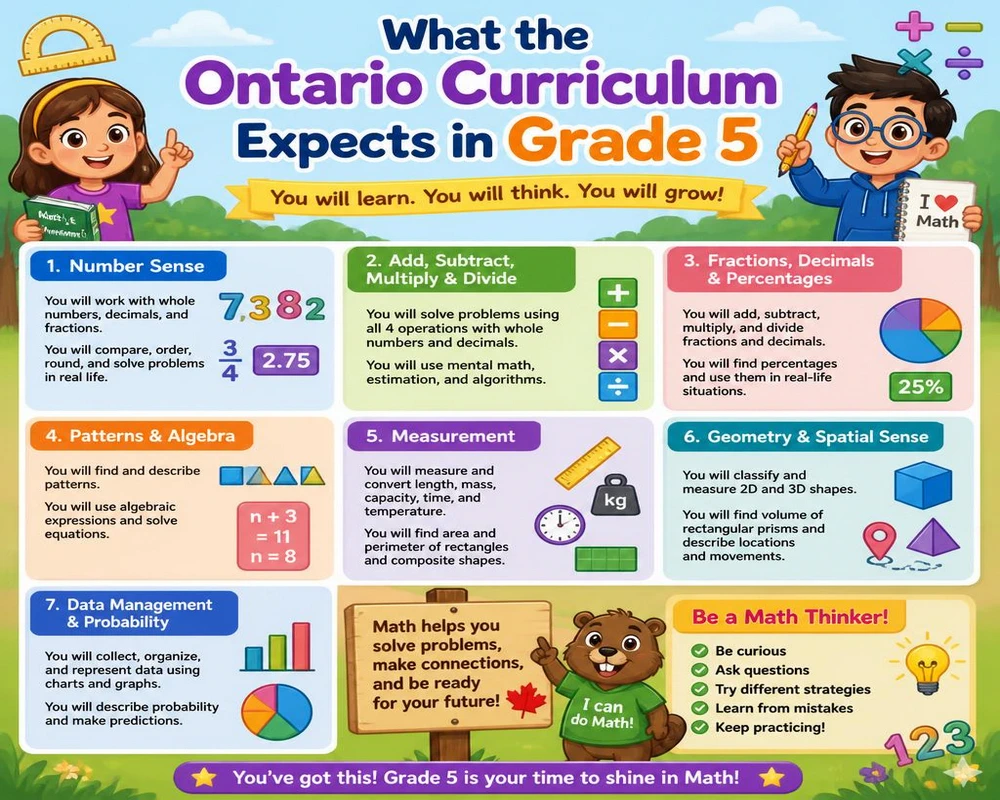
What the Ontario Curriculum Expects in Grade 5
By the end of Grade 5, students are generally expected to:
- Express probability as a fraction between 0 and 1
- Determine theoretical probability for simple events
- Conduct simple probability experiments and record the results
- Compare experimental results to theoretical predictions
- Use probability language (impossible, unlikely, even chance, likely, certain) accurately
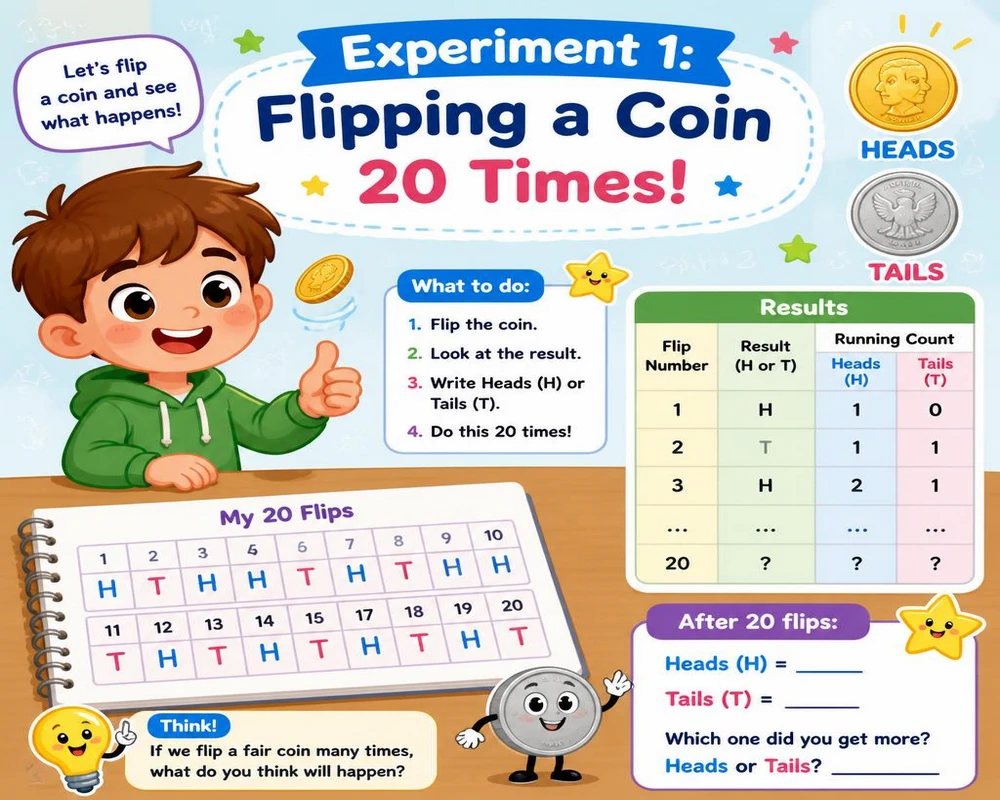
Experiment 1: Flipping a Coin 20 Times
Theoretically, a fair coin should land heads 10 times out of 20. This is one of the simplest Grade 5 probability questions Ontario students encounter, and here’s what actually happened in a real trial: 11 heads, 9 tails.
Grade 5 Probability Questions Ontario Students Should Try
- What is the theoretical probability of flipping heads on any single flip?
- Based on the actual results (11 heads, 9 tails), what is the experimental probability of heads?
- Is the experimental result close to the theoretical prediction? Why might they not match exactly?
Answers: 1) 1/2 2) 11/20 3) Yes, reasonably close — small differences between theoretical and experimental probability are completely normal with a limited number of trials
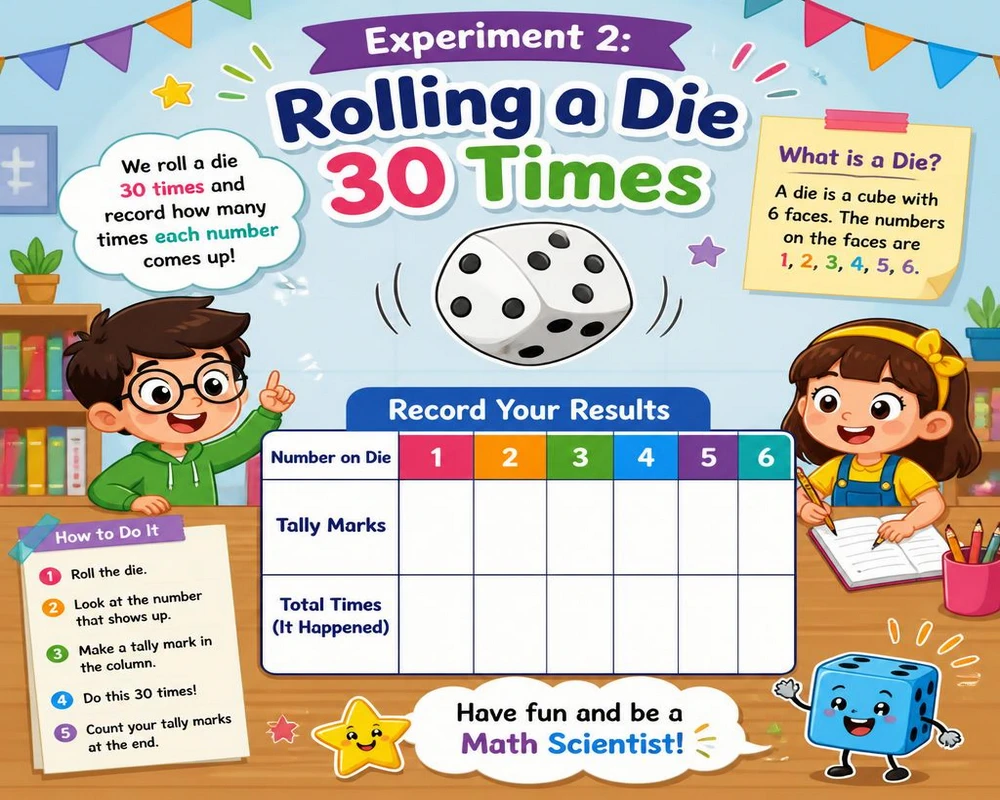
Experiment 2: Rolling a Die 30 Times
A fair six-sided die should land on each number roughly 5 times out of 30 rolls. This experiment is a classic source of Grade 5 probability questions Ontario teachers use, and here are the real results from one trial:
| Number | Times Rolled |
|---|---|
| 1 | 6 |
| 2 | 4 |
| 3 | 5 |
| 4 | 6 |
| 5 | 4 |
| 6 | 5 |
Practice Questions
- What is the theoretical probability of rolling a 3 on any single roll?
- Based on the table, what is the experimental probability of rolling a 4?
- What is the experimental probability of rolling an even number (2, 4, or 6)?
Answers: 1) 1/6 2) 6/30, which simplifies to 1/5 3) 15/30, which simplifies to 1/2
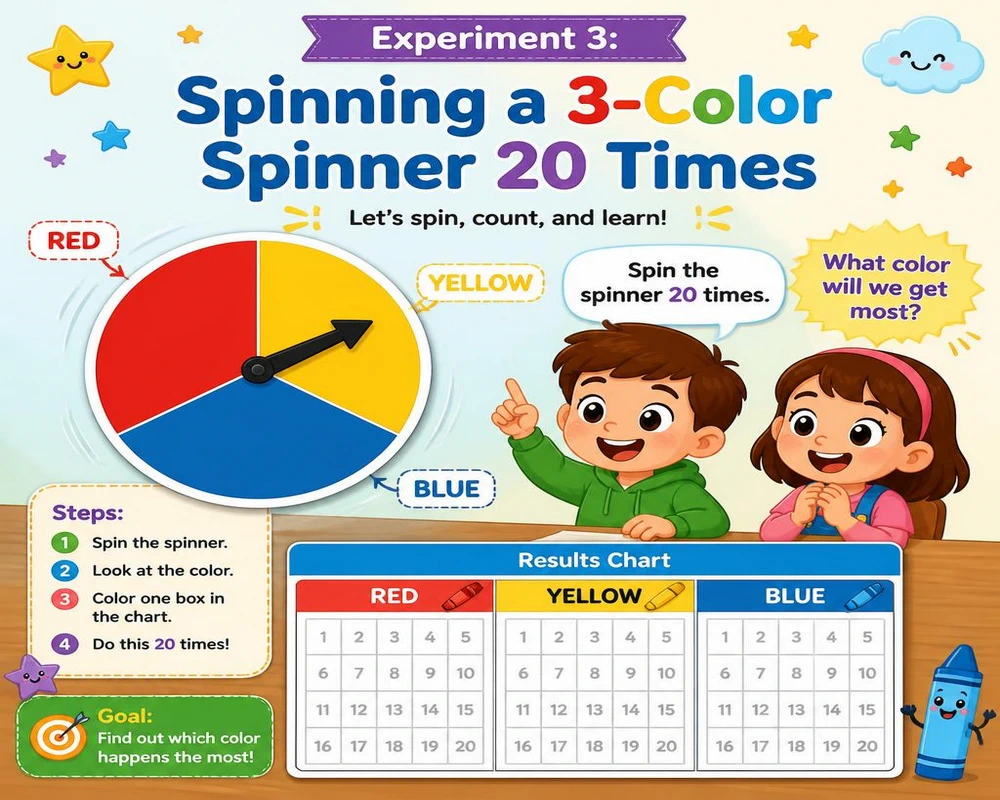
Experiment 3: Spinning a 3-Color Spinner 20 Times
A spinner divided evenly into red, blue, and green sections was spun 20 times, with these results: red 8 times, blue 7 times, green 5 times. Spinner-based Grade 5 probability questions Ontario curriculum uses often work especially well because the sections are visibly unequal at a glance, which invites a quick estimate before calculating.
Practice Questions
- If the spinner is divided into 3 equal sections, what is the theoretical probability of landing on red?
- Based on the actual results, what is the experimental probability of landing on green?
- Using probability language, would you describe landing on blue as unlikely, an even chance, or likely?
Answers: 1) 1/3 2) 5/20, which simplifies to 1/4 3) Close to an even chance, since 7/20 is reasonably near 1/3
Experiment 4: Drawing a Card 25 Times (With Replacement)
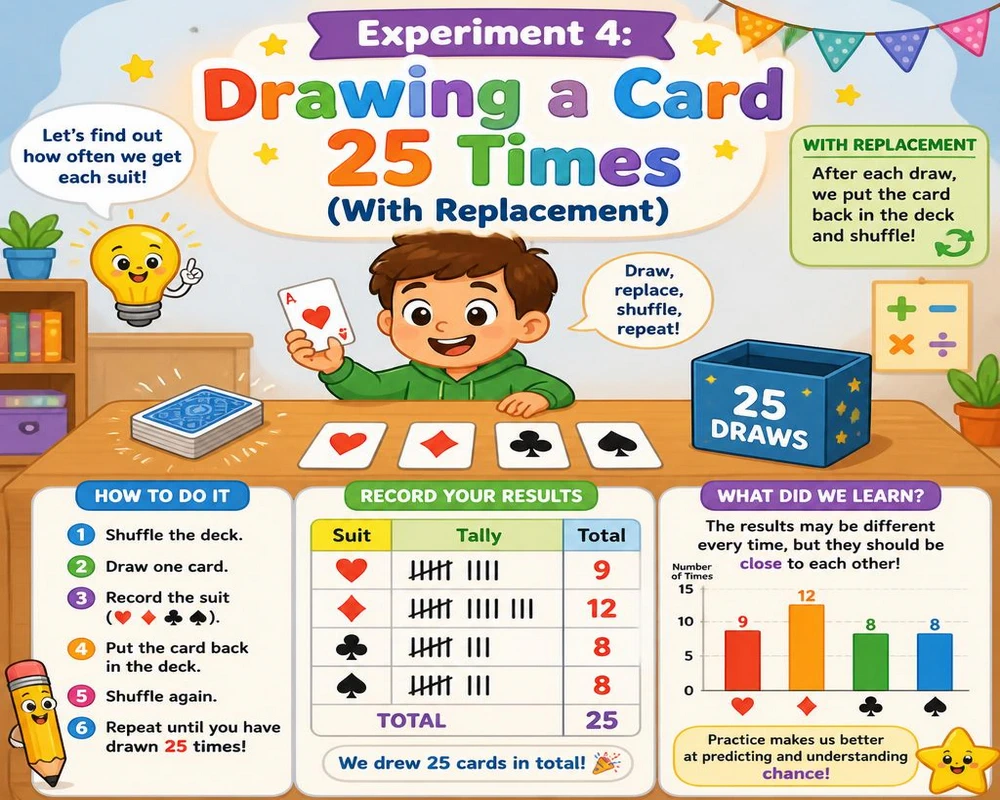
Card-drawing experiments are another reliable source of Grade 5 probability questions Ontario students practice with, since a standard deck offers four clean, equal categories to compare. Drawing a card from a shuffled deck, recording its suit, and putting it back each time, 25 draws produced these results: hearts 6, diamonds 5, clubs 7, spades 7.
Practice Questions
- What is the theoretical probability of drawing a heart from a full deck?
- Based on the actual results, what is the experimental probability of drawing a club?
- Which suit appeared most often in the actual results, and does that mean it’s more likely in future draws?
Answers: 1) 1/4 2) 7/25 3) Clubs and spades were tied for most frequent, but this doesn’t mean future draws favor them — each draw remains an independent 1/4 chance for any suit
The Pattern Across All Four Grade 5 Probability Questions Ontario Experiments
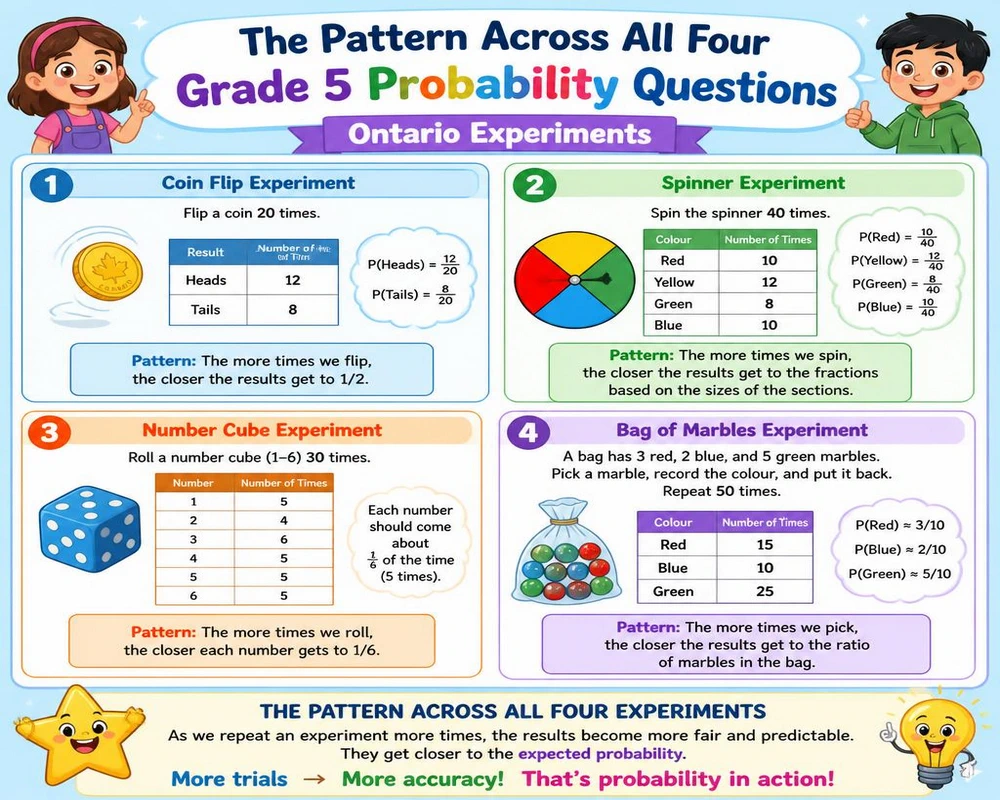
Notice something consistent across every one of these Grade 5 probability questions Ontario students work through: the experimental results never match the theoretical prediction exactly, but they land reasonably close. This is genuinely the entire concept of probability in action — a prediction about what’s likely, not a guarantee about what will happen every time.
Running Your Own Grade 5 Probability Questions Ontario Trials at Home
Repeat any of these four experiments with your own coin, die, spinner, or deck, and compare your actual results to both the theoretical prediction and the sample results shown above. More trials tend to bring experimental results closer to the theoretical prediction, which is worth pointing out directly if your child runs, say, 100 flips instead of 20.
Common Mistakes With Grade 5 Probability Questions Ontario Students Make
Expecting Exact Matches Every Time
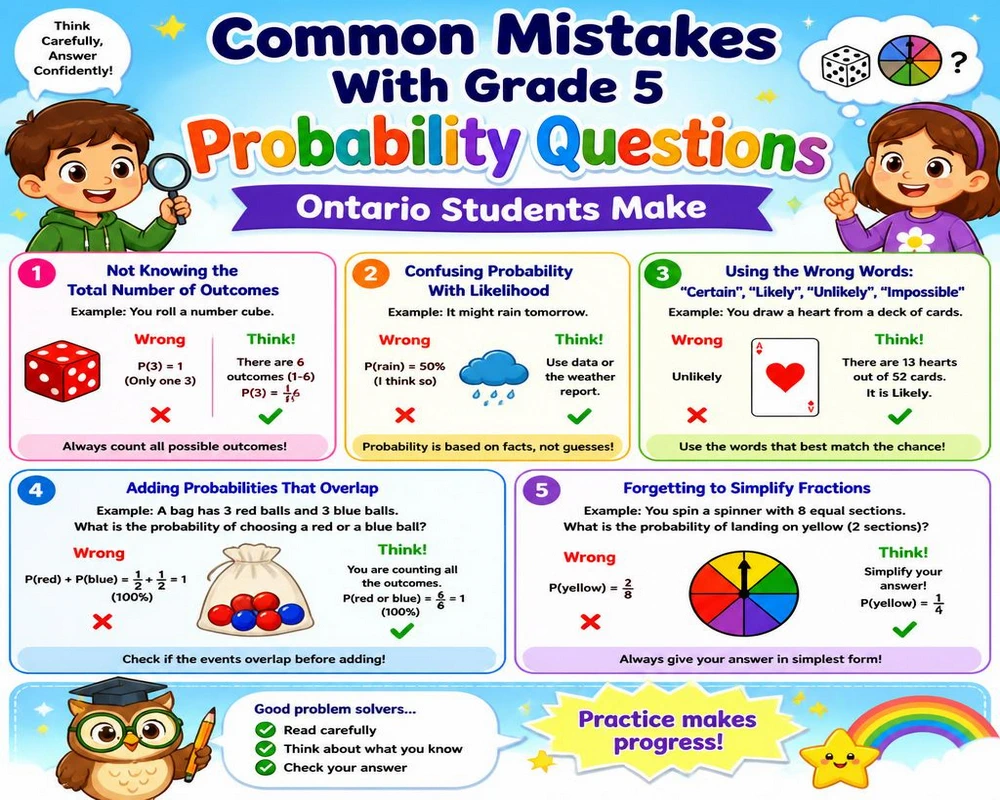
Some students assume something has gone wrong when experimental results don’t exactly match the theoretical prediction. This is one of the most common snags in Grade 5 probability questions Ontario classrooms encounter, and reinforcing that small gaps are normal, and usually shrink with more trials, prevents this confusion.
Believing Past Results Predict Future Ones
After rolling several 6s in a row, some students believe a 6 becomes less likely on the next roll. Each roll is independent, and the die has no memory of previous results — a common misconception worth addressing directly using real experiments like the ones in this Grade 5 probability questions Ontario guide.
Forgetting to Simplify Probability Fractions
Writing 6/30 instead of simplifying to 1/5 is a small but consistent error worth catching early, since simplified fractions make probabilities easier to compare across different experiments.
Frequently Asked Questions
1. What’s the difference between theoretical and experimental probability?
This distinction sits at the heart of every Grade 5 probability questions Ontario curriculum assessment includes. Theoretical probability is what should happen based on calculation, while experimental probability is what actually happens when you run a real trial. They’re usually close but rarely identical.
2. Why don’t experimental results match theoretical predictions exactly?
Randomness naturally produces some variation, especially with a smaller number of trials. Running more trials tends to bring experimental results closer to the theoretical prediction.
3. Do I need special materials to practice Grade 5 probability questions Ontario curriculum covers?
No, a coin, a standard die, or even a deck of cards from home covers most of what’s needed for genuine, hands-on probability practice.
4. Why does my child think a die is “due” for a certain number after several rolls?
This is a common misconception called the gambler’s fallacy — each roll is independent, and previous results don’t influence future ones, even after an unusual streak.
5. How is probability written as a fraction?
It’s written as favorable outcomes over total possible outcomes, like 1/6 for rolling a specific number on a six-sided die.
6. How much probability practice should we do at home?
About 15-20 minutes, a few times a week, tends to work well, especially when built around a real experiment rather than abstract worksheet questions alone.
7. How does this connect to Grade 6?
Grade 6 builds on this same foundation with more formal probability calculations and deeper comparisons between multiple events.
Probability is one part of a full Grade 5 year that also includes decimals, fractions, and geometry. These four experiments only scratch the surface of what Grade 5 probability questions Ontario students will encounter across the year. Our Grade 5 math practice hub covers every topic in one place.
For additional hands-on probability activities aligned with Ontario classrooms, the Ontario Association for Mathematics Education publishes free, classroom-tested resources built specifically around this kind of experiment-based learning.