
Grade 5 Decimals Practice — Ontario Curriculum Interactive Questions
Decimals have a funny way of tripping up even confident young mathematicians. A student who breezes through whole-number multiplication can suddenly freeze when asked to compare 0.4 and 0.25 — and if you’ve ever heard your child insist that 0.25 is bigger “because 25 is bigger than 4,” you already know exactly the kind of confusion we’re talking about.
Grade 5 decimals practice is where this misconception either gets sorted out for good or quietly follows a student straight into middle school. Having spent years teaching Ontario’s Junior Division curriculum and coaching students through exactly this kind of stumbling block, I can tell you the fix isn’t more repetition of the same worksheet — it’s building genuine understanding of what decimals actually represent.
This guide lays out what Ontario’s Grade 5 curriculum expects, why decimals confuse so many kids, and how to practice in a way that actually sticks.
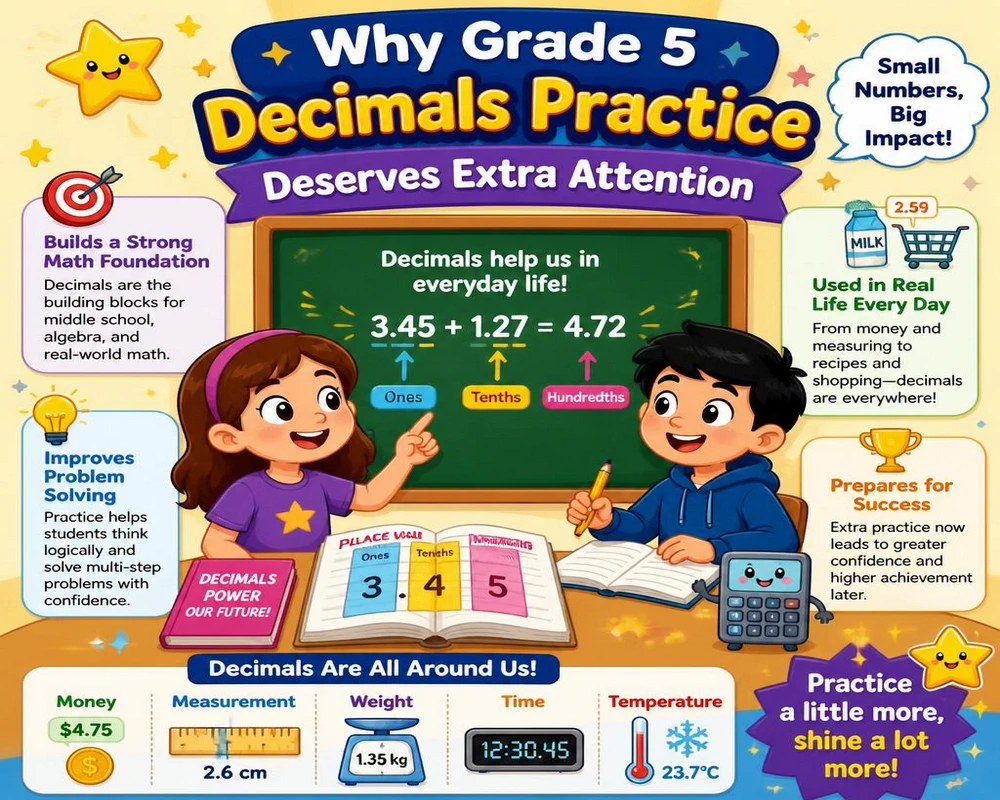
Why Grade 5 Decimals Practice Deserves Extra Attention
Decimals sit at an awkward intersection in a child’s math development. They look like whole numbers, they’re written with digits kids already recognize, but they behave according to a completely different set of rules. The Ontario 2020 mathematics curriculum introduces decimal tenths formally in Grade 4, then expands significantly in Grade 5 to include hundredths, decimal place value, and operations with decimal numbers.
A 2024 analysis from the Canadian Mathematics Education Study Group highlighted that place value misunderstanding — not lack of effort — is the leading cause of decimal errors among elementary students. In other words, when a child struggles with decimal math practice Grade 5 content, it’s rarely because they’re bad at math. It’s because the underlying concept of place value hasn’t fully clicked yet.
What the Ontario Curriculum Expects in Grade 5
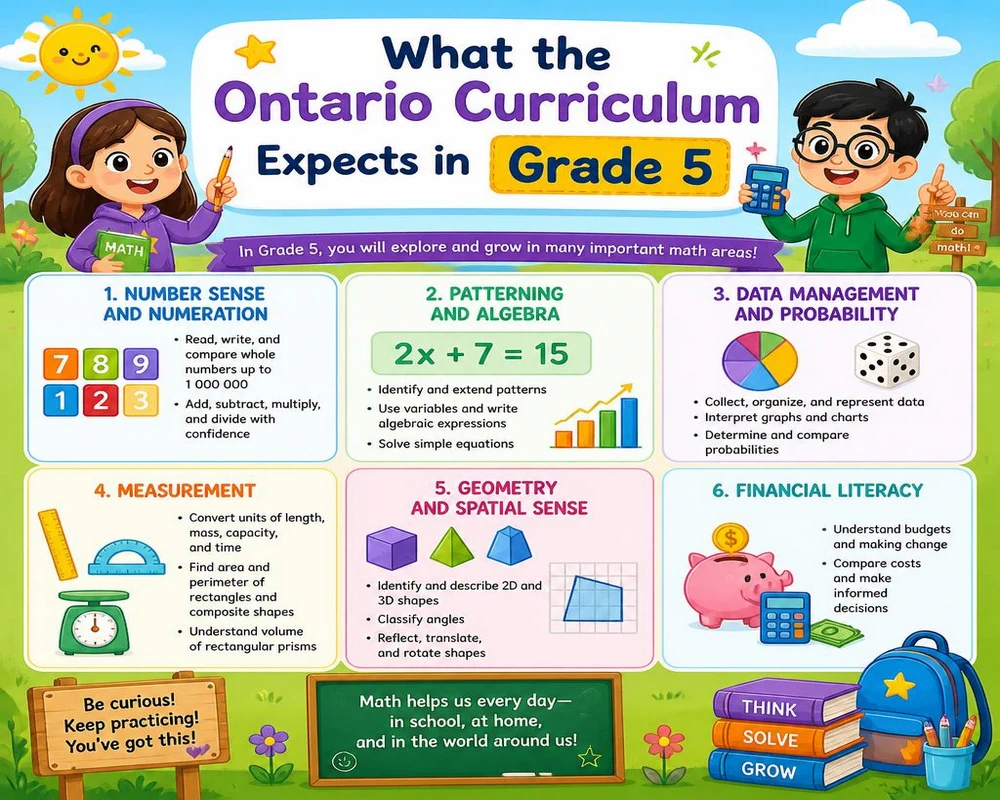
By the end of Grade 5, students in Ontario are expected to:
- Read, write, and represent decimal numbers to hundredths
- Compare and order decimal numbers up to hundredths
- Round decimal numbers to the nearest whole number or tenth
- Add and subtract decimal numbers to hundredths
- Understand the relationship between fractions and decimals
- Solve problems involving money, which naturally uses decimal notation
Notice that money comes up specifically. Ontario’s curriculum leans on real-world contexts like pricing and measurement to make decimals concrete rather than purely abstract — a strategy backed by classroom research showing that contextualized math instruction improves retention significantly more than isolated drill work.
Building Decimal Number Sense Before Jumping to Operations
Understanding Place Value
Before a student can confidently add or subtract decimals, they need a rock-solid grasp of place value. Here’s a quick reference table that’s worth keeping on the fridge during homework season.
| Place | Value | Example in 3.42 |
|---|---|---|
| Ones | 1 | The 3 in 3.42 |
| Tenths | 1/10 | The 4 in 3.42 |
| Hundredths | 1/100 | The 2 in 3.42 |
A simple but effective home activity: write a decimal number on a sticky note and ask your child to point to the tenths digit, then the hundredths digit. It sounds almost too basic, but this quick check reveals gaps that worksheets alone won’t catch.
Visual models make the leap from whole numbers to decimals far less abstract for most Grade 5 students. Online Math Learning’s Ontario-aligned resources offer additional worksheets and visual explanations that pair well with classroom instruction on place value and decimal operations.
Connecting Decimals to Fractions
Many students find decimals easier once they see the direct link to fractions they already understand. For instance:
- 0.1 = 1/10
- 0.25 = 25/100 = 1/4
- 0.5 = 5/10 = 1/2
Drawing this connection explicitly — rather than treating decimals and fractions as two unrelated topics — is one of the fastest ways to build genuine number sense rather than memorized rules.
Using Visual Models
Base-ten blocks, hundred grids, and decimal number lines are indispensable tools here. A hundred grid, in particular, makes hundredths visible in a way that abstract numbers on paper simply can’t. Shading 42 out of 100 squares to represent 0.42 turns an abstract symbol into something a child can literally see and count.
Grade 5 Decimals Practice Questions (With Answers)
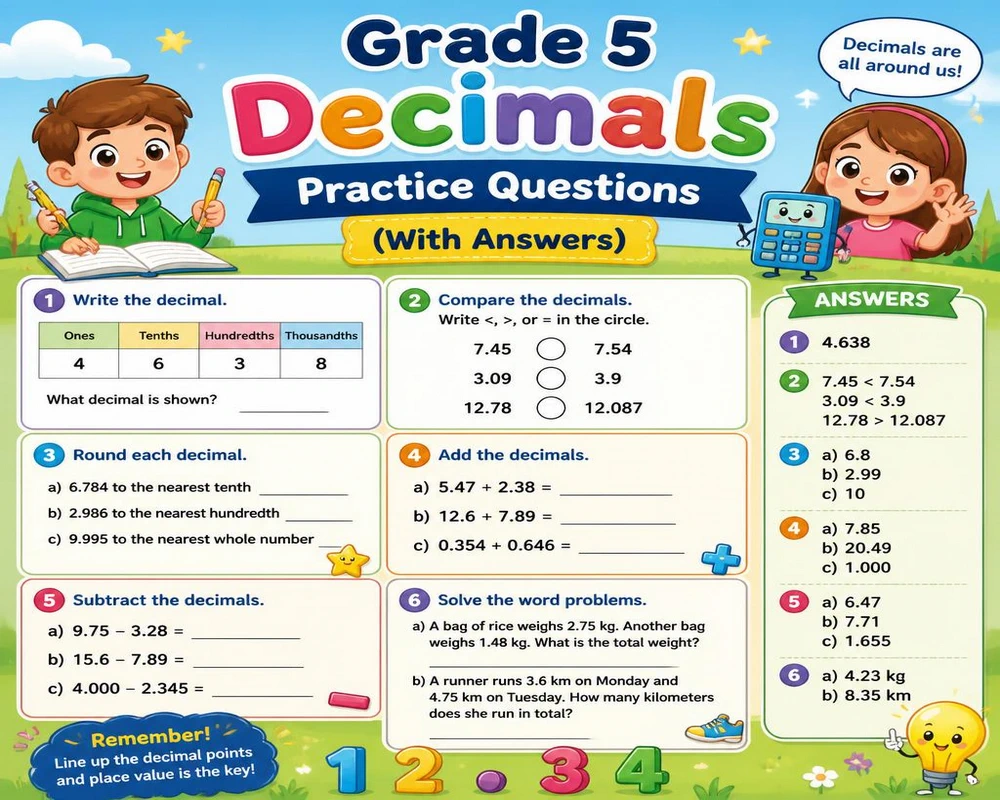
Below is a set of decimals questions Grade 5 Ontario students commonly encounter, organized by skill so you can target specific weak spots rather than practicing everything at once.
Reading and Writing Decimals
- Write “four and thirty-seven hundredths” as a decimal.
- What is the value of the 6 in 8.62?
- Write 0.09 in word form.
Answers: 1) 4.37 2) six tenths, or 0.6 3) nine hundredths
Comparing and Ordering Decimals
Order these decimals from smallest to largest: 0.6, 0.45, 0.09, 0.5
Answer: 0.09, 0.45, 0.5, 0.6
This type of question is exactly where the “bigger digit means bigger number” misconception shows up most. If your child gets this wrong, don’t just correct the answer — walk through why 0.5 is larger than 0.45 by comparing tenths first.
Rounding Decimals
- Round 3.68 to the nearest tenth.
- Round 7.42 to the nearest whole number.
- Round 12.55 to the nearest tenth.
Answers: 1) 3.7 2) 7 3) 12.6
Adding Decimals
| Question | Answer |
|---|---|
| 2.35 + 1.42 = ___ | 3.77 |
| 4.6 + 3.25 = ___ | 7.85 |
| 0.75 + 0.9 = ___ | 1.65 |
| 5.08 + 2.34 = ___ | 7.42 |
Subtracting Decimals
| Question | Answer |
|---|---|
| 6.5 − 2.35 = ___ | 4.15 |
| 8.9 − 3.45 = ___ | 5.45 |
| 10 − 4.65 = ___ | 5.35 |
| 7.2 − 1.08 = ___ | 6.12 |
Real-World Word Problems for Decimal Practice
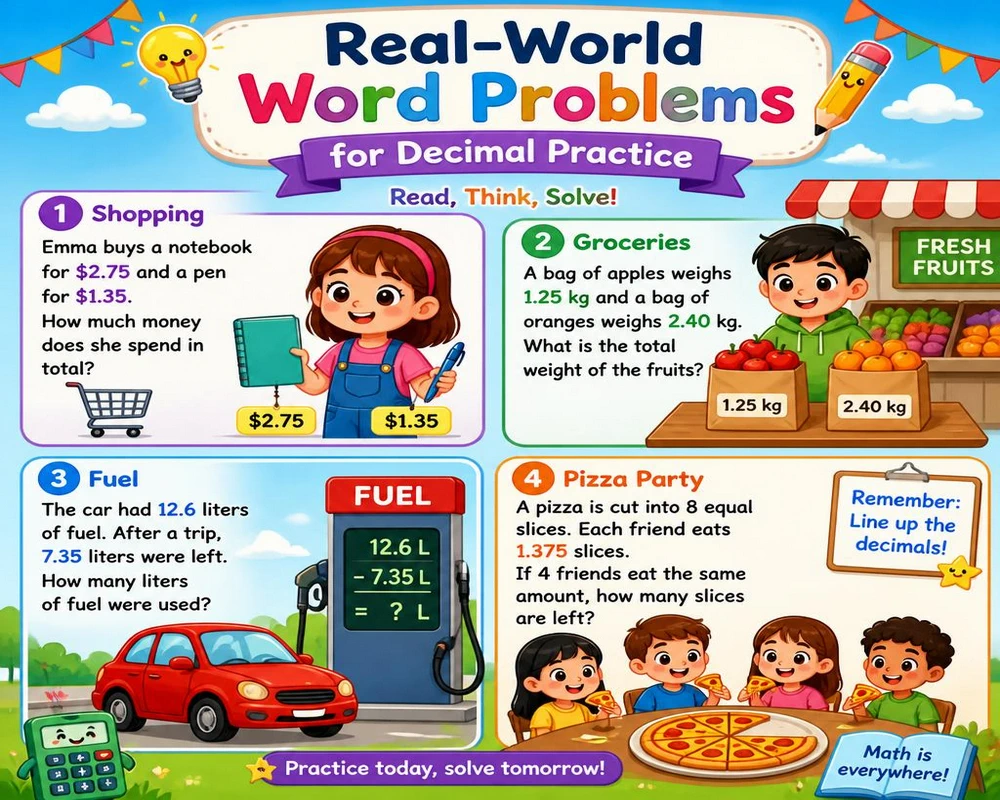
Word problems are where math decimals Grade 5 skills get tested in context, and they’re often more revealing than straight computation. Kids who can crunch numbers on a worksheet sometimes struggle to recognize when a real-world situation calls for a decimal operation at all.
- A notebook costs $3.75 and a pencil costs $0.60. How much do they cost together?
- Maria had $20.00. She bought a book for $12.45. How much money does she have left?
- A runner completed a race in 15.8 seconds. Another runner finished in 14.95 seconds. Who was faster, and by how much?
- A recipe calls for 0.75 liters of milk, but you only have 0.5 liters. How much more milk do you need?
- Three friends each measured the length of their pencils: 12.4 cm, 11.8 cm, and 12.9 cm. Order the pencils from shortest to longest.
Reading these aloud and having your child underline the important numbers before solving builds the same comprehension skills they’ll need for more complex problems in Grade 6 and beyond.
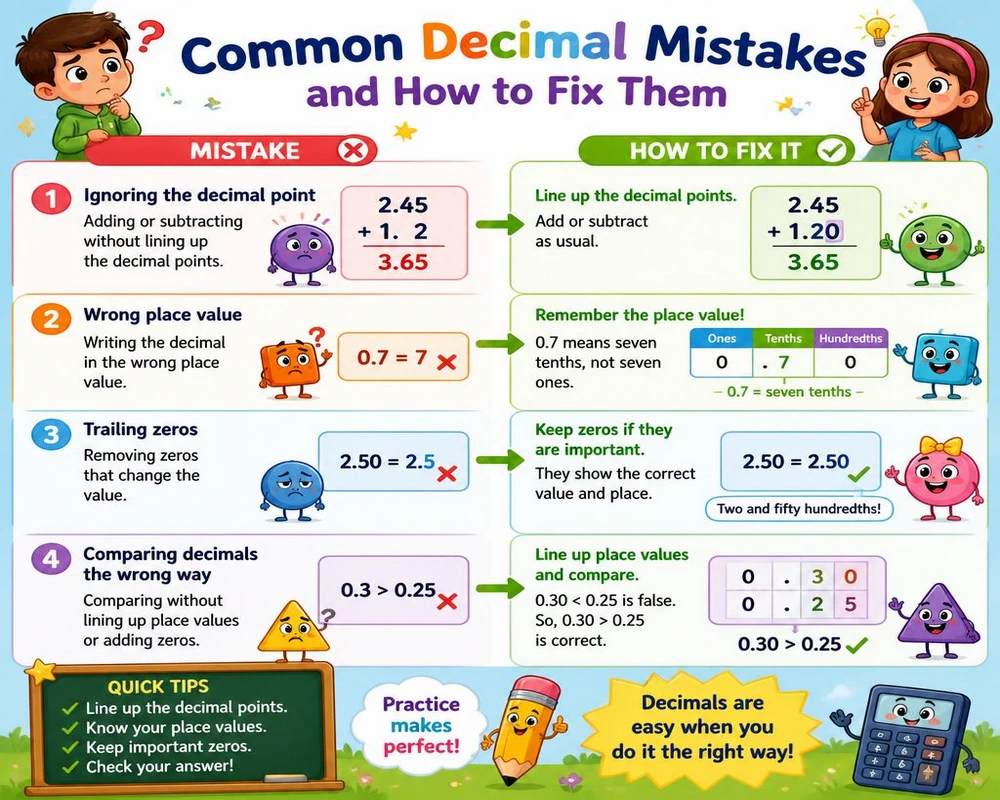
Common Decimal Mistakes and How to Fix Them
Misaligning Decimal Points When Adding or Subtracting
This is probably the single most common error in Grade 5 decimal practice. A student adds 3.5 + 2.75 by lining up the digits on the right instead of aligning the decimal points, and gets a wrong answer that looks deceptively reasonable.
Fix: Have your child rewrite both numbers with the same number of decimal places before adding — 3.50 + 2.75 — so the columns line up naturally.
Confusing Longer Decimals With Bigger Values
As mentioned earlier, kids often assume 0.45 is smaller than 0.6 because “45 looks like a bigger number than 6.” This stems from not fully grasping place value.
Fix: Convert both numbers to the same number of decimal places first (0.45 vs. 0.60), which makes the comparison far more intuitive.
Dropping or Adding Zeros Incorrectly
Some students write 0.5 as equivalent to 0.05, treating trailing and leading zeros as interchangeable.
Fix: Reinforce with visual models — a hundred grid shaded to show 0.5 versus 0.05 makes the tenfold difference impossible to miss.
Effective Strategies for Practicing at Home
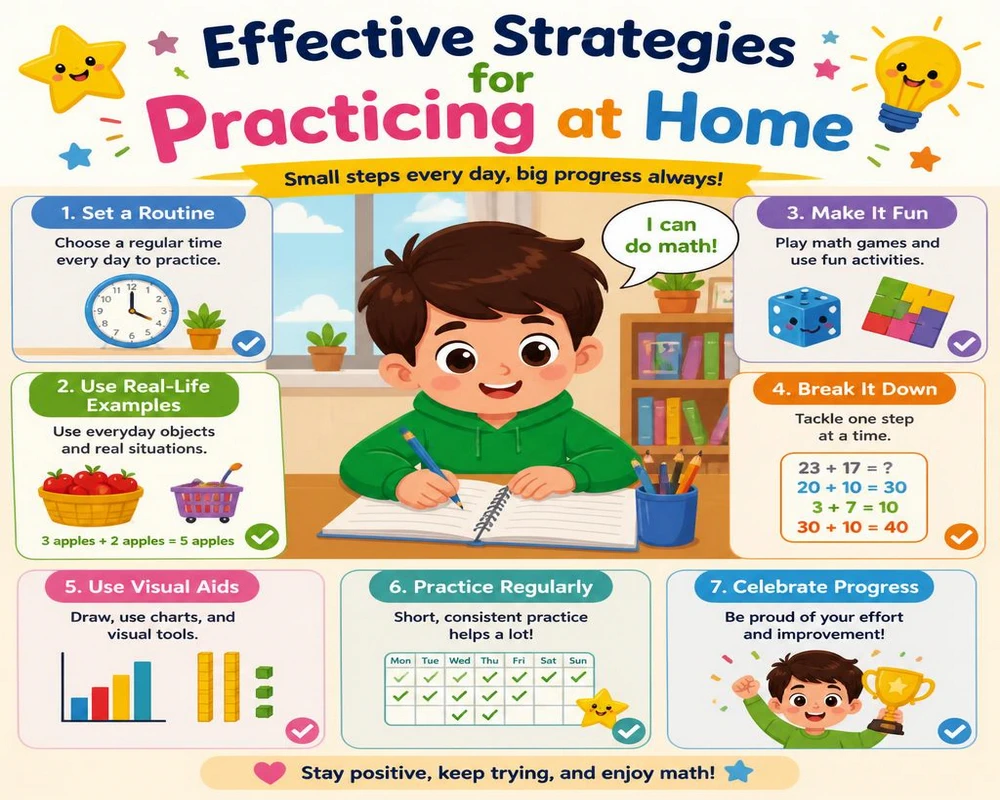
Cook Together
Recipes are a goldmine for decimal math practice Grade 5 students can use immediately. Measuring 0.5 cups of an ingredient or doubling a recipe that calls for 1.25 cups makes decimals functional rather than theoretical.
Turn Grocery Shopping Into Practice
Handing your child a calculator and a grocery list with prices is one of the most effective, zero-prep ways to reinforce decimal addition and subtraction. Ask them to estimate the total before checkout, then compare their estimate to the actual receipt.
Keep Practice Sessions Short and Targeted
Research on spaced practice consistently shows that shorter, more frequent sessions beat long cram sessions for retention in elementary-aged learners. Fifteen minutes of focused decimal practice three or four times a week will outperform a single hour-long Sunday session almost every time.
Balance Worksheets With Hands-On Models
| Pros of Worksheet Practice | Pros of Hands-On Models |
|---|---|
| Easy to measure progress | Builds deeper conceptual understanding |
| Good for reinforcing computation speed | Makes abstract place value concrete |
| Convenient and low-prep | Reduces reliance on memorized rules |
Neither approach alone is enough. The strongest results I’ve seen come from combining a few worksheet questions with a hands-on model or real-world example in the same session.
Conclusion: Turning Confusion Into Confidence
Decimals are one piece of a Grade 5 year that also covers ratios, algebra, and continued fraction work. For the complete picture, our Grade 5 math practice hub brings every topic together with practice questions to match.
Grade 5 decimals practice isn’t about drilling endless computation — it’s about helping your child truly understand what a decimal represents before asking them to manipulate it. Once the “why” clicks, the “how” tends to follow surprisingly quickly. Mix in visual models, real-world contexts like cooking and shopping, and short, consistent practice sessions, and you’ll see the confusion that once caused those homework meltdowns start to fade.
Pick two or three questions from this guide tonight, work through them together, and pay attention to where your child hesitates — that hesitation is exactly where the next bit of understanding needs to be built. Small, steady practice this month can prevent a much bigger struggle with decimals down the road.
Frequently Asked Questions
1. At what grade do Ontario students start learning decimals? Decimal tenths are formally introduced in Grade 4, and Grade 5 expands this to include hundredths, decimal comparisons, rounding, and operations like addition and subtraction.
2. Why do so many kids confuse 0.45 and 0.5? This usually stems from incomplete place value understanding — students compare the digits as if they were whole numbers instead of comparing tenths first, then hundredths.
3. What’s the best way to help my child with decimal addition? Have them line up decimal points, not just the rightmost digits, and consider adding trailing zeros so both numbers have the same number of decimal places before adding.
4. How are decimals and fractions related in the Grade 5 curriculum? Ontario’s curriculum explicitly connects the two, showing students that a decimal like 0.5 represents the same value as the fraction 1/2, which helps build more flexible number sense.
5. Are hundred grids and base-ten blocks really necessary for decimal practice? They’re not strictly required, but visual models make place value concepts concrete in a way that abstract numbers alone often can’t, especially for students who are still developing number sense.
6. How much time should my Grade 5 child spend practicing decimals at home? Around 15 to 20 minutes, three or four times a week, tends to be more effective than long, infrequent sessions, especially for maintaining focus and retention.
7. My child can compute decimals but struggles with word problems. What should I do? Practice underlining key numbers and identifying the operation needed before solving, and use real-life scenarios like shopping or cooking to build comprehension alongside computation.
8. Is it normal for decimal mistakes to persist even after a unit test? Yes, decimal misconceptions often take longer than a single unit to fully resolve. Continued, low-pressure practice across the school year typically clears up lingering errors more effectively than re-teaching the unit all at once.