Grade 4 Geometry Practice — Angles and Shapes Ontario Curriculum
Hand a nine-year-old a protractor for the first time, and you’ll usually get one of two reactions: genuine fascination, or a look of complete bewilderment. Geometry has a way of splitting kids into camps faster than almost any other math topic, mostly because it asks them to think spatially rather than just numerically.
Grade 4 geometry practice is where Ontario students move from simply naming shapes to actually analyzing their properties — classifying angles, comparing 2D and 3D figures, and starting to reason about symmetry and transformations.
Having spent years in Ontario classrooms and working one-on-one with students who found this shift tricky, I’ve learned that the kids who struggle aren’t lacking ability — they just haven’t had enough hands-on exposure to make the abstract concepts click.
This guide breaks down exactly what Ontario’s Grade 4 curriculum expects in geometry, why this year marks such a significant jump, and how you can reinforce these skills at home with real practice questions.
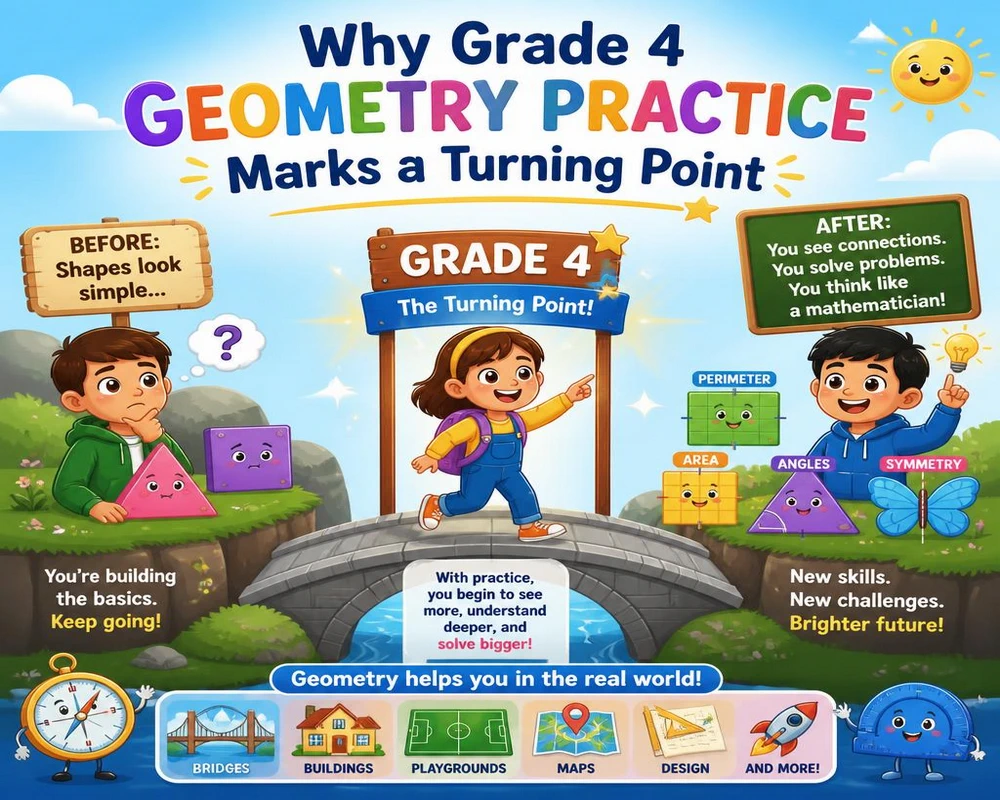
Why Grade 4 Geometry Practice Marks a Turning Point
Up through Grade 3, geometry largely revolves around recognizing and sorting shapes by obvious features — a triangle has three sides, a square has four equal sides. Grade 4 geometry practice pushes students into more analytical territory. They’re now expected to measure and classify angles, compare properties of two-dimensional and three-dimensional shapes, and begin exploring geometric transformations like reflections and translations.
This transition matters more than it might seem. Spatial reasoning — the skill underlying most of geometry — has been linked in multiple studies to later success in fields ranging from engineering to computer science. A 2025 report from the Fields Institute for Research in Mathematical Sciences noted that early spatial reasoning instruction correlates with stronger performance in algebra and data literacy years later, reinforcing that geometry isn’t a standalone unit — it’s a building block for a huge swath of future math.
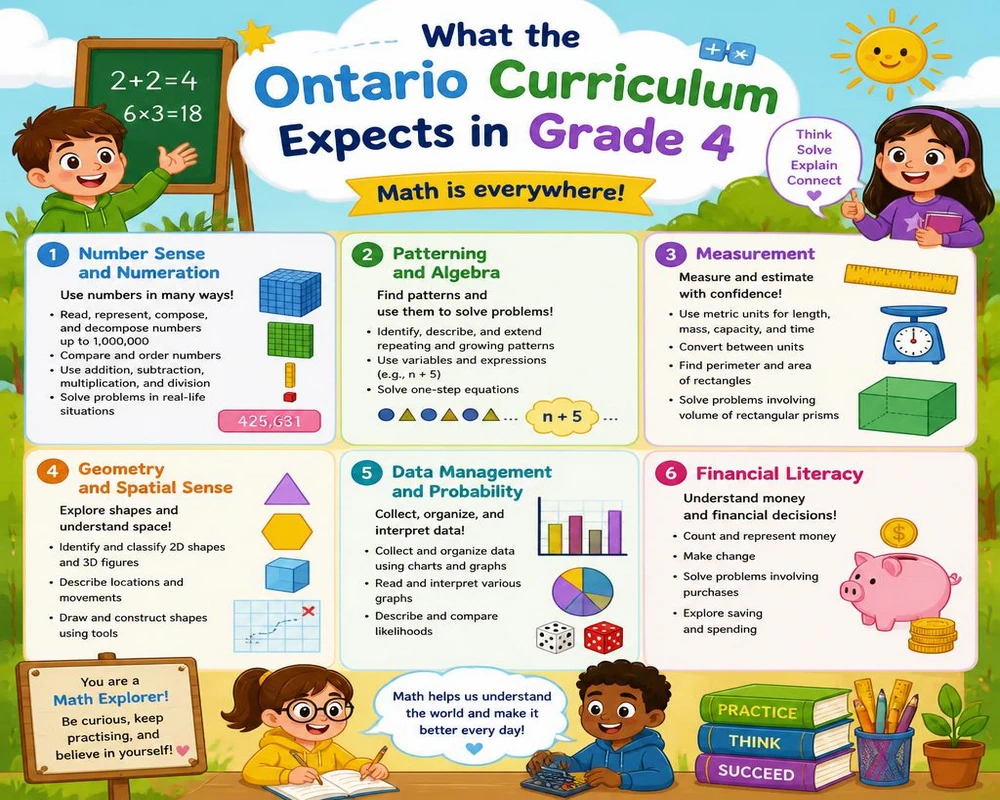
What the Ontario Curriculum Expects in Grade 4
By the end of Grade 4, Ontario students are expected to:
- Identify, classify, and compare angles as acute, right, obtuse, or straight
- Measure angles using a protractor
- Identify and classify 2D shapes based on their properties, including sides and angles
- Identify and describe properties of 3D solids, including faces, edges, and vertices
- Recognize and perform simple transformations: translations, reflections, and rotations
- Identify lines of symmetry in 2D shapes
This is a substantial jump from earlier grades, and it’s exactly why targeted geometry questions Grade 4 Ontario practice matters — students need repeated, varied exposure to actually internalize these classifications rather than just memorizing them for a single test.
Understanding Angles: The Foundation of Grade 4 Geometry
The Four Basic Angle Types
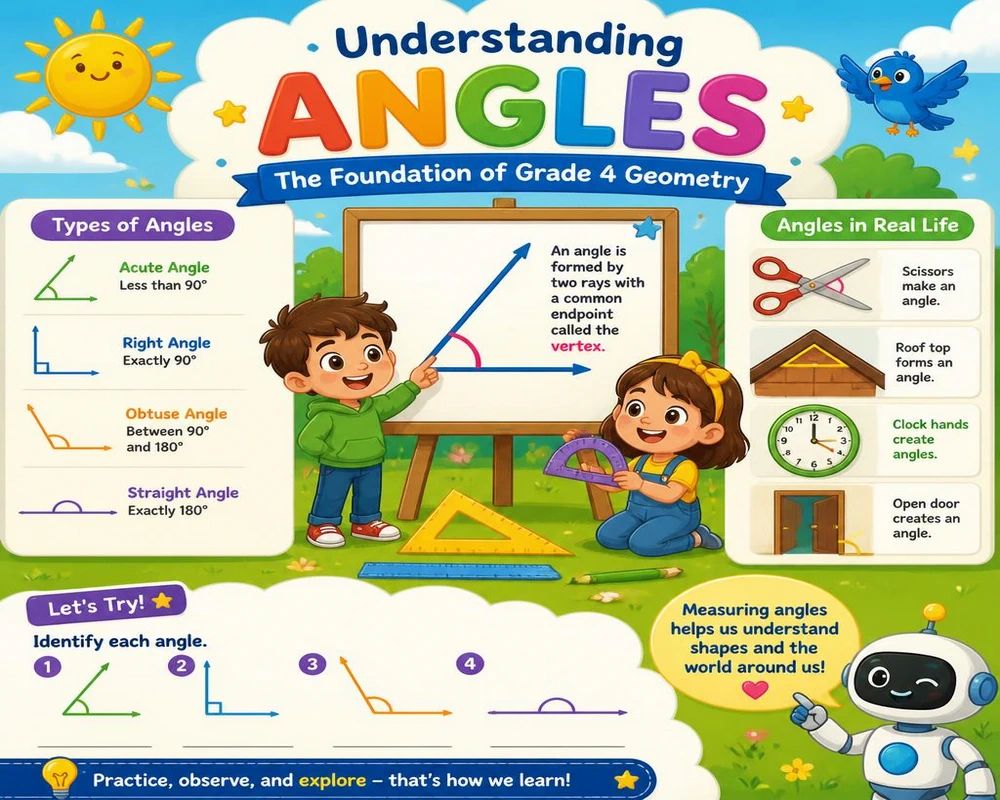
Before diving into practice questions, make sure your child can confidently identify these four categories, since almost everything else in the angles unit builds on this foundation.
| Angle Type | Description | Example |
|---|---|---|
| Acute | Less than 90 degrees | The angle in a slice of pizza |
| Right | Exactly 90 degrees | The corner of a piece of paper |
| Obtuse | Between 90 and 180 degrees | An open laptop screen tilted back |
| Straight | Exactly 180 degrees | A flat line |
A simple home trick: have your child use the corner of an index card as a quick right-angle checker. If an angle looks smaller than the card’s corner, it’s acute; if it’s larger, it’s obtuse. This low-tech tool builds intuition before formal protractor use even begins.
Hands-on geometry tools make a real difference at this age, since angles and shapes are far easier to grasp when a child can physically manipulate them. Mathies, Ontario’s free suite of digital math tools, includes interactive protractors and shape builders that mirror exactly what many Grade 4 classrooms use for this unit.
Using a Protractor With Confidence
Protractors intimidate a lot of fourth graders at first, mostly because the double scale (one going 0 to 180 in each direction) creates confusion about which number to read. Here’s a simple process to practice at home:
- Place the protractor’s center point exactly on the angle’s vertex.
- Line up the baseline of the protractor with one ray of the angle.
- Read the scale that starts at 0 on that same ray.
- Note where the second ray crosses the scale.
Practicing this a few times with angles drawn on paper — rather than jumping straight into a worksheet full of them — helps the mechanics become automatic before speed and accuracy are expected.
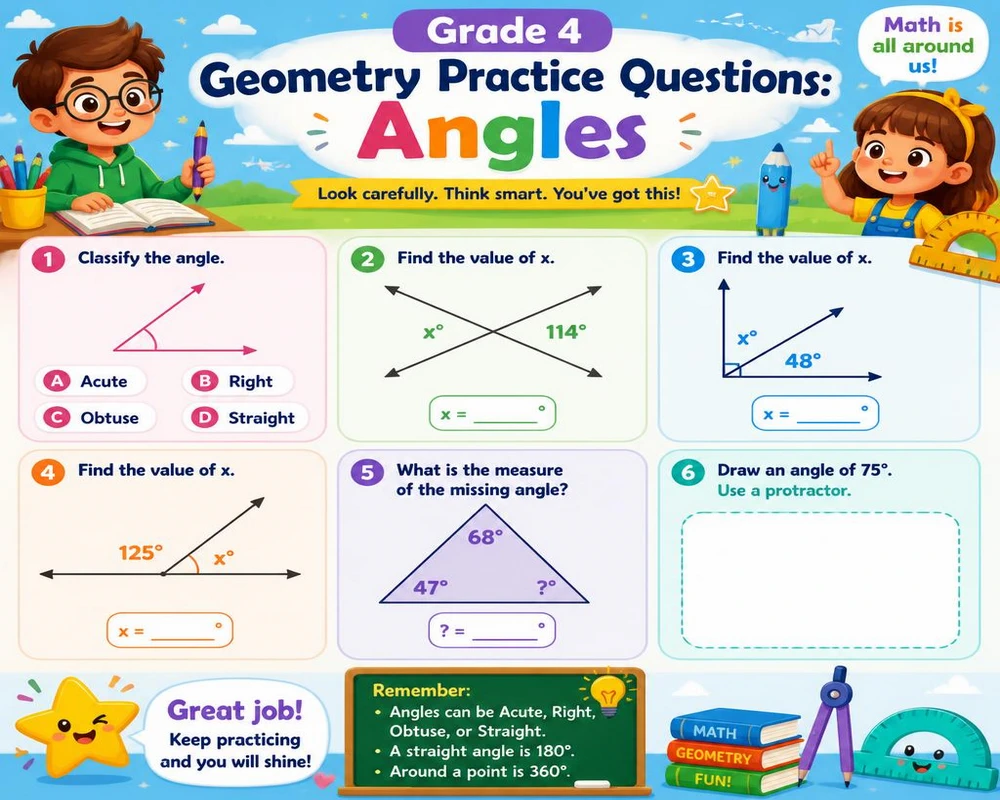
Grade 4 Geometry Practice Questions: Angles
Below are angles practice Grade 4 style questions, moving from identification to more applied reasoning.
Identifying Angle Types
- Is a 45-degree angle acute, right, obtuse, or straight?
- Classify a 130-degree angle.
- What type of angle is formed at the corner of a standard door frame?
- If an angle measures exactly 90 degrees, what is it called?
Answers: 1) Acute 2) Obtuse 3) Right 4) Right angle
Estimating and Comparing Angles
- Without measuring, estimate whether this angle looks closer to 30 degrees or 150 degrees. (Show your child a drawn angle to estimate.)
- Which is larger: an angle of 75 degrees or an angle of 95 degrees?
- Order these angles from smallest to largest: 100°, 45°, 175°, 89°
Answer for #3: 45°, 89°, 100°, 175°
Grade 4 Geometry Practice Questions: 2D and 3D Shapes
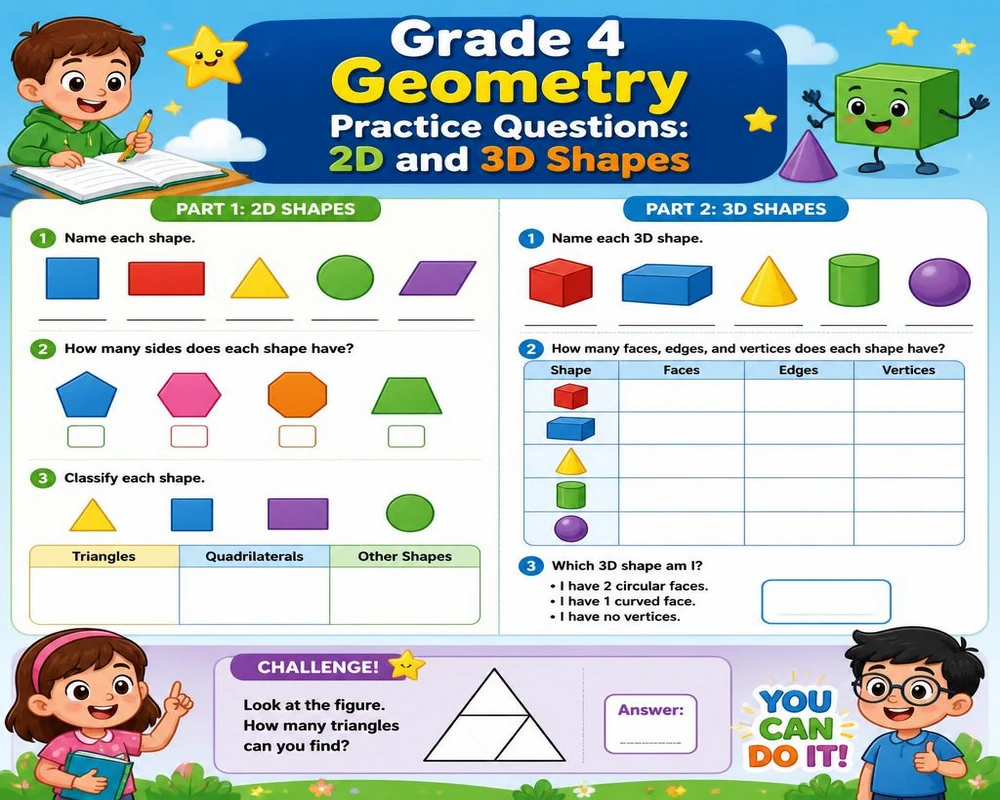
Classifying 2D Shapes
Grade 4 students should be comfortable describing shapes by their properties, not just their names.
- Name a quadrilateral with exactly one pair of parallel sides.
- How many sides does a hexagon have?
- What makes a shape a “regular” polygon?
- Name two properties that distinguish a rectangle from a square.
Answers: 1) Trapezoid 2) Six 3) All sides and angles are equal 4) A square has four equal sides, while a rectangle only requires opposite sides to be equal
Exploring 3D Solids
| Solid | Faces | Edges | Vertices |
|---|---|---|---|
| Cube | 6 | 12 | 8 |
| Rectangular Prism | 6 | 12 | 8 |
| Triangular Prism | 5 | 9 | 6 |
| Square Pyramid | 5 | 8 | 5 |
Practice question: A shape has 5 faces, 8 edges, and 5 vertices. What solid is it?
Answer: A square pyramid
Building physical models with toothpicks and marshmallows, or simply examining boxes and packaging around the house, gives this abstract vocabulary something tangible to attach to.
Transformations and Symmetry in Grade 4
Translations, Reflections, and Rotations
These three terms describe how a shape can move without changing its size or form:
- Translation: Sliding a shape in any direction without rotating or flipping it
- Reflection: Flipping a shape over a line, creating a mirror image
- Rotation: Turning a shape around a fixed point
Practice question: If you slide a triangle three squares to the right on a grid without turning it, which transformation did you perform?
Answer: Translation
Finding Lines of Symmetry
A shape has a line of symmetry if it can be folded along that line so both halves match exactly. Squares have four lines of symmetry, equilateral triangles have three, and a regular pentagon has five.
Practice activity: Give your child a folded paper cutout of a shape (square, rectangle, or heart) and have them find and mark every possible line of symmetry, checking each fold physically rather than guessing.
Real-World Word Problems for Geometry Practice
Word problems help connect shapes Grade 4 Canada students learn about to situations outside the classroom.
- A window is shaped like a rectangle with two right angles visible at the top corners. What type of angles are the other two corners?
- A stop sign has eight equal sides and eight equal angles. What is this shape called, and is it regular or irregular?
- A ramp forms an angle of 25 degrees with the ground. Is this angle acute, right, or obtuse?
- A kite-shaped shelf has one pair of equal angles. Sketch a kite and label its properties.
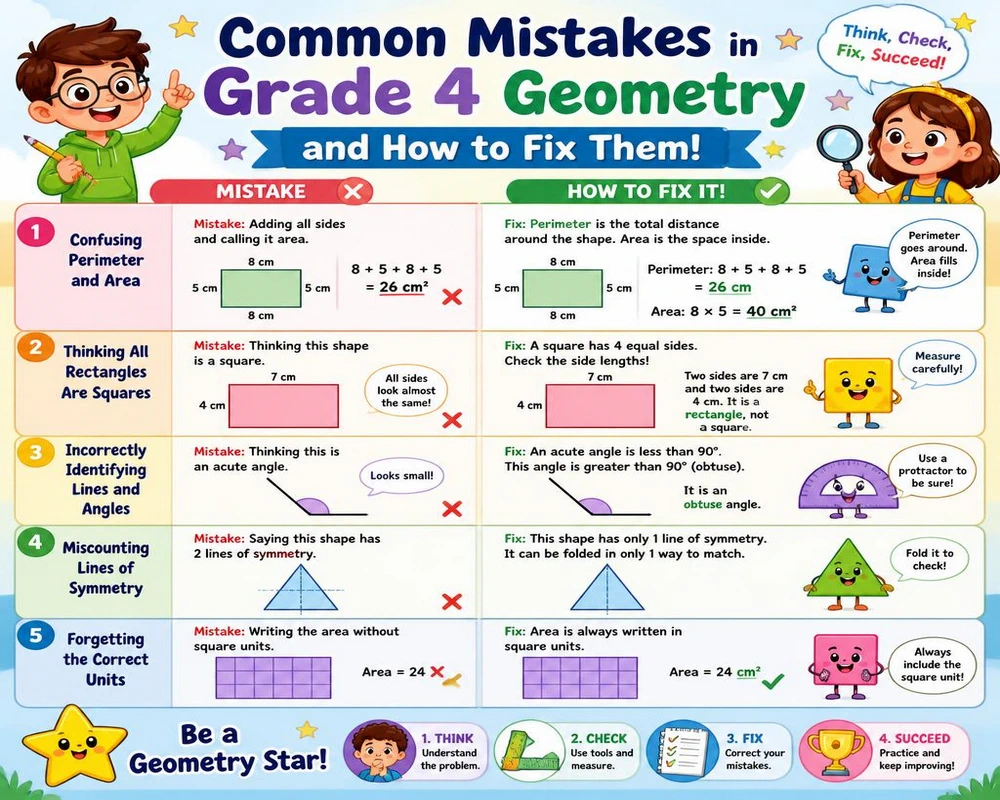
Common Mistakes in Grade 4 Geometry and How to Fix Them
Misreading the Protractor Scale
As mentioned earlier, students often read the wrong number on a protractor’s double scale, leading to answers that are off by a predictable amount (usually the angle’s supplement).
Fix: Always have your child estimate first — “does this look bigger or smaller than a right angle?” — before reading the exact measurement. This catches scale-reading errors immediately.
Confusing Similar-Looking Shapes
Rectangles and parallelograms, or squares and rhombi, get mixed up frequently because students focus on appearance rather than properties.
Fix: Practice sorting shapes by writing out their properties first (number of sides, whether sides are equal, whether angles are right angles) before naming the shape.
Assuming All Shapes With Four Sides Are the Same
Some students default to calling every quadrilateral a “square” or “rectangle.”
Fix: Introduce a simple decision-tree approach: does it have four right angles? Are all sides equal? This structured questioning helps kids narrow down the correct classification systematically.
Practical Tips for Practicing Geometry at Home
Go on a Shape Scavenger Hunt
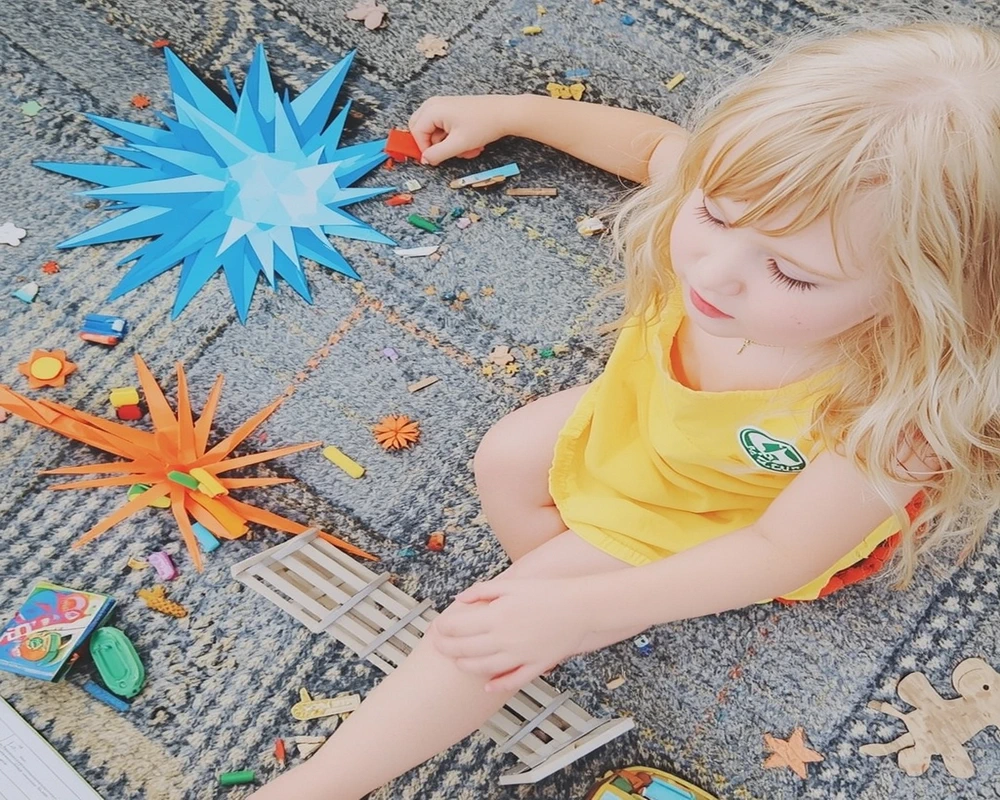
Walk around the house or neighborhood and challenge your child to find five different angle types or three different 3D solids in everyday objects — a cereal box, a road sign, a picture frame.
Build With Construction Toys
LEGO bricks, magnetic tiles, and building blocks are excellent, low-prep tools for exploring 3D shape properties. Counting faces, edges, and vertices on a physical model sticks far better than counting them from a flat picture.
Keep a Geometry Journal
Have your child sketch and label one new shape or angle each day for a week, noting its properties in their own words. This kind of low-stakes, repeated exposure tends to build stronger retention than a single intense study session.
Balance Screen-Based and Hands-On Practice
| Pros of Digital Geometry Practice | Pros of Hands-On Practice |
|---|---|
| Instant feedback on angle measurements | Builds physical intuition for shape properties |
| Engaging, game-like format | Reinforces vocabulary through tactile exploration |
| Easy to track progress over time | Deepens understanding of 3D solids specifically |
The best results tend to come from mixing both approaches rather than relying exclusively on one.
Conclusion: Building Spatial Confidence One Shape at a Time
Grade 4 geometry practice asks students to think in a genuinely new way — analyzing properties instead of just naming shapes on sight. That shift takes time, patience, and plenty of hands-on exposure, but it pays off far beyond this one school year. The spatial reasoning your child builds now, whether it’s measuring angles with a protractor or identifying lines of symmetry, lays groundwork for geometry, algebra, and even science courses well into the future.
This week, try picking just one area from this guide — angles, 3D solids, or symmetry — and spend fifteen minutes exploring it together using real objects around your home. Small, consistent practice like this turns abstract geometry vocabulary into concepts your child genuinely understands, not just memorizes for a test.
Angles and shapes are just one strand of a busy Grade 4 year that also includes division, measurement, and early data management. For the full picture, our Grade 4 math practice hub covers every topic with practice questions to match.
Frequently Asked Questions
1. What angle types should a Grade 4 student be able to identify? Students should be able to classify angles as acute (less than 90 degrees), right (exactly 90 degrees), obtuse (between 90 and 180 degrees), and straight (exactly 180 degrees).
2. When do students start using a protractor in Ontario? Formal protractor use for measuring angles typically begins in Grade 4, building on earlier informal angle comparison work done in Grades 2 and 3.
3. What’s the difference between a translation, reflection, and rotation? A translation slides a shape without turning it, a reflection flips a shape to create a mirror image, and a rotation turns a shape around a fixed point.
4. How can I help my child with 3D shape vocabulary at home? Use real objects like cereal boxes, dice, or building blocks, and have your child count and name the faces, edges, and vertices out loud as they examine each one.
5. Why does my child confuse rectangles and parallelograms? This usually happens when students focus on general appearance rather than specific properties, like whether all angles are right angles. Practicing property-based sorting helps resolve this.
6. Is it normal for kids to struggle with reading a protractor at first? Yes, this is extremely common due to the double-numbered scale. Encouraging an estimate before measuring helps catch and correct scale-reading mistakes quickly.
7. How much time should be spent on geometry practice at home each week? Short, focused sessions of 15 to 20 minutes, two or three times a week, tend to be more effective than infrequent longer sessions for building lasting spatial reasoning skills.
8. Does Grade 4 geometry connect to later math topics? Yes, strong spatial reasoning built through angle and shape work in Grade 4 supports later success in algebra, data literacy, and more advanced geometry in subsequent grades.