
Grade 4 Division Practice — Long Division Ontario Curriculum Questions
There’s a particular kind of frown that shows up on a fourth grader’s face the first time long division gets introduced — that mix of “wait, there are steps in a specific order?” and “why does this number keep going back on top of the other one?”
If you’ve watched that exact expression at your kitchen table, you’re witnessing one of the biggest conceptual jumps in elementary math. Grade 4 division practice is where students move from simple sharing and grouping to a genuine multi-step algorithm, and that transition trips up more kids than almost any other topic at this grade level.
Having spent years teaching Ontario’s Junior Division math curriculum and coaching students through exactly this hurdle, I can tell you the fix isn’t more repetition of the same problem type — it’s making sure each step of the process actually makes sense before speed becomes the goal.
This guide breaks down what Ontario’s Grade 4 curriculum expects around division, why long division specifically causes so much friction, and how to build real skill with practice questions that go beyond rote memorization.
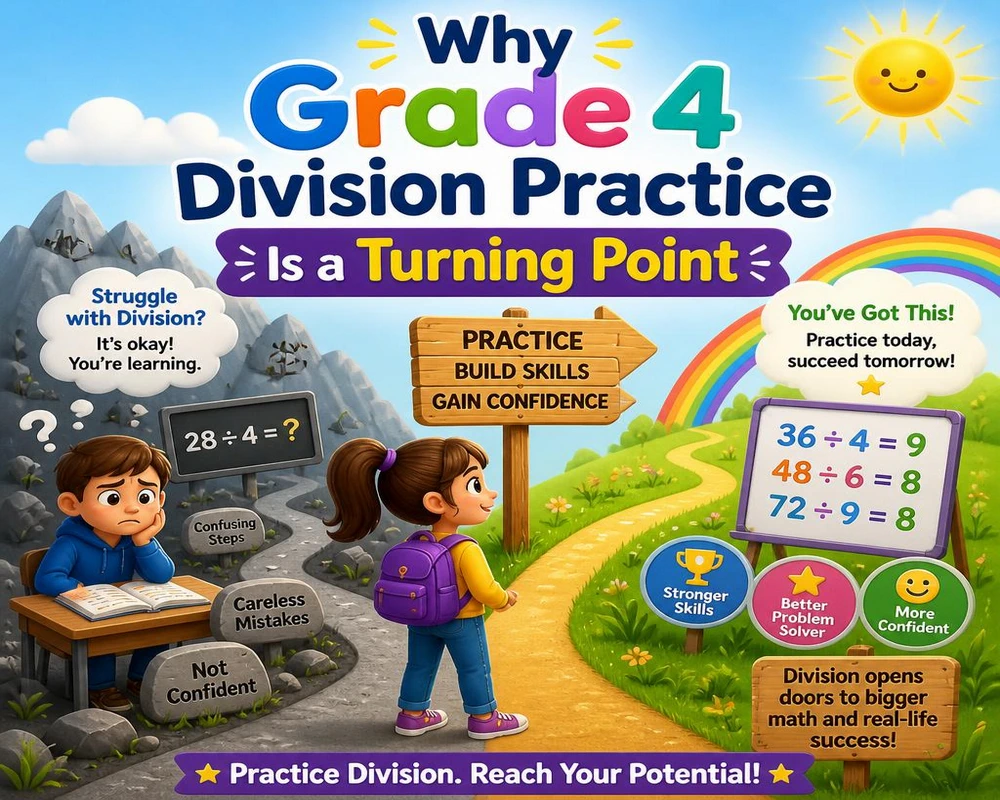
Why Grade 4 Division Practice Is a Turning Point
Through Grades 2 and 3, division tends to stay concrete — sharing 12 cookies equally among 4 friends, or grouping 20 counters into sets of 5. Grade 4 division practice pushes students toward more abstract territory: dividing two- and sometimes three-digit numbers by a single digit, understanding remainders, and eventually working through the standard long division algorithm.
This shift matters because division sits at the intersection of several other skills a student needs simultaneously: solid multiplication fact recall, an understanding of place value, and the ability to hold multiple steps in mind at once. A 2025 study summary from the Ontario Association for Mathematics Education noted that students who hadn’t yet automated their multiplication facts by Grade 4 showed measurably slower progress specifically in division, since so much mental bandwidth gets used up on basic recall rather than the division process itself. In other words, if your child is shaky on their times tables, that gap will surface loudly here.
What the Ontario Curriculum Expects in Grade 4
By the end of Grade 4, Ontario students are generally expected to:
- Divide two-digit numbers by one-digit numbers, with and without remainders
- Understand division as both sharing (equal groups) and as the inverse of multiplication
- Use mental math strategies for simple division facts
- Estimate quotients before calculating
- Solve word problems involving division in real-life contexts
- Begin working with the standard long division algorithm for numbers within the curriculum’s expected range
Notice that estimation appears right alongside computation. Ontario’s curriculum places real weight on number sense — wanting students to have a rough sense of what a reasonable answer looks like before diving into the mechanics of long division Grade 4 Ontario style problems.
Building the Foundation: Division as the Inverse of Multiplication
Why This Connection Matters
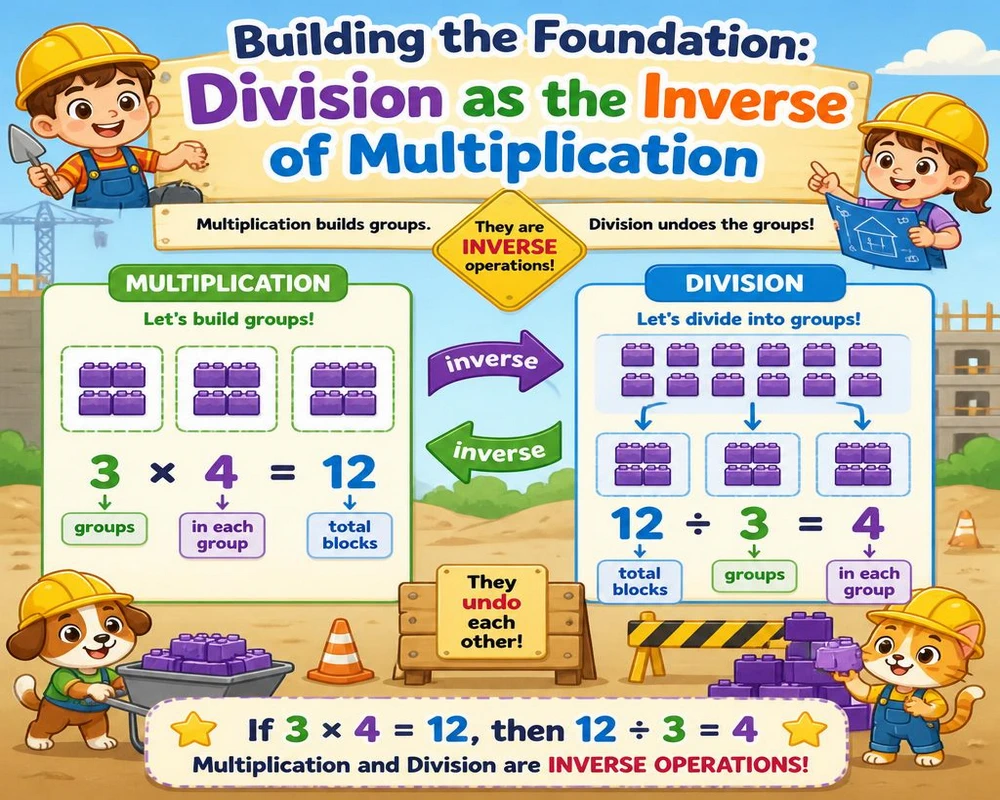
One of the fastest ways to strengthen division skills is reinforcing that every division fact has a matching multiplication fact. If a student knows 7 × 8 = 56, they already know 56 ÷ 8 = 7 and 56 ÷ 7 = 8. Teaching division in isolation from multiplication makes students work twice as hard for no reason.
Long division becomes far less intimidating once a child sees it as the reverse of multiplication rather than a brand-new, unrelated skill. HomeschoolMath.net offers free, printable worksheets and step-by-step breakdowns that pair well with classroom instruction on the division algorithm.
Quick Fact-Family Practice
Given the numbers 6, 9, and 54, a student should be able to write:
- 6 × 9 = 54
- 9 × 6 = 54
- 54 ÷ 6 = 9
- 54 ÷ 9 = 6
Practicing a handful of these fact triangles at home — 4, 8, 32 or 5, 7, 35 — takes only a few minutes but pays off enormously once long division enters the picture.
Basic Division Questions Grade 4 (With Answers)
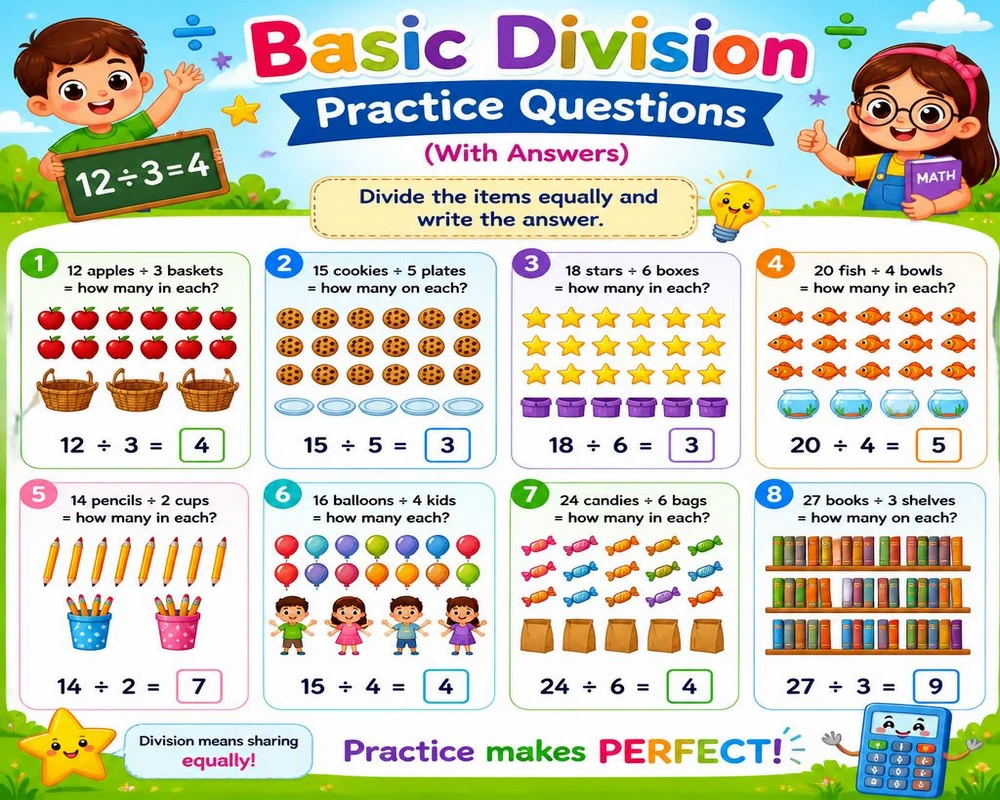
Before tackling long division, make sure these foundational math division practice Canada style questions feel automatic.
| Question | Answer |
|---|---|
| 84 ÷ 4 = ___ | 21 |
| 96 ÷ 6 = ___ | 16 |
| 72 ÷ 3 = ___ | 24 |
| 63 ÷ 7 = ___ | 9 |
| 56 ÷ 8 = ___ | 7 |
| 45 ÷ 5 = ___ | 9 |
If your child hesitates on more than one or two of these, it’s worth spending extra time here before moving forward. Long division builds directly on top of this fluency.
Understanding Remainders
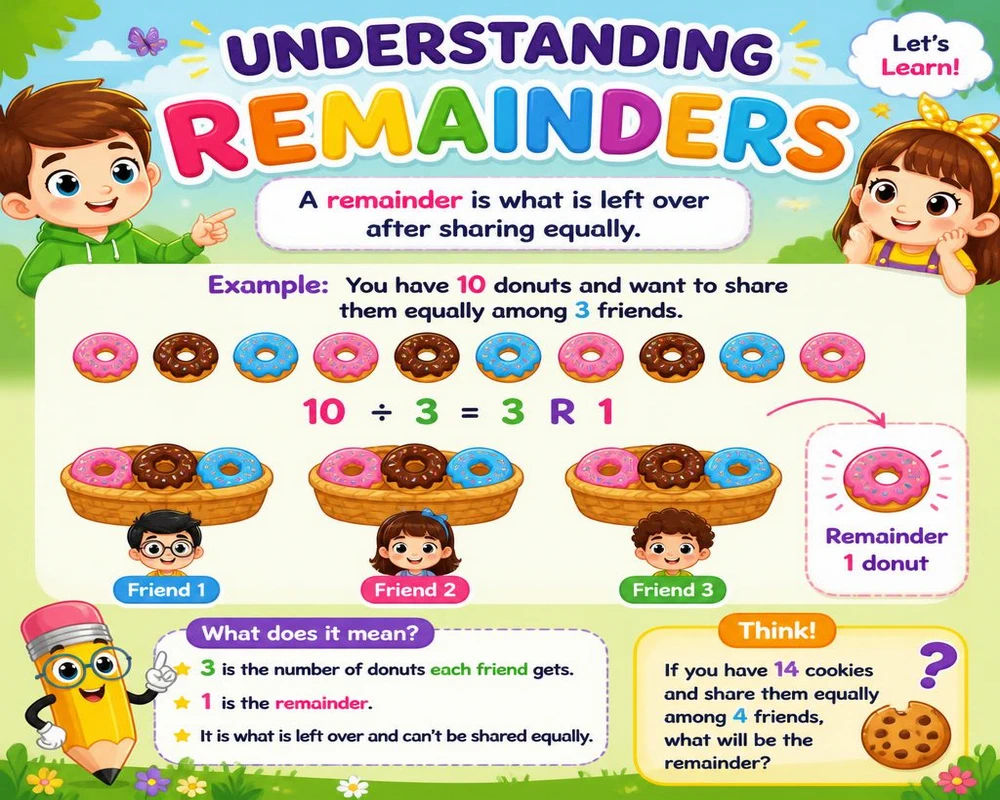
Not every division problem divides evenly, and Grade 4 is typically when remainders formally enter the picture.
What a Remainder Represents
A remainder is simply what’s left over after dividing as evenly as possible. If you have 13 stickers and want to share them equally among 4 friends, each friend gets 3 stickers, with 1 sticker left over. That’s written as 13 ÷ 4 = 3 remainder 1.
Remainder Practice Questions
- 53 ÷ 4 = ___ remainder ___
- 67 ÷ 5 = ___ remainder ___
- 91 ÷ 6 = ___ remainder ___
- 38 ÷ 7 = ___ remainder ___
Answers: 1) 13 remainder 1 2) 13 remainder 2 3) 15 remainder 1 4) 5 remainder 3
A useful home check: have your child verify their answer by multiplying the quotient by the divisor, then adding the remainder — it should equal the original number. For 53 ÷ 4, that’s (13 × 4) + 1 = 53. This habit catches careless errors before they become ingrained.
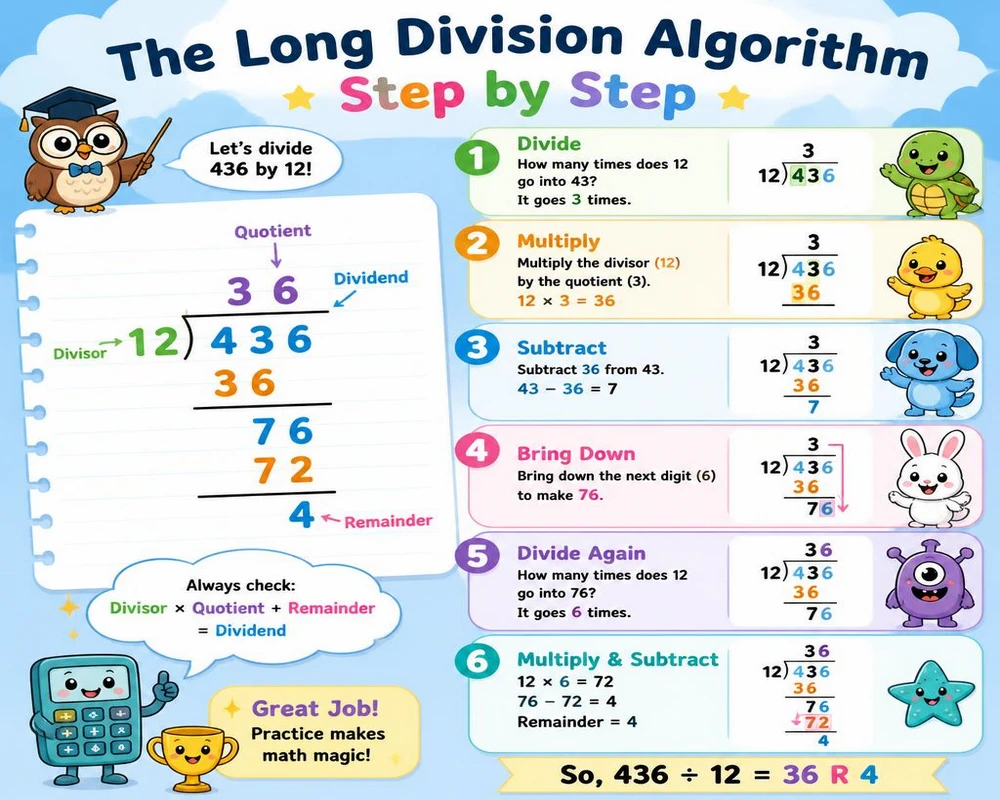
The Long Division Algorithm, Step by Step
Breaking Down the Process
Long division Grade 4 Ontario questions typically follow this four-step cycle, repeated for each digit: divide, multiply, subtract, bring down.
- Divide: How many times does the divisor go into the current digit(s)?
- Multiply: Multiply that number by the divisor.
- Subtract: Subtract the result from the current digit(s).
- Bring down: Bring down the next digit and repeat.
Worked Example
Let’s work through 96 ÷ 4 step by step:
- Divide: 9 ÷ 4 = 2, with some left over
- Multiply: 2 × 4 = 8
- Subtract: 9 − 8 = 1
- Bring down: bring down the 6, making 16
- Divide: 16 ÷ 4 = 4
- Multiply: 4 × 4 = 16
- Subtract: 16 − 16 = 0
The answer is 24, with nothing remaining. Walking through this out loud, narrating each step as you go, helps a lot of students internalize the rhythm of the process before they’re expected to do it independently.
Common Long Division Setup Mistakes
- Forgetting to bring down the next digit after subtracting
- Misplacing digits in the quotient, especially when a digit doesn’t divide evenly on the first pass
- Subtracting incorrectly, which throws off every subsequent step
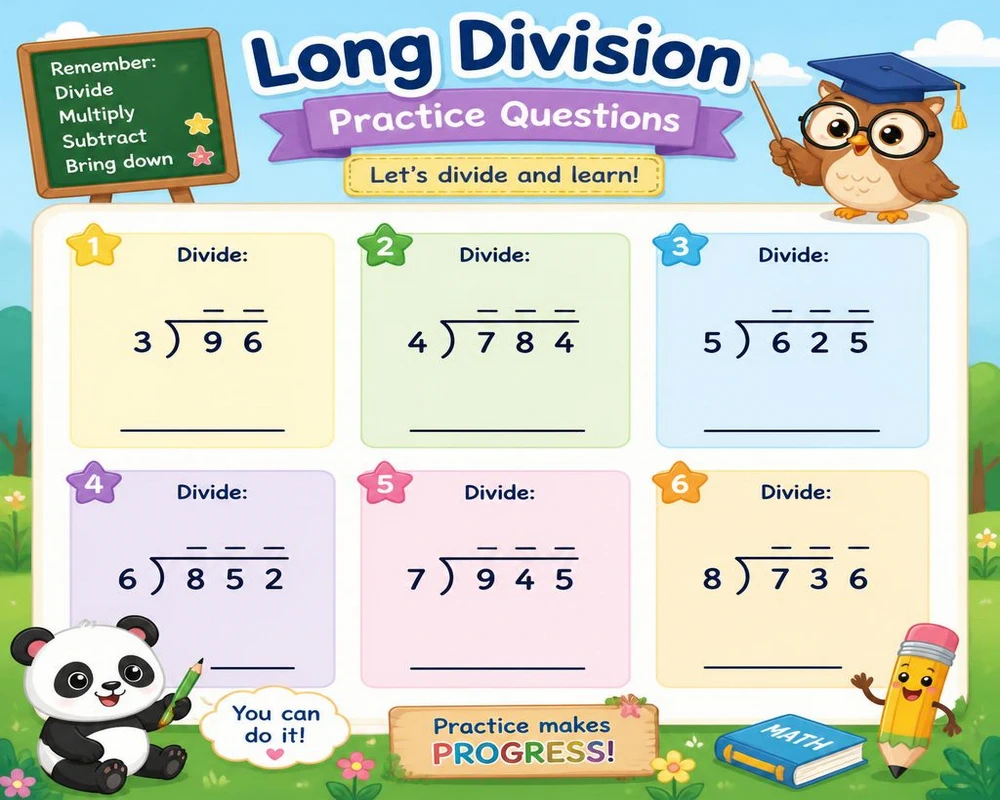
Long Division Practice Questions
Work through these gradually, checking each step rather than just the final answer.
- 128 ÷ 4 = ___
- 144 ÷ 6 = ___
- 156 ÷ 3 = ___
- 96 ÷ 8 = ___
- 85 ÷ 5 = ___
- 77 ÷ 7 = ___
Answers: 1) 32 2) 24 3) 52 4) 12 5) 17 6) 11
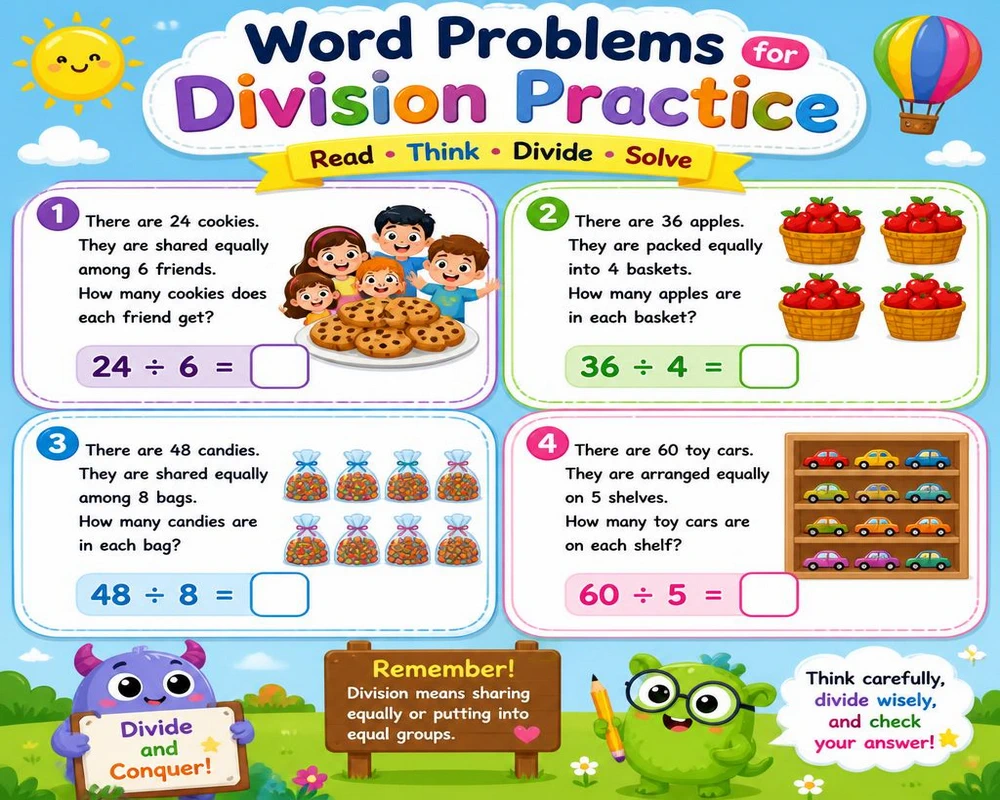
Word Problems for Division Practice
Real-world scenarios help students recognize when division applies, which is often trickier than the calculation itself.
- A teacher has 72 pencils to share equally among 6 groups. How many pencils does each group receive?
- There are 96 apples to be packed into boxes of 8. How many boxes are needed?
- A family drove 156 kilometers over 3 equal days. How far did they drive each day?
- Forty-five students are being split into teams of 5 for a field trip. How many teams will there be?
- A baker has 63 muffins to place equally on 7 trays. How many muffins go on each tray?
Reading these aloud and asking your child to identify the divisor and dividend before solving — rather than jumping straight to computation — builds the comprehension skills they’ll need for increasingly complex division questions Grade 4 and beyond.
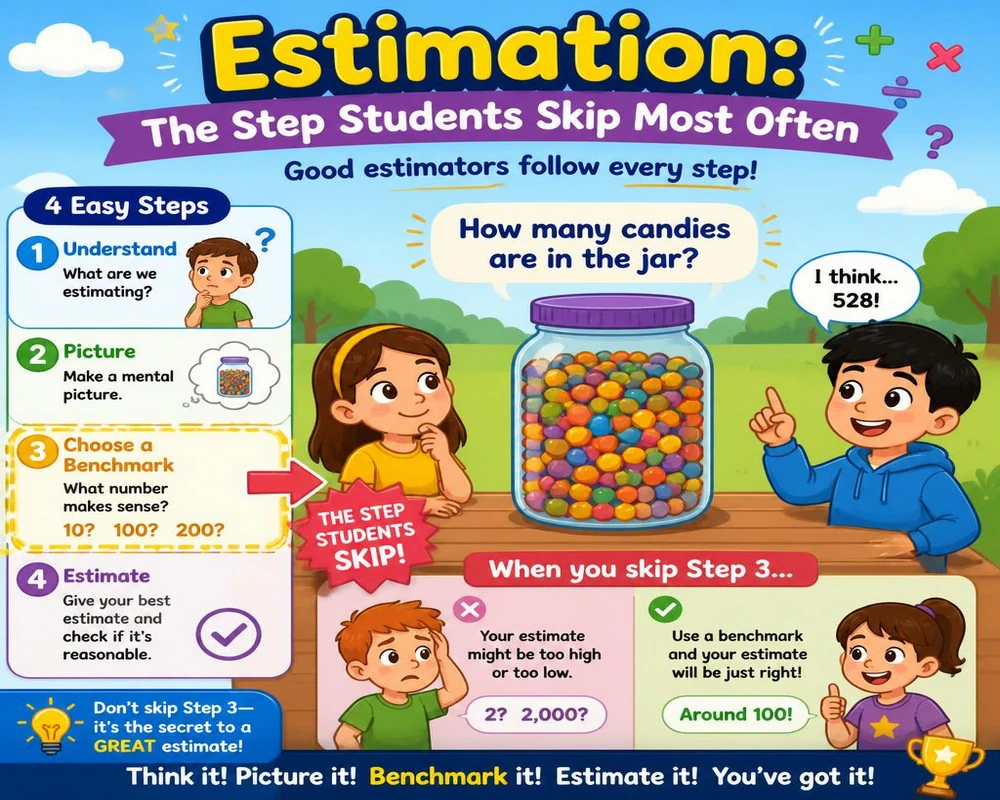
Estimation: The Step Students Skip Most Often
Why Estimating First Matters
Before solving 178 ÷ 6, a student should be able to estimate that the answer is somewhere around 30, since 6 × 30 = 180. This rough check catches major errors immediately — if a student calculates 178 ÷ 6 and gets 3, an estimate would have flagged that something went wrong.
Quick Estimation Practice
- Estimate: 243 ÷ 5 is closest to which number: 20, 50, or 90?
- Estimate: 361 ÷ 9 is closest to which number: 4, 40, or 400?
Answers: 1) 50 2) 40
Pros and Cons of Different Division Practice Methods
| Method | Pros | Cons |
|---|---|---|
| Worksheets | Easy to track progress, good for repetition | Can feel repetitive without variety |
| Manipulatives (counters, blocks) | Builds concrete understanding of sharing and grouping | Time-consuming for larger numbers |
| Real-life word problems | Connects math to everyday situations | Requires more reading comprehension |
| Digital apps and games | Engaging, often adaptive to skill level | Can encourage guessing without genuine understanding |
The most effective approach almost always combines a few of these rather than relying on just one. In my experience, students who only ever see division on a printed worksheet tend to struggle more with word problems than those who’ve also used manipulatives and real-life scenarios along the way.
Practical Tips for Practicing Division at Home
Keep Multiplication Facts Fresh
Since division and multiplication are so tightly linked, a quick two-minute multiplication fact review before a division practice session can make the entire session go more smoothly.
Use Everyday Sharing Situations
Splitting a bag of candy, dividing up chore time, or sharing a pizza all count as authentic division questions Grade 4 students can relate to immediately, often more so than an abstract worksheet.
Slow Down Before Speeding Up
It’s tempting to push for quick recall right away, but with long division specifically, accuracy in following each step should come well before speed. Rushing tends to introduce the exact setup errors mentioned earlier.
Check Work With Multiplication
Encourage your child to multiply their quotient by the divisor (and add any remainder) to verify their answer. This single habit builds both confidence and independence, since they’re not relying solely on you to confirm whether an answer is correct.
Long division is one of the more demanding skills in Grade 4, but it connects directly to multiplication facts and place value understanding from earlier lessons. For the complete picture of what the year covers, our Grade 4 math practice brings every topic together in one place.
Conclusion: From Frustration to Fluency
Grade 4 division practice asks a lot of young learners all at once — recalling multiplication facts, understanding remainders, and following a multi-step algorithm in the correct order. That’s genuinely hard, and a little frustration along the way is completely normal. The students who come out the other side confident aren’t the ones who practiced the most problems; they’re the ones who understood each step before chasing speed.
Start tonight with just five basic division facts and one long division problem, walking through every step out loud together. Building this kind of steady, understanding-first practice now will make every future math topic that relies on division — fractions, ratios, algebra — feel far more manageable down the road.
Frequently Asked Questions
1. What division skills should a Grade 4 student have by the end of the year? By year’s end, most Ontario Grade 4 students should be able to divide two-digit numbers by one-digit numbers, understand remainders, and begin working through the standard long division algorithm.
2. Why does my child struggle with long division specifically? Long division requires several skills at once — multiplication recall, place value understanding, and multi-step sequencing — so a gap in any one of these areas often shows up clearly during long division.
3. How can I help my child understand remainders? Use hands-on sharing scenarios, like dividing a set number of items among friends, and have them check their answer by multiplying the quotient by the divisor and adding the remainder.
4. Should my child memorize division facts the same way they memorize multiplication facts? Yes, reinforcing that division and multiplication are inverse operations through fact families tends to be far more effective than memorizing division facts as an entirely separate skill.
5. How much should estimation be part of division practice? Estimation should come before every division problem, since it helps students catch major calculation errors and builds the kind of number sense that supports more advanced math later on.
6. Is it normal for my child to make setup mistakes in long division? Yes, especially early on. Misplacing digits or forgetting to bring down the next number are extremely common and typically resolve with slow, careful, step-by-step practice.
7. How often should we practice division at home? Short sessions of 15 to 20 minutes, three to four times a week, tend to build more lasting skill than infrequent, longer practice sessions.
8. What’s the best way to make division practice feel less repetitive? Mix worksheet practice with real-life scenarios like sharing snacks or splitting costs, and rotate in hands-on tools like counters or grouping objects to keep the practice varied and concrete.