
Grade 7 Math Curriculum Ontario Preparation: 6 Real Shifts
Grade 7 isn’t just “harder Grade 6.” It’s the first year of Intermediate Division, and Ontario’s curriculum treats it as a genuine step up — new number types, new geometry, and a noticeably faster pace than Junior Division ever asked for. A student who was comfortable in Grade 6 can still find the first few months of Grade 7 genuinely disorienting if nobody explained what was actually going to be different. That’s exactly what real Grade 7 math curriculum Ontario preparation should focus on.
This guide walks through Grade 7 math curriculum Ontario preparation the honest way: six specific shifts from Grade 6, what each one actually looks like, and how to get ahead of them before September, without turning summer into an extra semester of school.
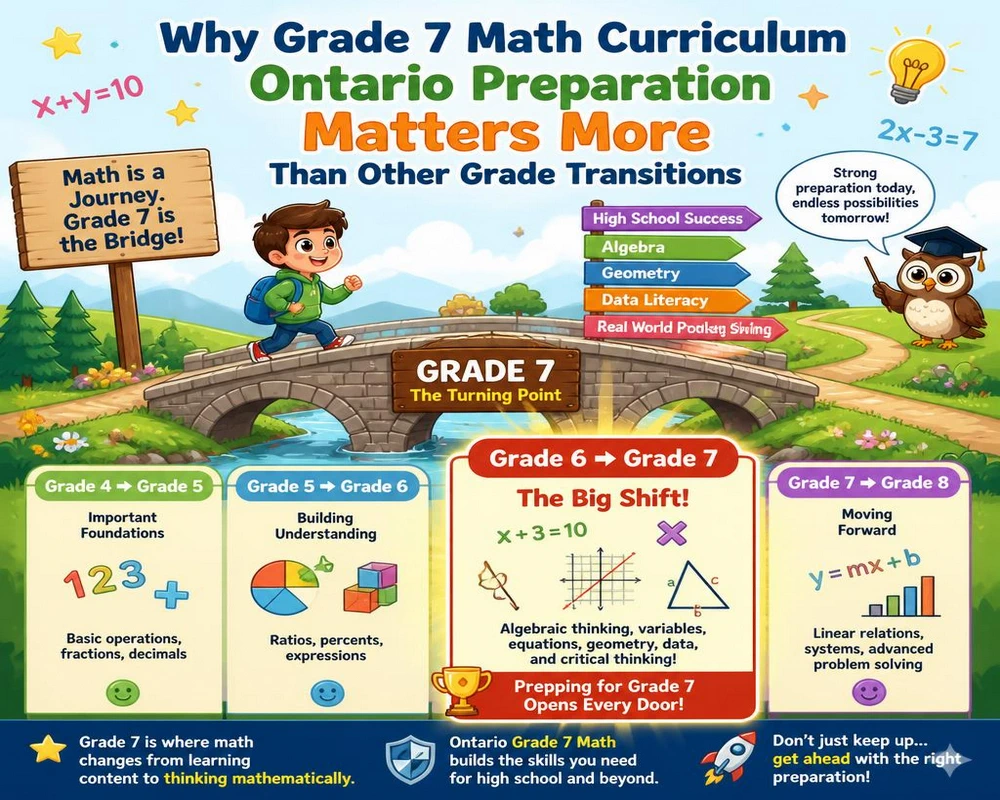
Why Grade 7 Math Curriculum Ontario Preparation Matters More Than Other Grade Transitions
Most grade-to-grade transitions in elementary school build gradually. Grade 7 is different — it marks the start of Intermediate Division, taught with a noticeably different pace and depth than Junior Division, and several genuinely new topics appear all at once rather than being eased in gradually. This is exactly why Grade 7 math curriculum Ontario preparation deserves more deliberate attention than the Grade 4-to-5 or Grade 5-to-6 transitions typically require. Ontario’s own curriculum documents show Grade 6, 7, and 8 sharing the same six strands, but the specific expectations within Number and Spatial Sense in particular expand substantially at Grade 7.
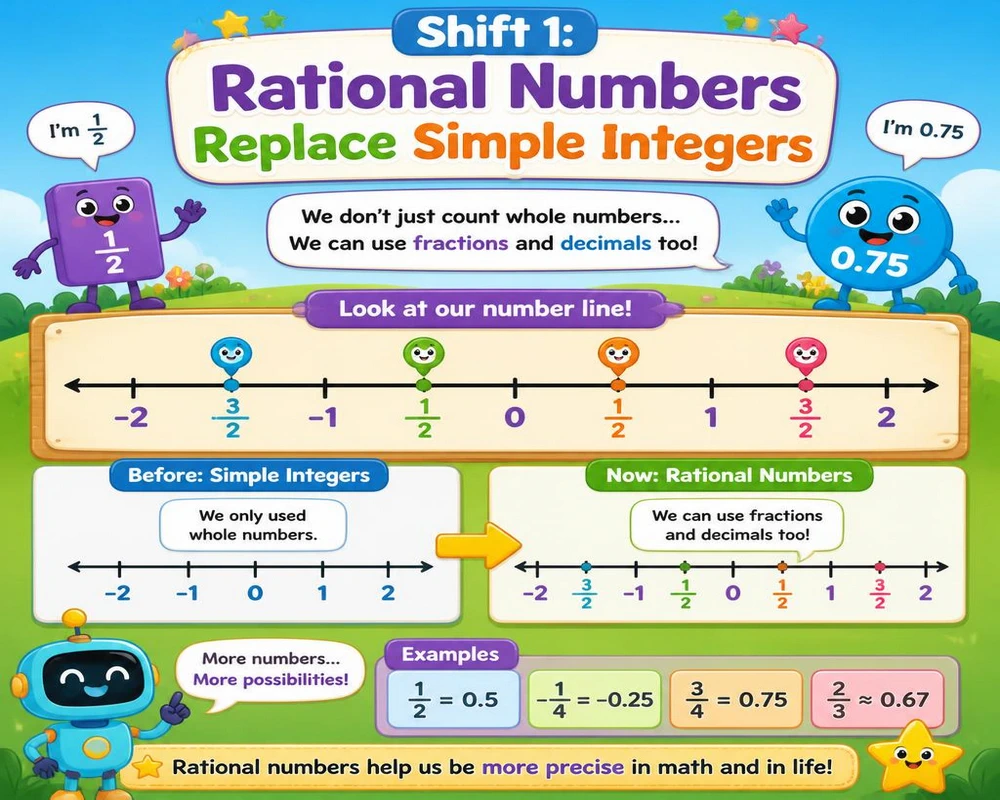
Shift 1: Rational Numbers Replace Simple Integers
Grade 6 introduces negative integers. Grade 7 expands this into the broader category of rational numbers — meaning students now work with negative fractions and negative decimals, not just negative whole numbers. Any real Grade 7 math curriculum Ontario preparation plan should address this shift directly, since it combines two skills (negatives and fractions) that were previously kept separate.
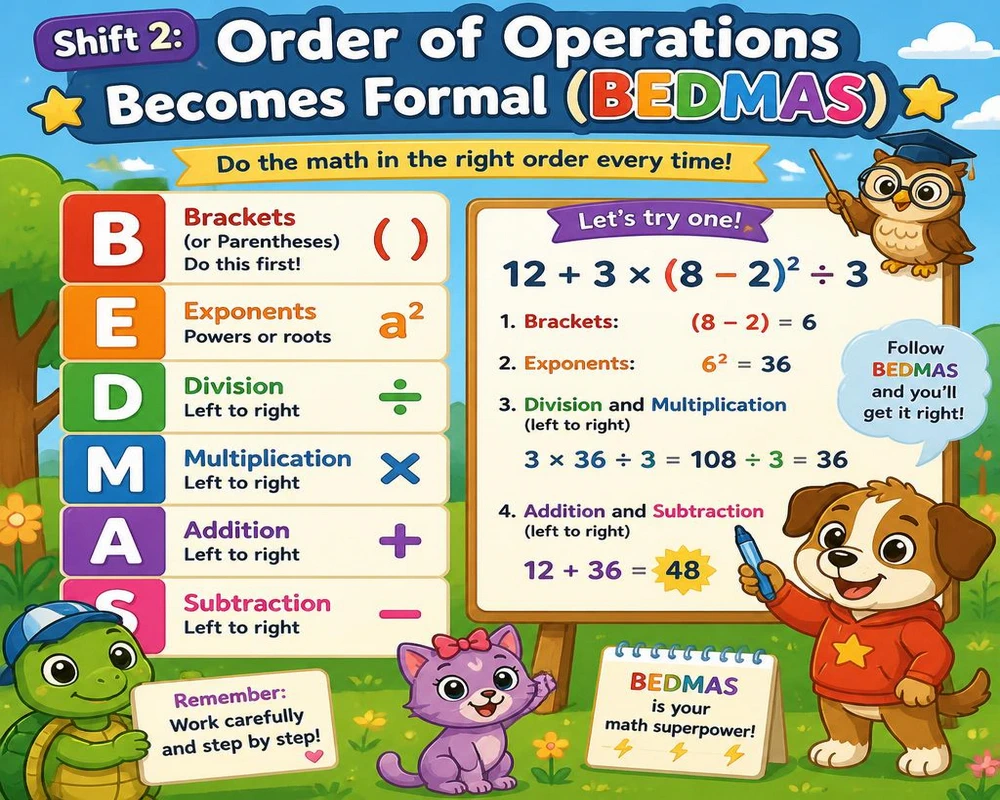
Shift 2: Order of Operations Becomes Formal (BEDMAS)
While earlier grades touch on solving expressions step by step, Grade 7 formalizes this into BEDMAS — Brackets, Exponents, Division and Multiplication, Addition and Subtraction — as an explicit rule students are expected to apply consistently. A student who’s never practiced a strict operation order can genuinely struggle here, even with strong basic calculation skills.
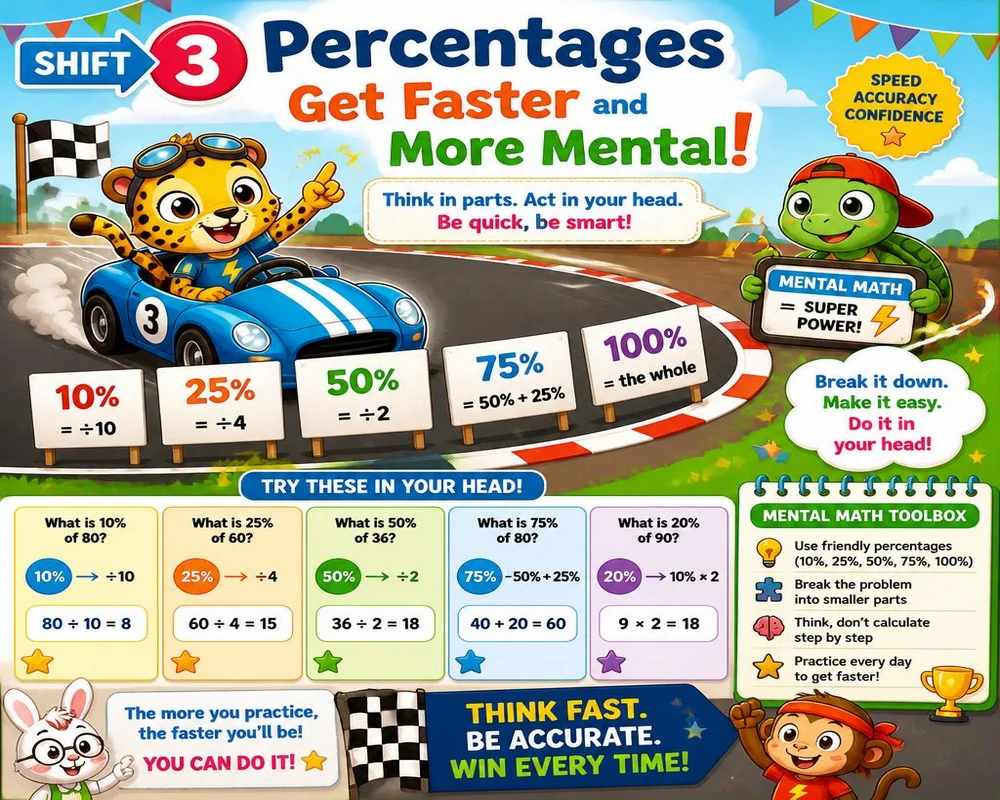
Shift 3: Percentages Get Faster and More Mental
Grade 6 covers percentages in a fairly deliberate, step-by-step way. Grade 7 pushes toward mental math fluency with common percentages — quickly finding 1%, 5%, 10%, 25%, and 50% of a number using scaling strategies, rather than working through a full written calculation every time.
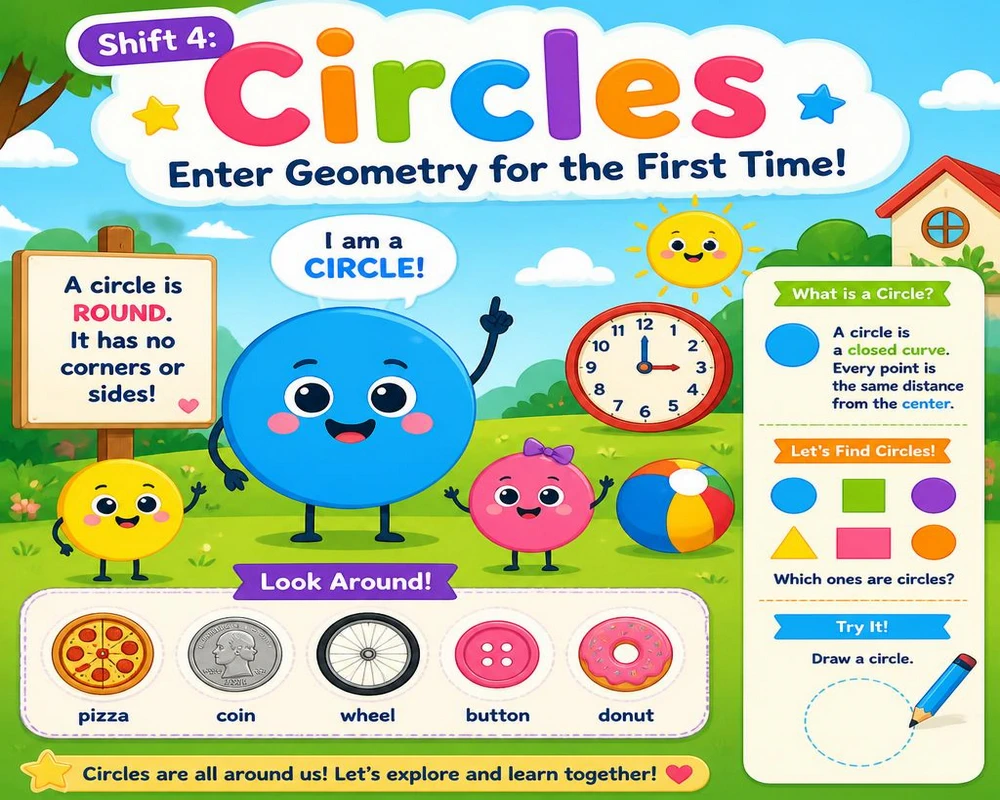
Shift 4: Circles Enter Geometry for the First Time
Grade 6 geometry focuses on angles, surface area, and coordinate grids, but circles specifically are new territory in Grade 7 — understanding the relationship between radius, diameter, and circumference, and being able to draw a circle based on any one of those three measurements.
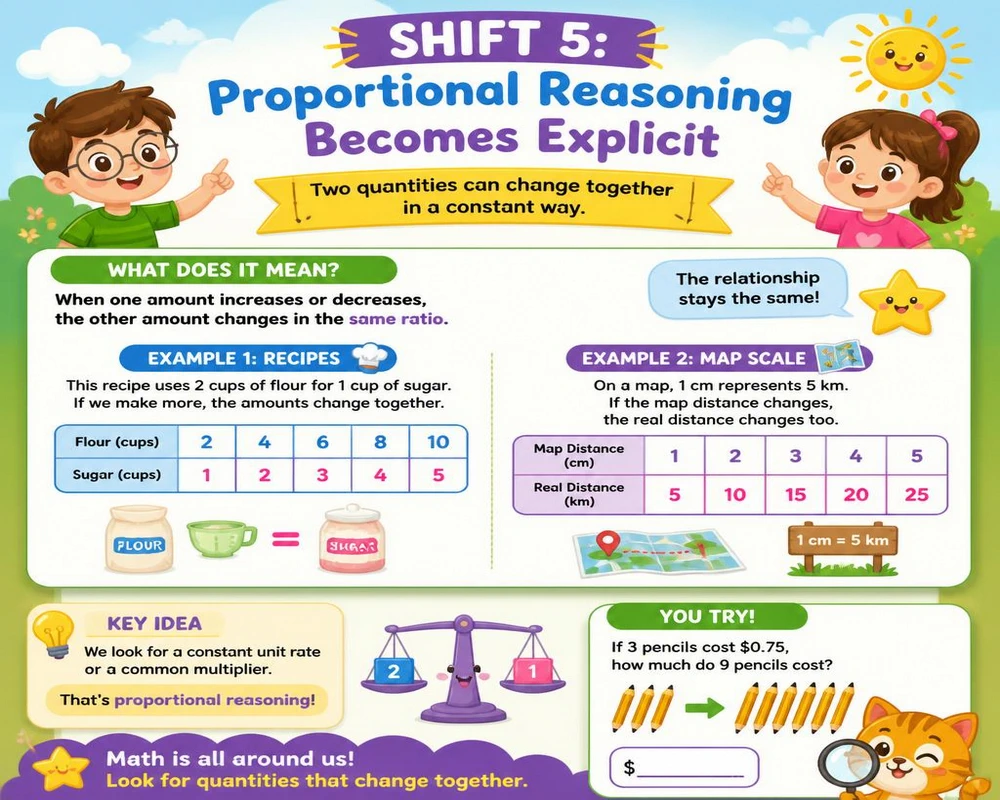
Shift 5: Proportional Reasoning Becomes Explicit
Grade 6 introduces ratios and rates. Grade 7 goes further, asking students to identify whether a relationship between two quantities is proportional or non-proportional in the first place — a more abstract judgment call than simply calculating a given ratio.
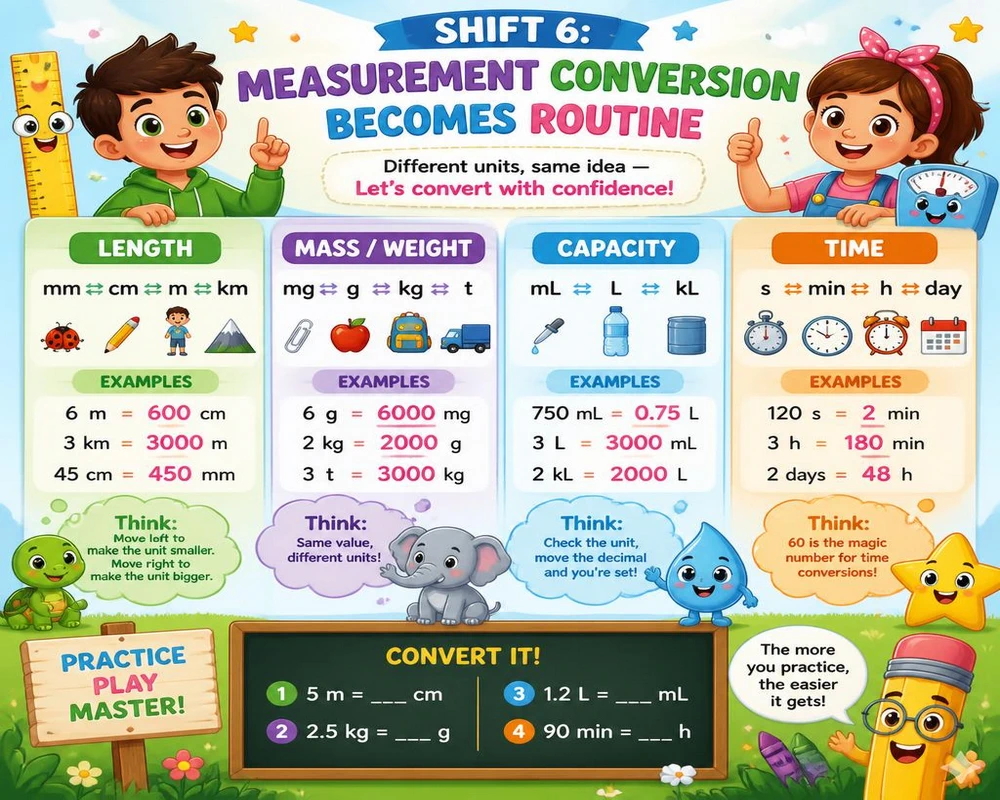
Shift 6: Measurement Conversion Becomes Routine
Problems involving perimeter, area, and volume in Grade 7 increasingly require converting between metric units within the same problem, rather than working in a single consistent unit throughout, adding a genuine extra layer most Grade 6 problems didn’t require.
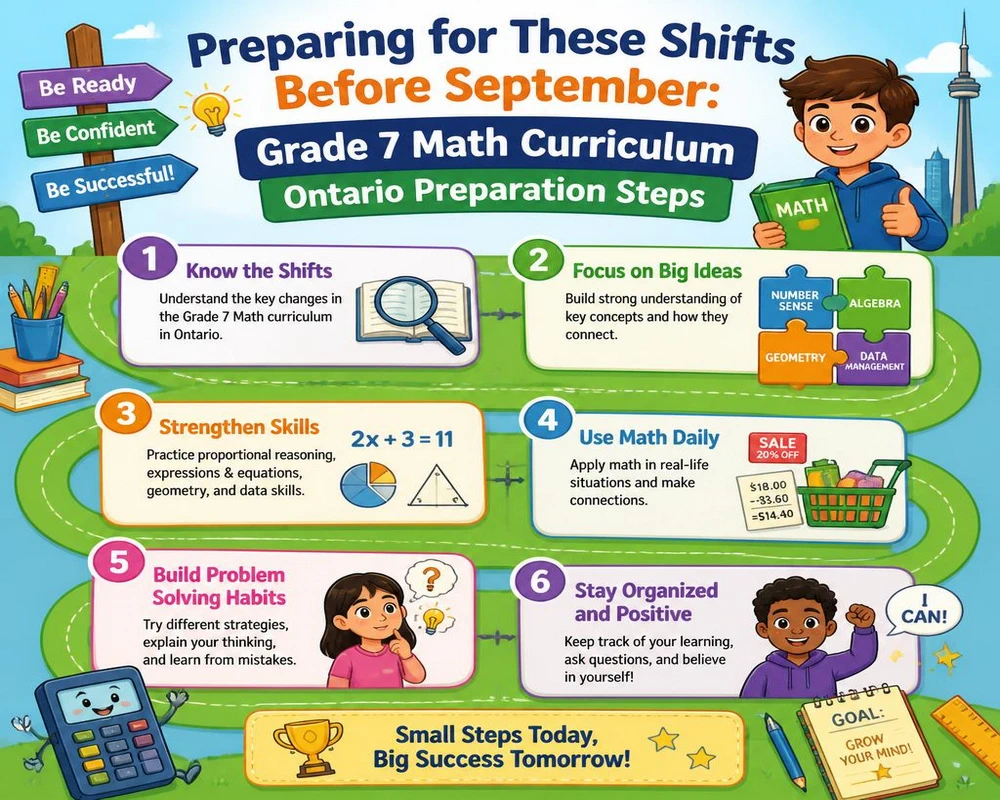
Preparing for These Shifts Before September: Grade 7 Math Curriculum Ontario Preparation Steps
Strengthen Negative Number Fluency First
Since rational numbers build directly on integer skills, confirming a child is genuinely solid with basic negative number addition and subtraction is the single highest-leverage piece of Grade 7 math curriculum Ontario preparation a family can do over the summer.
Practice Order of Operations Explicitly
Working through a handful of multi-operation expressions using the BEDMAS sequence, out loud, step by step, builds the habit before it becomes mandatory in September.
Build Mental Percentage Shortcuts
Practicing quick mental calculations of 10% and 50% of everyday numbers (prices, distances) builds toward the faster percentage fluency Grade 7 expects, without needing to sit down with a full worksheet.
Introduce Circle Vocabulary Early
Simply naming radius, diameter, and circumference on a real circular object at home — a plate, a wheel — gives a head start on vocabulary that will otherwise be entirely new in September.
What Stays the Same in Grade 7 Math Curriculum Ontario Preparation
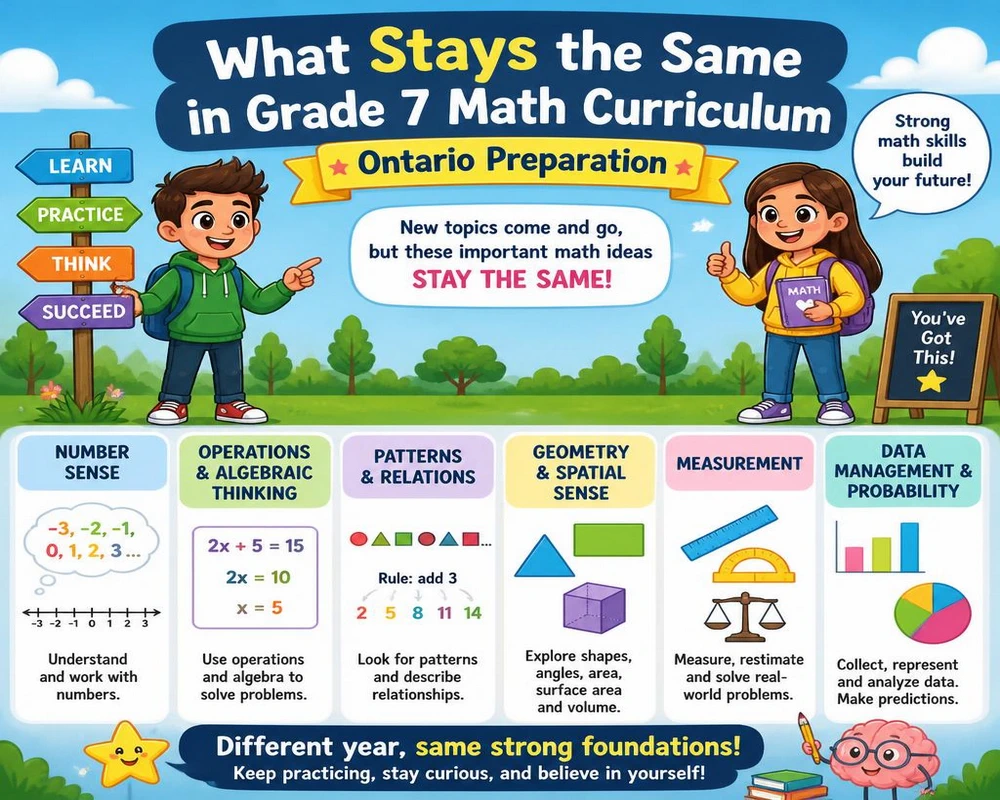
It’s worth noting what doesn’t change, since the shifts above can make Grade 7 sound more intimidating than it needs to. The same six strands continue — Number, Algebra, Data, Spatial Sense, Financial Literacy, and Social-Emotional Learning — and skills like fraction operations, basic ratios, and integer addition and subtraction carry forward directly rather than being replaced with something unfamiliar. The official Ontario Grades 7-8-9 alignment chart lays out exactly how each strand connects across these three years, if you want to see the full official picture beyond Grade 7 alone.
Frequently Asked Questions
1. Is Grade 7 math significantly harder than Grade 6?
It’s more accurately described as faster-paced and more abstract, introducing several genuinely new topics at once, rather than simply being a harder version of the same material.
2. What is BEDMAS, and why does it matter starting in Grade 7?
BEDMAS stands for Brackets, Exponents, Division and Multiplication, Addition and Subtraction, the required order for solving multi-step expressions, and it becomes a formal, explicit expectation starting in Grade 7.
3. Do students need a calculator for Grade 7 math?
Mental math remains a strong focus, especially for percentages, so building mental fluency matters even in a grade where calculators may be permitted for some tasks.
4. How is Grade 7 geometry different from Grade 6?
Grade 7 introduces circles specifically — radius, diameter, and circumference — which weren’t part of Grade 6’s geometry focus on angles and coordinate grids.
5. What’s the best single thing to review before starting Grade 7?
Negative number fluency tends to matter most, since Grade 7’s expanded rational numbers topic builds directly on integer skills from Grade 6.
6. Does Grade 7 still cover financial literacy?
Yes, Financial Literacy remains one of the six official strands through Grade 7 and beyond, continuing to build in complexity from what Grade 6 covered.
7. How can I find practice questions that bridge Grade 6 and Grade 7?
Our Grade 6 math practice hub covers the foundational skills — integers, ratios, percentages — that any solid Grade 7 math curriculum Ontario preparation plan builds directly on top of.
For a complete look at what every grade covers, see our Ontario math curriculum by grade guide, a useful companion to this Grade 7 math curriculum Ontario preparation guide.
For the complete, official Grade 7 curriculum document, the Ontario Ministry of Education’s elementary mathematics curriculum page provides the full, authoritative expectations.