Ontario Math Curriculum by Grade: The Full Breakdown
Parents searching for the Ontario math curriculum by grade are usually trying to answer one specific question: is my child learning what they’re supposed to be learning this year? That question deserves a straight answer, not a scattered collection of jargon pulled from a policy document. This guide lays out the Ontario math curriculum by grade, one year at a time, in plain language, covering exactly what each grade expects across all five curriculum strands. Whether you’re checking on Grade 1 basics or Grade 6 fractions, the Ontario math curriculum by grade breakdown below covers it all.
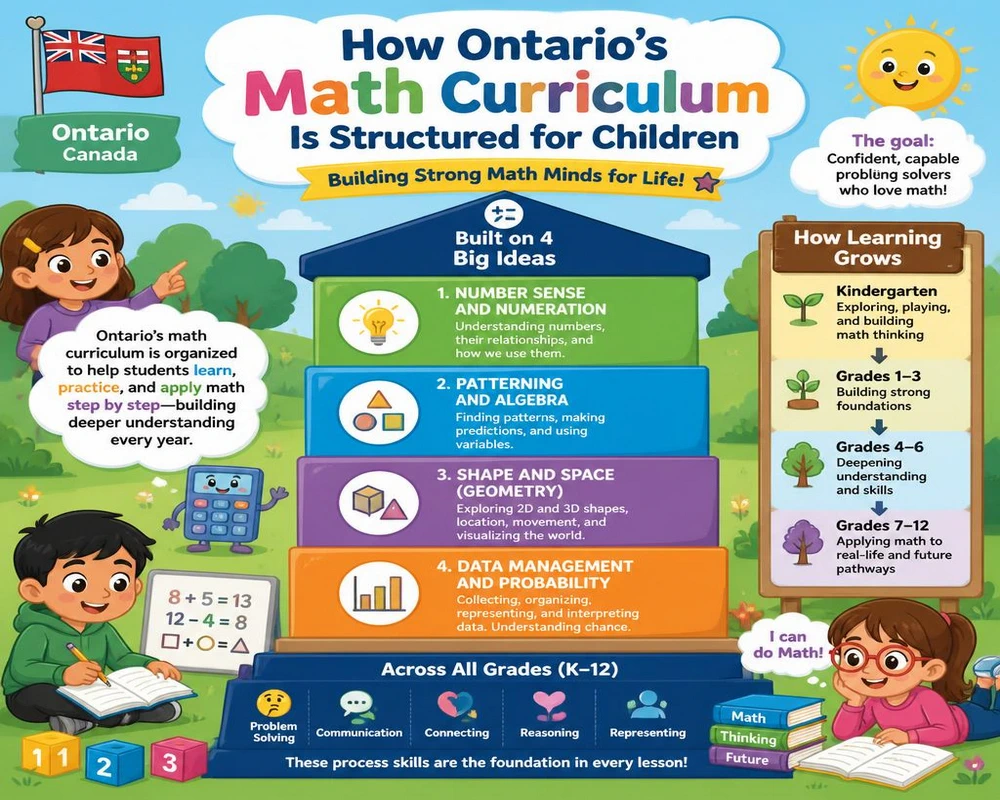
How Ontario’s Math Curriculum Is Structured
Ontario’s 2020 mathematics curriculum organizes every grade around five strands: Number, Algebra, Data, Spatial Sense, and Financial Literacy. Understanding this structure makes the Ontario math curriculum by grade much easier to follow, since the same five categories repeat every year, just with deeper expectations as students progress. This is exactly why breaking down the Ontario math curriculum by grade, rather than describing it all at once, gives parents a far more useful reference.
Grade 1 Math Curriculum
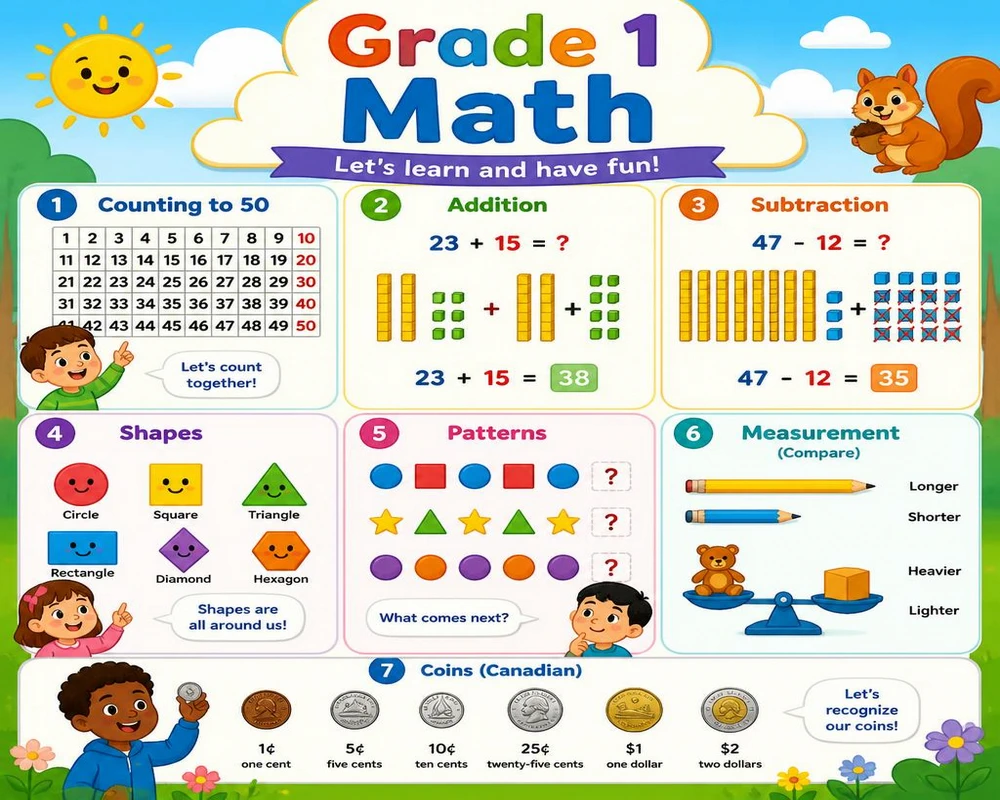
The grade 1 math curriculum, the first entry in the Ontario math curriculum by grade sequence, focuses on counting to 50, basic addition and subtraction, simple shapes and patterns, informal measurement comparisons, and coin recognition. Students work almost entirely with concrete objects and drawings rather than abstract numbers alone.
Grade 1 Curriculum at a Glance
- Number: counting to 50, addition and subtraction to 20
- Algebra: repeating patterns
- Data: sorting and simple graphs
- Spatial Sense: 2D and 3D shapes, non-standard measurement
- Financial Literacy: coin recognition
Grade 2 Math Curriculum Ontario
The grade 2 math curriculum ontario schools follow expands to two-digit addition and subtraction with regrouping, counting to 100, telling time to the half hour, an informal introduction to multiplication through equal groups, and counting coin combinations.
Grade 2 Curriculum at a Glance
- Number: counting to 100, two-digit addition and subtraction with regrouping
- Algebra: growing patterns, early multiplication concepts
- Data: bar graphs and simple surveys
- Spatial Sense: standard units of measurement, 2D and 3D shape properties
- Financial Literacy: counting coins, comparing amounts
Ontario Curriculum Math Grade 3
Grade 3 is where formal multiplication and division facts begin, alongside introductory fractions, perimeter, area, and elapsed time. This is also the first year students sit the EQAO provincial assessment.
Grade 3 Curriculum at a Glance
- Number: multiplication and division facts, introductory fractions
- Algebra: pattern rules, simple equality
- Data: scaled bar graphs, data interpretation
- Spatial Sense: perimeter, area, angle basics
- Financial Literacy: decimal money notation, simple change-making
Grade 4 Math Curriculum
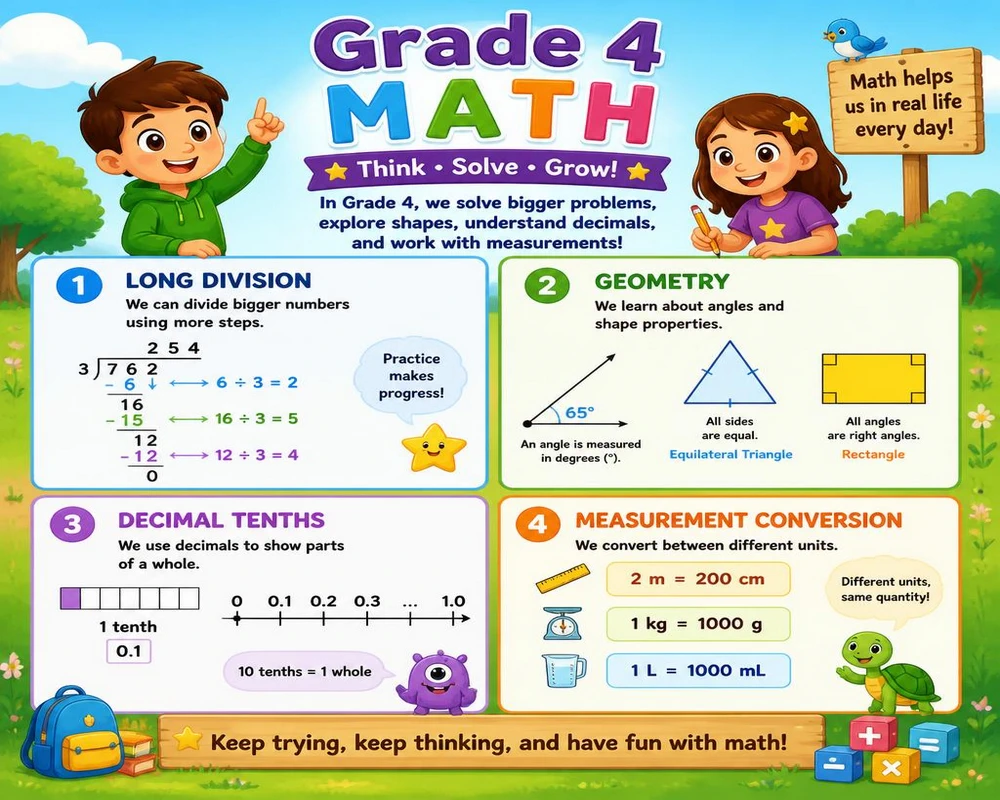
The grade 4 math curriculum introduces long division, geometry involving angles and shape properties, decimal tenths, and measurement unit conversion. Long division specifically marks a genuine jump in complexity from earlier grades.
Grade 4 Curriculum at a Glance
- Number: long division, decimal tenths
- Algebra: pattern rules with tables
- Data: data collection and interpretation
- Spatial Sense: angle classification, unit conversion
- Financial Literacy: simple budgeting concepts
Ontario Math Curriculum Grade 5
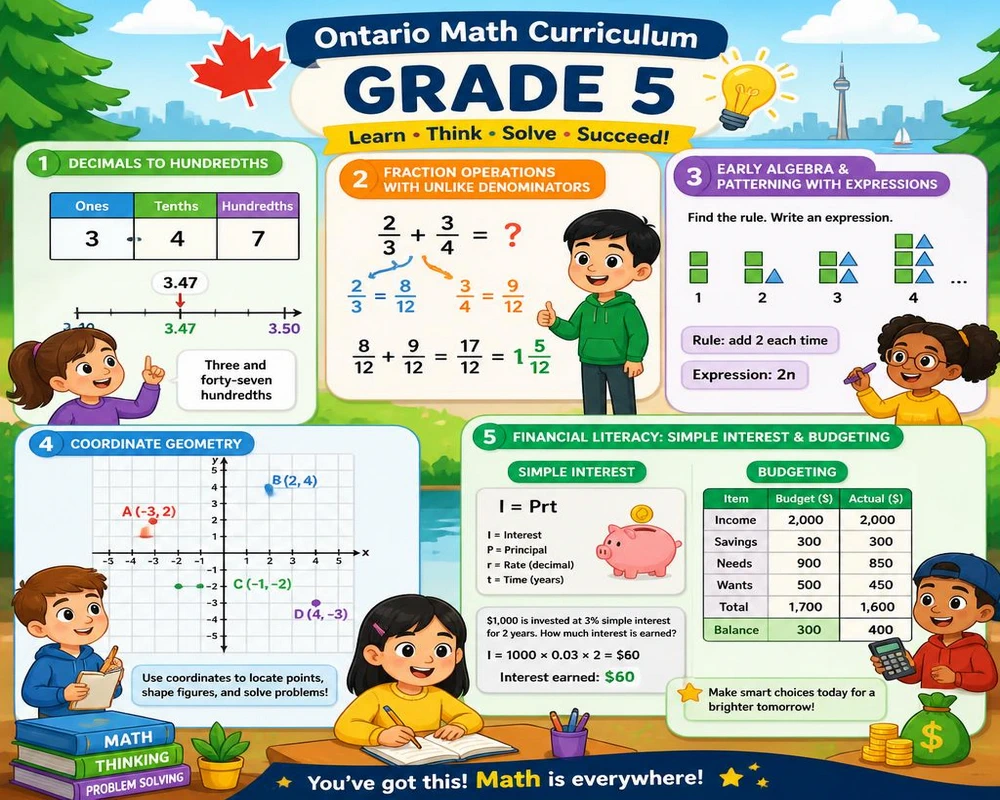
The ontario math curriculum grade 5 students follow deepens decimals to hundredths, introduces fraction operations with unlike denominators, early algebra and patterning with expressions, coordinate geometry, and genuine financial literacy including simple interest and budgeting.
Grade 5 Curriculum at a Glance
- Number: decimal hundredths, adding and subtracting fractions
- Algebra: pattern rules as expressions, solving for missing values
- Data: probability experiments, data comparison
- Spatial Sense: angle measurement, coordinate grids, nets of 3D solids
- Financial Literacy: simple interest, budgeting, comparing value
Grade 6 Math Curriculum Ontario
The grade 6 math curriculum ontario students complete before Junior Division ends covers integers, formal ratios and rates, fraction multiplication and division, surface area, circle graphs, and probability. This is the second and final EQAO assessment year in elementary school.
Grade 6 Curriculum at a Glance
- Number: integers, multiplying and dividing decimals and fractions
- Algebra: solving equations with variables
- Data: circle graphs, median and mode
- Spatial Sense: surface area, angle relationships, coordinate transformations
- Financial Literacy: more complex budgeting and percentage-based problems
How the Ontario Math Curriculum by Grade Builds Year Over Year
Number Sense Compounds Every Year
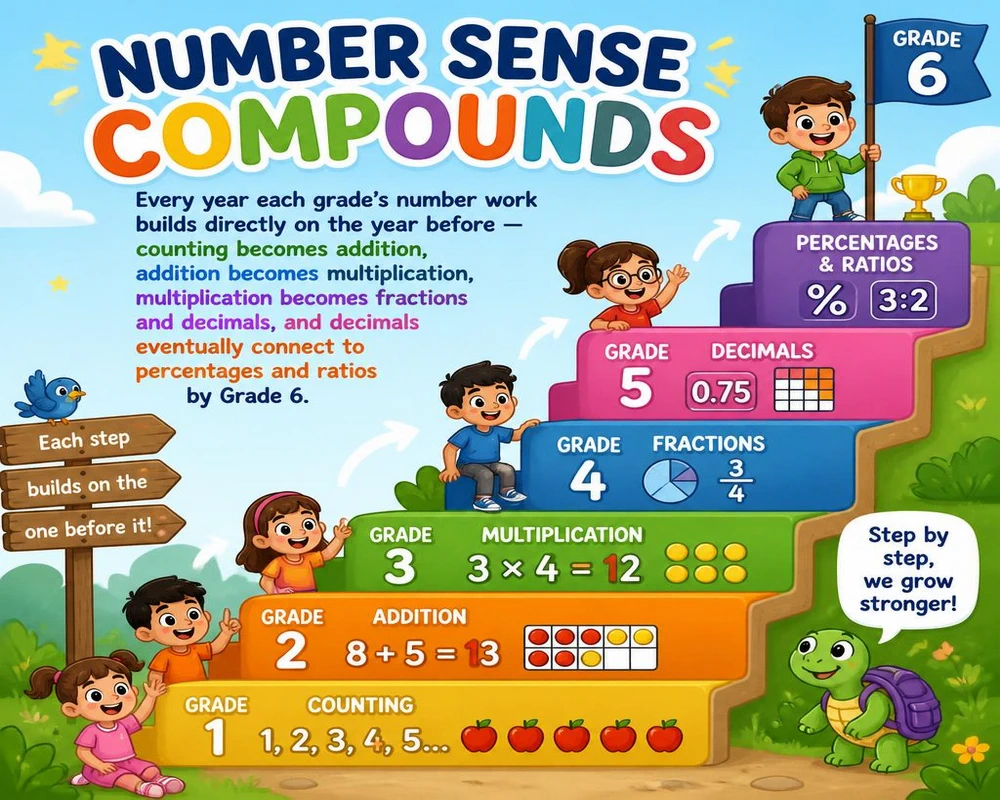
Each grade’s number work builds directly on the year before — counting becomes addition, addition becomes multiplication, multiplication becomes fractions and decimals, and decimals eventually connect to percentages and ratios by Grade 6.
Financial Literacy Grows From Recognition to Application
Money concepts start as simple coin recognition in Grade 1 and grow into genuine budgeting, interest calculations, and value comparisons by Grade 5 and 6, reflecting increasingly real-world financial decision-making.
Spatial Sense Moves From Concrete to Abstract
Early grades focus on physically comparing and sorting shapes, while later grades introduce formal angle measurement, coordinate geometry, and surface area calculations that require genuinely abstract spatial reasoning — a progression that’s easy to trace once the full Ontario math curriculum by grade sits in one place.
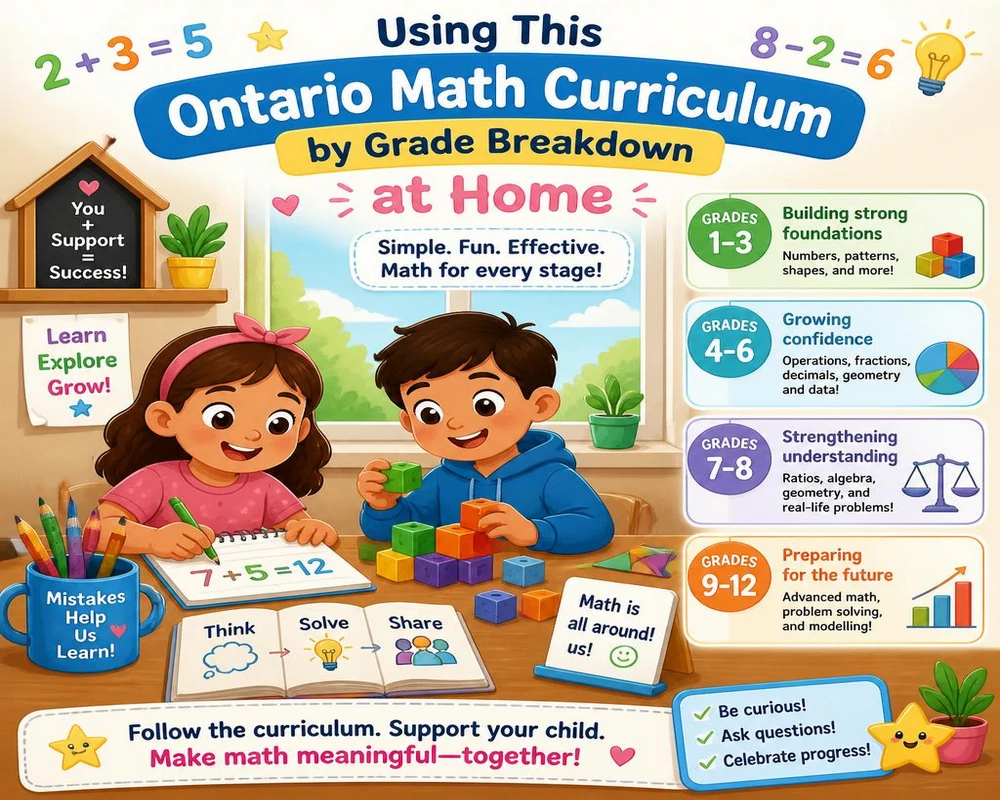
Using This Ontario Math Curriculum by Grade Breakdown at Home
Check Report Cards Against the Actual Grade Expectations
If a report card indicates a specific strand needs attention, this breakdown helps identify exactly what that strand covers at your child’s grade level, rather than guessing at generic “math help.”
Preview Next Year’s Expectations
Looking one grade ahead in the Ontario math curriculum by grade sequence can help a strong student stay engaged, or help a family understand what foundational skills matter most heading into a transition year.
Compare Curriculum Expectations Across Siblings
Since the Ontario math curriculum by grade builds so directly year over year, understanding what an older sibling covered can clarify what a younger one is currently working toward. This kind of cross-grade comparison is exactly why having the Ontario math curriculum by grade laid out in one place, rather than scattered across separate documents, saves real time.
Frequently Asked Questions
1. What are the five strands of the Ontario math curriculum?
Every grade from 1 through 8 covers Number, Algebra, Data, Spatial Sense, and Financial Literacy, with expectations deepening each year within each strand.
2. When did Ontario last update its math curriculum?
Ontario’s current math curriculum dates from 2020, and it introduced Financial Literacy as a formal, dedicated strand alongside the other four.
3. What’s the biggest jump in the Ontario math curriculum by grade?
Looking across the full Ontario math curriculum by grade, Grade 3 and Grade 6 both mark significant jumps, since they introduce formal multiplication and division, and formal ratios and integers respectively, alongside being EQAO assessment years.
4. Does the Ontario math curriculum grade 5 include algebra?
Yes, Grade 5 introduces writing pattern rules as simple algebraic expressions and solving for missing values, building toward more formal algebra in later grades.
5. How can I tell if my child is behind the current grade’s curriculum?
Compare recent homework or report card comments against the specific grade breakdown in this Ontario math curriculum by grade guide, and speak with the teacher about which exact strand, if any, needs extra support.
6. Is financial literacy really part of math class in Ontario?
Yes, it’s one of the five official strands taught from Grade 1 through Grade 8, growing from simple coin recognition to genuine budgeting and interest calculations by Grade 5 and 6.
7. Where can I find practice questions matching each grade’s curriculum?
Our Ontario math practice platform offers lessons and practice questions organized by grade and strand, matching exactly the curriculum breakdown covered in this guide.
Explore practice questions for each grade covered in this Ontario math curriculum by grade breakdown through our Grade 1 through Grade 6 math practice hubs.
For the complete, official curriculum document, the Ontario Ministry of Education’s elementary mathematics curriculum page provides the full, authoritative text this guide is based on.