
Grade 5 Word Problems: The Language That Reveals the Math
“Of” doesn’t sound like a math word. Neither does “left over,” “combined,” or “increased by.” But every one of these ordinary phrases is quietly doing the same job an operation symbol does — it’s telling the reader exactly what calculation the story requires. Grade 5 word problems lean on this kind of language constantly, especially once fractions, decimals, and percents start appearing in the same story, and most of the struggle comes down to not yet recognizing which words point to which operation.
This guide works like a translation dictionary — specific words and phrases on one side, the operation they signal on the other — followed by real Grade 5 word problems that put the dictionary to work.
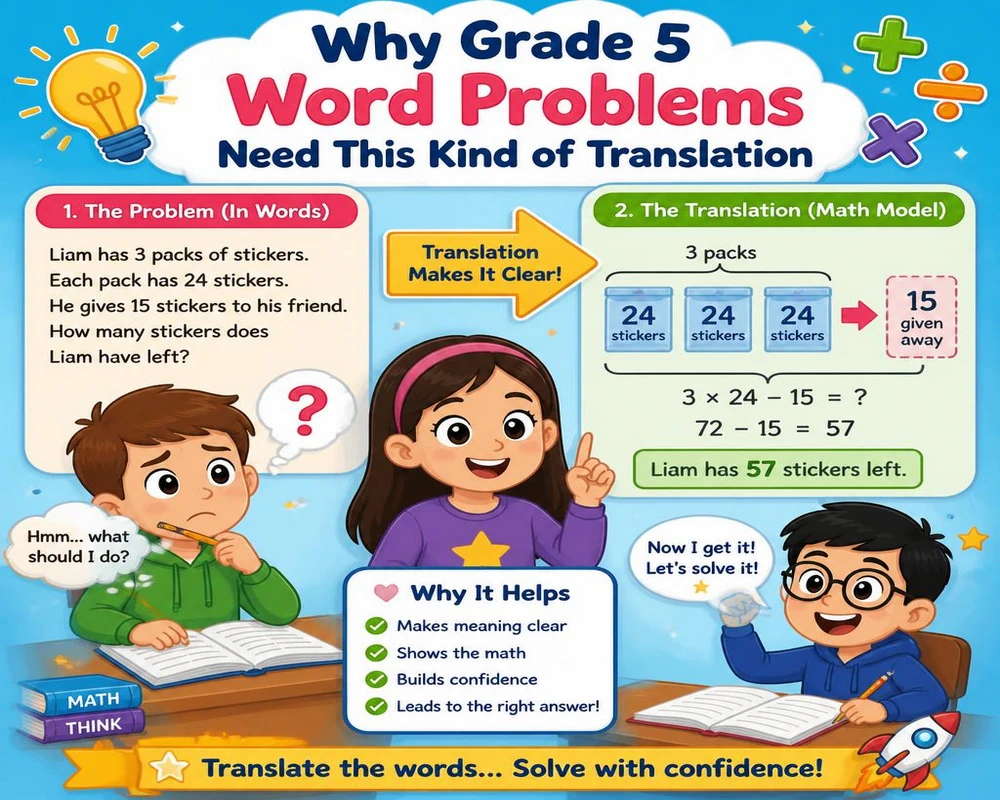
Why Grade 5 Word Problems Need This Kind of Translation
Ontario’s curriculum expects Grade 5 students to solve word problems involving whole numbers, decimals, fractions, and percents, often within the same question. That range is exactly what makes Grade 5 word problems harder than earlier grades — a story might describe “3/4 of a group,” then ask what’s “left over” after “15% is removed,” stacking multiple operations and multiple number types into one paragraph.
This matters because a student who knows how to calculate a fraction of a group, or a percent of an amount, in isolation can still struggle badly the moment those skills need to be identified inside a sentence rather than handed over directly. Grade 5 word problems test exactly that identification step, not just the calculation itself.
The Translation Dictionary
| Words in the Problem | What They Signal |
|---|---|
| “altogether,” “combined,” “in total” | Addition |
| “left over,” “remaining,” “fewer than” | Subtraction |
| “each,” “every,” “groups of” | Multiplication |
| “shared equally,” “split into,” “per” | Division |
| “of” (following a fraction or percent) | Multiply the fraction or percent by the amount |
| “increased by,” “more than the original” | Add a calculated amount to a starting value |
| “discount,” “off,” “reduced by” | Subtract a calculated amount from a starting value |
Why “Of” Deserves Special Attention
Among all the entries in this dictionary, “of” causes the most trouble in Grade 5 word problems specifically because it looks so harmless. When “of” follows a fraction or percent — “3/4 of the class,” “15% of $60” — it always means multiply. Students who miss this connection often try to add or subtract instead, producing answers that don’t match the story at all.
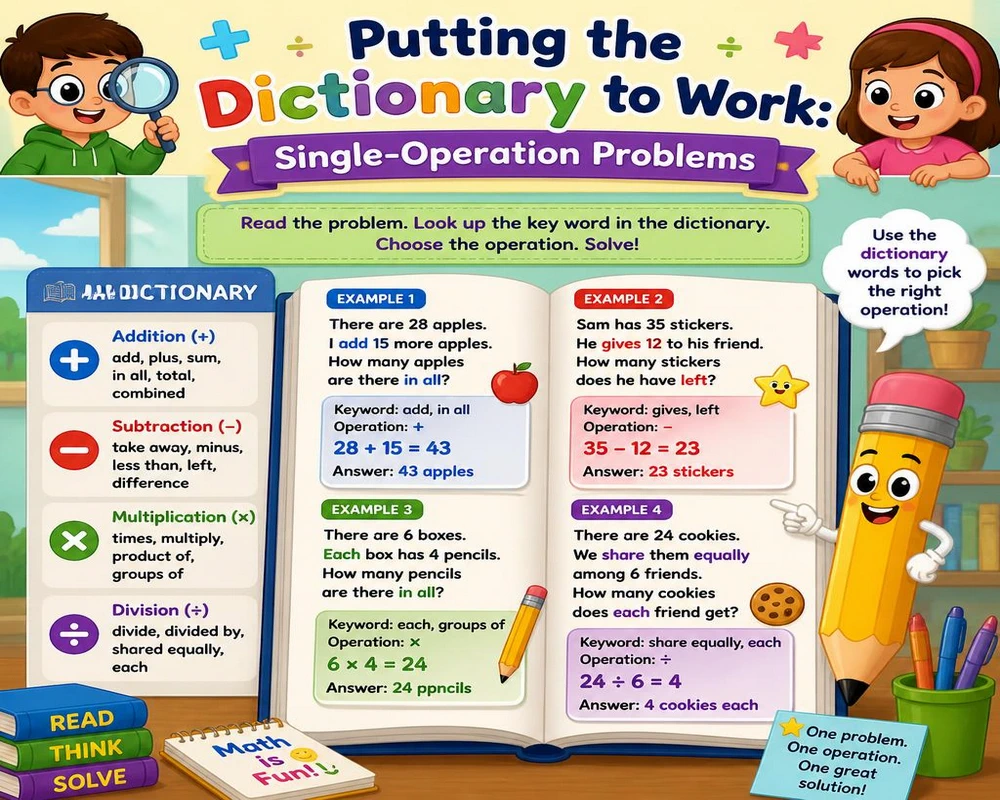
Putting the Dictionary to Work: Single-Operation Problems
- A bookstore has 8 shelves with 24 books on each shelf. How many books are there altogether?
- A school had 156 students. After 89 moved to a new class, how many students are left in the original class?
- 3/4 of a class of 20 students walk to school. How many students walk to school?
Answers: 1) 192 books (signal word: “each,” meaning multiplication) 2) 67 students (signal words: “left,” meaning subtraction) 3) 15 students (signal word: “of” following a fraction, meaning multiplication)
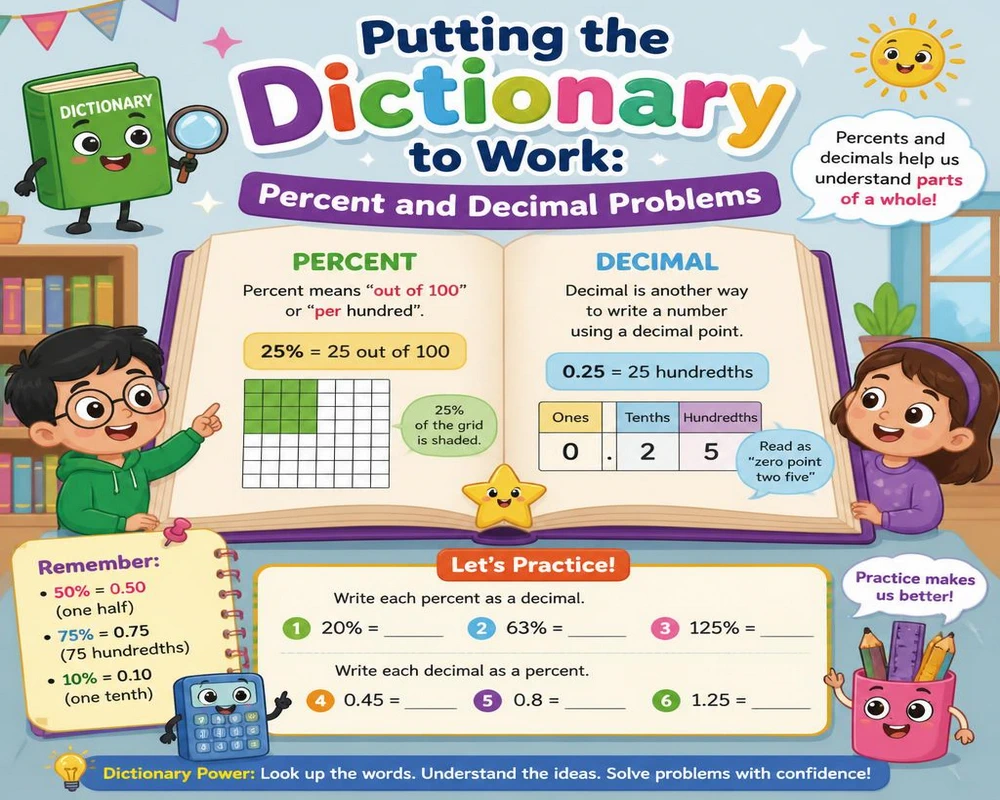
Putting the Dictionary to Work: Percent and Decimal Problems
- A jacket costs $45. It goes on sale with a 20% discount. How much is the discount worth?
- Using the same jacket, what is the sale price after the discount is subtracted?
- 15% of a $60 gift card is spent on a book. How much money was spent?
Answers: 1) $9 (signal word: “of” following a percent, meaning multiply 20% by $45) 2) $36 (signal word: “discount,” meaning subtract the calculated amount) 3) $9 (signal word: “of” following a percent)
Multi-Step Grade 5 Word Problems: Combining Signals
Real Grade 5 word problems often chain two or more of these signals together in a single story, which is where the translation dictionary earns its keep, especially once fractions and percents get involved too.
Worked Example
Here’s a typical multi-step Grade 5 word problems scenario, solved using the translation dictionary above.
Problem: A bookstore has 8 shelves with 24 books on each shelf. After a sale, 45 books are sold. How many books remain?
Step 1 (signal: “each,” multiplication): 8 × 24 = 192
Step 2 (signal: “sold,” subtraction): 192 − 45 = 147
Answer: 147 books remain
Practice Questions
- A garden centre has 120 plants. They receive a shipment of 45 more, and then sell 30. How many plants are left?
- 3/4 of a 20-item order is fragile glassware, and 15% of a separate $60 shipping fee is a rush charge. What is the combined value of the fragile items count and the rush charge amount?
Answers: 1) 135 plants (120 + 45 − 30) 2) 24 (15 fragile items + $9 rush charge, added together as the problem asks)
Building the Grade 5 Word Problems Translation Habit
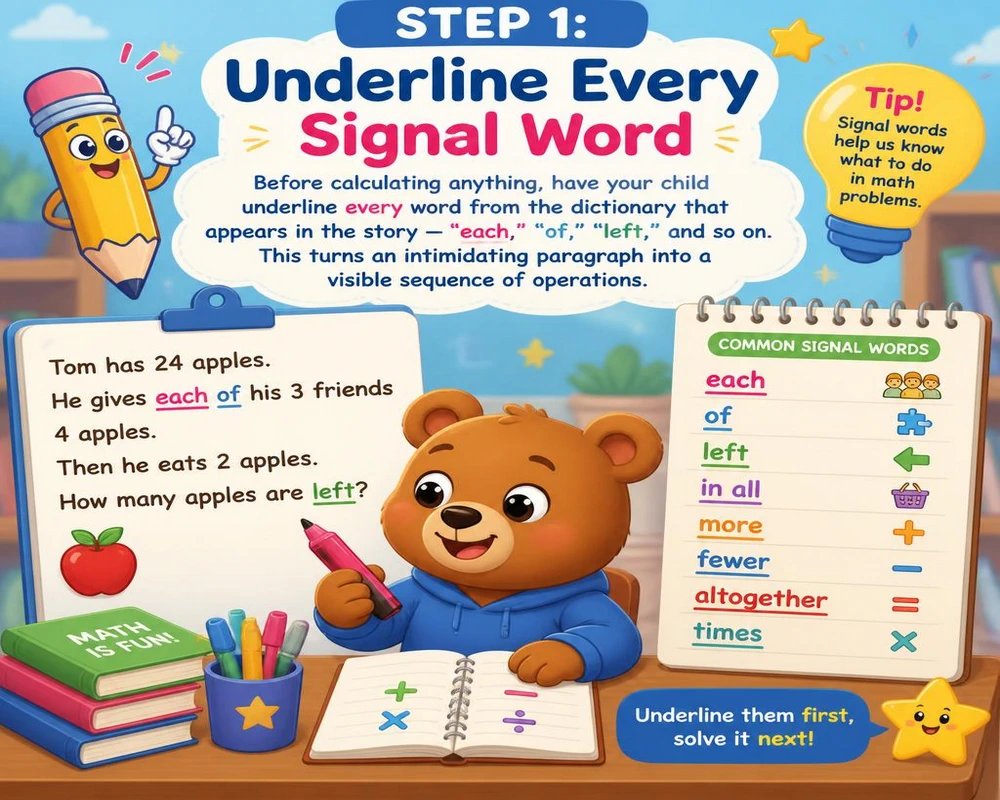
Step 1: Underline Every Signal Word
Before calculating anything, have your child underline every word from the dictionary that appears in the story — “each,” “of,” “left,” and so on. This turns an intimidating paragraph into a visible sequence of operations.
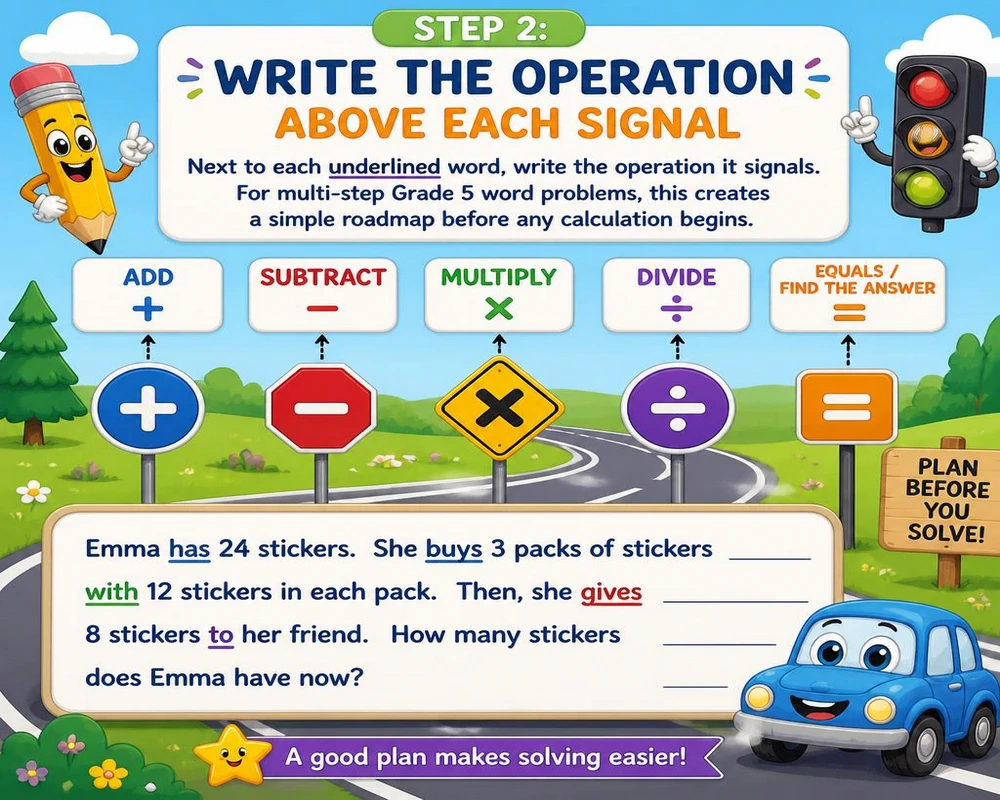
Step 2: Write the Operation Above Each Signal
Next to each underlined word, write the operation it signals. For multi-step Grade 5 word problems, this creates a simple roadmap before any calculation begins.
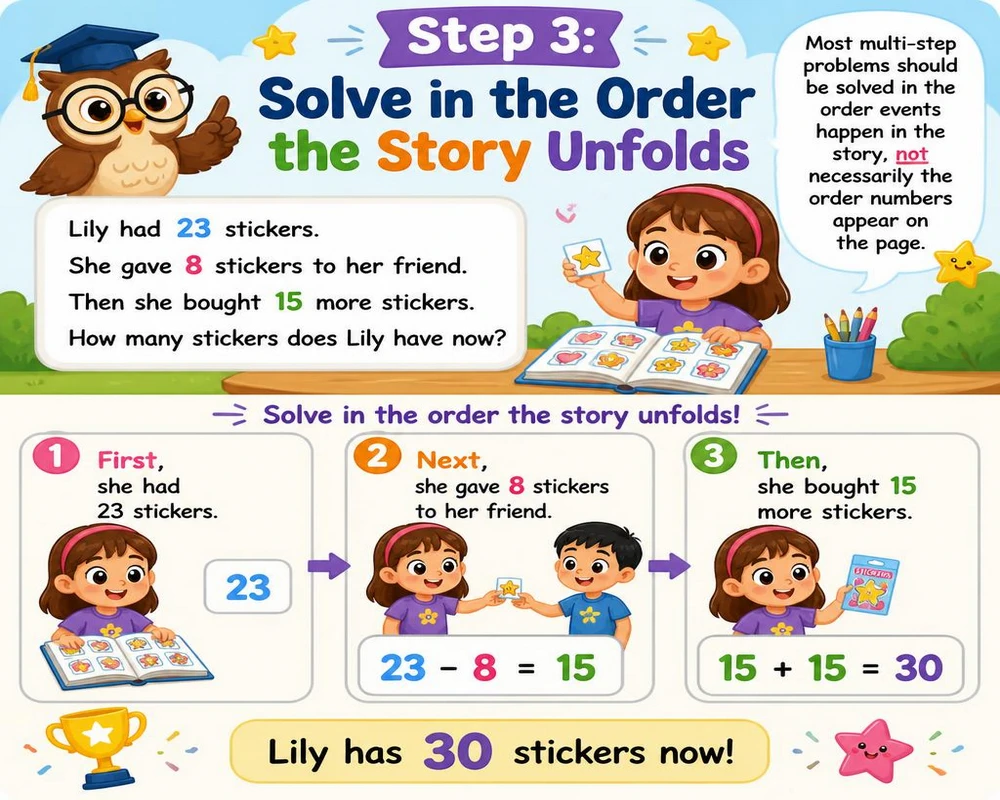
Step 3: Solve in the Order the Story Unfolds
Most multi-step problems should be solved in the order events happen in the story, not necessarily the order numbers appear on the page.
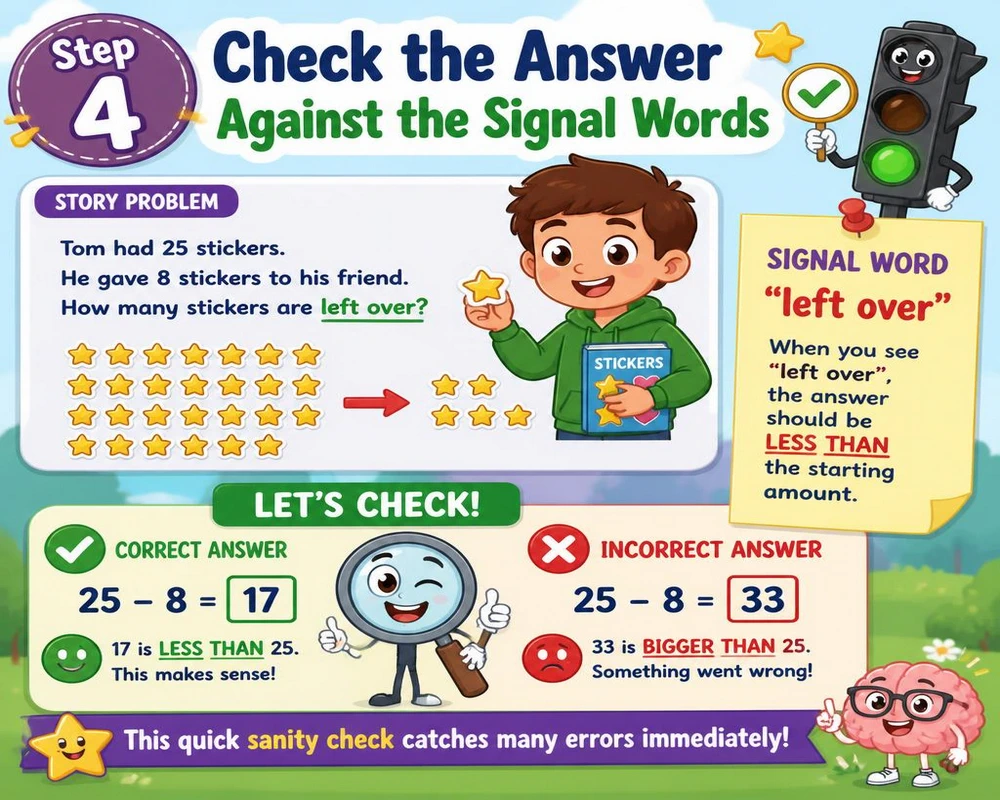
Step 4: Check the Answer Against the Signal Words
If the story used “left over” and the final answer is bigger than the starting amount, something went wrong. This quick sanity check catches many errors immediately.
Common Mistakes With Grade 5 Word Problems
Three specific errors account for most of the wrong answers seen in Grade 5 word problems, and all three trace back to the translation step, not the actual calculation.
Treating “Of” as Addition
Because “of” often follows a number in everyday speech, some students default to adding whatever numbers appear nearby. Reinforcing that “of” after a fraction or percent always means multiply resolves this directly.
Solving Steps Out of Order
In multi-step Grade 5 word problems, calculating the second event before the first produces an answer that technically uses the right numbers but in the wrong sequence, leading to an incorrect result.
Ignoring Signal Words Entirely
Some students skip straight to the numbers without reading for the language that connects them, guessing at an operation instead of identifying it. Making the underlining step mandatory, not optional, prevents this shortcut.
Frequently Asked Questions
1. Why does “of” cause so much trouble in Grade 5 word problems?
It looks like an ordinary connecting word, but after a fraction or percent, it always signals multiplication. Missing this connection is one of the most common sources of wrong answers at this grade.
2. How can I help my child with multi-step Grade 5 word problems specifically?
Have them underline every signal word first, write the corresponding operation above each one, and solve the steps in the order the story actually unfolds.
3. Are there other signal words beyond the ones in this dictionary?
Yes, and building a personal list together as new ones come up in homework reinforces the same skill, since noticing the pattern matters more than memorizing a fixed list.
4. My child gets the right numbers but the wrong operation. What’s happening?
This usually means the Grade 5 word problems were read for numbers rather than for language. Practicing the underline-and-label step directly targets this specific gap.
5. How many word problems should we practice each session?
Two or three varied problems, worked through fully with the translation steps, tend to build more transferable skill than ten problems solved quickly without them.
6. Should percent and fraction word problems be practiced separately or together?
Together, once each is individually comfortable, since real Grade 5 word problems frequently combine them within the same story.
7. How does this connect to Grade 6?
Grade 6 word problems build on this same translation skill while adding integers, ratios, and more complex multi-step reasoning into the mix.
Word problems draw on everything else covered in Grade 5, including decimals, fractions, and financial literacy. The translation dictionary approach in this Grade 5 word problems guide works across every one of those topics. Our Grade 5 math practice hub covers every topic in one place.
Reading comprehension plays a bigger role in word problems than most parents expect. EduGains, Ontario’s dedicated math resource hub, offers free strategies for building the reading-to-math connection these problems require.