
Grade 5 Financial Literacy Practice Ontario: 5 Real Scenarios
Sarah’s daughter came home from school last week asking why the bank pays you money just for keeping your savings there. That question is exactly what Grade 5 financial literacy practice Ontario schools are built around this year — not abstract theory, but real situations a ten-year-old can actually picture themselves in.
This guide walks through five real-life scenarios covering exactly what Ontario’s curriculum expects this year, along with practice questions for each one and a look at where families tend to get stuck.
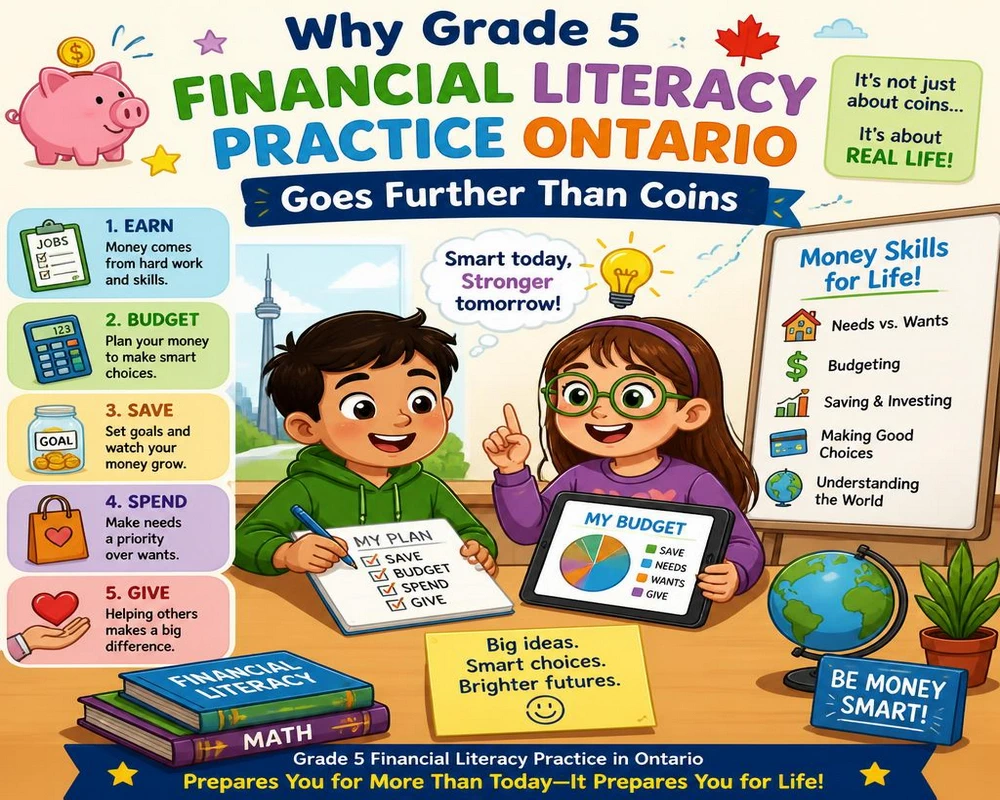
Why Grade 5 Financial Literacy Practice Ontario Goes Further Than Coins
Financial literacy has been part of Ontario’s math curriculum since Grade 1, but it stays fairly simple through the early years — recognizing coins, comparing prices. Grade 5 financial literacy practice Ontario curriculum documents describe pushes noticeably further, introducing genuine budgeting concepts, simple interest calculations, and decision-making around value and cost.
This matters because Grade 5 financial literacy practice Ontario students encounter this year isn’t really new arithmetic. Having spent years supporting Ontario’s Junior Division classrooms, I’ve found that Grade 5 financial literacy practice Ontario teachers assign works best when it’s tied to a genuine scenario, not a worksheet of isolated dollar amounts. The addition, subtraction, and percentage skills are already familiar. What’s new is applying those skills to real financial decisions — which is exactly why grounding every concept in a believable scenario works so much better than abstract number problems.
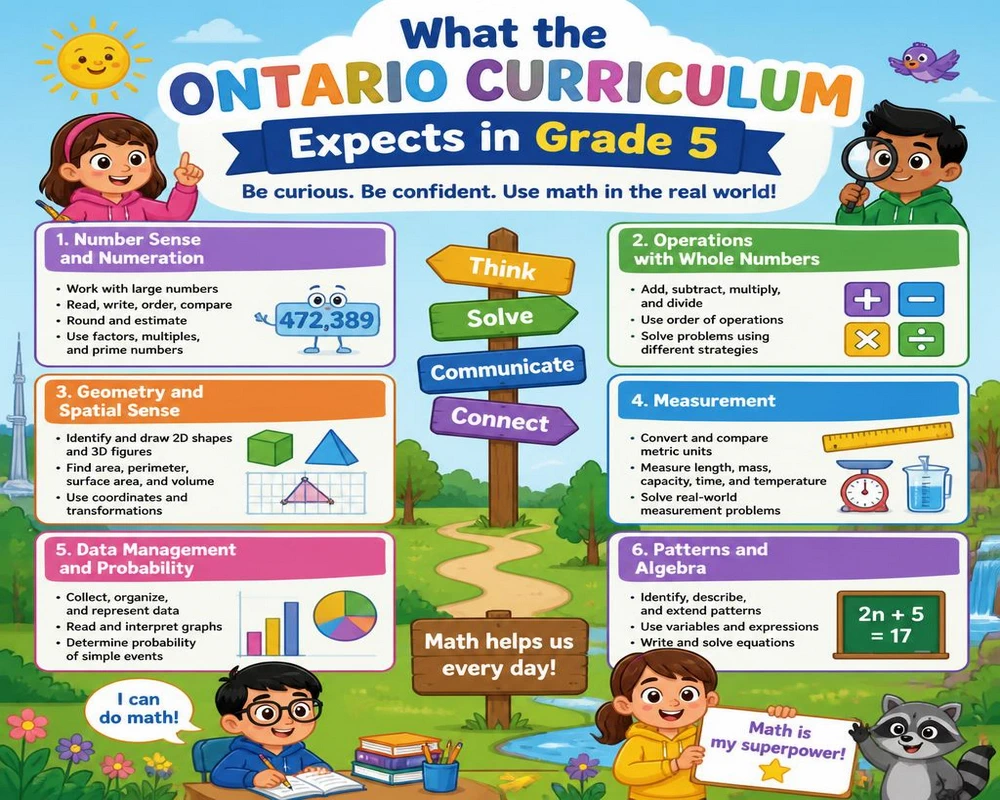
What the Ontario Curriculum Expects in Grade 5
By the end of Grade 5, students are generally expected to:
- Create and follow a simple personal budget
- Understand the concept of simple interest, both earned and owed
- Compare prices and calculate the better value between options
- Understand the difference between needs and wants when planning spending
- Solve word problems involving saving, spending, and simple interest
Notice how every one of these expectations describes something a family actually does. Grade 5 financial literacy practice Ontario teachers build around real scenarios tends to land far better than a list of abstract rules.
Scenario 1: The Allowance Budget
Jordan gets $10 a week in allowance. He wants to save for a $40 video game, spend some on snacks, and put a little toward a birthday gift for his sister. This is genuine Grade 5 financial literacy practice Ontario families can recreate at home with almost no setup, and it’s one of the easiest ways to start.
Practice Questions
- If Jordan saves $6 each week, how many weeks until he has $40?
- If Jordan spends $3 on snacks and saves the rest of his $10, how much does he save that week?
- Jordan wants to spend $15 on a gift, $20 on the game savings, and save the rest. How much is left for anything else out of $40?
Answers: 1) About 7 weeks 2) $7 3) $5
Notice how Grade 5 financial literacy practice Ontario families run through a simple allowance scenario like this one covers budgeting, saving, and spending decisions all at once, without ever feeling like a math worksheet.
Scenario 2: The Savings Account and Simple Interest
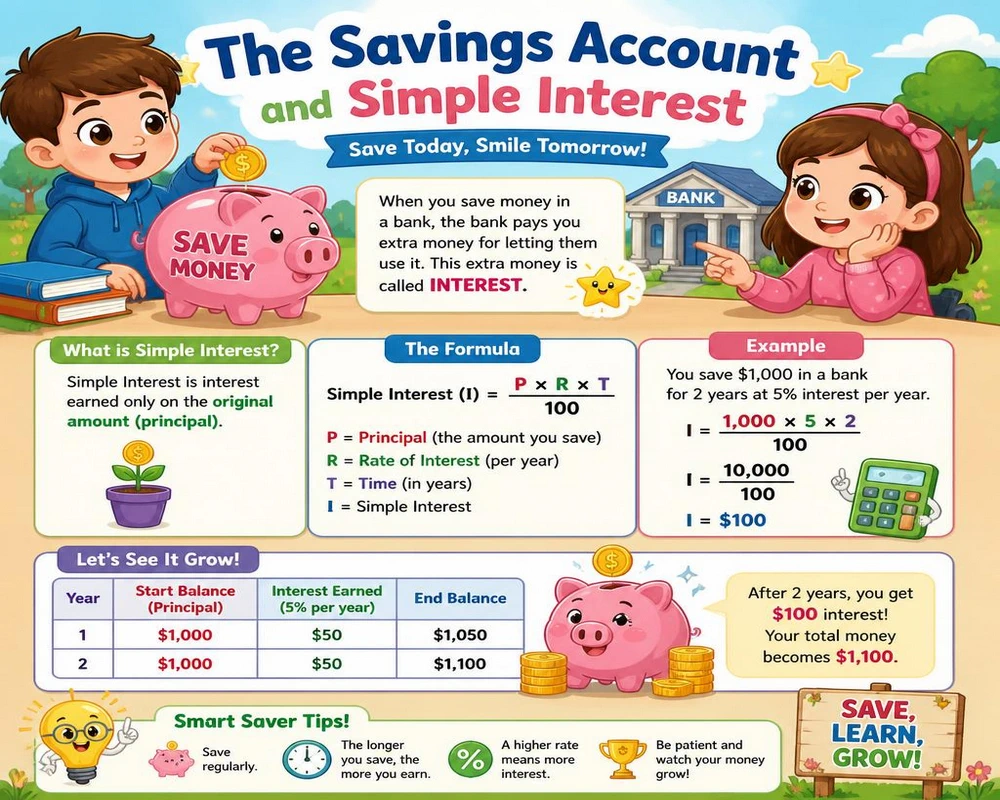
Priya deposits $100 into a savings account that earns 2% simple interest per year. Her parents explain that the bank pays her a little extra each year just for keeping the money there. This scenario captures the heart of Grade 5 simple interest work, and it genuinely surprises a lot of ten-year-olds the first time it clicks.
How Simple Interest Actually Works
Simple interest is calculated as a percentage of the original amount, added back each year. A $100 deposit earning 2% interest gains $2 after one year, bringing the total to $102. Grade 5 financial literacy practice Ontario curriculum documents describe treats this as one of the year’s central concepts.
Practice Questions
- Priya deposits $150 at 2% simple interest. How much interest does she earn after one year?
- If a $200 deposit earns 3% simple interest, how much interest is earned in one year?
- Malik borrows $100 at 5% simple interest. How much will he owe in total after one year?
Answers: 1) $3 2) $6 3) $105
Scenario 3: The Grocery Store Value Comparison
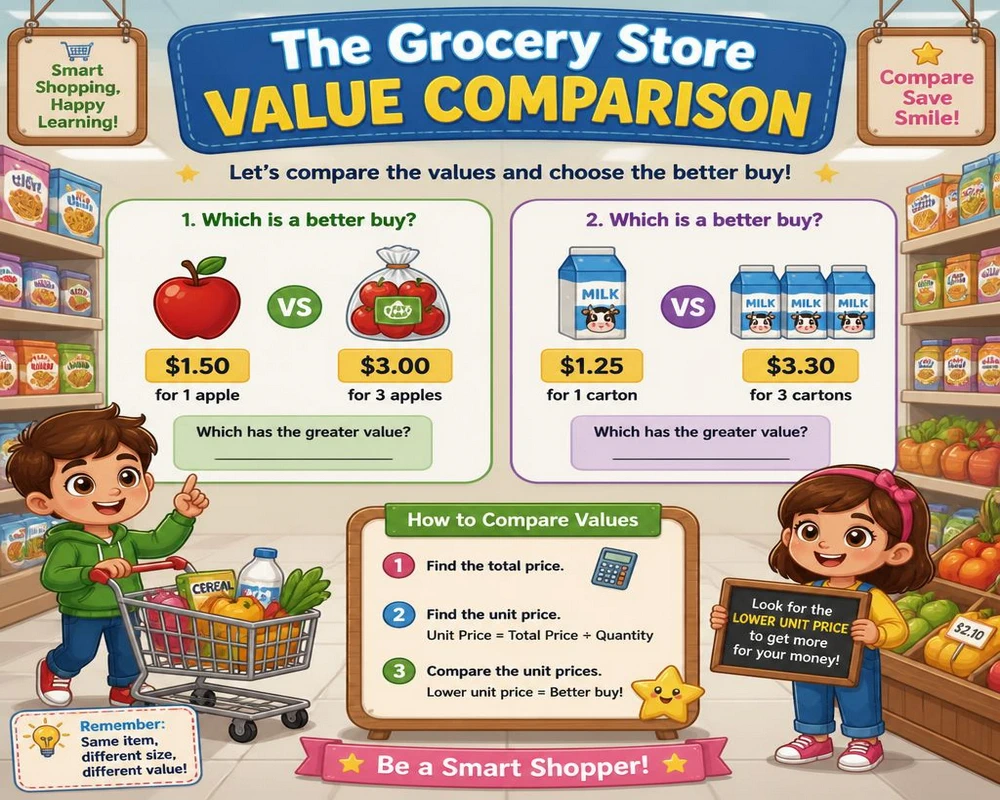
At the grocery store, a small box of crackers costs $2.50 for 200 grams, while a larger box costs $4.00 for 400 grams. Which one is the better deal? This kind of comparison is exactly the sort of Grade 5 financial literacy practice Ontario students are expected to handle confidently by year’s end, since it shows up constantly in everyday shopping.
Practice Questions
- Which is the better value: $2.50 for 200 grams, or $4.00 for 400 grams?
- A 6-pack of juice boxes costs $3.60. A 10-pack costs $5.50. Which is the better price per box?
- Store A sells apples at $1.20 each. Store B sells a bag of 5 apples for $5.00. Which is the better deal?
Answers: 1) The larger box, gram for gram they’re equal, but it gives more flexibility 2) The 10-pack, at 55 cents per box versus 60 cents per box 3) Store B, at $1.00 per apple versus $1.20 per apple
This kind of Grade 5 financial literacy practice Ontario students encounter at the grocery store builds real number sense that a worksheet alone rarely matches.
Scenario 4: Needs Versus Wants
Aisha has $25 saved up. She needs new socks, since her old ones have holes, and she wants a new toy she saw online. Sorting spending into needs and wants is one of the more conceptual pieces of Grade 5 financial literacy practice Ontario curriculum documents describe, since it asks for judgment, not just calculation. This particular corner of Grade 5 financial literacy practice tends to spark the most genuine family discussion.
Practice Questions
- Sort these into needs and wants: new socks, a video game, a winter coat, a toy.
- Aisha has $25. Socks cost $8 (a need) and the toy costs $20 (a want). Can she afford both?
- If Aisha prioritizes needs first, how much does she have left for wants after buying socks?
Answers: 1) Needs: socks, winter coat. Wants: video game, toy 2) No, together they cost $28, more than her $25 3) $17
Scenario 5: Planning a Small Fundraiser
Malik’s class is running a bake sale to raise $150 for a class trip. They need to buy ingredients, price the baked goods, and track how much they’ve earned. This kind of real, multi-step planning brings together nearly every skill covered so far in Grade 5 financial literacy practice Ontario classrooms teach this year, all inside one connected scenario.
Practice Questions
- Ingredients cost $30. If each item sells for $2, how many items need to be sold just to cover costs?
- The class sells 90 items at $2 each. How much money did they raise in total?
- After subtracting the $30 in ingredient costs, how much profit did the class make toward their $150 goal?
Answers: 1) 15 items 2) $180 3) $150 (they reached their goal exactly)
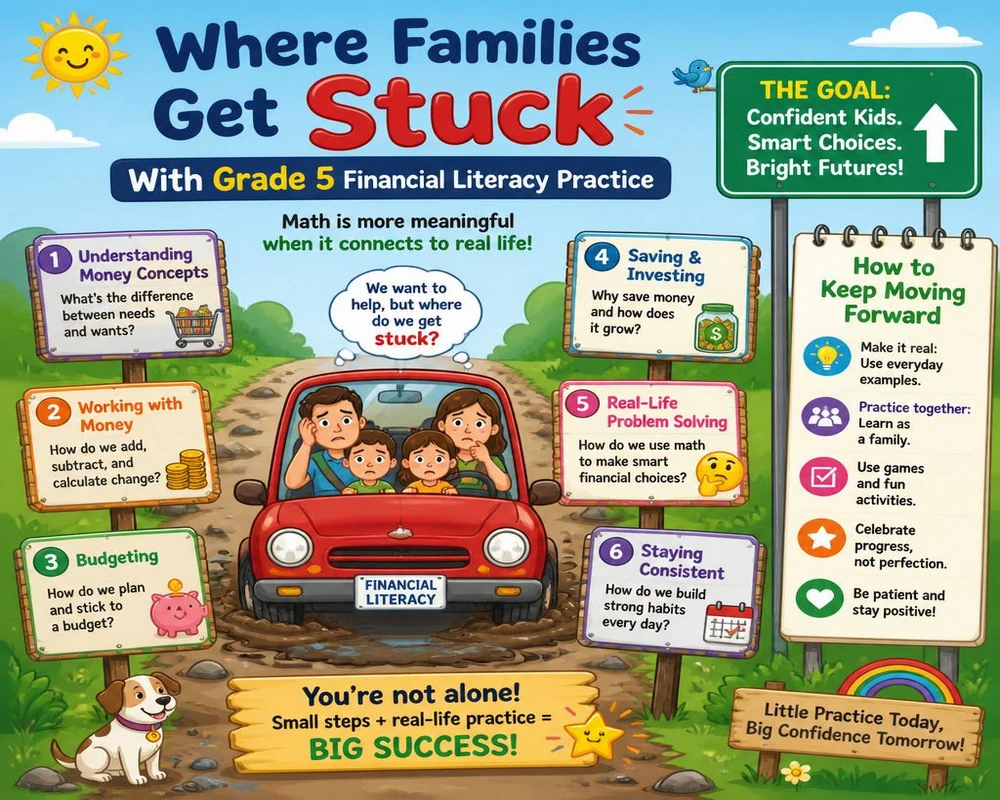
Where Families Get Stuck With Grade 5 Financial Literacy Practice
Confusing Percentage of Interest With a Fixed Dollar Amount
Students sometimes assume 2% interest always means $2, regardless of the deposit size. This is one of the most common snags in Grade 5 financial literacy practice, and reinforcing that percentage scales with the amount — 2% of $100 is different from 2% of $500 — resolves it quickly with a few varied examples.
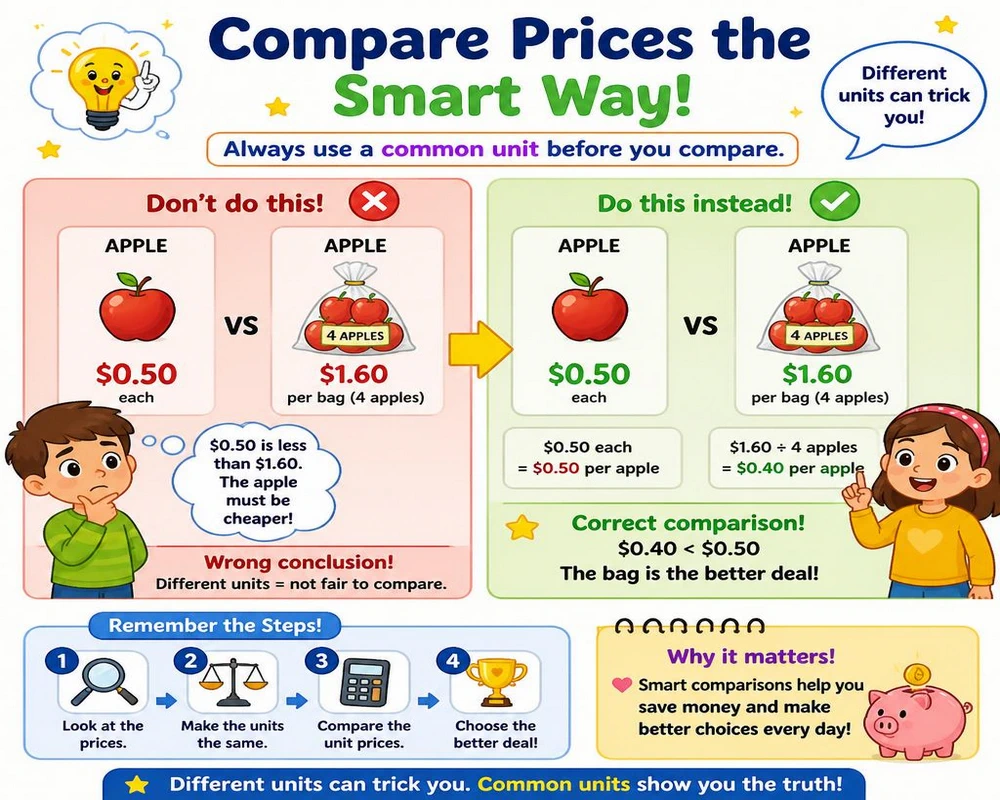
Comparing Prices Without Matching Units
Comparing a price per item to a price per package, without converting both to the same unit first, leads to wrong conclusions. Always converting to a common unit before comparing fixes this, and it’s a habit worth reinforcing in every Grade 5 financial literacy practice session at home.
Treating All Spending as Equally Important
Some students struggle to separate needs from wants, especially when something they genuinely want feels urgent in the moment. Real conversations about family budgeting decisions, woven into everyday Grade 5 financial literacy practice, help build this judgment more than worksheets alone.

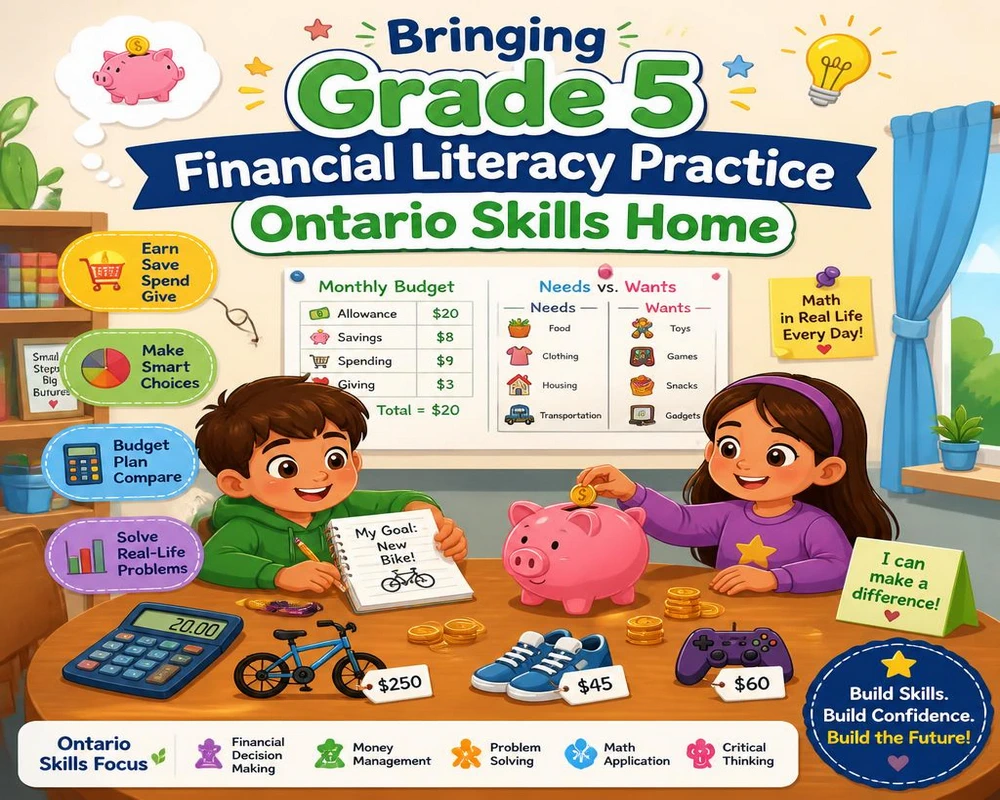
Bringing Grade 5 Financial Literacy Practice Ontario Skills Home
The single biggest advantage of scenario-based Grade 5 financial literacy practice Ontario families can run at home is that real money, real prices, and real decisions carry weight that a printed worksheet never quite matches. Let your child manage a small real budget, compare real prices at the store, or plan a small real fundraiser, and the underlying math becomes something they’re motivated to get right, not just complete.
Fifteen to twenty minutes of Grade 5 financial literacy practice Ontario families build into a real weekly routine — checking a grocery receipt together, planning a small purchase, tracking an allowance — tends to build far more lasting understanding than an occasional lesson focused purely on abstract numbers. Consistent, real-world Grade 5 financial literacy practice like this is what actually sticks, far more than any single lesson ever could.
Frequently Asked Questions About Grade 5 Financial Literacy Practice
1. What financial literacy skills should a Grade 5 student have?
Grade 5 financial literacy practice Ontario curriculum expects covers creating a simple budget, understanding simple interest, comparing value between options, and distinguishing between needs and wants when making spending decisions.
2. How is simple interest calculated?
Simple interest is a percentage of the original amount, calculated fresh each year based on that same starting amount, rather than growing on top of previously earned interest. This is one of the core ideas behind Grade 5 simple interest work.
3. Why does my child think 2% interest always equals $2?
This usually reflects a gap in understanding that percentages scale with the amount involved. Working through varied examples with different deposit amounts, as part of regular Grade 5 financial literacy practice, resolves this quickly.
4. How can I make financial literacy practice feel less abstract?
Use real scenarios your child can picture themselves in — an allowance, a grocery trip, a small fundraiser — rather than generic worksheet numbers with no context. This is exactly what makes Grade 5 financial literacy practice Ontario families run at home genuinely effective.
5. What’s the best way to teach needs versus wants?
Real family budgeting conversations tend to work better than abstract sorting exercises, since actual spending decisions carry genuine weight and context.
6. How much financial literacy practice should we do at home?
About 15-20 minutes, a few times a week, tends to work well for Grade 5 financial literacy practice Ontario families building into a regular routine, especially when tied to a real activity like grocery shopping or allowance planning.
7. How does this connect to Grade 6?
Grade 6 builds on these same Grade 5 money management skills with more complex budgeting scenarios and deeper work with percentages, so a solid grasp now pays off directly the following year.
Financial literacy is one part of a full Grade 5 year that also includes decimals, ratios, and algebra. Our Grade 5 math practice hub covers every topic in one place, giving families a complete picture beyond just this year’s Grade 5 financial literacy practice Ontario expectations.
For additional family-friendly resources on building these same skills, the Financial Consumer Agency of Canada offers free tools designed specifically to support financial literacy at home.