
Grade 5 Fractions Practice: Before and After the Click
Before: A student sees 1/4 + 1/3 and adds straight across — numerators together, denominators together — landing on 2/7. It feels reasonable. It’s also completely wrong, and worse, it’s wrong in a way that feels confident.
After: The same student pauses at the same problem, recognizes the denominators don’t match, converts both fractions to a shared denominator first, and solves it correctly without hesitation.
The distance between those two students isn’t more practice. It’s one specific idea — that fractions can only be added or compared once they’re describing the same-sized pieces — and everything in Grade 5 fractions practice either builds toward that click or works around a student who hasn’t had it yet.
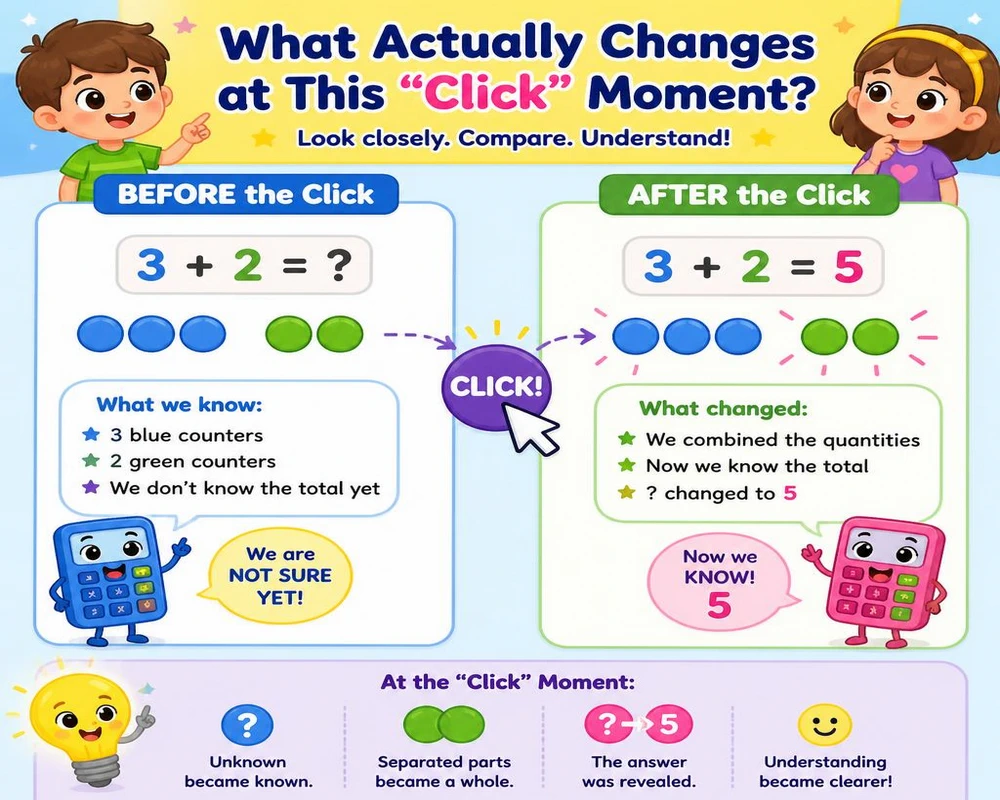
What Actually Changes at This “Click” Moment
Grade 5 fractions practice at this stage isn’t about learning new numbers — it’s about learning a new rule for how existing numbers combine.
Ontario’s curriculum expects Grade 5 students to move well beyond the equivalent-fraction and comparison work from Grade 4 into genuine fraction operations — adding and subtracting fractions with different denominators, something that’s mathematically impossible to do correctly without first understanding why matching denominators matters.
Before the click, a student treats a fraction’s two numbers as independent digits to manipulate. After the click, a student understands a fraction as a single value describing a specific-sized piece, and that pieces of different sizes can’t simply be combined by adding their labels.
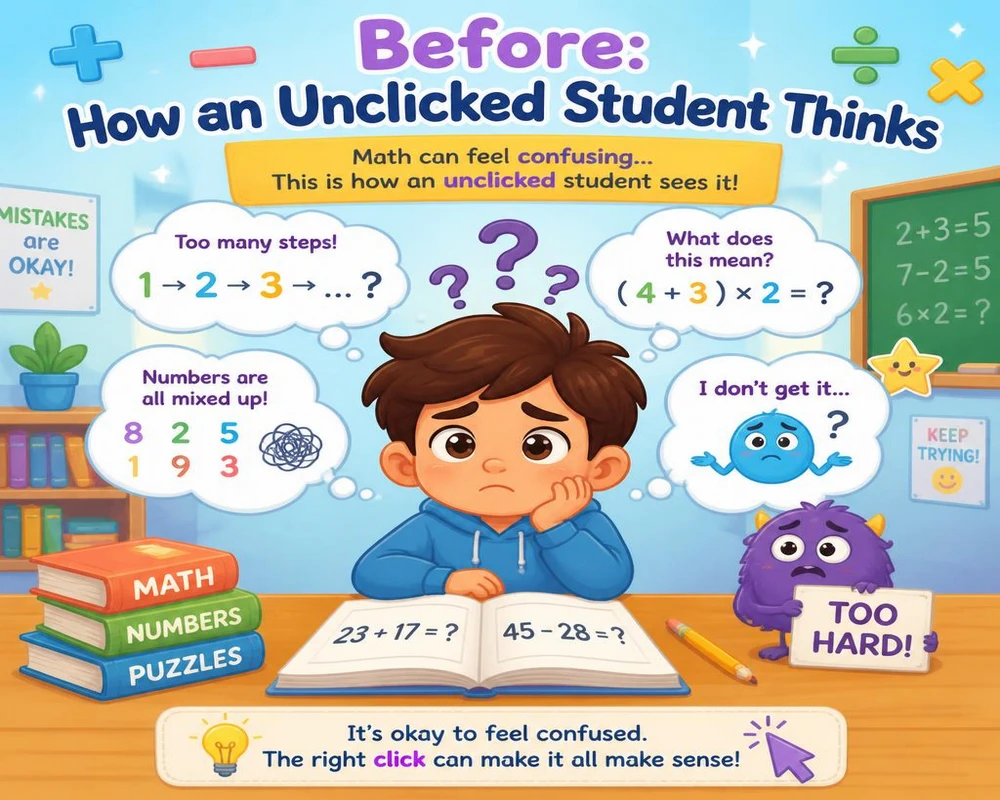
Before: How an Unclicked Student Thinks
| Problem | Before-Click Answer | Why It Feels Right |
|---|---|---|
| 1/4 + 1/3 | 2/7 | Adding across matches how whole numbers combine |
| 1/2 + 1/4 | 2/6 | Same pattern, same false confidence |
| 3/4 − 1/2 | 2/2 | Subtracting across mirrors the same flawed logic |
Notice the pattern: every wrong answer follows a completely consistent, logical rule. It’s just the wrong rule — borrowed from whole-number arithmetic, where it works perfectly, and applied to fractions, where it doesn’t.
The Bridge: What Actually Produces the Click
Bridge Activity 1: Physically Different-Sized Pieces
These three bridge activities are the core of effective Grade 5 fractions practice, since they create the exact experience that makes common denominators feel necessary rather than arbitrary.
Cut one paper strip into quarters and an identical strip into thirds. Ask your child to combine one piece from each. They can’t line up neatly — the pieces are physically different sizes, and no amount of relabeling changes that. This single, tactile moment does more than pages of explanation.
Bridge Activity 2: Finding a Common Denominator by Cutting Further
Take the same two strips and cut both into twelfths — now every piece is the same size, and combining them (3 twelfths plus 4 twelfths) makes visible, physical sense.
Bridge Activity 3: Naming the Rule Out Loud
After the physical activity, have your child state the rule in their own words: “I can only add fractions when the pieces are the same size.” This verbal step locks in what the hands-on activity demonstrated.
After: Practice Questions Once the Click Happens
Once the click happens, Grade 5 fractions practice questions like these become genuinely quick to solve, rather than a guessing game with a memorized formula.
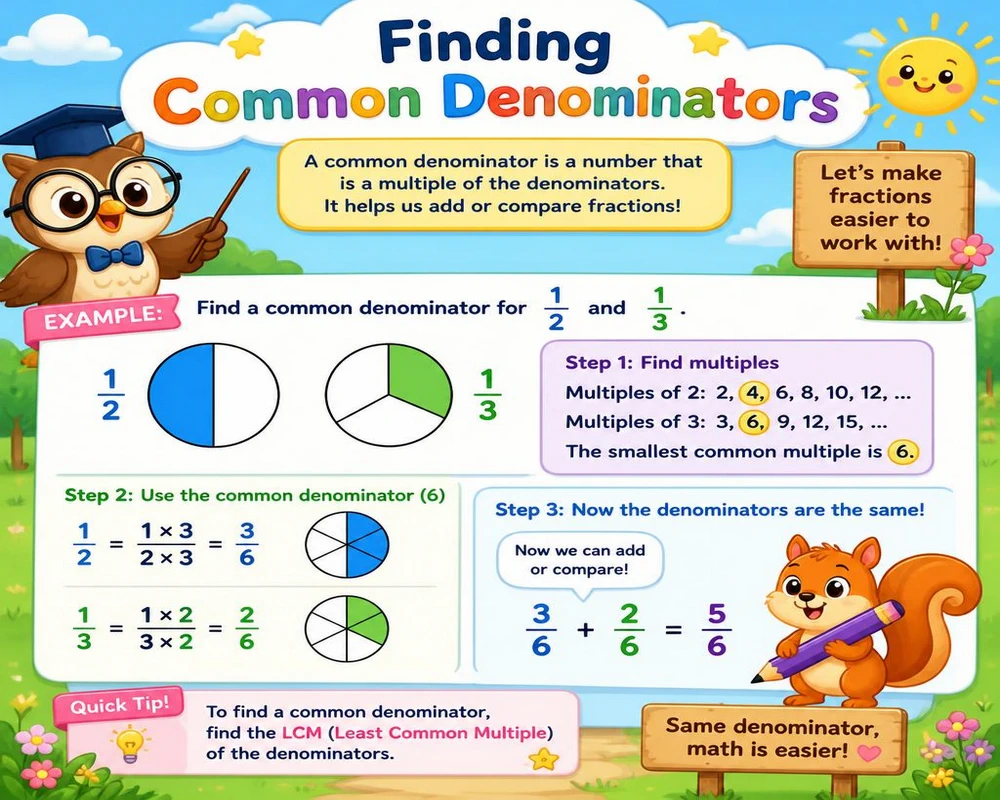
Finding Common Denominators
- Convert 1/3 and 1/4 to a common denominator.
- Convert 1/2 and 1/5 to a common denominator.
Answers: 1) 4/12 and 3/12 2) 5/10 and 2/10
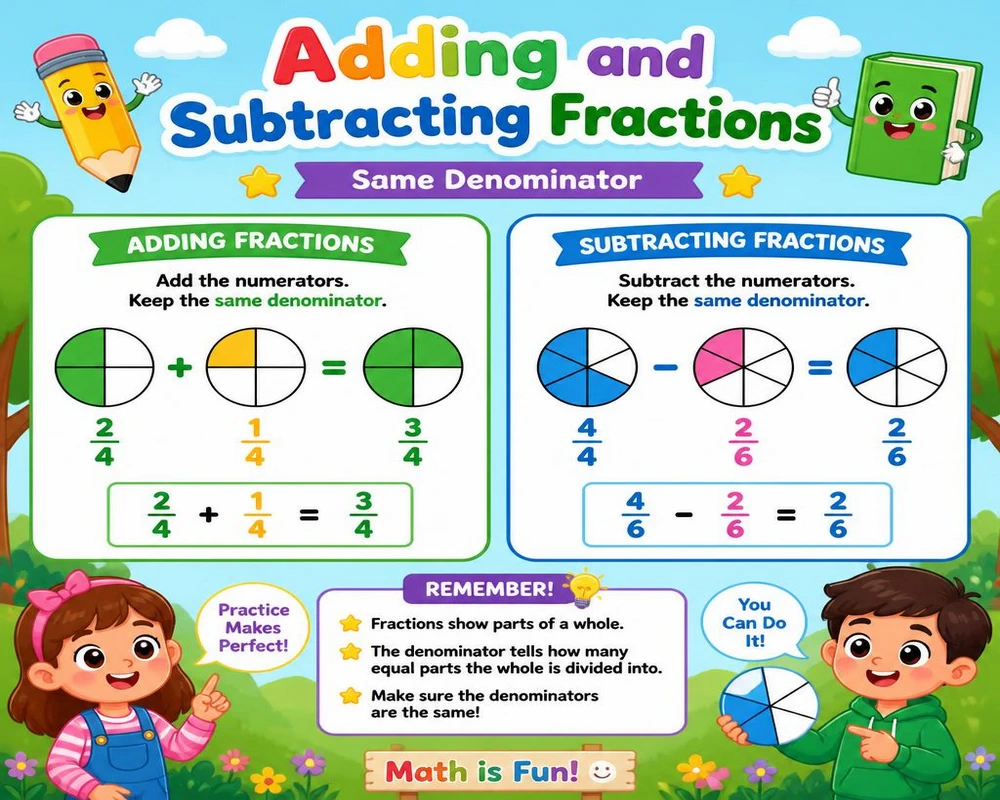
Adding and Subtracting Fractions
- 1/4 + 1/3 = ___
- 1/2 + 1/4 = ___
- 3/4 − 1/2 = ___
- 2/3 − 1/6 = ___
Answers: 1) 7/12 2) 3/4 3) 1/4 4) 1/2
Testing Whether the Click Actually Happened
This quick diagnostic reveals more about real Grade 5 fractions practice progress than a full page of correctly solved problems ever could. A student who’s memorized a procedure without genuinely clicking will often solve straightforward problems correctly but stumble the moment the format changes slightly. Try this diagnostic:
Ask: “Without solving it, can 1/4 and 1/3 be added directly, or does something need to happen first?”
A genuinely clicked student explains, in their own words, that the pieces are different sizes and need converting first — before ever touching a calculation. A student who’s only memorized steps will often go straight to the procedure without being able to explain why it’s necessary.
Real-Life Word Problems
- A recipe uses 1/3 cup of sugar and 1/4 cup of brown sugar. How much sugar in total?
- Malik ate 2/5 of a pizza. His sister ate 1/5 more. How much of the pizza did they eat together?
- A ribbon is 3/4 metres long. If 1/2 a metre is cut off, how much ribbon is left?
Answers: 1) 7/12 cup 2) 3/5 of the pizza 3) 1/4 metre
What Happens If the Click Doesn’t Happen
Grade 5 fractions practice built entirely around procedure, without this underlying understanding, tends to produce exactly this kind of inconsistent performance.
Grade 5 fractions practice that skips straight to procedures — “find a common denominator by multiplying the bottom numbers” — without the underlying reason produces students who can pass a quiz on Tuesday and fail the identical concept on Friday, presented with slightly different numbers. The procedure, memorized without understanding, simply doesn’t transfer.
This is exactly why the physical bridge activities matter more than additional repetition. A student stuck in the before-state doesn’t need more problems in the same format — they need the specific experience that makes matching denominators feel necessary, not arbitrary.
Grade 5 fractions practice succeeds the moment matching denominators stops feeling like an arbitrary rule and starts feeling like the only thing that makes sense.
Frequently Asked Questions
1. Why does my child add fractions straight across, like 1/2 + 1/3 = 2/5?
This is an extremely common error, caused by applying whole-number addition logic to a situation where it doesn’t hold. Physical fraction strips of different sizes demonstrate why this approach fails more convincingly than explanation alone.
2. How do I know if my child has genuinely understood common denominators, or just memorized the steps?
Ask them to explain, before calculating, why two fractions with different denominators can’t be added directly. A genuine understanding produces an explanation; memorization alone usually doesn’t.
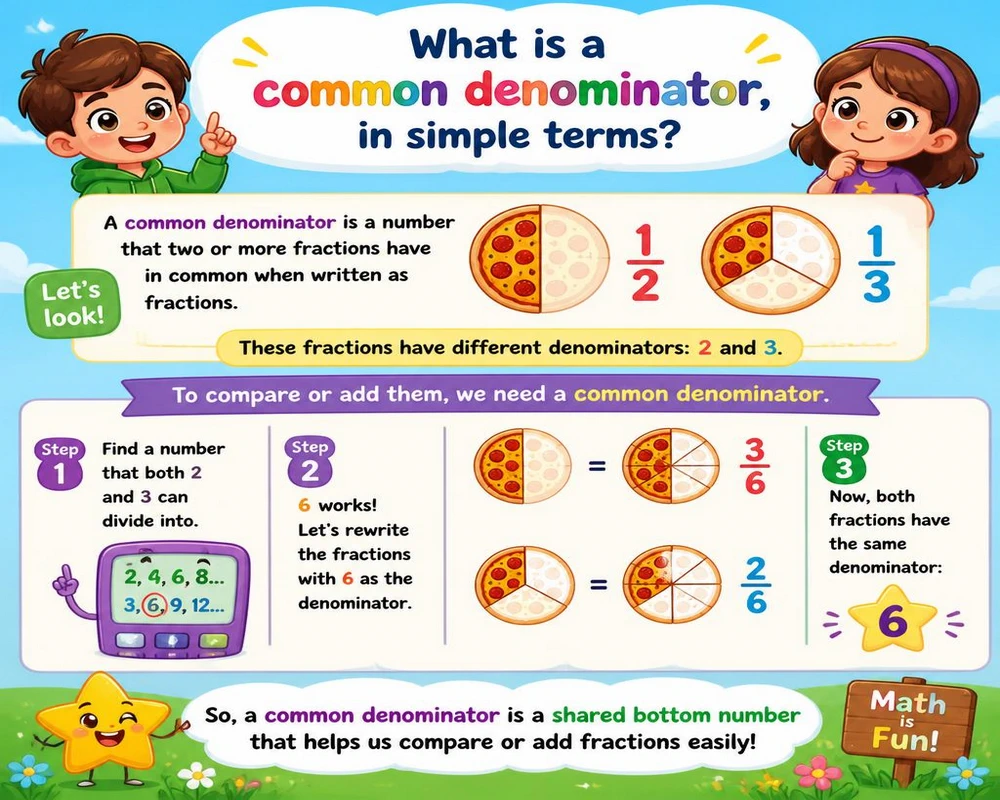
3. What is a common denominator, in simple terms?
It’s a shared “piece size” that both fractions can be rewritten in terms of, making it possible to combine or compare them directly.
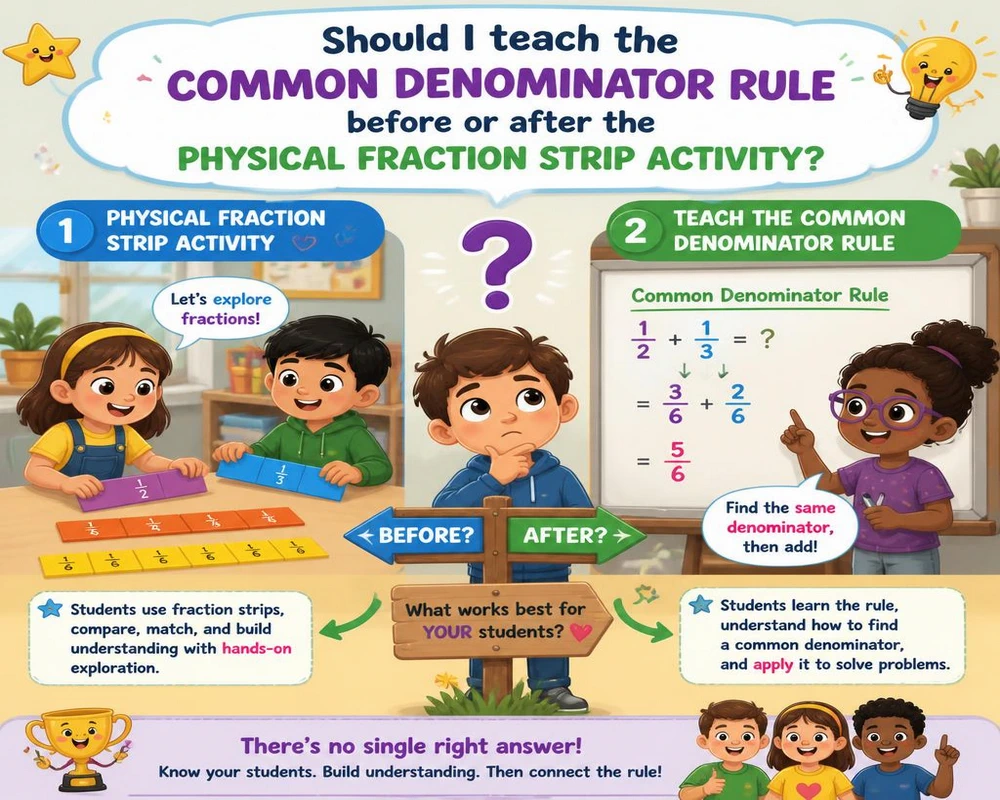
4. Should I teach the common denominator rule before or after the physical fraction strip activity?
After, if possible. The physical activity builds the reasoning; the rule then becomes a shortcut for something already understood, rather than an arbitrary instruction to memorize.
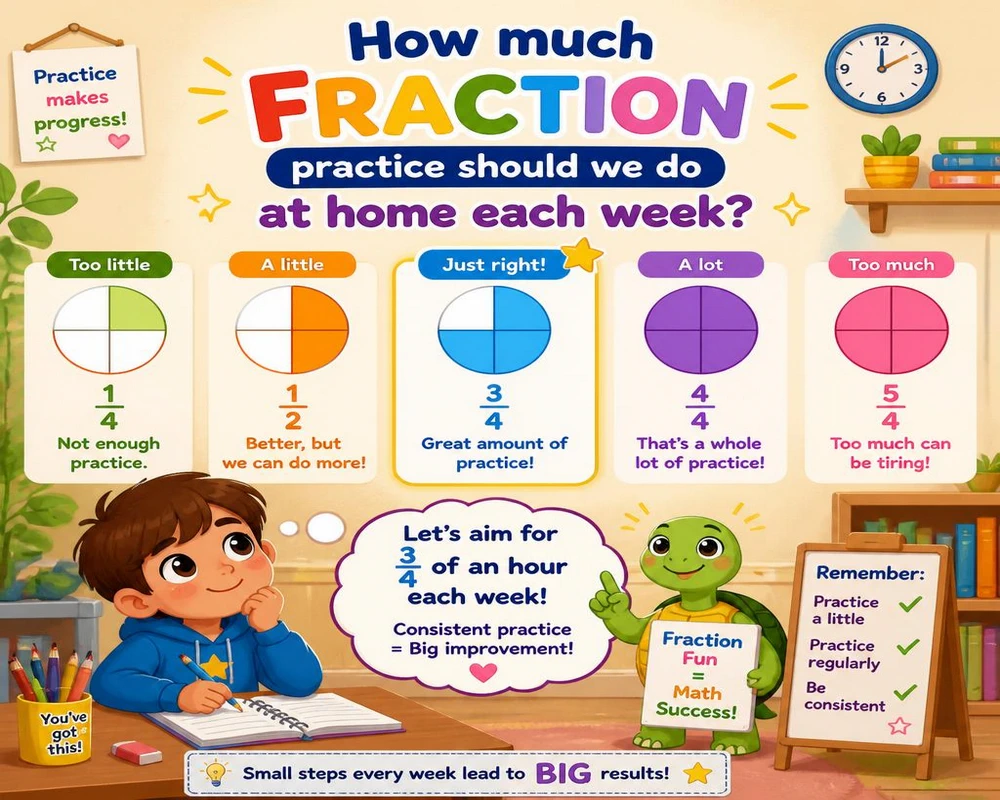
5. How much fraction practice should we do at home each week?
About 15-20 minutes, three to four times a week, tends to work well, especially when paired with hands-on fraction strips rather than worksheets alone.
6. Does Grade 5 cover multiplying fractions too?
Grade 5 focuses primarily on adding, subtracting, and comparing fractions with different denominators, with multiplication of fractions typically deepening in later grades.
7. How does this connect to Grade 6?
Grade 6 builds directly on this fraction fluency for ratio and rate work, so a genuine understanding of common denominators now pays off directly the following year.
Fractions are one part of a full Grade 5 year that also includes decimals, ratios, and algebra. Our Grade 5 math practice hub covers every topic in one place.
Interactive fraction models make this exact transition easier to visualize than static worksheets alone. Mathies, Ontario’s free suite of digital math tools, includes fraction strips and visual models built for exactly this stage of learning.